Northwestern University “NU Department”
Web Site Evaluation: Research & Analysis
Online Survey: March 5 – March 28, 2012
Report Date: April 11, 2012

Prepared by:
Office of Web Communications
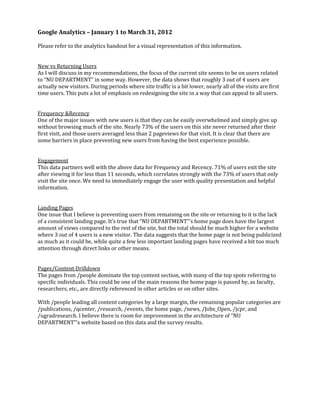
Google Analytics – January 1 to March 31, 2012
Please refer to the analytics handout for a visual representation of this information.
New vs Returning Users
As I will discuss in my recommendations, the focus of the current site seems to be on users related
to “NU DEPARTMENT” in some way. However, the data shows that roughly 3 out of 4 users are
actually new visitors. During periods where site traffic is a bit lower, nearly all of the visits are first
time users. This puts a lot of emphasis on redesigning the site in a way that can appeal to all users.
Frequency &Recency
One of the major issues with new users is that they can be easily overwhelmed and simply give up
without browsing much of the site. Nearly 73% of the users on this site never returned after their
first visit, and those users averaged less than 2 pageviews for that visit. It is clear that there are
some barriers in place preventing new users from having the best experience possible.
Engagement
This data partners well with the above data for Frequency and Recency. 71% of users exit the site
after viewing it for less than 11 seconds, which correlates strongly with the 73% of users that only
visit the site once. We need to immediately engage the user with quality presentation and helpful
information.
Landing Pages
One issue that I believe is preventing users from remaining on the site or returning to it is the lack
of a consistent landing page. It’s true that “NU DEPARTMENT”’s home page does have the largest
amount of views compared to the rest of the site, but the total should be much higher for a website
where 3 out of 4 users is a new visitor. The data suggests that the home page is not being publicized
as much as it could be, while quite a few less important landing pages have received a bit too much
attention through direct links or other means.
Pages/Content Drilldown
The pages from /people dominate the top content section, with many of the top spots referring to
specific individuals. This could be one of the main reasons the home page is passed by, as faculty,
researchers, etc., are directly referenced in other articles or on other sites.
With /people leading all content categories by a large margin, the remaining popular categories are
/publications, /qcenter, /research, /events, the home page, /news, /Jobs_Open, /jcpr, and
/ugradresearch. I believe there is room for improvement in the architecture of “NU
DEPARTMENT”’s website based on this data and the survey results.
Overview
A total of 122 users started the survey, with 116 completing it in full. 64 respondents participated
in Phase 1, which ran from Monday, March 5th to Friday, March 16th at 5pm. Phase 2 continued
where Phase 1 left off, and the filter was closed at 8am on Wednesday, March 28th.

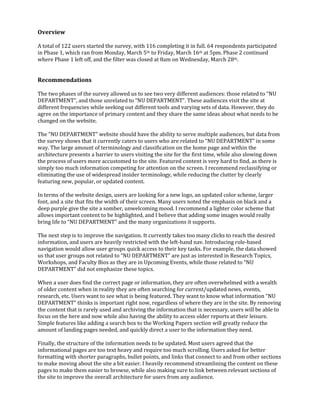
Recommendations
The two phases of the survey allowed us to see two very different audiences: those related to “NU
DEPARTMENT”, and those unrelated to “NU DEPARTMENT”. These audiences visit the site at
different frequencies while seeking out different tools and varying sets of data. However, they do
agree on the importance of primary content and they share the same ideas about what needs to be
changed on the website.
The “NU DEPARTMENT” website should have the ability to serve multiple audiences, but data from
the survey shows that it currently caters to users who are related to “NU DEPARTMENT” in some
way. The large amount of terminology and classification on the home page and within the
architecture presents a barrier to users visiting the site for the first time, while also slowing down
the process of users more accustomed to the site. Featured content is very hard to find, as there is
simply too much information competing for attention on the screen. I recommend reclassifying or
eliminating the use of widespread insider terminology, while reducing the clutter by clearly
featuring new, popular, or updated content.
In terms of the website design, users are looking for a new logo, an updated color scheme, larger
font, and a site that fits the width of their screen. Many users noted the emphasis on black and a
deep purple give the site a somber, unwelcoming mood. I recommend a lighter color scheme that
allows important content to be highlighted, and I believe that adding some images would really
bring life to “NU DEPARTMENT” and the many organizations it supports.
The next step is to improve the navigation. It currently takes too many clicks to reach the desired
information, and users are heavily restricted with the left-hand nav. Introducing role-based
navigation would allow user groups quick access to their key tasks. For example, the data showed
us that user groups not related to “NU DEPARTMENT” are just as interested in Research Topics,
Workshops, and Faculty Bios as they are in Upcoming Events, while those related to “NU
DEPARTMENT” did not emphasize these topics.
When a user does find the correct page or information, they are often overwhelmed with a wealth
of older content when in reality they are often searching for current/updated news, events,
research, etc. Users want to see what is being featured. They want to know what information “NU
DEPARTMENT” thinks is important right now, regardless of where they are in the site. By removing
the content that is rarely used and archiving the information that is necessary, users will be able to
focus on the here and now while also having the ability to access older reports at their leisure.
Simple features like adding a search box to the Working Papers section will greatly reduce the
amount of landing pages needed, and quickly direct a user to the information they need.
Finally, the structure of the information needs to be updated. Most users agreed that the
informational pages are too text heavy and require too much scrolling. Users asked for better
formatting with shorter paragraphs, bullet points, and links that connect to and from other sections
to make moving about the site a bit easier. I heavily recommend streamlining the content on these
pages to make them easier to browse, while also making sure to link between relevant sections of
the site to improve the overall architecture for users from any audience.
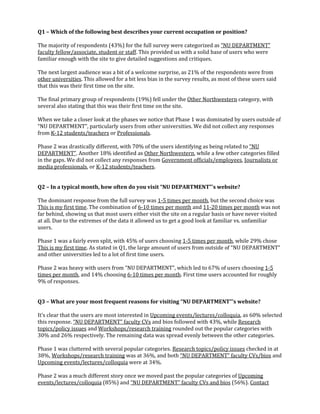
Q1 – Which of the following best describes your current occupation or position?
The majority of respondents (43%) for the full survey were categorized as “NU DEPARTMENT”
faculty fellow/associate, student or staff. This provided us with a solid base of users who were
familiar enough with the site to give detailed suggestions and critiques.
The next largest audience was a bit of a welcome surprise, as 21% of the respondents were from
other universities. This allowed for a bit less bias in the survey results, as most of these users said
that this was their first time on the site.
The final primary group of respondents (19%) fell under the Other Northwestern category, with
several also stating that this was their first time on the site.
When we take a closer look at the phases we notice that Phase 1 was dominated by users outside of
“NU DEPARTMENT”, particularly users from other universities. We did not collect any responses
from K-12 students/teachers or Professionals.
Phase 2 was drastically different, with 70% of the users identifying as being related to “NU
DEPARTMENT”. Another 18% identified as Other Northwestern, while a few other categories filled
in the gaps. We did not collect any responses from Government officials/employees, Journalists or
media professionals, or K-12 students/teachers.
Q2 – In a typical month, how often do you visit “NU DEPARTMENT”’s website?
The dominant response from the full survey was 1-5 times per month, but the second choice was
This is my first time. The combination of 6-10 times per month and 11-20 times per month was not
far behind, showing us that most users either visit the site on a regular basis or have never visited
at all. Due to the extremes of the data it allowed us to get a good look at familiar vs. unfamiliar
users.
Phase 1 was a fairly even split, with 45% of users choosing 1-5 times per month, while 29% chose
This is my first time. As stated in Q1, the large amount of users from outside of “NU DEPARTMENT”
and other universities led to a lot of first time users.
Phase 2 was heavy with users from “NU DEPARTMENT”, which led to 67% of users choosing 1-5
times per month, and 14% choosing 6-10 times per month. First time users accounted for roughly
9% of responses.
Q3 – What are your most frequent reasons for visiting “NU DEPARTMENT”’s website?
It’s clear that the users are most interested in Upcoming events/lectures/colloquia, as 60% selected
this response. “NU DEPARTMENT” faculty CVs and bios followed with 43%, while Research
topics/policy issues and Workshops/research training rounded out the popular categories with
30% and 26% respectively. The remaining data was spread evenly between the other categories.
Phase 1 was cluttered with several popular categories. Research topics/policy issues checked in at
38%, Workshops/research training was at 36%, and both “NU DEPARTMENT” faculty CVs/bios and
Upcoming events/lectures/colloquia were at 34%.
Phase 2 was a much different story once we moved past the popular categories of Upcoming
events/lectures/colloquia (85%) and “NU DEPARTMENT” faculty CVs and bios (56%). Contact
information was in third with 22%, while Research topics/policy issues and News articles about
“NU DEPARTMENT” were tied at 21%.
The data shows that users not directly related to “NU DEPARTMENT”do share “NU
DEPARTMENT”’s interests about upcoming events and faculty CVs and bios, but they have a greater
interest in workshops, training, and research topics/issues. They want to read working papers, find
out about employment information, and they are only slightly interested in “NU DEPARTMENT”
news. On the other hand, users related to “NU DEPARTMENT” seem to rely more on the primary
functions of the site and less on the additional tools offered to assist others.
Q4 – On a typical visit, how easy or hard is it to find the information you are looking for?
The data from the full survey shows that the website seems relatively easy to utilize, but there is
some concern about the number of users who chose Neutral or harder as an option. The ideal
website would have most users falling in the 1-2 range, a handful of users at 3, and maybe a few
users scattered between 4-5. A website will never be perfect for everyone, but it should be equally
accessible regardless of how comfortable you are with the site.
Phase 1 speaks volumes. Most users were not affiliated with “NU DEPARTMENT” and the data
shows a steady spread between Very Easy and Neutral, with six users stating that it was hard to
find info to some degree. Several comments later in the survey refer to how difficult it is for users
not related to “NU DEPARTMENT” to understand and navigate the site in an efficient manner.
With Phase 2 consisting of mostly “NU DEPARTMENT” related users I would have liked to see more
1s on the board, but 2 was easily the dominant response. Only seven users said the website was
Very Easy to use, and 24 out of the 55 users rated the site between 3 and 6. While it’s true that
users in Phase 2 had an easier time using the site, the results show room for improvement.
The comments confirm this notion, as many users said the site was text heavy, cluttered, and
unorganized. Users asked for shorter pages, clearer labels/section, and improved navigation.
Q5 –On your most recent visit, did you find the information that you were looking for?
Only three users throughout the entire survey answered No (1 P1, 2 P2). Ten users said that they
were Not Sure (8 P1, 2 P2).
Q6 – Please tell us what information you were unable to find.
The Other NU faculty, student, or staff from Phase 1 said they could not find research opportunities
for students. One “NU DEPARTMENT” faculty fellow/associate, student, or staff from Phase 2 said
they could not find the dates of colloquia for the spring quarter. One Other NU faculty, student or
staff from Phase 2 said they could not find event listings.
Q7 – Was this information helpful to you?
One user from Phase 1 said they were Not sure if the information was helpful. Every other user said
that the information was helpful.
Q8 – Please tell us why this information was not helpful.
This information is not applicable to the results, as zero respondents were directed to this question.
Q9 – Have you ever visited “NU DEPARTMENT”’s website to find information on a particular
research topic?
Overall, nearly 55% of users said No, while 42% said Yes and about 4% were Not sure. Phase 1 was
split evenly between Yes and No, while Phase 2 had twice as many No responses as Yes responses.
We can assume that outsiders would come to the site searching for research topics, while users
related to “NU DEPARTMENT” would have less of a need to do so.
Q10 – Please tell us what research topics you were searching for.
Please refer to the spreadsheets for a more detailed look at this information.
Q11 – What, if anything, would you change about “NU DEPARTMENT”’s website?
Please refer to the spreadsheets for a more detailed look at this information.
Q12 – Are there any websites that you think “NU DEPARTMENT” should consider during its
redesign?
Please refer to the spreadsheets for the full list of hyperlinks.
Q13 – Please rate the importance of the following site content.
When you break down the data into phases it is eerily similar, so we’ll use the full survey results for
this analysis.
The data for this question was a bit more cluttered than I’d like to see, but some favorites did
emerge. Upcoming events carried its weight from Q3 with an average rating of 4.48 overall and a
4.84 in Phase 2. Working papers/research reports only received 21 out of 275 votes on Q3, but it
was rated as the second highest category for this question with a score of 4.29. After reading the
comments, it appears that Working Papers are definitely an important aspect of the “NU
DEPARTMENT” site to all users, but the classifications and multiple landing pages make it hard to
find and absorb the data.
Publications, a category not featured in Q3, emerged as a favorite with an average of 4.28. News
articles on faculty and research, another quiet category from Q3, averaged a 3.94 from all users. The
critiques from the users about news articles focused on featuring current news while removing the
outdated news. The same can be said for events.

Questions?

NU Research Report #1

  • 1.
    Northwestern University “NUDepartment” Web Site Evaluation: Research & Analysis Online Survey: March 5 – March 28, 2012 Report Date: April 11, 2012 Prepared by: Office of Web Communications
  • 2.
    Google Analytics –January 1 to March 31, 2012 Please refer to the analytics handout for a visual representation of this information. New vs Returning Users As I will discuss in my recommendations, the focus of the current site seems to be on users related to “NU DEPARTMENT” in some way. However, the data shows that roughly 3 out of 4 users are actually new visitors. During periods where site traffic is a bit lower, nearly all of the visits are first time users. This puts a lot of emphasis on redesigning the site in a way that can appeal to all users. Frequency &Recency One of the major issues with new users is that they can be easily overwhelmed and simply give up without browsing much of the site. Nearly 73% of the users on this site never returned after their first visit, and those users averaged less than 2 pageviews for that visit. It is clear that there are some barriers in place preventing new users from having the best experience possible. Engagement This data partners well with the above data for Frequency and Recency. 71% of users exit the site after viewing it for less than 11 seconds, which correlates strongly with the 73% of users that only visit the site once. We need to immediately engage the user with quality presentation and helpful information. Landing Pages One issue that I believe is preventing users from remaining on the site or returning to it is the lack of a consistent landing page. It’s true that “NU DEPARTMENT”’s home page does have the largest amount of views compared to the rest of the site, but the total should be much higher for a website where 3 out of 4 users is a new visitor. The data suggests that the home page is not being publicized as much as it could be, while quite a few less important landing pages have received a bit too much attention through direct links or other means. Pages/Content Drilldown The pages from /people dominate the top content section, with many of the top spots referring to specific individuals. This could be one of the main reasons the home page is passed by, as faculty, researchers, etc., are directly referenced in other articles or on other sites. With /people leading all content categories by a large margin, the remaining popular categories are /publications, /qcenter, /research, /events, the home page, /news, /Jobs_Open, /jcpr, and /ugradresearch. I believe there is room for improvement in the architecture of “NU DEPARTMENT”’s website based on this data and the survey results.
  • 3.
    Overview A total of122 users started the survey, with 116 completing it in full. 64 respondents participated in Phase 1, which ran from Monday, March 5th to Friday, March 16th at 5pm. Phase 2 continued where Phase 1 left off, and the filter was closed at 8am on Wednesday, March 28th. Recommendations The two phases of the survey allowed us to see two very different audiences: those related to “NU DEPARTMENT”, and those unrelated to “NU DEPARTMENT”. These audiences visit the site at different frequencies while seeking out different tools and varying sets of data. However, they do agree on the importance of primary content and they share the same ideas about what needs to be changed on the website. The “NU DEPARTMENT” website should have the ability to serve multiple audiences, but data from the survey shows that it currently caters to users who are related to “NU DEPARTMENT” in some way. The large amount of terminology and classification on the home page and within the architecture presents a barrier to users visiting the site for the first time, while also slowing down the process of users more accustomed to the site. Featured content is very hard to find, as there is simply too much information competing for attention on the screen. I recommend reclassifying or eliminating the use of widespread insider terminology, while reducing the clutter by clearly featuring new, popular, or updated content. In terms of the website design, users are looking for a new logo, an updated color scheme, larger font, and a site that fits the width of their screen. Many users noted the emphasis on black and a deep purple give the site a somber, unwelcoming mood. I recommend a lighter color scheme that allows important content to be highlighted, and I believe that adding some images would really bring life to “NU DEPARTMENT” and the many organizations it supports. The next step is to improve the navigation. It currently takes too many clicks to reach the desired information, and users are heavily restricted with the left-hand nav. Introducing role-based navigation would allow user groups quick access to their key tasks. For example, the data showed us that user groups not related to “NU DEPARTMENT” are just as interested in Research Topics, Workshops, and Faculty Bios as they are in Upcoming Events, while those related to “NU DEPARTMENT” did not emphasize these topics. When a user does find the correct page or information, they are often overwhelmed with a wealth of older content when in reality they are often searching for current/updated news, events, research, etc. Users want to see what is being featured. They want to know what information “NU DEPARTMENT” thinks is important right now, regardless of where they are in the site. By removing the content that is rarely used and archiving the information that is necessary, users will be able to focus on the here and now while also having the ability to access older reports at their leisure. Simple features like adding a search box to the Working Papers section will greatly reduce the amount of landing pages needed, and quickly direct a user to the information they need. Finally, the structure of the information needs to be updated. Most users agreed that the informational pages are too text heavy and require too much scrolling. Users asked for better formatting with shorter paragraphs, bullet points, and links that connect to and from other sections to make moving about the site a bit easier. I heavily recommend streamlining the content on these pages to make them easier to browse, while also making sure to link between relevant sections of the site to improve the overall architecture for users from any audience.
  • 4.
    Q1 – Whichof the following best describes your current occupation or position? The majority of respondents (43%) for the full survey were categorized as “NU DEPARTMENT” faculty fellow/associate, student or staff. This provided us with a solid base of users who were familiar enough with the site to give detailed suggestions and critiques. The next largest audience was a bit of a welcome surprise, as 21% of the respondents were from other universities. This allowed for a bit less bias in the survey results, as most of these users said that this was their first time on the site. The final primary group of respondents (19%) fell under the Other Northwestern category, with several also stating that this was their first time on the site. When we take a closer look at the phases we notice that Phase 1 was dominated by users outside of “NU DEPARTMENT”, particularly users from other universities. We did not collect any responses from K-12 students/teachers or Professionals. Phase 2 was drastically different, with 70% of the users identifying as being related to “NU DEPARTMENT”. Another 18% identified as Other Northwestern, while a few other categories filled in the gaps. We did not collect any responses from Government officials/employees, Journalists or media professionals, or K-12 students/teachers. Q2 – In a typical month, how often do you visit “NU DEPARTMENT”’s website? The dominant response from the full survey was 1-5 times per month, but the second choice was This is my first time. The combination of 6-10 times per month and 11-20 times per month was not far behind, showing us that most users either visit the site on a regular basis or have never visited at all. Due to the extremes of the data it allowed us to get a good look at familiar vs. unfamiliar users. Phase 1 was a fairly even split, with 45% of users choosing 1-5 times per month, while 29% chose This is my first time. As stated in Q1, the large amount of users from outside of “NU DEPARTMENT” and other universities led to a lot of first time users. Phase 2 was heavy with users from “NU DEPARTMENT”, which led to 67% of users choosing 1-5 times per month, and 14% choosing 6-10 times per month. First time users accounted for roughly 9% of responses. Q3 – What are your most frequent reasons for visiting “NU DEPARTMENT”’s website? It’s clear that the users are most interested in Upcoming events/lectures/colloquia, as 60% selected this response. “NU DEPARTMENT” faculty CVs and bios followed with 43%, while Research topics/policy issues and Workshops/research training rounded out the popular categories with 30% and 26% respectively. The remaining data was spread evenly between the other categories. Phase 1 was cluttered with several popular categories. Research topics/policy issues checked in at 38%, Workshops/research training was at 36%, and both “NU DEPARTMENT” faculty CVs/bios and Upcoming events/lectures/colloquia were at 34%. Phase 2 was a much different story once we moved past the popular categories of Upcoming events/lectures/colloquia (85%) and “NU DEPARTMENT” faculty CVs and bios (56%). Contact
  • 5.
    information was inthird with 22%, while Research topics/policy issues and News articles about “NU DEPARTMENT” were tied at 21%. The data shows that users not directly related to “NU DEPARTMENT”do share “NU DEPARTMENT”’s interests about upcoming events and faculty CVs and bios, but they have a greater interest in workshops, training, and research topics/issues. They want to read working papers, find out about employment information, and they are only slightly interested in “NU DEPARTMENT” news. On the other hand, users related to “NU DEPARTMENT” seem to rely more on the primary functions of the site and less on the additional tools offered to assist others. Q4 – On a typical visit, how easy or hard is it to find the information you are looking for? The data from the full survey shows that the website seems relatively easy to utilize, but there is some concern about the number of users who chose Neutral or harder as an option. The ideal website would have most users falling in the 1-2 range, a handful of users at 3, and maybe a few users scattered between 4-5. A website will never be perfect for everyone, but it should be equally accessible regardless of how comfortable you are with the site. Phase 1 speaks volumes. Most users were not affiliated with “NU DEPARTMENT” and the data shows a steady spread between Very Easy and Neutral, with six users stating that it was hard to find info to some degree. Several comments later in the survey refer to how difficult it is for users not related to “NU DEPARTMENT” to understand and navigate the site in an efficient manner. With Phase 2 consisting of mostly “NU DEPARTMENT” related users I would have liked to see more 1s on the board, but 2 was easily the dominant response. Only seven users said the website was Very Easy to use, and 24 out of the 55 users rated the site between 3 and 6. While it’s true that users in Phase 2 had an easier time using the site, the results show room for improvement. The comments confirm this notion, as many users said the site was text heavy, cluttered, and unorganized. Users asked for shorter pages, clearer labels/section, and improved navigation. Q5 –On your most recent visit, did you find the information that you were looking for? Only three users throughout the entire survey answered No (1 P1, 2 P2). Ten users said that they were Not Sure (8 P1, 2 P2). Q6 – Please tell us what information you were unable to find. The Other NU faculty, student, or staff from Phase 1 said they could not find research opportunities for students. One “NU DEPARTMENT” faculty fellow/associate, student, or staff from Phase 2 said they could not find the dates of colloquia for the spring quarter. One Other NU faculty, student or staff from Phase 2 said they could not find event listings. Q7 – Was this information helpful to you? One user from Phase 1 said they were Not sure if the information was helpful. Every other user said that the information was helpful.
  • 6.
    Q8 – Pleasetell us why this information was not helpful. This information is not applicable to the results, as zero respondents were directed to this question. Q9 – Have you ever visited “NU DEPARTMENT”’s website to find information on a particular research topic? Overall, nearly 55% of users said No, while 42% said Yes and about 4% were Not sure. Phase 1 was split evenly between Yes and No, while Phase 2 had twice as many No responses as Yes responses. We can assume that outsiders would come to the site searching for research topics, while users related to “NU DEPARTMENT” would have less of a need to do so. Q10 – Please tell us what research topics you were searching for. Please refer to the spreadsheets for a more detailed look at this information. Q11 – What, if anything, would you change about “NU DEPARTMENT”’s website? Please refer to the spreadsheets for a more detailed look at this information. Q12 – Are there any websites that you think “NU DEPARTMENT” should consider during its redesign? Please refer to the spreadsheets for the full list of hyperlinks. Q13 – Please rate the importance of the following site content. When you break down the data into phases it is eerily similar, so we’ll use the full survey results for this analysis. The data for this question was a bit more cluttered than I’d like to see, but some favorites did emerge. Upcoming events carried its weight from Q3 with an average rating of 4.48 overall and a 4.84 in Phase 2. Working papers/research reports only received 21 out of 275 votes on Q3, but it was rated as the second highest category for this question with a score of 4.29. After reading the comments, it appears that Working Papers are definitely an important aspect of the “NU DEPARTMENT” site to all users, but the classifications and multiple landing pages make it hard to find and absorb the data. Publications, a category not featured in Q3, emerged as a favorite with an average of 4.28. News articles on faculty and research, another quiet category from Q3, averaged a 3.94 from all users. The critiques from the users about news articles focused on featuring current news while removing the outdated news. The same can be said for events. Questions?