Sample Lesson Script
Grade 1 – Filipino
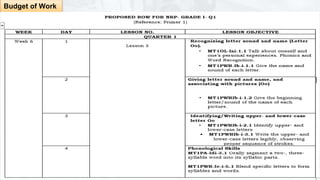
The Budget of Work
(BOW)
Note: Present BOW and sample lesson script by LA
Budget of Work
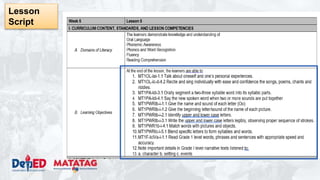
Lesson
Script
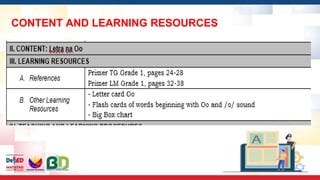
CONTENT AND LEARNING RESOURCES
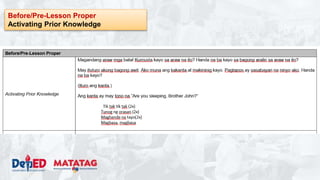
Before/Pre-Lesson Proper
Activating Prior Knowledge
Before/Pre-Lesson Proper
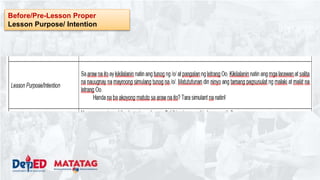
Lesson Purpose/ Intention
Before/Pre-Lesson Proper
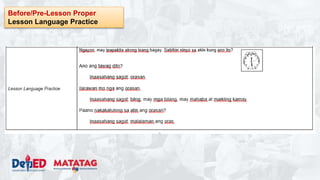
Lesson Language Practice
During/Lesson Proper
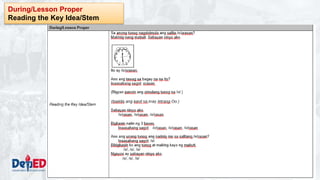
Reading the Key Idea/Stem
During/Lesson Proper
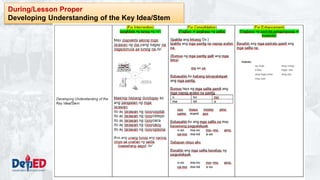
Developing Understanding of the Key Idea/Stem
During/Lesson Proper
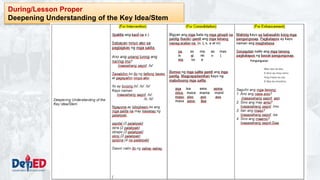
Deepening Understanding of the Key Idea/Stem
After/Post-Lesson Proper
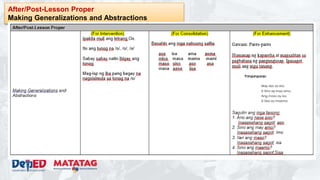
Making Generalizations and Abstractions
After/Post-Lesson Proper
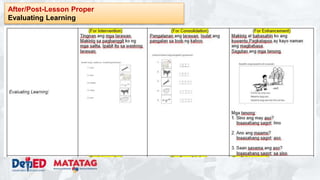
Evaluating Learning
After/Post-Lesson Proper
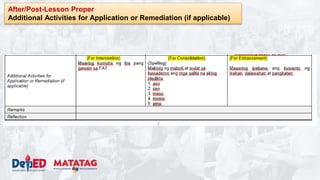
Additional Activities for Application or Remediation (if applicable)
Bansang Makabata
Batang Makabansa

Editor's Notes

  • #6 This part includes objectives related to content knowledge and competencies. It also describes the behavior or performance teachers want learners to exhibit to consider them competent. It states what the teacher intends to teach and serves as a guide for instruction and assessment.
  • #7 This component of the lesson plan states the specific topic or content that will be covered in the teaching session. It details the main subject area that students will be learning about. This part asks teachers to log the references and other learning resources that the teacher will use for the lesson. The references include the pages of the TG, LM, textbook, and the additional materials from the LRMDS portal. The other learning resources refer to materials such as those that are teacher-made, authentic, and others not included in the references. This part can also include the supplies, equipment, tools and other non-print materials needed for activities before, during, and after the lesson.
  • #8 Activating Prior Knowledge. This part connects the lesson with learners’ prior knowledge. It explicitly teaches the learners how the new lesson connects to previous lessons. It also reviews and presents new lessons in a systematic manner.
  • #9 This part will motivate the learner to learn the new lesson. It encourages them to ask questions about the new topic and helps establish a reason for learning the new lesson.
  • #10 The language practice suggested has been identified by considering the whole lesson and identifying those words/phrases/sentences that have the potential to cause difficulties for students. The focus is on words, phrases, or sentences that are to be used and have forgotten or found difficulty in the past
  • #11 It addresses the “key idea/stem” for the lesson. It involves understanding the concept of the key idea/stem.
  • #12 Involves a set of questions associated with the key idea/stem. Students will need to refer to the stem as they prepare to answer set of questions.
  • #13 Undertaking a new set of questions with a higher degree or level of complexity related to the same key idea/stem.
  • #14 Making Generalizations and Abstractions. It will conclude the lesson by asking learners good question/s that will help them crystallize their learning so they can declare knowledge and demonstrate their skills. It is also designed to offer a student-focused wrap-up to the main intentions of the lesson, helping students reflect on their progress, achievement of goals, and their performance and understanding during the lesson
  • #15 ASSESSMENT – EVALUATING LEARNING. A way of assessing the learners and whether the learning objectives have been met. Evaluation should tap or align to both learning objective and the key message of integration. Applies various methods of assessment including HOTS and 21st century skills.
  • #16 Additional Activities for Application or Remediation (if applicable). It will be based on the formative assessments and will provide children with enrichment or remedial activities. The teacher should provide extra time for additional teaching activities to those learners demonstrating that they have difficulties with the lesson. The giving of assignments is optional and should follow the provisions of DepEd Memorandum No. 392, s. 2010 entitled “Guidelines on Giving Homework or Assignments to All Public Elementary School Pupils.” Remarks. Teachers indicate special cases including but not limited to continuation of lesson plan to the following day in case of re-teaching or lack of time, transfer of lesson to the following day in cases of class suspension, etc. Reflection Teachers share their thoughts and feelings about their lessons including things about the lesson that were successfully implemented, need improvement, or could be adjusted in the future.