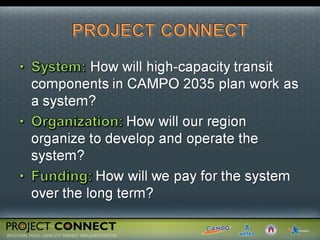
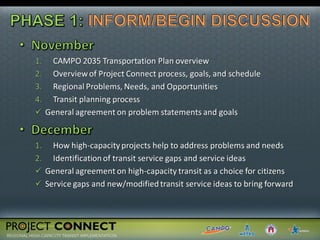
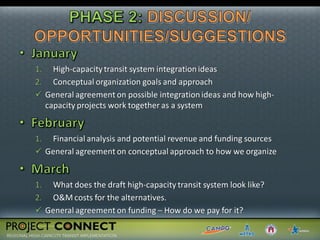
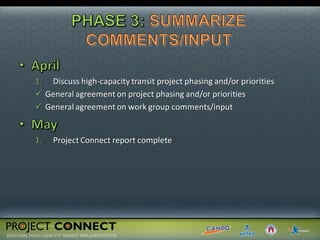
Transit Working Group Meeting November 18, 2011 1:30 PM – 3:30 PM
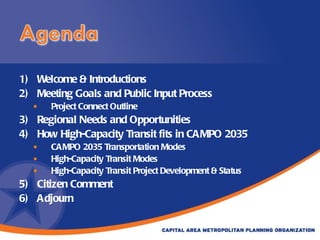
Welcome & Introductions Meeting Goals and Public Input Process Project Connect Outline Regional Needs and Opportunities How High-Capacity Transit fits in CAMPO 2035 CAMPO 2035 Transportation Modes High-Capacity Transit Modes High-Capacity Transit Project Development & Status Citizen Comment Adjourn
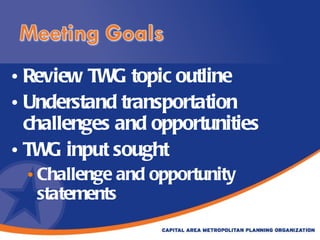
Review TWG topic outline Understand transportation challenges and opportunities TWG input sought  Challenge and opportunity statements


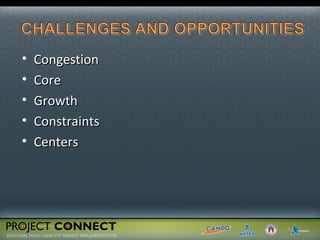
Congestion Core Growth Constraints Centers
•  Point 1 •  Point 2 •  Point 3 •  Point 4  •  Point 5 or more
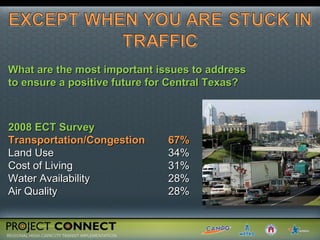
What are the most important issues to address to ensure a positive future for Central Texas? 2008 ECT Survey Transportation/Congestion 67% Land Use 34% Cost of Living 31% Water Availability 28% Air Quality 28%
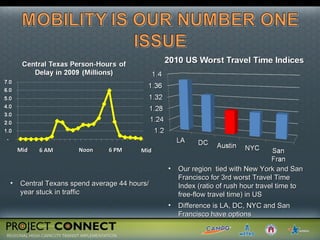
Central Texans spend average 44 hours/year stuck in traffic Our region  tied with New York and San Francisco for 3rd worst Travel Time Index (ratio of rush hour travel time to free-flow travel time) in US Difference is LA, DC, NYC and San Francisco have options Mid Noon 6 AM 6 PM Mid
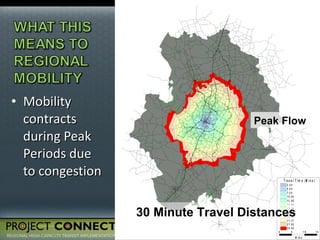
Mobility contracts during Peak Periods due to congestion Free Flow 30 Minute Travel Distances Peak Flow
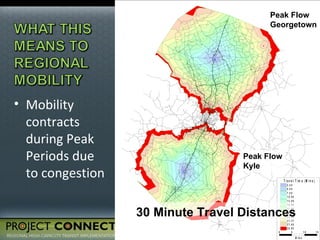
30 Minute Travel Distances Mobility contracts during Peak Periods due to congestion Free Flow Georgetown And Kyle Peak Flow Georgetown Peak Flow Kyle
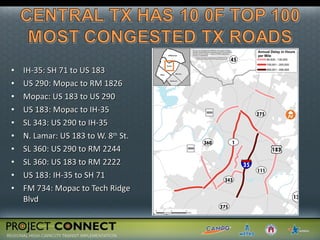
IH-35: SH 71 to US 183 US 290: Mopac to RM 1826 Mopac: US 183 to US 290 US 183: Mopac to IH-35 SL 343: US 290 to IH-35 N. Lamar: US 183 to W. 8 th  St. SL 360: US 290 to RM 2244 SL 360: US 183 to RM 2222 US 183: IH-35 to SH 71 FM 734: Mopac to Tech Ridge Blvd
Congestion Core
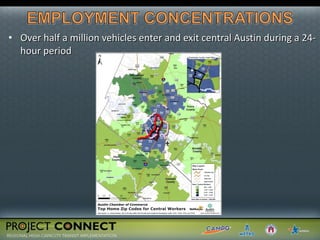
Over half a million vehicles enter and exit central Austin during a 24-hour period
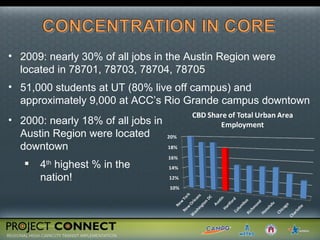
2000: nearly 18% of all jobs in Austin Region were located downtown  4 th  highest % in the nation! 2009: nearly 30% of all jobs in the Austin Region were located in 78701, 78703, 78704, 78705  51,000 students at UT (80% live off campus) and approximately 9,000 at ACC’s Rio Grande campus downtown
 
Congestion Core  Growth
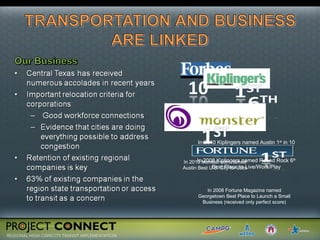
In 2010 Forbes named Austin 10 th  Best Place for Business & Career In 2010 Kiplingers named Austin 1 st  in 10 Best Cities for the Next Decade In 2008 Kiplingers named Round Rock 6 th  Best Place to Live/Work/Play In 2010 Monster.com named Austin Best U.S. City for Jobs In 2008 Fortune Magazine named Georgetown Best Place to Launch a Small Business (received only perfect score) In 2010 Forbes named Austin 10 th  Best Place for Business & Career In 2010 Kiplingers named Austin 1 st  in 10 Best Cities for the Next Decade In 2008 Kiplingers named Round Rock 6 th  Best Place to Live/Work/Play In 2010 Monster.com named Austin Best U.S. City for Jobs In 2008 Fortune Magazine named Georgetown Best Place to Launch a Small Business (received only perfect score)
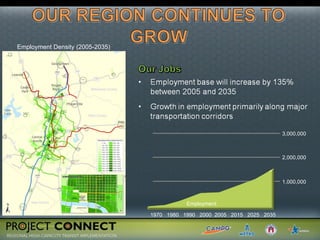
Employment Density (2005-2035) 3,000,000 2,000,000 1,000,000 1970  1980  1990  2000  2005  2015  2025  2035 Employment
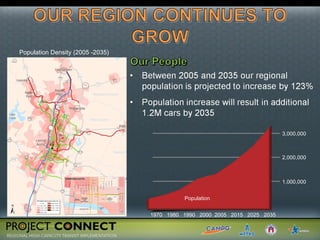
Population Density (2005 -2035) 3,000,000 2,000,000 1,000,000 1970  1980  1990  2000  2005  2015  2025  2035 Population
Congestion Core Growth Constraints
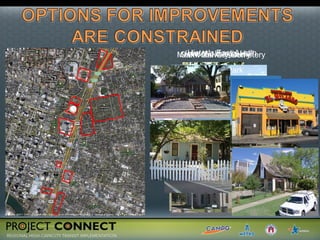
Mount Calvary Cemetery Frank Erwin Center John W. Hargis Hall Mike Myers Stadium Oakwood Cemetery University Medical Center Brackenridge University of Texas Practice Facilities Austin Police Headquarters Palm Park Historic East Austin
Congestion Core  Growth Constraints Centers
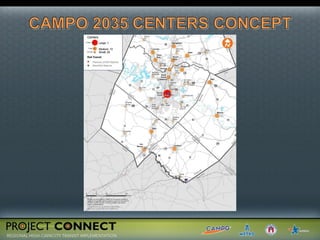
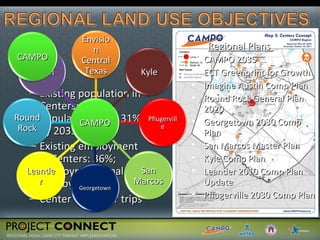
Existing population in Centers: 16%; Population Goal: 31% by 2035 Existing employment in Centers: 36%; Employment Goal: 38% by 2035 Center to Center trips Regional Plans  CAMPO 2035 ECT Greenprint for Growth Imagine Austin Comp Plan Round Rock General Plan 2020 Georgetown 2030 Comp Plan San Marcos Master Plan Kyle Comp Plan Leander 2010 Comp Plan Update Pflugerville 2030 Comp Plan Envision Central Texas Austin Round Rock CAMPO Leander Georgetown San Marcos Kyle Pflugerville CAMPO
Congestion Core Growth Constraints Centers
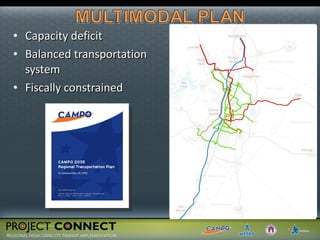
Capacity deficit Balanced transportation system Fiscally constrained
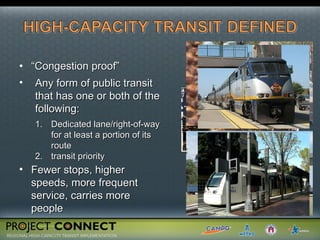
“ Congestion proof” Any form of public transit that has one or both of the following:  Dedicated lane/right-of-way for at least a portion of its route  transit priority  Fewer stops, higher  speeds, more frequent  service, carries more people
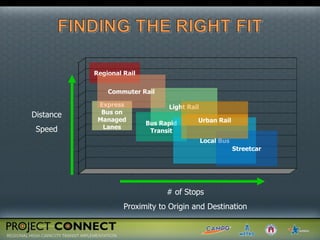
Distance Speed # of Stops Proximity to Origin and Destination Regional Rail Express Bus on Managed Lanes Light Rail Bus Rapid Transit Local Bus Streetcar Commuter Rail Urban Rail


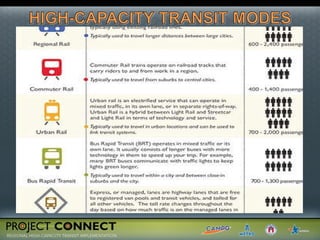
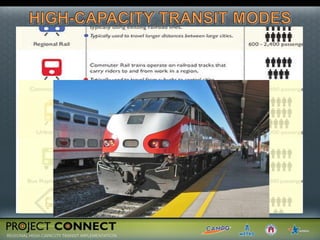
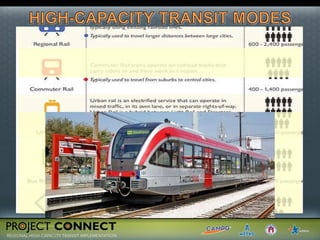
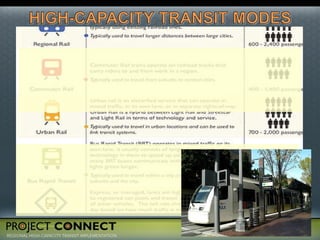
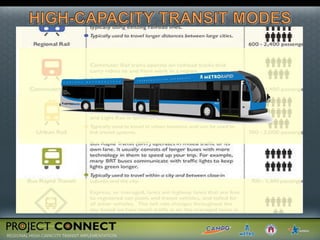
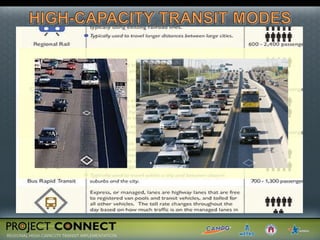
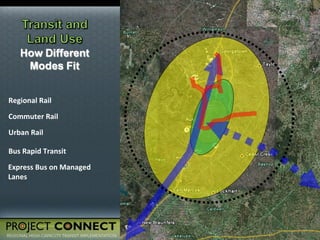
Regional Rail Commuter Rail Urban Rail Bus Rapid Transit Express Bus on Managed Lanes


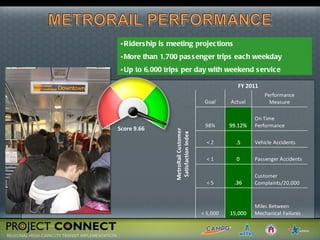
FY 2011 Ridership is meeting projections More than 1,700 passenger trips each weekday Up to 6,000 trips per day with weekend service Score 9.66
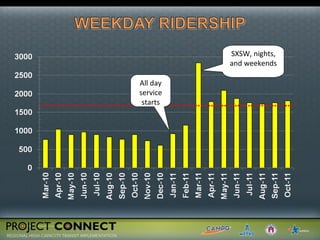
SXSW, nights, and weekends All day service starts
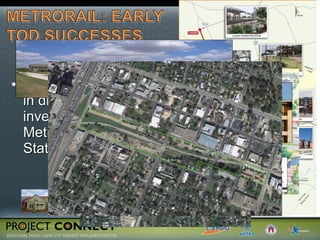
More than $90M in direct investment at MetroRail Stations to date


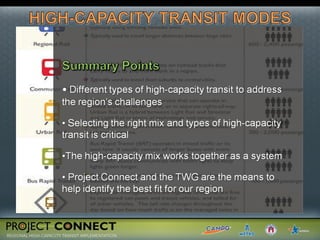
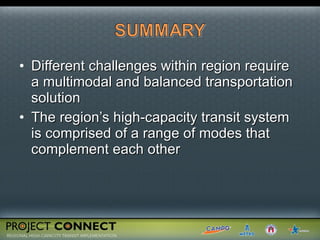
Different challenges within region require a multimodal and balanced transportation solution The region’s high-capacity transit system is comprised of a range of modes that complement each other
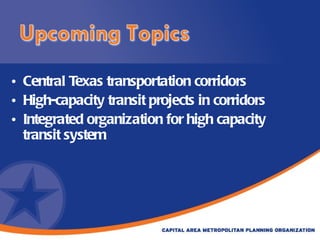
Central Texas transportation corridors High-capacity transit projects in corridors Integrated organization for high capacity transit system
15 minutes allotted 3 minutes per speaker Speakers heard in reverse order of previous meeting
Meeting Adjourned Next Meeting December 2, 2011 1:30 PM - 3:30 PM City Hall, City of Austin

November 18 TWG PPT Show

  • 1.
    Transit Working GroupMeeting November 18, 2011 1:30 PM – 3:30 PM
  • 2.
    Welcome & IntroductionsMeeting Goals and Public Input Process Project Connect Outline Regional Needs and Opportunities How High-Capacity Transit fits in CAMPO 2035 CAMPO 2035 Transportation Modes High-Capacity Transit Modes High-Capacity Transit Project Development & Status Citizen Comment Adjourn
  • 3.
    Review TWG topicoutline Understand transportation challenges and opportunities TWG input sought Challenge and opportunity statements
  • 4.
  • 5.
  • 6.
  • 7.
  • 8.
  • 9.
    Congestion Core GrowthConstraints Centers
  • 10.
    • Point1 • Point 2 • Point 3 • Point 4 • Point 5 or more
  • 11.
    What are themost important issues to address to ensure a positive future for Central Texas? 2008 ECT Survey Transportation/Congestion 67% Land Use 34% Cost of Living 31% Water Availability 28% Air Quality 28%
  • 12.
    Central Texans spendaverage 44 hours/year stuck in traffic Our region tied with New York and San Francisco for 3rd worst Travel Time Index (ratio of rush hour travel time to free-flow travel time) in US Difference is LA, DC, NYC and San Francisco have options Mid Noon 6 AM 6 PM Mid
  • 13.
    Mobility contracts duringPeak Periods due to congestion Free Flow 30 Minute Travel Distances Peak Flow
  • 14.
    30 Minute TravelDistances Mobility contracts during Peak Periods due to congestion Free Flow Georgetown And Kyle Peak Flow Georgetown Peak Flow Kyle
  • 15.
    IH-35: SH 71to US 183 US 290: Mopac to RM 1826 Mopac: US 183 to US 290 US 183: Mopac to IH-35 SL 343: US 290 to IH-35 N. Lamar: US 183 to W. 8 th St. SL 360: US 290 to RM 2244 SL 360: US 183 to RM 2222 US 183: IH-35 to SH 71 FM 734: Mopac to Tech Ridge Blvd
  • 16.
  • 17.
    Over half amillion vehicles enter and exit central Austin during a 24-hour period
  • 18.
    2000: nearly 18%of all jobs in Austin Region were located downtown 4 th highest % in the nation! 2009: nearly 30% of all jobs in the Austin Region were located in 78701, 78703, 78704, 78705 51,000 students at UT (80% live off campus) and approximately 9,000 at ACC’s Rio Grande campus downtown
  • 19.
  • 20.
  • 21.
    In 2010 Forbesnamed Austin 10 th Best Place for Business & Career In 2010 Kiplingers named Austin 1 st in 10 Best Cities for the Next Decade In 2008 Kiplingers named Round Rock 6 th Best Place to Live/Work/Play In 2010 Monster.com named Austin Best U.S. City for Jobs In 2008 Fortune Magazine named Georgetown Best Place to Launch a Small Business (received only perfect score) In 2010 Forbes named Austin 10 th Best Place for Business & Career In 2010 Kiplingers named Austin 1 st in 10 Best Cities for the Next Decade In 2008 Kiplingers named Round Rock 6 th Best Place to Live/Work/Play In 2010 Monster.com named Austin Best U.S. City for Jobs In 2008 Fortune Magazine named Georgetown Best Place to Launch a Small Business (received only perfect score)
  • 22.
    Employment Density (2005-2035)3,000,000 2,000,000 1,000,000 1970 1980 1990 2000 2005 2015 2025 2035 Employment
  • 23.
    Population Density (2005-2035) 3,000,000 2,000,000 1,000,000 1970 1980 1990 2000 2005 2015 2025 2035 Population
  • 24.
  • 25.
    Mount Calvary CemeteryFrank Erwin Center John W. Hargis Hall Mike Myers Stadium Oakwood Cemetery University Medical Center Brackenridge University of Texas Practice Facilities Austin Police Headquarters Palm Park Historic East Austin
  • 26.
    Congestion Core Growth Constraints Centers
  • 27.
    Existing population inCenters: 16%; Population Goal: 31% by 2035 Existing employment in Centers: 36%; Employment Goal: 38% by 2035 Center to Center trips Regional Plans CAMPO 2035 ECT Greenprint for Growth Imagine Austin Comp Plan Round Rock General Plan 2020 Georgetown 2030 Comp Plan San Marcos Master Plan Kyle Comp Plan Leander 2010 Comp Plan Update Pflugerville 2030 Comp Plan Envision Central Texas Austin Round Rock CAMPO Leander Georgetown San Marcos Kyle Pflugerville CAMPO
  • 28.
    Congestion Core GrowthConstraints Centers
  • 29.
    Capacity deficit Balancedtransportation system Fiscally constrained
  • 30.
    “ Congestion proof”Any form of public transit that has one or both of the following: Dedicated lane/right-of-way for at least a portion of its route transit priority Fewer stops, higher speeds, more frequent service, carries more people
  • 31.
    Distance Speed #of Stops Proximity to Origin and Destination Regional Rail Express Bus on Managed Lanes Light Rail Bus Rapid Transit Local Bus Streetcar Commuter Rail Urban Rail
  • 32.
  • 33.
  • 34.
  • 35.
  • 36.
  • 37.
  • 38.
    Regional Rail CommuterRail Urban Rail Bus Rapid Transit Express Bus on Managed Lanes
  • 39.
  • 40.
  • 41.
  • 42.
    FY 2011 Ridershipis meeting projections More than 1,700 passenger trips each weekday Up to 6,000 trips per day with weekend service Score 9.66
  • 43.
    SXSW, nights, andweekends All day service starts
  • 44.
    More than $90Min direct investment at MetroRail Stations to date
  • 45.
  • 46.
  • 47.
  • 48.
  • 49.
  • 51.
    Different challenges withinregion require a multimodal and balanced transportation solution The region’s high-capacity transit system is comprised of a range of modes that complement each other
  • 52.
    Central Texas transportationcorridors High-capacity transit projects in corridors Integrated organization for high capacity transit system
  • 53.
    15 minutes allotted3 minutes per speaker Speakers heard in reverse order of previous meeting
  • 54.
    Meeting Adjourned NextMeeting December 2, 2011 1:30 PM - 3:30 PM City Hall, City of Austin

Editor's Notes

  • #2 hgkjhgkjhgkjhgkhjg
  • #24 Growth is primarily along major transportation corridors
  • #42 This example is from Cleveland, Ohio.
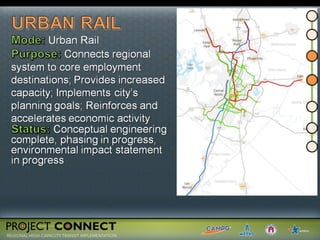
  • #48 Purpose – Connects regional system to core employment destinations Provides increased capacity Implements planning city’s planning goals Reinforces and accelerates economic activity Status: Conceptual engineering complete, alternatives analysis and phasing in progress, environmental impact analysis NOTE THIS IS DIFFERENT THEN WHAT I TOLD YOU. Don’t put characteristics on this slide do on next slide Source: City of Austin 2011
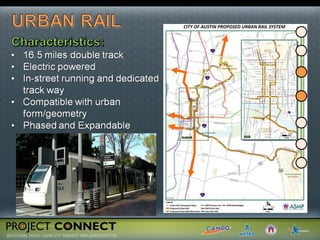
  • #49 Purpose – Connects regional system to core employment destinations Provides increased capacity Implements planning city’s planning goals Reinforces and accelerates economic activity Status: Conceptual engineering complete, alternatives analysis and phasing in progress, environmental impact analysis Characteristics: 16.5 miles double track Electric powered (typically) In-street running or dedicated track way Compatible with urban form/geometrics Phased and Expandable Source: City of Austin, 2011