This document summarizes a research paper that proposes a novel method to improve direct torque control (DTC) for induction machine drives using a controlled rectifier. The paper begins with an overview of DTC and its limitations of torque and flux ripples. It then describes the proposed method of using a PI controller and controlled rectifier to adjust the DC bus voltage based on torque error, allowing selection of a voltage vector that reduces ripples. Simulation results presented in MATLAB/Simulink show the proposed method significantly reduces current distortion and torque/flux ripples compared to standard DTC.
![International Journal of Power Electronics and Drive System (IJPEDS)
Vol. 10, No. 3, Sep 2019, pp. 1223~1228
ISSN: 2088-8694, DOI: 10.11591/ijpeds.v10.i3.pp1223-1228 1223
Journal homepage: http://iaescore.com/journals/index.php/IJPEDS
Novel DTC induction machine drive improvement using
controlled rectifier for DC voltage tuning
Nour Mohamed, Tedjini Hamza, Gasbaoui Brahim
SGRE Laboratory, Department of Electrical engineering, Tahri Mohamed University of Bechar. Algeria.
Article Info ABSTRACT
Article history:
Received Oct 19, 2018
Revised Jan 28, 2019
Accepted Mar 25, 2019
The application of the direct torque control strategy for induction machine
drives is mainly characterized by torque and flux distortions caused by
voltage vector limitation. The goal of this paper is to perform the
conventional DTC induction machine drives and reduce ripples of both flux
and torque response. The proposed contribution is based on the control of the
DC output side of the rectifier feeding the voltage source inverter by means
of PI controller in order to adapt the voltage vector used in typical DTC
switching table. Mathematic models are built using MATLAB Simulink and
programming environment; the simulation results show the difference
between the proposed method and classical DTC.
Keywords:
DC Direct Current
DTC Direct Torque Control
IM induction motor
VSI Voltage Source Inverter
Copyright © 2019 Institute of Advanced Engineering and Science.
All rights reserved.
Corresponding Author:
Nour Mohamed,
Departement of Electrical Engineering,
Tahri Mohamed University of Bechar.
The independence street, PB 417 Béchar ALGERIA.
Email: nour_enset@yahoo.fr
1. INTRODUCTION
Variable speed applications based on induction machine drives require an efficient control scheme,
in order to achieve this requirement, many control methods has been developed, One of the commonly used
control strategy for induction motor is Field Oriented Control (FOC) [1], it is inspired from the similarity of
an induction motor and a separate exited DC motor control strategy [2]. Compared to FOC control, the direct
torque control technique (DTC) proposed by I. Takahashi [3] and M. Depenbrock [4, 5] in the mid-eighties
have been recognized recognized to be an alternative solution to achieve a precise and quick torque response,
it is based on the direct flux and torque controlling using the adequate switching states for a three phase
voltage source inverter VSI [3, 4, 6].
Moreover, the DTC is a simple control strategy without current loop control and PWM strategy [7],
however, its simplicity, high torque and stator flux ripples is the main drawbacks of conventional
DTC drives [6, 8-10].
Overcoming this problem is the aim of the presented approach, such as many other proposed
strategies by means of extended switching tables [10], space vector modulation SVM [11], fuzzy logic
controllers [12] or multilevel inverters [13, 14], our solution is based on the control of the DC voltage input
of the voltage source inverter VSI using a controlled rectifier. The DC voltage value is selected with a PI
controller according to the torque error, and then the required firing angle is calculated and used for the
rectifier power switches control.
Starting with a review and modelling of DTC applied for IM, then a detailed description of our
contribution, finally simulation results and comparative study are performed among the proposed approach
and standard DTC, results are simulaire to other recently developed approchs [10, 14, 15].](https://image.slidesharecdn.com/1111420ijpedsid-milzamadg-210624022948/85/Novel-DTC-induction-machine-drive-improvement-using-controlled-rectifier-for-DC-voltage-tuning-1-320.jpg)
![ ISSN: 2088-8694
Int J Pow Elec & Dri Syst, Vol. 10, No. 3, Sep 2019 : 1223 – 1228
1224
2. DTC REVIEW AND DESCRIPTION
The direct torque control method Figure 1 is based on the direct control of stator flux linkage and
the electromagnetic torque [16].
The desired stator flux and torque modules are compared with their estimated values [14], the errors
are processed through hysteresis-band controllers [17, 18], then dividing flux plane into six sectors, the
adequate voltage vector is selected according to the hysteresis-band outputs value and the stator flux position
with a switching table (table 1) [18, 19]. Referred to stationary frame (α, β), the mathematical model of
induction motor is used to calculate flux and torque values [11, 13, 19].
Using the voltage vector and internal stator resistance of the motor, two stator flux components,
sector position and electromagnetic torque are estimated, the DTC algorithm processing uses the estimation
given the equations 1, 2 and 3 [10, 11] as a result the action on the voltage vector controls directly the flux
and the torque values of the motor.
DTC systems use estimated flux and torque feedback signals, they can be obtained from the IM
stator frame reference (α, β), by the following equations [20]:
( ) ( )
ˆs s s s
t V R i dt
= −
(1)
(2)
3
ˆ ( )
2
e s s s s
T P i i
= −
(3)
Figure 1. DTC block diagram applied for induction machine
The differences between estimated and reference controlled variables are processed through
hysteresis comparators; the corresponding outputs are used together
with six angular sectors by the switching table designed to select the appropriate voltage vector can
easily control both flux and torque, taking into account that the influence of Rs in (1) and (2) is too
small [18, 19].
Table 1. DTC switching-vector look-up table
N
I II III IV V VI
Δφs ΔTe
1 1 U2 U3 U4 U5 U6 U1
0 U7 U0 U7 U0 U7 U0
0 1 U3 U4 U5 U7 U1 U2
0 U0 U7 U0 U7 U0 U7
( ) ( )
ˆs s s s
t V R i dt
= −
](https://image.slidesharecdn.com/1111420ijpedsid-milzamadg-210624022948/85/Novel-DTC-induction-machine-drive-improvement-using-controlled-rectifier-for-DC-voltage-tuning-2-320.jpg)
![Int J Pow Elec & Dri Syst ISSN: 2088-8694
Novel DTC induction machine drive improvement using controlled rectifier for DC….. (Nour Mohamed)
1225
3. DTC WITH DC BUS ADJUSTMENT
Conventional DTC induction machine drives present torque and flux ripples in addition to current
waveform distortion, this major drawbacks is due to the use of hysteresis comparators and switching table,
only eight switching combination are possible. In most cases, overcoming this problem is based on new
voltage selection methods together with Space vector modulator [7, 8]. The output voltage of the VSI used to
drive the IM is function of the continuous voltage E. Presented in figure 3, our proposition adapts the voltage
vector module selected in typical DTC by acting on the DC voltage value using a three phase
controlled rectifier.
The desired voltage victor is produced with a three phase VSI represented in figure 2, for each leg
the three converter switching functions SU, SV, and SW take 0 or 1 values [17], the resulted six active
voltage vectors and the two zero voltage vectors are selected by the switching table [4, 11]. The output
voltage produced by the VSI is function of switching states and the DC voltage E:
2 /3 4 /3
2
3
j j
s U V W
V E S S e S e
= + +
(4)
Figure 2. Three phase VSI voltage vector presentation
The proposed strategy performs the corresponding voltage vector by means of PI controller. The
electromagnetic torque error is processed through the controller that selects an adequate DC voltage value
necessary to adapt the VSI output vector and consequently reduces torque and flux ripples;
Firing angles are calculated according to the required DC voltage.
A closed loop speed controller is used to found the reference torque value.
Figure 3. DC voltage control using controlled rectifier](https://image.slidesharecdn.com/1111420ijpedsid-milzamadg-210624022948/85/Novel-DTC-induction-machine-drive-improvement-using-controlled-rectifier-for-DC-voltage-tuning-3-320.jpg)
![ ISSN: 2088-8694
Int J Pow Elec & Dri Syst, Vol. 10, No. 3, Sep 2019 : 1223 – 1228
1226
4. SIMULATION RESULTS
Using the block diagrams in Figure 1 and 3, a mathematic model of the proposed control strategy
and typical DTC has been developed in MATLAB Simulink environment. As a result a comparison of both
control methods is performed with the same settings; the motor parameters are given in Table 3. The motor
speed responses are presented in figure 4, for the proposed strategy the speed actives their reference value
(1000 rpm) with a negligible overshot and an excellent response time. Compared to conventional DTC, The
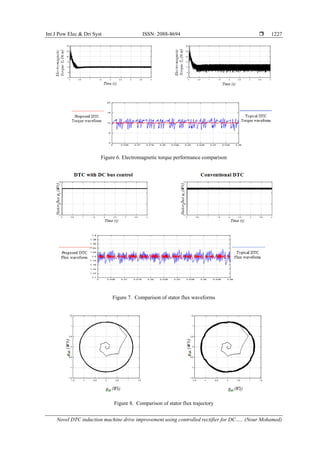
motor current waveform is improved; it takes the sinusoidal form as indicated in figure 5. The figure 6 shows
the comparison of the electromagnetic torque, the torque follows the torque load value (10 Nm) for the two
presented methods. In our approach, resulting from the soft voltage vector selection, the torque distortions are
greatly reduced. Similar to the torque, for the studied variant the stator flux follows the desired value that’s
demonstrated in Figure 7, their waveform is also performed, and consequently the ripples are significantly
decreased. Then, the flux trajectory behavior takes a circular shape with a diameter equal to the reference
stator flux value (1.2 Wb).
Comparaison of above performences with other results in recently published paper [7, 13, 16, 21],
demonstrats the significative current improvement and torque and flux ripples reduction.
Table 3. Induction machine parameters
2 pairs of poles, Rs =4.85Ω Ls = 274 mH
220/380 V, 50Hz 6.4/3.7 A Rr =3.805Ω Lr = 274 mH
2 hp , 1420 rpm Lm = 258 mH
J =0.031 kgm2 f =0.00114 Nms
Figure 4. Motor speed responses for both methods
Figure 5. Motor current waveform comparison](https://image.slidesharecdn.com/1111420ijpedsid-milzamadg-210624022948/85/Novel-DTC-induction-machine-drive-improvement-using-controlled-rectifier-for-DC-voltage-tuning-4-320.jpg)
![ ISSN: 2088-8694
Int J Pow Elec & Dri Syst, Vol. 10, No. 3, Sep 2019 : 1223 – 1228
1228
5. CONCLUSION
In the presented paper a controlled rectifier is used to perform a direct torque controlled induction
motor drive, where a PI controller generates the desired DC voltage. This approach acts on the rectifier firing
angles in order to adapt the selected voltage vector produced in conventional DTC switching table.
Through the simulation results comparisons cited and discussed above, we note a significant
reduction in electromagnetic torque and stator flux ripples; we can clearly observe excellent current
waveform amelioration and flux trajectory improvement. In conclusion, it had demonstrated by simulation
the performances improvement of the controlling of the DC voltage for a DTC applied on
induction machine drives.
REFERENCES
[1] F. Blaschke., "The principle of field oriented as applied to the new Tran vector closed loop control system for
rotating machine," Siemens Review, vol. 39, pp. 217-220, 1972.
[2] B. K. Bose, Power Electronics and Motor Drives Advances and Trends, (Academic Press is an imprint of Elsevier,
2006).
[3] I. Takahashi and T. Noguchi, "A New Quick-Response and High-Efficiency Control Strategy of an Induction
Motor" IEEE Transactions on Industry Applications, vol. IA-22, pp. 820-827. 1986.
[4] M. Depenbrock., "Direct self-control (DSC) of inverter-fed induction machine," IEEE Transactions on Power
Electronics, vol. 3, pp. 420-429, 1988.
[5] M. Depenbrock, "Direct self-control (DSC) of inverter fed induktion machine," IEEE Power Electronics
Specialists Conference, Blacksburg, VA, USA, USA, 1987.
[6] Mini. R, Shabana Backer. P, B. Hariram Satheesh & Dinesh M. N., "Low Speed Estimation of Sensorless DTC
Induction Motor Drive Using MRAS with Neuro Fuzzy Adaptive Controller," International Journal of Electrical
and Computer Engineering (IJECE), vol. 8(5), pp. 2691-2702, Oct 2018.
[7] A. Lokriti, I. Salhi, and S. Doubabi, "IM Direct Torque Control with no flux distortion and no static torque error,"
ISA Transactions, vol. 59, pp. 256-267, 2015.
[8] A. Berzoy, J. Rengifo, and O. Mohammed, "Fuzzy Predictive DTC of Induction Machines With Reduced Torque
Ripple and High-Performance Operation," IEEE Transactions on Power Electronics, vol. 33, pp. 2580-2587, 2018.
[9] Dris. Ahmed, Bendjebbar. Mokhtar, Belaidi. Aek, "DTC hybrid by different techniques of observation with
Artificial Neuronal Network (ANN) for induction machine drives, " International Journal of Power Electronics
and Drive System (IJPEDS), vol. 10(2), pp. 697-708, Jun 2019.
[10] B. Mokhtari and M. Benkhoris, "High ripples reduction in dtc of induction motor by using a new reduced switching
table," Journal of ELECTRICAL ENGINEERING, vol. 67, pp. 206-211, 2016.
[11] A. Chikhi, "Direct Torque Control of Induction Motor Based on Space Vector Modulation Using a Fuzzy Logic
Speed Controller," ACTA ELECTROTEHNICA, vol. 54, pp. 139-144, 2013.
[12] S. Krim, S. Gdaim, A. Mtibaa & M. F. Mimouni, "Design and Implementation of Direct Torque Control Based on
an Intelligent Technique of Induction Motor on FPGA," Journal of Electrical Engineering and Technology (JEET),
vol. 1, pp. 30-40, 2015.
[13] Draoui Abdelghani and Allaoua Boumediène, "Direct Torque Control of Two Induction Motors Using the Nine-
Switch Inverter " International Journal of Power Electronics and Drive System (IJPEDS), vol. 9(4), pp. 1552-
1564, Dec 2018.
[14] D. Kiran Kumar and G. Tulasi Ram Das, "Simulation and Analysis of Modified DTC of PMSM, " International
Journal of Electrical and Computer Engineering (IJECE), vol. 8(5), pp. 2894-2903, Oct 2018.
[15] D. Mohan, X. Zhang, & G. H. B. Foo, "Generalized DTC Strategy for Multilevel Inverter Fed IPMSMs With
Constant Inverter Switching Frequency and Reduced Torque Ripples," IEEE Transactions on Energy Conversion,
vol. 32, pp. 1031-1041, 2017.
[16] A. Berzoy, O. Mohammed, & J. Rengifo, "Fuzzy Predictive DTC of induction machines with reduced torque ripple
and high performance operation," IEEE Applied Power Electronics Conference and Exposition (APEC), Long
Beach, CA, USA, 2016.
[17] B. K. Bose, "Modern Power Electronics and AC Drives," (Prentice Hall PTR, 2002).
[18] H. Sudheer, S. Kodad, and B. Sarvesh, "Direct Torque and Flux control of induction machine using Fuzzy Logic
controller," 2nd International Conference on Advances in Electrical, Electronics, Information, Communication
and Bio-Informatics (AEEICB), Chennai, India, 2016.
[19] S. M. Gadoue, D. Giaouris, and J. W. Finch, "Artificial intelligence-based speed control of DTC induction motor
drives—A comparative study," Electric Power Systems Research, Vol. 79, pp. 210-219, 2009.
[20] N. P. Selvam, V.Rajasekaran, and M. A. Prasanna, "Minimization of torque ripple for dtc-csi fed induction motor
drives during low speed operation," Journal of Electrical Engineering, Vol. 17, pp. 82-90, 2017.
[21] V. Goutham, T. Himabindu, V. Vikas, and G. B. B. Singh, "Performance improvement using a multi-level
converter in a DTC based induction motor drive," IEEE IAS Joint Industrial and Commercial Power Systems /
Petroleum and Chemical Industry Conference (ICPSPCIC), Hyderabad, India, 2015.](https://image.slidesharecdn.com/1111420ijpedsid-milzamadg-210624022948/85/Novel-DTC-induction-machine-drive-improvement-using-controlled-rectifier-for-DC-voltage-tuning-6-320.jpg)


![[000008]](https://cdn.slidesharecdn.com/ss_thumbnails/000008-211028000724-thumbnail.jpg?width=640&height=640&fit=bounds)


