“
“CANCER-LINKED FAM190A GENE FOUND TO
REGULATE CELL DIVISIÓN” AND “CRITICAL
PATHWAY IN CELL CYCLE MAY LEAD TO CANCER
DEVELOPMENT”
 
 
Kelly Marisancén Carrasquilla
Medicine student
III Semester
Molecular biology
Introduction
Both  news  are  about  the 
relation between cell cycle,  the 
process,  molecules  involved 
and  control  regulation  with  an 
important disease: cancer.
Cancer-Linked FAM190A Gene
Found to Regulate Cell Division
(July 3, 2013)
 
Cancer-Linked FAM190A Gene Found to
Regulate Cell Division
(July 3, 2013)
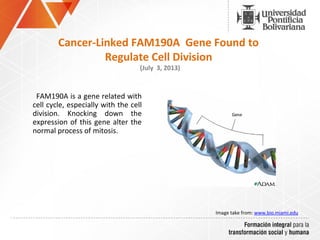
FAM190A is a gene related with
cell cycle, especially with the cell
division. Knocking down the
expression of this gene alter the
normal process of mitosis.
Image take from: www.bio.miami.edu
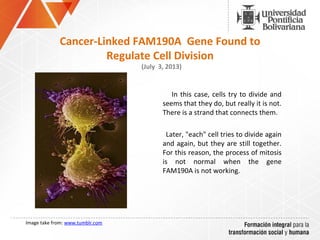
In this case, cells try to divide and
seems that they do, but really it is not.
There is a strand that connects them.
Later, "each" cell tries to divide again
and again, but they are still together.
For this reason, the process of mitosis
is not normal when the gene
FAM190A is not working.
Cancer-Linked FAM190A Gene Found to
Regulate Cell Division
(July 3, 2013)
Image take from: www.tumblr.com
Cancer-Linked FAM190A Gene Found to
Regulate Cell Division
(July 3, 2013)
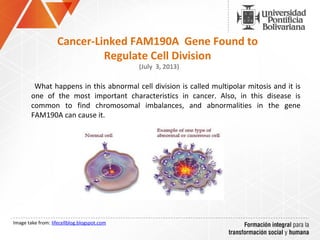
What happens in this abnormal cell division is called multipolar mitosis and it is
one of the most important characteristics in cancer. Also, in this disease is
common to find chromosomal imbalances, and abnormalities in the gene
FAM190A can cause it.
Image take from: lifecellblog.blogspot.com
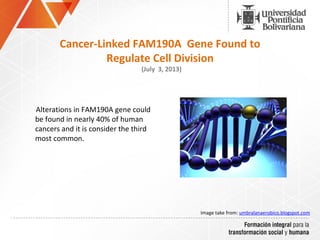
Alterations in FAM190A gene could
be found in nearly 40% of human
cancers and it is consider the third
most common.
Cancer-Linked FAM190A Gene Found to
Regulate Cell Division
(July 3, 2013)
Image take from: umbralanaerobico.blogspot.com
Personal Observation
I believe that knowing how our body and all of its components functions is an
essential part today in the scientific world, not only for the pursuit of knowledge
itself, but also in the case that something is wrong, knowing what is
malfunctioning is a key part in finding a cure or a working treatment.
Critical Pathway in Cell Cycle May Lead to Cancer
Development
(July 11, 2013)
 
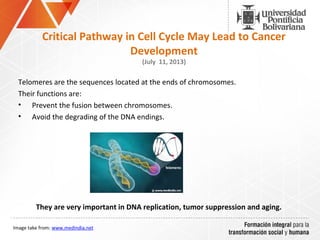
Telomeres are the sequences located at the ends of chromosomes.
Their functions are:
•  Prevent the fusion between chromosomes.
•  Avoid the degrading of the DNA endings.
They are very important in DNA replication, tumor suppression and aging.
Critical Pathway in Cell Cycle May Lead to Cancer
Development
(July 11, 2013)
 
Image take from: www.medindia.net
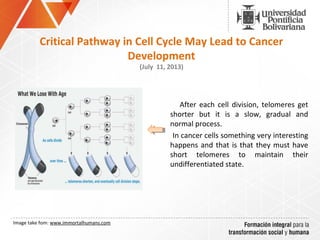
              After  each  cell  division,  telomeres  get 
shorter  but  it  is  a  slow,  gradual  and 
normal process.
       In cancer cells something very interesting 
happens and that is that they must have 
short  telomeres  to  maintain  their 
undifferentiated state. 
Critical Pathway in Cell Cycle May Lead to Cancer
Development
(July 11, 2013)
 
Image take fom: www.immortalhumans.com
Critical Pathway in Cell Cycle May Lead to Cancer
Development
(July 11, 2013)
    
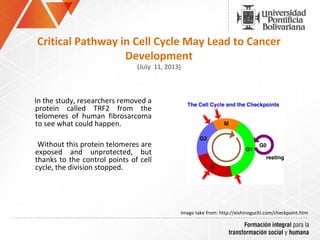
        In the study, researchers removed a 
protein  called  TRF2  from  the 
telomeres  of  human  fibrosarcoma 
to see what could happen.
       Without this protein telomeres are 
exposed  and  unprotected,  but 
thanks to the control points of cell 
cycle, the division stopped.
 
Image take from: http://eishinoguchi.com/checkpoint.htm 
The p53 pathway
       p53 is a protein that acts in the G1 control point, it responds quickly to damaged 
DNA. 
            The  p53  pathway  is  a  mechanism  that  protects  a  cell's  genetic  material  and 
suppresses tumors, because it detects any error (like deprotection telomeres) or a 
problem in the cell cycle.
Critical Pathway in Cell Cycle May Lead to Cancer
Development
(July 11, 2013)
 
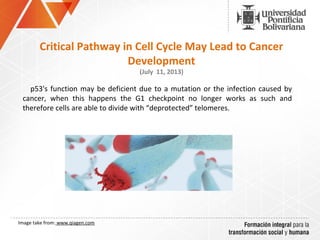
p53's function may be deficient due to a mutation or the infection caused by
cancer, when this happens the G1 checkpoint no longer works as such and
therefore cells are able to divide with “deprotected” telomeres.
Critical Pathway in Cell Cycle May Lead to Cancer
Development
(July 11, 2013)
Image take from: www.qiagen.com
I think that the cell being such a small structure, has many processes and each of
them is essential for the proper operation and status of the cell. In this case, I should
emphasize how the shortening of telomeres and mutation of the p53 protein leads
to cancer. I believe that as more processes are discovered, it will be easier to find an
effective treatment for this disease.
Personal Observation
Medical utility
It is important to understand the molecular mechanisms and the scientific
explanation of diseases to consider a treatment or cure for them. in this case,
regarding cancer which is a fairly common disease today.
Medical utility
Image take from: http://blog.alkalinecare.com/brocoli-defensa-contra-el-cancer/
Bibliography
• Kalpesh Patel, Francesca Scrimieri, Soma Ghosh, Jun Zhong, Min-Sik Kim, et al. FAM190A Deficiency
Creates a Cell Division Defect. Sciencedaily, (online magazine), 2013 (July 3).
Available at: http://www.sciencedaily.com/releases/2013/07/130703160357.htm
• Anthony J. Cesare, Makoto T. Hayashi, Laure Crabbe, Jan Karlseder. The Telomere Deprotection Response
Is Functionally Distinct from the Genomic DNA Damage Response. Science daily. (online magazine). 2013
(July 11).
Available at: http://www.sciencedaily.com/releases/2013/07/130711135223.htm
• Martinez Sánchez, Lina María. Biología molecular. 2. ed. Medellín: UPB. Fac. de Medicina, 2006. 208 pp.
47-51.

Trabajo de Biologia Molecular

  • 1.
    “ “CANCER-LINKED FAM190A GENEFOUND TO REGULATE CELL DIVISIÓN” AND “CRITICAL PATHWAY IN CELL CYCLE MAY LEAD TO CANCER DEVELOPMENT”     Kelly Marisancén Carrasquilla Medicine student III Semester Molecular biology
  • 4.
    Introduction Both  news  are about  the  relation between cell cycle,  the  process,  molecules  involved  and  control  regulation  with  an  important disease: cancer.
  • 5.
    Cancer-Linked FAM190A Gene Foundto Regulate Cell Division (July 3, 2013)  
  • 6.
    Cancer-Linked FAM190A GeneFound to Regulate Cell Division (July 3, 2013) FAM190A is a gene related with cell cycle, especially with the cell division. Knocking down the expression of this gene alter the normal process of mitosis. Image take from: www.bio.miami.edu
  • 7.
    In this case,cells try to divide and seems that they do, but really it is not. There is a strand that connects them. Later, "each" cell tries to divide again and again, but they are still together. For this reason, the process of mitosis is not normal when the gene FAM190A is not working. Cancer-Linked FAM190A Gene Found to Regulate Cell Division (July 3, 2013) Image take from: www.tumblr.com
  • 8.
    Cancer-Linked FAM190A GeneFound to Regulate Cell Division (July 3, 2013) What happens in this abnormal cell division is called multipolar mitosis and it is one of the most important characteristics in cancer. Also, in this disease is common to find chromosomal imbalances, and abnormalities in the gene FAM190A can cause it. Image take from: lifecellblog.blogspot.com
  • 9.
    Alterations in FAM190Agene could be found in nearly 40% of human cancers and it is consider the third most common. Cancer-Linked FAM190A Gene Found to Regulate Cell Division (July 3, 2013) Image take from: umbralanaerobico.blogspot.com
  • 10.
    Personal Observation I believethat knowing how our body and all of its components functions is an essential part today in the scientific world, not only for the pursuit of knowledge itself, but also in the case that something is wrong, knowing what is malfunctioning is a key part in finding a cure or a working treatment.
  • 11.
    Critical Pathway inCell Cycle May Lead to Cancer Development (July 11, 2013)  
  • 12.
    Telomeres are the sequences located at the ends of chromosomes. Their functions are: •  Prevent the fusion between chromosomes. •  Avoid the degrading of the DNA endings. Theyare very important in DNA replication, tumor suppression and aging. Critical Pathway in Cell Cycle May Lead to Cancer Development (July 11, 2013)   Image take from: www.medindia.net
  • 13.
                 After  each  cell  division,  telomeres  get  shorter  but  it  is  a  slow,  gradual  and  normal process.        In cancer cells something very interesting  happens and that is that they must have  short  telomeres  to  maintain  their  undifferentiated state.  Critical Pathway in Cell Cycle May Lead to Cancer Development (July 11, 2013)   Image take fom: www.immortalhumans.com
  • 14.
    Critical Pathway inCell Cycle May Lead to Cancer Development (July 11, 2013)              In the study, researchers removed a  protein  called  TRF2  from  the  telomeres  of  human  fibrosarcoma  to see what could happen.        Without this protein telomeres are  exposed  and  unprotected,  but  thanks to the control points of cell  cycle, the division stopped.   Image take from: http://eishinoguchi.com/checkpoint.htm 
  • 15.
    The p53 pathway        p53 is a protein that acts in the G1 control point, it responds quickly to damaged  DNA.             The  p53  pathway  is  a  mechanism  that  protects  a  cell's  genetic  material  and  suppresses tumors, because it detects any error (like deprotection telomeres) or a  problem in the cell cycle. Critical Pathway in Cell Cycle May Lead to Cancer Development (July 11, 2013)  
  • 16.
    p53's function maybe deficient due to a mutation or the infection caused by cancer, when this happens the G1 checkpoint no longer works as such and therefore cells are able to divide with “deprotected” telomeres. Critical Pathway in Cell Cycle May Lead to Cancer Development (July 11, 2013) Image take from: www.qiagen.com
  • 17.
    I think thatthe cell being such a small structure, has many processes and each of them is essential for the proper operation and status of the cell. In this case, I should emphasize how the shortening of telomeres and mutation of the p53 protein leads to cancer. I believe that as more processes are discovered, it will be easier to find an effective treatment for this disease. Personal Observation
  • 18.
  • 19.
    It is importantto understand the molecular mechanisms and the scientific explanation of diseases to consider a treatment or cure for them. in this case, regarding cancer which is a fairly common disease today. Medical utility Image take from: http://blog.alkalinecare.com/brocoli-defensa-contra-el-cancer/
  • 20.
    Bibliography • Kalpesh Patel,Francesca Scrimieri, Soma Ghosh, Jun Zhong, Min-Sik Kim, et al. FAM190A Deficiency Creates a Cell Division Defect. Sciencedaily, (online magazine), 2013 (July 3). Available at: http://www.sciencedaily.com/releases/2013/07/130703160357.htm • Anthony J. Cesare, Makoto T. Hayashi, Laure Crabbe, Jan Karlseder. The Telomere Deprotection Response Is Functionally Distinct from the Genomic DNA Damage Response. Science daily. (online magazine). 2013 (July 11). Available at: http://www.sciencedaily.com/releases/2013/07/130711135223.htm • Martinez Sánchez, Lina María. Biología molecular. 2. ed. Medellín: UPB. Fac. de Medicina, 2006. 208 pp. 47-51.