Not Your Mother’s
SD-WAN 101
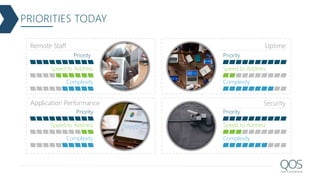
Remote Staff Uptime
Application Performance Security
PRIORITIES TODAY
Priority
Speed to Address
Complexity
Priority
Speed to Address
Complexity
Priority
Speed to Address
Complexity
Priority
Speed to Address
Complexity
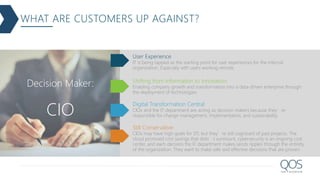
WHAT ARE CUSTOMERS UP AGAINST?
IT is being tapped as the starting point for user experiences for the internal
organization. Especially with users working remote.
User Experience
Enabling company growth and transformation into a data-driven enterprise through
the deployment of technologies
Shifting from Information to Innovation
CIOs and the IT department are acting as decision makers because they’re
responsible for change management, implementation, and sustainability.
Digital Transformation Central
CIOs may have high goals for DT, but they’re still cognizant of past projects. The
cloud promised cost savings that didn’t surmount, cybersecurity is an ongoing cost
center, and each decision the IT department makes sends ripples through the entirety
of the organization. They want to make safe and effective decisions that are proven.
Still Conservative
Decision Maker:
CIO
WHAT ARE CUSTOMERS UP AGAINST?
Directors are being tasked more and more to ensure their teams are mobile friendly
and the network and associated platforms are up to the demand – especially for home
users.
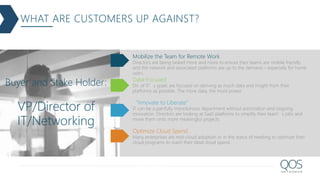
Mobilize the Team for Remote Work
Dir. of IT’s goals are focused on deriving as much data and insight from their
platforms as possible. The more data, the more power.
Data-Focused
IT can be a painfully monotonous department without automation and ongoing
innovation. Directors are looking at SaaS platforms to simplify their team’s jobs and
move them onto more meaningful projects.
“Innovate to Liberate”
Many enterprises are mid-cloud adoption or in the status of needing to optimize their
cloud programs to reach their ideal cloud spend.
Optimize Cloud Spend
Buyer and Stake Holder:
VP/Director of
IT/Networking
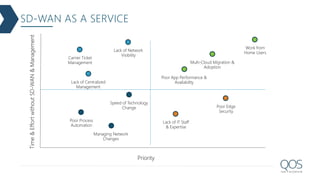
SD-WAN AS A SERVICE
Priority
Time&EffortwithoutSD-WAN&Management
Lack of Network
Visibility
Poor Process
Automation
Lack of IT Staff
& Expertise
Poor App Performance &
Availability
Poor Edge
Security
Managing Network
Changes
Work from
Home Users
Multi-Cloud Migration &
Adoption
Lack of Centralized
Management
Carrier Ticket
Management
Speed of Technology
Change
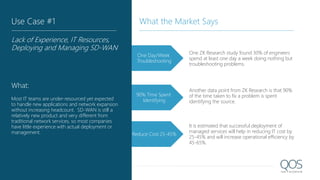
One Day/Week
Troubleshooting
One ZK Research study found 30% of engineers
spend at least one day a week doing nothing but
troubleshooting problems.
Another data point from ZK Research is that 90%
of the time taken to fix a problem is spent
identifying the source.
It is estimated that successful deployment of
managed services will help in reducing IT cost by
25-45% and will increase operational efficiency by
45-65%.
90% Time Spent
Identifying
Reduce Cost 25-45%
Use Case #1
Lack of Experience, IT Resources,
Deploying and Managing SD-WAN
What:
Most IT teams are under-resourced yet expected
to handle new applications and network expansion
without increasing headcount. SD-WAN is still a
relatively new product and very different from
traditional network services, so most companies
have little experience with actual deployment or
management.
What the Market Says
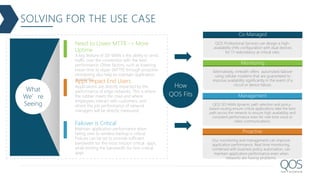
SOLVING FOR THE USE CASE
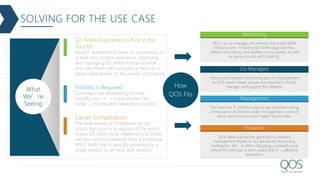
What
We’re
Seeing
SD-WAN Experience is Not in the
Tool Kit
Most IT departments have no experience, or
at best very limited experience, deploying
and managing SD-WAN enterprise-wide,
and even fewer still managed a national or
global deployment to thousands of locations.
Visibility is Required
Customers are demanding to have
visibility too – it’s a requirement for
today’s transparent network ecosystem.
Carrier Complications
The wide variety of broadband access
across the country or regions of the world
makes SD-WAN more challenging to install,
monitor and troubleshoot than a traditional
MPLS WAN that is typically provided by a
single vendor, or at most dual vendors.
Co-Managed
Outsourced network monitoring and co-management
to QOS means fewer people are required to install,
manage, and support the network.
Monitoring
QOS can co-manage and monitor the entire WAN
infrastructure, including SD-WAN edge switches,
cellular redundancy and wireless access points, as well
as carrier circuits and ticketing.
Management
This frees the IT staff from day to day troubleshooting
of thousands of devices under management, some of
which are known to have higher failure rates.
Proactive
QOS takes a proactive approach to network
management thanks to our advanced monitoring
intelligence. We’re often mitigating a network issue
before the end user is even aware that it’s affecting
operations.
How
QOS Fits
LACK OF EXPERIENCE – THE AUDIENCE
CIO VP/Dir of IT
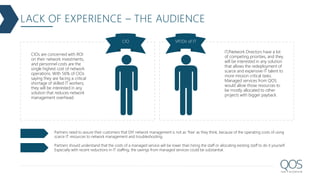
CIOs are concerned with ROI
on their network investments,
and personnel costs are the
single highest cost of network
operations. With 56% of CIOs
saying they are facing a critical
shortage of skilled IT workers,
they will be interested in any
solution that reduces network
management overhead.
IT/Network Directors have a lot
of competing priorities, and they
will be interested in any solution
that allows the redeployment of
scarce and expensive IT talent to
more mission critical tasks.
Managed services from QOS
would allow those resources to
be mostly allocated to other
projects with bigger payback.
Partners need to assure their customers that DIY network management is not as 'free' as they think, because of the operating costs of using
scarce IT resources to network management and troubleshooting.
Partners should understand that the costs of a managed service will be lower than hiring the staff or allocating existing staff to do it yourself.
Especially with recent reductions in IT staffing, the savings from managed services could be substantial.
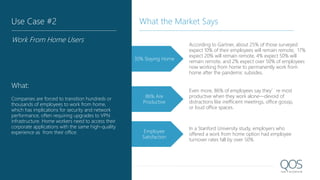
30% Staying Home
According to Gartner, about 25% of those surveyed
expect 10% of their employees will remain remote, 17%
expect 20% will remain remote, 4% expect 50% will
remain remote, and 2% expect over 50% of employees
now working from home to permanently work from
home after the pandemic subsides.
Even more, 86% of employees say they’re most
productive when they work alone—devoid of
distractions like inefficient meetings, office gossip,
or loud office spaces.
86% Are
Productive
In a Stanford University study, employers who
offered a work from home option had employee
turnover rates fall by over 50%
Employee
Satisfaction
Use Case #2
Work From Home Users
What:
Companies are forced to transition hundreds or
thousands of employees to work from home,
which has implications for security and network
performance, often requiring upgrades to VPN
infrastructure. Home workers need to access their
corporate applications with the same high-quality
experience as from their office.
What the Market Says
SOLVING FOR THE USE CASE
What
We’re
Seeing
Speed
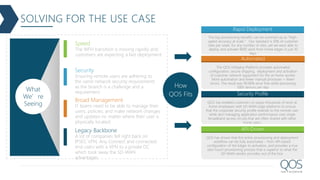
The WFH transition is moving rapidly and
customers are expecting a fast deployment.
Security
Ensuring remote users are adhering to
the same network security requirements
as the branch is a challenge and a
requirement.
Broad Management
IT teams need to be able to manage their
users, policies, and make network changes
and updates no matter where their user is
physically located.
How
QOS Fits
Rapid Deployment
The top provisioning benefits can be summed up as "High-
speed accuracy at scale.” Our standard is 10% of customer
sites per week, for any number of sites, yet we were able to
deploy and activate 9000 work from home edges in just 10
days.
Security Profile
QOS has enabled customers to equip thousands of work at
home employees with SD-WAN edge platforms to ensure
that the corporate security profile extends to the remote user
while also managing application performance over single
broadband access circuits that are often shared with other
home users.
API-Driven
QOS has shown that this entire provisioning and deployment
workflow can be fully automated – from API-based
configuration of the Edges to activation, and provides a true
zero touch provisioning process that is superior to what the
SD-WAN vendor provides out of the box.
Automated
The QOS inDeploy Platform provides automated
configuration, secure shipping, deployment and activation
of customer network equipment for the at-home worker.
More automation and fewer manual processes = fewer
errors. The result was 99.96% error free while processing
1000 devices per day.
Legacy Backbone
A lot of companies fell right back on
IPSEC VPN, Any Connect and connected
end users with a VPN to a private DC
which took away the SD-WAN
advantages
Action based on business policy
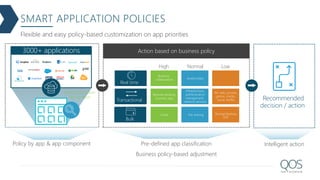
SMART APPLICATION POLICIES
3000+ applications
High Normal Low
Real time
Transactional
Bulk
Business
collaboration
Remote desktop,
business app
Email
Audio/video
Infrastructure,
authentication
management,
network services
File sharing
IM, web, proxies,
games, media,
social, Netflix
Storage/backup,
P2P
Recommended
decision / action
Policy by app & app component Pre-defined app classification
Business policy-based adjustment
Deep Application
Recognition
Intelligent action
Flexible and easy policy-based customization on app priorities
WORK FROM HOME – THE AUDIENCE
CIO VP/Dir of IT
CIOs will be interested in how
QOS supports the sudden
need to equip large numbers
of employees to work from
home on short notice, and do
so in a way that is secure and
provides the same high quality
as in the office.
IT/Network Directors will be
impressed that the leading SD-WAN
vendor admitted our automated
provisioning process was superior to
its own out of the box activation
process. They will appreciate our
focus on high-speed accuracy (no
DOAs) and scalability, as well as
project management, deployment
scheduling and cost-efficiencies due
to IT resources available to focus on
their company's mission critical apps
instead of installing thousands of in-
home edge devices.
Partners will want to tell our 9,000 WFH user deployment story to their customers, which demonstrates how we achieve high-speed accuracy at scale.
Speed – 9000 work from home employees equipped with SD-WAN in under 2 weeks, and a depot that can process 1000 devices per day!
That story is also about accuracy - how more automation and fewer manual processes resulted in 99.96% accuracy for this customer deployment.
75% Managing
Multiple monitoring tools meant a network team
was spending 75% of their time on overhead just
keeping the systems running.
Due to acquisitions, average 'tool sprawl'
costs were at around $5 Million dollars
annually"
$5M
Annually
Use Case #3
Lack of Centralized Management
What:
IT managers have too many tools and systems
they have to log into when trying to track down
network issues. There is no 'single-source-of-truth'
which leads to excessive hours spent compiling
data from disparate systems for analysis and
resolution.
What the Market Says
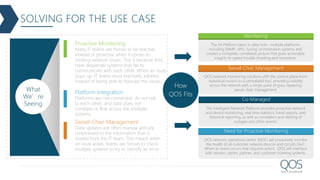
SOLVING FOR THE USE CASE
What
We’re
Seeing
Proactive Monitoring
Many IT teams are forced to be reactive
instead of proactive when it comes to
tackling network issues. This is because they
have desperate systems that fail to
communicate with each other. When an issue
pops up, IT teams must reactively address
instead of being able to forecast the issues.
Platform Integration
Platforms are not connected, do not talk
to each other, and data does not
correlate or flow across the multiple
systems.
Swivel-Chair Management
Data updates are often manual and are
constrained to the information that is
shared from the IT team. This means when
an issue arises, teams are forced to check
multiple systems to try to identify an error.
How
QOS Fits
Swivel-Chair Management
QOS network monitoring solutions shift the control plane from
individual routers to a centralized tool, providing visibility
across the network with a single pane of glass replacing
swivel-chair management.
Need for Proactive Monitoring
QOS network operations center (NOC) will proactively monitor
the health of all customer network devices and circuits 24x7.
When an event occurs that requires action, QOS will interface
with vendor, carrier, partner, and customer ticketing systems.
Co-Managed
The Intelligent Network Platform provides proactive network
and device monitoring, real time statistics, trend reports, and
historical reporting, as well as correlation and alerting of
outages and other events.
Monitoring
The IN Platform takes in data from multiple platforms
including SNMP, APIs, Syslog, orchestration systems and
creates a complete, correlated, picture that gives actionable
insights to speed trouble shooting and resolution.
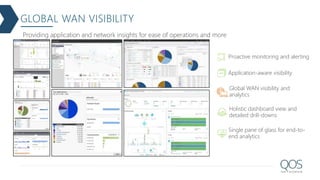
GLOBAL WAN VISIBILITY
Application-aware visibility
Single pane of glass for end-to-
end analytics
Holistic dashboard view and
detailed drill-downs
Global WAN visibility and
analytics
Proactive monitoring and alerting
Providing application and network insights for ease of operations and more
LACK OF CENTRALIZED MANAGEMENT – THE AUDIENCE
CIO VP/Dir of IT
CIOs are concerned with the ROI
and application availability
affecting end user satisfaction. If
employees can't access
applications or performance is
slow, it ultimately impacts the
bottom line. QOS co-
management and monitoring
systems can reduce the mean-
time-to-resolution which
increases availability, productivity
and end-user satisfaction with a
company's IT systems.
IT/Network Directors need a
centralized and unified network
management interface that is both
comprehensive and efficient. The
QOS Intelligent Network Platform is
all of these, saving hours of
troubleshooting and speeding the
time it takes to resolve incidents.
The result is reduced IT overhead
for day-to-day management and
fault-isolation, and more time to
focus on the company's mission-
critical applications.
Partners need to understand that our Intelligent Network Platform is a unique value proposition which sets QOS apart. While most MSPs manage one
or two data sources, the QOS IN Platform uses AIOps automation to manage 5-tools for network alerting and correlation for rapid root- cause
identification and remediation.
21% Have Had
Breaches
"According to a study by Capgemini, 21% of the
companies surveyed reported that they
experienced security breaches as their businesses
grew.
In the U.S. a data breach costs a
company on average $8.19 million.
$8.19M per
Breach
Use Case #4
Poor Edge Security
What:
Backhauling Internet/cloud traffic to centralized
firewall in data center for inspection is inefficient,
adds latency. Companies are implementing direct
Internet breakout from branches which increases
vulnerability without edge or cloud-based security.
What the Market Says
One in four enterprises (1,000+ employees)
are increasing 2020 IT spend due to a
recent security incident.
1 of 4 Enterprises
Increasing Spend
SOLVING FOR THE USE CASE
What
We’re
Seeing
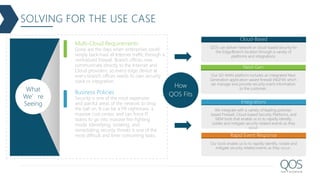
Multi-Cloud Requirements
Gone are the days when enterprises could
simply back-haul all Internet traffic through a
centralized firewall. Branch offices now
communicate directly to the Internet and
Cloud providers, so every edge device at
every branch offices needs its own security
stack or integration.
Business Policies
Security is one of the most expensive
and painful areas of the network to drop
the ball on. It can be a PR nightmare, a
massive cost center, and can force IT
teams to go into massive fire-fighting
mode. Identifying, isolating, and
remediating security threats is one of the
most difficult and time-consuming tasks.
How
QOS Fits
Cloud-Based
QOS can deliver network or cloud-based security for
the Edge/Branch location through a variety of
platforms and integrations.
Next-Gen
Our SD-WAN platform includes an integrated Next
Generation application-aware firewall (NGFW) which
we manage and provide security event information
to the customer.
Integrations
We integrate with a variety of leading premise-
based Firewall, Cloud-based Security Platforms, and
SIEM tools that enable us to to rapidly identify,
isolate and mitigate security related events as they
occur.
Rapid Event Response
Our tools enable us to to rapidly identify, isolate and
mitigate security related events as they occur..
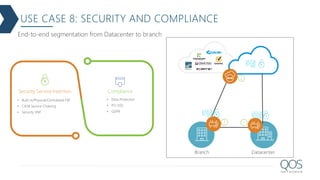
USE CASE 8: SECURITY AND COMPLIANCE
Security Service Insertion Compliance
• Built-in/Physical/Centralized FW
• CASB Service Chaining
• Security VNF
• Data Protection
• PCI DSS
• GDPR
Branch Datacenter
3
2
1
End-to-end segmentation from Datacenter to branch
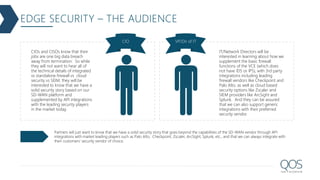
EDGE SECURITY – THE AUDIENCE
CIO VP/Dir of IT
CIOs and CISOs know that their
jobs are one big data breach
away from termination. So while
they will not want to hear all of
the technical details of integrated
vs standalone firewall vs cloud
security vs SEIM, they will be
interested to know that we have a
solid security story based on our
SD-WAN platform and
supplemented by API integrations
with the leading security players
in the market today.
IT/Network Directors will be
interested in learning about how we
supplement the basic firewall
functions of the VCE (which does
not have IDS or IPS), with 3rd party
integrations including leading
firewall vendors like Checkpoint and
Palo Alto, as well as cloud based
security options like Zscaler and
SIEM providers like ArcSight and
Splunk. And they can be assured
that we can also support generic
integrations with their preferred
security vendor.
Partners will just want to know that we have a solid security story that goes beyond the capabilities of the SD-WAN vendor through API
integrations with market leading players such as Palo Alto, Checkpoint, Zscaler, ArcSight, Splunk, etc., and that we can always integrate with
their customers' security vendor of choice.
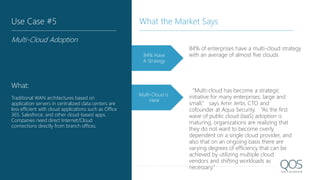
84% Have
A Strategy
84% of enterprises have a multi-cloud strategy
with an average of almost five clouds
“Multi-cloud has become a strategic
initiative for many enterprises, large and
small,” says Amir Jerbi, CTO and
cofounder at Aqua Security. “As the first
wave of public cloud (IaaS) adoption is
maturing, organizations are realizing that
they do not want to become overly
dependent on a single cloud provider, and
also that on an ongoing basis there are
varying degrees of efficiency that can be
achieved by utilizing multiple cloud
vendors and shifting workloads as
necessary.”
Multi-Cloud is
Here
Use Case #5
Multi-Cloud Adoption
What:
Traditional WAN architectures based on
application servers in centralized data centers are
less efficient with cloud applications such as Office
365, Salesforce, and other cloud-based apps.
Companies need direct Internet/Cloud
connections directly from branch offices.
What the Market Says
SOLVING FOR THE USE CASE
What
We’re
Seeing
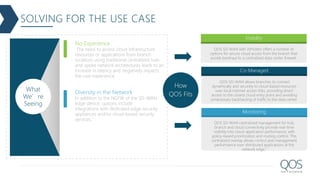
No Experience
The need to access cloud infrastructure
resources or applications from branch
locations using traditional centralized hub-
and-spoke network architectures leads to an
increase in latency and negatively impacts
the user experience.
Diversity in the Network
In addition to the NGFW of the SD-WAN
edge device, options include
integrations with dedicated edge security
appliances and/or cloud-based security
services."
How
QOS Fits
Visibility
QOS SD-WAN with inProtect offers a number of
options for secure cloud access from the branch that
avoids backhaul to a centralized data center firewall.
Co-Managed
QOS SD-WAN allows branches to connect
dynamically and securely to cloud-based resources
over local Internet access links, providing direct
access to the closest cloud entry point and avoiding
unnecessary backhauling of traffic to the data center.
Monitoring
QOS SD-WAN centralized management for hub,
branch and cloud connectivity provide real-time
visibility into cloud-application performance, with
policy-based prioritization and routing control. This
centralized overlay allows control and management
performance over distributed applications at the
network edge."
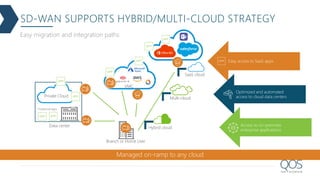
SD-WAN SUPPORTS HYBRID/MULTI-CLOUD STRATEGY
Managed on-ramp to any cloud
VMC
Hybrid cloud
Multi-cloud
Branch or Home User
Data center
Traditional apps
Private Cloud
SaaS cloud
Access to on-premises
enterprise applications
Optimized and automated
access to cloud data centers
Easy access to SaaS apps
Easy migration and integration paths
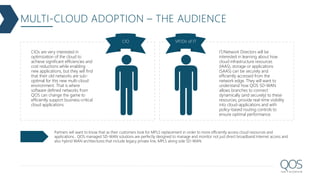
MULTI-CLOUD ADOPTION – THE AUDIENCE
CIO VP/Dir of IT
CIOs are very interested in
optimization of the cloud to
achieve significant efficiencies and
cost reductions while enabling
new applications, but they will find
that their old networks are sub-
optimal for this new multi-cloud
environment. That is where
software defined networks from
QOS can change the game to
efficiently support business-critical
cloud applications.
IT/Network Directors will be
interested in learning about how
cloud infrastructure resources
(IAAS), storage or applications
(SAAS) can be securely and
efficiently accessed from the
network edge. They will want to
understand how QOS SD-WAN
allows branches to connect
dynamically (and securely) to these
resources, provide real-time visibility
into cloud-applications and with
policy-based routing controls to
ensure optimal performance.
Partners will want to know that as their customers look for MPLS replacement in order to more efficiently access cloud resources and
applications , QOS managed SD-WAN solutions are perfectly designed to manage and monitor not just direct broadband Internet access and
also hybrid WAN architectures that include legacy private line, MPLS along side SD-WAN.
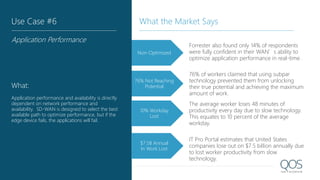
Non-Optimized
Forrester also found only 14% of respondents
were fully confident in their WAN’s ability to
optimize application performance in real-time .
76% of workers claimed that using subpar
technology prevented them from unlocking
their true potential and achieving the maximum
amount of work.
76% Not Reaching
Potential
Use Case #6
Application Performance
What:
Application performance and availability is directly
dependent on network performance and
availability. SD-WAN is designed to select the best
available path to optimize performance, but if the
edge device fails, the applications will fail.
What the Market Says
The average worker loses 48 minutes of
productivity every day due to slow technology.
This equates to 10 percent of the average
workday.
10% Workday
Lost
IT Pro Portal estimates that United States
companies lose out on $7.5 billion annually due
to lost worker productivity from slow
technology.
$7.5B Annual
In Work Lost
SOLVING FOR THE USE CASE
What
We’re
Seeing
Need to Lower MTTR -> More
Uptime
A key feature of SD-WAN is the ability to send
traffic over the connection with the best
performance. Other factors, such as lowering
mean time to repair (MTTR) through proactive
monitoring also help to maintain application
availability.
Apps Impact End Users
Applications are directly impacted by the
performance of edge networks. This is where
the rubber meets the road and where
employees interact with customers, and
where the job performance of network
managers will be directly measured.
How
QOS Fits
Failover is Critical
Maintain application performance when
failing over to wireless backup is critical.
Policies can be set to provide sufficient
bandwidth for the most mission critical apps,
while limiting the bandwidth for non-critical
apps.
Co-Managed
QOS Professional Services can design a high-
availability (HA) configuration with dual devices
for 1:1 redundancy at critical sites.
Monitoring
Alternatively, inHealth offers automated failover
using cellular modems that are guaranteed to
improve availability significantly in the event of a
circuit or device failure.
Management
QOS SD-WAN dynamic path selection and policy-
based routing ensure critical applications take the best
path across the network to ensure high availability and
consistent performance even for real-time voice or
video communications.
Proactive
Our monitoring and management can improve
application performance. Real time monitoring,
combined with business policy automation, can
maintain application performance even when
networks are having problems.
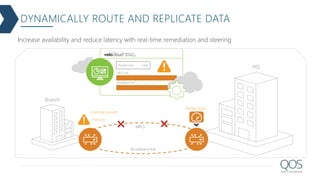
0.1%Packet loss: .01%
DYNAMICALLY ROUTE AND REPLICATE DATA
Broadband link
MPLS
Branch
HQ
MPLS link
Broadband link
1.5%
Reroute
MPLS
Duplicate packets
2.0%
Packet loss!
Increase availability and reduce latency with real-time remediation and steering
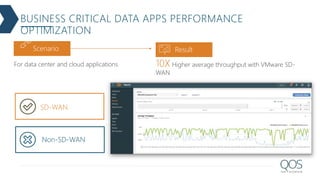
BUSINESS CRITICAL DATA APPS PERFORMANCE
OPTIMIZATION
• Office 365 performance from Branch to
Gateway is high and reliable
Scenario
10X Higher average throughput with VMware SD-
WAN
Result
SD-WAN
Non-SD-WAN
For data center and cloud applications
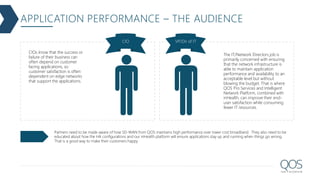
APPLICATION PERFORMANCE – THE AUDIENCE
CIO VP/Dir of IT
CIOs know that the success or
failure of their business can
often depend on customer
facing applications, so
customer satisfaction is often
dependent on edge networks
that support the applications.
The IT/Network Directors job is
primarily concerned with ensuring
that the network infrastructure is
able to maintain application
performance and availability to an
acceptable level but without
blowing the budget. That is where
QOS Pro Services and Intelligent
Network Platform, combined with
inHealth, can improve their end-
user satisfaction while consuming
fewer IT resources.
Partners need to be made aware of how SD-WAN from QOS maintains high performance over lower cost broadband. They also need to be
educated about how the HA configurations and our inHealth platform will ensure applications stay up and running when things go wrong.
That is a good way to make their customers happy.
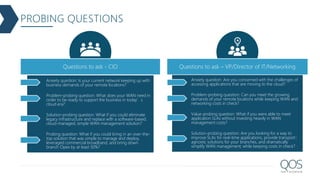
PROBING QUESTIONS
Anxiety question: Is your current network keeping up with
business demands of your remote locations?
Problem-probing question: What does your WAN need in
order to be ready to support the business in today’s
cloud era?
Solution-probing question: What if you could eliminate
legacy infrastructure and replace with a software-based,
cloud-managed, simple WAN management solution?
Probing question: What if you could bring in an over-the-
top solution that was simple to manage and deploy,
leveraged commercial broadband, and bring down
branch Opex by at least 50%?
Anxiety question: Are you concerned with the challenges of
accessing applications that are moving to the cloud?
Problem-probing question: Can you meet the growing
demands of your remote locations while keeping WAN and
networking costs in check?
Value-probing question: What if you were able to meet
application SLAs without investing heavily in WAN
management costs?
Solution-probing question: Are you looking for a way to
improve SLAs for real-time applications, provide transport-
agnostic solutions for your branches, and dramatically
simplify WAN management, while keeping costs in check?
Questions to ask - CIO Questions to ask – VP/Director of IT/Networking
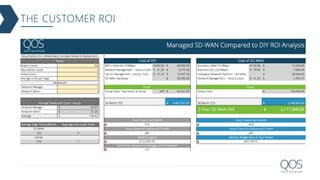
THE CUSTOMER ROI
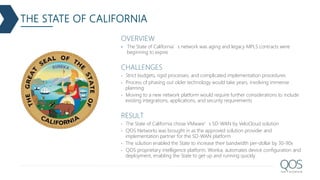
OVERVIEW
 The State of California’s network was aging and legacy MPLS contracts were
beginning to expire
CHALLENGES
• Strict budgets, rigid processes, and complicated implementation procedures
• Process of phasing out older technology would take years, involving immense
planning
• Moving to a new network platform would require further considerations to include
existing integrations, applications, and security requirements
RESULT
• The State of California chose VMware’s SD-WAN by VeloCloud solution
• QOS Networks was brought in as the approved solution provider and
implementation partner for the SD-WAN platform
• The solution enabled the State to increase their bandwidth per-dollar by 30-90x
• QOS proprietary intelligence platform, Wonka, automates device configuration and
deployment, enabling the State to get up and running quickly
THE STATE OF CALIFORNIA
OVERVIEW
 Public Storage is a self storage retail giant with over 2,600 locations nationally
 The Company’s current MPLS network design was inflexible, unreliable with service outages and
voice quality issues, and was not scalable
 Public Storage needed a solution to solve their latency and stability issues while remaining flexible
CHALLENGES
 Originally considered an MPLS solution to solve their network needs
 Found that an SD-WAN platform would give them more flexibility and performance, allowing them to
select the connectivity that suited their budget
 Needed integrations for their SolarWinds network monitoring platform and ServiceNow network
management platform, as well as compatibility with VeloCloud’s orchestrator SD-WAN monitoring
tool
RESULT
 QOS Networks assigned a dedicated team to handle the design and implementation of VeloCloud
into Public Storage’s environment at a scale of approximately 40-50 locations each day
 QOS designed custom APIs for SolarWinds and ServiceNow to ensure data sharing across their
network platforms
 Provided 100% uptime on the overlay network from QOS, virtually eliminating network outages
“QOS is a great partner and has
demonstrated the operational maturity
to manage our growing network with
ease”
-Mark Delcher CIO
CUSTOM DEPLOYMENT SUCCESS STORY
Questions?

Not Your Mother's SD-WAN 101

  • 1.
  • 2.
    Remote Staff Uptime ApplicationPerformance Security PRIORITIES TODAY Priority Speed to Address Complexity Priority Speed to Address Complexity Priority Speed to Address Complexity Priority Speed to Address Complexity
  • 3.
    WHAT ARE CUSTOMERSUP AGAINST? IT is being tapped as the starting point for user experiences for the internal organization. Especially with users working remote. User Experience Enabling company growth and transformation into a data-driven enterprise through the deployment of technologies Shifting from Information to Innovation CIOs and the IT department are acting as decision makers because they’re responsible for change management, implementation, and sustainability. Digital Transformation Central CIOs may have high goals for DT, but they’re still cognizant of past projects. The cloud promised cost savings that didn’t surmount, cybersecurity is an ongoing cost center, and each decision the IT department makes sends ripples through the entirety of the organization. They want to make safe and effective decisions that are proven. Still Conservative Decision Maker: CIO
  • 4.
    WHAT ARE CUSTOMERSUP AGAINST? Directors are being tasked more and more to ensure their teams are mobile friendly and the network and associated platforms are up to the demand – especially for home users. Mobilize the Team for Remote Work Dir. of IT’s goals are focused on deriving as much data and insight from their platforms as possible. The more data, the more power. Data-Focused IT can be a painfully monotonous department without automation and ongoing innovation. Directors are looking at SaaS platforms to simplify their team’s jobs and move them onto more meaningful projects. “Innovate to Liberate” Many enterprises are mid-cloud adoption or in the status of needing to optimize their cloud programs to reach their ideal cloud spend. Optimize Cloud Spend Buyer and Stake Holder: VP/Director of IT/Networking
  • 5.
    SD-WAN AS ASERVICE Priority Time&EffortwithoutSD-WAN&Management Lack of Network Visibility Poor Process Automation Lack of IT Staff & Expertise Poor App Performance & Availability Poor Edge Security Managing Network Changes Work from Home Users Multi-Cloud Migration & Adoption Lack of Centralized Management Carrier Ticket Management Speed of Technology Change
  • 6.
    One Day/Week Troubleshooting One ZKResearch study found 30% of engineers spend at least one day a week doing nothing but troubleshooting problems. Another data point from ZK Research is that 90% of the time taken to fix a problem is spent identifying the source. It is estimated that successful deployment of managed services will help in reducing IT cost by 25-45% and will increase operational efficiency by 45-65%. 90% Time Spent Identifying Reduce Cost 25-45% Use Case #1 Lack of Experience, IT Resources, Deploying and Managing SD-WAN What: Most IT teams are under-resourced yet expected to handle new applications and network expansion without increasing headcount. SD-WAN is still a relatively new product and very different from traditional network services, so most companies have little experience with actual deployment or management. What the Market Says
  • 7.
    SOLVING FOR THEUSE CASE What We’re Seeing SD-WAN Experience is Not in the Tool Kit Most IT departments have no experience, or at best very limited experience, deploying and managing SD-WAN enterprise-wide, and even fewer still managed a national or global deployment to thousands of locations. Visibility is Required Customers are demanding to have visibility too – it’s a requirement for today’s transparent network ecosystem. Carrier Complications The wide variety of broadband access across the country or regions of the world makes SD-WAN more challenging to install, monitor and troubleshoot than a traditional MPLS WAN that is typically provided by a single vendor, or at most dual vendors. Co-Managed Outsourced network monitoring and co-management to QOS means fewer people are required to install, manage, and support the network. Monitoring QOS can co-manage and monitor the entire WAN infrastructure, including SD-WAN edge switches, cellular redundancy and wireless access points, as well as carrier circuits and ticketing. Management This frees the IT staff from day to day troubleshooting of thousands of devices under management, some of which are known to have higher failure rates. Proactive QOS takes a proactive approach to network management thanks to our advanced monitoring intelligence. We’re often mitigating a network issue before the end user is even aware that it’s affecting operations. How QOS Fits
  • 8.
    LACK OF EXPERIENCE– THE AUDIENCE CIO VP/Dir of IT CIOs are concerned with ROI on their network investments, and personnel costs are the single highest cost of network operations. With 56% of CIOs saying they are facing a critical shortage of skilled IT workers, they will be interested in any solution that reduces network management overhead. IT/Network Directors have a lot of competing priorities, and they will be interested in any solution that allows the redeployment of scarce and expensive IT talent to more mission critical tasks. Managed services from QOS would allow those resources to be mostly allocated to other projects with bigger payback. Partners need to assure their customers that DIY network management is not as 'free' as they think, because of the operating costs of using scarce IT resources to network management and troubleshooting. Partners should understand that the costs of a managed service will be lower than hiring the staff or allocating existing staff to do it yourself. Especially with recent reductions in IT staffing, the savings from managed services could be substantial.
  • 9.
    30% Staying Home Accordingto Gartner, about 25% of those surveyed expect 10% of their employees will remain remote, 17% expect 20% will remain remote, 4% expect 50% will remain remote, and 2% expect over 50% of employees now working from home to permanently work from home after the pandemic subsides. Even more, 86% of employees say they’re most productive when they work alone—devoid of distractions like inefficient meetings, office gossip, or loud office spaces. 86% Are Productive In a Stanford University study, employers who offered a work from home option had employee turnover rates fall by over 50% Employee Satisfaction Use Case #2 Work From Home Users What: Companies are forced to transition hundreds or thousands of employees to work from home, which has implications for security and network performance, often requiring upgrades to VPN infrastructure. Home workers need to access their corporate applications with the same high-quality experience as from their office. What the Market Says
  • 10.
    SOLVING FOR THEUSE CASE What We’re Seeing Speed The WFH transition is moving rapidly and customers are expecting a fast deployment. Security Ensuring remote users are adhering to the same network security requirements as the branch is a challenge and a requirement. Broad Management IT teams need to be able to manage their users, policies, and make network changes and updates no matter where their user is physically located. How QOS Fits Rapid Deployment The top provisioning benefits can be summed up as "High- speed accuracy at scale.” Our standard is 10% of customer sites per week, for any number of sites, yet we were able to deploy and activate 9000 work from home edges in just 10 days. Security Profile QOS has enabled customers to equip thousands of work at home employees with SD-WAN edge platforms to ensure that the corporate security profile extends to the remote user while also managing application performance over single broadband access circuits that are often shared with other home users. API-Driven QOS has shown that this entire provisioning and deployment workflow can be fully automated – from API-based configuration of the Edges to activation, and provides a true zero touch provisioning process that is superior to what the SD-WAN vendor provides out of the box. Automated The QOS inDeploy Platform provides automated configuration, secure shipping, deployment and activation of customer network equipment for the at-home worker. More automation and fewer manual processes = fewer errors. The result was 99.96% error free while processing 1000 devices per day. Legacy Backbone A lot of companies fell right back on IPSEC VPN, Any Connect and connected end users with a VPN to a private DC which took away the SD-WAN advantages
  • 11.
    Action based onbusiness policy SMART APPLICATION POLICIES 3000+ applications High Normal Low Real time Transactional Bulk Business collaboration Remote desktop, business app Email Audio/video Infrastructure, authentication management, network services File sharing IM, web, proxies, games, media, social, Netflix Storage/backup, P2P Recommended decision / action Policy by app & app component Pre-defined app classification Business policy-based adjustment Deep Application Recognition Intelligent action Flexible and easy policy-based customization on app priorities
  • 12.
    WORK FROM HOME– THE AUDIENCE CIO VP/Dir of IT CIOs will be interested in how QOS supports the sudden need to equip large numbers of employees to work from home on short notice, and do so in a way that is secure and provides the same high quality as in the office. IT/Network Directors will be impressed that the leading SD-WAN vendor admitted our automated provisioning process was superior to its own out of the box activation process. They will appreciate our focus on high-speed accuracy (no DOAs) and scalability, as well as project management, deployment scheduling and cost-efficiencies due to IT resources available to focus on their company's mission critical apps instead of installing thousands of in- home edge devices. Partners will want to tell our 9,000 WFH user deployment story to their customers, which demonstrates how we achieve high-speed accuracy at scale. Speed – 9000 work from home employees equipped with SD-WAN in under 2 weeks, and a depot that can process 1000 devices per day! That story is also about accuracy - how more automation and fewer manual processes resulted in 99.96% accuracy for this customer deployment.
  • 13.
    75% Managing Multiple monitoringtools meant a network team was spending 75% of their time on overhead just keeping the systems running. Due to acquisitions, average 'tool sprawl' costs were at around $5 Million dollars annually" $5M Annually Use Case #3 Lack of Centralized Management What: IT managers have too many tools and systems they have to log into when trying to track down network issues. There is no 'single-source-of-truth' which leads to excessive hours spent compiling data from disparate systems for analysis and resolution. What the Market Says
  • 14.
    SOLVING FOR THEUSE CASE What We’re Seeing Proactive Monitoring Many IT teams are forced to be reactive instead of proactive when it comes to tackling network issues. This is because they have desperate systems that fail to communicate with each other. When an issue pops up, IT teams must reactively address instead of being able to forecast the issues. Platform Integration Platforms are not connected, do not talk to each other, and data does not correlate or flow across the multiple systems. Swivel-Chair Management Data updates are often manual and are constrained to the information that is shared from the IT team. This means when an issue arises, teams are forced to check multiple systems to try to identify an error. How QOS Fits Swivel-Chair Management QOS network monitoring solutions shift the control plane from individual routers to a centralized tool, providing visibility across the network with a single pane of glass replacing swivel-chair management. Need for Proactive Monitoring QOS network operations center (NOC) will proactively monitor the health of all customer network devices and circuits 24x7. When an event occurs that requires action, QOS will interface with vendor, carrier, partner, and customer ticketing systems. Co-Managed The Intelligent Network Platform provides proactive network and device monitoring, real time statistics, trend reports, and historical reporting, as well as correlation and alerting of outages and other events. Monitoring The IN Platform takes in data from multiple platforms including SNMP, APIs, Syslog, orchestration systems and creates a complete, correlated, picture that gives actionable insights to speed trouble shooting and resolution.
  • 15.
    GLOBAL WAN VISIBILITY Application-awarevisibility Single pane of glass for end-to- end analytics Holistic dashboard view and detailed drill-downs Global WAN visibility and analytics Proactive monitoring and alerting Providing application and network insights for ease of operations and more
  • 16.
    LACK OF CENTRALIZEDMANAGEMENT – THE AUDIENCE CIO VP/Dir of IT CIOs are concerned with the ROI and application availability affecting end user satisfaction. If employees can't access applications or performance is slow, it ultimately impacts the bottom line. QOS co- management and monitoring systems can reduce the mean- time-to-resolution which increases availability, productivity and end-user satisfaction with a company's IT systems. IT/Network Directors need a centralized and unified network management interface that is both comprehensive and efficient. The QOS Intelligent Network Platform is all of these, saving hours of troubleshooting and speeding the time it takes to resolve incidents. The result is reduced IT overhead for day-to-day management and fault-isolation, and more time to focus on the company's mission- critical applications. Partners need to understand that our Intelligent Network Platform is a unique value proposition which sets QOS apart. While most MSPs manage one or two data sources, the QOS IN Platform uses AIOps automation to manage 5-tools for network alerting and correlation for rapid root- cause identification and remediation.
  • 17.
    21% Have Had Breaches "Accordingto a study by Capgemini, 21% of the companies surveyed reported that they experienced security breaches as their businesses grew. In the U.S. a data breach costs a company on average $8.19 million. $8.19M per Breach Use Case #4 Poor Edge Security What: Backhauling Internet/cloud traffic to centralized firewall in data center for inspection is inefficient, adds latency. Companies are implementing direct Internet breakout from branches which increases vulnerability without edge or cloud-based security. What the Market Says One in four enterprises (1,000+ employees) are increasing 2020 IT spend due to a recent security incident. 1 of 4 Enterprises Increasing Spend
  • 18.
    SOLVING FOR THEUSE CASE What We’re Seeing Multi-Cloud Requirements Gone are the days when enterprises could simply back-haul all Internet traffic through a centralized firewall. Branch offices now communicate directly to the Internet and Cloud providers, so every edge device at every branch offices needs its own security stack or integration. Business Policies Security is one of the most expensive and painful areas of the network to drop the ball on. It can be a PR nightmare, a massive cost center, and can force IT teams to go into massive fire-fighting mode. Identifying, isolating, and remediating security threats is one of the most difficult and time-consuming tasks. How QOS Fits Cloud-Based QOS can deliver network or cloud-based security for the Edge/Branch location through a variety of platforms and integrations. Next-Gen Our SD-WAN platform includes an integrated Next Generation application-aware firewall (NGFW) which we manage and provide security event information to the customer. Integrations We integrate with a variety of leading premise- based Firewall, Cloud-based Security Platforms, and SIEM tools that enable us to to rapidly identify, isolate and mitigate security related events as they occur. Rapid Event Response Our tools enable us to to rapidly identify, isolate and mitigate security related events as they occur..
  • 19.
    USE CASE 8:SECURITY AND COMPLIANCE Security Service Insertion Compliance • Built-in/Physical/Centralized FW • CASB Service Chaining • Security VNF • Data Protection • PCI DSS • GDPR Branch Datacenter 3 2 1 End-to-end segmentation from Datacenter to branch
  • 20.
    EDGE SECURITY –THE AUDIENCE CIO VP/Dir of IT CIOs and CISOs know that their jobs are one big data breach away from termination. So while they will not want to hear all of the technical details of integrated vs standalone firewall vs cloud security vs SEIM, they will be interested to know that we have a solid security story based on our SD-WAN platform and supplemented by API integrations with the leading security players in the market today. IT/Network Directors will be interested in learning about how we supplement the basic firewall functions of the VCE (which does not have IDS or IPS), with 3rd party integrations including leading firewall vendors like Checkpoint and Palo Alto, as well as cloud based security options like Zscaler and SIEM providers like ArcSight and Splunk. And they can be assured that we can also support generic integrations with their preferred security vendor. Partners will just want to know that we have a solid security story that goes beyond the capabilities of the SD-WAN vendor through API integrations with market leading players such as Palo Alto, Checkpoint, Zscaler, ArcSight, Splunk, etc., and that we can always integrate with their customers' security vendor of choice.
  • 21.
    84% Have A Strategy 84%of enterprises have a multi-cloud strategy with an average of almost five clouds “Multi-cloud has become a strategic initiative for many enterprises, large and small,” says Amir Jerbi, CTO and cofounder at Aqua Security. “As the first wave of public cloud (IaaS) adoption is maturing, organizations are realizing that they do not want to become overly dependent on a single cloud provider, and also that on an ongoing basis there are varying degrees of efficiency that can be achieved by utilizing multiple cloud vendors and shifting workloads as necessary.” Multi-Cloud is Here Use Case #5 Multi-Cloud Adoption What: Traditional WAN architectures based on application servers in centralized data centers are less efficient with cloud applications such as Office 365, Salesforce, and other cloud-based apps. Companies need direct Internet/Cloud connections directly from branch offices. What the Market Says
  • 22.
    SOLVING FOR THEUSE CASE What We’re Seeing No Experience The need to access cloud infrastructure resources or applications from branch locations using traditional centralized hub- and-spoke network architectures leads to an increase in latency and negatively impacts the user experience. Diversity in the Network In addition to the NGFW of the SD-WAN edge device, options include integrations with dedicated edge security appliances and/or cloud-based security services." How QOS Fits Visibility QOS SD-WAN with inProtect offers a number of options for secure cloud access from the branch that avoids backhaul to a centralized data center firewall. Co-Managed QOS SD-WAN allows branches to connect dynamically and securely to cloud-based resources over local Internet access links, providing direct access to the closest cloud entry point and avoiding unnecessary backhauling of traffic to the data center. Monitoring QOS SD-WAN centralized management for hub, branch and cloud connectivity provide real-time visibility into cloud-application performance, with policy-based prioritization and routing control. This centralized overlay allows control and management performance over distributed applications at the network edge."
  • 23.
    SD-WAN SUPPORTS HYBRID/MULTI-CLOUDSTRATEGY Managed on-ramp to any cloud VMC Hybrid cloud Multi-cloud Branch or Home User Data center Traditional apps Private Cloud SaaS cloud Access to on-premises enterprise applications Optimized and automated access to cloud data centers Easy access to SaaS apps Easy migration and integration paths
  • 24.
    MULTI-CLOUD ADOPTION –THE AUDIENCE CIO VP/Dir of IT CIOs are very interested in optimization of the cloud to achieve significant efficiencies and cost reductions while enabling new applications, but they will find that their old networks are sub- optimal for this new multi-cloud environment. That is where software defined networks from QOS can change the game to efficiently support business-critical cloud applications. IT/Network Directors will be interested in learning about how cloud infrastructure resources (IAAS), storage or applications (SAAS) can be securely and efficiently accessed from the network edge. They will want to understand how QOS SD-WAN allows branches to connect dynamically (and securely) to these resources, provide real-time visibility into cloud-applications and with policy-based routing controls to ensure optimal performance. Partners will want to know that as their customers look for MPLS replacement in order to more efficiently access cloud resources and applications , QOS managed SD-WAN solutions are perfectly designed to manage and monitor not just direct broadband Internet access and also hybrid WAN architectures that include legacy private line, MPLS along side SD-WAN.
  • 25.
    Non-Optimized Forrester also foundonly 14% of respondents were fully confident in their WAN’s ability to optimize application performance in real-time . 76% of workers claimed that using subpar technology prevented them from unlocking their true potential and achieving the maximum amount of work. 76% Not Reaching Potential Use Case #6 Application Performance What: Application performance and availability is directly dependent on network performance and availability. SD-WAN is designed to select the best available path to optimize performance, but if the edge device fails, the applications will fail. What the Market Says The average worker loses 48 minutes of productivity every day due to slow technology. This equates to 10 percent of the average workday. 10% Workday Lost IT Pro Portal estimates that United States companies lose out on $7.5 billion annually due to lost worker productivity from slow technology. $7.5B Annual In Work Lost
  • 26.
    SOLVING FOR THEUSE CASE What We’re Seeing Need to Lower MTTR -> More Uptime A key feature of SD-WAN is the ability to send traffic over the connection with the best performance. Other factors, such as lowering mean time to repair (MTTR) through proactive monitoring also help to maintain application availability. Apps Impact End Users Applications are directly impacted by the performance of edge networks. This is where the rubber meets the road and where employees interact with customers, and where the job performance of network managers will be directly measured. How QOS Fits Failover is Critical Maintain application performance when failing over to wireless backup is critical. Policies can be set to provide sufficient bandwidth for the most mission critical apps, while limiting the bandwidth for non-critical apps. Co-Managed QOS Professional Services can design a high- availability (HA) configuration with dual devices for 1:1 redundancy at critical sites. Monitoring Alternatively, inHealth offers automated failover using cellular modems that are guaranteed to improve availability significantly in the event of a circuit or device failure. Management QOS SD-WAN dynamic path selection and policy- based routing ensure critical applications take the best path across the network to ensure high availability and consistent performance even for real-time voice or video communications. Proactive Our monitoring and management can improve application performance. Real time monitoring, combined with business policy automation, can maintain application performance even when networks are having problems.
  • 27.
    0.1%Packet loss: .01% DYNAMICALLYROUTE AND REPLICATE DATA Broadband link MPLS Branch HQ MPLS link Broadband link 1.5% Reroute MPLS Duplicate packets 2.0% Packet loss! Increase availability and reduce latency with real-time remediation and steering
  • 28.
    BUSINESS CRITICAL DATAAPPS PERFORMANCE OPTIMIZATION • Office 365 performance from Branch to Gateway is high and reliable Scenario 10X Higher average throughput with VMware SD- WAN Result SD-WAN Non-SD-WAN For data center and cloud applications
  • 29.
    APPLICATION PERFORMANCE –THE AUDIENCE CIO VP/Dir of IT CIOs know that the success or failure of their business can often depend on customer facing applications, so customer satisfaction is often dependent on edge networks that support the applications. The IT/Network Directors job is primarily concerned with ensuring that the network infrastructure is able to maintain application performance and availability to an acceptable level but without blowing the budget. That is where QOS Pro Services and Intelligent Network Platform, combined with inHealth, can improve their end- user satisfaction while consuming fewer IT resources. Partners need to be made aware of how SD-WAN from QOS maintains high performance over lower cost broadband. They also need to be educated about how the HA configurations and our inHealth platform will ensure applications stay up and running when things go wrong. That is a good way to make their customers happy.
  • 30.
    PROBING QUESTIONS Anxiety question:Is your current network keeping up with business demands of your remote locations? Problem-probing question: What does your WAN need in order to be ready to support the business in today’s cloud era? Solution-probing question: What if you could eliminate legacy infrastructure and replace with a software-based, cloud-managed, simple WAN management solution? Probing question: What if you could bring in an over-the- top solution that was simple to manage and deploy, leveraged commercial broadband, and bring down branch Opex by at least 50%? Anxiety question: Are you concerned with the challenges of accessing applications that are moving to the cloud? Problem-probing question: Can you meet the growing demands of your remote locations while keeping WAN and networking costs in check? Value-probing question: What if you were able to meet application SLAs without investing heavily in WAN management costs? Solution-probing question: Are you looking for a way to improve SLAs for real-time applications, provide transport- agnostic solutions for your branches, and dramatically simplify WAN management, while keeping costs in check? Questions to ask - CIO Questions to ask – VP/Director of IT/Networking
  • 31.
  • 32.
    OVERVIEW  The Stateof California’s network was aging and legacy MPLS contracts were beginning to expire CHALLENGES • Strict budgets, rigid processes, and complicated implementation procedures • Process of phasing out older technology would take years, involving immense planning • Moving to a new network platform would require further considerations to include existing integrations, applications, and security requirements RESULT • The State of California chose VMware’s SD-WAN by VeloCloud solution • QOS Networks was brought in as the approved solution provider and implementation partner for the SD-WAN platform • The solution enabled the State to increase their bandwidth per-dollar by 30-90x • QOS proprietary intelligence platform, Wonka, automates device configuration and deployment, enabling the State to get up and running quickly THE STATE OF CALIFORNIA
  • 33.
    OVERVIEW  Public Storageis a self storage retail giant with over 2,600 locations nationally  The Company’s current MPLS network design was inflexible, unreliable with service outages and voice quality issues, and was not scalable  Public Storage needed a solution to solve their latency and stability issues while remaining flexible CHALLENGES  Originally considered an MPLS solution to solve their network needs  Found that an SD-WAN platform would give them more flexibility and performance, allowing them to select the connectivity that suited their budget  Needed integrations for their SolarWinds network monitoring platform and ServiceNow network management platform, as well as compatibility with VeloCloud’s orchestrator SD-WAN monitoring tool RESULT  QOS Networks assigned a dedicated team to handle the design and implementation of VeloCloud into Public Storage’s environment at a scale of approximately 40-50 locations each day  QOS designed custom APIs for SolarWinds and ServiceNow to ensure data sharing across their network platforms  Provided 100% uptime on the overlay network from QOS, virtually eliminating network outages “QOS is a great partner and has demonstrated the operational maturity to manage our growing network with ease” -Mark Delcher CIO CUSTOM DEPLOYMENT SUCCESS STORY
  • 34.