NoSQL Dbs. 
By easydata.in 
easydata - Online Training
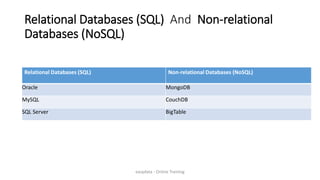
Relational Databases (SQL) And Non-relational 
Databases (NoSQL) 
Relational Databases (SQL) Non-relational Databases (NoSQL) 
Oracle MongoDB 
MySQL CouchDB 
SQL Server BigTable 
easydata - Online Training
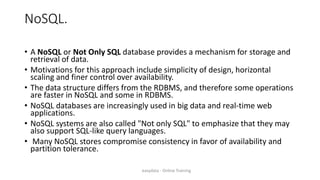
NoSQL. 
• A NoSQL or Not Only SQL database provides a mechanism for storage and 
retrieval of data. 
• Motivations for this approach include simplicity of design, horizontal 
scaling and finer control over availability. 
• The data structure differs from the RDBMS, and therefore some operations 
are faster in NoSQL and some in RDBMS. 
• NoSQL databases are increasingly used in big data and real-time web 
applications. 
• NoSQL systems are also called "Not only SQL" to emphasize that they may 
also support SQL-like query languages. 
• Many NoSQL stores compromise consistency in favor of availability and 
partition tolerance. 
easydata - Online Training
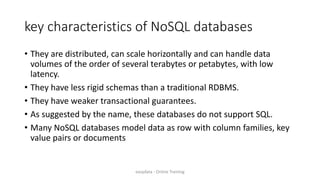
key characteristics of NoSQL databases 
• They are distributed, can scale horizontally and can handle data 
volumes of the order of several terabytes or petabytes, with low 
latency. 
• They have less rigid schemas than a traditional RDBMS. 
• They have weaker transactional guarantees. 
• As suggested by the name, these databases do not support SQL. 
• Many NoSQL databases model data as row with column families, key 
value pairs or documents 
easydata - Online Training
If RDBMSs are so good, Why does any one 
need NoSQL databases ? 
• When your application is on the internet, where you are dealing with 
millions of users and data in the order of petabytes, things start to 
slow down with a RDBMS. 
• The basic operations with any database are read and write. Reads can 
be scaled by replicating data to multiple machines and load balancing 
read requests. However this does not work for writes because data 
consistency needs to be maintained. 
• Writes can be scaled only by partitioning the data. But this affects 
read as distributed joins can be slow and hard to implement. 
Additionally, to maintain ACID properties, databases need to lock data 
at the cost of performance. 
easydata - Online Training
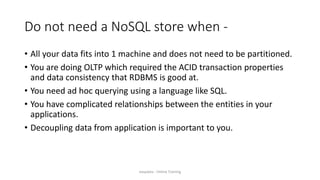
Do not need a NoSQL store when - 
• All your data fits into 1 machine and does not need to be partitioned. 
• You are doing OLTP which required the ACID transaction properties 
and data consistency that RDBMS is good at. 
• You need ad hoc querying using a language like SQL. 
• You have complicated relationships between the entities in your 
applications. 
• Decoupling data from application is important to you. 
easydata - Online Training
Thank You 
easydata - Online Training

NoSQL - Not Only SQL

  • 1.
    NoSQL Dbs. Byeasydata.in easydata - Online Training
  • 2.
    Relational Databases (SQL)And Non-relational Databases (NoSQL) Relational Databases (SQL) Non-relational Databases (NoSQL) Oracle MongoDB MySQL CouchDB SQL Server BigTable easydata - Online Training
  • 3.
    NoSQL. • ANoSQL or Not Only SQL database provides a mechanism for storage and retrieval of data. • Motivations for this approach include simplicity of design, horizontal scaling and finer control over availability. • The data structure differs from the RDBMS, and therefore some operations are faster in NoSQL and some in RDBMS. • NoSQL databases are increasingly used in big data and real-time web applications. • NoSQL systems are also called "Not only SQL" to emphasize that they may also support SQL-like query languages. • Many NoSQL stores compromise consistency in favor of availability and partition tolerance. easydata - Online Training
  • 4.
    key characteristics ofNoSQL databases • They are distributed, can scale horizontally and can handle data volumes of the order of several terabytes or petabytes, with low latency. • They have less rigid schemas than a traditional RDBMS. • They have weaker transactional guarantees. • As suggested by the name, these databases do not support SQL. • Many NoSQL databases model data as row with column families, key value pairs or documents easydata - Online Training
  • 5.
    If RDBMSs areso good, Why does any one need NoSQL databases ? • When your application is on the internet, where you are dealing with millions of users and data in the order of petabytes, things start to slow down with a RDBMS. • The basic operations with any database are read and write. Reads can be scaled by replicating data to multiple machines and load balancing read requests. However this does not work for writes because data consistency needs to be maintained. • Writes can be scaled only by partitioning the data. But this affects read as distributed joins can be slow and hard to implement. Additionally, to maintain ACID properties, databases need to lock data at the cost of performance. easydata - Online Training
  • 6.
    Do not needa NoSQL store when - • All your data fits into 1 machine and does not need to be partitioned. • You are doing OLTP which required the ACID transaction properties and data consistency that RDBMS is good at. • You need ad hoc querying using a language like SQL. • You have complicated relationships between the entities in your applications. • Decoupling data from application is important to you. easydata - Online Training
  • 7.
    Thank You easydata- Online Training