The psychological impacts of 
nostalgia for people with 
dementia: an experimental study 
Sanda Ismail 
Prof Richard Cheston 
Dr Gary Christopher
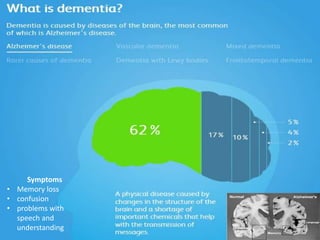
Symptoms 
• Memory loss 
• confusion 
• problems with 
speech and 
understanding
Dementia: a significant health and social 
threat 
• About 35.6 million people have been estimated to have 
dementia worldwide 
• By next year (2015) 850, 000 will be living with dementia 
in the UK 
• This That’s translates enough to pay into the annual a total energy cost bill of of every £26.3 household billion in the per country 
year. 
• There is no cure for dementia… 
(Alzheimer’s Society, 2014)
Dementia goes beyond the 
neurological process…. 
It has been regarded as a 
disease of the entire person 
rather than a mere illness of 
the brain
Recent conceptualisations 
of dementia argue that it 
represents an 
(Cheston, 2011)
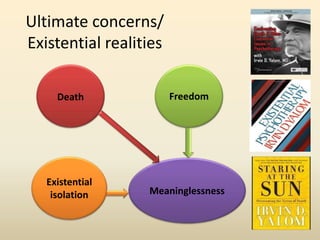
Ultimate concerns/ 
Existential realities 
Freedom 
Death 
Existential 
isolation Meaninglessness
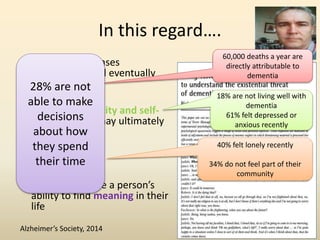
In this regard…. 
• Dementia increases 
dependency and eventually 
leads to death 
• Threatens identity and self-esteem 
which may ultimately 
lead to… 
• social isolation 
• and compromise a person’s 
ability to find meaning in their 
life 
60,000 deaths a year are 
directly attributable to 
dementia 
18% are not living well with 
dementia 
61% felt depressed or 
anxious recently 
40% felt lonely recently 
34% do not feel part of their 
community 
28% are not 
able to make 
decisions 
about how 
they spend 
their time 
Alzheimer’s Society, 2014
Existential concerns are implicit within the dementia care 
literature; research literature and clinical literature involving 
interventions 
Dementia care literature 
• attachment needs (Van Assche et al, 2013, 
Stephens, Cheston and Gleeson, 2013) 
• how meaning or purpose in life is established 
(McGovern, 2012) 
• how the potential loss of identity is 
negotiated (Eustache et al, 2013, Steeman et 
al, 2013)
Research literature 
Various studies have suggested that the early stages of 
dementia, after receiving a diagnosis, generally cause 
profound psychological effects on : 
• self-esteem (Steeman et al, 2006) 
• meaning/ purpose in life (Lingler et al, 2006, Macquarrie, 
2005) 
• social connectedness (Hatch, 2013) 
• general psychological wellbeing (Piiparinen and Whitlatch, 
2011).
Clinical literature involving interventions 
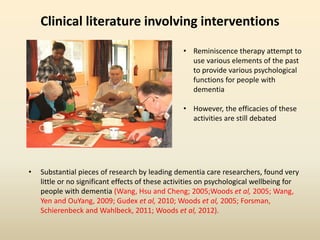
• Reminiscence therapy attempt to 
use various elements of the past 
to provide various psychological 
functions for people with 
dementia 
• However, the efficacies of these 
activities are still debated 
• Substantial pieces of research by leading dementia care researchers, found very 
little or no significant effects of these activities on psychological wellbeing for 
people with dementia (Wang, Hsu and Cheng; 2005;Woods et al, 2005; Wang, 
Yen and OuYang, 2009; Gudex et al, 2010; Woods et al, 2005; Forsman, 
Schierenbeck and Wahlbeck, 2011; Woods et al, 2012).
It is therefore not 
clear which of the 
active components 
in these activities 
significantly 
contribute to 
enhancing the 
psychological 
equanimity for 
people with 
dementia (Moos 
and Bjorn, 2006).
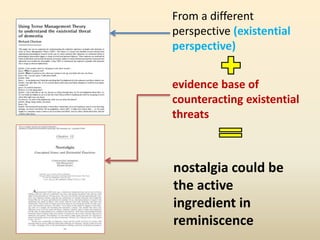
From a different 
perspective (existential 
perspective) 
evidence base of 
counteracting existential 
threats 
nostalgia could be 
the active 
ingredient in 
reminiscence
What is nostalgia? 
• Nostalgia is defined as a “sentimental 
longing for the past” (The New Oxford 
Dictionary of English, 1998; p. 1266) 
• Different from reminiscence and 
ordinary autobiographical memory 
• “One can remember without being 
nostalgic, but one cannot be nostalgic 
without remembering” (Batcho, 2007; p. 
362).
The use of nostalgia by people with dementia to 
provide desirable psychological functions is not 
clear and has not been explored among people with 
dementia 
Aim of the 
research 
To explore the psychological 
impacts of nostalgic 
memories compared to non-nostalgic 
memories on 
people affected by 
dementia.
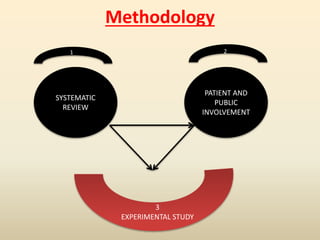
Methodology 
1 2 
SYSTEMATIC 
REVIEW 
PATIENT AND 
PUBLIC 
INVOLVEMENT 
3 
EXPERIMENTAL STUDY
Systematic review 
• Involves the use of systematic, 
clear and detailed methods to 
identify, critically appraise 
relevant studies and analyse 
data from such studies in 
order to answer a formulated 
question (Moher et al., 2009). 
• What is the strength of 
evidence relating to a range of 
psychosocial functions of 
nostalgia including self-esteem, 
social connectedness 
and meaning in life within the 
general population?
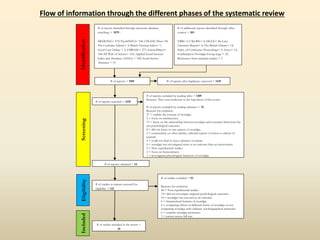
Flow of information through the different phases of the systematic review 
Included Eligibility Screening Identification 
# of reports identified through electronic database 
searching = 1879 : 
MEDLINE= 279; PsychINFO= 768; CINAHL Plus= 99; 
The Cochrane Library= 3; British Nursing Index= 7; 
Social Care Online = 3; EMBASE= 271; ScienceDirect= 
144; ISI Web of Science= 163; Applied Social Sciences 
Index and Abstracts (ASSIA) = 109; Social Service 
Abstracts = 33 
# of additional reports identified through other 
sources = 103 : 
NRR= 0; UKCRN= 0; SIGLE= 46; Grey 
Literature Report= 0; The British Library= 14; 
Index of Conference Proceedings= 0; Zetoc= 14; 
Southampton Nostalgia Group page = 29; 
References from included studies = 3 
# of reports after duplicates removed = 1439 
The Psychologist= 0. . 
# of reports = 1985 
# of reports screened = 1439 
# of reports obtained = 54 
# of studies included in the review = 
39 
# of reports excluded by reading titles = 1309 
Reasons: They were irrelevant to the hypothesis of the review 
# of reports excluded by reading abstracts = 76 
Reasons for exclusion: 
27 = explain the concept of nostalgia 
5 = focus on reminiscence 
13 = focus on the relationship between nostalgia and consumer behaviour but 
not psychological outcomes 
8 = did not focus on any aspects of nostalgia. 
5 = commentary on other articles, editorial reports or letters to editors of 
journals 
4 = could not find or access abstract of articles 
6 = nostalgia was investigated more as an outcome than an intervention 
5 = Non-experimental studies. 
2 = focus on homesickness 
1 = investigated physiological functions of nostalgia 
# of studies in reports assessed for 
eligibility = 132 
# of studies excluded = 93 
Reasons for exclusion: 
44 = Non-experimental studies 
13= did not investigate targeted psychological outcomes 
18 = nostalgia was assessed as an outcome 
6 = characterised features of nostalgia 
2 = comparing effects of different forms of nostalgia or not 
comparing nostalgia with ordinary autobiographical memories 
6 = examine nostalgia proneness 
3 = cannot access full text
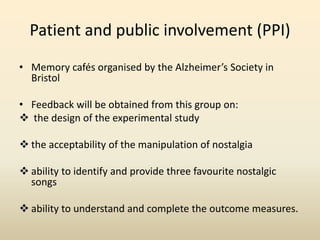
Patient and public involvement (PPI) 
• Memory cafés organised by the Alzheimer’s Society in 
Bristol 
• Feedback will be obtained from this group on: 
 the design of the experimental study 
 the acceptability of the manipulation of nostalgia 
 ability to identify and provide three favourite nostalgic 
songs 
 ability to understand and complete the outcome measures.
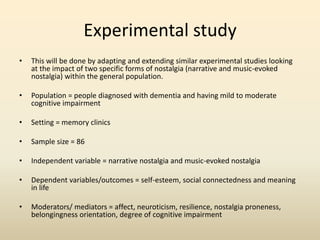
Experimental study 
• This will be done by adapting and extending similar experimental studies looking 
at the impact of two specific forms of nostalgia (narrative and music-evoked 
nostalgia) within the general population. 
• Population = people diagnosed with dementia and having mild to moderate 
cognitive impairment 
• Setting = memory clinics 
• Sample size = 86 
• Independent variable = narrative nostalgia and music-evoked nostalgia 
• Dependent variables/outcomes = self-esteem, social connectedness and meaning 
in life 
• Moderators/ mediators = affect, neuroticism, resilience, nostalgia proneness, 
belongingness orientation, degree of cognitive impairment
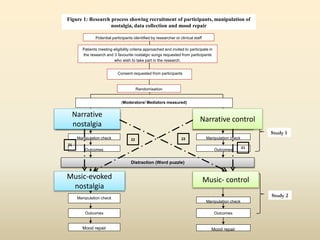
Figure 1: Research process showing recruitment of participants, manipulation of 
nostalgia, data collection and mood repair 
Potential participants identified by researcher or clinical staff 
Patients meeting eligibility criteria approached and invited to participate in 
the research and 3 favourite nostalgic songs requested from participants 
who wish to take part in the research. 
Consent requested from participants 
Randomisation 
Narrative control 
Manipulation check 
Music- control 
Manipulation check 
Outcomes 
Narrative nostalgia 
Manipulation check 
Music-nostalgia 
Manipulation check 
Outcomes 
Outcomes 
Outcomes 
(Moderators/ Mediators measured) 
Distraction (Word puzzle) 
Mood repair Mood repair 
21 
Narrative 
nostalgia 
Narrative control 
Music-evoked 
nostalgia 
control 
21 
22 22 
Study 1 
Study 2
Significance of the research 
• Theoretically: strengthen arguments perceiving dementia 
as an existential threat. 
• Also, while reminiscence therapy is frequently used with 
people with dementia, research findings are unclear as to 
whether this has any benefit. It may be that one of the 
factors determining whether reminiscence is of benefit is 
whether or not a nostalgic memory is evoked 
• Clinically: may be able to shed light on the way in which 
nostalgia buffers the psychological challenges of living with 
dementia
References 
Alzheimer’s Society (2014) Dementia 2014: Opportunity for change . Available from: http://www.alzheimers.org.uk/dementia2014 [Accessed 29 November 2013]. 
Batcho, K.I. (2007) Nostalgia and the emotional tone and content of song lyrics. The American Journal of Psychology [online]. pp.361-381 [04 November 2013]. 
Cheston, R. (2011) Using Terror Management Theory to understand the existential threat of dementia. PSIGE Newsletter [online] 118, pp. 7-15. Available from: 
http://www.psige.org/public/files/newsletters/PSIGE_118_web.pdf [Accessed 13 May 2013]. 
Coleman, P.G. (2005) Uses of reminiscence: Functions and benefits. [online] [Accessed 19 December 2013]. 
Eustache, M.-., Laisney, M., Juskenaite, A., Letortu, O., Platel, H., Eustache, F. and Desgranges, B. (2013) Sense of identity in advanced Alzheimer’s dementia: A cognitive dissociation between sameness and 
selfhood? Consciousness and Cognition [online]. 22 (4), pp.1456-1467 [Accessed 15 January 2014]. 
Forsman, A.K., Schierenbeck, I. and Wahlbeck, K. (2011) Psychosocial interventions for the prevention of depression in older adults: Systematic review and meta-analysis. Journal of Aging and Health 
[online]. 23 (3), pp.387-416 [Accessed 08 January 2014]. 
Gudex, C., Horsted, C., Jensen, A.M., Kjer, M. and Sørensen, J. (2010) Consequences from use of reminiscence-a randomised intervention study in ten Danish nursing homes. BMC Geriatrics [online]. 10 (1), 
pp.33 [Accessed 12 April 2014]. 
Hatch, D.J. (2013) The Influence of Widowhood and Sociodemographic Moderators on Dementia and Alzheimer's Disease Risk. [online] [Accessed 11 January 2014]. 
Lingler, J.H., Nightingale, M.C., Erlen, J.A., Kane, A.L., Reynolds, C.F.,3rd, Schulz, R. and DeKosky, S.T. (2006) Making sense of mild cognitive impairment: a qualitative exploration of the patient's experience. 
The Gerontologist [online]. 46 (6), pp.791-800 [Accessed 15 January 2014]. 
Macquarrie, C.R. (2005) Experiences in early stage Alzheimer's disease: understanding the paradox of acceptance and denial. Aging & Mental Health [online]. 9 (5), pp.430-441[Accessed 14 January 2014]. 
McGovern, J. (2012) Couplehood and the Phenomenology of Meaning for Older Couples Living with Dementia [online] [Accessed 20 November 2014]. 
Moher, D., Liberati, A., Tetzlaff, J. and Altman, D.G. (2009) Preferred reporting items for systematic reviews and meta-analyses: the PRISMA statement. Annals of Internal Medicine [online]. 151 (4), pp.264- 
269 [Accessed 15 January 2014]. 
Moos, I. and Bjorn, A. (2006) Use of the life story in the institutional care of people with dementia: A review of intervention studies. Ageing & Society [online]. 26 (3), pp.431-454 [Accessed 10 December 
2014]. 
Piiparinen, R. and Whitlatch, C.J. (2011) Existential loss as a determinant to well-being in the dementia caregiving dyad: A conceptual model. Dementia [online]. 10 (2), pp.185-201[Accessed 28 December 
2013] 
Sedikides, C., Wildschut, T. and Baden, D. (2004) Conceptual Issues and Existential Functions. Handbook of Experimental Existential Psychology [online]. pp.205 [Accessed 31October 2013]. 
Steeman, E., Casterlé, D., Dierckx, B., Godderis, J. and Grypdonck, M. (2006) Living with early‐stage dementia: a review of qualitative studies. Journal of Advanced Nursing [online]. 54 (6), pp.722-738 
[Accessed 17 November 2013]. 
Steeman, E., Tournoy, J., Grypdonck, M., Godderis, J. and DE CASTERLÉ, B.D. (2013) Managing identity in early-stage dementia: maintaining a sense of being valued. Ageing & Society [online]. 33 pp.216-242 
[Accessed 14 November 2013]. 
Stephens, A., Cheston, R. and Gleeson, K. (2013) An exploration into the relationships people with dementia have with physical objects: an ethnographic study. Dementia (London, England) [online]. 12 (6), 
pp.697-712 [Accessed 08 October 2013]. 
Van Assche, L., Luyten, P., Bruffaerts, R., Persoons, P., van de Ven, L. and Vandenbulcke, M. (2013) Attachment in old age: Theoretical assumptions, empirical findings and implications for clinical practice. 
Clinical Psychology Review [online]. 33 (1), pp.67-81[Accessed 12 November 2013]. 
van Tilburg, W.A., Igou, E.R. and Sedikides, C. (2013) In search of meaningfulness: Nostalgia as an antidote to boredom. Emotion [online]. 13 (3), pp.450. [Accessed 10 November 2013]. 
Wang, J., Hsu, Y. and Cheng, S. (2005) The effects of reminiscence in promoting mental health of Taiwanese elderly. International Journal of Nursing Studies [online]. 42 (1), pp.31-36 [Accessed 25 October 
2013]. 
Wang, J., Yen, M. and OuYang, W. (2009) Group reminiscence intervention in Taiwanese elders with dementia. Archives of Gerontology and Geriatrics [online]. 49 (2), pp.227-232 [Accessed 25 October 
2014]. 
Woods, B., Spector, A., Jones, C., Orrell, M. and Davies, S. (2005) Reminiscence therapy for dementia. Cochrane Database Syst Rev [online]. 2 [Accessed 25 October 2013]. 
Woods, R.T., Bruce, E., Edwards, R., Elvish, R., Hoare, Z., Hounsome, B., Keady, J., Moniz-Cook, E., Orgeta, V. and Orrell, M. (2012) REMCARE: reminiscence groups for people with dementia and their family 
caregivers–effectiveness and cost-effectiveness pragmatic multicentre randomised trial. Health Technology Assessment [online]. 16 (48), pp.1366-5278 [Accessed 25 October 2013].
The psychological impacts of nostalgia for people with dementia

The psychological impacts of nostalgia for people with dementia

  • 1.
    The psychological impactsof nostalgia for people with dementia: an experimental study Sanda Ismail Prof Richard Cheston Dr Gary Christopher
  • 2.
    Symptoms • Memoryloss • confusion • problems with speech and understanding
  • 3.
    Dementia: a significanthealth and social threat • About 35.6 million people have been estimated to have dementia worldwide • By next year (2015) 850, 000 will be living with dementia in the UK • This That’s translates enough to pay into the annual a total energy cost bill of of every £26.3 household billion in the per country year. • There is no cure for dementia… (Alzheimer’s Society, 2014)
  • 4.
    Dementia goes beyondthe neurological process…. It has been regarded as a disease of the entire person rather than a mere illness of the brain
  • 5.
    Recent conceptualisations ofdementia argue that it represents an (Cheston, 2011)
  • 6.
    Ultimate concerns/ Existentialrealities Freedom Death Existential isolation Meaninglessness
  • 7.
    In this regard…. • Dementia increases dependency and eventually leads to death • Threatens identity and self-esteem which may ultimately lead to… • social isolation • and compromise a person’s ability to find meaning in their life 60,000 deaths a year are directly attributable to dementia 18% are not living well with dementia 61% felt depressed or anxious recently 40% felt lonely recently 34% do not feel part of their community 28% are not able to make decisions about how they spend their time Alzheimer’s Society, 2014
  • 8.
    Existential concerns areimplicit within the dementia care literature; research literature and clinical literature involving interventions Dementia care literature • attachment needs (Van Assche et al, 2013, Stephens, Cheston and Gleeson, 2013) • how meaning or purpose in life is established (McGovern, 2012) • how the potential loss of identity is negotiated (Eustache et al, 2013, Steeman et al, 2013)
  • 9.
    Research literature Variousstudies have suggested that the early stages of dementia, after receiving a diagnosis, generally cause profound psychological effects on : • self-esteem (Steeman et al, 2006) • meaning/ purpose in life (Lingler et al, 2006, Macquarrie, 2005) • social connectedness (Hatch, 2013) • general psychological wellbeing (Piiparinen and Whitlatch, 2011).
  • 10.
    Clinical literature involvinginterventions • Reminiscence therapy attempt to use various elements of the past to provide various psychological functions for people with dementia • However, the efficacies of these activities are still debated • Substantial pieces of research by leading dementia care researchers, found very little or no significant effects of these activities on psychological wellbeing for people with dementia (Wang, Hsu and Cheng; 2005;Woods et al, 2005; Wang, Yen and OuYang, 2009; Gudex et al, 2010; Woods et al, 2005; Forsman, Schierenbeck and Wahlbeck, 2011; Woods et al, 2012).
  • 11.
    It is thereforenot clear which of the active components in these activities significantly contribute to enhancing the psychological equanimity for people with dementia (Moos and Bjorn, 2006).
  • 12.
    From a different perspective (existential perspective) evidence base of counteracting existential threats nostalgia could be the active ingredient in reminiscence
  • 13.
    What is nostalgia? • Nostalgia is defined as a “sentimental longing for the past” (The New Oxford Dictionary of English, 1998; p. 1266) • Different from reminiscence and ordinary autobiographical memory • “One can remember without being nostalgic, but one cannot be nostalgic without remembering” (Batcho, 2007; p. 362).
  • 14.
    The use ofnostalgia by people with dementia to provide desirable psychological functions is not clear and has not been explored among people with dementia Aim of the research To explore the psychological impacts of nostalgic memories compared to non-nostalgic memories on people affected by dementia.
  • 15.
    Methodology 1 2 SYSTEMATIC REVIEW PATIENT AND PUBLIC INVOLVEMENT 3 EXPERIMENTAL STUDY
  • 16.
    Systematic review •Involves the use of systematic, clear and detailed methods to identify, critically appraise relevant studies and analyse data from such studies in order to answer a formulated question (Moher et al., 2009). • What is the strength of evidence relating to a range of psychosocial functions of nostalgia including self-esteem, social connectedness and meaning in life within the general population?
  • 17.
    Flow of informationthrough the different phases of the systematic review Included Eligibility Screening Identification # of reports identified through electronic database searching = 1879 : MEDLINE= 279; PsychINFO= 768; CINAHL Plus= 99; The Cochrane Library= 3; British Nursing Index= 7; Social Care Online = 3; EMBASE= 271; ScienceDirect= 144; ISI Web of Science= 163; Applied Social Sciences Index and Abstracts (ASSIA) = 109; Social Service Abstracts = 33 # of additional reports identified through other sources = 103 : NRR= 0; UKCRN= 0; SIGLE= 46; Grey Literature Report= 0; The British Library= 14; Index of Conference Proceedings= 0; Zetoc= 14; Southampton Nostalgia Group page = 29; References from included studies = 3 # of reports after duplicates removed = 1439 The Psychologist= 0. . # of reports = 1985 # of reports screened = 1439 # of reports obtained = 54 # of studies included in the review = 39 # of reports excluded by reading titles = 1309 Reasons: They were irrelevant to the hypothesis of the review # of reports excluded by reading abstracts = 76 Reasons for exclusion: 27 = explain the concept of nostalgia 5 = focus on reminiscence 13 = focus on the relationship between nostalgia and consumer behaviour but not psychological outcomes 8 = did not focus on any aspects of nostalgia. 5 = commentary on other articles, editorial reports or letters to editors of journals 4 = could not find or access abstract of articles 6 = nostalgia was investigated more as an outcome than an intervention 5 = Non-experimental studies. 2 = focus on homesickness 1 = investigated physiological functions of nostalgia # of studies in reports assessed for eligibility = 132 # of studies excluded = 93 Reasons for exclusion: 44 = Non-experimental studies 13= did not investigate targeted psychological outcomes 18 = nostalgia was assessed as an outcome 6 = characterised features of nostalgia 2 = comparing effects of different forms of nostalgia or not comparing nostalgia with ordinary autobiographical memories 6 = examine nostalgia proneness 3 = cannot access full text
  • 18.
    Patient and publicinvolvement (PPI) • Memory cafés organised by the Alzheimer’s Society in Bristol • Feedback will be obtained from this group on:  the design of the experimental study  the acceptability of the manipulation of nostalgia  ability to identify and provide three favourite nostalgic songs  ability to understand and complete the outcome measures.
  • 19.
    Experimental study •This will be done by adapting and extending similar experimental studies looking at the impact of two specific forms of nostalgia (narrative and music-evoked nostalgia) within the general population. • Population = people diagnosed with dementia and having mild to moderate cognitive impairment • Setting = memory clinics • Sample size = 86 • Independent variable = narrative nostalgia and music-evoked nostalgia • Dependent variables/outcomes = self-esteem, social connectedness and meaning in life • Moderators/ mediators = affect, neuroticism, resilience, nostalgia proneness, belongingness orientation, degree of cognitive impairment
  • 20.
    Figure 1: Researchprocess showing recruitment of participants, manipulation of nostalgia, data collection and mood repair Potential participants identified by researcher or clinical staff Patients meeting eligibility criteria approached and invited to participate in the research and 3 favourite nostalgic songs requested from participants who wish to take part in the research. Consent requested from participants Randomisation Narrative control Manipulation check Music- control Manipulation check Outcomes Narrative nostalgia Manipulation check Music-nostalgia Manipulation check Outcomes Outcomes Outcomes (Moderators/ Mediators measured) Distraction (Word puzzle) Mood repair Mood repair 21 Narrative nostalgia Narrative control Music-evoked nostalgia control 21 22 22 Study 1 Study 2
  • 21.
    Significance of theresearch • Theoretically: strengthen arguments perceiving dementia as an existential threat. • Also, while reminiscence therapy is frequently used with people with dementia, research findings are unclear as to whether this has any benefit. It may be that one of the factors determining whether reminiscence is of benefit is whether or not a nostalgic memory is evoked • Clinically: may be able to shed light on the way in which nostalgia buffers the psychological challenges of living with dementia
  • 22.
    References Alzheimer’s Society(2014) Dementia 2014: Opportunity for change . Available from: http://www.alzheimers.org.uk/dementia2014 [Accessed 29 November 2013]. Batcho, K.I. (2007) Nostalgia and the emotional tone and content of song lyrics. The American Journal of Psychology [online]. pp.361-381 [04 November 2013]. Cheston, R. (2011) Using Terror Management Theory to understand the existential threat of dementia. PSIGE Newsletter [online] 118, pp. 7-15. Available from: http://www.psige.org/public/files/newsletters/PSIGE_118_web.pdf [Accessed 13 May 2013]. Coleman, P.G. (2005) Uses of reminiscence: Functions and benefits. [online] [Accessed 19 December 2013]. Eustache, M.-., Laisney, M., Juskenaite, A., Letortu, O., Platel, H., Eustache, F. and Desgranges, B. (2013) Sense of identity in advanced Alzheimer’s dementia: A cognitive dissociation between sameness and selfhood? Consciousness and Cognition [online]. 22 (4), pp.1456-1467 [Accessed 15 January 2014]. Forsman, A.K., Schierenbeck, I. and Wahlbeck, K. (2011) Psychosocial interventions for the prevention of depression in older adults: Systematic review and meta-analysis. Journal of Aging and Health [online]. 23 (3), pp.387-416 [Accessed 08 January 2014]. Gudex, C., Horsted, C., Jensen, A.M., Kjer, M. and Sørensen, J. (2010) Consequences from use of reminiscence-a randomised intervention study in ten Danish nursing homes. BMC Geriatrics [online]. 10 (1), pp.33 [Accessed 12 April 2014]. Hatch, D.J. (2013) The Influence of Widowhood and Sociodemographic Moderators on Dementia and Alzheimer's Disease Risk. [online] [Accessed 11 January 2014]. Lingler, J.H., Nightingale, M.C., Erlen, J.A., Kane, A.L., Reynolds, C.F.,3rd, Schulz, R. and DeKosky, S.T. (2006) Making sense of mild cognitive impairment: a qualitative exploration of the patient's experience. The Gerontologist [online]. 46 (6), pp.791-800 [Accessed 15 January 2014]. Macquarrie, C.R. (2005) Experiences in early stage Alzheimer's disease: understanding the paradox of acceptance and denial. Aging & Mental Health [online]. 9 (5), pp.430-441[Accessed 14 January 2014]. McGovern, J. (2012) Couplehood and the Phenomenology of Meaning for Older Couples Living with Dementia [online] [Accessed 20 November 2014]. Moher, D., Liberati, A., Tetzlaff, J. and Altman, D.G. (2009) Preferred reporting items for systematic reviews and meta-analyses: the PRISMA statement. Annals of Internal Medicine [online]. 151 (4), pp.264- 269 [Accessed 15 January 2014]. Moos, I. and Bjorn, A. (2006) Use of the life story in the institutional care of people with dementia: A review of intervention studies. Ageing & Society [online]. 26 (3), pp.431-454 [Accessed 10 December 2014]. Piiparinen, R. and Whitlatch, C.J. (2011) Existential loss as a determinant to well-being in the dementia caregiving dyad: A conceptual model. Dementia [online]. 10 (2), pp.185-201[Accessed 28 December 2013] Sedikides, C., Wildschut, T. and Baden, D. (2004) Conceptual Issues and Existential Functions. Handbook of Experimental Existential Psychology [online]. pp.205 [Accessed 31October 2013]. Steeman, E., Casterlé, D., Dierckx, B., Godderis, J. and Grypdonck, M. (2006) Living with early‐stage dementia: a review of qualitative studies. Journal of Advanced Nursing [online]. 54 (6), pp.722-738 [Accessed 17 November 2013]. Steeman, E., Tournoy, J., Grypdonck, M., Godderis, J. and DE CASTERLÉ, B.D. (2013) Managing identity in early-stage dementia: maintaining a sense of being valued. Ageing & Society [online]. 33 pp.216-242 [Accessed 14 November 2013]. Stephens, A., Cheston, R. and Gleeson, K. (2013) An exploration into the relationships people with dementia have with physical objects: an ethnographic study. Dementia (London, England) [online]. 12 (6), pp.697-712 [Accessed 08 October 2013]. Van Assche, L., Luyten, P., Bruffaerts, R., Persoons, P., van de Ven, L. and Vandenbulcke, M. (2013) Attachment in old age: Theoretical assumptions, empirical findings and implications for clinical practice. Clinical Psychology Review [online]. 33 (1), pp.67-81[Accessed 12 November 2013]. van Tilburg, W.A., Igou, E.R. and Sedikides, C. (2013) In search of meaningfulness: Nostalgia as an antidote to boredom. Emotion [online]. 13 (3), pp.450. [Accessed 10 November 2013]. Wang, J., Hsu, Y. and Cheng, S. (2005) The effects of reminiscence in promoting mental health of Taiwanese elderly. International Journal of Nursing Studies [online]. 42 (1), pp.31-36 [Accessed 25 October 2013]. Wang, J., Yen, M. and OuYang, W. (2009) Group reminiscence intervention in Taiwanese elders with dementia. Archives of Gerontology and Geriatrics [online]. 49 (2), pp.227-232 [Accessed 25 October 2014]. Woods, B., Spector, A., Jones, C., Orrell, M. and Davies, S. (2005) Reminiscence therapy for dementia. Cochrane Database Syst Rev [online]. 2 [Accessed 25 October 2013]. Woods, R.T., Bruce, E., Edwards, R., Elvish, R., Hoare, Z., Hounsome, B., Keady, J., Moniz-Cook, E., Orgeta, V. and Orrell, M. (2012) REMCARE: reminiscence groups for people with dementia and their family caregivers–effectiveness and cost-effectiveness pragmatic multicentre randomised trial. Health Technology Assessment [online]. 16 (48), pp.1366-5278 [Accessed 25 October 2013].

Editor's Notes

  • #2 Stage at research Proposed methodology and background Drawing stuff from social psychology From medicine dominated to different framework
  • #4 That’s enough to pay the annual energy bill of every household in the country. People in the audience….their parents, relatives……
  • #7 Irvin David Yalom is an American existential psychiatrist who is emeritus professor of psychiatry In his classic text on existential psychotherapy, Yalom described existential thought as focused on human confrontation with the fundamentals of existence. These are deep, potentially terrifying issues, and consequently, people typically avoid direct confrontation with them. Indeed, many people claim they may never think about such things.
  • #8 Gov’t policy on living well with dementia….