Noon Conference
Anton Manyak
2/12/2019
© 2016 Virginia Mason Medical Center 2
Objectives
Hypercalcemia
• Differential
• Work up
• Treatment
© 2016 Virginia Mason Medical Center
Question 1
20-year-old man is hospitalized after sustaining a pelvic fracture in an automobile
accident. One month into his hospitalization, the patient notes nausea and
anorexia. Before the injury, he was in good health and took no medications. Family
history is unremarkable. Current medications are enoxaparin and hydromorphone.
Physical examination reveals an alert, oriented, and thin patient. Blood pressure is
128/78 mm Hg, pulse rate is 88/min, and respiration rate is 16/min. Thyroid
examination reveals no goiter, and the lungs are clear to auscultation. The patient
is immobilized in bed and a pelvic external fixation device is in place. Neurologic
examination findings are unremarkable.
Laboratory studies show albumin 4.4 g/dL (44 g/L), calcium 12.6 mg/dL (3.15
mmol/L), creatinine 1.6 mg/dL (141.4 µmol/L), phosphorus 4.1 mg/dL (1.3
mmol/L), parathyroid hormone 7.1 pg/mL (7.1 ng/L), thyroid-stimulating hormone
0.3 µU/mL (0.3 mU/L), thyroxine (T4), free 1.1 ng/dL (14.2 pmol/L), 1,25-
Dihydroxy vitamin D 35.2 pg/mL (84.5 pmol/L), 25-Hydroxy vitamin D 38 ng/mL
(95 nmol/L).
Which of the following is the most likely cause of his hypercalcemia?
A. Acute kidney injury
B. Fracture-related hypercalcemia
C. Humoral hypercalcemia of malignancy
D. Hypercalcemia of immobilization
3
© 2016 Virginia Mason Medical Center
Differential/Work up
• Hyperparathyroidism – primary,
secondary, and tertiary
• Immobilization
• Vitamin D excess – granulomatous
disease
• Familial Hypocalciuric Hypercalcemia
• Malignancy – breast, NSCLC, MM,
RCC, Lymphoma
• Meds – theophylline, thiazide,
lithium 4
© 2016 Virginia Mason Medical Center
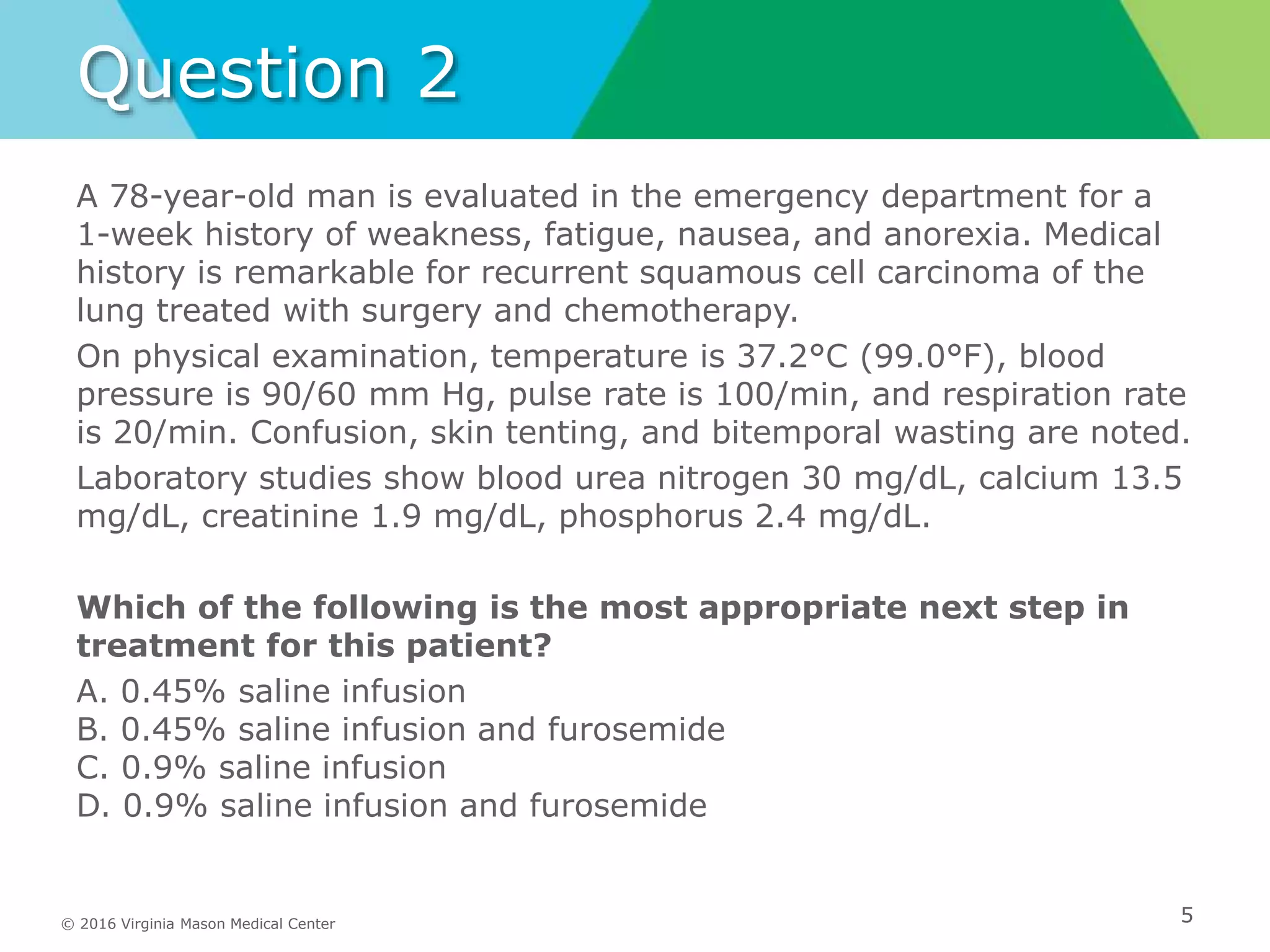
Question 2
A 78-year-old man is evaluated in the emergency department for a
1-week history of weakness, fatigue, nausea, and anorexia. Medical
history is remarkable for recurrent squamous cell carcinoma of the
lung treated with surgery and chemotherapy.
On physical examination, temperature is 37.2°C (99.0°F), blood
pressure is 90/60 mm Hg, pulse rate is 100/min, and respiration rate
is 20/min. Confusion, skin tenting, and bitemporal wasting are noted.
Laboratory studies show blood urea nitrogen 30 mg/dL, calcium 13.5
mg/dL, creatinine 1.9 mg/dL, phosphorus 2.4 mg/dL.
Which of the following is the most appropriate next step in
treatment for this patient?
A. 0.45% saline infusion
B. 0.45% saline infusion and furosemide
C. 0.9% saline infusion
D. 0.9% saline infusion and furosemide
5
© 2016 Virginia Mason Medical Center
Treatment
1. Normal saline – a lot. Works now
a. Add furosemide ifhypervolemic
2. Calcitonin – works in the 1st 48h
3. Bisphosphonates – work in 2-4 days
a. Long-term use causes jaw necrosis
b. Can’t be used w/ severe renal insufficiency
4. Steroids if suspected granulomatous disease
5. Denosumab – for hypercalcemia of malignancy
refractory to bisphosphonates or w/ severe renal
impairment
a. Can cause profound and prolonged hypocalcemia
6. Dialysis
6
© 2016 Virginia Mason Medical Center
Illness Scripts
7
Primary Hyperparathyroidism
Malignancy-associated
Hypercalcemia
Pathophysiology Inappropriately elevated PTH Bone resorption vs PTHrP production
Epidemiology
Any age but usually 50-65
2F : 1M
Older
Most common: PTHrP
(Couldn’t find too much epidemiologic data on
broad topic)
Clinical
presentation
Bones, moans, stones, and psychiatric overtones
Same, but also weight loss, ?breast mass,
?SOB
Diagnostics
BMP (adjust for albumin)
PTH levels
Urinary calcium
VitD levels
Labs: BMP (adjust for albumin), PTH, PTHrP,
VitD levels, alpha-1 hydroxylase, UPEP/SPEP,
LDH
Imaging: CT Chest, Mammography, Bone scan
Therapeutics NS!!! +/- furosemide -> calcitonin -> bisphosphonates -> denosumab; dialysis?
© 2016 Virginia Mason Medical Center
References
https://www.uptodate.com/contents/diagnostic-approach-to-
hypercalcemia?search=hypercalcemia&source=search_result&selectedTitle=1
~150&usage_type=default&display_rank=1
https://www.uptodate.com/contents/etiology-of-
hypercalcemia?search=hypercalcemia&topicRef=836&source=see_link
https://www.uptodate.com/contents/treatment-of-
hypercalcemia?search=hypercalcemia&topicRef=836&source=see_link
https://www.ncbi.nlm.nih.gov/pmc/articles/PMC4683803/
8

Noon conference template

  • 1.
  • 2.
    © 2016 VirginiaMason Medical Center 2 Objectives Hypercalcemia • Differential • Work up • Treatment
  • 3.
    © 2016 VirginiaMason Medical Center Question 1 20-year-old man is hospitalized after sustaining a pelvic fracture in an automobile accident. One month into his hospitalization, the patient notes nausea and anorexia. Before the injury, he was in good health and took no medications. Family history is unremarkable. Current medications are enoxaparin and hydromorphone. Physical examination reveals an alert, oriented, and thin patient. Blood pressure is 128/78 mm Hg, pulse rate is 88/min, and respiration rate is 16/min. Thyroid examination reveals no goiter, and the lungs are clear to auscultation. The patient is immobilized in bed and a pelvic external fixation device is in place. Neurologic examination findings are unremarkable. Laboratory studies show albumin 4.4 g/dL (44 g/L), calcium 12.6 mg/dL (3.15 mmol/L), creatinine 1.6 mg/dL (141.4 µmol/L), phosphorus 4.1 mg/dL (1.3 mmol/L), parathyroid hormone 7.1 pg/mL (7.1 ng/L), thyroid-stimulating hormone 0.3 µU/mL (0.3 mU/L), thyroxine (T4), free 1.1 ng/dL (14.2 pmol/L), 1,25- Dihydroxy vitamin D 35.2 pg/mL (84.5 pmol/L), 25-Hydroxy vitamin D 38 ng/mL (95 nmol/L). Which of the following is the most likely cause of his hypercalcemia? A. Acute kidney injury B. Fracture-related hypercalcemia C. Humoral hypercalcemia of malignancy D. Hypercalcemia of immobilization 3
  • 4.
    © 2016 VirginiaMason Medical Center Differential/Work up • Hyperparathyroidism – primary, secondary, and tertiary • Immobilization • Vitamin D excess – granulomatous disease • Familial Hypocalciuric Hypercalcemia • Malignancy – breast, NSCLC, MM, RCC, Lymphoma • Meds – theophylline, thiazide, lithium 4
  • 5.
    © 2016 VirginiaMason Medical Center Question 2 A 78-year-old man is evaluated in the emergency department for a 1-week history of weakness, fatigue, nausea, and anorexia. Medical history is remarkable for recurrent squamous cell carcinoma of the lung treated with surgery and chemotherapy. On physical examination, temperature is 37.2°C (99.0°F), blood pressure is 90/60 mm Hg, pulse rate is 100/min, and respiration rate is 20/min. Confusion, skin tenting, and bitemporal wasting are noted. Laboratory studies show blood urea nitrogen 30 mg/dL, calcium 13.5 mg/dL, creatinine 1.9 mg/dL, phosphorus 2.4 mg/dL. Which of the following is the most appropriate next step in treatment for this patient? A. 0.45% saline infusion B. 0.45% saline infusion and furosemide C. 0.9% saline infusion D. 0.9% saline infusion and furosemide 5
  • 6.
    © 2016 VirginiaMason Medical Center Treatment 1. Normal saline – a lot. Works now a. Add furosemide ifhypervolemic 2. Calcitonin – works in the 1st 48h 3. Bisphosphonates – work in 2-4 days a. Long-term use causes jaw necrosis b. Can’t be used w/ severe renal insufficiency 4. Steroids if suspected granulomatous disease 5. Denosumab – for hypercalcemia of malignancy refractory to bisphosphonates or w/ severe renal impairment a. Can cause profound and prolonged hypocalcemia 6. Dialysis 6
  • 7.
    © 2016 VirginiaMason Medical Center Illness Scripts 7 Primary Hyperparathyroidism Malignancy-associated Hypercalcemia Pathophysiology Inappropriately elevated PTH Bone resorption vs PTHrP production Epidemiology Any age but usually 50-65 2F : 1M Older Most common: PTHrP (Couldn’t find too much epidemiologic data on broad topic) Clinical presentation Bones, moans, stones, and psychiatric overtones Same, but also weight loss, ?breast mass, ?SOB Diagnostics BMP (adjust for albumin) PTH levels Urinary calcium VitD levels Labs: BMP (adjust for albumin), PTH, PTHrP, VitD levels, alpha-1 hydroxylase, UPEP/SPEP, LDH Imaging: CT Chest, Mammography, Bone scan Therapeutics NS!!! +/- furosemide -> calcitonin -> bisphosphonates -> denosumab; dialysis?
  • 8.
    © 2016 VirginiaMason Medical Center References https://www.uptodate.com/contents/diagnostic-approach-to- hypercalcemia?search=hypercalcemia&source=search_result&selectedTitle=1 ~150&usage_type=default&display_rank=1 https://www.uptodate.com/contents/etiology-of- hypercalcemia?search=hypercalcemia&topicRef=836&source=see_link https://www.uptodate.com/contents/treatment-of- hypercalcemia?search=hypercalcemia&topicRef=836&source=see_link https://www.ncbi.nlm.nih.gov/pmc/articles/PMC4683803/ 8

Editor's Notes

  • #2 Title your presentation “Noon Conference” Prevents inadvertently giving away the case.
  • #8 purpuric rash may suggest so-called “double-positive” patients who have concurrent ANCA-associated vasculitis (granulomatosis with polyangiitis).