Modelling And Control Of Miniflying Machines
Advances In Industrial Control 1st Edition Pedro
Castillo download
https://ebookbell.com/product/modelling-and-control-of-
miniflying-machines-advances-in-industrial-control-1st-edition-
pedro-castillo-2164230
Explore and download more ebooks at ebookbell.com
Here are some recommended products that we believe you will be
interested in. You can click the link to download.
Modelling And Control Of Dialysis Systems Volume 1 Modeling Techniques
Of Hemodialysis Systems 1st Edition Ahmad Taher Azar
https://ebookbell.com/product/modelling-and-control-of-dialysis-
systems-volume-1-modeling-techniques-of-hemodialysis-systems-1st-
edition-ahmad-taher-azar-4522410
Modelling And Control Of Mechatronic And Robotic Systems Alessandro
Gasparetto
https://ebookbell.com/product/modelling-and-control-of-mechatronic-
and-robotic-systems-alessandro-gasparetto-50680842
Modelling And Control Of Dynamic Systems Using Gaussian Process Models
1st Edition Ju Kocijan Auth
https://ebookbell.com/product/modelling-and-control-of-dynamic-
systems-using-gaussian-process-models-1st-edition-ju-kocijan-
auth-5604766
Modelling And Control Of Dynamical Systems Numerical Implementation In
A Behavioral Framework 1st Edition Ricardo Zavala Yoe
https://ebookbell.com/product/modelling-and-control-of-dynamical-
systems-numerical-implementation-in-a-behavioral-framework-1st-
edition-ricardo-zavala-yoe-1205586
Planning And Control Of Maintenance Systems Modelling And Analysis 2nd
Edition Salih O Duffuaa
https://ebookbell.com/product/planning-and-control-of-maintenance-
systems-modelling-and-analysis-2nd-edition-salih-o-duffuaa-5234992
Adaptive Identification And Control Of Uncertain Systems With
Nonsmooth Dynamics New Modelling And Control Methods Applied To A
Collection Of Nonsmooth Systems Na J Chen
https://ebookbell.com/product/adaptive-identification-and-control-of-
uncertain-systems-with-nonsmooth-dynamics-new-modelling-and-control-
methods-applied-to-a-collection-of-nonsmooth-systems-na-j-chen-9970398
Electroactive Polymer Gel Robots Modelling And Control Of Artifical
Muscles 1st Edition Mihoko Otake Auth
https://ebookbell.com/product/electroactive-polymer-gel-robots-
modelling-and-control-of-artifical-muscles-1st-edition-mihoko-otake-
auth-2128302
Advances In Modelling And Control Of Nonintegerorder Systems 6th
Conference On Noninteger Order Calculus And Its Applications 2014
Opole Poland 1st Edition Krzysztof J Latawiec
https://ebookbell.com/product/advances-in-modelling-and-control-of-
nonintegerorder-systems-6th-conference-on-noninteger-order-calculus-
and-its-applications-2014-opole-poland-1st-edition-krzysztof-j-
latawiec-4932352
Process Modelling And Simulation With Finite Element Methods Series On
Stability Vibration And Control Of Systems Series A First Edition
William B J Zimmerman
https://ebookbell.com/product/process-modelling-and-simulation-with-
finite-element-methods-series-on-stability-vibration-and-control-of-
systems-series-a-first-edition-william-b-j-zimmerman-2538366
Advances in Industrial Control
Other titles published in this Series:
Data-driven Techniques for Fault Detection and Diagnosis in Chemical Processes
Evan L. Russell, Leo H. Chiang and Richard D. Braatz
Nonlinear Identification and Control
Guoping Liu
Digital Controller Implementation and Fragility
Robert S.H. Istepanian and James F. Whidborne (Eds.)
Optimisation of Industrial Processes at Supervisory Level
Doris Sáez, Aldo Cipriano and Andrzej W. Ordys
Applied Predictive Control
Huang Sunan, Tan Kok Kiong and Lee Tong Heng
Hard Disk Drive Servo Systems
Ben M. Chen, Tong H. Lee and Venkatakrishnan Venkataramanan
Robust Control of Diesel Ship Propulsion
Nikolaos Xiros
Hydraulic Servo-systems
Mohieddine Jelali and Andreas Kroll
Model-based Fault Diagnosis in Dynamic Systems Using Identification Techniques
Silvio Simani, Cesare Fantuzzi and Ron J. Patton
Strategies for Feedback Linearisation
Freddy Garces,Victor M. Becerra, Chandrasekhar Kambhampati and Kevin Warwick
Robust Autonomous Guidance
Alberto Isidori, Lorenzo Marconi and Andrea Serrani
Dynamic Modelling of Gas Turbines
Gennady G. Kulikov and Haydn A. Thompson (Eds.)
Control of Fuel Cell Power Systems
Jay T. Pukrushpan, Anna G. Stefanopoulou and Huei Peng
Publication due September 2004
Fuzzy Logic, Identification and Predictive Control
Jairo Espinosa, Joos Vandewalle and Vincent Wertz
Optimal Real-time Control of Sewer Networks
Magdalene Marinaki and Markos Papageorgiou
Process Modelling for Control
Benoît Codrons
Computational Intelligence in Time Series Forecasting
Ajoy K. Palit and Dobrivoje Popovic
Rudder and Fin Ship Roll Stabilization
Tristan Perez
Publication due July 2005
Manufacturing Systems Control Design
Stjepan Bogdan, Frank L. Lewis and Zdenko Kovac̆ić
Publication due September 2005
Pedro Castillo, Rogelio Lozano and Alejandro E. Dzul
Modelling and Control
of Mini-Flying
Machines
With 126 Figures
123
Pedro Castillo, PhD
Rogelio Lozano, PhD
Alejandro E. Dzul, PhD
Heuristique et Diagnostic des Système Complexes, UMR-CNRS 6599,
Université de Technologie de Compiègne, Centre de Recherche de Royalieu,
BP 20529, 60200 Compiègne, France
Whilst we have made considerable efforts to contact all holders of copyright material contained in this
book, we may have failed to locate some of them. Should holders wish to contact the Publisher, we will
be happy to come to some arrangement with them.
British Library Cataloguing in Publication Data
Castillo, Pedro
Modelling and control of mini-flying machines. – (Advances in industrial control)
1. Drone aircraft – Control systems 2. Drone aircraft – Control systems – Mathematical models
3. Airplanes – Automatic control 4. Airplanes – Automatic control – Mathematical models
I. Title II. Lozano, R. (Rogelio), 1954– III. Dzul, Alejandro E.
629.1′326
ISBN 1852339578
Library of Congress Control Number:
2005924800
Apart from any fair dealing for the purposes of research or private study, or criticism or review, as
permitted under the Copyright,Designs and Patents Act 1988,this publication may only be reproduced,
stored or transmitted,in any form or by any means,with the prior permission in writing of the publishers,
or in the case of reprographic reproduction in accordance with the terms of licences issued by the
Copyright Licensing Agency. Enquiries concerning reproduction outside those terms should be sent to
the publishers.
Advances in Industrial Control series ISSN 1430-9491
ISBN 1-85233-957-8
Springer Science+Business Media
springeronline.com
© Springer-Verlag London Limited 2005
The use of registered names, trademarks, etc. in this publication does not imply, even in the absence of
a specific statement, that such names are exempt from the relevant laws and regulations and therefore
free for general use.
The publisher makes no representation,express or implied,with regard to the accuracy of the information
contained in this book and cannot accept any legal responsibility or liability for any errors or omissions
that may be made.
Typesetting: Electronic text files prepared by authors
Printed in the United States of America
69/3830-543210 Printed on acid-free paper SPIN 10978573
Advances in Industrial Control
Series Editors
Professor Michael J. Grimble, Professor Emeritus of Industrial Systems and Director
Professor Michael A. Johnson, Professor of Control Systems and Deputy Director
Industrial Control Centre
Department of Electronic and Electrical Engineering
University of Strathclyde
Graham Hills Building
50 George Street
Glasgow G1 1QE
United Kingdom
Series Advisory Board
Professor E.F. Camacho
Escuela Superior de Ingenieros
Universidad de Sevilla
Camino de los Descobrimientos s/n
41092 Sevilla
Spain
Professor S. Engell
Lehrstuhl für Anlagensteuerungstechnik
Fachbereich Chemietechnik
Universität Dortmund
44221 Dortmund
Germany
Professor G. Goodwin
Department of Electrical and Computer Engineering
The University of Newcastle
Callaghan
NSW 2308
Australia
Professor T.J. Harris
Department of Chemical Engineering
Queen’s University
Kingston, Ontario
K7L 3N6
Canada
Professor T.H. Lee
Department of Electrical Engineering
National University of Singapore
4 Engineering Drive 3
Singapore 117576
Professor Emeritus O.P. Malik
Department of Electrical and Computer Engineering
University of Calgary
2500, University Drive, NW
Calgary
Alberta
T2N 1N4
Canada
Professor K.-F. Man
Electronic Engineering Department
City University of Hong Kong
Tat Chee Avenue
Kowloon
Hong Kong
Professor G. Olsson
Department of Industrial Electrical Engineering and Automation
Lund Institute of Technology
Box 118
S-221 00 Lund
Sweden
Professor A. Ray
Pennsylvania State University
Department of Mechanical Engineering
0329 Reber Building
University Park
PA 16802
USA
Professor D.E. Seborg
Chemical Engineering
3335 Engineering II
University of California Santa Barbara
Santa Barbara
CA 93106
USA
Doctor I.Yamamoto
Technical Headquarters
Nagasaki Research & Development Center
Mitsubishi Heavy Industries Ltd
5-717-1, Fukahori-Machi
Nagasaki 851-0392
Japan
Foreword
The series Advances in Industrial Control aims to report and encourage tech-
nology transfer in control engineering. The rapid development of control tech-
nology impacts all areas of the control discipline. New theory, new controllers,
actuators, sensors, new industrial processes, computer methods, new applica-
tions, new philosophies,. . . , new challenges. Much of this development work
resides in industrial reports, feasibility study papers and the reports of ad-
vanced collaborative projects. The series offers an opportunity for researchers
to present an extended exposition of such new work in all aspects of industrial
control for wider and rapid dissemination.
Nonlinear control theory and applications are the main focus of much
recent research within the control community at present. A common sentiment
is that to make further performance gains it is necessary to formulate and work
with the full nonlinear modelled behaviour of practical systems. Aeronautic
applications are one field where nonlinear models are often available and where
there is a key necessity to use high performance control systems. However,
whilst many control researchers have access to fairly sophisticated nonlinear
aeronautical system models, few will have access to working and experimental
systems in the field. One solution to this might be to explore the control
of mini-flying machines. This Advances in Industrial Control monograph by
P. Castillo, R. Lozano and A. Dzul provides just the right sort of inspiration to
start such an initiative. It is a fascinating mix of mini-flying machine history,
modelling and experimental results from constructed mini flying machines.
The volume opens with a historical review featuring the inventions of
Leonardo da Vinci, the success of Heinrich Focke and Gert Achgelis (1936) and
the first certified commercial helicopter of Igor Sikorsky (ca1950) supported
by some fascinating pictures of these technological developments. Through-
out the volume, a number of aeronautical control problems are investigated
theoretically and then pursued using various type of mini flying machine ex-
perimental platforms. One of these platforms is a quad-rotor rotorcraft used
in Chapters 2 and 3 for which experiment videos are available on the web at
http://www.hds.utc.fr/˜castillo/4r_fr.html.
viii Foreword
This rotorcraft is also used in experiments for Chapter 4. Chapter 6 sees
the use of a different experimental set-up, a vertical flying stand, which is
used to investigate the altitude control of mini- helicopters.
Chapter 7 reviews and investigates the control of the tail-sitter unmanned
aerial vehicle; again there is an interesting description of an experimental
platform devised by Dr R. H. Stone of the University of Sydney, Australia.
The chapter includes the derivation of a six-degrees of freedom model and
experimental results.
To compete the set of flying technologies and configurations, autonomous
airships are introduced in Chapter 8. This chapter is contributed by Dr
Y. Bestaoui at the University of Evry, France and presents modelling and
control system results motivated by the experimental platform, the AS200
airship devised by the Laboratoire des Systemes Complexes.
The volume concludes with a very detailed chapter on sensors, modems
and micro controllers for unmanned aerial vehicles. These devices are very
important for the accurate control of mini-flying machines and the detailed
descriptions provide a useful introduction for the novice reader and excellent
reference material for the expert.
The industrial, commercial and scientific uses of mini-flying machines are
still under development and the aeronautical control engineer interested in
this field will find this monograph a valuable source of new modelling and
control material. In the academic world, educators are always seeking new
and exciting ways of demonstrating control system techniques and technolo-
gies; some of the experimental platforms described in this volume seem tailor
made for such a role. A most satisfying aspect of this new Advances in Indus-
trial Control monograph is the way aeronautical technology, models, control
systems theory and control engineering come together in the experimental re-
sults presented and as such, the volume should also appeal to the wide range
of control engineering readership.
M.J. Grimble and M.A. Johnson
Industrial Control Centre
Glasgow, Scotland, U.K.
Winter, 2004
Preface
The opportunities to apply control principles and methods to mini-aircraft
are flourishing in the beginning of the 21st century. Nonlinear modelling and
modern nonlinear control theory play an important role in achieving high
performance autonomous flight for new mini- and micro-flying machines. The
rapid development is also due to the advances in computation, communication
and sensing which are becoming increasingly inexpensive and omnipresent.
This will make possible the development of new small UAVs (Unmanned Au-
tonomous Vehicles) with sophisticated aerodynamical configurations. The use
of automatic control theory will permit mini-aircraft to be more efficient and
cost effective with a degree of intelligence and reactivity that will dramatically
expand their field of applications.
This book presents a systematic study of modelling and nonlinear con-
trol of aerial vehicles taking into account mini-aircraft physical nonlinearities
and aerodynamical forces, sensors and actuators limitations, and the effects
of delays due to the computation time. The objective is to obtain control
laws which perform satisfactorily even in presence of disturbances commonly
encountered in real applications. This book presents also the development of
platforms of aerial vehicles and an overview of the main sensors currently used
in mini-UAVs.
This book particularly focus on aerial vehicles capable of hovering as he-
licopters as well as performing forward flight as normal planes. We study the
following flying machines:
• A planar vertical take-off and landing vehicle (PVTOL aircraft).
• A four-rotor rotorcraft.1
• A reduced model of a classical helicopter.
• A mini-airplane (T-Wing).
• A mini-blimp.
1
Also named quad-rotor rotorcraft.
x Preface
Chapter 1 presents a brief history of aeronautics and particularly focuses
on the evolution of multi-rotor rotorcraft. The success of aerial vehicles today
would certainly not be possible without the relentless attempts realized in the
last century by many courageous pioneers of the aerospace domain.
The model of the planar vertical take-off and landing aircraft represents a
simplification of the model of a real vertical take-off aircraft. It also represents
the longitudinal model of a helicopter. The control community has shown great
interest in the PVTOL problem because it is an interesting and challenging
theoretical problem of nonlinear systems which is clearly motivated by an
application. Designing appropriate nonlinear controllers based on the PVTOL
model can be used to improve the performance and the stability margins of
the closed-loop system for vertical take-off and landing aircraft.
Chapter 2 presents a nonlinear control strategy for stabilizing the PVTOL
using the approach of nested saturations. We have developed an experimental
platform for testing the control algorithms we have proposed.
The four-rotor rotorcraft can be viewed as a generalization of the PVTOL
in three-dimensional space. It can also be viewed as an alternative to standard
helicopters having no swashplate. Four-rotor rotorcraft have fewer mechanical
parts than standard mini-helicopters. This results in reduced time spent in
maintenance. Given that the blades turn in opposite directions, the gyroscopic
phenomena due to the blades is less important in quad-rotor rotorcraft than it
is for standard helicopters. As a consequence quad-rotor rotorcraft have larger
manoeuvrability but this also means that they tend to be more unstable. In
Chapter 3 we present a nonlinear control strategy for stabilizing the helicopter
having four rotors. The proposed control law has been tested in real-time
experiments.
We have also carried out experiments to test the robustness of the con-
troller with respect to delays which appear in the computation of the control
law as well as in the computation of the position and orientation of the air-
craft. We have studied in particular the controller used for the yaw angular
displacement. We have designed a controller based on the prediction of the
state and tested it in real-time flight. It has been shown that the system re-
sponse remained basically unaffected in spite of significant delay. Chapter 4
presents these results.
In Chapter 5 we present the nonlinear model for the classical helicopter
obtained using the Euler–Lagrange technique and also using the Newton laws.
We have used the model we have obtained for designing a nonlinear control
law based on the backstepping technique.
The control of a helicopter in 3D is an experiment which involves certain
risks for the persons performing the study as well as for the equipment. In
Preface xi
order to minimize the risks of accident we have built a vertical flying stand
that allows the helicopter to move freely vertically and also to turn around
the vertical axis. Although the behaviour of the helicopter in such a platform
is different to its behaviour in free flight, this platform allows to gain a lot of
insight on the problem and to perform experiments with limited risks.
The model of the helicopter during free flight reduces to a simpler model
when it operates in the vertical flying stand. The model of the helicopter
in the platform can also be obtained directly by using the Euler–Lagrange
approach. Chapter 6 presents the model of the helicopter mounted on the
vertical flying stand and a control law to stabilize the helicopter altitude and
the yaw angular displacement.
For many years researchers have devoted much effort to developing planes
that can take-off and land vertically. Such aircraft would require very inex-
pensive airport facilities. Chapter 7 presents the “T-wing” aircraft which is a
new tailsitter plane developed by H. Stone at the University of Sydney. The
nonlinear model structure, the identification of the aircraft parameters and
the control algorithm for the T-wing are presented. We are indebted to Dr.
H. Stone for writing this chapter.
Lighter than air vehicles, or blimps, are suitable for a wide range of applica-
tions such as advertising, aerial photography and aerial inspection platforms.
They play an important role in environmental and climatologic research which
require the development of autonomous airships. Chapter 8 presents a model
of a blimp and the application of modern control theory of underactuated non-
linear systems to stabilize the airship. We thank Dr. Y. Bestaoui for writing
this chapter.
Sensors are an essential part of the closed-loop control system. Sensors
used in UAVs are rapidly changing. New sensors are more precise, lighter and
less expensive than ever before. Chapter 9 presents an overview of the sensors
that are currently used in mini-aircraft.
We wish to thank the University of Technology of Compiègne, Labora-
tory Heudiasyc, CNRS, Ministry of Education, Picardie Region in France,
CONACYT in México and the bilateral laboratory LAFMAA. The research
in UAVs and the experimental platforms that led to this book would not have
been possible without their valuable support.
Compiègne, France P. Castillo
July 2004 R. Lozano
A. Dzul
Contents
1 Introduction and Historical Background . . . . . . . . . . . . . . . . . . . 1
1.1 Definitions. . . . . . . . . . . . . . . . . . . . . . . . . . . . . . . . . . . . . . . . . . . . . . 2
1.2 Early Concepts of VTOL Aircraft . . . . . . . . . . . . . . . . . . . . . . . . . 3
1.3 Configuration of the Rotorcraft. . . . . . . . . . . . . . . . . . . . . . . . . . . . 12
1.3.1 Conventional Main Rotor/Tail Rotor Configuration . . . . 12
1.3.2 Single Rotor Configuration . . . . . . . . . . . . . . . . . . . . . . . . . 12
1.3.3 Twin Rotor in Coaxial Configuration . . . . . . . . . . . . . . . . 13
1.3.4 Twin Rotor Side by Side . . . . . . . . . . . . . . . . . . . . . . . . . . . 13
1.3.5 Multi-rotors . . . . . . . . . . . . . . . . . . . . . . . . . . . . . . . . . . . . . . 15
1.4 New Configurations of UAVs . . . . . . . . . . . . . . . . . . . . . . . . . . . . . . 15
2 The PVTOL Aircraft . . . . . . . . . . . . . . . . . . . . . . . . . . . . . . . . . . . . . . 23
2.1 Introduction . . . . . . . . . . . . . . . . . . . . . . . . . . . . . . . . . . . . . . . . . . . . 23
2.2 System Description . . . . . . . . . . . . . . . . . . . . . . . . . . . . . . . . . . . . . . 24
2.3 Control Strategy . . . . . . . . . . . . . . . . . . . . . . . . . . . . . . . . . . . . . . . . 25
2.3.1 Control of the Vertical Displacement . . . . . . . . . . . . . . . . . 26
2.3.2 Control of the Roll Angle and the Horizontal
Displacement . . . . . . . . . . . . . . . . . . . . . . . . . . . . . . . . . . . . . 26
2.4 Real-time Experimental Results . . . . . . . . . . . . . . . . . . . . . . . . . . . 31
2.4.1 Experiment using a Quad-Rotor Rotorcraft . . . . . . . . . . . 31
2.4.2 Experimental Platform Using Vision . . . . . . . . . . . . . . . . . 34
2.5 Conclusion . . . . . . . . . . . . . . . . . . . . . . . . . . . . . . . . . . . . . . . . . . . . . 37
3 The Quad-rotor Rotorcraft . . . . . . . . . . . . . . . . . . . . . . . . . . . . . . . . 39
3.1 Introduction . . . . . . . . . . . . . . . . . . . . . . . . . . . . . . . . . . . . . . . . . . . . 39
3.2 Dynamic Model . . . . . . . . . . . . . . . . . . . . . . . . . . . . . . . . . . . . . . . . . 41
3.2.1 Characteristics of the Quad-rotor Rotorcraft . . . . . . . . . . 41
3.2.2 System Description . . . . . . . . . . . . . . . . . . . . . . . . . . . . . . . . 43
3.3 Control Strategy . . . . . . . . . . . . . . . . . . . . . . . . . . . . . . . . . . . . . . . . 47
3.3.1 Altitude and Yaw Control . . . . . . . . . . . . . . . . . . . . . . . . . . 48
3.3.2 Roll Control (φ, y) . . . . . . . . . . . . . . . . . . . . . . . . . . . . . . . . 49
xiv Contents
3.3.3 Pitch Control (θ, x) . . . . . . . . . . . . . . . . . . . . . . . . . . . . . . . 52
3.4 Experimental Results . . . . . . . . . . . . . . . . . . . . . . . . . . . . . . . . . . . . 53
3.4.1 Platform Description . . . . . . . . . . . . . . . . . . . . . . . . . . . . . . 53
3.4.2 Controller Parameter Tuning . . . . . . . . . . . . . . . . . . . . . . . 55
3.4.3 Experiment . . . . . . . . . . . . . . . . . . . . . . . . . . . . . . . . . . . . . . . 56
3.5 Conclusion . . . . . . . . . . . . . . . . . . . . . . . . . . . . . . . . . . . . . . . . . . . . . 59
4 Robust Prediction-based Control for Unstable Delay
Systems . . . . . . . . . . . . . . . . . . . . . . . . . . . . . . . . . . . . . . . . . . . . . . . . . . . 61
4.1 Introduction . . . . . . . . . . . . . . . . . . . . . . . . . . . . . . . . . . . . . . . . . . . . 61
4.2 Problem Formulation . . . . . . . . . . . . . . . . . . . . . . . . . . . . . . . . . . . . 63
4.3 d-Step Ahead Prediction Scheme . . . . . . . . . . . . . . . . . . . . . . . . . . 68
4.4 Prediction-based State Feedback Control . . . . . . . . . . . . . . . . . . . 69
4.5 Stability of the Closed-loop System . . . . . . . . . . . . . . . . . . . . . . . . 71
4.6 Application to the Yaw Control of a Mini-helicopter . . . . . . . . . 72
4.6.1 Characteristics of MaRTE OS . . . . . . . . . . . . . . . . . . . . . . . 73
4.6.2 Real-time Implementation . . . . . . . . . . . . . . . . . . . . . . . . . . 74
4.6.3 Experimental Results . . . . . . . . . . . . . . . . . . . . . . . . . . . . . . 76
4.7 Conclusion . . . . . . . . . . . . . . . . . . . . . . . . . . . . . . . . . . . . . . . . . . . . . 79
5 Modelling and Control of Mini-helicopters . . . . . . . . . . . . . . . . . 81
5.1 Introduction . . . . . . . . . . . . . . . . . . . . . . . . . . . . . . . . . . . . . . . . . . . . 81
5.2 Newton–Euler Model . . . . . . . . . . . . . . . . . . . . . . . . . . . . . . . . . . . . 82
5.2.1 Standard Helicopter . . . . . . . . . . . . . . . . . . . . . . . . . . . . . . . 82
5.2.2 Tandem Helicopter . . . . . . . . . . . . . . . . . . . . . . . . . . . . . . . . 87
5.2.3 Coaxial Helicopter . . . . . . . . . . . . . . . . . . . . . . . . . . . . . . . . . 91
5.2.4 Adapted Dynamic Model for Control Design . . . . . . . . . . 94
5.3 Euler–Lagrange Model . . . . . . . . . . . . . . . . . . . . . . . . . . . . . . . . . . . 97
5.4 Nonlinear Control Strategy . . . . . . . . . . . . . . . . . . . . . . . . . . . . . . . 102
5.5 Simulations . . . . . . . . . . . . . . . . . . . . . . . . . . . . . . . . . . . . . . . . . . . . . 113
6 Helicopter in a Vertical Flying Stand . . . . . . . . . . . . . . . . . . . . . . 121
6.1 Introduction . . . . . . . . . . . . . . . . . . . . . . . . . . . . . . . . . . . . . . . . . . . . 121
6.2 Dynamic Model . . . . . . . . . . . . . . . . . . . . . . . . . . . . . . . . . . . . . . . . . 123
6.3 Adaptive Altitude Robust Control Design . . . . . . . . . . . . . . . . . . 126
6.4 Experimental Results . . . . . . . . . . . . . . . . . . . . . . . . . . . . . . . . . . . . 130
6.4.1 Hardware . . . . . . . . . . . . . . . . . . . . . . . . . . . . . . . . . . . . . . . . 130
6.4.2 Experiment . . . . . . . . . . . . . . . . . . . . . . . . . . . . . . . . . . . . . . . 131
6.5 Conclusion . . . . . . . . . . . . . . . . . . . . . . . . . . . . . . . . . . . . . . . . . . . . . 132
7 Modelling and Control of a Tandem-Wing Tail-Sitter UAV 133
7.1 Introduction . . . . . . . . . . . . . . . . . . . . . . . . . . . . . . . . . . . . . . . . . . . . 133
7.2 Tail-Sitters: A Historical Perspective . . . . . . . . . . . . . . . . . . . . . . . 134
7.3 Applications for a Tail-Sitter UAV . . . . . . . . . . . . . . . . . . . . . . . . . 135
7.3.1 Defence Applications . . . . . . . . . . . . . . . . . . . . . . . . . . . . . . 136
Contents xv
7.3.2 Civilian Applications . . . . . . . . . . . . . . . . . . . . . . . . . . . . . . 136
7.4 The T-Wing: A Tandem-Wing Tail-Sitter UAV . . . . . . . . . . . . . . 137
7.5 Description of the T-Wing Vehicle . . . . . . . . . . . . . . . . . . . . . . . . . 139
7.5.1 Typical Flight Path for the T-Wing Vehicle . . . . . . . . . . . 139
7.6 6-DOF Nonlinear Model . . . . . . . . . . . . . . . . . . . . . . . . . . . . . . . . . . 141
7.6.1 Derivation of Rigid Body Equations of Motion . . . . . . . . 142
7.6.2 Orientation of the Aircraft. . . . . . . . . . . . . . . . . . . . . . . . . . 146
7.6.3 Equations of Motion . . . . . . . . . . . . . . . . . . . . . . . . . . . . . . . 150
7.7 Real-time Flight Simulation. . . . . . . . . . . . . . . . . . . . . . . . . . . . . . . 155
7.8 Hover Control Model . . . . . . . . . . . . . . . . . . . . . . . . . . . . . . . . . . . . 156
7.8.1 Vertical Flight Controllers . . . . . . . . . . . . . . . . . . . . . . . . . . 157
7.9 Flight of T-Wing Vehicle . . . . . . . . . . . . . . . . . . . . . . . . . . . . . . . . . 162
7.10 Conclusion . . . . . . . . . . . . . . . . . . . . . . . . . . . . . . . . . . . . . . . . . . . . . 164
8 Modelling and Control of Small Autonomous Airships . . . . . 165
8.1 Introduction . . . . . . . . . . . . . . . . . . . . . . . . . . . . . . . . . . . . . . . . . . . . 165
8.2 Euler–Lagrange Modelling . . . . . . . . . . . . . . . . . . . . . . . . . . . . . . . . 167
8.2.1 Kinematics . . . . . . . . . . . . . . . . . . . . . . . . . . . . . . . . . . . . . . . 167
8.2.2 Dynamics . . . . . . . . . . . . . . . . . . . . . . . . . . . . . . . . . . . . . . . . 170
8.2.3 Propulsion. . . . . . . . . . . . . . . . . . . . . . . . . . . . . . . . . . . . . . . . 172
8.3 Stabilization Problem . . . . . . . . . . . . . . . . . . . . . . . . . . . . . . . . . . . . 174
8.4 Simulation Results. . . . . . . . . . . . . . . . . . . . . . . . . . . . . . . . . . . . . . . 179
8.5 Conclusions . . . . . . . . . . . . . . . . . . . . . . . . . . . . . . . . . . . . . . . . . . . . . 182
8.6 Nomenclature . . . . . . . . . . . . . . . . . . . . . . . . . . . . . . . . . . . . . . . . . . . 183
9 Sensors, Modems and Microcontrollers for UAVs . . . . . . . . . . 185
9.1 Polhemus Electromagnetic Sensor . . . . . . . . . . . . . . . . . . . . . . . . . 186
9.1.1 Components . . . . . . . . . . . . . . . . . . . . . . . . . . . . . . . . . . . . . . 186
9.2 Inertial Navigation System . . . . . . . . . . . . . . . . . . . . . . . . . . . . . . . 187
9.3 Accelerometers . . . . . . . . . . . . . . . . . . . . . . . . . . . . . . . . . . . . . . . . . . 188
9.3.1 Accelerometer Principles . . . . . . . . . . . . . . . . . . . . . . . . . . . 189
9.3.2 Applicability of Accelerometers . . . . . . . . . . . . . . . . . . . . . 198
9.4 Inclinometers . . . . . . . . . . . . . . . . . . . . . . . . . . . . . . . . . . . . . . . . . . . 199
9.5 Altimeters . . . . . . . . . . . . . . . . . . . . . . . . . . . . . . . . . . . . . . . . . . . . . . 199
9.6 Gyroscopes . . . . . . . . . . . . . . . . . . . . . . . . . . . . . . . . . . . . . . . . . . . . . 201
9.6.1 Types of Gyroscopes . . . . . . . . . . . . . . . . . . . . . . . . . . . . . . . 203
9.6.2 Uses of Gyroscopes . . . . . . . . . . . . . . . . . . . . . . . . . . . . . . . . 209
9.7 Inertial Measurement Unit (IMU) . . . . . . . . . . . . . . . . . . . . . . . . . 212
9.8 Magnetic Compasses . . . . . . . . . . . . . . . . . . . . . . . . . . . . . . . . . . . . . 213
9.9 Global Positioning System (GPS). . . . . . . . . . . . . . . . . . . . . . . . . . 214
9.9.1 Elements . . . . . . . . . . . . . . . . . . . . . . . . . . . . . . . . . . . . . . . . . 216
9.10 Vision Sensors . . . . . . . . . . . . . . . . . . . . . . . . . . . . . . . . . . . . . . . . . . 219
9.11 Ideal Sensor . . . . . . . . . . . . . . . . . . . . . . . . . . . . . . . . . . . . . . . . . . . . 221
9.12 Modems . . . . . . . . . . . . . . . . . . . . . . . . . . . . . . . . . . . . . . . . . . . . . . . . 221
9.12.1 Radio Modems . . . . . . . . . . . . . . . . . . . . . . . . . . . . . . . . . . . . 223
xvi Contents
9.13 Microcontrollers . . . . . . . . . . . . . . . . . . . . . . . . . . . . . . . . . . . . . . . . . 224
9.13.1 Fabrication Techniques . . . . . . . . . . . . . . . . . . . . . . . . . . . . . 225
9.13.2 Applications . . . . . . . . . . . . . . . . . . . . . . . . . . . . . . . . . . . . . . 226
9.13.3 Microcontroller Programming Languages . . . . . . . . . . . . . 228
9.14 Real-time Operating System . . . . . . . . . . . . . . . . . . . . . . . . . . . . . . 229
9.14.1 Some Definitions . . . . . . . . . . . . . . . . . . . . . . . . . . . . . . . . . . 230
A Model Coefficients . . . . . . . . . . . . . . . . . . . . . . . . . . . . . . . . . . . . . . . . . 233
References . . . . . . . . . . . . . . . . . . . . . . . . . . . . . . . . . . . . . . . . . . . . . . . . . . . . . 235
Index . . . . . . . . . . . . . . . . . . . . . . . . . . . . . . . . . . . . . . . . . . . . . . . . . . . . . . . . . . 249
1
Introduction and Historical Background
Automatic flying of intelligent vehicles moving in space represents a huge
field of applications. We are particularly interested in this book in small vehi-
cles, such as helicopters in all configurations (configuration with a main rotor
with or without tail rotor, configuration in tandem, configuration with coaxial
opposite rotary rotors, configuration with four, two or one rotors) for their
adaptability and manoeuvrability. Helicopters are relatively complex and dif-
ficult to control but they allow to carry out various tasks. Automating these
machines allows among other things to guarantee a minimum of security when
the pilot is no longer able to control the vehicle. Automatic flying can also
be used when the task to be achieved is too repetitive or too difficult for the
pilot [122].
Automatic control of small flying machines opens up applications in the
fields of security (supervision of aerial space, urban traffic), management
of natural risks (supervision of active volcanoes), of environment (measur-
ing air pollution, supervision of forests), for intervention in hostile environ-
ments (radioactive atmospheres, removal of mines without human interven-
tion), management of ground installations (dams, lines with high tension,
pipelines), agriculture (detection and treatment of infested cultivations), and
aerial shooting in the production of movies, to cite a few examples [114, 157].
In this chapter we briefly present the evolution of flying machines that are
able to take-off vertically. A historical review is given for various multi-rotor
rotorcraft as well as some definitions.
2 1 Introduction and Historical Background
1.1 Definitions
Aircraft
An aircraft is any machine capable of flight. Aircraft can be divided into two
categories [185]:
• Heavier: Autogyros, helicopters and variants, and conventional fixed-wing
aircraft.
• Lighter: Balloons and airships. The distinction between a balloon and an
airship is that an airship has some means of controlling forward motion
and steering while balloons simply drift with the wind.
The abbreviation VTOL is applied to aircraft other than helicopters that
can take-off or land vertically. Similarly, STOL stands for Short Take Off and
Landing.
Fig. 1.1. Components of a helicopter.
Helicopter
A helicopter is an aircraft that can take-off and land vertically. Also called
a rotary aircraft, this aircraft can hover and rotate in the air and can move
sideways and backwards while aloft. This aerial vehicle can change direction
very quickly and can stop moving completely and begin hovering [116].
The helicopter began as a basic principle of rotary-wing aviation. The
precision of parts due to the Industrial Revolution enabled the helicopter to
evolve into the modern machines we see flying today. The need for accurate
machinery and fixtures was evident when the earliest helicopter models lacked
the efficiency and flying capability of modern helicopters. The main compo-
nents of a helicopter are given in Figure 1.1.
1.2 Early Concepts of VTOL Aircraft 3
UAV
An Unmanned Aerial Vehicle (UAV), also called a drone, is a self-descriptive
term used to describe military and civil applications of the latest generations
of pilotless aircraft [185]. UAVs are defined as aircraft without the onboard
presence of pilots [179], used to perform intelligence, surveillance, and re-
connaissance missions. The technological promise of UAVs is to serve across
the full range of missions. UAVs have several basic advantages over manned
systems including increased manoeuvrability, reduced cost, reduced radar sig-
natures, longer endurance, and less risk to crews.
1.2 Early Concepts of VTOL Aircraft
“The idea of a vehicle that could lift itself vertically from the ground and
hover motionless in the air was probably born at the same time that man first
dreamed of flying.”1
During the past sixty years since their first successful flights, helicopters
have matured from unstable, vibrating contraptions that could barely lift the
pilot off the ground, into sophisticated machines of quite extraordinary flying
capability.
The idea of vertical flight aircraft can be traced back to early Chinese
tops, a toy first used about 400 BC. The earliest versions of the Chinese top
consisted of feathers at the end of a stick, which was rapidly spun between
the hands to generate lift and then released into free flight (see Figure 1.2).
These toys were probably inspired by observations of the seeds of trees such
as the sycamore, whose whirling, autorotating seeds can be seen to carry on
the breeze [47, 61, 64].
Fig. 1.2. The first concept of rotary-wing aviation.
1
Igor Ivanovitch Sikorsky
4 1 Introduction and Historical Background
“Trovo, se questo strumento a vite sar ben fatto, cio fatto di tela lina,
stopata i suoi pori con amido, e svoltata con prestezza, che detta vite si fa la
femmina nellaria e monter in alto.”2
“I believe that if this screw device is
well manufactured, that is, if it is made of linen cloth, the pores of which have
been closed with starch, and if the device is promptly reversed, the screw will
engage its gear when in the air and it will rise up on high” [120].
In 1483 Leonardo Da Vinci designed a sophisticated aircraft capable of
hovering. Some experts have identified this aircraft as the ancestor of the
helicopter. The aircraft called aerial screw or air gyroscope had a diameter of
5 m (see Figure 1.3), and was operated presumably by four men who might
have stood on the central platform and exerted pressure on the bars in front
of them with their hands, so as to make the shaft turn.
The main idea was that if an adequate driving force were applied, the
machine might have spun in the air and risen off the ground.
Fig. 1.3. The air screw. Credits – Hiller Aviation Museum [66].
In 1754, Mikhail Lomonosov developed a small coaxial rotor similar to the
Chinese top but powered by a wound-up spring device. The aircraft flew freely
and climbed to a good altitude [61, 64].
In 1783, Launoy and Bienvenu used a coaxial version of the Chinese top
in a model consisting of a counter-rotating set of turkey feathers [61, 64].
2
Leonardo Da Vinci
1.2 Early Concepts of VTOL Aircraft 5
A large number of minor inventions contributed to the advancement of
the helicopter. Between the fifteenth and twentieth centuries, it was not yet
possible to produce the machinery needed to build helicopters, like turbine
engines and rotors, but as the Industrial Revolution created factories and
technology accelerated, the helicopter evolved.
One of the first breakthroughs in helicopter advancement was by George
Cayley who produced a converti-plane in 1843 [146]. Cayley designed an air-
craft capable of hovering that he called the “aerial carriage” (see Figure 1.4).
However, Cayley’s device remained an idea because the only powerplants avail-
able at the time were steam engines, and these were much too heavy to allow
for successful powered flight [61, 64].
Fig. 1.4. Aerial carriage. Credits – Hiller Aviation Museum [66].
The lack of a suitable powerplant continued to stifle aeronautical progress,
both for fixed and rotating wing applications, but the use of miniature
lightweight steam engines met with some limited success.
In the 1840s, Horatio Phillips constructed a steam-driven vertical flight
machine where steam generated by a miniature boiler was ejected out of the
blade tips [61, 64].
In the 1860s, Ponton d’Amecourt flew a number of small steam-powered
helicopter models (Figure 1.5). He called his machines helicopteres, which is a
word derived from the Greek adjective elikoeioas meaning spiral or winding,
and the noun pteron meaning feather or wing [61, 64].
6 1 Introduction and Historical Background
Fig. 1.5. Gustave Ponton d’Amecourt’s helicopters. Credits – Hiller Aviation Mu-
seum [66].
At the beginning of the twentieth century nearly all prior attempts at
vertical flight could be considered as inventive, the inherent aerodynamic and
mechanical complexities of building a vertical flight aircraft were to challenge
many ambitious efforts. A contributing factor was the relatively few scientific
investigations of flight or studies into the science of aerodynamics. The history
of flight documents literally hundreds of failed helicopter inventions, which
either had inadequate installed power or limited control capability, or more
often than not, the machine just vibrated itself to pieces [61].
In the 1880s, Thomas Alva Edison experimented with small helicopter
models in the United States. He tested several rotor configurations driven by
a gun cotton engine, which was an early form of internal combustion engine.
However, a series of explosions deterred further efforts with these engines.
Later, Edison used an electric motor for power, and he was one of the first
to realize from his experiments the need for a large diameter rotor with low
blade area to give good hovering efficiency [61, 64].
While one can draw several parallels in the technical development of the
helicopter when compared with fixed-wing aircraft, the longer and more tu-
multuous gestation of vertical flight aircraft is a result of the greater depth of
knowledge required before all the various aerodynamic and mechanical prob-
lems could be understood and overcome.
By 1920, gasoline powered piston engines with higher power-to-weight ra-
tios were more widely available, and the control problems of achieving success-
ful vertical flight were at the forefront. This era is marked by the development
of a vast number of prototype helicopters throughout the world. Most of these
machines made short hops into the air or flew slowly forward in ground effect.
Many of the early designs were built in Great Britain, France, Germany, Italy,
and the United States, who led the field in several technical areas [61].
1.2 Early Concepts of VTOL Aircraft 7
Fig. 1.6. Paul Cornu’s aircraft. Credits – Pilotfriend [135, 136].
In 1907, Paul Cornu constructed a vertical flight machine that was re-
ported to have carried a human off the ground for the first time (see Figure
1.6). The airframe was very simple, with a rotor at each end. Power was sup-
plied to the rotors by a 22 hp gasoline motor and belt transmission. Each rotor
had two relatively large but low aspect ratio blades set at the periphery of a
large spoked wheel. The rotors rotated in opposite directions to cancel torque
reaction. A primitive means of control was achieved by placing auxiliary wings
in the slipstream below the rotors. The flight lasted only twenty seconds and
acquired an altitude of thirty centimeters but was still a landmark develop-
ment in helicopter evolution. The helicopter had no effective means of control
and was abandoned after a few flights [61, 64, 116].
By 1909, Igor Ivanovitch Sikorsky had built a nonpiloted coaxial helicopter
prototype. This aircraft did not fly because of vibration problems and the lack
of a powerful enough engine. In 1912, Boris Yur’ev tried to build a helicopter
in Russia (Figure 1.7). This machine had a very modern looking single rotor
and tail rotor configuration. The large diameter, high aspect ratio blades sug-
gested some knowledge that this was the configuration for high aerodynamic
efficiency. Yet, besides being one of the first to use a tail rotor design, Yur’ev
was one of the firsts to propose the concepts of cyclic pitch for rotor control.
Fig. 1.7. Boris Yur’ev’s aircraft [64, 148].
8 1 Introduction and Historical Background
During World War I, military interest contributed to the advancement
of the helicopter. Von Karman and Petrosczy, both from Germany, and the
Hungarian Asboth intended to produce, without success, a lifting device to
replace kite balloons for observation consisted of two superimposed lifting
propellers (Figure 1.8).
Fig. 1.8. Petroczy – Von Karman’s helicopter. Credits – Hiller Aviation Museum
[66, 116].
It was not until late in World War I that major helicopter advances were
made. The quality and quantity of production materials increased, and great
improvements were made in the field of engine technology. With better tech-
nology and more need, the next step in helicopter advancement would soon
come.
In 1922, George de Bothezat built a helicopter with four rotors, under the
sponsorship of the U.S. Army (see Figure 1.9). The helicopter had four six-
bladed rotors mounted at the ends of beams 18 m in length, forming a cross
and intersecting in all directions. The rotor axes were not parallel but slightly
inclined inwards so that if extended they would have met at a point directly
above the centre of gravity. Besides the rotors with variable-pitch blades, the
helicopter had two horizontal propellers called steering airscrews as well as
two small airscrews placed above the gearbox and acting as regulators for the
220 hp engine. Ready for flight, the helicopter weighed 1700 kg.
In 1923, Juan de la Cierva developed the autogyro,3
which resembled the
helicopter, but used an unpowered rotor. This aircraft looked a lot like a hybrid
between a fixed-wing airplane and a helicopter, with a set of conventional
wings and a tail but with a rotor mounted on a vertical shaft above the
fuselage (Figure 1.10). The blades were attached to the shaft for cyclic pitch
control to balance the amount of lift and torque caused by the rotating blades
and produce a stable ride. The articulated rotor blade is used today on all
3
An autogyro is an aircraft with an unpowered rotary wing, or rotor, that resembles
a helicopter. It is powered by either an engine-powered propeller or a tow cable.
The movement of air past the rotor causes the lift [185].
1.2 Early Concepts of VTOL Aircraft 9
Fig. 1.9. Bothezat’s helicopter. Credits – National Museum of the United States
Air Force [121].
helicopters. Two Cierva C.40 autogyros were used for Air Observation Post
during World War I. Autogyros could neither hover nor descend vertically like
the modern helicopter.
Fig. 1.10. Cierva’s autogyro. Credits – Hiller Aviation Museum [66, 116].
In 1936, Heinrich Focke and Gert Achgelis built a side-by-side, two-rotor
machine, called the Fa-61 (Figure 1.11). This aerial vehicle was constructed
from the fuselage of a small biplane trainer with rotor components provided
by the Weir-Cierva company. Longitudinal control was achieved by tilting the
rotors forward and aft by means of a swashplate mechanism, while yaw control
was gained by tilting the rotors differentially. The rotors had no variable
collective pitch, instead using a slow and clumsy system of changing rotor
speed to change the rotor thrust. A vertical rudder and horizontal tail provided
for additional directional stability. The cut-down propeller on the front of the
machine served only to cool the radial engine. The Fa-61 vehicle was the first
helicopter to show fully controlled flight and also to demonstrate successful
autorotations [61].
10 1 Introduction and Historical Background
Fig. 1.11. The Fa-61 helicopter. Credits – Pilotfriend [64, 135, 136].
The success in the field of rotary-wing aviation was due almost entirely
to Igor Sikorsky. In 1939, Sikorsky built the first classical helicopter, the VS-
300 (Figure 1.12). This aircraft had one main rotor and three auxiliary tail
rotors, with longitudinal and lateral control being obtained by means of pitch
variations on the two vertically thrusting horizontal tail rotors. Powered only
with a 75 hp engine, the machine could hover, fly sideways and backwards,
and perform many other manoeuvres.
The main rotor of the VS-300 was used in the VS-300A helicopter with
a more powerful engine, but only the vertical (sideward thrusting) tail rotor
was retained out of the original three auxiliary rotors. In this configuration,
longitudinal and lateral control was achieved by tilting the main rotor by
means of cyclic-pitch inputs; the single tail rotor was used for antitorque and
directional control purposes. This configuration was to become the standard
for most modern helicopters.
Fig. 1.12. Sikorsky’s helicopters. Credits – Sikorsky Aircraft Corp. [64, 152].
During the 1950s many new advancements in helicopters were made. Siko-
rsky crafted the world’s first certified commercial transport helicopter, the
S-55 Chickasaw (H-19) (Figure 1.13).
1.2 Early Concepts of VTOL Aircraft 11
Fig. 1.13. The S-55 helicopter. Credits – Enell Postcards [40].
Another well-known pioneer who contributed to the development of the
modern helicopter was Stanley Hiller. In 1944, Hiller built the coaxial heli-
copter. His main breakthrough was the rotormatic main rotor design, where
the cyclic pitch controls were connected to a set of small auxiliary blades set
at ninety degrees to the main rotor blades [61].
The creation of the turbine engine advanced the helicopter’s capabilities
even further. With assembly lines brought about by the Industrial Revolution,
these engines could be produced with high efficiency and increased precision.
At the beginning of the new millennium, the advance in many technologies,
i.e. propulsion, materials, electronics, computers, sensors, navigation instru-
ments, etc., contributed to the development of helicopters and other configu-
rations of aerial vehicles capable of hovering.
The main roles of helicopters range from the civilian to the military. Civil-
ian roles are surveillance, sea and mountain rescue, air ambulance, fire fight-
ing, crop dusting, etc. Military roles include troop transport, mine-sweeping,
battlefield surveillance, assault and anti-tank missions, etc.
Since the 1980s, sustained scientific research has been particularly inter-
ested in understanding the most difficult technical problems associated with
helicopter flight, particularly in regard to aerodynamic limitations imposed
by the main rotor. The improved design of the helicopter and the increasing
viability of other vertical lift aircraft such as the tilt-rotor continue to advance
as a result of the revolution in new technology.
The helicopter today is a safe, versatile, and reliable aircraft, that plays
a unique role in modern aviation. The new generations of aircraft capable
of hovering are designed to be smaller, lighter and with some autonomous
functions.
12 1 Introduction and Historical Background
1.3 Configuration of the Rotorcraft
Rotorcraft can be classified as follows:
1. Conventional main rotor/tail rotor configuration.
2. Single rotor configuration.
3. Twin rotor in coaxial configuration.
4. Twin rotor side by side.
5. Multi-rotor (example: four-rotor rotorcraft).
1.3.1 Conventional Main Rotor/Tail Rotor Configuration
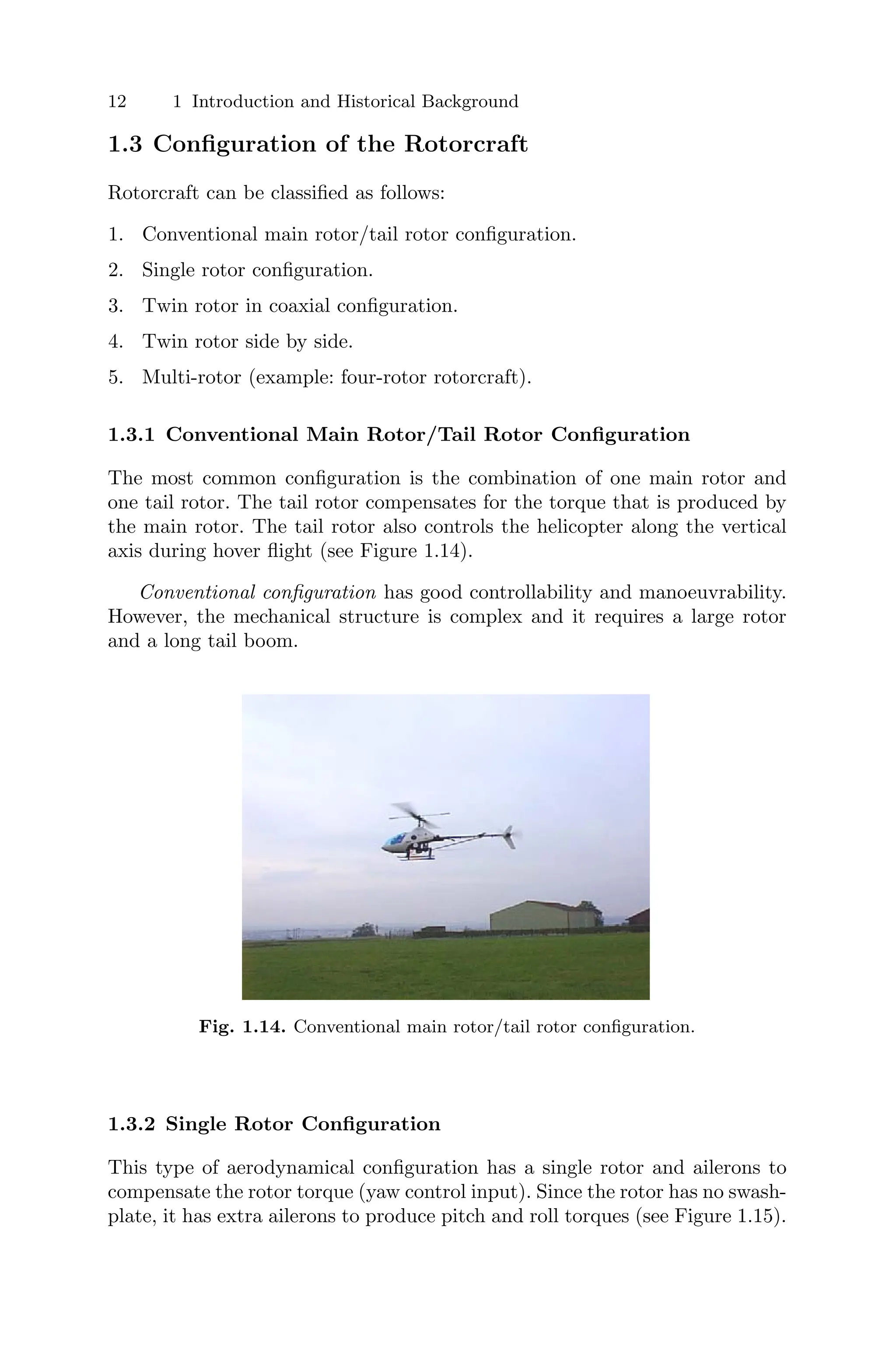
The most common configuration is the combination of one main rotor and
one tail rotor. The tail rotor compensates for the torque that is produced by
the main rotor. The tail rotor also controls the helicopter along the vertical
axis during hover flight (see Figure 1.14).
Conventional configuration has good controllability and manoeuvrability.
However, the mechanical structure is complex and it requires a large rotor
and a long tail boom.
Fig. 1.14. Conventional main rotor/tail rotor configuration.
1.3.2 Single Rotor Configuration
This type of aerodynamical configuration has a single rotor and ailerons to
compensate the rotor torque (yaw control input). Since the rotor has no swash-
plate, it has extra ailerons to produce pitch and roll torques (see Figure 1.15).
1.3 Configuration of the Rotorcraft 13
This type of flying machine is in general difficult to control even for experi-
enced pilots.
Single rotor configuration is mechanically simpler than standard heli-
copters but it does not have as much control authority. In both cases a sig-
nificant amount of energy is used in the anti-torque, i.e. to stop the fuselage
turning around the vertical axis. Due to its mechanical simplicity, this config-
uration seems more suitable for micro-aircraft than the other configurations.
Fig. 1.15. Single rotor configuration – Eurosatory 2004. SAGEM, France.
1.3.3 Twin Rotor in Coaxial Configuration
In this configuration, one rotor is located on top of the other (see Figure
1.16). The two rotors turn in opposite directions. Depending on the angular
velocity difference between the two rotors, the helicopter will turn left or
right. Helicopters with this configuration cannot reach a high cruising speed
because the drag is relatively large. Only after the development of the rigid
rotor was it possible to build the two rotors closer together and reduce the
drag considerably [116].
The coaxial configuration has advantages of compactness. However a sig-
nificant amount of energy is lost because the rotors interfere with each other.
The hover efficiency of the twin rotor side by side is higher than that of the
coaxial because there is no interference between the rotors.
1.3.4 Twin Rotor Side by Side
The tandem rotor (or twin rotor side by side) configuration is used mainly in
large helicopters (Figure 1.17). Because of the opposite rotation of the rotors,
14 1 Introduction and Historical Background
Fig. 1.16. Twin rotor in coaxial configuration (AirScoot helicopter). Credits –
AirScooter Corporation [2].
the torque of each single rotor is neutralized. The construction of the control
system is much more complicated compared with a helicopter with a tail rotor.
The arrangement of two rotors side by side was never very popular [116].
Fig. 1.17. Twin rotor side by side (Sea Knight CH-46 aircraft). Credits – National
Museum of Naval Aviation [119].
1.4 New Configurations of UAVs 15
1.3.5 Multi-rotors
The four-rotor rotorcraft or quadrotor is the more popular multi-rotor rotor-
craft (Figure 1.18). This type of rotorcraft attempts to achieve stable hovering
and precise flight by balancing the forces produced by the four rotors.
One of the advantages of using a multi-rotor helicopter is the increased pay-
load capacity. It has more lift therefore heavier weights can be carried. Quad-
rotors are highly manoeuvrable, which enables vertical take-off and landing,
as well as flying into hard to reach areas. Disadvantages are the increased
helicopter weight and increased energy consumption due to the extra motors.
Since it is controlled with rotor-speed changes, it is more suitable to electric
motors, and large helicopter engines which have slow response may not be
satisfactory without a proper gear-box system [5].
The quadrotor is superior from the control authority point of view. Con-
trolled hover and low-speed flight has been successfully demonstrated. How-
ever further improvements are required before demonstrating sustained con-
trolled forward-flight. When internal-combustion engines are used, multiple
rotor configurations have disadvantages over single rotor configurations be-
cause of the complexity of the transmission gear.
Fig. 1.18. Four-rotor rotorcraft (multi-rotor configuration).
1.4 New Configurations of UAVs
The aerodynamical configurations for mini-UAV are rapidly changing. In Fig-
ures 1.19 to 1.36 we present a selection of recent aerial vehicles capable of
hovering [180].
16 1 Introduction and Historical Background
Fig. 1.19. Seagull-Elbit Systems, Israel. Credits – Defense Update [31].
Fig. 1.20. Dragoneye-AeroVironment, Inc., U.S.A. Credits – Defense Update [31].
Fig. 1.21. Skylite-RAFAEL, Israel. Credits – Defense Update [31].
Fig. 1.22. Skylark-Elbit Systems, Israel. Credits – Defense Update [31].
1.4 New Configurations of UAVs 17
Fig. 1.23. Aerosonde aircraft - Aerosonde Robotic Aircraft. Credits – Aerosonde
[1].
Fig. 1.24. Mikado aircraft - EMT, Germany. Credits – Defense Update [31].
Fig. 1.25. X-45 UCAV aircraft – Boeing Corp.
18 1 Introduction and Historical Background
Fig. 1.26. Cypher aircraft. Credits – Sikorsky Aircraft Corp. [152].
Fig. 1.27. Cypher II aircraft. Credits – Sikorsky Aircraft Corp. [152].
Fig. 1.28. Golden Eye aircraft – Aurora Flight Sciences Corp.
1.4 New Configurations of UAVs 19
Fig. 1.29. iSTAR MAV aircraft – Allied Aerospace. Credits – Defense Update [31].
Fig. 1.30. Kestrel aircraft – Honeywell.
Fig. 1.31. X-50 aircraft – Boeing Corp.
20 1 Introduction and Historical Background
Fig. 1.32. Guardian CL-327 aircraft – Bombadier Services Corp.
Fig. 1.33. TAGM65/M80 - Tactical Aerospace Group (TAG). Credits – Defense
Update [31].
Fig. 1.34. T-Wing aircraft. Credits – University of Sydney, Australia [160].
1.4 New Configurations of UAVs 21
Fig. 1.35. Four-rotor rotorcraft. Credits – Draganfly Innovations Inc. [33].
Fig. 1.36. Three-rotor rotorcraft. Credits – Heudiasyc-UTC, France
2
The PVTOL Aircraft
2.1 Introduction
We introduce in this chapter the well-known Planar Vertical Take-Off and
Landing (PVTOL) aircraft problem. The PVTOL represents a challenging
nonlinear systems control problem that is a particular case of what is today
known as “motion control”. The PVTOL is clearly motivated by the need to
stabilize aircraft that are able to take-off vertically such as helicopters and
some special airplanes.
The PVTOL is a mathematical model of a flying object that evolves in a
vertical plane. It has three degrees of freedom (x, y, φ) corresponding to its
position and orientation in the plane. The PVTOL is composed of two inde-
pendent thrusters that produce a force and a moment on the flying machine,
see Figure 2.1. The PVTOL is an underactuated system since it has three de-
grees of freedom and only two inputs [144]. The PVTOL is a very interesting
nonlinear control problem.
Numerous design methods for the flight control of the PVTOL aircraft
model exist in the literature [24, 26, 45, 53, 92, 96]. Indeed, this particular
system is a simplified aircraft model with a minimal number of states and
inputs but retains the main features that must be considered when designing
control laws for a real aircraft. Since, the system possesses special properties
such as, for instance, unstable zero dynamics and signed (thrust) input [63],
several methodologies for controlling such a system have been proposed.
An algorithm to control the PVTOL based on an approximate I-O lin-
earization procedure was proposed in [63]. Their algorithm achieves bounded
tracking and asymptotic stability. A nonlinear small gain theorem was pro-
posed in [173] which can be used to stabilize a PVTOL. The author has proved
the stability of a controller based on nested saturations [172]. The algorithm
is very simple, has bounded control inputs and performs well even if the initial
horizontal displacement error is large.
24 2 The PVTOL Aircraft
An extension of the algorithm proposed by [63] was presented in [100].
They were able to find a flat output of the system that was used for tracking
control of the PVTOL in presence of unmodelled dynamics.
The forwarding technique developed in [102] was used in [44] to propose a
control algorithm for the PVTOL. This approach leads to a Lyapunov function
which ensures asymptotic stability. Other techniques based on linearization
were also proposed in [43].
Recently [99] proposed a control algorithm for the PVTOL for landing
on a ship whose deck oscillates. They designed an internal model-based error
feedback dynamic regulator that is robust with respect to uncertainties.
In this chapter we present a global stabilizing strategy for the control of
the PVTOL aircraft. The stability proof is simple. The control algorithm has
been tested in numerical simulations and in real-time applications.
This chapter is organized as follows. Section 2.2 presents the PVTOL
dynamical model. Section 2.3.1 gives the control of the vertical displacement
while the roll and horizontal displacement control are presented in Section
2.3.2. Real-time experimental results are given in Section 2.4. The conclusions
are finally given in Section 2.5.
2.2 System Description
The dynamical model of the PVTOL aircraft can be obtained using the La-
grangian approach or Newton’s laws. Therefore, the PVTOL system equations
are given by (see Figure 2.1)
ẍ = − sin(φ)u1 + ε cos(φ)u2
ÿ = cos(φ)u1 + ε sin(φ)u2 − 1 (2.1)
φ̈ = u2
where x is the horizontal displacement, y is the vertical displacement and φ is
the angle the PVTOL makes with the horizontal line. u1 is the total thrust and
u2 is the couple as shown in Figure 2.1. The parameter ε is a small coefficient
which characterizes the coupling between the rolling moment and the lateral
acceleration of the aircraft. The constant −1 is the normalized gravitational
acceleration.
In general, ε is negligible and not always well known [63]. Therefore, it is
possible to suppose that ε = 0, i.e.
ẍ = − sin(φ)u1 (2.2)
ÿ = cos(φ)u1 − 1 (2.3)
φ̈ = u2 (2.4)
2.3 Control Strategy 25
Fig. 2.1. The PVTOL aircraft (front view).
Furthermore, several authors have shown that by an appropriate change
of coordinates, we can obtain a representation of the system without the term
due to ε [125]. For instance, R. Olfati-Saber [125] applied the following change
of coordinates
x̄ = x − ε sin(φ) (2.5)
ȳ = y + ε(cos(φ) − 1) (2.6)
The system dynamics considering these new coordinates become
¨
x̄ = − sin(φ)ū1
¨
ȳ = cos(φ)ū1 − 1 (2.7)
φ̈ = u2
where ū1 = u1 −εφ̇2
. Note that this structure (2.7) has the same form as (2.1)
with ε = 0.
2.3 Control Strategy
In this section we present a simple control algorithm for the PVTOL whose
convergence analysis is also relatively simple as compared with other con-
trollers proposed in the literature. We present a new approach based on nested
saturations to control the PVTOL which can lead to further developments in
nonlinear systems. The simplicity of both the algorithm and the analysis al-
lows for a better understanding of the problem. The proposed algorithm can
be considered as an extension of the control of multiple integrators of [172] to
the case when there are nonlinear functions between the integrators.
26 2 The PVTOL Aircraft
This section is divided in two parts. In the first part, we are interested in
stabilizing the altitude y, while in the second part we propose u2 in order to
control the roll angle and the horizontal displacement in the x-axis.
2.3.1 Control of the Vertical Displacement
The vertical displacement y will be controlled by forcing the altitude to behave
as a linear system. This is done by using the following control strategy
u1 =
r1 + 1
cos σp(φ)
(2.8)
where 0 < p < π
2 and ση, for some η > 0, is a saturation function
ση(s) =
⎧
⎨
⎩
η for s > η
s for −η ≤ s ≤ η
−η for s < −η
(2.9)
and
r1 = −a1ẏ − a2(y − yd) (2.10)
where yd is the desired altitude and a1 and a2 are positive constants such that
the polynomial s2
+ a1s + a2 is stable. Let us assume that after a finite time
T2, φ(t) belongs to the interval
Iπ
2
= (−
π
2
+ ,
π
2
− ) (2.11)
for some   0 so that cos φ(t) = 0. Introducing (2.8) and (2.10) into (2.2)–
(2.4) we obtain for t  T2
ẍ = − tan φ(r1 + 1)
ÿ = −a1ẏ − a2(y − yd)
φ̈ = u2
(2.12)
Note that in view of the above, y → yd and r1 → 0 as t → ∞.
2.3.2 Control of the Roll Angle and the Horizontal Displacement
We will now propose u2 to control φ̇, φ, ẋ and x. The control algorithm will
be obtained step by step. The final expression for u2 will be given at the end
of this section (see (2.63)). Roughly speaking, for φ close to zero, the (x, φ)
subsystem is represented by four integrators in cascade. A. Teel [172] proposed
a control strategy based on nested saturations that can be used to control a set
of integrators connected in cascade. We will show that the strategy proposed
in [172] for linear systems can be modified to control x and φ in the nonlinear
system (2.12).
We will also show that φ(t) ∈ Iπ
2
in (2.11) after t = T2 independently of
the input u1 in (2.8).
2.3 Control Strategy 27
Boundedness of φ̇
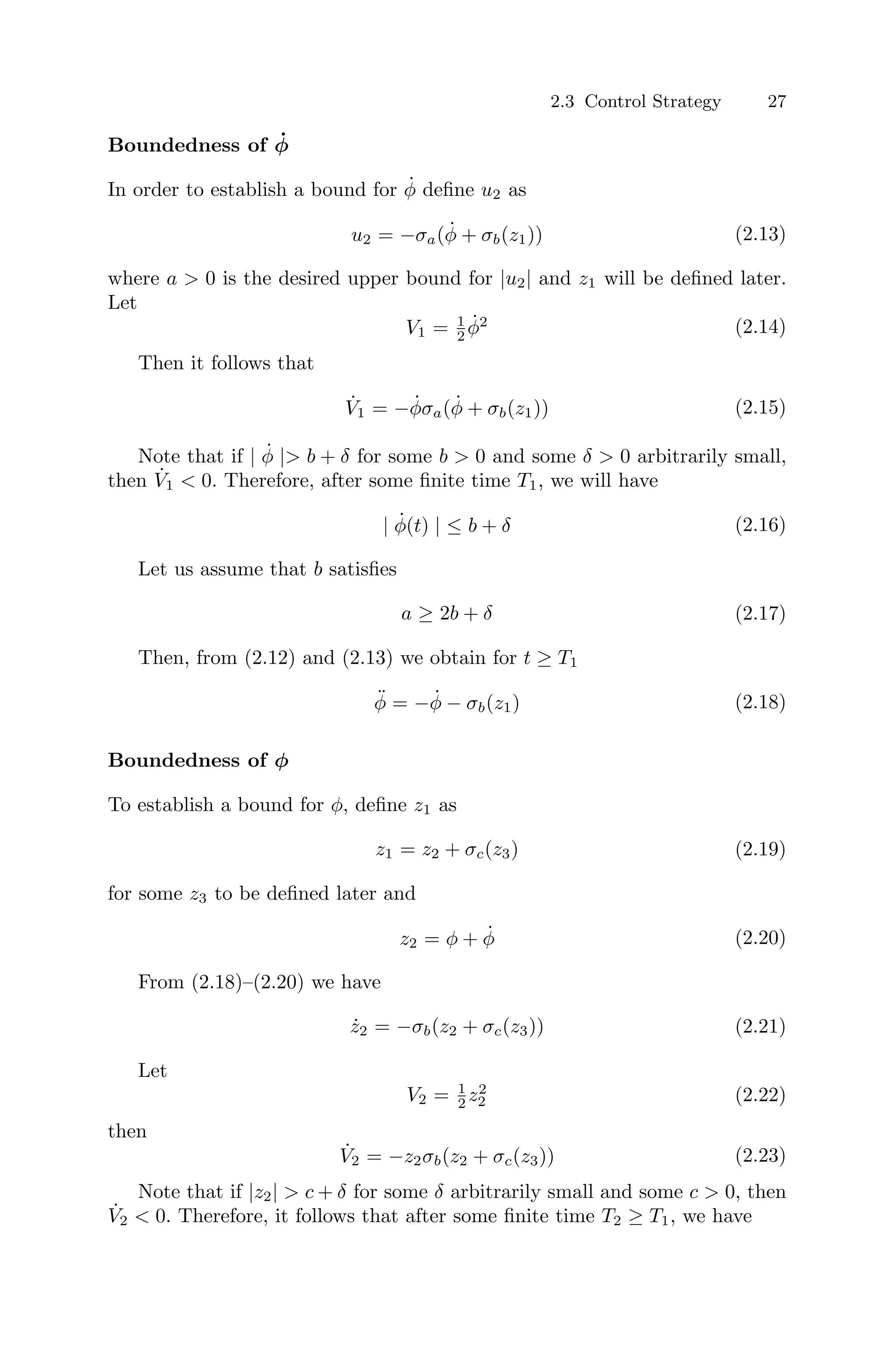
In order to establish a bound for φ̇ define u2 as
u2 = −σa(φ̇ + σb(z1)) (2.13)
where a  0 is the desired upper bound for |u2| and z1 will be defined later.
Let
V1 = 1
2 φ̇2 (2.14)
Then it follows that
V̇1 = −φ̇σa(φ̇ + σb(z1)) (2.15)
Note that if | φ̇ | b + δ for some b  0 and some δ  0 arbitrarily small,
then V̇1  0. Therefore, after some finite time T1, we will have
| φ̇(t) | ≤ b + δ (2.16)
Let us assume that b satisfies
a ≥ 2b + δ (2.17)
Then, from (2.12) and (2.13) we obtain for t ≥ T1
φ̈ = −φ̇ − σb(z1) (2.18)
Boundedness of φ
To establish a bound for φ, define z1 as
z1 = z2 + σc(z3) (2.19)
for some z3 to be defined later and
z2 = φ + φ̇ (2.20)
From (2.18)–(2.20) we have
ż2 = −σb(z2 + σc(z3)) (2.21)
Let
V2 = 1
2 z2
2 (2.22)
then
V̇2 = −z2σb(z2 + σc(z3)) (2.23)
Note that if |z2|  c + δ for some δ arbitrarily small and some c  0, then
V̇2  0. Therefore, it follows that after some finite time T2 ≥ T1, we have
28 2 The PVTOL Aircraft
|z2(t)| ≤ c + δ (2.24)
From (2.20) we obtain for t ≥ T2
φ(t) = φ(T2)e−(t−T2)
+
 t
T2
e−(t−τ)
z2(τ)dτ (2.25)
Therefore, it follows that there exists a finite time T3 such that for t ≥
T3  T2 we have
|φ(t)| ≤ φ̄  c + 2δ (2.26)
If
c + 2δ ≤
π
2
−  (2.27)
then φ(t) ∈ Iπ
2
, see (2.11), for t ≥ T2.
Assume that b and c also satisfy
b ≥ 2c + δ (2.28)
Then, in view of (2.24), (2.21) reduces to
ż2 = −z2 − σc(z3) (2.29)
for t ≥ T3.
Note that the following inequality holds for |φ|  1
|tan φ − φ| ≤ φ2
(2.30)
We will use the above inequality in the following development.
Boundedness of ẋ
To establish a bound for ẋ, let us define z3 as
z3 = z4 + σd(z5) (2.31)
where z4 is defined as
z4 = z2 + φ − ẋ (2.32)
and z5 will be defined later. From (2.12), (2.20) and (2.29) and the above it
follows that
ż4 = (1 + r1) tan φ − φ − σc(z4 + σd(z5)) (2.33)
Define
V3 = 1
2 z2
4 (2.34)
then
V̇3 = z4 [(1 + r1) tan φ − φ − σc(z4 + σd(z5))] (2.35)
Since r1 tan φ → 0 (see (2.10) and (2.12)), there exists a finite time T5  T4,
large enough such that if
2.3 Control Strategy 29
|z4|  d + φ̄2
+ δ (2.36)
and
c ≥ φ̄2
+ δ (2.37)
for some δ arbitrarily small and d  0, then V̇3  0. Therefore, after some
finite time T6  T5, we have
|z4(t)| ≤ d + δ + φ̄2
(2.38)
Let us assume that d and c satisfy
c ≥ 2d + δ + φ̄2
(2.39)
Thus, after a finite time T6, (2.33) reduces to
ż4 = (1 + r1) tan φ − φ − z4 − σd(z5) (2.40)
Note that in view of (2.20), (2.32) and (2.38) it follows that ẋ is bounded.
Boundedness of x
To establish a bound for x, let us define z5 as
z5 = z4 + φ − 2ẋ − x (2.41)
From (2.12), (2.20), (2.32) and (2.40) we get
ż5 = (1 + r1) tan φ − φ − z4 − σd(z5) + φ̇ + 2 tan φ(r1 + 1) − ẋ
= −σd(z5) + 3r1 tan φ + 3(tan φ − φ) (2.42)
Define
V4 = 1
2 z2
5 (2.43)
then
V̇4 = z5 [−σd(z5) + 3r1 tan φ + 3(tan φ − φ)] (2.44)
Since r1 tan φ → 0, there exists a finite time T7  T6, large enough such
that if |z5|  3φ̄2
+ δ for some δ arbitrarily small and
d ≥ 3φ̄2
+ δ (2.45)
then V̇4  0. Therefore, after some finite time T8  T7, we have
|z5(t)| ≤ 3φ
2
+ δ (2.46)
After time T8 (2.42) reduces to
ż5 = −z5 + 3r1 tan φ + 3(tan φ − φ) (2.47)
30 2 The PVTOL Aircraft
Boundedness of x follows from (2.38), (2.41) and (2.46).
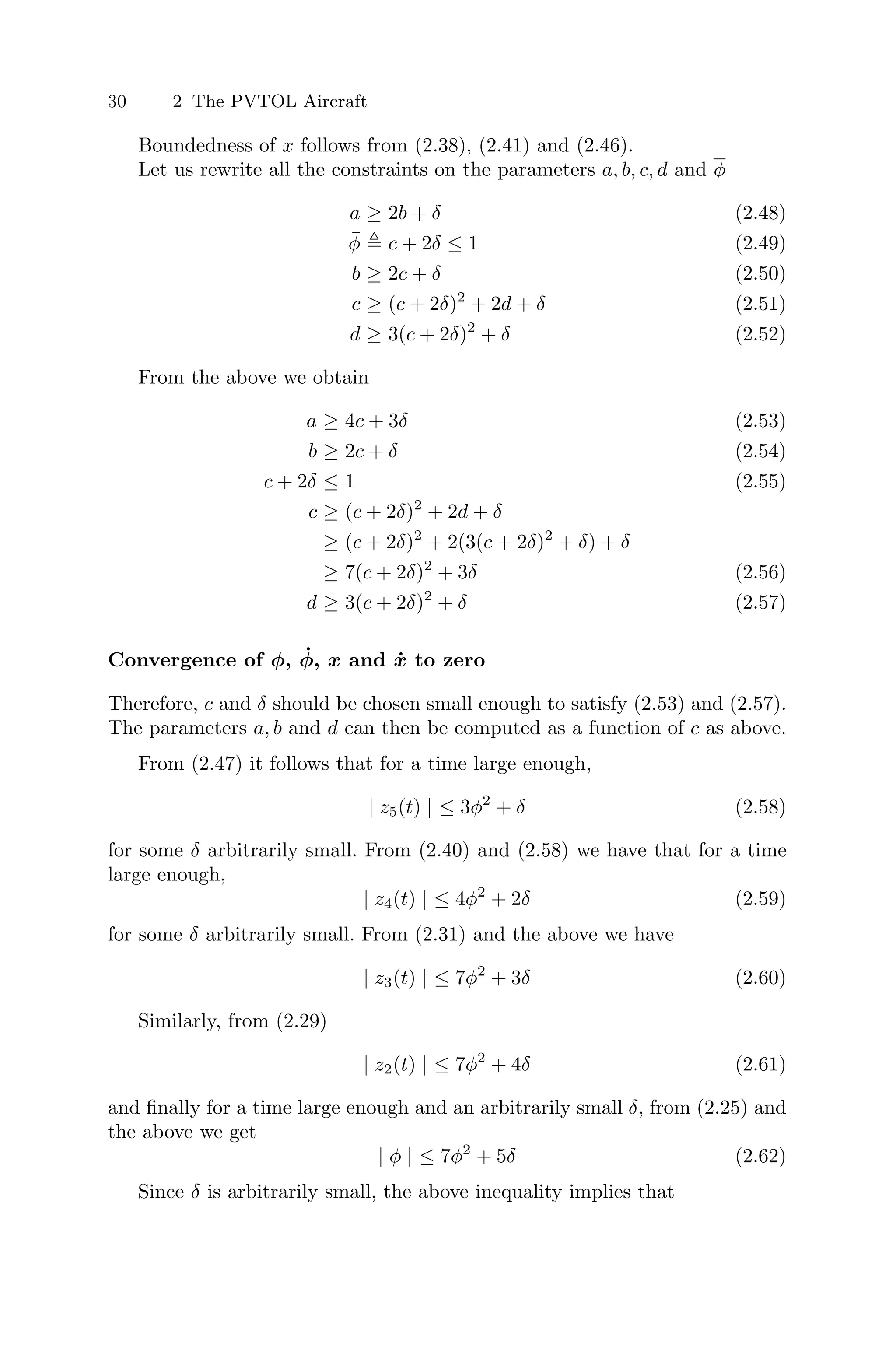
Let us rewrite all the constraints on the parameters a, b, c, d and φ
a ≥ 2b + δ (2.48)
φ̄  c + 2δ ≤ 1 (2.49)
b ≥ 2c + δ (2.50)
c ≥ (c + 2δ)2
+ 2d + δ (2.51)
d ≥ 3(c + 2δ)2
+ δ (2.52)
From the above we obtain
a ≥ 4c + 3δ (2.53)
b ≥ 2c + δ (2.54)
c + 2δ ≤ 1 (2.55)
c ≥ (c + 2δ)2
+ 2d + δ
≥ (c + 2δ)2
+ 2(3(c + 2δ)2
+ δ) + δ
≥ 7(c + 2δ)2
+ 3δ (2.56)
d ≥ 3(c + 2δ)2
+ δ (2.57)
Convergence of φ, φ̇, x and ẋ to zero
Therefore, c and δ should be chosen small enough to satisfy (2.53) and (2.57).
The parameters a, b and d can then be computed as a function of c as above.
From (2.47) it follows that for a time large enough,
| z5(t) | ≤ 3φ2
+ δ (2.58)
for some δ arbitrarily small. From (2.40) and (2.58) we have that for a time
large enough,
| z4(t) | ≤ 4φ2
+ 2δ (2.59)
for some δ arbitrarily small. From (2.31) and the above we have
| z3(t) | ≤ 7φ2
+ 3δ (2.60)
Similarly, from (2.29)
| z2(t) | ≤ 7φ2
+ 4δ (2.61)
and finally for a time large enough and an arbitrarily small δ, from (2.25) and
the above we get
| φ | ≤ 7φ2
+ 5δ (2.62)
Since δ is arbitrarily small, the above inequality implies that
2.4 Real-time Experimental Results 31
φ = 0
| φ | ≥
1
7
If c is chosen small enough such that φ̄  1
7 (see (2.26)), then the only
possible solution is φ = 0. Therefore φ → 0 as t → ∞. From (2.58)–(2.61) and
(2.19) we have that zi(t) → 0 for i = 1, 2, ..., 5. From (2.20) we get φ̇ → 0.
From (2.32) and (2.41) it follows respectively that ẋ → 0 and x → 0. The
control input u2 is given by (2.13), (2.19), (2.20), (2.31), (2.32) and (2.41),
i.e.
u2 = −σa(φ̇ + σb(φ + φ̇ + σc(2φ + φ̇ − ẋ + σd(3φ + φ̇ − 3ẋ − x)))) (2.63)
The amplitudes of the saturation functions should satisfy the constraints
in (2.53)–(2.57).
2.4 Real-time Experimental Results
In this section we present a real-time application of the control algorithm for
the PVTOL presented in the previous sections. We have tested our control
algorithm in two experiments, the first one was made using a quad-rotor
rotorcraft and the second one with a prototype of the PVTOL built at the
Heudiasyc laboratory.
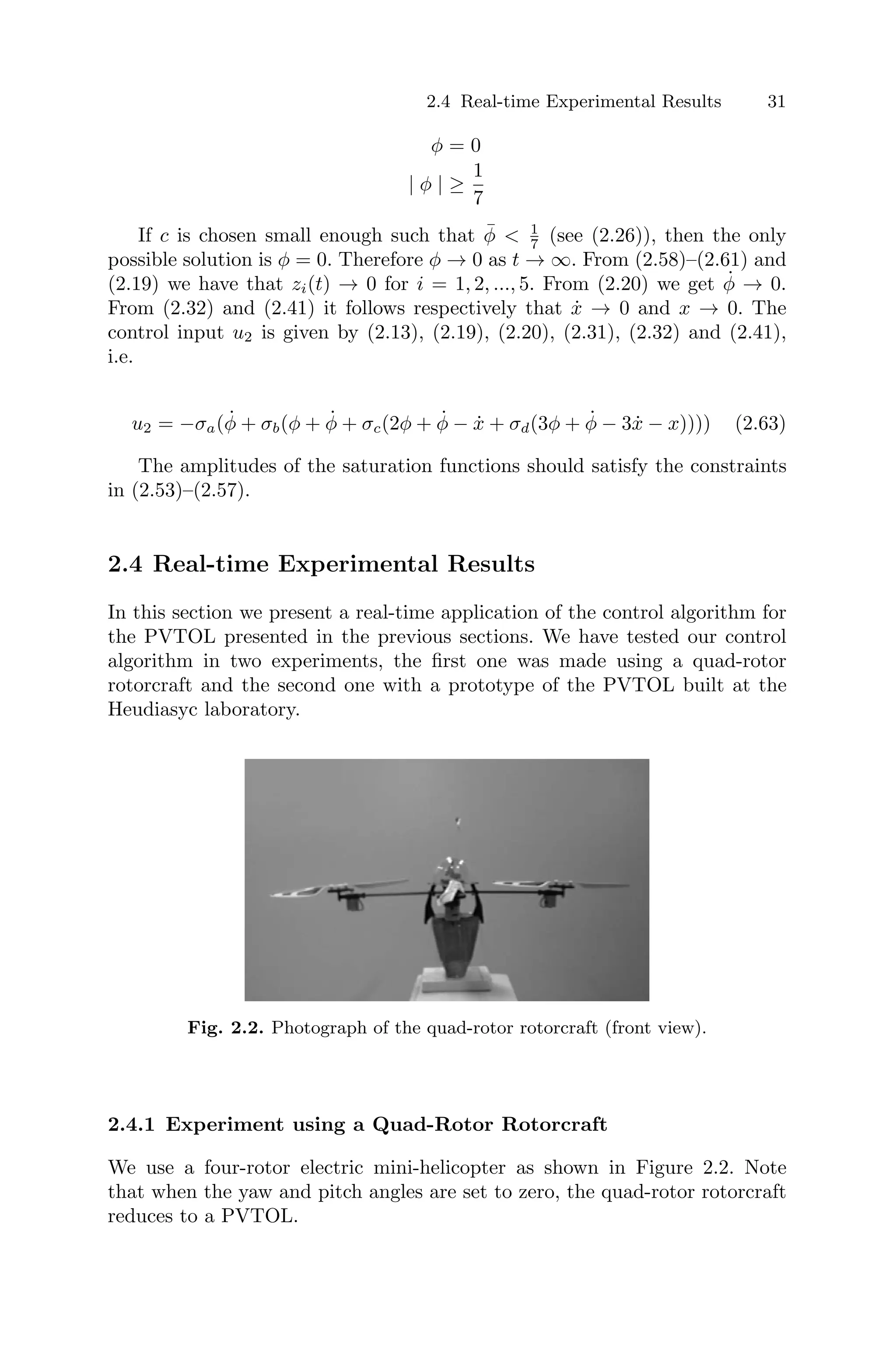
Fig. 2.2. Photograph of the quad-rotor rotorcraft (front view).
2.4.1 Experiment using a Quad-Rotor Rotorcraft
We use a four-rotor electric mini-helicopter as shown in Figure 2.2. Note
that when the yaw and pitch angles are set to zero, the quad-rotor rotorcraft
reduces to a PVTOL.
32 2 The PVTOL Aircraft
In our experiment the pitch and yaw angles are controlled manually by an
experienced pilot. The remaining controls, i.e. the main thrust and the roll
control, are controlled using the control strategy presented in the previous
sections. In the four-rotor helicopter, the main thrust is the sum of the thrusts
of each motor. Pitch movement is obtained by increasing (reducing) the speed
of the rear motor while reducing (increasing) the speed of the front motor.
The roll movement is obtained similarly using the lateral motors.
The radio is a Futaba Skysport 4. The radio and the PC (INTEL Pentium
III) are connected using data acquisition cards (ADVANTECH PCL-818HG
and PCL-726). The connection in the radio is directly made to the joystick
potentiometers for the main thrust and pitch control.
We use the 3D tracker system (POLHEMUS) [46] for measuring the po-
sition and the orientation of the rotorcraft. The Polhemus is connected via
RS232 to the PC.
In Chapter 3, we will give a detailed description of this platform.
We wish to use our control law with a quad-rotor rotorcraft; this helicopter
evolves in 3D and its movements are defined by the variables (x, y, z, ψ, θ, φ).
We are going to assimilate the altitude of the quad-rotor rotorcraft to the
altitude of the PVTOL. This means that we will see y of the PVTOL as z of
the quad-rotor rotorcraft.
The control objective for this experience is to make the quad-rotor ro-
torcraft hover at an altitude of 20 cm i.e. we wish to reach the position
(x, z) = (0, 20) cm while φ = 0◦
.
With respect to the time derivatives, we have simplified the mathematical
computation by setting q̇t
∼
=
qt−qt−T
T , where q is a given variable and T is the
sampling period. In the experiment T = 71 ms.
20 25 30 35 40 45 50 55 60
−5
0
5
10
15
20
25
Time [s]
z
[cm]
Fig. 2.3. Altitude of the quad-rotor rotorcraft.
2.4 Real-time Experimental Results 33
20 25 30 35 40 45 50 55 60
−8
−6
−4
−2
0
2
4
6
8
10
12
Time [s]
x
[cm]
Fig. 2.4. x position of the quad-rotor rotorcraft.
Figures 2.3–2.4 show the performance of the controller when applied to the
helicopter. Take-off and landing were performed autonomously. The choice of
the values for a, b, c, d were carried out satisfying inequalities (2.53)−(2.57).
However these parameters have been tuned experimentally in the sequence as
they appear in the control input u2.
Figure 2.3 describes the gap between the real altitude of the rotorcraft and
the desired altitude. One can notice that it follows satisfactorily the desired
reference. Following the vertical axis, we notice that the position error in the
variable z is of about 3 to 4 cm. In Figure 2.4, one can see the gap between
the real horizontal position of the quad-rotor rotorcraft (according to x) and
the desired position. We note that the rotorcraft position converges towards
the desired position. The final position error is about 2 to 4 cm.
20 25 30 35 40 45 50 55 60
−3
−2
−1
0
1
2
3
4
5
Time [s]
Roll
[°]
Fig. 2.5. Roll angle (φ) of the quad-rotor rotorcraft.
34 2 The PVTOL Aircraft
Figure 2.5 shows the evolution of the φ angle. It can be seen that the control
law achieves convergence of the roll angle to zero, as the helicopter goes up
to the altitude of 20 cm. It also shows the rotorcraft horizontal displacement
in the x-axis.
2.4.2 Experimental Platform Using Vision
In this subsection we have tested the control algorithm using vision [131].
The PVTOL prototype built at Heudiasyc laboratory is shown in Fig-
ure 2.6. The rotors are driven separately by two motors. One motor rotates
clockwise while the second one rotates counter-clockwise. The main thrust
is the sum of the thrusts of each motor. The rolling moment is obtained by
increasing (decreasing) the speed of one motor while decreasing (increasing)
the speed of the second motor.
Fig. 2.6. Photograph of the PVTOL aircraft (front view).
The PVTOL moves on an inclined plane, which defines our 2D workspace.
The PVTOL platform is an experimental setup designed to study the prob-
lems currently found in navigation at low altitude of a small flying object. At
low altitude, GPS and even intertial navigation systems are not enough to
stabilize mini-flying objects. Vision using cameras should provide additional
information to make autonomous flights near the ground possible. For sim-
plicity, at a first stage, we have placed the camera outside the aircraft. In the
future, the camera will be located at the base of the mini-helicopter, pointing
downwards. Note that even when the camera is located outside the flying ob-
ject, we still have to deal with the problems of object localization computation
using cameras and delays in the closed-loop system.
In the platform, a CCD camera Pulnix is located perpendicular to the
plane at a fixed altitude and provides an image of the whole workspace. We
have used an acquisition card PCI-1409 of National Instruments Company.
The camera is linked to the PC dedicated to the vision part (which will be
2.4 Real-time Experimental Results 35
referred as Vision PC). From the image provided by the camera, the program
calculates the position (x, y) and the orientation φ of the PVTOL with respect
to a given origin. Then, the Vision PC sends this information to another
PC dedicated to the control part (which we call Control PC), via a RS232
connection, transmitting at 115 200 bps (bauds per second).
The control inputs are therefore calculated according to the proposed strat-
egy based on saturation functions and sent to the PVTOL via the radio. In
order to simplify the implementation of the control law we have designed the
platform in such a way that each of the two control inputs can independently
work either in automatic or in manual mode. The minimum sampling period
we are able to obtain in the experimental platform is 40 ms. This includes the
computation of the control law, image processing, localization computation
and A/D and D/A conversion in the radio–PC interface.
Experiment
The control objective is to make the PVTOL hover at an altitude of 60 pixels
i.e. we wish to reach the position (x, y) = (0, 60) in pixels while φ = 0◦
.
The measurements of x, y are expressed in pixels in the image frame and
φ is expressed in degrees, which means that the servoing is done on the basis
of image features directly.
With respect to the time derivatives, we have simplified the mathematical
computation by setting q̇t = qt−qt−T
T , where q represent either x, y or φ and
T is the sampling period.
Fig. 2.7. Vision interface.
36 2 The PVTOL Aircraft
In Figure 2.7, the results of the image acquisition program are shown. We
clearly see the detection of two points located on the PVTOL prototype. From
the measurement of these two points, we compute the position x, y and the
angle φ of the system.
Figures 2.8–2.10 show the performance of the controller when applied to
the PVTOL aircraft. Hovering at 60 pixels as well as following a horizontal
trajectory were performed satisfactorily. The choice of the values for a, b, c,
d were carried out satisfying inequalities (2.53)–(2.57). However these param-
eters have been tuned experimentally in the sequence as they appear in the
control input u2.
In Figure 2.8, one can see the gap between the real horizontal position
of the PVTOL in the x-axis and the desired position. In the x-axis, 1 cm
corresponds to 5 pixels. This means that the error position is about 2 to 3
cm.
Figure 2.9 presents the gap between the real PVTOL altitude and the
desired altitude. One can notice that the PVTOL follows the desired reference.
In the vertical y-axis, 1 cm corresponds to 2.5 pixels. This means that the
vertical position error is about 2 to 3 cm.
Figure 2.10 shows the evolution of the φ-angle In this figure, one can see
that the control law achieves convergence of the φ-angle to zero. Therefore,
the difference between the real trajectory and desired one is due to friction.
The results are nevertheless very satisfactory.
0 10 20 30 40 50 60 70
−20
−15
−10
−5
0
5
10
Time [sec]
x
[pixel]
1 [cm] = 5 [pix]
Fig. 2.8. Position [x] of the PVTOL.
Other documents randomly have
different content
Valentino
(toccandogli la pancia come si fa carezzando un cavallo) Buono,
buono, don Fausto!
Don Fausto
Giù le mani!
Valentino
Uno di questi giorni, gli parlo io.
Don Fausto
Oggi ho delle scadenze e mi necessita il contante per fare onore alla
mia firma. Per mezzogiorno al più tardi, il mio conto dev'essere
saldato.
Valentino
Per mezzogiorno, è un po' difficile. Questa è l'ora in cui Stefano è
chiuso nel suo studio, e guai a disturbarlo!...
Don Fausto
Chiuso o non chiuso, se fra un'ora non sono soddisfatto, mando al
vostro signor parente uno sveglierino per atto d'usciere e metto....
Valentino
(continuando subito) Un comunicato nei giornali.
Don Fausto
(fermamente) Nè più nè meno.
Valentino
Così Stefano vi risponderà in versi.
Don Fausto
E io lo chiamerò imbroglione in prosa.
Valentino
Ma, dico: che modo di parlare è questo?!
Don Fausto
E voi perchè mi stuzzicate?
SCENA III.
DON FAUSTO, VALENTINO, TERESA.
Teresa
(venendo dal fondo) Che c'è, che c'è, Valentino?
Valentino
(a Don Fausto) Questa è sua moglie. Fate il gentiluomo con lei. (A
Teresa) Non c'è niente, signora Teresa. Niente di serio. C'è soltanto il
signor Fausto Cantajello, qui presente, il quale avrebbe un conticino
di mille e settecento lire da farsi saldare. Una cornice e due sedie.
Don Fausto
Due sedie a bracciuoli, Errico Quarto puro....
Valentino
(a Teresa) Devono essere quei due seggioloni con quella spalliera...
(fa dei gesti descrittivi.)
Don Fausto
A servirvi. Su quei due seggioloni pare certo sia stato seduto Errico
Quarto in persona.
Valentino
E diamine! (Gesto analogo) Se ne vede ancora l'impronta.
Don Fausto
La cornice, poi, ha contenuto il primo ritratto a olio di Napoleone I.
Valentino
Ho capito: è per questo che Stefano ci ha messo il ritratto suo.
Teresa
(che si trova alla destra di don Fausto) Sì, ma io non credo che per
oggi mio marito abbia disponibile questa somma. Dovreste avere la
bontà di pazientare.
Don Fausto
(che ha udito poco, — a Valentino) Dovrei avere la bontà... di che?
Valentino
A sinistra, a sinistra, signora Teresa.
Teresa
A sinistra!?...
Valentino
A destra è sordo. Parlategli a sinistra.
Teresa
(passando alla sinistra di don Fausto) Dicevo che dovreste avere la
bontà di pazientare.
Don Fausto
Ah no, signora mia. Ho già spiegato al cugino in terzo grado di
vostro marito le ragioni per cui non posso più pazientare.
Teresa
(deviando involontariamente) Valentino!
Valentino
(accostandosi con zelo) Comandate.
Teresa
(piano) Lo sapete che Stefano non vuole che vi si conosca come suo
cugino....
Valentino
È vero, sì, ogni tanto me ne dimentico.
Teresa
(affettuosamente) Ha i suoi principii.... Dobbiamo rispettarli....
Don Fausto
Dunque, signora, che si decide?
Teresa
Che volete che vi dica?... Io non ho l'abitudine d'incomodare mio
marito per simili faccende. E oggi, meno che mai. Tutt'al più, quando
saprò che ha dei quattrini....
Don Fausto
Quando saprete che ha dei quattrini, cara signora, sarà troppo tardi.
Per fortuna, (cavando una carta da una tasca) il conticino è firmato
da vostro marito a mo' di obbligazione. Ecco qua. (Lo mostra) Il
termine è trascorso da un pezzo; e quindi io ricorro ai ferri corti.
Valentino
Intimazione per atto d'usciere e pubblica denunzia nei giornali della
città.
Teresa
(spaventata) Dio mio! Che dite mai!?
Don Fausto
D'altronde, io ragiono così, cara signora: chi possiede un villino a
Posillipo, costruito, per giunta, a bella posta con parecchie decine di
migliaia di lire, e va in carrozza invece d'andare in tram o a piedi
come vado io....
Valentino
(interrompendolo) Poveretto! Con quella pancia!
Don Fausto
(inalberandosi) Con questa pancia vado a piedi, e ci vado a fronte
alta. Ciò che mi stupisce è che il signor Stefano Baldi....
Valentino
... vada in carrozza a fronte bassa.
Don Fausto
A fronte bassa dovrebbe andarci, visto che non mantiene i suoi
impegni!
Teresa
Ma, signore, voi vi permettete di dire delle enormità!
Don Fausto
A me non piace di offendere nessuno; ma se mi si tocca in quel poco
che ho fatto coi miei sudori, non transigo.
Valentino
La cornice di Napoleone l'avete fatta con i vostri sudori?!
Don Fausto
(con energia) Precisamente!
Valentino
E allora è un altro paio di maniche!
Don Fausto
Breve breve, signora mia. I tempi sono tristi. Con l'abbondanza di
antichità che c'è sulla piazza e con la moda dello stile libertino, io a
stento mi tengo a galla. C'è qualcuno che gioca a farmi affogare? E
io lo tiro giù con me, e ci si affoga insieme. Quando vostro marito,
dopo otto mesi di preghiere, non si fa vivo, male parole, saette,
uscieri, comunicati, scandali, senza misericordia!
Teresa
(tremando) No, per carità! Piuttosto... sentite... sentite, signore:
cercherò di provvedere io.
Don Fausto
Un'ora di tempo avete.
Teresa
Valentino mio, soltanto voi potete aiutarmi.
Valentino
Per voi, qualunque cosa, signora Teresa; ma io non so veramente...
Teresa
Conoscete qualche agenzia di pegnorazione?
Valentino
(con prosopopea faceta) Vi prego di credere che io le conosco tutte!
Teresa
Forse, però, qui, a Posillipo, non ce ne sono.
Valentino
V'ingannate. In queste aure balsamiche esse fioriscono benissimo.
Teresa
E dite: dagli orecchini che porto quanto si potrebbe ricavare?
Valentino
Ma come! Voi vorreste....?!
Teresa
È la sola risorsa che ho.
Valentino
Ecco poi un altruismo che mi urta i nervi.
Don Fausto
(s'accorge che l'affare è in via di soluzione e si apparta per dar loro
agio di confabulare liberamente.)
Valentino
(osservando gli orecchini) Si arriverebbe appena alle mille e cento,
alle mille e duecento...
Teresa
Altre centodieci lire le ho di economie....
Valentino
E ne mancano ancora parecchie!
Teresa
(animandosi) Un'idea!... Me le faccio prestare dalla zia Matilde. Sì, sì!
E andrete proprio voi a chiedergliele da parte mia. Le siete molto
simpatico e non si negherà.
Valentino
E voi credete che per le mie attrattive la zia Matilde vi aprirà la sua
borsa?
Teresa
È stata sempre affettuosa con me. Mi ha fatto da mamma quando
sono rimasta orfana.
Valentino
E ha sperperato quel poco che avevate di vostro.
Teresa
Per la mia educazione.
Valentino
Già, voi siete d'una buona fede meravigliosa...
Teresa
Insomma, Valentino, non divaghiamo adesso. La presenza di
quell'uomo mi agghiaccia il sangue nelle vene. Sbrighiamoci. Prima
di tutto, gli orecchini. (Se li toglie e glieli consegna.) Le cento e dieci
lire sono queste. (Le prende da un portafogli che ha in petto.) Le
avevo raggranellate per fare una bella sorpresina a Stefano; mah!..
pazienza! (Le unisce agli orecchini.)
Don Fausto
(guarda con la coda dell'occhio.)
Valentino
(intascando tutto) E per il resto, speriamo nel miracolo della zia.
Teresa
Madonna santa, con la vostra diffidenza mi scoraggiate!
Valentino
Perchè diffidenza? Ho detto: «speriamo». (A don Fausto, con un
cenno della mano) A voi! Accidente d'un antiquario! Venite con me.
Don Fausto
(gli si accosta offrendo l'orecchio sinistro.)
Valentino
Vi pagheremo.
Don Fausto
Sono a voi. (A Teresa, cavandosi il cappello) Tanti complimenti.
Teresa
Buon giorno, signore.
Valentino
Per questa volta, farete riposare i giornali e l'usciere, caro il nostro
Don Fausto.
Don Fausto
Non lo giurerei ancora.
Valentino
(sbadatamente, se lo prende a braccetto dal lato destro) Siete un
animale! (Si avviano per il viale.)
Don Fausto
(che non ha udito) Sono... che cosa?
Valentino
(passando subito alla sinistra di lui e riprendendoselo a braccetto)
Siete un animale!
Don Fausto
Mi pare che per dirmi questo potevate restare a destra.
Valentino
(allontanandosi con lui) No! a sinistra, mio diletto amico! A sinistra!
(Spariscono.)
Teresa
(cercando di farsi sentire pur moderando la voce) Tornate presto,
Valentino. Sono sulla corda.
La voce di Valentino
Il tempo materiale ci vuole.
Teresa
La zia è qui presso. E poi, un po' di sveltezza!
La voce di Valentino
(che s'allontana) A sinistra, caro il mio bestione!
Teresa
(tuttora pensosa per questo incidente, siede sul sedile di legno e
sospira, preparandosi pazientemente ad agucchiare.)
SCENA IV.
TERESA e STEFANO.
Stefano
(facendo capolino dall'uscio che era chiuso) Teresa!
Teresa
(con un lieve sussulto) Stefano?
Stefano
Ho sentito un borbottìo... un vocìo...
Teresa
Ah sì... era Valentino che parlava animatamente con un uomo...
Stefano
Con chi parlava?
Teresa
... Con un suo amico, credo.
Stefano
Valentino potrebbe fare a meno di ricevere i suoi amici in casa mia.
Sono quasi sempre degli straccioni. T'incarico di dirgli, senza
mitigare, che io non voglio.
Teresa
Glie lo dirò.
Stefano
(s'avvicina a Teresa e con una certa vanità dissimulata le mette sotto
il naso una busta aperta che ha tra mano.)
Teresa
Che profumo!
Stefano
È una lettera della principessa Heller.
Teresa
Chi è la principessa Heller?
Stefano
Tu non sai mai nulla di ciò che accade fuori del tuo guscio. La
principessa Heller è una gran dama, che s'è stabilita a Napoli da
qualche anno ed è già rinomatissima perchè ha il salone più fiorente,
più elegante e più intellettuale.
Teresa
Che potevo saperne, io? (Intenta al lavoro) Se qualche volta tu mi
avessi parlato di lei....
Stefano
Io, personalmente, non l'ho conosciuta che ieri, nello studio del
pittore Ferrantino, che lei era andata a visitare.
Teresa
(semplice) Ieri l'hai conosciuta e oggi ricevi una sua lettera?
Stefano
Mi scrive per invitarmi a frequentare il suo salone.
Teresa
(sincerissima) Mi fa piacere. Questo potrà giovarti molto.
Stefano
(con una punta di risentimento) Ti prego di credere che gioverà
molto a lei.
Teresa
(mortificata) Io dicevo che potrà giovarti perchè... ti divertirai un
poco, ti distrarrai...
Stefano
(con buonumore) Non cercar di rimediare, sai, che è peggio. Hai
fatta una gaffe e non parliamone altro. Tanto, ne fai per lo meno
cinquanta al giorno: mi ci sono abituato.
Teresa
(con rammarico) Poi finirai con l'esserne stufo.
Stefano
Ma no, non temere. Come moglie, va bene. (Graziosamente) Mi sei
sempre piaciuta così.
Teresa
Davvero?
Stefano
Davvero.
Teresa
(ha un'espressione d'ingenua fierezza.)
Stefano
(sedendole accanto con un'affettuosità lievemente sensuale) Dimmi
un po', mogliettina: cosa lavori di bello?
Teresa
Dei grembiuli.
Stefano
Per la cameriera?
Teresa
Per me.
Stefano
Per te!?
Teresa
Sì, perchè quando si è in faccende per la casa...
Stefano
Ma questo è ciò che io non approvo. Abbiamo un segretario, una
cameriera, un servo, un cocchiere, un cuoco....
Teresa
Quanti più sono, meno c'è da fidarsi. E, anzi, proprio quel cuoco si
dà un'importanza insopportabile! Stamane — per raccontarne una —
io sono andata in cucina a controllare il peso della frutta comperata
per la colezione, e lui....
Stefano
(mettendole una mano sulla bocca) No, Teresa! Le gesta del cuoco
poi no!
Teresa
Me l'hai nominato tu, altrimenti non te ne avrei detto nulla. Ti parlo
mai di qualche cosa se non cominci a parlarne tu?
Stefano
(torturandole un po' il collo carezzosamente) Ma che sciocchina che
sei!
Teresa
(ridendo con bonarietà) E che posso farci io?
Stefano
Non capisci nemmeno che in questo momento vorrei che tu
smettessi di lavorare.
Teresa
Subito, amor mio! (Ripone immediatamente nel cestino la stoffa,
l'ago, le forbici.) Tu, intanto, hai lavorato finora.
Stefano
Con qualche differenza, se non ti dispiace.
Teresa
Hai lavorato bene?
Stefano
Ahimè, no! Per ora, sono condannato a un lavoro di transazione che
non mi piglia tutto. I bisogni quotidiani mi ci costringono per
l'insufficienza del mio patrimonio assottigliato, e io ne soffro, ne
soffro... Ma così non potrà durare a lungo. No, no! Io sento già che
l'angusto involucro della vita pratica e gretta si sfascia sotto le
pulsazioni violente della mia forza. E scriverò appunto il Poema della
forza. Perdio! Sarà un'opera di battaglia contro gli esseri inferiori,
contro i deboli, contro i vili, contro gl'inutili, contro gli sciocchi....
Teresa
Anche contro di me?!
Stefano
(interrompendo il suo volo lirico e sorridendo) Naturalmente!
Teresa
E che me ne importa che scrivi contro di me? Sempre mio marito sei.
Stefano
(celiando) E che vuol dire?
Teresa
Vuol dire che sei tutto mio.
Stefano
Domando scusa: tutto, no.
Teresa
Però, iersera, quando stavi per prendere sonno, con la testa
appoggiata alla mia spalla, non dicevi così.
Stefano
Se stavo per prendere sonno, non sapevo quel che mi dicessi.
Teresa
Sì che lo sapevi.
Stefano
Mi pare che diventi pretensiosetta!
Teresa
Io?
Stefano
(facendosi abbastanza serio) E questo non mi garba.
Teresa
Ricordavo una tua espressione tanto cara!
Stefano
L'unico mezzo per farmene pentire.
Teresa
(dolorosamente colpita, con mitezza) Stefano!
Stefano
O i grembiuli della cameriera e le gesta del cuoco, o le solite
melensaggini sentimentali!
Teresa
Ma Stefano!
Stefano
E non allungarmi il muso per giunta. Cos'hai? Ti ho fatto un
avvertimento. Me ne vuoi per questo?
Teresa
No. Mai!
Stefano
E allora, su, su, Teresa!
Teresa
(si rianima, suggestionata dall'animazione di lui.)
Stefano
Oggi voglio una giornata tutta bella e benaugurante. L'ho desiderata
sin da stanotte, dopo che un sogno di terrore mi ha bruscamente
destato; e al mio desiderio già sono stati docili il sole e il mare. L'uno
difatti mi largisce oggi tutti quanti i suoi raggi, e l'altro non minaccia,
non rumoreggia e non mormora neppure la nenia dei suoi riposi
malinconici. Tace in un sorriso di bellezza infinita e in questo sorriso
la sua immensità non ha più insidie e mi chiama col dolce silenzio
d'un'amante! (Festoso, vibrante, prendendola per una mano e
conducendola verso il mare) Vieni, vieni, Teresa! Vieni a vedere,
vieni a sentire com'è grande e com'è tranquillo! (Presso il parapetto)
Di': lo ami tu il mare, Teresa?
Teresa
Molto lo amo! (Si affaccia. — Le sue parole hanno una soavità
concentrata e infantile.) Vedi la tinta smeraldina che ha l'acqua in
questa minuscola insenatura!... E com'è limpida!... Mi piacerebbe di
tuffarmici e andare diritta in fondo, sino a toccare l'arena con la
mano!
Stefano
(scultorio e altisonante) Io, invece, vorrei, con una vela prodigiosa,
solcare in un attimo solo tutta questa superficie sin dove arriva lo
sguardo!
SCENA V.
TERESA, STEFANO, il VECCHIO MENDICANTE e la sua VECCHIA
MOGLIE.
La voce del Vecchio
Chiudi gli occhi — sopra il mare.
Apri gli occhi — sulla terra.
Sulla terra — non far guerra:
guarda attorno — notte e giorno.
Stefano
(a Teresa) Chi è che verseggia in così buffa maniera?
Teresa
È un vecchio mendicante che viene due o tre volte al mese. Dice dei
versetti per meritarsi l'elemosina.
Stefano
Io non l'ho mai visto.
Teresa
Per evitarti la noia, Valentino ed io lo mettiamo sempre in fuga prima
che tu sopraggiunga.
La voce del Vecchio
Fate la carità a un povero vecchio marinaio!
Senza barca — e senza rete
muore di fame — muore di sete.
Teresa
(andando verso il viale — al mendicante che non è ancora
comparso) No, no, buon vecchio! Oggi, no!
Stefano
Perchè?... Fammi fare la conoscenza di questo bel tipo.
Teresa
Ah, sì?... (richiamando il vecchio anche col gesto) Puoi avvicinarti,
sai! Puoi avvicinarti. Non aver paura!
Stefano
(raggiungendo Teresa) E quella vecchietta?
Teresa
È sua moglie. Non si distacca mai da lui!
(Arriva la coppia. Egli è nonagenario. Rugoso, curvo, lento, ma
relativamente forte. Ha i piedi scalzi, grossi, piatti, nodosi. Indossa
una giacca fatta di brandelli. Al collo nudo, porta un nastrino dal
quale pende una borsetta votiva con l'immagine di Santa Lucia. In
testa, porta un lungo berrettone di lana color tabacco, che, senza
visiera, floscio, con la punta cascante sin quasi sulla spalla, ricorda
l'origine marinaresca di lui. Agli orecchi porta gli orecchini, che sono
due semplici cerchietti dorati. La Vecchia che lo accompagna è anche
più rattrappita, più disseccata ed è molto meno vegeta. La veste
logora covre un compassionevole rudero umano.)
Il Vecchio
Buongiorno a lor signori.
La Vecchia
(agitando le mascelle sdentate) Buon giorno all'eccellenze vostre.
Stefano
(sedendo sull'alto dei gradini) Vieni avanti, vieni avanti, gagliardo
menestrello!... Chi ti ha insegnato a comporre questi bei versi?
Il Vecchio
(con gaiezza) Eh eh!... La fame. Sono chiacchiere che vendo per dar
pane a me e alla mia vecchia.
Stefano
Sicchè, tu con la poesia te la cavi? Quanto ti frutta al giorno?
Sentiamo.
Il Vecchio
Non mi lamento. Sapete come dico, io?
«A chi ha cento, io cerco tre...
Tutto a voi e... un poco a me».
Stefano
E prima d'essere poeta e mendicante, eri marinaio?
Il Vecchio
Il pescatore facevo.
Stefano
E perchè abbandonasti il mestiere? Forse per qualche mal'azione che
ti commise il mare?
Il Vecchio
Nossignore. Fu la vecchiaia. (Indicando il mare) Quello lì male azioni
non ne fa a nessuno.
Sopra il mare — non guardare:
chiudi gli occhi — e poi cammina.
C'è un'amica — a te vicina.
Chiudi gli occhi — e poi cammina.
Stefano
E chi sarebbe quest'amica che si trova a mare?
Il Vecchio
Sono chiacchiere, capite?
Stefano
L'amica, dunque, non c'è?
Il Vecchio
Come non c'è?!... È la morte.
Stefano
E ti pare che sia un'amica?!
Il Vecchio
Sissignore. (Dolcemente) Perchè è Dio che ce la manda.
Teresa
Caro!
Stefano
(alzandosi) Va là! Sei ancora un codino? (Umoristicamente) Ciò non
ostante, io compenserò la tua opera poetica. Vuoi del denaro?...
Molto denaro? (Mettendogli a un tratto nella mano una gran quantità
di soldi) Prendi.
Il Vecchio
(meravigliato e giubilante) Benedetto!... Benedetto!...
La Vecchia
(con espansione) Benedetto!
Teresa
Da me, solamente un soldo, perchè... non sono ricca come lui. (Lo
cava da una tasca e lo dà al mendicante.)
Il Vecchio
(con commossa umiltà) Eh! ma questa è un'elemosina che non
manca mai. (Rivolgendosi vivamente alla compagna) Forza alle mani,
vecchia! (Sollevando poi i piedi con pesantezza senile, abbozza una
specie di danza sulla cantilena che brontola:)
llà, llà llà,
llà, llà, llà....
La Vecchia
(movendo il capo e battendo le mani, gli dà il tempo.)
Stefano
Cos'è?
Teresa
Poveretti! È la solita ballatina di ringraziamento. (Ai due vecchi)
Basta, basta, adesso!
Stefano
(scoppiando a ridere) No... no... Lasciali fare. Sono così ridicoli!...
Teresa
(senza dargli retta) Basta, vi dico!
(I due Vecchi obbediscono. Il balletto e la cantilena cessano, mentre
arrivano le grida giocose di Valentino.)
SCENA VI.
STEFANO, TERESA, il VECCHIO, la VECCHIA e VALENTINO.
La voce di Valentino
Vittoria, vittoria, signora Teresa! Vittoria!
Teresa
(ha un soprassalto di gioia, ma subito si reprime e si turba per
l'imprudenza di Valentino.)
Stefano
Ma è Valentino che strepita così?
Valentino
Vittoria! Vittoria! (Giunge precipitosamente tutto scalmanato e,
vedendo Stefano, si ferma, comprende d'aver fatto male a gridare,
s'imbarazza.)
(Un breve silenzio.)
Stefano
(a Valentino) E poi?... Ci dirai qual'è l'azione eroica che hai compiuta.
Teresa
(alle spalle di Stefano, fa segno a Valentino di tacere.)
Valentino
(a Stefano) Perchè?... A che proposito?
Stefano
Andavi urlando a squarciagola: «vittoria, vittoria!».
Valentino
Io andavo urlando a squarciagola «vittoria, vittoria»? Ah! è
verissimo. Hai ragione. Ero ancora eccitato per i discorsi fatti... con
un coso... come si chiama?... con un ex sottufficiale di cavalleria...
Un bravissimo giovane... un mio amico intimo....
Stefano
Quello ch'era qui nel parco?
Teresa
(di nuovo, con un cenno raccomanda a Valentino di tacere.)
Valentino
Già, quello ch'era qui.... Avevamo parlato... di prodezze guerresche!
Stefano
Di prodezze guerresche?!
Valentino
Tu mi hai comunicata la passione per le grandi imprese militari, e io
non parlo oramai che di armi, di battaglie, di sconfitte, di vittorie...
Stefano
Ma che frottole racconti, Rigoletto in sessantaquattresimo? Ti eserciti
nell'arte della buffoneria?
Valentino
Si fa quel che si può per ingraziarci l'animo di Vostra Maestà.
Stefano
Bada però che hai un concorrente. (Indicando il Vecchio) Questo tuo
collega pocanzi mi esilarava di più.
Valentino
Collega mio in qualità di pezzente e di buffone, ma in qualità di
poeta è collega tuo.
Stefano
(celiando) Non essere impertinente che ti piglio come un agnello e
dall'altezza di trenta metri ti mando in acqua a nudrire i pesci cani.
Valentino
(celiando come lui) Chi lo sa! Oggi ho la vena bellicosa e potrebbe
accadere invece che io ci mandassi te.
Stefano
(con crescente buonumore) E tu saresti capace di mettere un dito
addosso al tuo padrone?!
Valentino
Un dito no, ma tutte e due le mani sì.
Stefano
Ah, canaglia d'un segretario! Pèntiti della tua baldanza!
Valentino
Domani, forse: oggi è impossibile!
Stefano
E aspetta che voglio sperimentare il tuo ribelle ardimento.
Valentino
(atteggiandosi a gladiatore) Sono pronto!
Stefano
(corre in fondo, e siede sul parapetto con le spalle al mare.)
Teresa
Sta attento, Stefano! Che fai?!
Stefano
(piega le braccia con spavalderia comica mista di sincerità) Avanti,
millantatore!.. Vieni a mandarmi giù, se ne hai il coraggio!
Valentino
Sei spacciato! (Egli si slancia con apparente energia per continuare il
giuoco.)
Teresa
(getta un alto grido di terrore.)
Valentino
(arrestandosi e voltandosi) Signora Teresa?!
Stefano
(correndo a lei) Che è stato?!
Teresa
(tramortita) No... no... Non li fate più questi scherzi. (Sentendosi
mancare il respiro e impallidendo) Oh Dio.... Che paura ho avuta!...
Che cosa orribile!...
Stefano
Ma sul serio?
Valentino
(desolato) Io vi domando scusa, signora Teresa.... Vi domando mille
volte scusa.... (Dandosi un pugno sulla testa) Sono l'ultimo dei
cretini, ecco!
Stefano
Ho ragione sì o no di darti della sciocchina?
Teresa
(rivolge a Stefano gli sguardi pieni di tenerezza e si aggrappa a lui
allacciandogli strettamente le braccia al collo.)
Valentino
(vedendo la coppia dei mendicanti, lì, stupidamente impalati, si
sfoga un po' con loro) Ma, insomma, che state a fare qui? Volete
onorarci per tutta la giornata? Volete accomodarvi in salotto? Volete
stabilirvi con noi?... Fuori, fuori dai piedi!... Sgombrate! Sgombrate!
(I due mendicanti, senza rispondere nemmeno con un gesto,
stringendosi tra loro, conducendosi a vicenda, risalgono il viale e si
perdono tra gli alberi.)
Stefano
(a Teresa, carezzandole i capelli) E se io corressi davvero un
pericolo, che faresti?
Teresa
Morirei.
Welcome to our website – the perfect destination for book lovers and
knowledge seekers. We believe that every book holds a new world,
offering opportunities for learning, discovery, and personal growth.
That’s why we are dedicated to bringing you a diverse collection of
books, ranging from classic literature and specialized publications to
self-development guides and children's books.
More than just a book-buying platform, we strive to be a bridge
connecting you with timeless cultural and intellectual values. With an
elegant, user-friendly interface and a smart search system, you can
quickly find the books that best suit your interests. Additionally,
our special promotions and home delivery services help you save time
and fully enjoy the joy of reading.
Join us on a journey of knowledge exploration, passion nurturing, and
personal growth every day!
ebookbell.com

Modelling And Control Of Miniflying Machines Advances In Industrial Control 1st Edition Pedro Castillo
  • 1.
    Modelling And ControlOf Miniflying Machines Advances In Industrial Control 1st Edition Pedro Castillo download https://ebookbell.com/product/modelling-and-control-of- miniflying-machines-advances-in-industrial-control-1st-edition- pedro-castillo-2164230 Explore and download more ebooks at ebookbell.com
  • 2.
    Here are somerecommended products that we believe you will be interested in. You can click the link to download. Modelling And Control Of Dialysis Systems Volume 1 Modeling Techniques Of Hemodialysis Systems 1st Edition Ahmad Taher Azar https://ebookbell.com/product/modelling-and-control-of-dialysis- systems-volume-1-modeling-techniques-of-hemodialysis-systems-1st- edition-ahmad-taher-azar-4522410 Modelling And Control Of Mechatronic And Robotic Systems Alessandro Gasparetto https://ebookbell.com/product/modelling-and-control-of-mechatronic- and-robotic-systems-alessandro-gasparetto-50680842 Modelling And Control Of Dynamic Systems Using Gaussian Process Models 1st Edition Ju Kocijan Auth https://ebookbell.com/product/modelling-and-control-of-dynamic- systems-using-gaussian-process-models-1st-edition-ju-kocijan- auth-5604766 Modelling And Control Of Dynamical Systems Numerical Implementation In A Behavioral Framework 1st Edition Ricardo Zavala Yoe https://ebookbell.com/product/modelling-and-control-of-dynamical- systems-numerical-implementation-in-a-behavioral-framework-1st- edition-ricardo-zavala-yoe-1205586
  • 3.
    Planning And ControlOf Maintenance Systems Modelling And Analysis 2nd Edition Salih O Duffuaa https://ebookbell.com/product/planning-and-control-of-maintenance- systems-modelling-and-analysis-2nd-edition-salih-o-duffuaa-5234992 Adaptive Identification And Control Of Uncertain Systems With Nonsmooth Dynamics New Modelling And Control Methods Applied To A Collection Of Nonsmooth Systems Na J Chen https://ebookbell.com/product/adaptive-identification-and-control-of- uncertain-systems-with-nonsmooth-dynamics-new-modelling-and-control- methods-applied-to-a-collection-of-nonsmooth-systems-na-j-chen-9970398 Electroactive Polymer Gel Robots Modelling And Control Of Artifical Muscles 1st Edition Mihoko Otake Auth https://ebookbell.com/product/electroactive-polymer-gel-robots- modelling-and-control-of-artifical-muscles-1st-edition-mihoko-otake- auth-2128302 Advances In Modelling And Control Of Nonintegerorder Systems 6th Conference On Noninteger Order Calculus And Its Applications 2014 Opole Poland 1st Edition Krzysztof J Latawiec https://ebookbell.com/product/advances-in-modelling-and-control-of- nonintegerorder-systems-6th-conference-on-noninteger-order-calculus- and-its-applications-2014-opole-poland-1st-edition-krzysztof-j- latawiec-4932352 Process Modelling And Simulation With Finite Element Methods Series On Stability Vibration And Control Of Systems Series A First Edition William B J Zimmerman https://ebookbell.com/product/process-modelling-and-simulation-with- finite-element-methods-series-on-stability-vibration-and-control-of- systems-series-a-first-edition-william-b-j-zimmerman-2538366
  • 5.
  • 6.
    Other titles publishedin this Series: Data-driven Techniques for Fault Detection and Diagnosis in Chemical Processes Evan L. Russell, Leo H. Chiang and Richard D. Braatz Nonlinear Identification and Control Guoping Liu Digital Controller Implementation and Fragility Robert S.H. Istepanian and James F. Whidborne (Eds.) Optimisation of Industrial Processes at Supervisory Level Doris Sáez, Aldo Cipriano and Andrzej W. Ordys Applied Predictive Control Huang Sunan, Tan Kok Kiong and Lee Tong Heng Hard Disk Drive Servo Systems Ben M. Chen, Tong H. Lee and Venkatakrishnan Venkataramanan Robust Control of Diesel Ship Propulsion Nikolaos Xiros Hydraulic Servo-systems Mohieddine Jelali and Andreas Kroll Model-based Fault Diagnosis in Dynamic Systems Using Identification Techniques Silvio Simani, Cesare Fantuzzi and Ron J. Patton Strategies for Feedback Linearisation Freddy Garces,Victor M. Becerra, Chandrasekhar Kambhampati and Kevin Warwick Robust Autonomous Guidance Alberto Isidori, Lorenzo Marconi and Andrea Serrani Dynamic Modelling of Gas Turbines Gennady G. Kulikov and Haydn A. Thompson (Eds.) Control of Fuel Cell Power Systems Jay T. Pukrushpan, Anna G. Stefanopoulou and Huei Peng Publication due September 2004 Fuzzy Logic, Identification and Predictive Control Jairo Espinosa, Joos Vandewalle and Vincent Wertz Optimal Real-time Control of Sewer Networks Magdalene Marinaki and Markos Papageorgiou Process Modelling for Control Benoît Codrons Computational Intelligence in Time Series Forecasting Ajoy K. Palit and Dobrivoje Popovic Rudder and Fin Ship Roll Stabilization Tristan Perez Publication due July 2005 Manufacturing Systems Control Design Stjepan Bogdan, Frank L. Lewis and Zdenko Kovac̆ić Publication due September 2005
  • 7.
    Pedro Castillo, RogelioLozano and Alejandro E. Dzul Modelling and Control of Mini-Flying Machines With 126 Figures 123
  • 8.
    Pedro Castillo, PhD RogelioLozano, PhD Alejandro E. Dzul, PhD Heuristique et Diagnostic des Système Complexes, UMR-CNRS 6599, Université de Technologie de Compiègne, Centre de Recherche de Royalieu, BP 20529, 60200 Compiègne, France Whilst we have made considerable efforts to contact all holders of copyright material contained in this book, we may have failed to locate some of them. Should holders wish to contact the Publisher, we will be happy to come to some arrangement with them. British Library Cataloguing in Publication Data Castillo, Pedro Modelling and control of mini-flying machines. – (Advances in industrial control) 1. Drone aircraft – Control systems 2. Drone aircraft – Control systems – Mathematical models 3. Airplanes – Automatic control 4. Airplanes – Automatic control – Mathematical models I. Title II. Lozano, R. (Rogelio), 1954– III. Dzul, Alejandro E. 629.1′326 ISBN 1852339578 Library of Congress Control Number: 2005924800 Apart from any fair dealing for the purposes of research or private study, or criticism or review, as permitted under the Copyright,Designs and Patents Act 1988,this publication may only be reproduced, stored or transmitted,in any form or by any means,with the prior permission in writing of the publishers, or in the case of reprographic reproduction in accordance with the terms of licences issued by the Copyright Licensing Agency. Enquiries concerning reproduction outside those terms should be sent to the publishers. Advances in Industrial Control series ISSN 1430-9491 ISBN 1-85233-957-8 Springer Science+Business Media springeronline.com © Springer-Verlag London Limited 2005 The use of registered names, trademarks, etc. in this publication does not imply, even in the absence of a specific statement, that such names are exempt from the relevant laws and regulations and therefore free for general use. The publisher makes no representation,express or implied,with regard to the accuracy of the information contained in this book and cannot accept any legal responsibility or liability for any errors or omissions that may be made. Typesetting: Electronic text files prepared by authors Printed in the United States of America 69/3830-543210 Printed on acid-free paper SPIN 10978573
  • 9.
    Advances in IndustrialControl Series Editors Professor Michael J. Grimble, Professor Emeritus of Industrial Systems and Director Professor Michael A. Johnson, Professor of Control Systems and Deputy Director Industrial Control Centre Department of Electronic and Electrical Engineering University of Strathclyde Graham Hills Building 50 George Street Glasgow G1 1QE United Kingdom Series Advisory Board Professor E.F. Camacho Escuela Superior de Ingenieros Universidad de Sevilla Camino de los Descobrimientos s/n 41092 Sevilla Spain Professor S. Engell Lehrstuhl für Anlagensteuerungstechnik Fachbereich Chemietechnik Universität Dortmund 44221 Dortmund Germany Professor G. Goodwin Department of Electrical and Computer Engineering The University of Newcastle Callaghan NSW 2308 Australia Professor T.J. Harris Department of Chemical Engineering Queen’s University Kingston, Ontario K7L 3N6 Canada Professor T.H. Lee Department of Electrical Engineering National University of Singapore 4 Engineering Drive 3 Singapore 117576
  • 10.
    Professor Emeritus O.P.Malik Department of Electrical and Computer Engineering University of Calgary 2500, University Drive, NW Calgary Alberta T2N 1N4 Canada Professor K.-F. Man Electronic Engineering Department City University of Hong Kong Tat Chee Avenue Kowloon Hong Kong Professor G. Olsson Department of Industrial Electrical Engineering and Automation Lund Institute of Technology Box 118 S-221 00 Lund Sweden Professor A. Ray Pennsylvania State University Department of Mechanical Engineering 0329 Reber Building University Park PA 16802 USA Professor D.E. Seborg Chemical Engineering 3335 Engineering II University of California Santa Barbara Santa Barbara CA 93106 USA Doctor I.Yamamoto Technical Headquarters Nagasaki Research & Development Center Mitsubishi Heavy Industries Ltd 5-717-1, Fukahori-Machi Nagasaki 851-0392 Japan
  • 11.
    Foreword The series Advancesin Industrial Control aims to report and encourage tech- nology transfer in control engineering. The rapid development of control tech- nology impacts all areas of the control discipline. New theory, new controllers, actuators, sensors, new industrial processes, computer methods, new applica- tions, new philosophies,. . . , new challenges. Much of this development work resides in industrial reports, feasibility study papers and the reports of ad- vanced collaborative projects. The series offers an opportunity for researchers to present an extended exposition of such new work in all aspects of industrial control for wider and rapid dissemination. Nonlinear control theory and applications are the main focus of much recent research within the control community at present. A common sentiment is that to make further performance gains it is necessary to formulate and work with the full nonlinear modelled behaviour of practical systems. Aeronautic applications are one field where nonlinear models are often available and where there is a key necessity to use high performance control systems. However, whilst many control researchers have access to fairly sophisticated nonlinear aeronautical system models, few will have access to working and experimental systems in the field. One solution to this might be to explore the control of mini-flying machines. This Advances in Industrial Control monograph by P. Castillo, R. Lozano and A. Dzul provides just the right sort of inspiration to start such an initiative. It is a fascinating mix of mini-flying machine history, modelling and experimental results from constructed mini flying machines. The volume opens with a historical review featuring the inventions of Leonardo da Vinci, the success of Heinrich Focke and Gert Achgelis (1936) and the first certified commercial helicopter of Igor Sikorsky (ca1950) supported by some fascinating pictures of these technological developments. Through- out the volume, a number of aeronautical control problems are investigated theoretically and then pursued using various type of mini flying machine ex- perimental platforms. One of these platforms is a quad-rotor rotorcraft used in Chapters 2 and 3 for which experiment videos are available on the web at http://www.hds.utc.fr/˜castillo/4r_fr.html.
  • 12.
    viii Foreword This rotorcraftis also used in experiments for Chapter 4. Chapter 6 sees the use of a different experimental set-up, a vertical flying stand, which is used to investigate the altitude control of mini- helicopters. Chapter 7 reviews and investigates the control of the tail-sitter unmanned aerial vehicle; again there is an interesting description of an experimental platform devised by Dr R. H. Stone of the University of Sydney, Australia. The chapter includes the derivation of a six-degrees of freedom model and experimental results. To compete the set of flying technologies and configurations, autonomous airships are introduced in Chapter 8. This chapter is contributed by Dr Y. Bestaoui at the University of Evry, France and presents modelling and control system results motivated by the experimental platform, the AS200 airship devised by the Laboratoire des Systemes Complexes. The volume concludes with a very detailed chapter on sensors, modems and micro controllers for unmanned aerial vehicles. These devices are very important for the accurate control of mini-flying machines and the detailed descriptions provide a useful introduction for the novice reader and excellent reference material for the expert. The industrial, commercial and scientific uses of mini-flying machines are still under development and the aeronautical control engineer interested in this field will find this monograph a valuable source of new modelling and control material. In the academic world, educators are always seeking new and exciting ways of demonstrating control system techniques and technolo- gies; some of the experimental platforms described in this volume seem tailor made for such a role. A most satisfying aspect of this new Advances in Indus- trial Control monograph is the way aeronautical technology, models, control systems theory and control engineering come together in the experimental re- sults presented and as such, the volume should also appeal to the wide range of control engineering readership. M.J. Grimble and M.A. Johnson Industrial Control Centre Glasgow, Scotland, U.K. Winter, 2004
  • 13.
    Preface The opportunities toapply control principles and methods to mini-aircraft are flourishing in the beginning of the 21st century. Nonlinear modelling and modern nonlinear control theory play an important role in achieving high performance autonomous flight for new mini- and micro-flying machines. The rapid development is also due to the advances in computation, communication and sensing which are becoming increasingly inexpensive and omnipresent. This will make possible the development of new small UAVs (Unmanned Au- tonomous Vehicles) with sophisticated aerodynamical configurations. The use of automatic control theory will permit mini-aircraft to be more efficient and cost effective with a degree of intelligence and reactivity that will dramatically expand their field of applications. This book presents a systematic study of modelling and nonlinear con- trol of aerial vehicles taking into account mini-aircraft physical nonlinearities and aerodynamical forces, sensors and actuators limitations, and the effects of delays due to the computation time. The objective is to obtain control laws which perform satisfactorily even in presence of disturbances commonly encountered in real applications. This book presents also the development of platforms of aerial vehicles and an overview of the main sensors currently used in mini-UAVs. This book particularly focus on aerial vehicles capable of hovering as he- licopters as well as performing forward flight as normal planes. We study the following flying machines: • A planar vertical take-off and landing vehicle (PVTOL aircraft). • A four-rotor rotorcraft.1 • A reduced model of a classical helicopter. • A mini-airplane (T-Wing). • A mini-blimp. 1 Also named quad-rotor rotorcraft.
  • 14.
    x Preface Chapter 1presents a brief history of aeronautics and particularly focuses on the evolution of multi-rotor rotorcraft. The success of aerial vehicles today would certainly not be possible without the relentless attempts realized in the last century by many courageous pioneers of the aerospace domain. The model of the planar vertical take-off and landing aircraft represents a simplification of the model of a real vertical take-off aircraft. It also represents the longitudinal model of a helicopter. The control community has shown great interest in the PVTOL problem because it is an interesting and challenging theoretical problem of nonlinear systems which is clearly motivated by an application. Designing appropriate nonlinear controllers based on the PVTOL model can be used to improve the performance and the stability margins of the closed-loop system for vertical take-off and landing aircraft. Chapter 2 presents a nonlinear control strategy for stabilizing the PVTOL using the approach of nested saturations. We have developed an experimental platform for testing the control algorithms we have proposed. The four-rotor rotorcraft can be viewed as a generalization of the PVTOL in three-dimensional space. It can also be viewed as an alternative to standard helicopters having no swashplate. Four-rotor rotorcraft have fewer mechanical parts than standard mini-helicopters. This results in reduced time spent in maintenance. Given that the blades turn in opposite directions, the gyroscopic phenomena due to the blades is less important in quad-rotor rotorcraft than it is for standard helicopters. As a consequence quad-rotor rotorcraft have larger manoeuvrability but this also means that they tend to be more unstable. In Chapter 3 we present a nonlinear control strategy for stabilizing the helicopter having four rotors. The proposed control law has been tested in real-time experiments. We have also carried out experiments to test the robustness of the con- troller with respect to delays which appear in the computation of the control law as well as in the computation of the position and orientation of the air- craft. We have studied in particular the controller used for the yaw angular displacement. We have designed a controller based on the prediction of the state and tested it in real-time flight. It has been shown that the system re- sponse remained basically unaffected in spite of significant delay. Chapter 4 presents these results. In Chapter 5 we present the nonlinear model for the classical helicopter obtained using the Euler–Lagrange technique and also using the Newton laws. We have used the model we have obtained for designing a nonlinear control law based on the backstepping technique. The control of a helicopter in 3D is an experiment which involves certain risks for the persons performing the study as well as for the equipment. In
  • 15.
    Preface xi order tominimize the risks of accident we have built a vertical flying stand that allows the helicopter to move freely vertically and also to turn around the vertical axis. Although the behaviour of the helicopter in such a platform is different to its behaviour in free flight, this platform allows to gain a lot of insight on the problem and to perform experiments with limited risks. The model of the helicopter during free flight reduces to a simpler model when it operates in the vertical flying stand. The model of the helicopter in the platform can also be obtained directly by using the Euler–Lagrange approach. Chapter 6 presents the model of the helicopter mounted on the vertical flying stand and a control law to stabilize the helicopter altitude and the yaw angular displacement. For many years researchers have devoted much effort to developing planes that can take-off and land vertically. Such aircraft would require very inex- pensive airport facilities. Chapter 7 presents the “T-wing” aircraft which is a new tailsitter plane developed by H. Stone at the University of Sydney. The nonlinear model structure, the identification of the aircraft parameters and the control algorithm for the T-wing are presented. We are indebted to Dr. H. Stone for writing this chapter. Lighter than air vehicles, or blimps, are suitable for a wide range of applica- tions such as advertising, aerial photography and aerial inspection platforms. They play an important role in environmental and climatologic research which require the development of autonomous airships. Chapter 8 presents a model of a blimp and the application of modern control theory of underactuated non- linear systems to stabilize the airship. We thank Dr. Y. Bestaoui for writing this chapter. Sensors are an essential part of the closed-loop control system. Sensors used in UAVs are rapidly changing. New sensors are more precise, lighter and less expensive than ever before. Chapter 9 presents an overview of the sensors that are currently used in mini-aircraft. We wish to thank the University of Technology of Compiègne, Labora- tory Heudiasyc, CNRS, Ministry of Education, Picardie Region in France, CONACYT in México and the bilateral laboratory LAFMAA. The research in UAVs and the experimental platforms that led to this book would not have been possible without their valuable support. Compiègne, France P. Castillo July 2004 R. Lozano A. Dzul
  • 16.
    Contents 1 Introduction andHistorical Background . . . . . . . . . . . . . . . . . . . 1 1.1 Definitions. . . . . . . . . . . . . . . . . . . . . . . . . . . . . . . . . . . . . . . . . . . . . . 2 1.2 Early Concepts of VTOL Aircraft . . . . . . . . . . . . . . . . . . . . . . . . . 3 1.3 Configuration of the Rotorcraft. . . . . . . . . . . . . . . . . . . . . . . . . . . . 12 1.3.1 Conventional Main Rotor/Tail Rotor Configuration . . . . 12 1.3.2 Single Rotor Configuration . . . . . . . . . . . . . . . . . . . . . . . . . 12 1.3.3 Twin Rotor in Coaxial Configuration . . . . . . . . . . . . . . . . 13 1.3.4 Twin Rotor Side by Side . . . . . . . . . . . . . . . . . . . . . . . . . . . 13 1.3.5 Multi-rotors . . . . . . . . . . . . . . . . . . . . . . . . . . . . . . . . . . . . . . 15 1.4 New Configurations of UAVs . . . . . . . . . . . . . . . . . . . . . . . . . . . . . . 15 2 The PVTOL Aircraft . . . . . . . . . . . . . . . . . . . . . . . . . . . . . . . . . . . . . . 23 2.1 Introduction . . . . . . . . . . . . . . . . . . . . . . . . . . . . . . . . . . . . . . . . . . . . 23 2.2 System Description . . . . . . . . . . . . . . . . . . . . . . . . . . . . . . . . . . . . . . 24 2.3 Control Strategy . . . . . . . . . . . . . . . . . . . . . . . . . . . . . . . . . . . . . . . . 25 2.3.1 Control of the Vertical Displacement . . . . . . . . . . . . . . . . . 26 2.3.2 Control of the Roll Angle and the Horizontal Displacement . . . . . . . . . . . . . . . . . . . . . . . . . . . . . . . . . . . . . 26 2.4 Real-time Experimental Results . . . . . . . . . . . . . . . . . . . . . . . . . . . 31 2.4.1 Experiment using a Quad-Rotor Rotorcraft . . . . . . . . . . . 31 2.4.2 Experimental Platform Using Vision . . . . . . . . . . . . . . . . . 34 2.5 Conclusion . . . . . . . . . . . . . . . . . . . . . . . . . . . . . . . . . . . . . . . . . . . . . 37 3 The Quad-rotor Rotorcraft . . . . . . . . . . . . . . . . . . . . . . . . . . . . . . . . 39 3.1 Introduction . . . . . . . . . . . . . . . . . . . . . . . . . . . . . . . . . . . . . . . . . . . . 39 3.2 Dynamic Model . . . . . . . . . . . . . . . . . . . . . . . . . . . . . . . . . . . . . . . . . 41 3.2.1 Characteristics of the Quad-rotor Rotorcraft . . . . . . . . . . 41 3.2.2 System Description . . . . . . . . . . . . . . . . . . . . . . . . . . . . . . . . 43 3.3 Control Strategy . . . . . . . . . . . . . . . . . . . . . . . . . . . . . . . . . . . . . . . . 47 3.3.1 Altitude and Yaw Control . . . . . . . . . . . . . . . . . . . . . . . . . . 48 3.3.2 Roll Control (φ, y) . . . . . . . . . . . . . . . . . . . . . . . . . . . . . . . . 49
  • 17.
    xiv Contents 3.3.3 PitchControl (θ, x) . . . . . . . . . . . . . . . . . . . . . . . . . . . . . . . 52 3.4 Experimental Results . . . . . . . . . . . . . . . . . . . . . . . . . . . . . . . . . . . . 53 3.4.1 Platform Description . . . . . . . . . . . . . . . . . . . . . . . . . . . . . . 53 3.4.2 Controller Parameter Tuning . . . . . . . . . . . . . . . . . . . . . . . 55 3.4.3 Experiment . . . . . . . . . . . . . . . . . . . . . . . . . . . . . . . . . . . . . . . 56 3.5 Conclusion . . . . . . . . . . . . . . . . . . . . . . . . . . . . . . . . . . . . . . . . . . . . . 59 4 Robust Prediction-based Control for Unstable Delay Systems . . . . . . . . . . . . . . . . . . . . . . . . . . . . . . . . . . . . . . . . . . . . . . . . . . . 61 4.1 Introduction . . . . . . . . . . . . . . . . . . . . . . . . . . . . . . . . . . . . . . . . . . . . 61 4.2 Problem Formulation . . . . . . . . . . . . . . . . . . . . . . . . . . . . . . . . . . . . 63 4.3 d-Step Ahead Prediction Scheme . . . . . . . . . . . . . . . . . . . . . . . . . . 68 4.4 Prediction-based State Feedback Control . . . . . . . . . . . . . . . . . . . 69 4.5 Stability of the Closed-loop System . . . . . . . . . . . . . . . . . . . . . . . . 71 4.6 Application to the Yaw Control of a Mini-helicopter . . . . . . . . . 72 4.6.1 Characteristics of MaRTE OS . . . . . . . . . . . . . . . . . . . . . . . 73 4.6.2 Real-time Implementation . . . . . . . . . . . . . . . . . . . . . . . . . . 74 4.6.3 Experimental Results . . . . . . . . . . . . . . . . . . . . . . . . . . . . . . 76 4.7 Conclusion . . . . . . . . . . . . . . . . . . . . . . . . . . . . . . . . . . . . . . . . . . . . . 79 5 Modelling and Control of Mini-helicopters . . . . . . . . . . . . . . . . . 81 5.1 Introduction . . . . . . . . . . . . . . . . . . . . . . . . . . . . . . . . . . . . . . . . . . . . 81 5.2 Newton–Euler Model . . . . . . . . . . . . . . . . . . . . . . . . . . . . . . . . . . . . 82 5.2.1 Standard Helicopter . . . . . . . . . . . . . . . . . . . . . . . . . . . . . . . 82 5.2.2 Tandem Helicopter . . . . . . . . . . . . . . . . . . . . . . . . . . . . . . . . 87 5.2.3 Coaxial Helicopter . . . . . . . . . . . . . . . . . . . . . . . . . . . . . . . . . 91 5.2.4 Adapted Dynamic Model for Control Design . . . . . . . . . . 94 5.3 Euler–Lagrange Model . . . . . . . . . . . . . . . . . . . . . . . . . . . . . . . . . . . 97 5.4 Nonlinear Control Strategy . . . . . . . . . . . . . . . . . . . . . . . . . . . . . . . 102 5.5 Simulations . . . . . . . . . . . . . . . . . . . . . . . . . . . . . . . . . . . . . . . . . . . . . 113 6 Helicopter in a Vertical Flying Stand . . . . . . . . . . . . . . . . . . . . . . 121 6.1 Introduction . . . . . . . . . . . . . . . . . . . . . . . . . . . . . . . . . . . . . . . . . . . . 121 6.2 Dynamic Model . . . . . . . . . . . . . . . . . . . . . . . . . . . . . . . . . . . . . . . . . 123 6.3 Adaptive Altitude Robust Control Design . . . . . . . . . . . . . . . . . . 126 6.4 Experimental Results . . . . . . . . . . . . . . . . . . . . . . . . . . . . . . . . . . . . 130 6.4.1 Hardware . . . . . . . . . . . . . . . . . . . . . . . . . . . . . . . . . . . . . . . . 130 6.4.2 Experiment . . . . . . . . . . . . . . . . . . . . . . . . . . . . . . . . . . . . . . . 131 6.5 Conclusion . . . . . . . . . . . . . . . . . . . . . . . . . . . . . . . . . . . . . . . . . . . . . 132 7 Modelling and Control of a Tandem-Wing Tail-Sitter UAV 133 7.1 Introduction . . . . . . . . . . . . . . . . . . . . . . . . . . . . . . . . . . . . . . . . . . . . 133 7.2 Tail-Sitters: A Historical Perspective . . . . . . . . . . . . . . . . . . . . . . . 134 7.3 Applications for a Tail-Sitter UAV . . . . . . . . . . . . . . . . . . . . . . . . . 135 7.3.1 Defence Applications . . . . . . . . . . . . . . . . . . . . . . . . . . . . . . 136
  • 18.
    Contents xv 7.3.2 CivilianApplications . . . . . . . . . . . . . . . . . . . . . . . . . . . . . . 136 7.4 The T-Wing: A Tandem-Wing Tail-Sitter UAV . . . . . . . . . . . . . . 137 7.5 Description of the T-Wing Vehicle . . . . . . . . . . . . . . . . . . . . . . . . . 139 7.5.1 Typical Flight Path for the T-Wing Vehicle . . . . . . . . . . . 139 7.6 6-DOF Nonlinear Model . . . . . . . . . . . . . . . . . . . . . . . . . . . . . . . . . . 141 7.6.1 Derivation of Rigid Body Equations of Motion . . . . . . . . 142 7.6.2 Orientation of the Aircraft. . . . . . . . . . . . . . . . . . . . . . . . . . 146 7.6.3 Equations of Motion . . . . . . . . . . . . . . . . . . . . . . . . . . . . . . . 150 7.7 Real-time Flight Simulation. . . . . . . . . . . . . . . . . . . . . . . . . . . . . . . 155 7.8 Hover Control Model . . . . . . . . . . . . . . . . . . . . . . . . . . . . . . . . . . . . 156 7.8.1 Vertical Flight Controllers . . . . . . . . . . . . . . . . . . . . . . . . . . 157 7.9 Flight of T-Wing Vehicle . . . . . . . . . . . . . . . . . . . . . . . . . . . . . . . . . 162 7.10 Conclusion . . . . . . . . . . . . . . . . . . . . . . . . . . . . . . . . . . . . . . . . . . . . . 164 8 Modelling and Control of Small Autonomous Airships . . . . . 165 8.1 Introduction . . . . . . . . . . . . . . . . . . . . . . . . . . . . . . . . . . . . . . . . . . . . 165 8.2 Euler–Lagrange Modelling . . . . . . . . . . . . . . . . . . . . . . . . . . . . . . . . 167 8.2.1 Kinematics . . . . . . . . . . . . . . . . . . . . . . . . . . . . . . . . . . . . . . . 167 8.2.2 Dynamics . . . . . . . . . . . . . . . . . . . . . . . . . . . . . . . . . . . . . . . . 170 8.2.3 Propulsion. . . . . . . . . . . . . . . . . . . . . . . . . . . . . . . . . . . . . . . . 172 8.3 Stabilization Problem . . . . . . . . . . . . . . . . . . . . . . . . . . . . . . . . . . . . 174 8.4 Simulation Results. . . . . . . . . . . . . . . . . . . . . . . . . . . . . . . . . . . . . . . 179 8.5 Conclusions . . . . . . . . . . . . . . . . . . . . . . . . . . . . . . . . . . . . . . . . . . . . . 182 8.6 Nomenclature . . . . . . . . . . . . . . . . . . . . . . . . . . . . . . . . . . . . . . . . . . . 183 9 Sensors, Modems and Microcontrollers for UAVs . . . . . . . . . . 185 9.1 Polhemus Electromagnetic Sensor . . . . . . . . . . . . . . . . . . . . . . . . . 186 9.1.1 Components . . . . . . . . . . . . . . . . . . . . . . . . . . . . . . . . . . . . . . 186 9.2 Inertial Navigation System . . . . . . . . . . . . . . . . . . . . . . . . . . . . . . . 187 9.3 Accelerometers . . . . . . . . . . . . . . . . . . . . . . . . . . . . . . . . . . . . . . . . . . 188 9.3.1 Accelerometer Principles . . . . . . . . . . . . . . . . . . . . . . . . . . . 189 9.3.2 Applicability of Accelerometers . . . . . . . . . . . . . . . . . . . . . 198 9.4 Inclinometers . . . . . . . . . . . . . . . . . . . . . . . . . . . . . . . . . . . . . . . . . . . 199 9.5 Altimeters . . . . . . . . . . . . . . . . . . . . . . . . . . . . . . . . . . . . . . . . . . . . . . 199 9.6 Gyroscopes . . . . . . . . . . . . . . . . . . . . . . . . . . . . . . . . . . . . . . . . . . . . . 201 9.6.1 Types of Gyroscopes . . . . . . . . . . . . . . . . . . . . . . . . . . . . . . . 203 9.6.2 Uses of Gyroscopes . . . . . . . . . . . . . . . . . . . . . . . . . . . . . . . . 209 9.7 Inertial Measurement Unit (IMU) . . . . . . . . . . . . . . . . . . . . . . . . . 212 9.8 Magnetic Compasses . . . . . . . . . . . . . . . . . . . . . . . . . . . . . . . . . . . . . 213 9.9 Global Positioning System (GPS). . . . . . . . . . . . . . . . . . . . . . . . . . 214 9.9.1 Elements . . . . . . . . . . . . . . . . . . . . . . . . . . . . . . . . . . . . . . . . . 216 9.10 Vision Sensors . . . . . . . . . . . . . . . . . . . . . . . . . . . . . . . . . . . . . . . . . . 219 9.11 Ideal Sensor . . . . . . . . . . . . . . . . . . . . . . . . . . . . . . . . . . . . . . . . . . . . 221 9.12 Modems . . . . . . . . . . . . . . . . . . . . . . . . . . . . . . . . . . . . . . . . . . . . . . . . 221 9.12.1 Radio Modems . . . . . . . . . . . . . . . . . . . . . . . . . . . . . . . . . . . . 223
  • 19.
    xvi Contents 9.13 Microcontrollers. . . . . . . . . . . . . . . . . . . . . . . . . . . . . . . . . . . . . . . . . 224 9.13.1 Fabrication Techniques . . . . . . . . . . . . . . . . . . . . . . . . . . . . . 225 9.13.2 Applications . . . . . . . . . . . . . . . . . . . . . . . . . . . . . . . . . . . . . . 226 9.13.3 Microcontroller Programming Languages . . . . . . . . . . . . . 228 9.14 Real-time Operating System . . . . . . . . . . . . . . . . . . . . . . . . . . . . . . 229 9.14.1 Some Definitions . . . . . . . . . . . . . . . . . . . . . . . . . . . . . . . . . . 230 A Model Coefficients . . . . . . . . . . . . . . . . . . . . . . . . . . . . . . . . . . . . . . . . . 233 References . . . . . . . . . . . . . . . . . . . . . . . . . . . . . . . . . . . . . . . . . . . . . . . . . . . . . 235 Index . . . . . . . . . . . . . . . . . . . . . . . . . . . . . . . . . . . . . . . . . . . . . . . . . . . . . . . . . . 249
  • 20.
    1 Introduction and HistoricalBackground Automatic flying of intelligent vehicles moving in space represents a huge field of applications. We are particularly interested in this book in small vehi- cles, such as helicopters in all configurations (configuration with a main rotor with or without tail rotor, configuration in tandem, configuration with coaxial opposite rotary rotors, configuration with four, two or one rotors) for their adaptability and manoeuvrability. Helicopters are relatively complex and dif- ficult to control but they allow to carry out various tasks. Automating these machines allows among other things to guarantee a minimum of security when the pilot is no longer able to control the vehicle. Automatic flying can also be used when the task to be achieved is too repetitive or too difficult for the pilot [122]. Automatic control of small flying machines opens up applications in the fields of security (supervision of aerial space, urban traffic), management of natural risks (supervision of active volcanoes), of environment (measur- ing air pollution, supervision of forests), for intervention in hostile environ- ments (radioactive atmospheres, removal of mines without human interven- tion), management of ground installations (dams, lines with high tension, pipelines), agriculture (detection and treatment of infested cultivations), and aerial shooting in the production of movies, to cite a few examples [114, 157]. In this chapter we briefly present the evolution of flying machines that are able to take-off vertically. A historical review is given for various multi-rotor rotorcraft as well as some definitions.
  • 21.
    2 1 Introductionand Historical Background 1.1 Definitions Aircraft An aircraft is any machine capable of flight. Aircraft can be divided into two categories [185]: • Heavier: Autogyros, helicopters and variants, and conventional fixed-wing aircraft. • Lighter: Balloons and airships. The distinction between a balloon and an airship is that an airship has some means of controlling forward motion and steering while balloons simply drift with the wind. The abbreviation VTOL is applied to aircraft other than helicopters that can take-off or land vertically. Similarly, STOL stands for Short Take Off and Landing. Fig. 1.1. Components of a helicopter. Helicopter A helicopter is an aircraft that can take-off and land vertically. Also called a rotary aircraft, this aircraft can hover and rotate in the air and can move sideways and backwards while aloft. This aerial vehicle can change direction very quickly and can stop moving completely and begin hovering [116]. The helicopter began as a basic principle of rotary-wing aviation. The precision of parts due to the Industrial Revolution enabled the helicopter to evolve into the modern machines we see flying today. The need for accurate machinery and fixtures was evident when the earliest helicopter models lacked the efficiency and flying capability of modern helicopters. The main compo- nents of a helicopter are given in Figure 1.1.
  • 22.
    1.2 Early Conceptsof VTOL Aircraft 3 UAV An Unmanned Aerial Vehicle (UAV), also called a drone, is a self-descriptive term used to describe military and civil applications of the latest generations of pilotless aircraft [185]. UAVs are defined as aircraft without the onboard presence of pilots [179], used to perform intelligence, surveillance, and re- connaissance missions. The technological promise of UAVs is to serve across the full range of missions. UAVs have several basic advantages over manned systems including increased manoeuvrability, reduced cost, reduced radar sig- natures, longer endurance, and less risk to crews. 1.2 Early Concepts of VTOL Aircraft “The idea of a vehicle that could lift itself vertically from the ground and hover motionless in the air was probably born at the same time that man first dreamed of flying.”1 During the past sixty years since their first successful flights, helicopters have matured from unstable, vibrating contraptions that could barely lift the pilot off the ground, into sophisticated machines of quite extraordinary flying capability. The idea of vertical flight aircraft can be traced back to early Chinese tops, a toy first used about 400 BC. The earliest versions of the Chinese top consisted of feathers at the end of a stick, which was rapidly spun between the hands to generate lift and then released into free flight (see Figure 1.2). These toys were probably inspired by observations of the seeds of trees such as the sycamore, whose whirling, autorotating seeds can be seen to carry on the breeze [47, 61, 64]. Fig. 1.2. The first concept of rotary-wing aviation. 1 Igor Ivanovitch Sikorsky
  • 23.
    4 1 Introductionand Historical Background “Trovo, se questo strumento a vite sar ben fatto, cio fatto di tela lina, stopata i suoi pori con amido, e svoltata con prestezza, che detta vite si fa la femmina nellaria e monter in alto.”2 “I believe that if this screw device is well manufactured, that is, if it is made of linen cloth, the pores of which have been closed with starch, and if the device is promptly reversed, the screw will engage its gear when in the air and it will rise up on high” [120]. In 1483 Leonardo Da Vinci designed a sophisticated aircraft capable of hovering. Some experts have identified this aircraft as the ancestor of the helicopter. The aircraft called aerial screw or air gyroscope had a diameter of 5 m (see Figure 1.3), and was operated presumably by four men who might have stood on the central platform and exerted pressure on the bars in front of them with their hands, so as to make the shaft turn. The main idea was that if an adequate driving force were applied, the machine might have spun in the air and risen off the ground. Fig. 1.3. The air screw. Credits – Hiller Aviation Museum [66]. In 1754, Mikhail Lomonosov developed a small coaxial rotor similar to the Chinese top but powered by a wound-up spring device. The aircraft flew freely and climbed to a good altitude [61, 64]. In 1783, Launoy and Bienvenu used a coaxial version of the Chinese top in a model consisting of a counter-rotating set of turkey feathers [61, 64]. 2 Leonardo Da Vinci
  • 24.
    1.2 Early Conceptsof VTOL Aircraft 5 A large number of minor inventions contributed to the advancement of the helicopter. Between the fifteenth and twentieth centuries, it was not yet possible to produce the machinery needed to build helicopters, like turbine engines and rotors, but as the Industrial Revolution created factories and technology accelerated, the helicopter evolved. One of the first breakthroughs in helicopter advancement was by George Cayley who produced a converti-plane in 1843 [146]. Cayley designed an air- craft capable of hovering that he called the “aerial carriage” (see Figure 1.4). However, Cayley’s device remained an idea because the only powerplants avail- able at the time were steam engines, and these were much too heavy to allow for successful powered flight [61, 64]. Fig. 1.4. Aerial carriage. Credits – Hiller Aviation Museum [66]. The lack of a suitable powerplant continued to stifle aeronautical progress, both for fixed and rotating wing applications, but the use of miniature lightweight steam engines met with some limited success. In the 1840s, Horatio Phillips constructed a steam-driven vertical flight machine where steam generated by a miniature boiler was ejected out of the blade tips [61, 64]. In the 1860s, Ponton d’Amecourt flew a number of small steam-powered helicopter models (Figure 1.5). He called his machines helicopteres, which is a word derived from the Greek adjective elikoeioas meaning spiral or winding, and the noun pteron meaning feather or wing [61, 64].
  • 25.
    6 1 Introductionand Historical Background Fig. 1.5. Gustave Ponton d’Amecourt’s helicopters. Credits – Hiller Aviation Mu- seum [66]. At the beginning of the twentieth century nearly all prior attempts at vertical flight could be considered as inventive, the inherent aerodynamic and mechanical complexities of building a vertical flight aircraft were to challenge many ambitious efforts. A contributing factor was the relatively few scientific investigations of flight or studies into the science of aerodynamics. The history of flight documents literally hundreds of failed helicopter inventions, which either had inadequate installed power or limited control capability, or more often than not, the machine just vibrated itself to pieces [61]. In the 1880s, Thomas Alva Edison experimented with small helicopter models in the United States. He tested several rotor configurations driven by a gun cotton engine, which was an early form of internal combustion engine. However, a series of explosions deterred further efforts with these engines. Later, Edison used an electric motor for power, and he was one of the first to realize from his experiments the need for a large diameter rotor with low blade area to give good hovering efficiency [61, 64]. While one can draw several parallels in the technical development of the helicopter when compared with fixed-wing aircraft, the longer and more tu- multuous gestation of vertical flight aircraft is a result of the greater depth of knowledge required before all the various aerodynamic and mechanical prob- lems could be understood and overcome. By 1920, gasoline powered piston engines with higher power-to-weight ra- tios were more widely available, and the control problems of achieving success- ful vertical flight were at the forefront. This era is marked by the development of a vast number of prototype helicopters throughout the world. Most of these machines made short hops into the air or flew slowly forward in ground effect. Many of the early designs were built in Great Britain, France, Germany, Italy, and the United States, who led the field in several technical areas [61].
  • 26.
    1.2 Early Conceptsof VTOL Aircraft 7 Fig. 1.6. Paul Cornu’s aircraft. Credits – Pilotfriend [135, 136]. In 1907, Paul Cornu constructed a vertical flight machine that was re- ported to have carried a human off the ground for the first time (see Figure 1.6). The airframe was very simple, with a rotor at each end. Power was sup- plied to the rotors by a 22 hp gasoline motor and belt transmission. Each rotor had two relatively large but low aspect ratio blades set at the periphery of a large spoked wheel. The rotors rotated in opposite directions to cancel torque reaction. A primitive means of control was achieved by placing auxiliary wings in the slipstream below the rotors. The flight lasted only twenty seconds and acquired an altitude of thirty centimeters but was still a landmark develop- ment in helicopter evolution. The helicopter had no effective means of control and was abandoned after a few flights [61, 64, 116]. By 1909, Igor Ivanovitch Sikorsky had built a nonpiloted coaxial helicopter prototype. This aircraft did not fly because of vibration problems and the lack of a powerful enough engine. In 1912, Boris Yur’ev tried to build a helicopter in Russia (Figure 1.7). This machine had a very modern looking single rotor and tail rotor configuration. The large diameter, high aspect ratio blades sug- gested some knowledge that this was the configuration for high aerodynamic efficiency. Yet, besides being one of the first to use a tail rotor design, Yur’ev was one of the firsts to propose the concepts of cyclic pitch for rotor control. Fig. 1.7. Boris Yur’ev’s aircraft [64, 148].
  • 27.
    8 1 Introductionand Historical Background During World War I, military interest contributed to the advancement of the helicopter. Von Karman and Petrosczy, both from Germany, and the Hungarian Asboth intended to produce, without success, a lifting device to replace kite balloons for observation consisted of two superimposed lifting propellers (Figure 1.8). Fig. 1.8. Petroczy – Von Karman’s helicopter. Credits – Hiller Aviation Museum [66, 116]. It was not until late in World War I that major helicopter advances were made. The quality and quantity of production materials increased, and great improvements were made in the field of engine technology. With better tech- nology and more need, the next step in helicopter advancement would soon come. In 1922, George de Bothezat built a helicopter with four rotors, under the sponsorship of the U.S. Army (see Figure 1.9). The helicopter had four six- bladed rotors mounted at the ends of beams 18 m in length, forming a cross and intersecting in all directions. The rotor axes were not parallel but slightly inclined inwards so that if extended they would have met at a point directly above the centre of gravity. Besides the rotors with variable-pitch blades, the helicopter had two horizontal propellers called steering airscrews as well as two small airscrews placed above the gearbox and acting as regulators for the 220 hp engine. Ready for flight, the helicopter weighed 1700 kg. In 1923, Juan de la Cierva developed the autogyro,3 which resembled the helicopter, but used an unpowered rotor. This aircraft looked a lot like a hybrid between a fixed-wing airplane and a helicopter, with a set of conventional wings and a tail but with a rotor mounted on a vertical shaft above the fuselage (Figure 1.10). The blades were attached to the shaft for cyclic pitch control to balance the amount of lift and torque caused by the rotating blades and produce a stable ride. The articulated rotor blade is used today on all 3 An autogyro is an aircraft with an unpowered rotary wing, or rotor, that resembles a helicopter. It is powered by either an engine-powered propeller or a tow cable. The movement of air past the rotor causes the lift [185].
  • 28.
    1.2 Early Conceptsof VTOL Aircraft 9 Fig. 1.9. Bothezat’s helicopter. Credits – National Museum of the United States Air Force [121]. helicopters. Two Cierva C.40 autogyros were used for Air Observation Post during World War I. Autogyros could neither hover nor descend vertically like the modern helicopter. Fig. 1.10. Cierva’s autogyro. Credits – Hiller Aviation Museum [66, 116]. In 1936, Heinrich Focke and Gert Achgelis built a side-by-side, two-rotor machine, called the Fa-61 (Figure 1.11). This aerial vehicle was constructed from the fuselage of a small biplane trainer with rotor components provided by the Weir-Cierva company. Longitudinal control was achieved by tilting the rotors forward and aft by means of a swashplate mechanism, while yaw control was gained by tilting the rotors differentially. The rotors had no variable collective pitch, instead using a slow and clumsy system of changing rotor speed to change the rotor thrust. A vertical rudder and horizontal tail provided for additional directional stability. The cut-down propeller on the front of the machine served only to cool the radial engine. The Fa-61 vehicle was the first helicopter to show fully controlled flight and also to demonstrate successful autorotations [61].
  • 29.
    10 1 Introductionand Historical Background Fig. 1.11. The Fa-61 helicopter. Credits – Pilotfriend [64, 135, 136]. The success in the field of rotary-wing aviation was due almost entirely to Igor Sikorsky. In 1939, Sikorsky built the first classical helicopter, the VS- 300 (Figure 1.12). This aircraft had one main rotor and three auxiliary tail rotors, with longitudinal and lateral control being obtained by means of pitch variations on the two vertically thrusting horizontal tail rotors. Powered only with a 75 hp engine, the machine could hover, fly sideways and backwards, and perform many other manoeuvres. The main rotor of the VS-300 was used in the VS-300A helicopter with a more powerful engine, but only the vertical (sideward thrusting) tail rotor was retained out of the original three auxiliary rotors. In this configuration, longitudinal and lateral control was achieved by tilting the main rotor by means of cyclic-pitch inputs; the single tail rotor was used for antitorque and directional control purposes. This configuration was to become the standard for most modern helicopters. Fig. 1.12. Sikorsky’s helicopters. Credits – Sikorsky Aircraft Corp. [64, 152]. During the 1950s many new advancements in helicopters were made. Siko- rsky crafted the world’s first certified commercial transport helicopter, the S-55 Chickasaw (H-19) (Figure 1.13).
  • 30.
    1.2 Early Conceptsof VTOL Aircraft 11 Fig. 1.13. The S-55 helicopter. Credits – Enell Postcards [40]. Another well-known pioneer who contributed to the development of the modern helicopter was Stanley Hiller. In 1944, Hiller built the coaxial heli- copter. His main breakthrough was the rotormatic main rotor design, where the cyclic pitch controls were connected to a set of small auxiliary blades set at ninety degrees to the main rotor blades [61]. The creation of the turbine engine advanced the helicopter’s capabilities even further. With assembly lines brought about by the Industrial Revolution, these engines could be produced with high efficiency and increased precision. At the beginning of the new millennium, the advance in many technologies, i.e. propulsion, materials, electronics, computers, sensors, navigation instru- ments, etc., contributed to the development of helicopters and other configu- rations of aerial vehicles capable of hovering. The main roles of helicopters range from the civilian to the military. Civil- ian roles are surveillance, sea and mountain rescue, air ambulance, fire fight- ing, crop dusting, etc. Military roles include troop transport, mine-sweeping, battlefield surveillance, assault and anti-tank missions, etc. Since the 1980s, sustained scientific research has been particularly inter- ested in understanding the most difficult technical problems associated with helicopter flight, particularly in regard to aerodynamic limitations imposed by the main rotor. The improved design of the helicopter and the increasing viability of other vertical lift aircraft such as the tilt-rotor continue to advance as a result of the revolution in new technology. The helicopter today is a safe, versatile, and reliable aircraft, that plays a unique role in modern aviation. The new generations of aircraft capable of hovering are designed to be smaller, lighter and with some autonomous functions.
  • 31.
    12 1 Introductionand Historical Background 1.3 Configuration of the Rotorcraft Rotorcraft can be classified as follows: 1. Conventional main rotor/tail rotor configuration. 2. Single rotor configuration. 3. Twin rotor in coaxial configuration. 4. Twin rotor side by side. 5. Multi-rotor (example: four-rotor rotorcraft). 1.3.1 Conventional Main Rotor/Tail Rotor Configuration The most common configuration is the combination of one main rotor and one tail rotor. The tail rotor compensates for the torque that is produced by the main rotor. The tail rotor also controls the helicopter along the vertical axis during hover flight (see Figure 1.14). Conventional configuration has good controllability and manoeuvrability. However, the mechanical structure is complex and it requires a large rotor and a long tail boom. Fig. 1.14. Conventional main rotor/tail rotor configuration. 1.3.2 Single Rotor Configuration This type of aerodynamical configuration has a single rotor and ailerons to compensate the rotor torque (yaw control input). Since the rotor has no swash- plate, it has extra ailerons to produce pitch and roll torques (see Figure 1.15).
  • 32.
    1.3 Configuration ofthe Rotorcraft 13 This type of flying machine is in general difficult to control even for experi- enced pilots. Single rotor configuration is mechanically simpler than standard heli- copters but it does not have as much control authority. In both cases a sig- nificant amount of energy is used in the anti-torque, i.e. to stop the fuselage turning around the vertical axis. Due to its mechanical simplicity, this config- uration seems more suitable for micro-aircraft than the other configurations. Fig. 1.15. Single rotor configuration – Eurosatory 2004. SAGEM, France. 1.3.3 Twin Rotor in Coaxial Configuration In this configuration, one rotor is located on top of the other (see Figure 1.16). The two rotors turn in opposite directions. Depending on the angular velocity difference between the two rotors, the helicopter will turn left or right. Helicopters with this configuration cannot reach a high cruising speed because the drag is relatively large. Only after the development of the rigid rotor was it possible to build the two rotors closer together and reduce the drag considerably [116]. The coaxial configuration has advantages of compactness. However a sig- nificant amount of energy is lost because the rotors interfere with each other. The hover efficiency of the twin rotor side by side is higher than that of the coaxial because there is no interference between the rotors. 1.3.4 Twin Rotor Side by Side The tandem rotor (or twin rotor side by side) configuration is used mainly in large helicopters (Figure 1.17). Because of the opposite rotation of the rotors,
  • 33.
    14 1 Introductionand Historical Background Fig. 1.16. Twin rotor in coaxial configuration (AirScoot helicopter). Credits – AirScooter Corporation [2]. the torque of each single rotor is neutralized. The construction of the control system is much more complicated compared with a helicopter with a tail rotor. The arrangement of two rotors side by side was never very popular [116]. Fig. 1.17. Twin rotor side by side (Sea Knight CH-46 aircraft). Credits – National Museum of Naval Aviation [119].
  • 34.
    1.4 New Configurationsof UAVs 15 1.3.5 Multi-rotors The four-rotor rotorcraft or quadrotor is the more popular multi-rotor rotor- craft (Figure 1.18). This type of rotorcraft attempts to achieve stable hovering and precise flight by balancing the forces produced by the four rotors. One of the advantages of using a multi-rotor helicopter is the increased pay- load capacity. It has more lift therefore heavier weights can be carried. Quad- rotors are highly manoeuvrable, which enables vertical take-off and landing, as well as flying into hard to reach areas. Disadvantages are the increased helicopter weight and increased energy consumption due to the extra motors. Since it is controlled with rotor-speed changes, it is more suitable to electric motors, and large helicopter engines which have slow response may not be satisfactory without a proper gear-box system [5]. The quadrotor is superior from the control authority point of view. Con- trolled hover and low-speed flight has been successfully demonstrated. How- ever further improvements are required before demonstrating sustained con- trolled forward-flight. When internal-combustion engines are used, multiple rotor configurations have disadvantages over single rotor configurations be- cause of the complexity of the transmission gear. Fig. 1.18. Four-rotor rotorcraft (multi-rotor configuration). 1.4 New Configurations of UAVs The aerodynamical configurations for mini-UAV are rapidly changing. In Fig- ures 1.19 to 1.36 we present a selection of recent aerial vehicles capable of hovering [180].
  • 35.
    16 1 Introductionand Historical Background Fig. 1.19. Seagull-Elbit Systems, Israel. Credits – Defense Update [31]. Fig. 1.20. Dragoneye-AeroVironment, Inc., U.S.A. Credits – Defense Update [31]. Fig. 1.21. Skylite-RAFAEL, Israel. Credits – Defense Update [31]. Fig. 1.22. Skylark-Elbit Systems, Israel. Credits – Defense Update [31].
  • 36.
    1.4 New Configurationsof UAVs 17 Fig. 1.23. Aerosonde aircraft - Aerosonde Robotic Aircraft. Credits – Aerosonde [1]. Fig. 1.24. Mikado aircraft - EMT, Germany. Credits – Defense Update [31]. Fig. 1.25. X-45 UCAV aircraft – Boeing Corp.
  • 37.
    18 1 Introductionand Historical Background Fig. 1.26. Cypher aircraft. Credits – Sikorsky Aircraft Corp. [152]. Fig. 1.27. Cypher II aircraft. Credits – Sikorsky Aircraft Corp. [152]. Fig. 1.28. Golden Eye aircraft – Aurora Flight Sciences Corp.
  • 38.
    1.4 New Configurationsof UAVs 19 Fig. 1.29. iSTAR MAV aircraft – Allied Aerospace. Credits – Defense Update [31]. Fig. 1.30. Kestrel aircraft – Honeywell. Fig. 1.31. X-50 aircraft – Boeing Corp.
  • 39.
    20 1 Introductionand Historical Background Fig. 1.32. Guardian CL-327 aircraft – Bombadier Services Corp. Fig. 1.33. TAGM65/M80 - Tactical Aerospace Group (TAG). Credits – Defense Update [31]. Fig. 1.34. T-Wing aircraft. Credits – University of Sydney, Australia [160].
  • 40.
    1.4 New Configurationsof UAVs 21 Fig. 1.35. Four-rotor rotorcraft. Credits – Draganfly Innovations Inc. [33]. Fig. 1.36. Three-rotor rotorcraft. Credits – Heudiasyc-UTC, France
  • 41.
    2 The PVTOL Aircraft 2.1Introduction We introduce in this chapter the well-known Planar Vertical Take-Off and Landing (PVTOL) aircraft problem. The PVTOL represents a challenging nonlinear systems control problem that is a particular case of what is today known as “motion control”. The PVTOL is clearly motivated by the need to stabilize aircraft that are able to take-off vertically such as helicopters and some special airplanes. The PVTOL is a mathematical model of a flying object that evolves in a vertical plane. It has three degrees of freedom (x, y, φ) corresponding to its position and orientation in the plane. The PVTOL is composed of two inde- pendent thrusters that produce a force and a moment on the flying machine, see Figure 2.1. The PVTOL is an underactuated system since it has three de- grees of freedom and only two inputs [144]. The PVTOL is a very interesting nonlinear control problem. Numerous design methods for the flight control of the PVTOL aircraft model exist in the literature [24, 26, 45, 53, 92, 96]. Indeed, this particular system is a simplified aircraft model with a minimal number of states and inputs but retains the main features that must be considered when designing control laws for a real aircraft. Since, the system possesses special properties such as, for instance, unstable zero dynamics and signed (thrust) input [63], several methodologies for controlling such a system have been proposed. An algorithm to control the PVTOL based on an approximate I-O lin- earization procedure was proposed in [63]. Their algorithm achieves bounded tracking and asymptotic stability. A nonlinear small gain theorem was pro- posed in [173] which can be used to stabilize a PVTOL. The author has proved the stability of a controller based on nested saturations [172]. The algorithm is very simple, has bounded control inputs and performs well even if the initial horizontal displacement error is large.
  • 42.
    24 2 ThePVTOL Aircraft An extension of the algorithm proposed by [63] was presented in [100]. They were able to find a flat output of the system that was used for tracking control of the PVTOL in presence of unmodelled dynamics. The forwarding technique developed in [102] was used in [44] to propose a control algorithm for the PVTOL. This approach leads to a Lyapunov function which ensures asymptotic stability. Other techniques based on linearization were also proposed in [43]. Recently [99] proposed a control algorithm for the PVTOL for landing on a ship whose deck oscillates. They designed an internal model-based error feedback dynamic regulator that is robust with respect to uncertainties. In this chapter we present a global stabilizing strategy for the control of the PVTOL aircraft. The stability proof is simple. The control algorithm has been tested in numerical simulations and in real-time applications. This chapter is organized as follows. Section 2.2 presents the PVTOL dynamical model. Section 2.3.1 gives the control of the vertical displacement while the roll and horizontal displacement control are presented in Section 2.3.2. Real-time experimental results are given in Section 2.4. The conclusions are finally given in Section 2.5. 2.2 System Description The dynamical model of the PVTOL aircraft can be obtained using the La- grangian approach or Newton’s laws. Therefore, the PVTOL system equations are given by (see Figure 2.1) ẍ = − sin(φ)u1 + ε cos(φ)u2 ÿ = cos(φ)u1 + ε sin(φ)u2 − 1 (2.1) φ̈ = u2 where x is the horizontal displacement, y is the vertical displacement and φ is the angle the PVTOL makes with the horizontal line. u1 is the total thrust and u2 is the couple as shown in Figure 2.1. The parameter ε is a small coefficient which characterizes the coupling between the rolling moment and the lateral acceleration of the aircraft. The constant −1 is the normalized gravitational acceleration. In general, ε is negligible and not always well known [63]. Therefore, it is possible to suppose that ε = 0, i.e. ẍ = − sin(φ)u1 (2.2) ÿ = cos(φ)u1 − 1 (2.3) φ̈ = u2 (2.4)
  • 43.
    2.3 Control Strategy25 Fig. 2.1. The PVTOL aircraft (front view). Furthermore, several authors have shown that by an appropriate change of coordinates, we can obtain a representation of the system without the term due to ε [125]. For instance, R. Olfati-Saber [125] applied the following change of coordinates x̄ = x − ε sin(φ) (2.5) ȳ = y + ε(cos(φ) − 1) (2.6) The system dynamics considering these new coordinates become ¨ x̄ = − sin(φ)ū1 ¨ ȳ = cos(φ)ū1 − 1 (2.7) φ̈ = u2 where ū1 = u1 −εφ̇2 . Note that this structure (2.7) has the same form as (2.1) with ε = 0. 2.3 Control Strategy In this section we present a simple control algorithm for the PVTOL whose convergence analysis is also relatively simple as compared with other con- trollers proposed in the literature. We present a new approach based on nested saturations to control the PVTOL which can lead to further developments in nonlinear systems. The simplicity of both the algorithm and the analysis al- lows for a better understanding of the problem. The proposed algorithm can be considered as an extension of the control of multiple integrators of [172] to the case when there are nonlinear functions between the integrators.
  • 44.
    26 2 ThePVTOL Aircraft This section is divided in two parts. In the first part, we are interested in stabilizing the altitude y, while in the second part we propose u2 in order to control the roll angle and the horizontal displacement in the x-axis. 2.3.1 Control of the Vertical Displacement The vertical displacement y will be controlled by forcing the altitude to behave as a linear system. This is done by using the following control strategy u1 = r1 + 1 cos σp(φ) (2.8) where 0 < p < π 2 and ση, for some η > 0, is a saturation function ση(s) = ⎧ ⎨ ⎩ η for s > η s for −η ≤ s ≤ η −η for s < −η (2.9) and r1 = −a1ẏ − a2(y − yd) (2.10) where yd is the desired altitude and a1 and a2 are positive constants such that the polynomial s2 + a1s + a2 is stable. Let us assume that after a finite time T2, φ(t) belongs to the interval Iπ 2 = (− π 2 + , π 2 − ) (2.11) for some 0 so that cos φ(t) = 0. Introducing (2.8) and (2.10) into (2.2)– (2.4) we obtain for t T2 ẍ = − tan φ(r1 + 1) ÿ = −a1ẏ − a2(y − yd) φ̈ = u2 (2.12) Note that in view of the above, y → yd and r1 → 0 as t → ∞. 2.3.2 Control of the Roll Angle and the Horizontal Displacement We will now propose u2 to control φ̇, φ, ẋ and x. The control algorithm will be obtained step by step. The final expression for u2 will be given at the end of this section (see (2.63)). Roughly speaking, for φ close to zero, the (x, φ) subsystem is represented by four integrators in cascade. A. Teel [172] proposed a control strategy based on nested saturations that can be used to control a set of integrators connected in cascade. We will show that the strategy proposed in [172] for linear systems can be modified to control x and φ in the nonlinear system (2.12). We will also show that φ(t) ∈ Iπ 2 in (2.11) after t = T2 independently of the input u1 in (2.8).
  • 45.
    2.3 Control Strategy27 Boundedness of φ̇ In order to establish a bound for φ̇ define u2 as u2 = −σa(φ̇ + σb(z1)) (2.13) where a 0 is the desired upper bound for |u2| and z1 will be defined later. Let V1 = 1 2 φ̇2 (2.14) Then it follows that V̇1 = −φ̇σa(φ̇ + σb(z1)) (2.15) Note that if | φ̇ | b + δ for some b 0 and some δ 0 arbitrarily small, then V̇1 0. Therefore, after some finite time T1, we will have | φ̇(t) | ≤ b + δ (2.16) Let us assume that b satisfies a ≥ 2b + δ (2.17) Then, from (2.12) and (2.13) we obtain for t ≥ T1 φ̈ = −φ̇ − σb(z1) (2.18) Boundedness of φ To establish a bound for φ, define z1 as z1 = z2 + σc(z3) (2.19) for some z3 to be defined later and z2 = φ + φ̇ (2.20) From (2.18)–(2.20) we have ż2 = −σb(z2 + σc(z3)) (2.21) Let V2 = 1 2 z2 2 (2.22) then V̇2 = −z2σb(z2 + σc(z3)) (2.23) Note that if |z2| c + δ for some δ arbitrarily small and some c 0, then V̇2 0. Therefore, it follows that after some finite time T2 ≥ T1, we have
  • 46.
    28 2 ThePVTOL Aircraft |z2(t)| ≤ c + δ (2.24) From (2.20) we obtain for t ≥ T2 φ(t) = φ(T2)e−(t−T2) + t T2 e−(t−τ) z2(τ)dτ (2.25) Therefore, it follows that there exists a finite time T3 such that for t ≥ T3 T2 we have |φ(t)| ≤ φ̄ c + 2δ (2.26) If c + 2δ ≤ π 2 − (2.27) then φ(t) ∈ Iπ 2 , see (2.11), for t ≥ T2. Assume that b and c also satisfy b ≥ 2c + δ (2.28) Then, in view of (2.24), (2.21) reduces to ż2 = −z2 − σc(z3) (2.29) for t ≥ T3. Note that the following inequality holds for |φ| 1 |tan φ − φ| ≤ φ2 (2.30) We will use the above inequality in the following development. Boundedness of ẋ To establish a bound for ẋ, let us define z3 as z3 = z4 + σd(z5) (2.31) where z4 is defined as z4 = z2 + φ − ẋ (2.32) and z5 will be defined later. From (2.12), (2.20) and (2.29) and the above it follows that ż4 = (1 + r1) tan φ − φ − σc(z4 + σd(z5)) (2.33) Define V3 = 1 2 z2 4 (2.34) then V̇3 = z4 [(1 + r1) tan φ − φ − σc(z4 + σd(z5))] (2.35) Since r1 tan φ → 0 (see (2.10) and (2.12)), there exists a finite time T5 T4, large enough such that if
  • 47.
    2.3 Control Strategy29 |z4| d + φ̄2 + δ (2.36) and c ≥ φ̄2 + δ (2.37) for some δ arbitrarily small and d 0, then V̇3 0. Therefore, after some finite time T6 T5, we have |z4(t)| ≤ d + δ + φ̄2 (2.38) Let us assume that d and c satisfy c ≥ 2d + δ + φ̄2 (2.39) Thus, after a finite time T6, (2.33) reduces to ż4 = (1 + r1) tan φ − φ − z4 − σd(z5) (2.40) Note that in view of (2.20), (2.32) and (2.38) it follows that ẋ is bounded. Boundedness of x To establish a bound for x, let us define z5 as z5 = z4 + φ − 2ẋ − x (2.41) From (2.12), (2.20), (2.32) and (2.40) we get ż5 = (1 + r1) tan φ − φ − z4 − σd(z5) + φ̇ + 2 tan φ(r1 + 1) − ẋ = −σd(z5) + 3r1 tan φ + 3(tan φ − φ) (2.42) Define V4 = 1 2 z2 5 (2.43) then V̇4 = z5 [−σd(z5) + 3r1 tan φ + 3(tan φ − φ)] (2.44) Since r1 tan φ → 0, there exists a finite time T7 T6, large enough such that if |z5| 3φ̄2 + δ for some δ arbitrarily small and d ≥ 3φ̄2 + δ (2.45) then V̇4 0. Therefore, after some finite time T8 T7, we have |z5(t)| ≤ 3φ 2 + δ (2.46) After time T8 (2.42) reduces to ż5 = −z5 + 3r1 tan φ + 3(tan φ − φ) (2.47)
  • 48.
    30 2 ThePVTOL Aircraft Boundedness of x follows from (2.38), (2.41) and (2.46). Let us rewrite all the constraints on the parameters a, b, c, d and φ a ≥ 2b + δ (2.48) φ̄ c + 2δ ≤ 1 (2.49) b ≥ 2c + δ (2.50) c ≥ (c + 2δ)2 + 2d + δ (2.51) d ≥ 3(c + 2δ)2 + δ (2.52) From the above we obtain a ≥ 4c + 3δ (2.53) b ≥ 2c + δ (2.54) c + 2δ ≤ 1 (2.55) c ≥ (c + 2δ)2 + 2d + δ ≥ (c + 2δ)2 + 2(3(c + 2δ)2 + δ) + δ ≥ 7(c + 2δ)2 + 3δ (2.56) d ≥ 3(c + 2δ)2 + δ (2.57) Convergence of φ, φ̇, x and ẋ to zero Therefore, c and δ should be chosen small enough to satisfy (2.53) and (2.57). The parameters a, b and d can then be computed as a function of c as above. From (2.47) it follows that for a time large enough, | z5(t) | ≤ 3φ2 + δ (2.58) for some δ arbitrarily small. From (2.40) and (2.58) we have that for a time large enough, | z4(t) | ≤ 4φ2 + 2δ (2.59) for some δ arbitrarily small. From (2.31) and the above we have | z3(t) | ≤ 7φ2 + 3δ (2.60) Similarly, from (2.29) | z2(t) | ≤ 7φ2 + 4δ (2.61) and finally for a time large enough and an arbitrarily small δ, from (2.25) and the above we get | φ | ≤ 7φ2 + 5δ (2.62) Since δ is arbitrarily small, the above inequality implies that
  • 49.
    2.4 Real-time ExperimentalResults 31 φ = 0 | φ | ≥ 1 7 If c is chosen small enough such that φ̄ 1 7 (see (2.26)), then the only possible solution is φ = 0. Therefore φ → 0 as t → ∞. From (2.58)–(2.61) and (2.19) we have that zi(t) → 0 for i = 1, 2, ..., 5. From (2.20) we get φ̇ → 0. From (2.32) and (2.41) it follows respectively that ẋ → 0 and x → 0. The control input u2 is given by (2.13), (2.19), (2.20), (2.31), (2.32) and (2.41), i.e. u2 = −σa(φ̇ + σb(φ + φ̇ + σc(2φ + φ̇ − ẋ + σd(3φ + φ̇ − 3ẋ − x)))) (2.63) The amplitudes of the saturation functions should satisfy the constraints in (2.53)–(2.57). 2.4 Real-time Experimental Results In this section we present a real-time application of the control algorithm for the PVTOL presented in the previous sections. We have tested our control algorithm in two experiments, the first one was made using a quad-rotor rotorcraft and the second one with a prototype of the PVTOL built at the Heudiasyc laboratory. Fig. 2.2. Photograph of the quad-rotor rotorcraft (front view). 2.4.1 Experiment using a Quad-Rotor Rotorcraft We use a four-rotor electric mini-helicopter as shown in Figure 2.2. Note that when the yaw and pitch angles are set to zero, the quad-rotor rotorcraft reduces to a PVTOL.
  • 50.
    32 2 ThePVTOL Aircraft In our experiment the pitch and yaw angles are controlled manually by an experienced pilot. The remaining controls, i.e. the main thrust and the roll control, are controlled using the control strategy presented in the previous sections. In the four-rotor helicopter, the main thrust is the sum of the thrusts of each motor. Pitch movement is obtained by increasing (reducing) the speed of the rear motor while reducing (increasing) the speed of the front motor. The roll movement is obtained similarly using the lateral motors. The radio is a Futaba Skysport 4. The radio and the PC (INTEL Pentium III) are connected using data acquisition cards (ADVANTECH PCL-818HG and PCL-726). The connection in the radio is directly made to the joystick potentiometers for the main thrust and pitch control. We use the 3D tracker system (POLHEMUS) [46] for measuring the po- sition and the orientation of the rotorcraft. The Polhemus is connected via RS232 to the PC. In Chapter 3, we will give a detailed description of this platform. We wish to use our control law with a quad-rotor rotorcraft; this helicopter evolves in 3D and its movements are defined by the variables (x, y, z, ψ, θ, φ). We are going to assimilate the altitude of the quad-rotor rotorcraft to the altitude of the PVTOL. This means that we will see y of the PVTOL as z of the quad-rotor rotorcraft. The control objective for this experience is to make the quad-rotor ro- torcraft hover at an altitude of 20 cm i.e. we wish to reach the position (x, z) = (0, 20) cm while φ = 0◦ . With respect to the time derivatives, we have simplified the mathematical computation by setting q̇t ∼ = qt−qt−T T , where q is a given variable and T is the sampling period. In the experiment T = 71 ms. 20 25 30 35 40 45 50 55 60 −5 0 5 10 15 20 25 Time [s] z [cm] Fig. 2.3. Altitude of the quad-rotor rotorcraft.
  • 51.
    2.4 Real-time ExperimentalResults 33 20 25 30 35 40 45 50 55 60 −8 −6 −4 −2 0 2 4 6 8 10 12 Time [s] x [cm] Fig. 2.4. x position of the quad-rotor rotorcraft. Figures 2.3–2.4 show the performance of the controller when applied to the helicopter. Take-off and landing were performed autonomously. The choice of the values for a, b, c, d were carried out satisfying inequalities (2.53)−(2.57). However these parameters have been tuned experimentally in the sequence as they appear in the control input u2. Figure 2.3 describes the gap between the real altitude of the rotorcraft and the desired altitude. One can notice that it follows satisfactorily the desired reference. Following the vertical axis, we notice that the position error in the variable z is of about 3 to 4 cm. In Figure 2.4, one can see the gap between the real horizontal position of the quad-rotor rotorcraft (according to x) and the desired position. We note that the rotorcraft position converges towards the desired position. The final position error is about 2 to 4 cm. 20 25 30 35 40 45 50 55 60 −3 −2 −1 0 1 2 3 4 5 Time [s] Roll [°] Fig. 2.5. Roll angle (φ) of the quad-rotor rotorcraft.
  • 52.
    34 2 ThePVTOL Aircraft Figure 2.5 shows the evolution of the φ angle. It can be seen that the control law achieves convergence of the roll angle to zero, as the helicopter goes up to the altitude of 20 cm. It also shows the rotorcraft horizontal displacement in the x-axis. 2.4.2 Experimental Platform Using Vision In this subsection we have tested the control algorithm using vision [131]. The PVTOL prototype built at Heudiasyc laboratory is shown in Fig- ure 2.6. The rotors are driven separately by two motors. One motor rotates clockwise while the second one rotates counter-clockwise. The main thrust is the sum of the thrusts of each motor. The rolling moment is obtained by increasing (decreasing) the speed of one motor while decreasing (increasing) the speed of the second motor. Fig. 2.6. Photograph of the PVTOL aircraft (front view). The PVTOL moves on an inclined plane, which defines our 2D workspace. The PVTOL platform is an experimental setup designed to study the prob- lems currently found in navigation at low altitude of a small flying object. At low altitude, GPS and even intertial navigation systems are not enough to stabilize mini-flying objects. Vision using cameras should provide additional information to make autonomous flights near the ground possible. For sim- plicity, at a first stage, we have placed the camera outside the aircraft. In the future, the camera will be located at the base of the mini-helicopter, pointing downwards. Note that even when the camera is located outside the flying ob- ject, we still have to deal with the problems of object localization computation using cameras and delays in the closed-loop system. In the platform, a CCD camera Pulnix is located perpendicular to the plane at a fixed altitude and provides an image of the whole workspace. We have used an acquisition card PCI-1409 of National Instruments Company. The camera is linked to the PC dedicated to the vision part (which will be
  • 53.
    2.4 Real-time ExperimentalResults 35 referred as Vision PC). From the image provided by the camera, the program calculates the position (x, y) and the orientation φ of the PVTOL with respect to a given origin. Then, the Vision PC sends this information to another PC dedicated to the control part (which we call Control PC), via a RS232 connection, transmitting at 115 200 bps (bauds per second). The control inputs are therefore calculated according to the proposed strat- egy based on saturation functions and sent to the PVTOL via the radio. In order to simplify the implementation of the control law we have designed the platform in such a way that each of the two control inputs can independently work either in automatic or in manual mode. The minimum sampling period we are able to obtain in the experimental platform is 40 ms. This includes the computation of the control law, image processing, localization computation and A/D and D/A conversion in the radio–PC interface. Experiment The control objective is to make the PVTOL hover at an altitude of 60 pixels i.e. we wish to reach the position (x, y) = (0, 60) in pixels while φ = 0◦ . The measurements of x, y are expressed in pixels in the image frame and φ is expressed in degrees, which means that the servoing is done on the basis of image features directly. With respect to the time derivatives, we have simplified the mathematical computation by setting q̇t = qt−qt−T T , where q represent either x, y or φ and T is the sampling period. Fig. 2.7. Vision interface.
  • 54.
    36 2 ThePVTOL Aircraft In Figure 2.7, the results of the image acquisition program are shown. We clearly see the detection of two points located on the PVTOL prototype. From the measurement of these two points, we compute the position x, y and the angle φ of the system. Figures 2.8–2.10 show the performance of the controller when applied to the PVTOL aircraft. Hovering at 60 pixels as well as following a horizontal trajectory were performed satisfactorily. The choice of the values for a, b, c, d were carried out satisfying inequalities (2.53)–(2.57). However these param- eters have been tuned experimentally in the sequence as they appear in the control input u2. In Figure 2.8, one can see the gap between the real horizontal position of the PVTOL in the x-axis and the desired position. In the x-axis, 1 cm corresponds to 5 pixels. This means that the error position is about 2 to 3 cm. Figure 2.9 presents the gap between the real PVTOL altitude and the desired altitude. One can notice that the PVTOL follows the desired reference. In the vertical y-axis, 1 cm corresponds to 2.5 pixels. This means that the vertical position error is about 2 to 3 cm. Figure 2.10 shows the evolution of the φ-angle In this figure, one can see that the control law achieves convergence of the φ-angle to zero. Therefore, the difference between the real trajectory and desired one is due to friction. The results are nevertheless very satisfactory. 0 10 20 30 40 50 60 70 −20 −15 −10 −5 0 5 10 Time [sec] x [pixel] 1 [cm] = 5 [pix] Fig. 2.8. Position [x] of the PVTOL.
  • 55.
    Other documents randomlyhave different content
  • 56.
    Valentino (toccandogli la panciacome si fa carezzando un cavallo) Buono, buono, don Fausto! Don Fausto Giù le mani! Valentino Uno di questi giorni, gli parlo io. Don Fausto Oggi ho delle scadenze e mi necessita il contante per fare onore alla mia firma. Per mezzogiorno al più tardi, il mio conto dev'essere saldato. Valentino Per mezzogiorno, è un po' difficile. Questa è l'ora in cui Stefano è chiuso nel suo studio, e guai a disturbarlo!... Don Fausto Chiuso o non chiuso, se fra un'ora non sono soddisfatto, mando al vostro signor parente uno sveglierino per atto d'usciere e metto.... Valentino (continuando subito) Un comunicato nei giornali. Don Fausto (fermamente) Nè più nè meno. Valentino Così Stefano vi risponderà in versi. Don Fausto E io lo chiamerò imbroglione in prosa.
  • 57.
    Valentino Ma, dico: chemodo di parlare è questo?! Don Fausto E voi perchè mi stuzzicate? SCENA III. DON FAUSTO, VALENTINO, TERESA. Teresa (venendo dal fondo) Che c'è, che c'è, Valentino? Valentino (a Don Fausto) Questa è sua moglie. Fate il gentiluomo con lei. (A Teresa) Non c'è niente, signora Teresa. Niente di serio. C'è soltanto il signor Fausto Cantajello, qui presente, il quale avrebbe un conticino di mille e settecento lire da farsi saldare. Una cornice e due sedie. Don Fausto Due sedie a bracciuoli, Errico Quarto puro.... Valentino (a Teresa) Devono essere quei due seggioloni con quella spalliera... (fa dei gesti descrittivi.) Don Fausto A servirvi. Su quei due seggioloni pare certo sia stato seduto Errico Quarto in persona. Valentino E diamine! (Gesto analogo) Se ne vede ancora l'impronta.
  • 58.
    Don Fausto La cornice,poi, ha contenuto il primo ritratto a olio di Napoleone I. Valentino Ho capito: è per questo che Stefano ci ha messo il ritratto suo. Teresa (che si trova alla destra di don Fausto) Sì, ma io non credo che per oggi mio marito abbia disponibile questa somma. Dovreste avere la bontà di pazientare. Don Fausto (che ha udito poco, — a Valentino) Dovrei avere la bontà... di che? Valentino A sinistra, a sinistra, signora Teresa. Teresa A sinistra!?... Valentino A destra è sordo. Parlategli a sinistra. Teresa (passando alla sinistra di don Fausto) Dicevo che dovreste avere la bontà di pazientare. Don Fausto Ah no, signora mia. Ho già spiegato al cugino in terzo grado di vostro marito le ragioni per cui non posso più pazientare. Teresa (deviando involontariamente) Valentino! Valentino
  • 59.
    (accostandosi con zelo)Comandate. Teresa (piano) Lo sapete che Stefano non vuole che vi si conosca come suo cugino.... Valentino È vero, sì, ogni tanto me ne dimentico. Teresa (affettuosamente) Ha i suoi principii.... Dobbiamo rispettarli.... Don Fausto Dunque, signora, che si decide? Teresa Che volete che vi dica?... Io non ho l'abitudine d'incomodare mio marito per simili faccende. E oggi, meno che mai. Tutt'al più, quando saprò che ha dei quattrini.... Don Fausto Quando saprete che ha dei quattrini, cara signora, sarà troppo tardi. Per fortuna, (cavando una carta da una tasca) il conticino è firmato da vostro marito a mo' di obbligazione. Ecco qua. (Lo mostra) Il termine è trascorso da un pezzo; e quindi io ricorro ai ferri corti. Valentino Intimazione per atto d'usciere e pubblica denunzia nei giornali della città. Teresa (spaventata) Dio mio! Che dite mai!? Don Fausto
  • 60.
    D'altronde, io ragionocosì, cara signora: chi possiede un villino a Posillipo, costruito, per giunta, a bella posta con parecchie decine di migliaia di lire, e va in carrozza invece d'andare in tram o a piedi come vado io.... Valentino (interrompendolo) Poveretto! Con quella pancia! Don Fausto (inalberandosi) Con questa pancia vado a piedi, e ci vado a fronte alta. Ciò che mi stupisce è che il signor Stefano Baldi.... Valentino ... vada in carrozza a fronte bassa. Don Fausto A fronte bassa dovrebbe andarci, visto che non mantiene i suoi impegni! Teresa Ma, signore, voi vi permettete di dire delle enormità! Don Fausto A me non piace di offendere nessuno; ma se mi si tocca in quel poco che ho fatto coi miei sudori, non transigo. Valentino La cornice di Napoleone l'avete fatta con i vostri sudori?! Don Fausto (con energia) Precisamente! Valentino E allora è un altro paio di maniche! Don Fausto
  • 61.
    Breve breve, signoramia. I tempi sono tristi. Con l'abbondanza di antichità che c'è sulla piazza e con la moda dello stile libertino, io a stento mi tengo a galla. C'è qualcuno che gioca a farmi affogare? E io lo tiro giù con me, e ci si affoga insieme. Quando vostro marito, dopo otto mesi di preghiere, non si fa vivo, male parole, saette, uscieri, comunicati, scandali, senza misericordia! Teresa (tremando) No, per carità! Piuttosto... sentite... sentite, signore: cercherò di provvedere io. Don Fausto Un'ora di tempo avete. Teresa Valentino mio, soltanto voi potete aiutarmi. Valentino Per voi, qualunque cosa, signora Teresa; ma io non so veramente... Teresa Conoscete qualche agenzia di pegnorazione? Valentino (con prosopopea faceta) Vi prego di credere che io le conosco tutte! Teresa Forse, però, qui, a Posillipo, non ce ne sono. Valentino V'ingannate. In queste aure balsamiche esse fioriscono benissimo. Teresa E dite: dagli orecchini che porto quanto si potrebbe ricavare? Valentino
  • 62.
    Ma come! Voivorreste....?! Teresa È la sola risorsa che ho. Valentino Ecco poi un altruismo che mi urta i nervi. Don Fausto (s'accorge che l'affare è in via di soluzione e si apparta per dar loro agio di confabulare liberamente.) Valentino (osservando gli orecchini) Si arriverebbe appena alle mille e cento, alle mille e duecento... Teresa Altre centodieci lire le ho di economie.... Valentino E ne mancano ancora parecchie! Teresa (animandosi) Un'idea!... Me le faccio prestare dalla zia Matilde. Sì, sì! E andrete proprio voi a chiedergliele da parte mia. Le siete molto simpatico e non si negherà. Valentino E voi credete che per le mie attrattive la zia Matilde vi aprirà la sua borsa? Teresa È stata sempre affettuosa con me. Mi ha fatto da mamma quando sono rimasta orfana. Valentino
  • 63.
    E ha sperperatoquel poco che avevate di vostro. Teresa Per la mia educazione. Valentino Già, voi siete d'una buona fede meravigliosa... Teresa Insomma, Valentino, non divaghiamo adesso. La presenza di quell'uomo mi agghiaccia il sangue nelle vene. Sbrighiamoci. Prima di tutto, gli orecchini. (Se li toglie e glieli consegna.) Le cento e dieci lire sono queste. (Le prende da un portafogli che ha in petto.) Le avevo raggranellate per fare una bella sorpresina a Stefano; mah!.. pazienza! (Le unisce agli orecchini.) Don Fausto (guarda con la coda dell'occhio.) Valentino (intascando tutto) E per il resto, speriamo nel miracolo della zia. Teresa Madonna santa, con la vostra diffidenza mi scoraggiate! Valentino Perchè diffidenza? Ho detto: «speriamo». (A don Fausto, con un cenno della mano) A voi! Accidente d'un antiquario! Venite con me. Don Fausto (gli si accosta offrendo l'orecchio sinistro.) Valentino Vi pagheremo. Don Fausto
  • 64.
    Sono a voi.(A Teresa, cavandosi il cappello) Tanti complimenti. Teresa Buon giorno, signore. Valentino Per questa volta, farete riposare i giornali e l'usciere, caro il nostro Don Fausto. Don Fausto Non lo giurerei ancora. Valentino (sbadatamente, se lo prende a braccetto dal lato destro) Siete un animale! (Si avviano per il viale.) Don Fausto (che non ha udito) Sono... che cosa? Valentino (passando subito alla sinistra di lui e riprendendoselo a braccetto) Siete un animale! Don Fausto Mi pare che per dirmi questo potevate restare a destra. Valentino (allontanandosi con lui) No! a sinistra, mio diletto amico! A sinistra! (Spariscono.) Teresa (cercando di farsi sentire pur moderando la voce) Tornate presto, Valentino. Sono sulla corda. La voce di Valentino
  • 65.
    Il tempo materialeci vuole. Teresa La zia è qui presso. E poi, un po' di sveltezza! La voce di Valentino (che s'allontana) A sinistra, caro il mio bestione! Teresa (tuttora pensosa per questo incidente, siede sul sedile di legno e sospira, preparandosi pazientemente ad agucchiare.) SCENA IV. TERESA e STEFANO. Stefano (facendo capolino dall'uscio che era chiuso) Teresa! Teresa (con un lieve sussulto) Stefano? Stefano Ho sentito un borbottìo... un vocìo... Teresa Ah sì... era Valentino che parlava animatamente con un uomo... Stefano Con chi parlava? Teresa ... Con un suo amico, credo.
  • 66.
    Stefano Valentino potrebbe farea meno di ricevere i suoi amici in casa mia. Sono quasi sempre degli straccioni. T'incarico di dirgli, senza mitigare, che io non voglio. Teresa Glie lo dirò. Stefano (s'avvicina a Teresa e con una certa vanità dissimulata le mette sotto il naso una busta aperta che ha tra mano.) Teresa Che profumo! Stefano È una lettera della principessa Heller. Teresa Chi è la principessa Heller? Stefano Tu non sai mai nulla di ciò che accade fuori del tuo guscio. La principessa Heller è una gran dama, che s'è stabilita a Napoli da qualche anno ed è già rinomatissima perchè ha il salone più fiorente, più elegante e più intellettuale. Teresa Che potevo saperne, io? (Intenta al lavoro) Se qualche volta tu mi avessi parlato di lei.... Stefano Io, personalmente, non l'ho conosciuta che ieri, nello studio del pittore Ferrantino, che lei era andata a visitare.
  • 67.
    Teresa (semplice) Ieri l'haiconosciuta e oggi ricevi una sua lettera? Stefano Mi scrive per invitarmi a frequentare il suo salone. Teresa (sincerissima) Mi fa piacere. Questo potrà giovarti molto. Stefano (con una punta di risentimento) Ti prego di credere che gioverà molto a lei. Teresa (mortificata) Io dicevo che potrà giovarti perchè... ti divertirai un poco, ti distrarrai... Stefano (con buonumore) Non cercar di rimediare, sai, che è peggio. Hai fatta una gaffe e non parliamone altro. Tanto, ne fai per lo meno cinquanta al giorno: mi ci sono abituato. Teresa (con rammarico) Poi finirai con l'esserne stufo. Stefano Ma no, non temere. Come moglie, va bene. (Graziosamente) Mi sei sempre piaciuta così. Teresa Davvero? Stefano Davvero.
  • 68.
    Teresa (ha un'espressione d'ingenuafierezza.) Stefano (sedendole accanto con un'affettuosità lievemente sensuale) Dimmi un po', mogliettina: cosa lavori di bello? Teresa Dei grembiuli. Stefano Per la cameriera? Teresa Per me. Stefano Per te!? Teresa Sì, perchè quando si è in faccende per la casa... Stefano Ma questo è ciò che io non approvo. Abbiamo un segretario, una cameriera, un servo, un cocchiere, un cuoco.... Teresa Quanti più sono, meno c'è da fidarsi. E, anzi, proprio quel cuoco si dà un'importanza insopportabile! Stamane — per raccontarne una — io sono andata in cucina a controllare il peso della frutta comperata per la colezione, e lui.... Stefano (mettendole una mano sulla bocca) No, Teresa! Le gesta del cuoco poi no!
  • 69.
    Teresa Me l'hai nominatotu, altrimenti non te ne avrei detto nulla. Ti parlo mai di qualche cosa se non cominci a parlarne tu? Stefano (torturandole un po' il collo carezzosamente) Ma che sciocchina che sei! Teresa (ridendo con bonarietà) E che posso farci io? Stefano Non capisci nemmeno che in questo momento vorrei che tu smettessi di lavorare. Teresa Subito, amor mio! (Ripone immediatamente nel cestino la stoffa, l'ago, le forbici.) Tu, intanto, hai lavorato finora. Stefano Con qualche differenza, se non ti dispiace. Teresa Hai lavorato bene? Stefano Ahimè, no! Per ora, sono condannato a un lavoro di transazione che non mi piglia tutto. I bisogni quotidiani mi ci costringono per l'insufficienza del mio patrimonio assottigliato, e io ne soffro, ne soffro... Ma così non potrà durare a lungo. No, no! Io sento già che l'angusto involucro della vita pratica e gretta si sfascia sotto le pulsazioni violente della mia forza. E scriverò appunto il Poema della forza. Perdio! Sarà un'opera di battaglia contro gli esseri inferiori, contro i deboli, contro i vili, contro gl'inutili, contro gli sciocchi....
  • 70.
    Teresa Anche contro dime?! Stefano (interrompendo il suo volo lirico e sorridendo) Naturalmente! Teresa E che me ne importa che scrivi contro di me? Sempre mio marito sei. Stefano (celiando) E che vuol dire? Teresa Vuol dire che sei tutto mio. Stefano Domando scusa: tutto, no. Teresa Però, iersera, quando stavi per prendere sonno, con la testa appoggiata alla mia spalla, non dicevi così. Stefano Se stavo per prendere sonno, non sapevo quel che mi dicessi. Teresa Sì che lo sapevi. Stefano Mi pare che diventi pretensiosetta! Teresa Io? Stefano
  • 71.
    (facendosi abbastanza serio)E questo non mi garba. Teresa Ricordavo una tua espressione tanto cara! Stefano L'unico mezzo per farmene pentire. Teresa (dolorosamente colpita, con mitezza) Stefano! Stefano O i grembiuli della cameriera e le gesta del cuoco, o le solite melensaggini sentimentali! Teresa Ma Stefano! Stefano E non allungarmi il muso per giunta. Cos'hai? Ti ho fatto un avvertimento. Me ne vuoi per questo? Teresa No. Mai! Stefano E allora, su, su, Teresa! Teresa (si rianima, suggestionata dall'animazione di lui.) Stefano Oggi voglio una giornata tutta bella e benaugurante. L'ho desiderata sin da stanotte, dopo che un sogno di terrore mi ha bruscamente destato; e al mio desiderio già sono stati docili il sole e il mare. L'uno
  • 72.
    difatti mi largisceoggi tutti quanti i suoi raggi, e l'altro non minaccia, non rumoreggia e non mormora neppure la nenia dei suoi riposi malinconici. Tace in un sorriso di bellezza infinita e in questo sorriso la sua immensità non ha più insidie e mi chiama col dolce silenzio d'un'amante! (Festoso, vibrante, prendendola per una mano e conducendola verso il mare) Vieni, vieni, Teresa! Vieni a vedere, vieni a sentire com'è grande e com'è tranquillo! (Presso il parapetto) Di': lo ami tu il mare, Teresa? Teresa Molto lo amo! (Si affaccia. — Le sue parole hanno una soavità concentrata e infantile.) Vedi la tinta smeraldina che ha l'acqua in questa minuscola insenatura!... E com'è limpida!... Mi piacerebbe di tuffarmici e andare diritta in fondo, sino a toccare l'arena con la mano! Stefano (scultorio e altisonante) Io, invece, vorrei, con una vela prodigiosa, solcare in un attimo solo tutta questa superficie sin dove arriva lo sguardo! SCENA V. TERESA, STEFANO, il VECCHIO MENDICANTE e la sua VECCHIA MOGLIE. La voce del Vecchio Chiudi gli occhi — sopra il mare. Apri gli occhi — sulla terra. Sulla terra — non far guerra: guarda attorno — notte e giorno.
  • 73.
    Stefano (a Teresa) Chiè che verseggia in così buffa maniera? Teresa È un vecchio mendicante che viene due o tre volte al mese. Dice dei versetti per meritarsi l'elemosina. Stefano Io non l'ho mai visto. Teresa Per evitarti la noia, Valentino ed io lo mettiamo sempre in fuga prima che tu sopraggiunga. La voce del Vecchio Fate la carità a un povero vecchio marinaio! Senza barca — e senza rete muore di fame — muore di sete. Teresa (andando verso il viale — al mendicante che non è ancora comparso) No, no, buon vecchio! Oggi, no! Stefano Perchè?... Fammi fare la conoscenza di questo bel tipo. Teresa Ah, sì?... (richiamando il vecchio anche col gesto) Puoi avvicinarti, sai! Puoi avvicinarti. Non aver paura! Stefano (raggiungendo Teresa) E quella vecchietta?
  • 74.
    Teresa È sua moglie.Non si distacca mai da lui! (Arriva la coppia. Egli è nonagenario. Rugoso, curvo, lento, ma relativamente forte. Ha i piedi scalzi, grossi, piatti, nodosi. Indossa una giacca fatta di brandelli. Al collo nudo, porta un nastrino dal quale pende una borsetta votiva con l'immagine di Santa Lucia. In testa, porta un lungo berrettone di lana color tabacco, che, senza visiera, floscio, con la punta cascante sin quasi sulla spalla, ricorda l'origine marinaresca di lui. Agli orecchi porta gli orecchini, che sono due semplici cerchietti dorati. La Vecchia che lo accompagna è anche più rattrappita, più disseccata ed è molto meno vegeta. La veste logora covre un compassionevole rudero umano.) Il Vecchio Buongiorno a lor signori. La Vecchia (agitando le mascelle sdentate) Buon giorno all'eccellenze vostre. Stefano (sedendo sull'alto dei gradini) Vieni avanti, vieni avanti, gagliardo menestrello!... Chi ti ha insegnato a comporre questi bei versi? Il Vecchio (con gaiezza) Eh eh!... La fame. Sono chiacchiere che vendo per dar pane a me e alla mia vecchia. Stefano Sicchè, tu con la poesia te la cavi? Quanto ti frutta al giorno? Sentiamo. Il Vecchio Non mi lamento. Sapete come dico, io?
  • 75.
    «A chi hacento, io cerco tre... Tutto a voi e... un poco a me». Stefano E prima d'essere poeta e mendicante, eri marinaio? Il Vecchio Il pescatore facevo. Stefano E perchè abbandonasti il mestiere? Forse per qualche mal'azione che ti commise il mare? Il Vecchio Nossignore. Fu la vecchiaia. (Indicando il mare) Quello lì male azioni non ne fa a nessuno. Sopra il mare — non guardare: chiudi gli occhi — e poi cammina. C'è un'amica — a te vicina. Chiudi gli occhi — e poi cammina. Stefano E chi sarebbe quest'amica che si trova a mare? Il Vecchio Sono chiacchiere, capite? Stefano L'amica, dunque, non c'è? Il Vecchio Come non c'è?!... È la morte.
  • 76.
    Stefano E ti pareche sia un'amica?! Il Vecchio Sissignore. (Dolcemente) Perchè è Dio che ce la manda. Teresa Caro! Stefano (alzandosi) Va là! Sei ancora un codino? (Umoristicamente) Ciò non ostante, io compenserò la tua opera poetica. Vuoi del denaro?... Molto denaro? (Mettendogli a un tratto nella mano una gran quantità di soldi) Prendi. Il Vecchio (meravigliato e giubilante) Benedetto!... Benedetto!... La Vecchia (con espansione) Benedetto! Teresa Da me, solamente un soldo, perchè... non sono ricca come lui. (Lo cava da una tasca e lo dà al mendicante.) Il Vecchio (con commossa umiltà) Eh! ma questa è un'elemosina che non manca mai. (Rivolgendosi vivamente alla compagna) Forza alle mani, vecchia! (Sollevando poi i piedi con pesantezza senile, abbozza una specie di danza sulla cantilena che brontola:) llà, llà llà, llà, llà, llà....
  • 77.
    La Vecchia (movendo ilcapo e battendo le mani, gli dà il tempo.) Stefano Cos'è? Teresa Poveretti! È la solita ballatina di ringraziamento. (Ai due vecchi) Basta, basta, adesso! Stefano (scoppiando a ridere) No... no... Lasciali fare. Sono così ridicoli!... Teresa (senza dargli retta) Basta, vi dico! (I due Vecchi obbediscono. Il balletto e la cantilena cessano, mentre arrivano le grida giocose di Valentino.) SCENA VI. STEFANO, TERESA, il VECCHIO, la VECCHIA e VALENTINO. La voce di Valentino Vittoria, vittoria, signora Teresa! Vittoria! Teresa (ha un soprassalto di gioia, ma subito si reprime e si turba per l'imprudenza di Valentino.) Stefano Ma è Valentino che strepita così? Valentino
  • 78.
    Vittoria! Vittoria! (Giungeprecipitosamente tutto scalmanato e, vedendo Stefano, si ferma, comprende d'aver fatto male a gridare, s'imbarazza.) (Un breve silenzio.) Stefano (a Valentino) E poi?... Ci dirai qual'è l'azione eroica che hai compiuta. Teresa (alle spalle di Stefano, fa segno a Valentino di tacere.) Valentino (a Stefano) Perchè?... A che proposito? Stefano Andavi urlando a squarciagola: «vittoria, vittoria!». Valentino Io andavo urlando a squarciagola «vittoria, vittoria»? Ah! è verissimo. Hai ragione. Ero ancora eccitato per i discorsi fatti... con un coso... come si chiama?... con un ex sottufficiale di cavalleria... Un bravissimo giovane... un mio amico intimo.... Stefano Quello ch'era qui nel parco? Teresa (di nuovo, con un cenno raccomanda a Valentino di tacere.) Valentino Già, quello ch'era qui.... Avevamo parlato... di prodezze guerresche! Stefano Di prodezze guerresche?!
  • 79.
    Valentino Tu mi haicomunicata la passione per le grandi imprese militari, e io non parlo oramai che di armi, di battaglie, di sconfitte, di vittorie... Stefano Ma che frottole racconti, Rigoletto in sessantaquattresimo? Ti eserciti nell'arte della buffoneria? Valentino Si fa quel che si può per ingraziarci l'animo di Vostra Maestà. Stefano Bada però che hai un concorrente. (Indicando il Vecchio) Questo tuo collega pocanzi mi esilarava di più. Valentino Collega mio in qualità di pezzente e di buffone, ma in qualità di poeta è collega tuo. Stefano (celiando) Non essere impertinente che ti piglio come un agnello e dall'altezza di trenta metri ti mando in acqua a nudrire i pesci cani. Valentino (celiando come lui) Chi lo sa! Oggi ho la vena bellicosa e potrebbe accadere invece che io ci mandassi te. Stefano (con crescente buonumore) E tu saresti capace di mettere un dito addosso al tuo padrone?! Valentino Un dito no, ma tutte e due le mani sì. Stefano
  • 80.
    Ah, canaglia d'unsegretario! Pèntiti della tua baldanza! Valentino Domani, forse: oggi è impossibile! Stefano E aspetta che voglio sperimentare il tuo ribelle ardimento. Valentino (atteggiandosi a gladiatore) Sono pronto! Stefano (corre in fondo, e siede sul parapetto con le spalle al mare.) Teresa Sta attento, Stefano! Che fai?! Stefano (piega le braccia con spavalderia comica mista di sincerità) Avanti, millantatore!.. Vieni a mandarmi giù, se ne hai il coraggio! Valentino Sei spacciato! (Egli si slancia con apparente energia per continuare il giuoco.) Teresa (getta un alto grido di terrore.) Valentino (arrestandosi e voltandosi) Signora Teresa?! Stefano (correndo a lei) Che è stato?! Teresa
  • 81.
    (tramortita) No... no...Non li fate più questi scherzi. (Sentendosi mancare il respiro e impallidendo) Oh Dio.... Che paura ho avuta!... Che cosa orribile!... Stefano Ma sul serio? Valentino (desolato) Io vi domando scusa, signora Teresa.... Vi domando mille volte scusa.... (Dandosi un pugno sulla testa) Sono l'ultimo dei cretini, ecco! Stefano Ho ragione sì o no di darti della sciocchina? Teresa (rivolge a Stefano gli sguardi pieni di tenerezza e si aggrappa a lui allacciandogli strettamente le braccia al collo.) Valentino (vedendo la coppia dei mendicanti, lì, stupidamente impalati, si sfoga un po' con loro) Ma, insomma, che state a fare qui? Volete onorarci per tutta la giornata? Volete accomodarvi in salotto? Volete stabilirvi con noi?... Fuori, fuori dai piedi!... Sgombrate! Sgombrate! (I due mendicanti, senza rispondere nemmeno con un gesto, stringendosi tra loro, conducendosi a vicenda, risalgono il viale e si perdono tra gli alberi.) Stefano (a Teresa, carezzandole i capelli) E se io corressi davvero un pericolo, che faresti? Teresa Morirei.
  • 82.
    Welcome to ourwebsite – the perfect destination for book lovers and knowledge seekers. We believe that every book holds a new world, offering opportunities for learning, discovery, and personal growth. That’s why we are dedicated to bringing you a diverse collection of books, ranging from classic literature and specialized publications to self-development guides and children's books. More than just a book-buying platform, we strive to be a bridge connecting you with timeless cultural and intellectual values. With an elegant, user-friendly interface and a smart search system, you can quickly find the books that best suit your interests. Additionally, our special promotions and home delivery services help you save time and fully enjoy the joy of reading. Join us on a journey of knowledge exploration, passion nurturing, and personal growth every day! ebookbell.com