..non ti resta che cercare, se vuoi trovare qualcosa…..
EBM L’ Evidence based medicine (EBM) consiste in 4 processi separati: Formulare il quesito clinico Trovare le evidenze Valutare e Sintetizzare le Evidenze Applicare le Evidenze
Scenario possibile Sei di fronte ad un lattante di 2 mesi (ex prematuro con DIV), ricoverato in PICU ( Unità di Terapia Intensiva Pediatrica) per Bronchiolite da VRS Lo specializzando che lo ha visitato ricorda di aver sentiuto che in tale situazione dovrebbe essere somministrato il Surfactant, ma non ricorda i dettagli Il medico di reparto prende il Nelson ( vecchia edizione) che non fa cenno a cosa fare Va al computer e digita “bronchiolite” e “ surfactant” con Google La ricerca dà esito a 29.000 voci, ha poco tempo ma fortunatamente la prima citazione sembra essere rilevante: è una Cochrane Review
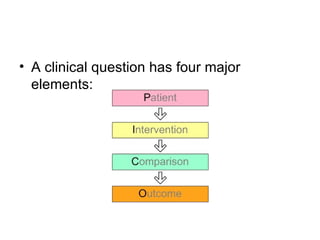
Come formulare il quesito Il miglior modo per struttura la domanda è usare l’acronimo  PICO : P  per paziente I  per Intervento C  per Comparison (confronto) non sempre necessario O  per Outcome
Scenario precedente Bambino con Bronchiolite La nostra domanda dovrebbe essere: In un lattante con Bronchiolite (paziente) in Surfactant (Intervento) comparato al placebo (Comparison) porta ad una riduzione della degenza in Terapia Intensiva (outcome)?
Formulating a Clinical Question Objectives: From this tutorial you will learn: The impact of the clinical question on EBM research  The key elements of a clinical question  How to form an answerable clinical question  The role of the clinical question in the overall EBM process
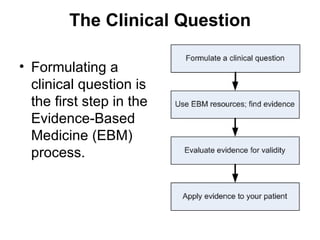
The Clinical Question Formulating a clinical question is the first step in the Evidence-Based Medicine (EBM) process.
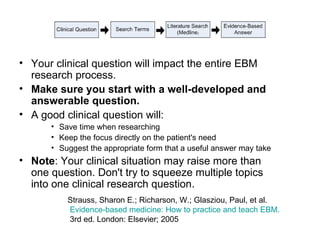
Your clinical question will impact the entire EBM research process. Make sure you start with a well-developed and answerable question. A good clinical question will: Save time when researching  Keep the focus directly on the patient's need  Suggest the appropriate form that a useful answer may take  Note : Your clinical situation may raise more than one question. Don't try to squeeze multiple topics into one clinical research question. Strauss, Sharon E.; Richarson, W.; Glasziou, Paul, et al. Evidence-based  medicine:  How   to   practice  and  teach  EBM. 3rd ed. London: Elsevier; 2005
The Clinical Question You examine a five-year old Asian American female, Junko Morioka, in your office and determine that she is suffering from Acute Otitis Media.  Her mother mentions that Junko seems to get these ear infections every once and a while and that sometimes they "just go away" and other times Junko seems to need antibiotics.  Junko's mother is worried about Junko developing a resistance to all these antibiotics and wonders aloud if antibiotics are really necessary. Formulate a question you might research for the case above
A clinical question has four major elements:
Who is your patient?   A clinical question must identify a patient or patient group. Additionally a clinical question should include any information that is relevant to the treatment or diagnosis or the patient.  For example, you might include the patient's:  Sex, age or race  Disease History  Primary Complaint

Non ti resta che cercare, se

  • 1.
    ..non ti restache cercare, se vuoi trovare qualcosa…..
  • 2.
    EBM L’ Evidencebased medicine (EBM) consiste in 4 processi separati: Formulare il quesito clinico Trovare le evidenze Valutare e Sintetizzare le Evidenze Applicare le Evidenze
  • 3.
    Scenario possibile Seidi fronte ad un lattante di 2 mesi (ex prematuro con DIV), ricoverato in PICU ( Unità di Terapia Intensiva Pediatrica) per Bronchiolite da VRS Lo specializzando che lo ha visitato ricorda di aver sentiuto che in tale situazione dovrebbe essere somministrato il Surfactant, ma non ricorda i dettagli Il medico di reparto prende il Nelson ( vecchia edizione) che non fa cenno a cosa fare Va al computer e digita “bronchiolite” e “ surfactant” con Google La ricerca dà esito a 29.000 voci, ha poco tempo ma fortunatamente la prima citazione sembra essere rilevante: è una Cochrane Review
  • 4.
    Come formulare ilquesito Il miglior modo per struttura la domanda è usare l’acronimo PICO : P per paziente I per Intervento C per Comparison (confronto) non sempre necessario O per Outcome
  • 5.
    Scenario precedente Bambinocon Bronchiolite La nostra domanda dovrebbe essere: In un lattante con Bronchiolite (paziente) in Surfactant (Intervento) comparato al placebo (Comparison) porta ad una riduzione della degenza in Terapia Intensiva (outcome)?
  • 6.
    Formulating a ClinicalQuestion Objectives: From this tutorial you will learn: The impact of the clinical question on EBM research The key elements of a clinical question How to form an answerable clinical question The role of the clinical question in the overall EBM process
  • 7.
    The Clinical QuestionFormulating a clinical question is the first step in the Evidence-Based Medicine (EBM) process.
  • 8.
    Your clinical questionwill impact the entire EBM research process. Make sure you start with a well-developed and answerable question. A good clinical question will: Save time when researching Keep the focus directly on the patient's need Suggest the appropriate form that a useful answer may take Note : Your clinical situation may raise more than one question. Don't try to squeeze multiple topics into one clinical research question. Strauss, Sharon E.; Richarson, W.; Glasziou, Paul, et al. Evidence-based medicine: How to practice and teach EBM. 3rd ed. London: Elsevier; 2005
  • 9.
    The Clinical QuestionYou examine a five-year old Asian American female, Junko Morioka, in your office and determine that she is suffering from Acute Otitis Media. Her mother mentions that Junko seems to get these ear infections every once and a while and that sometimes they "just go away" and other times Junko seems to need antibiotics. Junko's mother is worried about Junko developing a resistance to all these antibiotics and wonders aloud if antibiotics are really necessary. Formulate a question you might research for the case above
  • 10.
    A clinical questionhas four major elements:
  • 11.
    Who is yourpatient? A clinical question must identify a patient or patient group. Additionally a clinical question should include any information that is relevant to the treatment or diagnosis or the patient. For example, you might include the patient's: Sex, age or race Disease History Primary Complaint