WCB/McGraw-Hill © The McGraw-Hill Companies, Inc.,1998
Thermodynamics
Çengel
Boles
Third Edition
Thermodynamics
An Engineering
Approach
Third Edition
Yunus A. Çengel
Michael A. Boles
WCB/McGraw-Hill © The McGraw-Hill Companies, Inc.,1998
Thermodynamics
Çengel
Boles
Third Edition
1
CHAPTER
Basic
Concepts of
Thermodynamics
WCB/McGraw-Hill © The McGraw-Hill Companies, Inc.,1998
Thermodynamics
Çengel
Boles
Third Edition
What is thermodynamics?
• The study of thermodynamics is concerned with ways energy
is stored within a body and how energy transformations,
which involve heat and work, may take place.
• Approaches to studying thermodynamics
– Macroscopic (Classical thermodynamics)
• study large number of particles (molecules) that make up the
substance in question
• does not require knowledge of the behavior of individual
molecules
– Microscopic (Statistical thermodynamics)
• concerned within behavior of individual particles (molecules)
• study average behavior of large groups of individual particles
WCB/McGraw-Hill © The McGraw-Hill Companies, Inc.,1998
Thermodynamics
Çengel
Boles
Third Edition
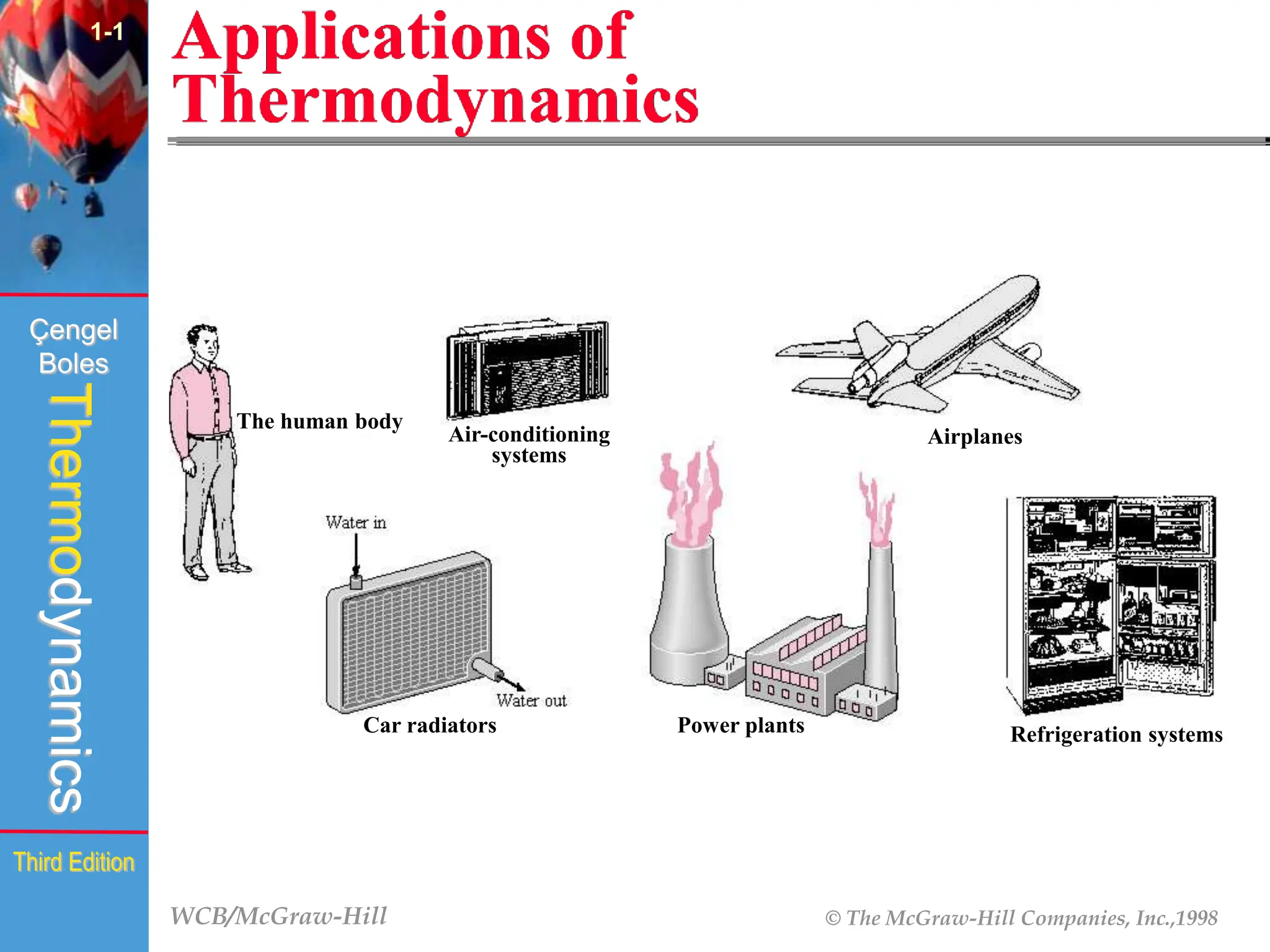
Applications of
Thermodynamics
1-1
Power plants
The human body
Air-conditioning
systems
Airplanes
Car radiators Refrigeration systems
WCB/McGraw-Hill © The McGraw-Hill Companies, Inc.,1998
Thermodynamics
Çengel
Boles
Third Edition
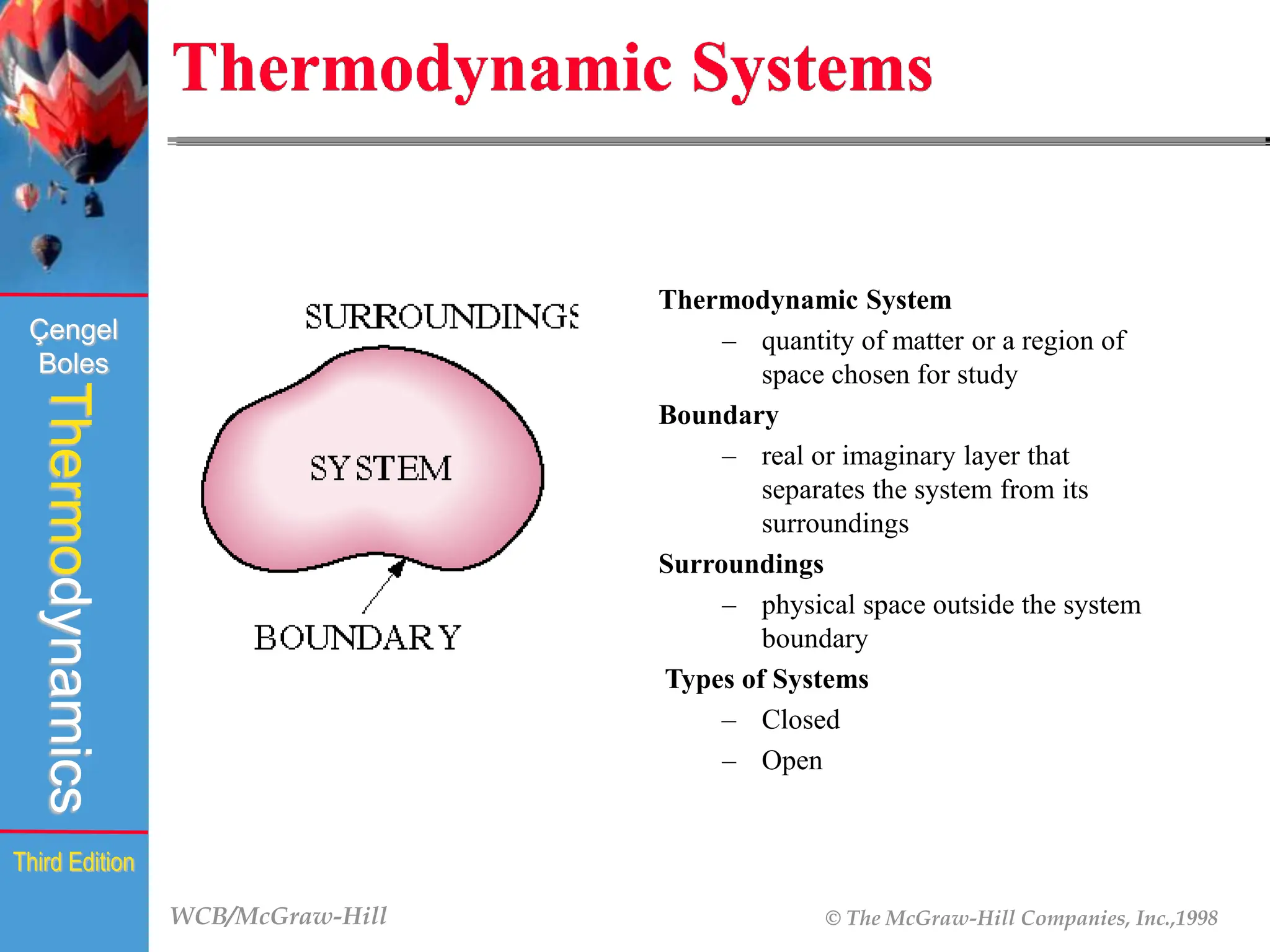
Thermodynamic Systems
Thermodynamic System
– quantity of matter or a region of
space chosen for study
Boundary
– real or imaginary layer that
separates the system from its
surroundings
Surroundings
– physical space outside the system
boundary
Types of Systems
– Closed
– Open
WCB/McGraw-Hill © The McGraw-Hill Companies, Inc.,1998
Thermodynamics
Çengel
Boles
Third Edition
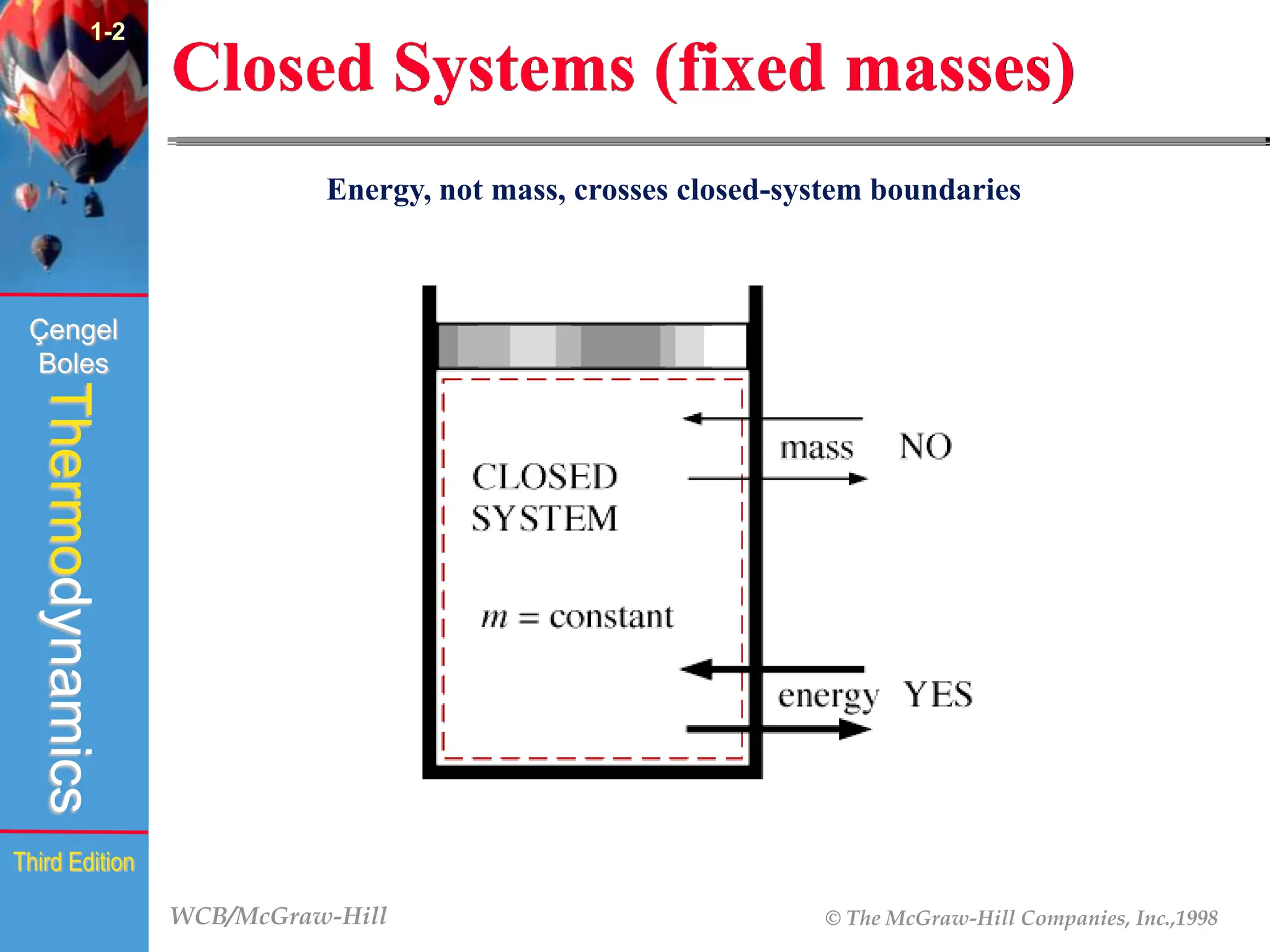
Closed Systems (fixed masses)
1-2
(Fig. 1-13)
Energy, not mass, crosses closed-system boundaries
WCB/McGraw-Hill © The McGraw-Hill Companies, Inc.,1998
Thermodynamics
Çengel
Boles
Third Edition
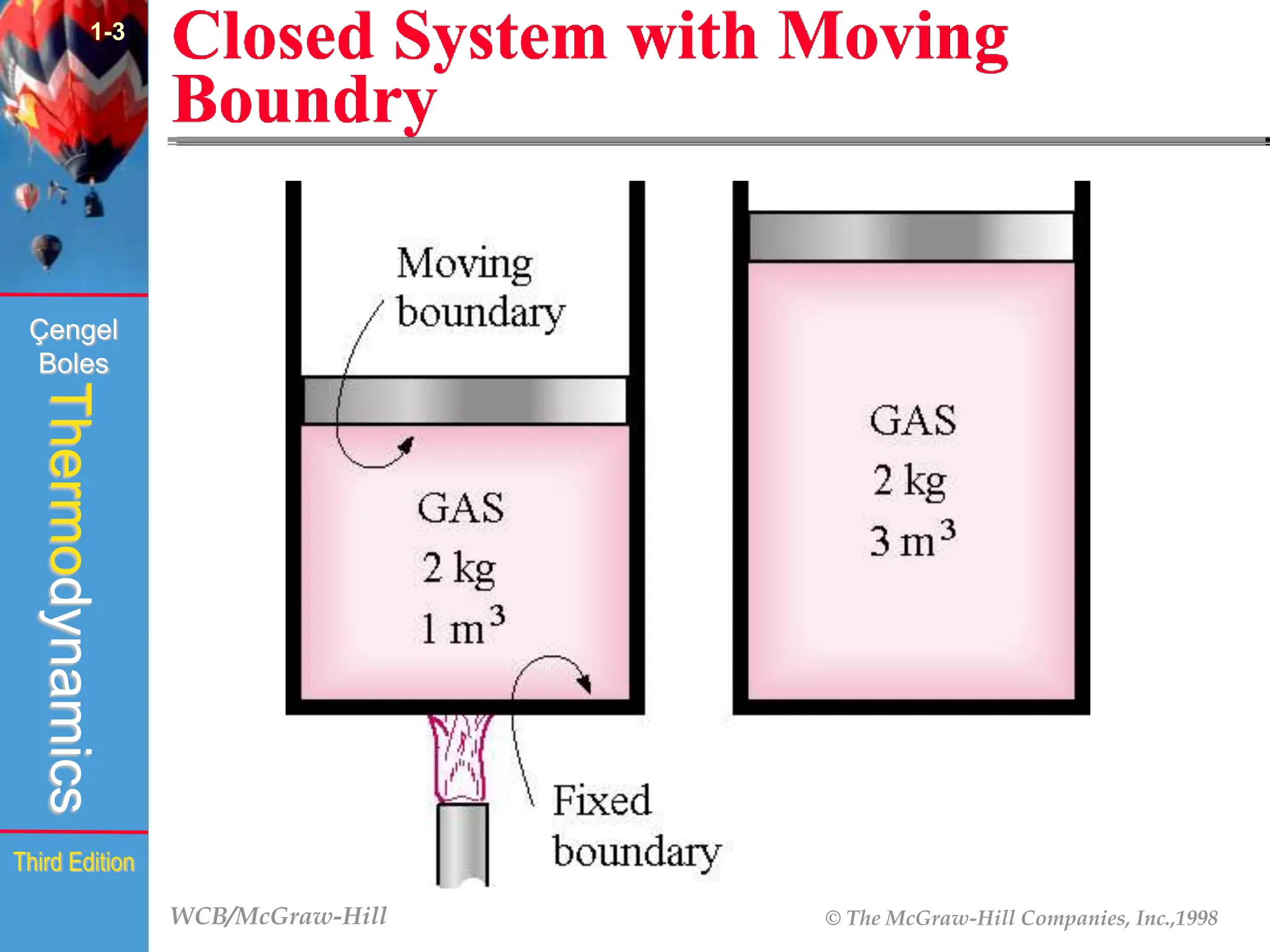
Closed System with Moving
Boundry
1-3
WCB/McGraw-Hill © The McGraw-Hill Companies, Inc.,1998
Thermodynamics
Çengel
Boles
Third Edition
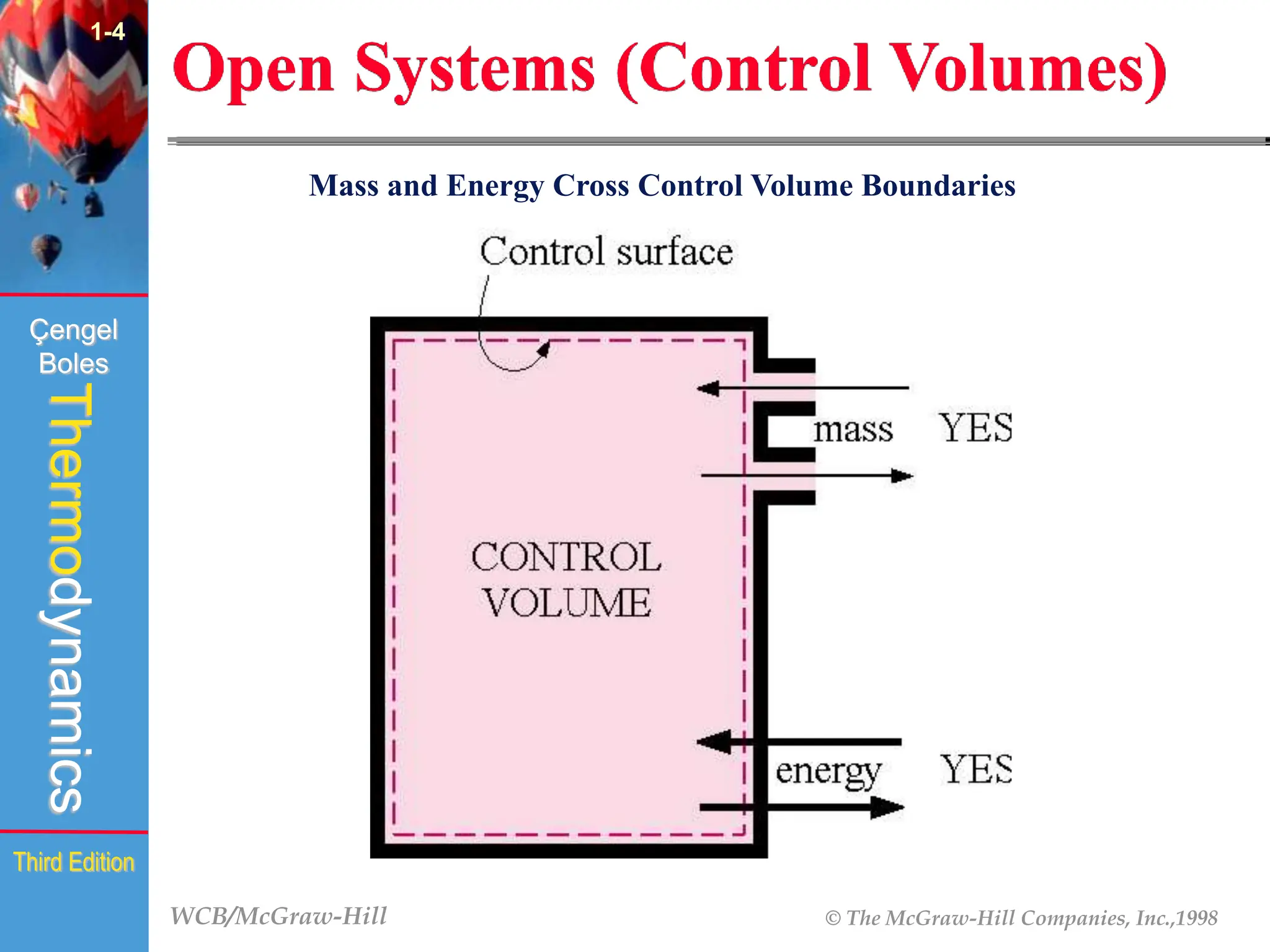
Open Systems (Control Volumes)
1-4
Mass and Energy Cross Control Volume Boundaries
WCB/McGraw-Hill © The McGraw-Hill Companies, Inc.,1998
Thermodynamics
Çengel
Boles
Third Edition
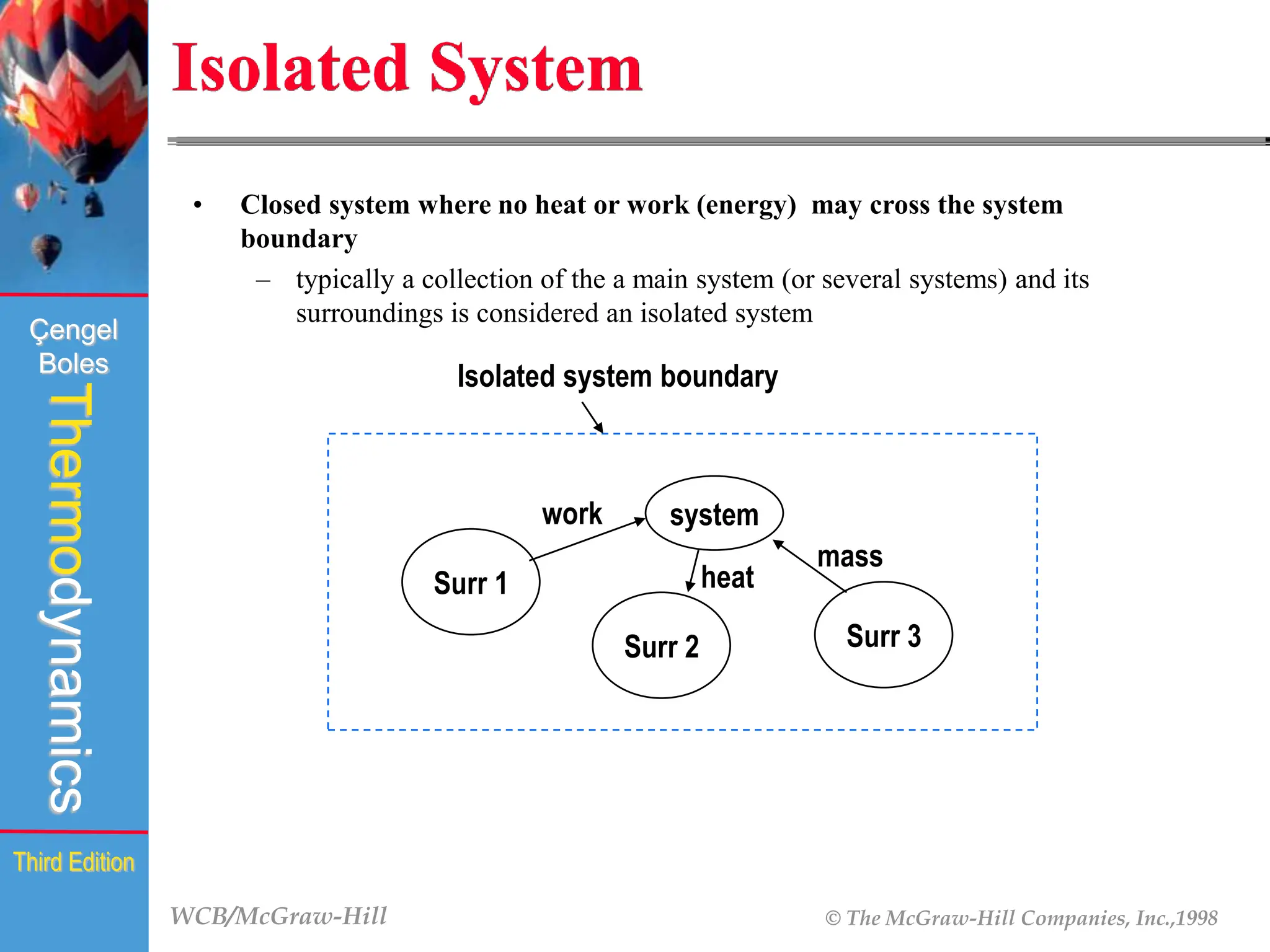
Isolated System
• Closed system where no heat or work (energy) may cross the system
boundary
– typically a collection of the a main system (or several systems) and its
surroundings is considered an isolated system
Surr 1
system
Surr 3
Surr 2
mass
heat
work
Isolated system boundary
WCB/McGraw-Hill © The McGraw-Hill Companies, Inc.,1998
Thermodynamics
Çengel
Boles
Third Edition
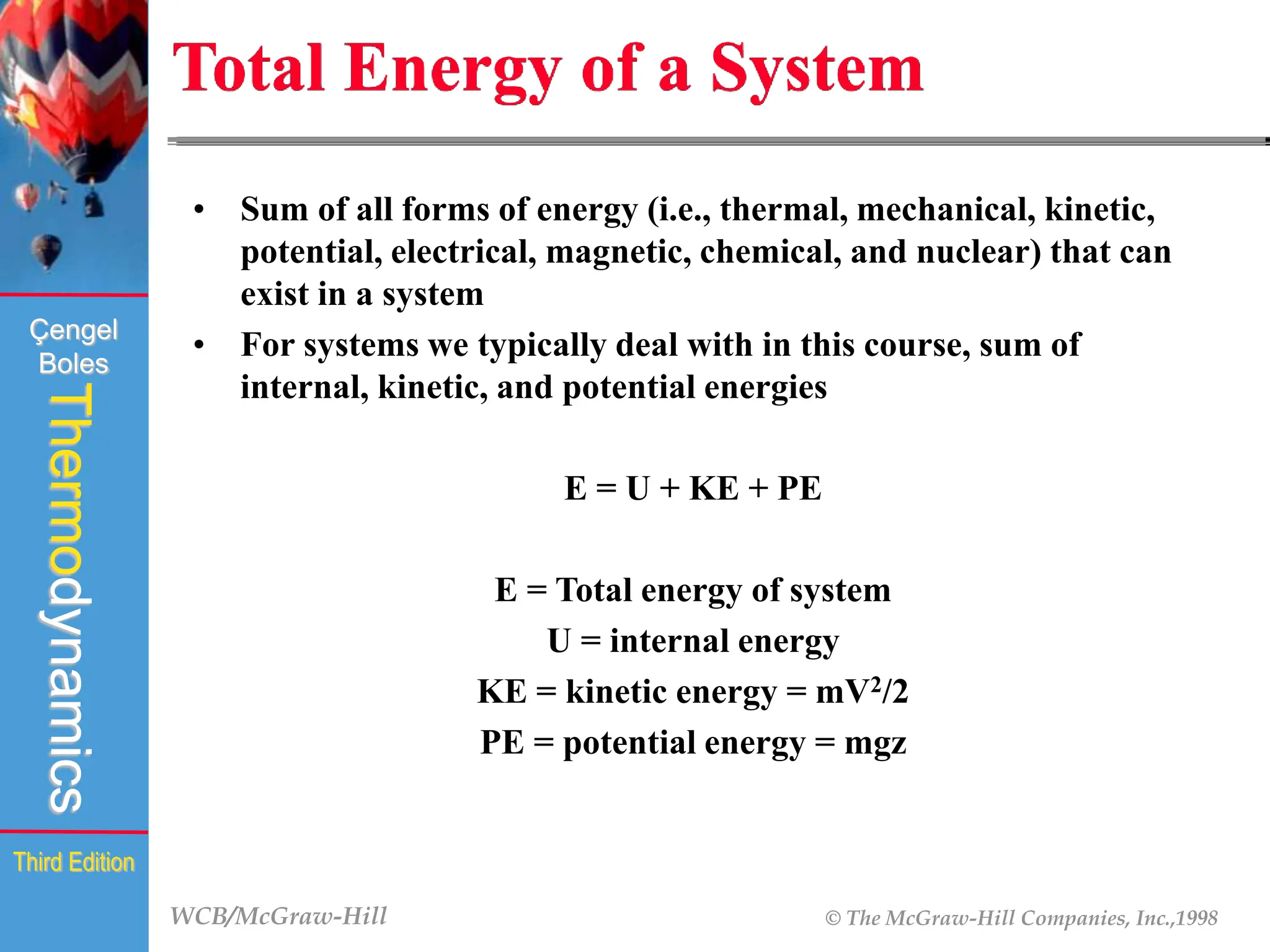
Total Energy of a System
• Sum of all forms of energy (i.e., thermal, mechanical, kinetic,
potential, electrical, magnetic, chemical, and nuclear) that can
exist in a system
• For systems we typically deal with in this course, sum of
internal, kinetic, and potential energies
E = U + KE + PE
E = Total energy of system
U = internal energy
KE = kinetic energy = mV2/2
PE = potential energy = mgz
WCB/McGraw-Hill © The McGraw-Hill Companies, Inc.,1998
Thermodynamics
Çengel
Boles
Third Edition
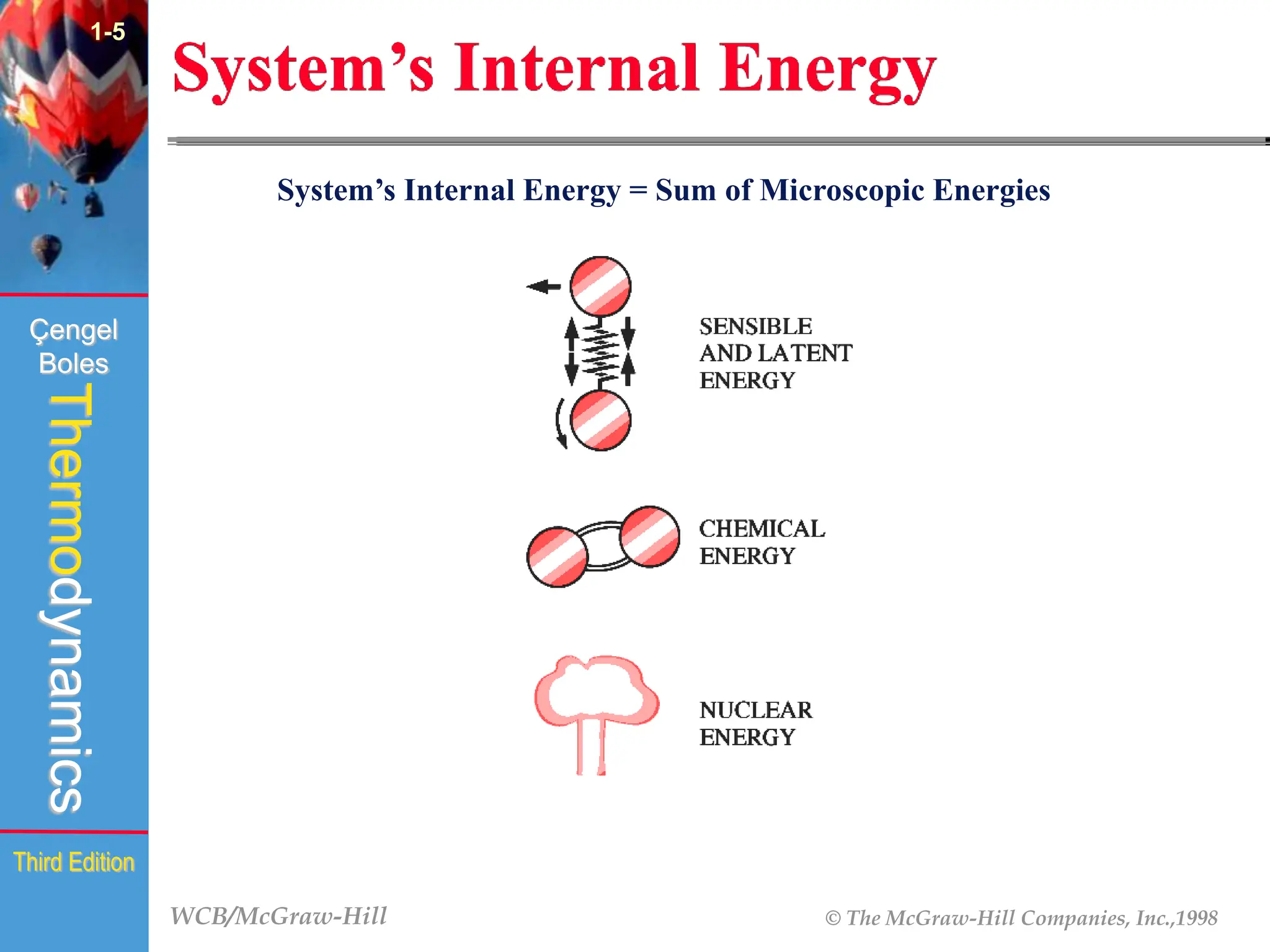
System’s Internal Energy
(Fig. 1-19)
1-5
System’s Internal Energy = Sum of Microscopic Energies
WCB/McGraw-Hill © The McGraw-Hill Companies, Inc.,1998
Thermodynamics
Çengel
Boles
Third Edition
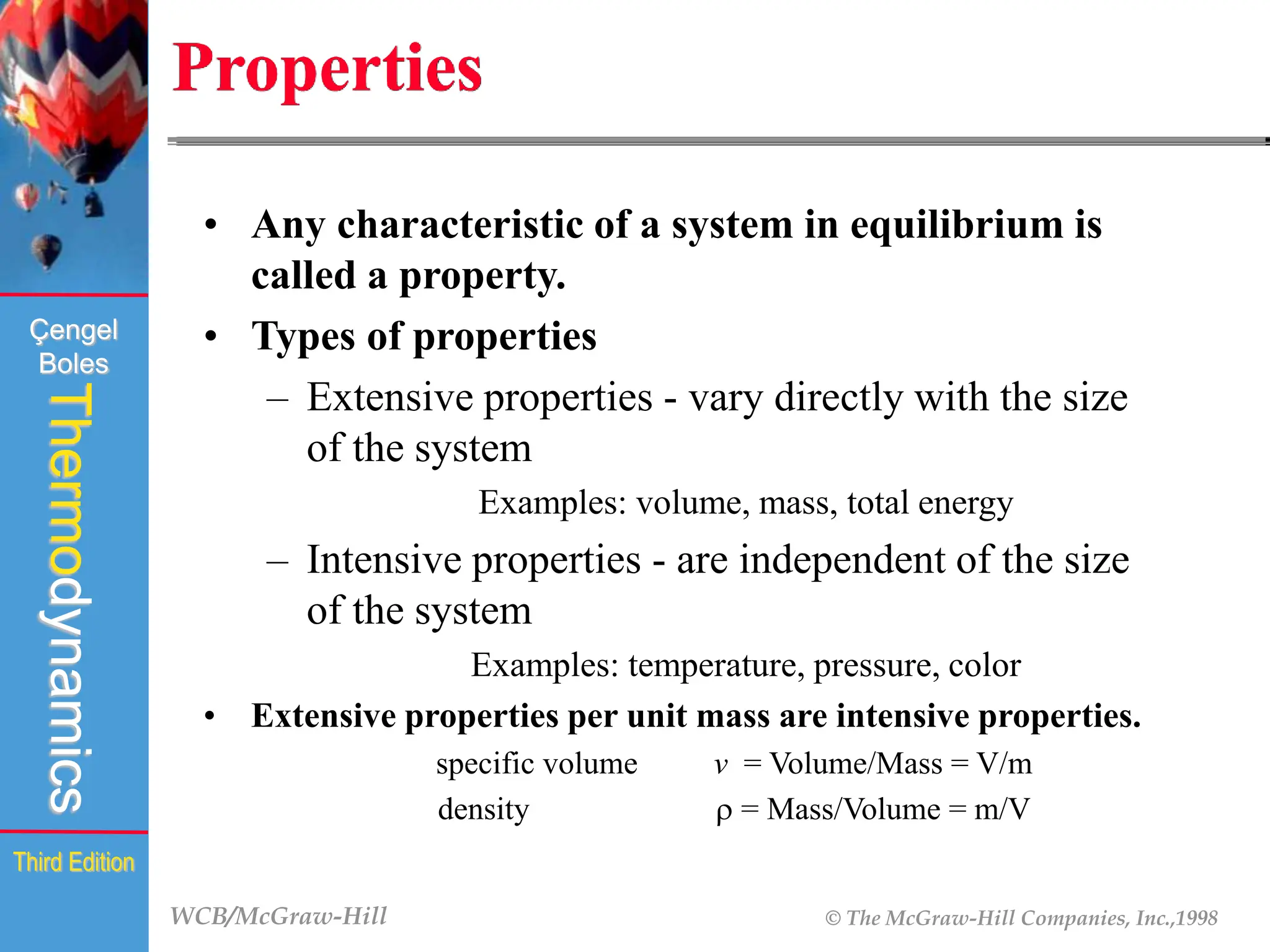
Properties
• Any characteristic of a system in equilibrium is
called a property.
• Types of properties
– Extensive properties - vary directly with the size
of the system
Examples: volume, mass, total energy
– Intensive properties - are independent of the size
of the system
Examples: temperature, pressure, color
• Extensive properties per unit mass are intensive properties.
specific volume v = Volume/Mass = V/m
density r = Mass/Volume = m/V
WCB/McGraw-Hill © The McGraw-Hill Companies, Inc.,1998
Thermodynamics
Çengel
Boles
Third Edition
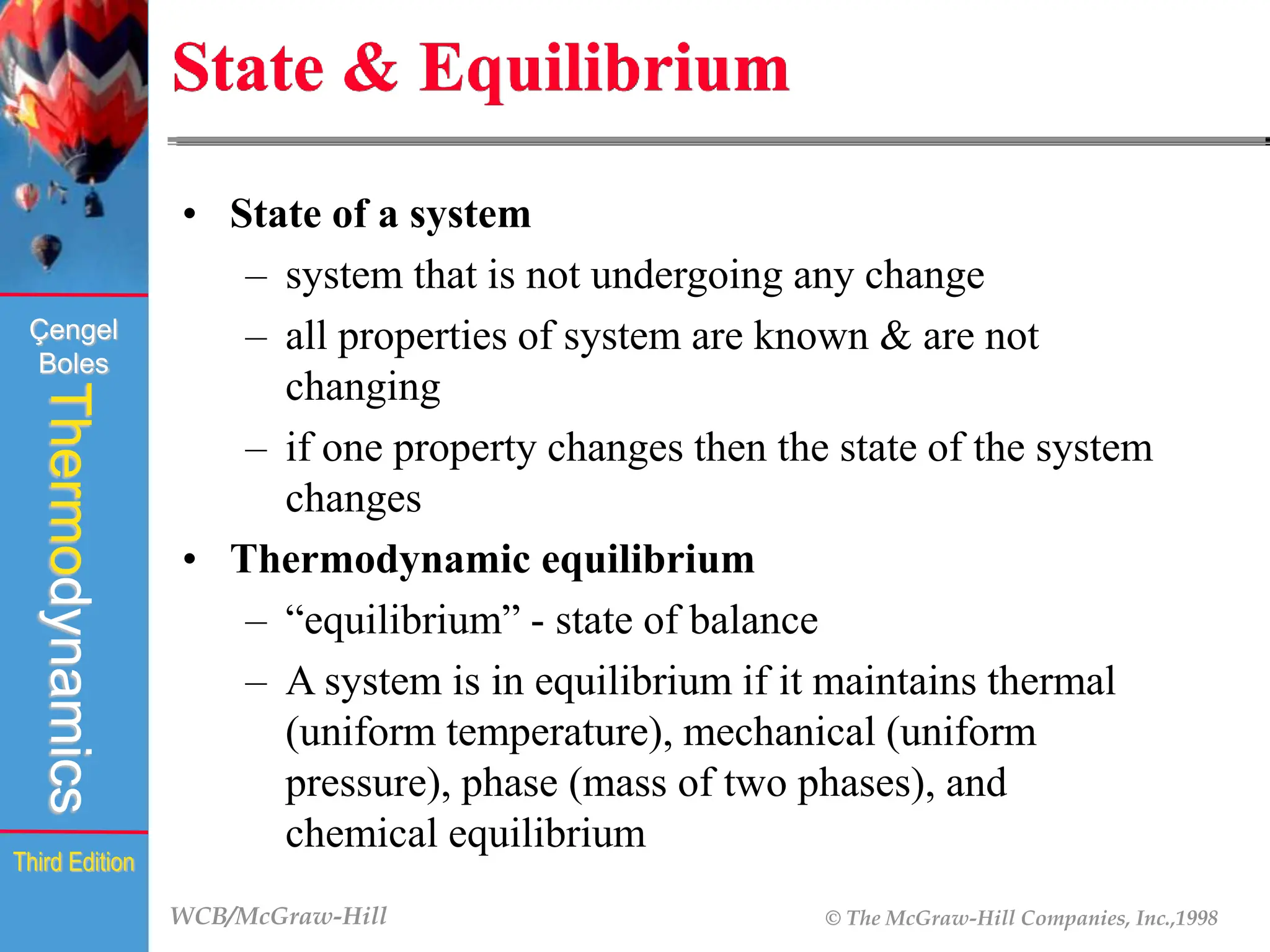
State & Equilibrium
• State of a system
– system that is not undergoing any change
– all properties of system are known & are not
changing
– if one property changes then the state of the system
changes
• Thermodynamic equilibrium
– “equilibrium” - state of balance
– A system is in equilibrium if it maintains thermal
(uniform temperature), mechanical (uniform
pressure), phase (mass of two phases), and
chemical equilibrium
WCB/McGraw-Hill © The McGraw-Hill Companies, Inc.,1998
Thermodynamics
Çengel
Boles
Third Edition
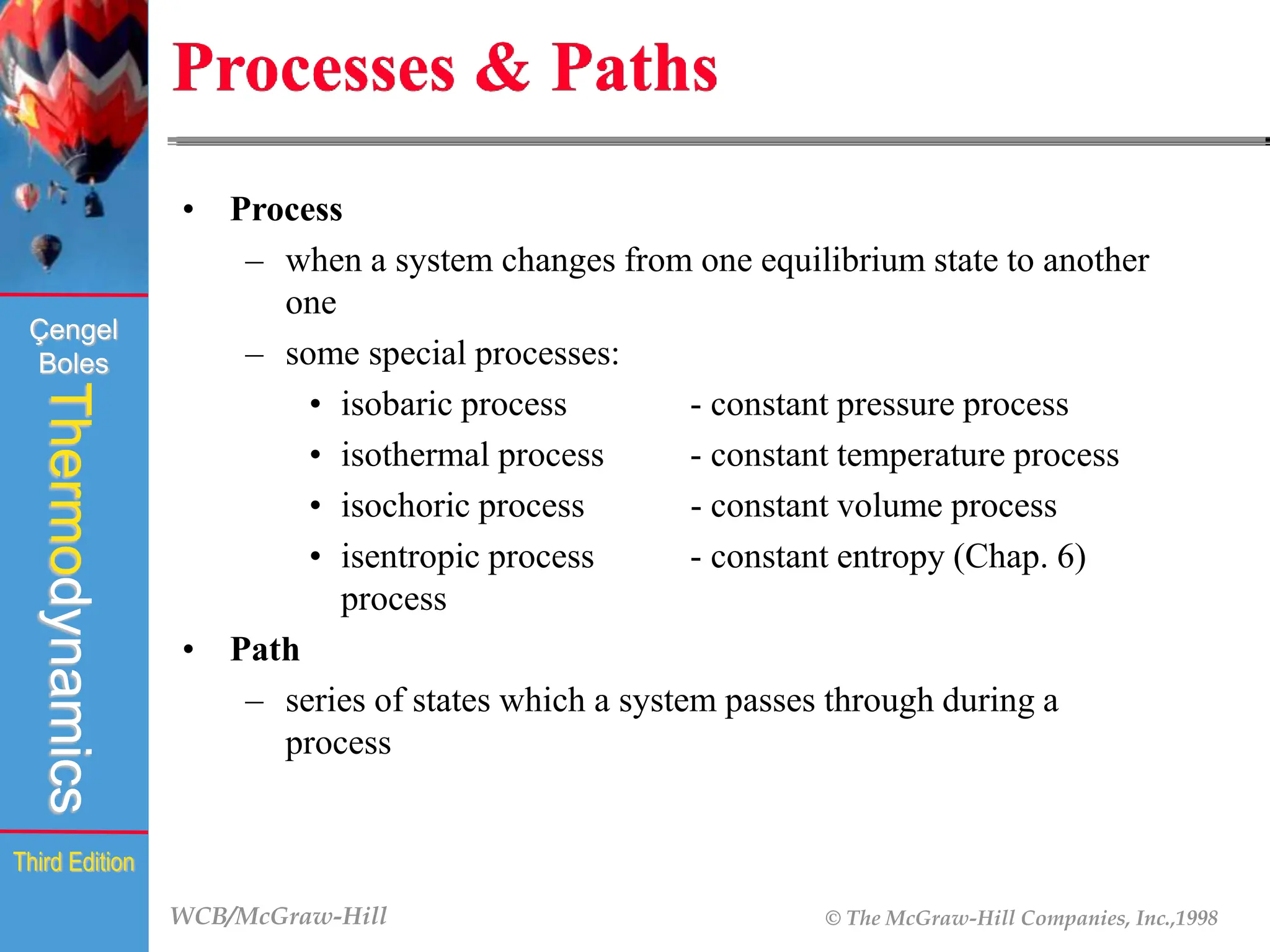
Processes & Paths
• Process
– when a system changes from one equilibrium state to another
one
– some special processes:
• isobaric process - constant pressure process
• isothermal process - constant temperature process
• isochoric process - constant volume process
• isentropic process - constant entropy (Chap. 6)
process
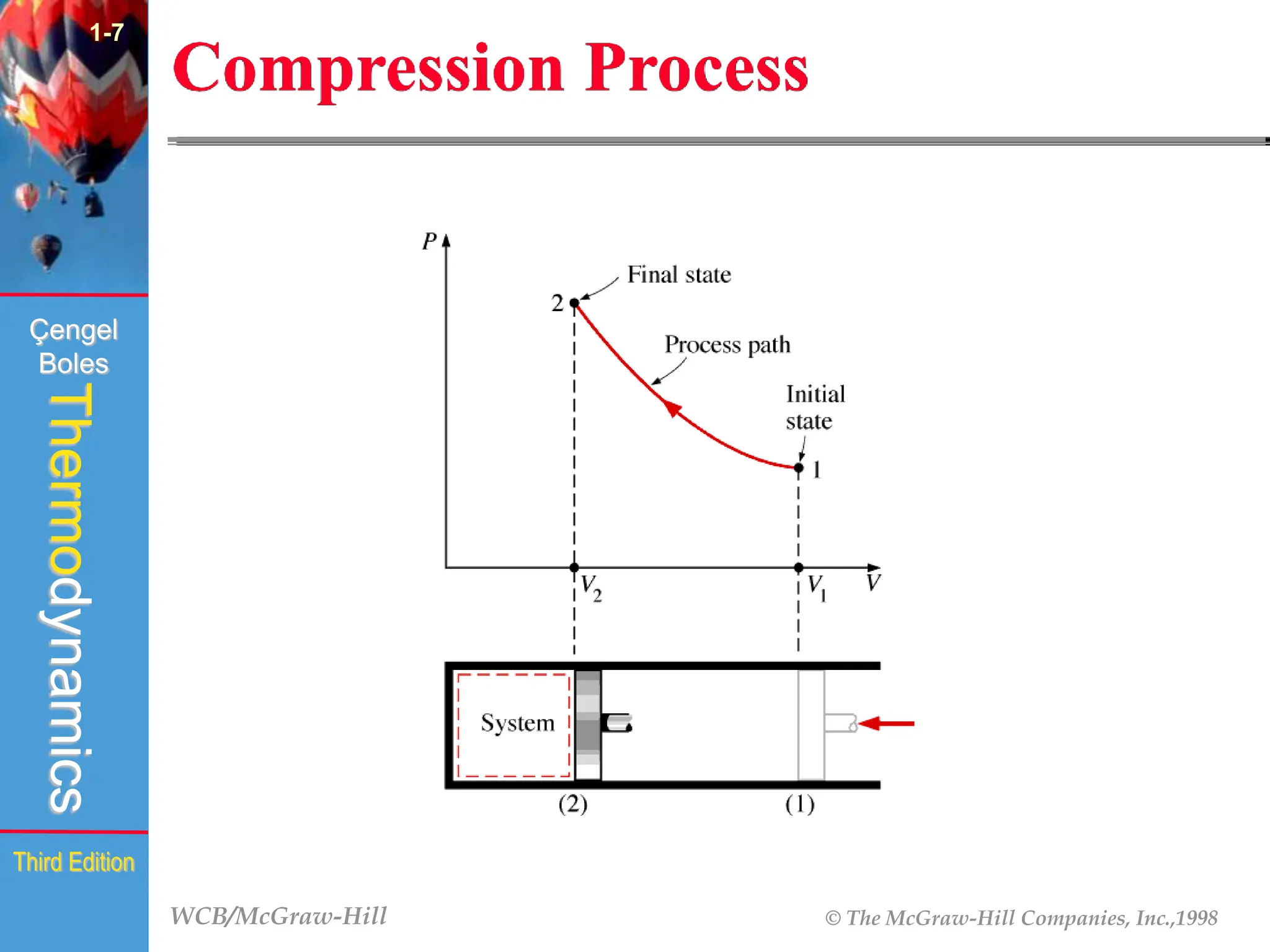
• Path
– series of states which a system passes through during a
process
WCB/McGraw-Hill © The McGraw-Hill Companies, Inc.,1998
Thermodynamics
Çengel
Boles
Third Edition
Compression Process
1-7
WCB/McGraw-Hill © The McGraw-Hill Companies, Inc.,1998
Thermodynamics
Çengel
Boles
Third Edition
1-6
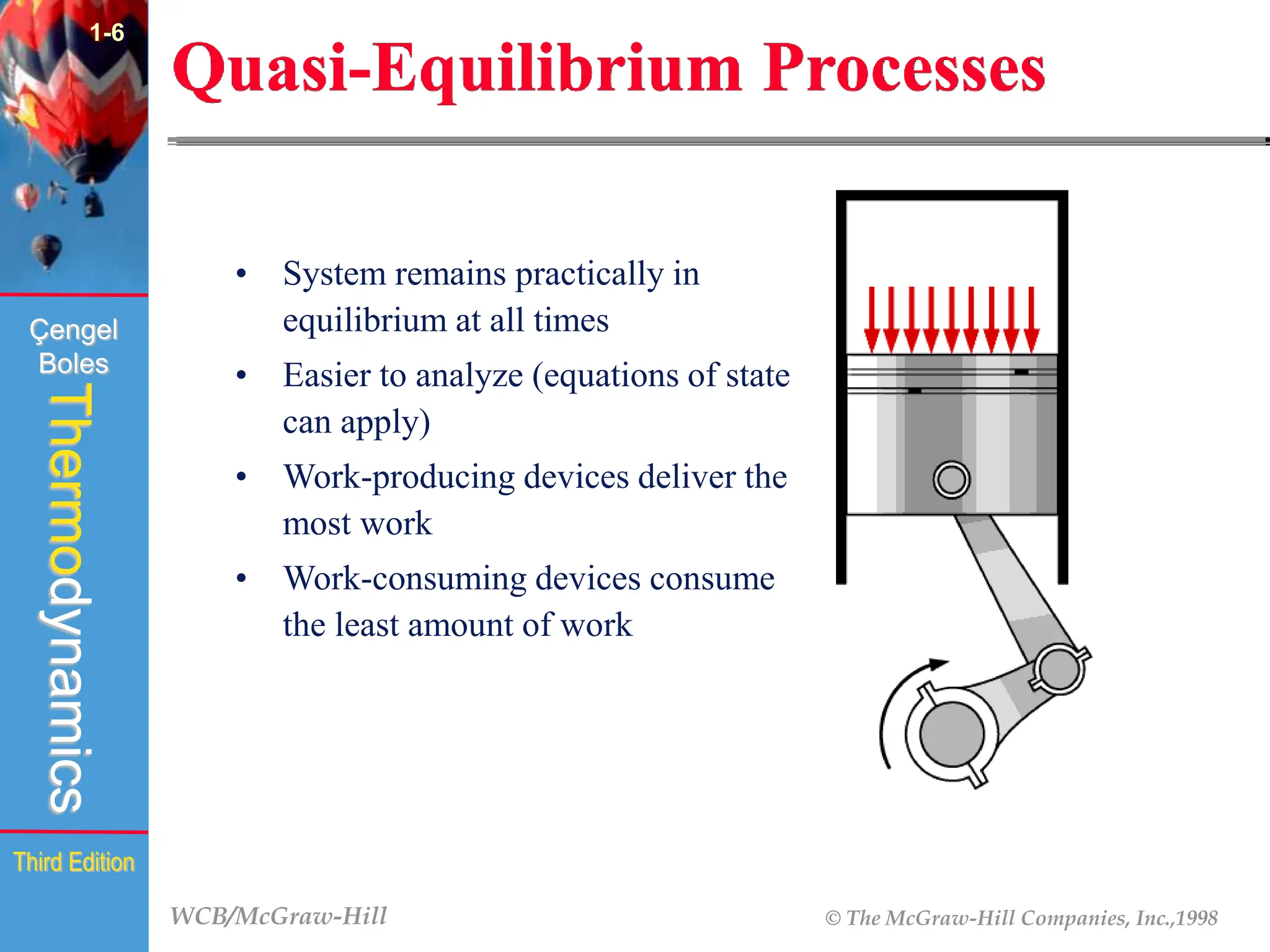
Quasi-Equilibrium Processes
• System remains practically in
equilibrium at all times
• Easier to analyze (equations of state
can apply)
• Work-producing devices deliver the
most work
• Work-consuming devices consume
the least amount of work
WCB/McGraw-Hill © The McGraw-Hill Companies, Inc.,1998
Thermodynamics
Çengel
Boles
Third Edition
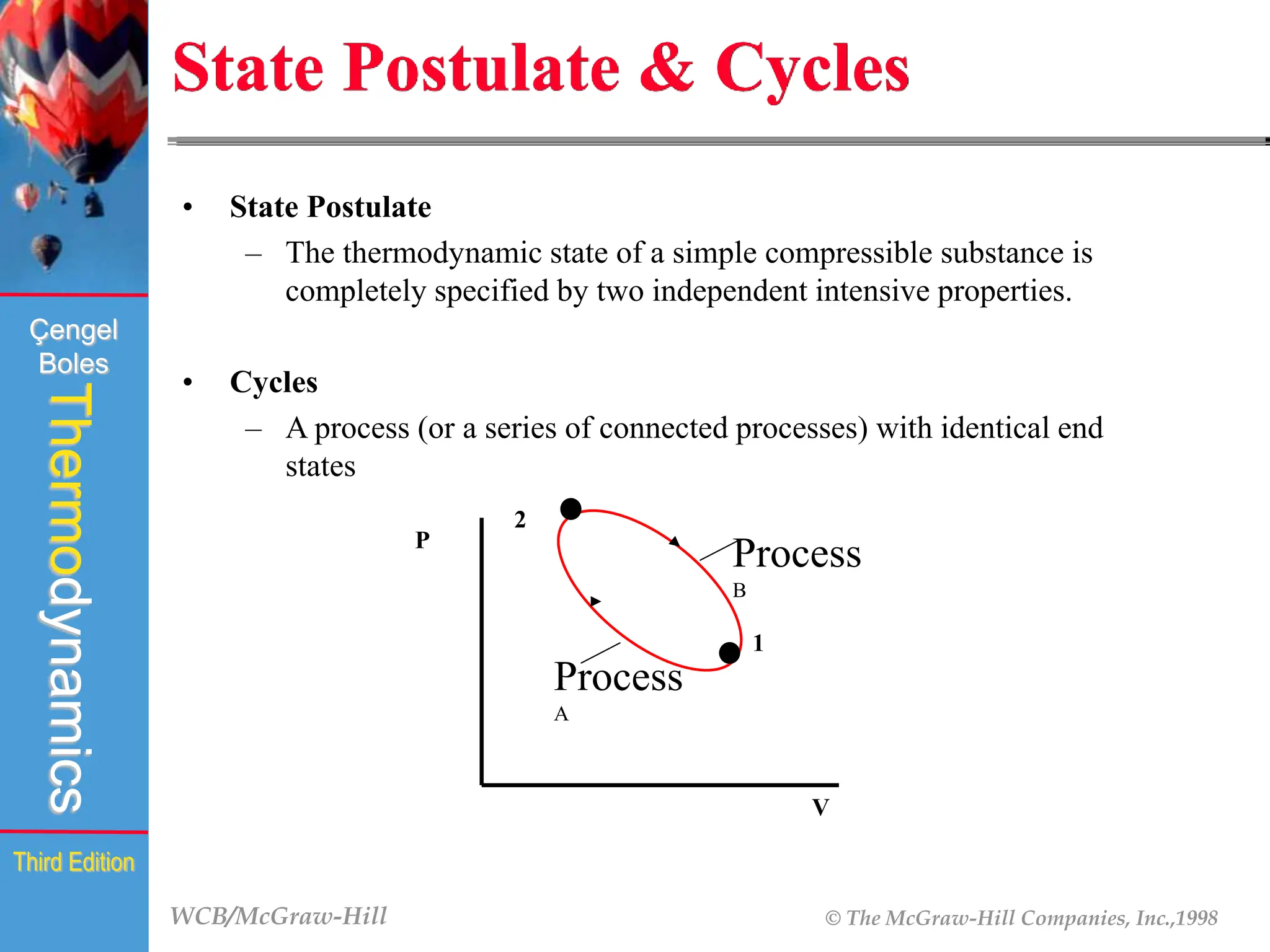
State Postulate & Cycles
• State Postulate
– The thermodynamic state of a simple compressible substance is
completely specified by two independent intensive properties.
• Cycles
– A process (or a series of connected processes) with identical end
states
Process
B
Process
A
1
2
P
V

non-homogeneous thermodynamic systems of the fourth order.ppt

  • 1.
    WCB/McGraw-Hill © TheMcGraw-Hill Companies, Inc.,1998 Thermodynamics Çengel Boles Third Edition Thermodynamics An Engineering Approach Third Edition Yunus A. Çengel Michael A. Boles WCB/McGraw-Hill © The McGraw-Hill Companies, Inc.,1998
  • 2.
    WCB/McGraw-Hill © TheMcGraw-Hill Companies, Inc.,1998 Thermodynamics Çengel Boles Third Edition 1 CHAPTER Basic Concepts of Thermodynamics
  • 3.
    WCB/McGraw-Hill © TheMcGraw-Hill Companies, Inc.,1998 Thermodynamics Çengel Boles Third Edition What is thermodynamics? • The study of thermodynamics is concerned with ways energy is stored within a body and how energy transformations, which involve heat and work, may take place. • Approaches to studying thermodynamics – Macroscopic (Classical thermodynamics) • study large number of particles (molecules) that make up the substance in question • does not require knowledge of the behavior of individual molecules – Microscopic (Statistical thermodynamics) • concerned within behavior of individual particles (molecules) • study average behavior of large groups of individual particles
  • 4.
    WCB/McGraw-Hill © TheMcGraw-Hill Companies, Inc.,1998 Thermodynamics Çengel Boles Third Edition Applications of Thermodynamics 1-1 Power plants The human body Air-conditioning systems Airplanes Car radiators Refrigeration systems
  • 5.
    WCB/McGraw-Hill © TheMcGraw-Hill Companies, Inc.,1998 Thermodynamics Çengel Boles Third Edition Thermodynamic Systems Thermodynamic System – quantity of matter or a region of space chosen for study Boundary – real or imaginary layer that separates the system from its surroundings Surroundings – physical space outside the system boundary Types of Systems – Closed – Open
  • 6.
    WCB/McGraw-Hill © TheMcGraw-Hill Companies, Inc.,1998 Thermodynamics Çengel Boles Third Edition Closed Systems (fixed masses) 1-2 (Fig. 1-13) Energy, not mass, crosses closed-system boundaries
  • 7.
    WCB/McGraw-Hill © TheMcGraw-Hill Companies, Inc.,1998 Thermodynamics Çengel Boles Third Edition Closed System with Moving Boundry 1-3
  • 8.
    WCB/McGraw-Hill © TheMcGraw-Hill Companies, Inc.,1998 Thermodynamics Çengel Boles Third Edition Open Systems (Control Volumes) 1-4 Mass and Energy Cross Control Volume Boundaries
  • 9.
    WCB/McGraw-Hill © TheMcGraw-Hill Companies, Inc.,1998 Thermodynamics Çengel Boles Third Edition Isolated System • Closed system where no heat or work (energy) may cross the system boundary – typically a collection of the a main system (or several systems) and its surroundings is considered an isolated system Surr 1 system Surr 3 Surr 2 mass heat work Isolated system boundary
  • 10.
    WCB/McGraw-Hill © TheMcGraw-Hill Companies, Inc.,1998 Thermodynamics Çengel Boles Third Edition Total Energy of a System • Sum of all forms of energy (i.e., thermal, mechanical, kinetic, potential, electrical, magnetic, chemical, and nuclear) that can exist in a system • For systems we typically deal with in this course, sum of internal, kinetic, and potential energies E = U + KE + PE E = Total energy of system U = internal energy KE = kinetic energy = mV2/2 PE = potential energy = mgz
  • 11.
    WCB/McGraw-Hill © TheMcGraw-Hill Companies, Inc.,1998 Thermodynamics Çengel Boles Third Edition System’s Internal Energy (Fig. 1-19) 1-5 System’s Internal Energy = Sum of Microscopic Energies
  • 12.
    WCB/McGraw-Hill © TheMcGraw-Hill Companies, Inc.,1998 Thermodynamics Çengel Boles Third Edition Properties • Any characteristic of a system in equilibrium is called a property. • Types of properties – Extensive properties - vary directly with the size of the system Examples: volume, mass, total energy – Intensive properties - are independent of the size of the system Examples: temperature, pressure, color • Extensive properties per unit mass are intensive properties. specific volume v = Volume/Mass = V/m density r = Mass/Volume = m/V
  • 13.
    WCB/McGraw-Hill © TheMcGraw-Hill Companies, Inc.,1998 Thermodynamics Çengel Boles Third Edition State & Equilibrium • State of a system – system that is not undergoing any change – all properties of system are known & are not changing – if one property changes then the state of the system changes • Thermodynamic equilibrium – “equilibrium” - state of balance – A system is in equilibrium if it maintains thermal (uniform temperature), mechanical (uniform pressure), phase (mass of two phases), and chemical equilibrium
  • 14.
    WCB/McGraw-Hill © TheMcGraw-Hill Companies, Inc.,1998 Thermodynamics Çengel Boles Third Edition Processes & Paths • Process – when a system changes from one equilibrium state to another one – some special processes: • isobaric process - constant pressure process • isothermal process - constant temperature process • isochoric process - constant volume process • isentropic process - constant entropy (Chap. 6) process • Path – series of states which a system passes through during a process
  • 15.
    WCB/McGraw-Hill © TheMcGraw-Hill Companies, Inc.,1998 Thermodynamics Çengel Boles Third Edition Compression Process 1-7
  • 16.
    WCB/McGraw-Hill © TheMcGraw-Hill Companies, Inc.,1998 Thermodynamics Çengel Boles Third Edition 1-6 Quasi-Equilibrium Processes • System remains practically in equilibrium at all times • Easier to analyze (equations of state can apply) • Work-producing devices deliver the most work • Work-consuming devices consume the least amount of work
  • 17.
    WCB/McGraw-Hill © TheMcGraw-Hill Companies, Inc.,1998 Thermodynamics Çengel Boles Third Edition State Postulate & Cycles • State Postulate – The thermodynamic state of a simple compressible substance is completely specified by two independent intensive properties. • Cycles – A process (or a series of connected processes) with identical end states Process B Process A 1 2 P V