IIT (BHU), Varanasi
Engineering Thermodynamics
(ME-103)
Date: 6th July 2022
Basics of Thermodynamics
Dr. Akhilendra Pratap Singh
Department of Mechanical Engineering
IIT (BHU), Varanasi, India
Email: akhilendra.mec@itbhu.ac.in
Thermodynamics
Recap: Thermodynamics and Energy
Thermodynamics: The science of energy.
Energy: The ability to cause changes (tangible or intangible).
The name thermodynamics stems from the Greek words therme (heat) and
dynamis (power).
Conservation of Energy Principle: Energy cannot be created or destroyed.
During an interaction, energy can change from one form to another but the total
amount of energy remains constant.
The First Law of Thermodynamics: An expression of the conservation of energy
principle. The first law asserts that energy is a thermodynamic property.
The second law of thermodynamics: It asserts that energy has quality as well as
quantity, and actual processes occur in the direction of decreasing quality of energy.
Classical Thermodynamics: A macroscopic approach to the study of
thermodynamics that does not require a knowledge of the behavior of individual
particles. It provides a direct and easy way to the solution of engineering problems.
Statistical Thermodynamics: A microscopic approach, based on the average
behavior of large groups of individual particles.
Thermodynamics
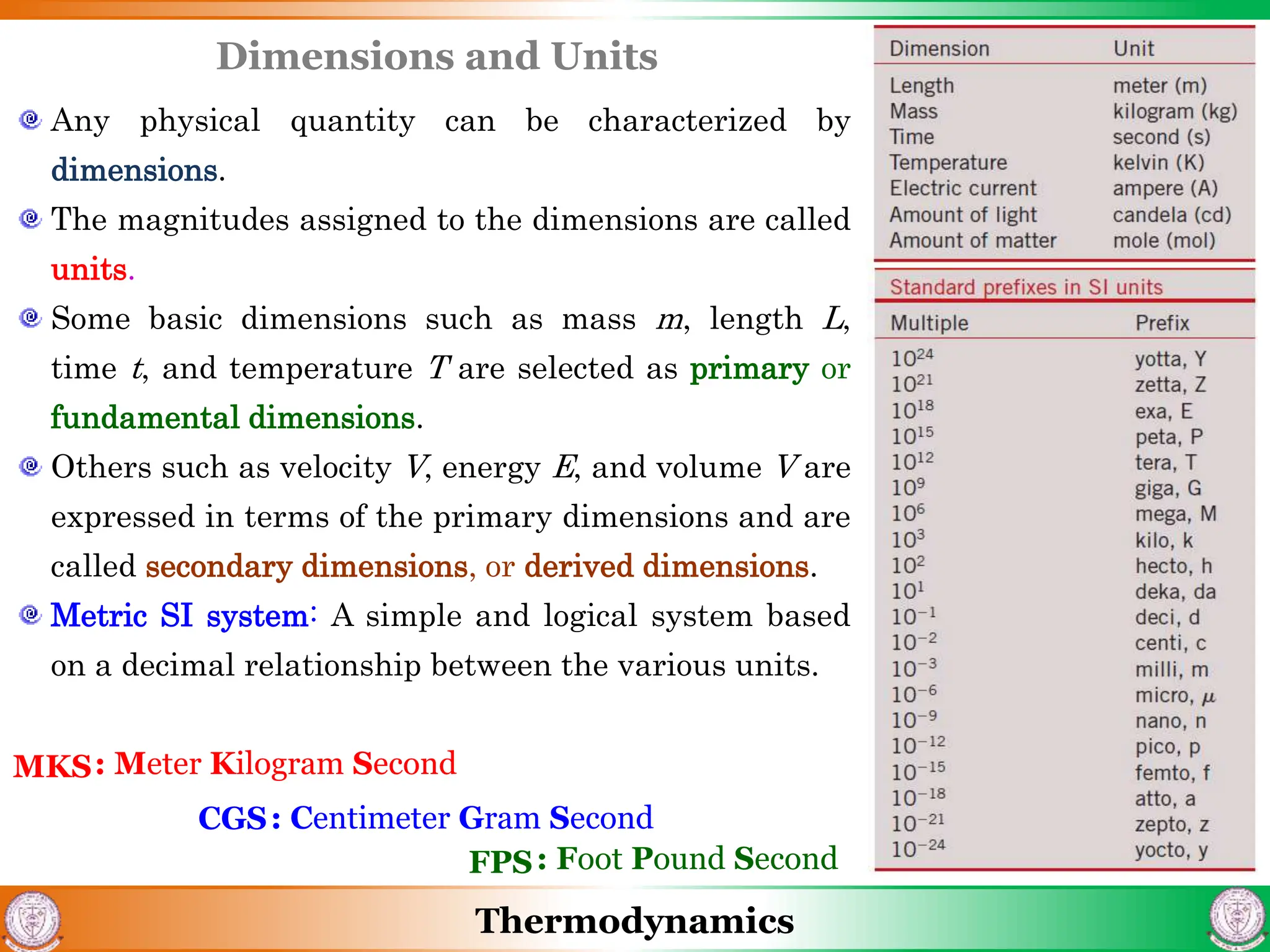
Dimensions and Units
Any physical quantity can be characterized by
dimensions.
The magnitudes assigned to the dimensions are called
units.
Some basic dimensions such as mass m, length L,
time t, and temperature T are selected as primary or
fundamental dimensions.
Others such as velocity V, energy E, and volume V are
expressed in terms of the primary dimensions and are
called secondary dimensions, or derived dimensions.
Metric SI system: A simple and logical system based
on a decimal relationship between the various units.
MKS
CGS
FPS
: Meter Kilogram Second
: Centimeter Gram Second
: Foot Pound Second
Thermodynamics
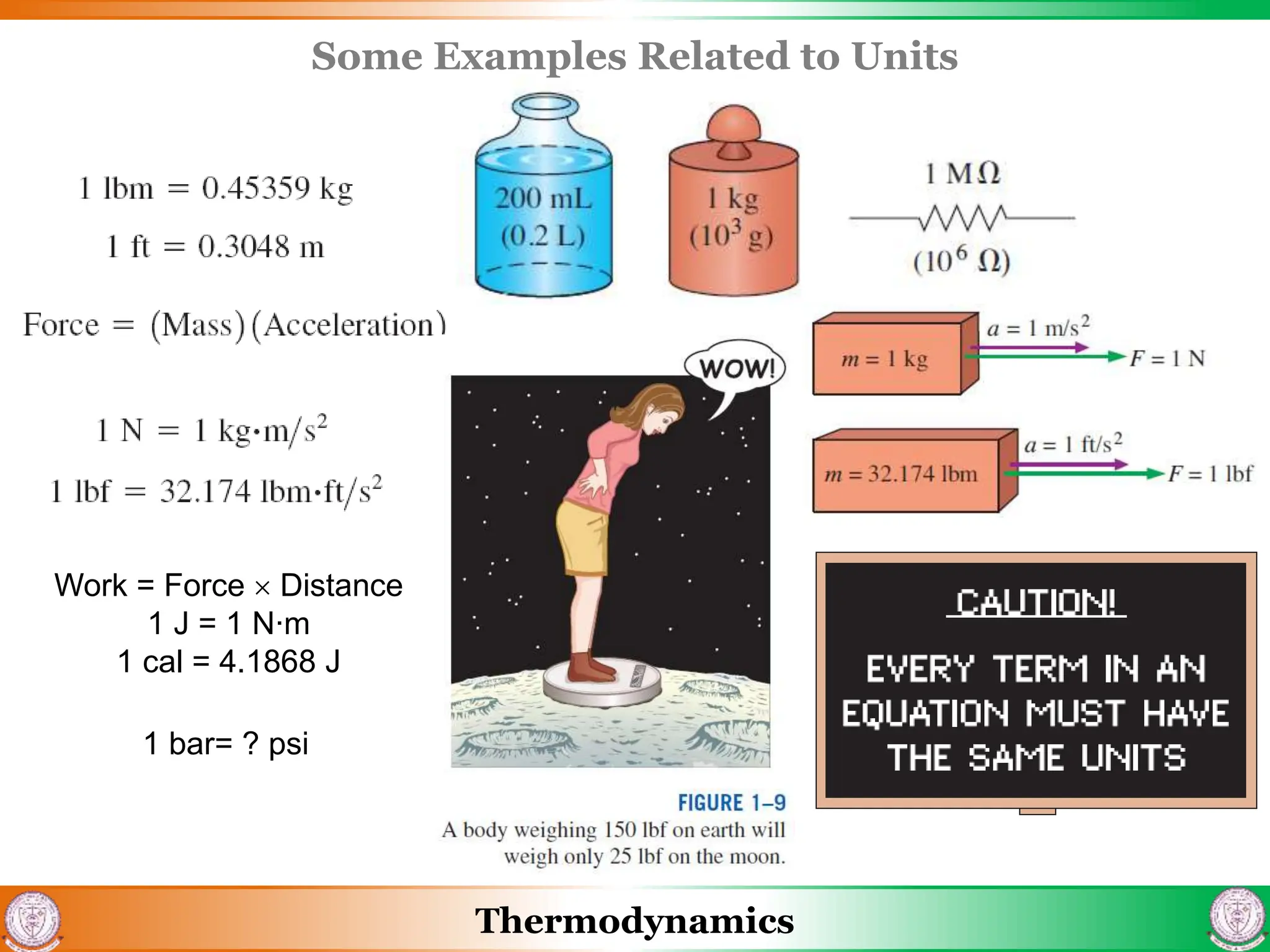
Some Examples Related to Units
Work = Force  Distance
1 J = 1 N∙m
1 cal = 4.1868 J
1 bar= ? psi
Thermodynamics
Definitions
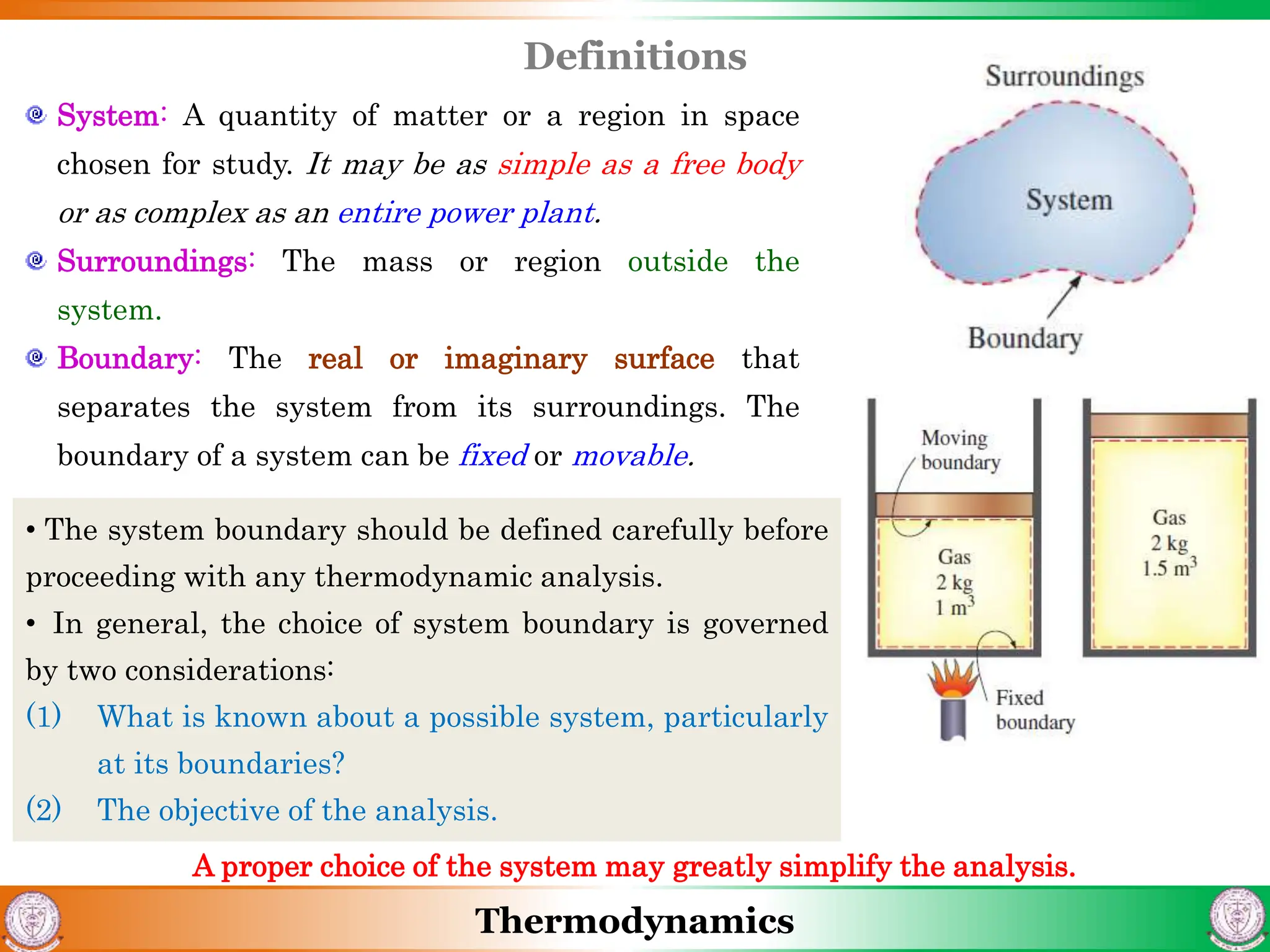
System: A quantity of matter or a region in space
chosen for study. It may be as simple as a free body
or as complex as an entire power plant.
Surroundings: The mass or region outside the
system.
Boundary: The real or imaginary surface that
separates the system from its surroundings. The
boundary of a system can be fixed or movable.
• The system boundary should be defined carefully before
proceeding with any thermodynamic analysis.
• In general, the choice of system boundary is governed
by two considerations:
(1) What is known about a possible system, particularly
at its boundaries?
(2) The objective of the analysis.
A proper choice of the system may greatly simplify the analysis.
Thermodynamics
Definitions
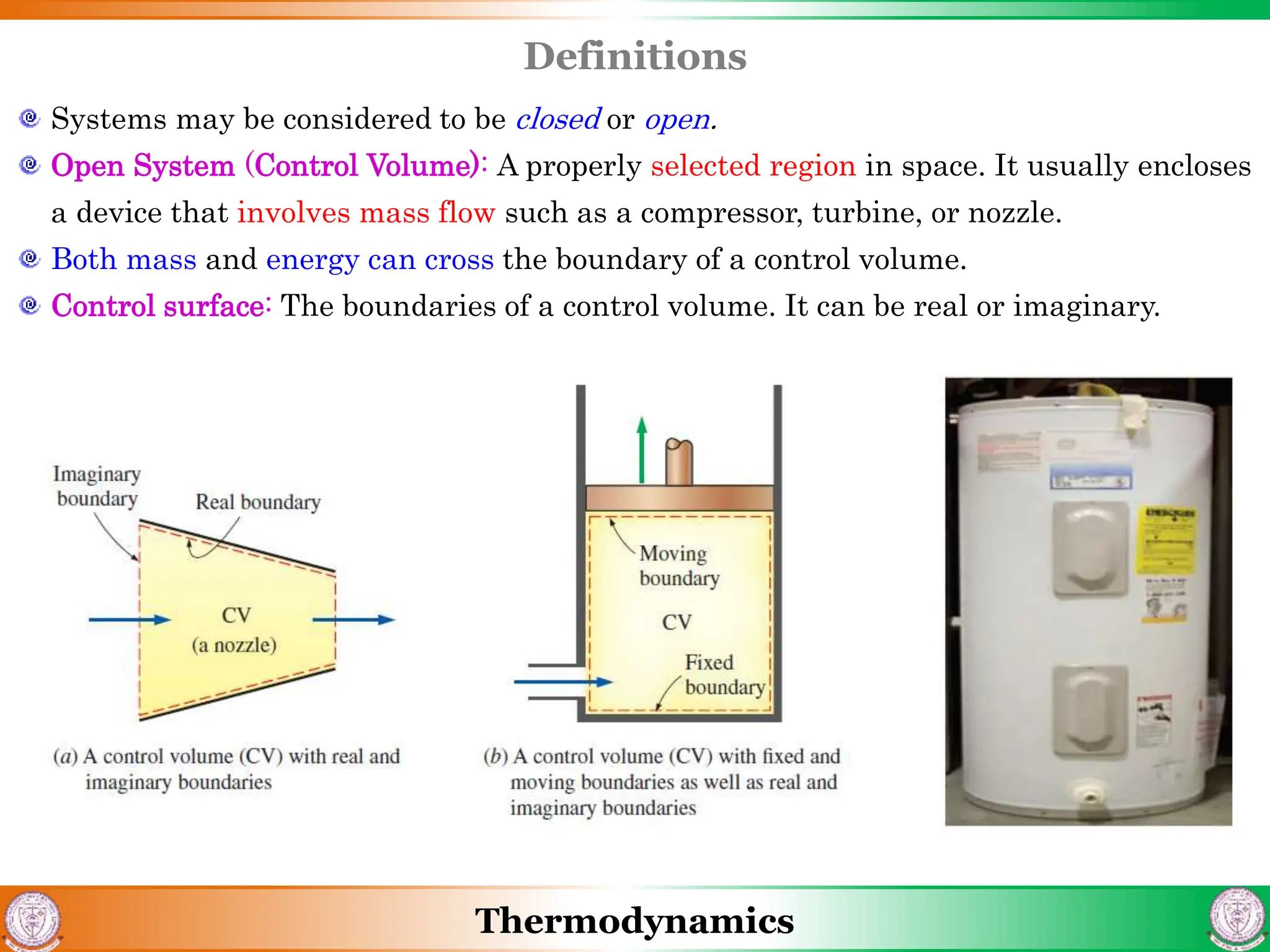
Systems may be considered to be closed or open.
Open System (Control Volume): A properly selected region in space. It usually encloses
a device that involves mass flow such as a compressor, turbine, or nozzle.
Both mass and energy can cross the boundary of a control volume.
Control surface: The boundaries of a control volume. It can be real or imaginary.
Thermodynamics
Definitions
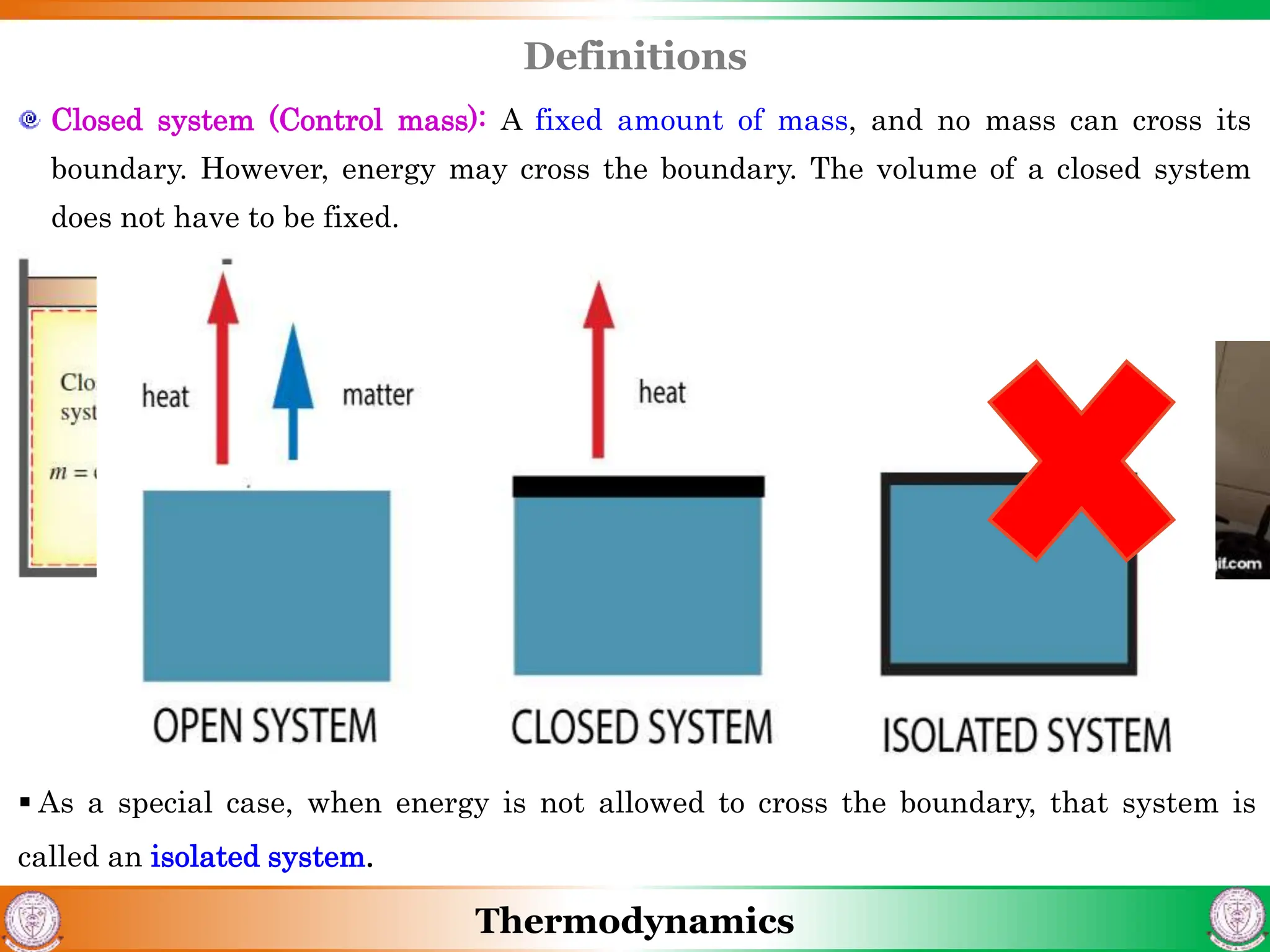
Closed system (Control mass): A fixed amount of mass, and no mass can cross its
boundary. However, energy may cross the boundary. The volume of a closed system
does not have to be fixed.
 As a special case, when energy is not allowed to cross the boundary, that system is
called an isolated system.
Thermodynamics
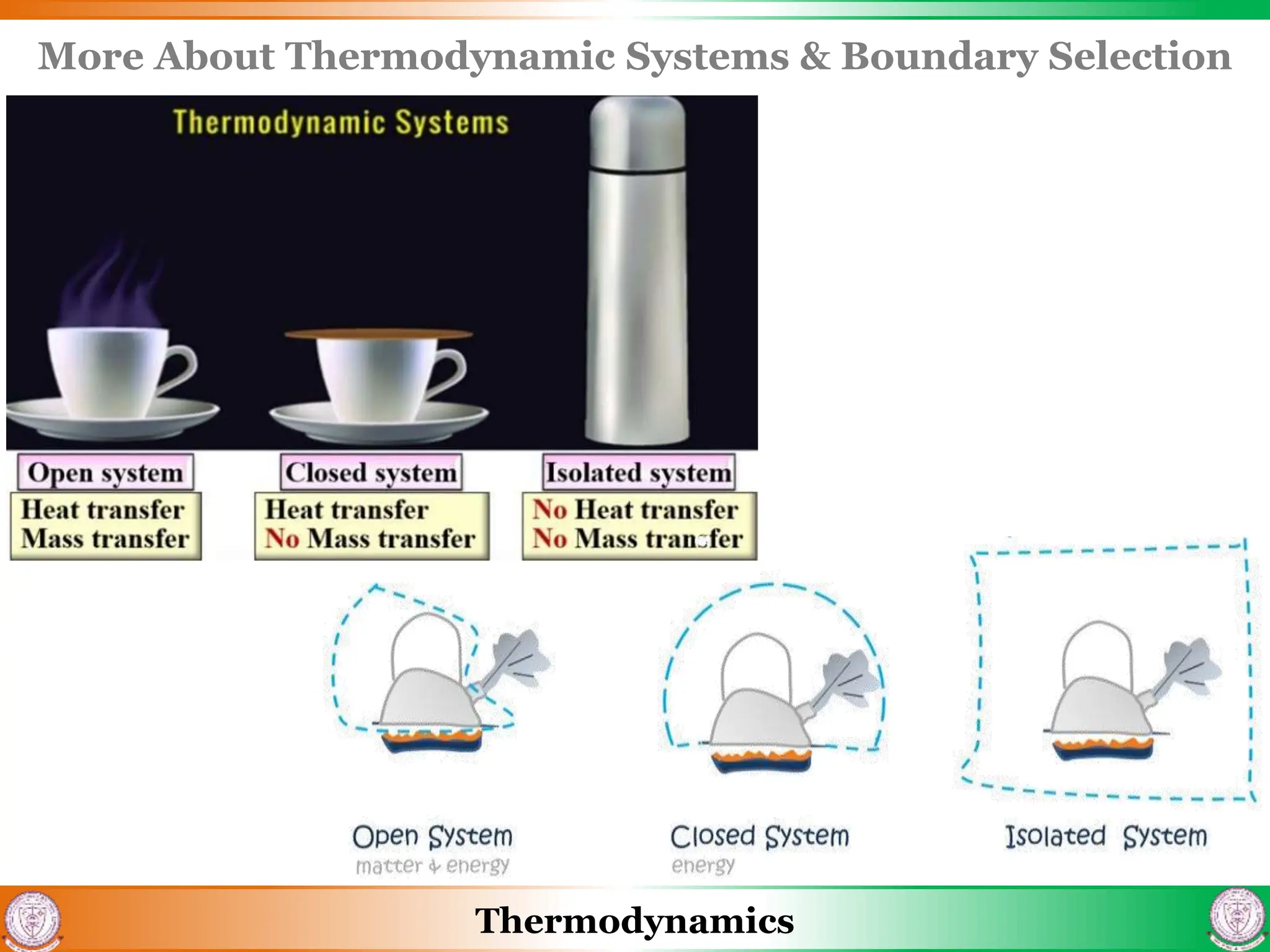
More About Thermodynamic Systems & Boundary Selection
Thermodynamics
Properties of a System
Property: Property is a macroscopic characteristic of a system by which we can
describe the system behavior (physical condition) or characteristic of a system.
Some familiar properties are pressure P, temperature T, volume V, and mass m.
Properties are considered to be either intensive or extensive.
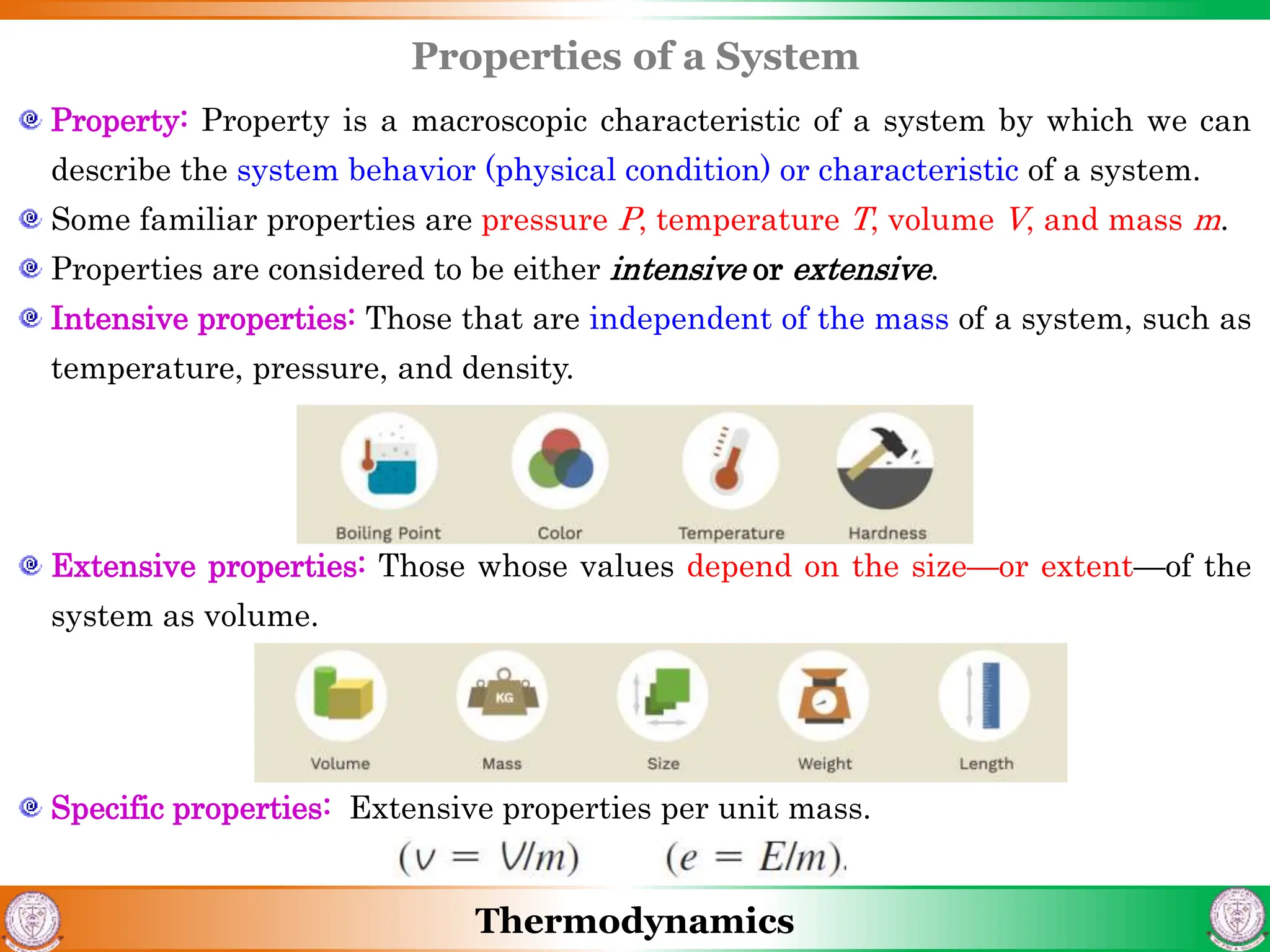
Intensive properties: Those that are independent of the mass of a system, such as
temperature, pressure, and density.
Extensive properties: Those whose values depend on the size—or extent—of the
system as volume.
Specific properties: Extensive properties per unit mass.
Thermodynamics
State and Equilibrium
Thermodynamics deals with equilibrium states.
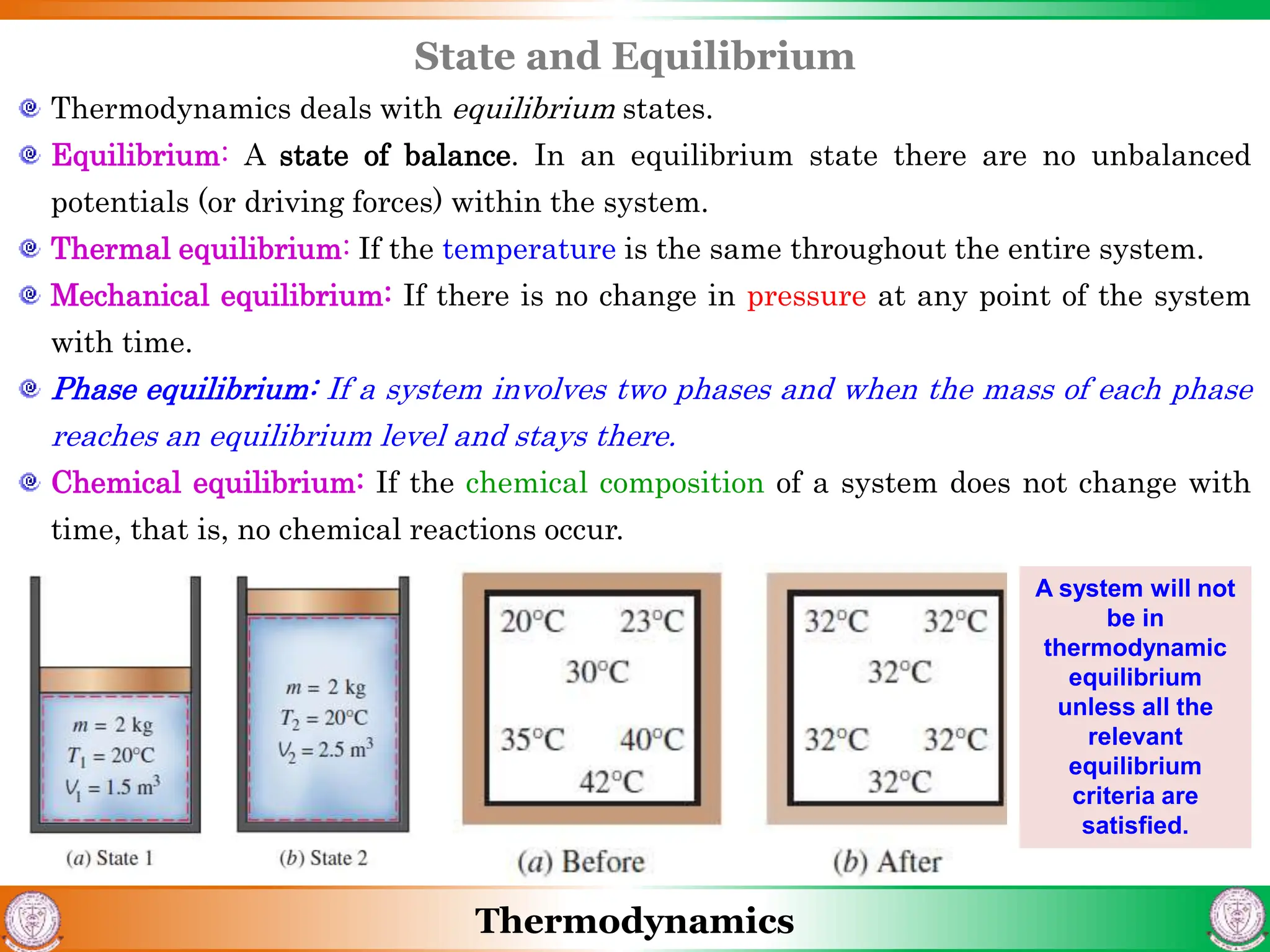
Equilibrium: A state of balance. In an equilibrium state there are no unbalanced
potentials (or driving forces) within the system.
Thermal equilibrium: If the temperature is the same throughout the entire system.
Mechanical equilibrium: If there is no change in pressure at any point of the system
with time.
Phase equilibrium: If a system involves two phases and when the mass of each phase
reaches an equilibrium level and stays there.
Chemical equilibrium: If the chemical composition of a system does not change with
time, that is, no chemical reactions occur.
A system will not
be in
thermodynamic
equilibrium
unless all the
relevant
equilibrium
criteria are
satisfied.
Thermodynamics
Thermodynamic State
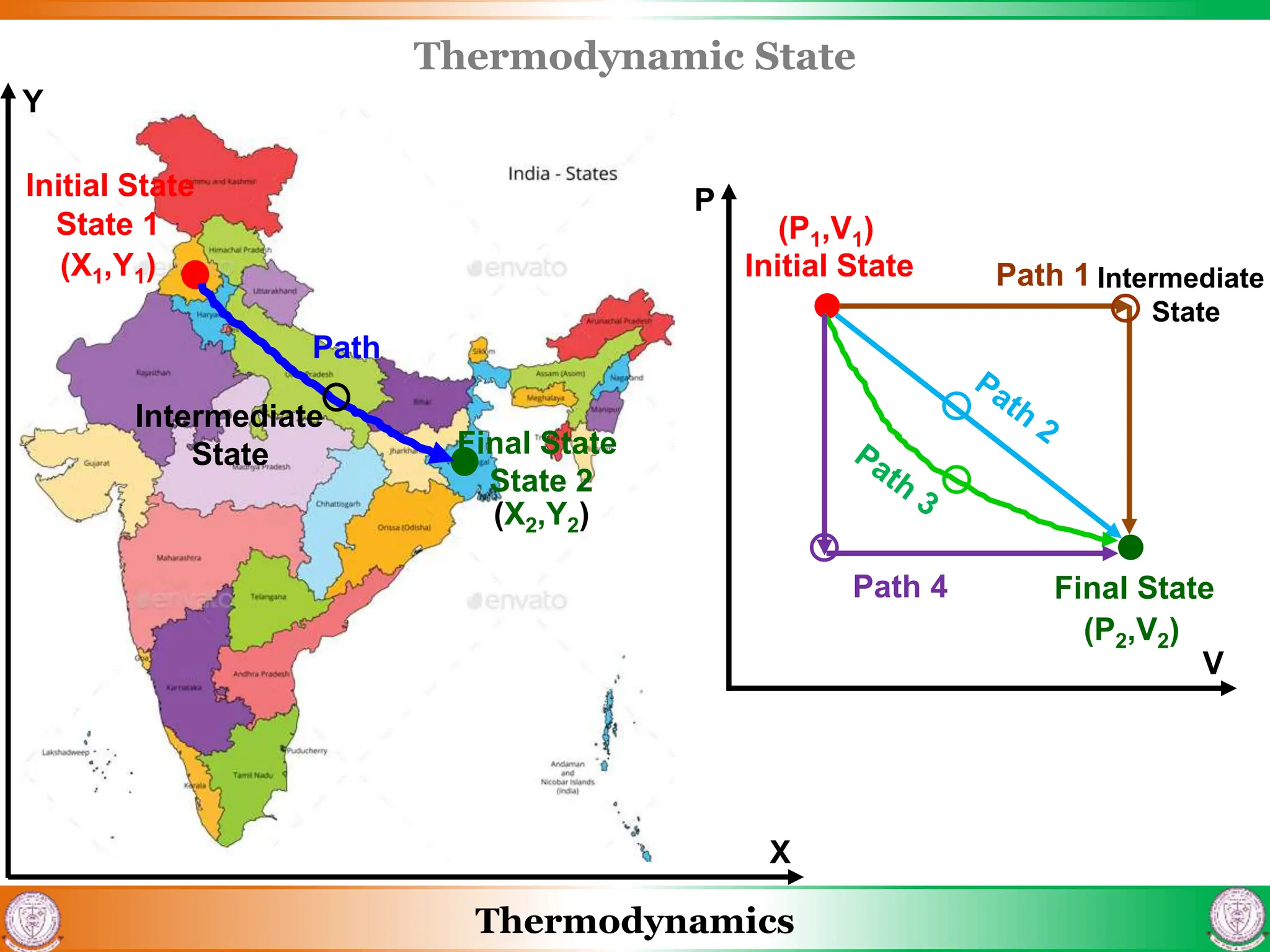
X
Y
State 1
State 2
Path
(X2,Y2)
(X1,Y1)
Initial State
Final State
Intermediate
State
V
P
Initial State
Final State
Path 4
Path 1
(P1,V1)
(P2,V2)
Intermediate
State
Thermodynamics
Processes and Cycles
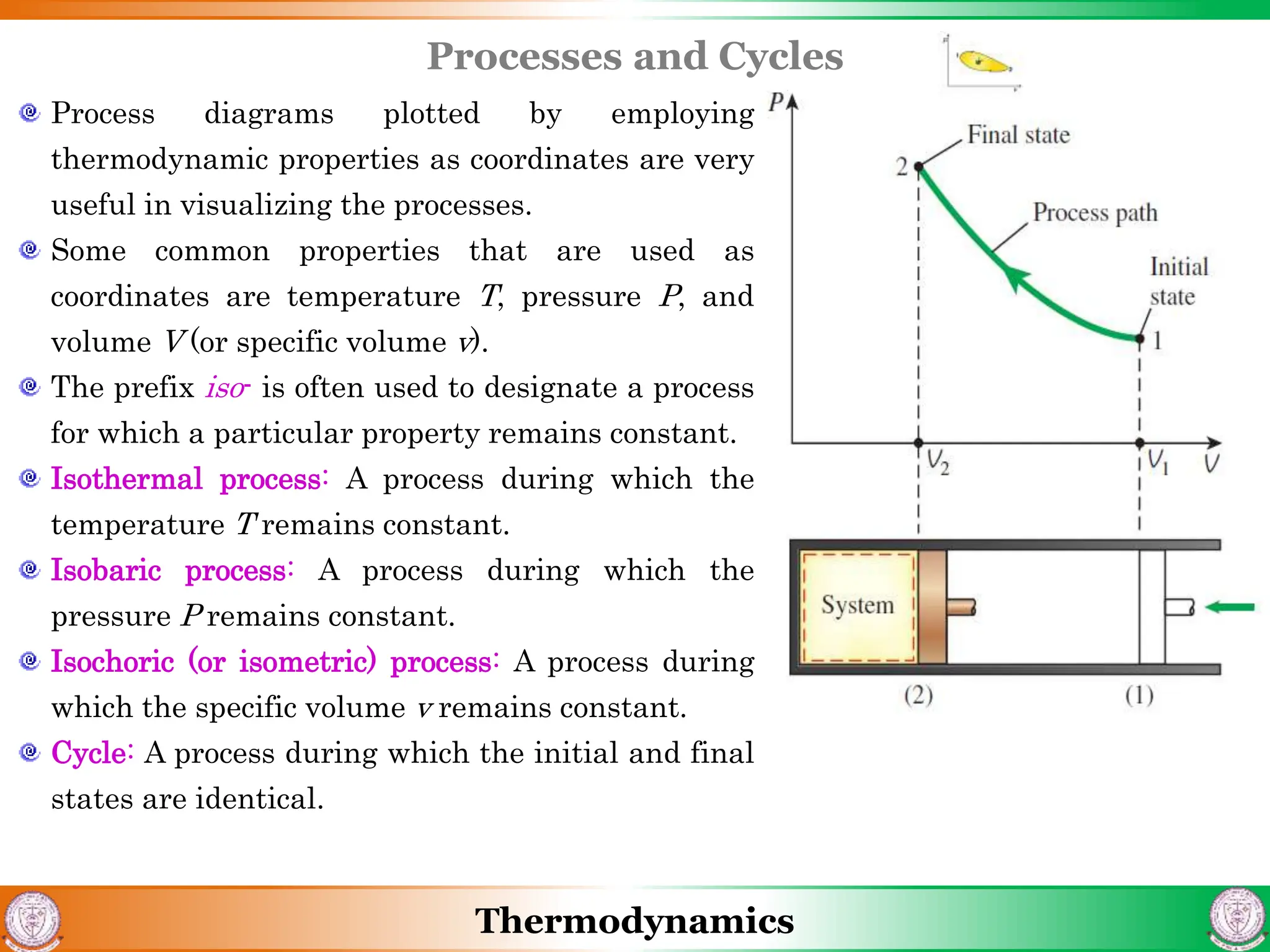
Process: Any change that a system undergoes from one equilibrium state to
another.
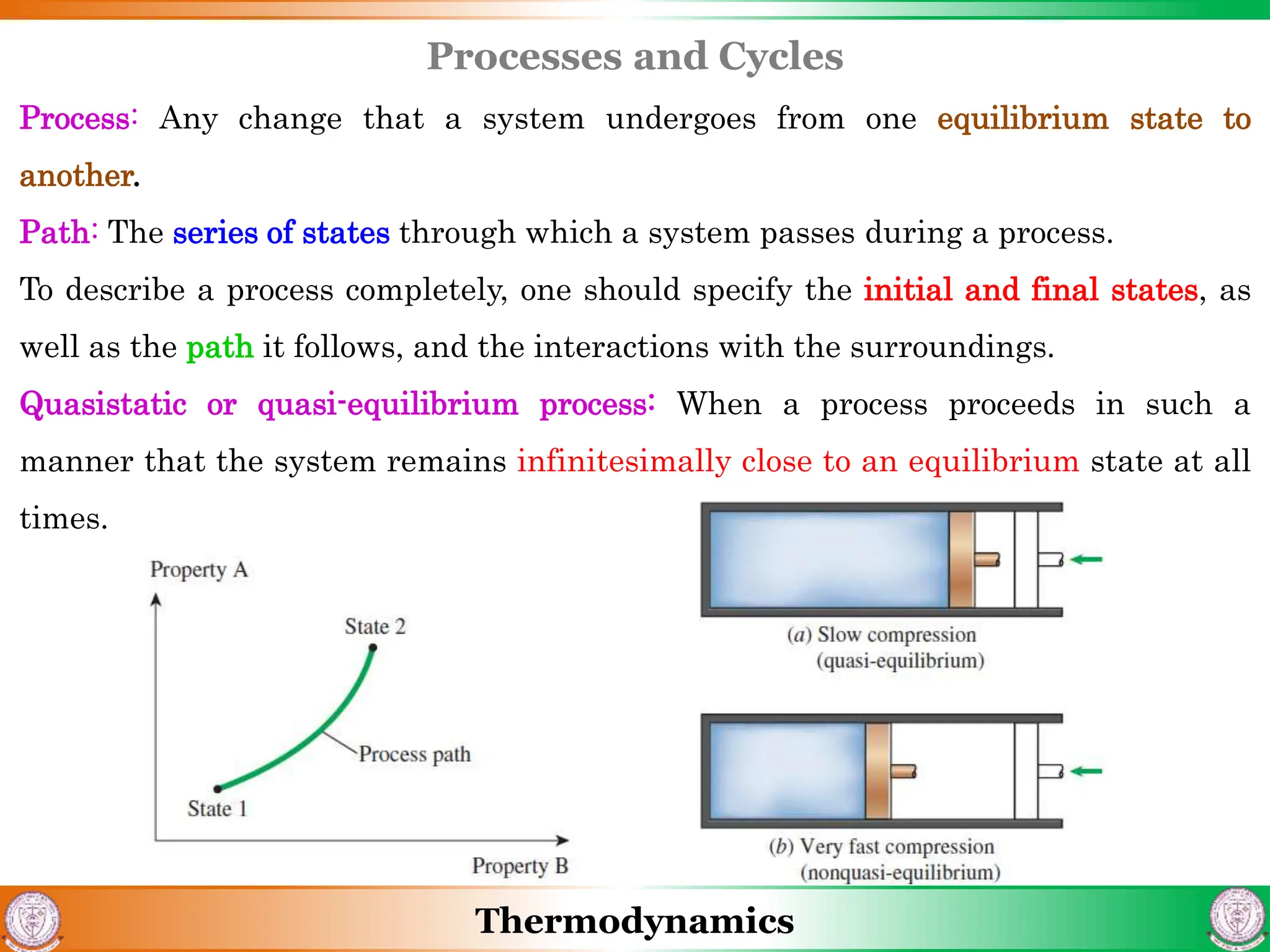
Path: The series of states through which a system passes during a process.
To describe a process completely, one should specify the initial and final states, as
well as the path it follows, and the interactions with the surroundings.
Quasistatic or quasi-equilibrium process: When a process proceeds in such a
manner that the system remains infinitesimally close to an equilibrium state at all
times.
Thermodynamics
Processes and Cycles
Process diagrams plotted by employing
thermodynamic properties as coordinates are very
useful in visualizing the processes.
Some common properties that are used as
coordinates are temperature T, pressure P, and
volume V (or specific volume v).
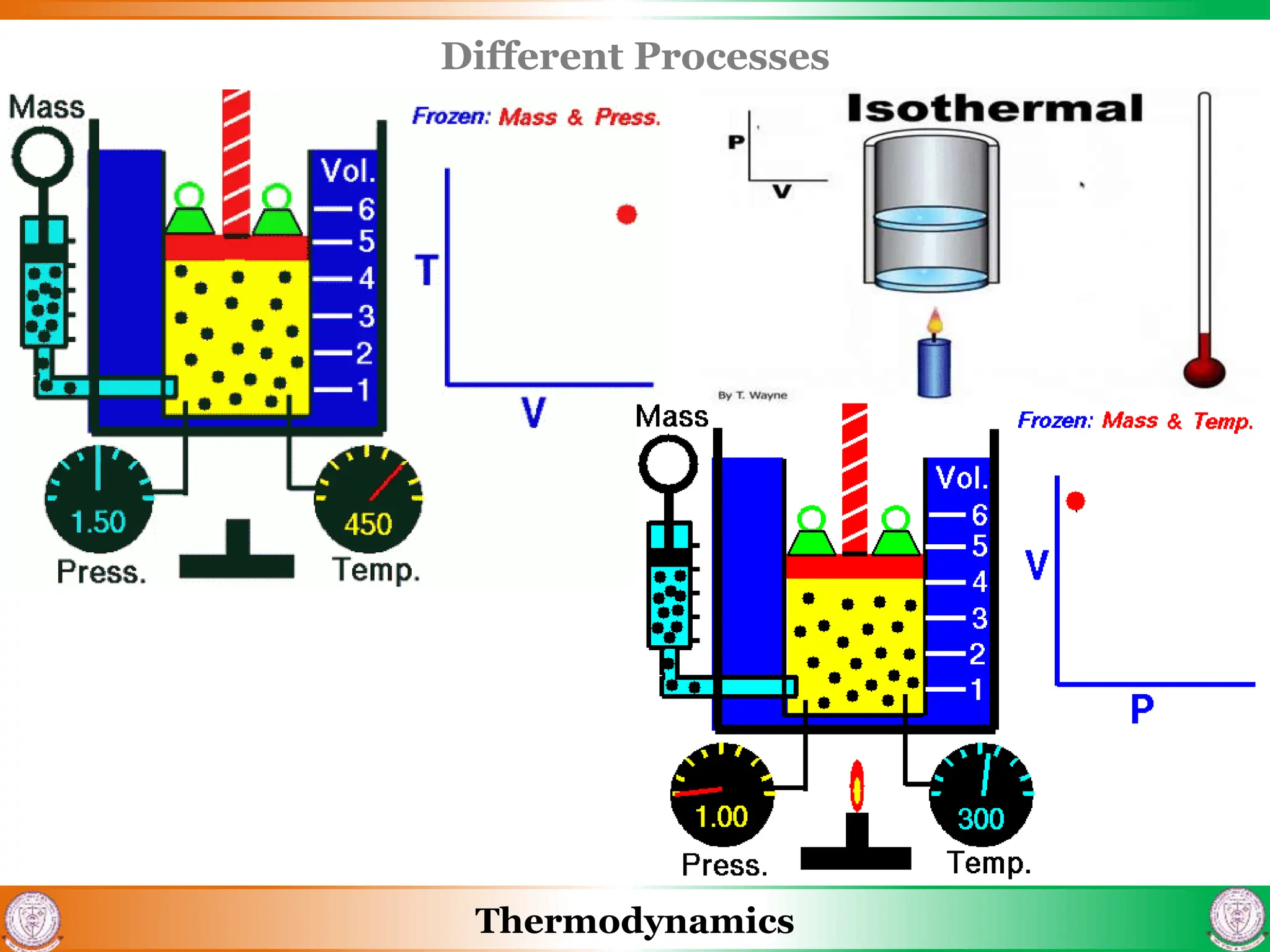
The prefix iso- is often used to designate a process
for which a particular property remains constant.
Isothermal process: A process during which the
temperature T remains constant.
Isobaric process: A process during which the
pressure P remains constant.
Isochoric (or isometric) process: A process during
which the specific volume v remains constant.
Cycle: A process during which the initial and final
states are identical.
Thermodynamics
Different Processes
Thermodynamics
The Steady-Flow Process
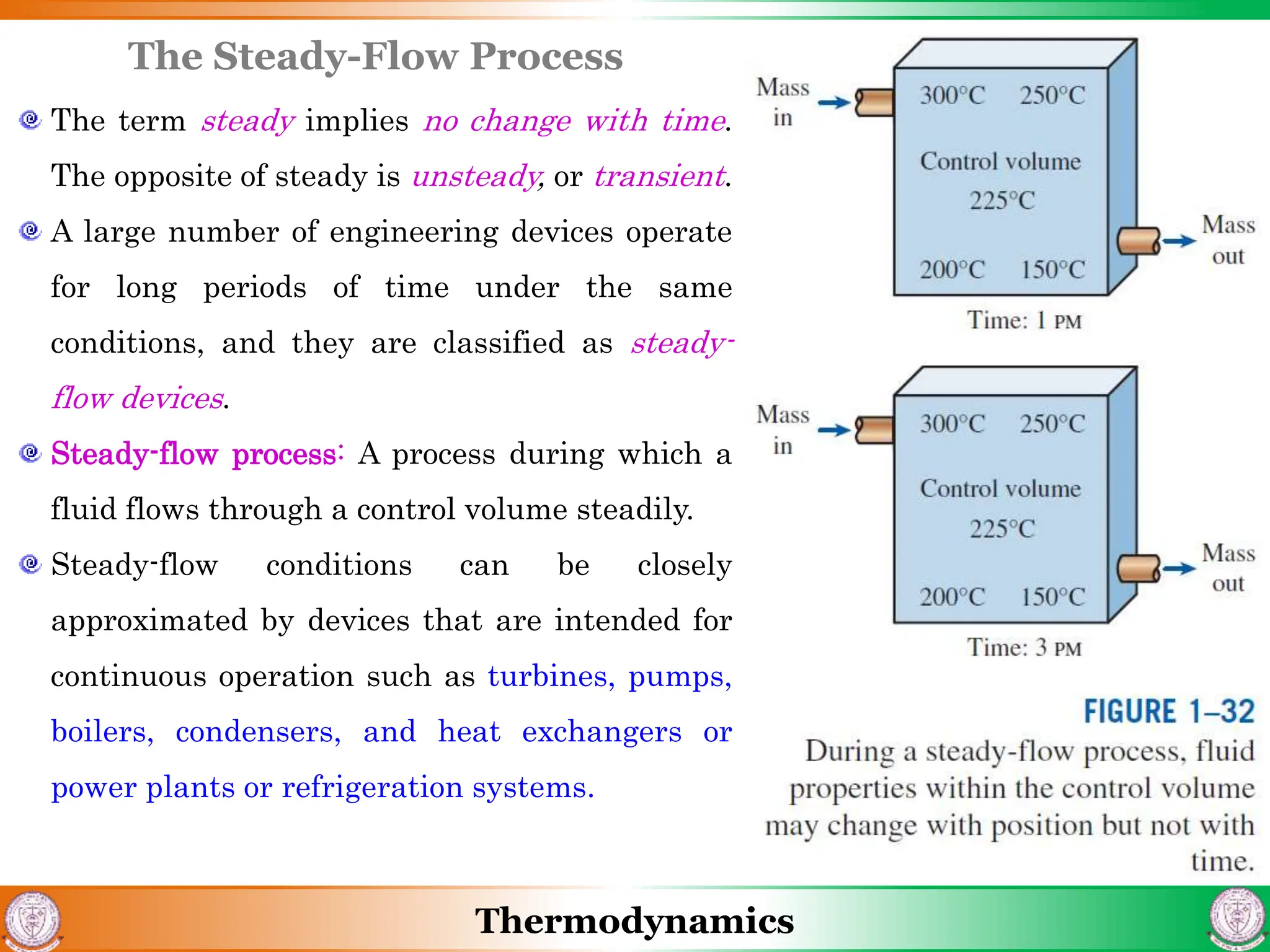
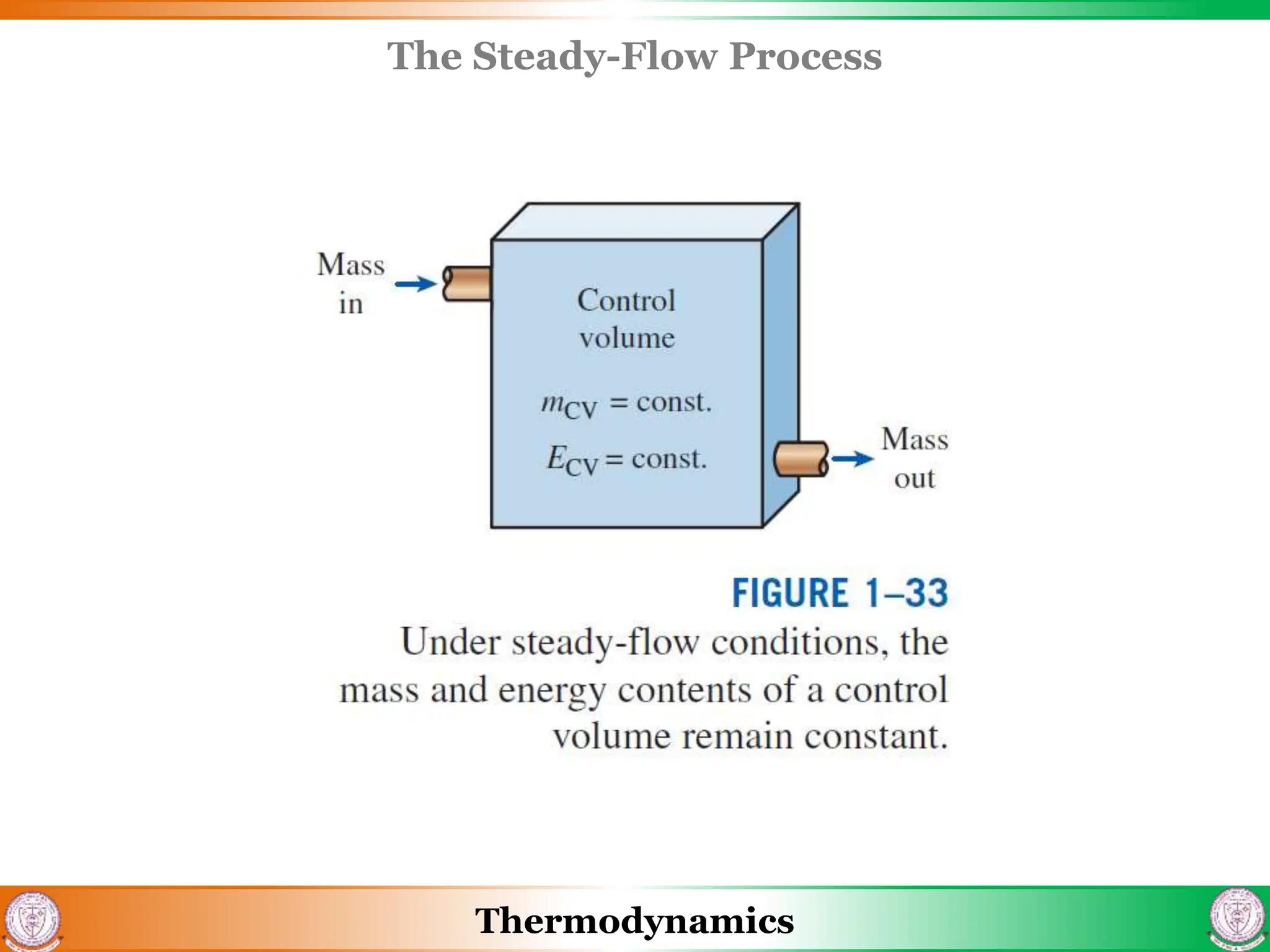
The term steady implies no change with time.
The opposite of steady is unsteady, or transient.
A large number of engineering devices operate
for long periods of time under the same
conditions, and they are classified as steady-
flow devices.
Steady-flow process: A process during which a
fluid flows through a control volume steadily.
Steady-flow conditions can be closely
approximated by devices that are intended for
continuous operation such as turbines, pumps,
boilers, condensers, and heat exchangers or
power plants or refrigeration systems.
Thermodynamics
The Steady-Flow Process
Thermodynamics

Notes_Lecture 2_FT-123 & DT-125.pptxubnko

  • 1.
    IIT (BHU), Varanasi EngineeringThermodynamics (ME-103) Date: 6th July 2022 Basics of Thermodynamics Dr. Akhilendra Pratap Singh Department of Mechanical Engineering IIT (BHU), Varanasi, India Email: akhilendra.mec@itbhu.ac.in
  • 2.
    Thermodynamics Recap: Thermodynamics andEnergy Thermodynamics: The science of energy. Energy: The ability to cause changes (tangible or intangible). The name thermodynamics stems from the Greek words therme (heat) and dynamis (power). Conservation of Energy Principle: Energy cannot be created or destroyed. During an interaction, energy can change from one form to another but the total amount of energy remains constant. The First Law of Thermodynamics: An expression of the conservation of energy principle. The first law asserts that energy is a thermodynamic property. The second law of thermodynamics: It asserts that energy has quality as well as quantity, and actual processes occur in the direction of decreasing quality of energy. Classical Thermodynamics: A macroscopic approach to the study of thermodynamics that does not require a knowledge of the behavior of individual particles. It provides a direct and easy way to the solution of engineering problems. Statistical Thermodynamics: A microscopic approach, based on the average behavior of large groups of individual particles.
  • 3.
    Thermodynamics Dimensions and Units Anyphysical quantity can be characterized by dimensions. The magnitudes assigned to the dimensions are called units. Some basic dimensions such as mass m, length L, time t, and temperature T are selected as primary or fundamental dimensions. Others such as velocity V, energy E, and volume V are expressed in terms of the primary dimensions and are called secondary dimensions, or derived dimensions. Metric SI system: A simple and logical system based on a decimal relationship between the various units. MKS CGS FPS : Meter Kilogram Second : Centimeter Gram Second : Foot Pound Second
  • 4.
    Thermodynamics Some Examples Relatedto Units Work = Force  Distance 1 J = 1 N∙m 1 cal = 4.1868 J 1 bar= ? psi
  • 5.
    Thermodynamics Definitions System: A quantityof matter or a region in space chosen for study. It may be as simple as a free body or as complex as an entire power plant. Surroundings: The mass or region outside the system. Boundary: The real or imaginary surface that separates the system from its surroundings. The boundary of a system can be fixed or movable. • The system boundary should be defined carefully before proceeding with any thermodynamic analysis. • In general, the choice of system boundary is governed by two considerations: (1) What is known about a possible system, particularly at its boundaries? (2) The objective of the analysis. A proper choice of the system may greatly simplify the analysis.
  • 6.
    Thermodynamics Definitions Systems may beconsidered to be closed or open. Open System (Control Volume): A properly selected region in space. It usually encloses a device that involves mass flow such as a compressor, turbine, or nozzle. Both mass and energy can cross the boundary of a control volume. Control surface: The boundaries of a control volume. It can be real or imaginary.
  • 7.
    Thermodynamics Definitions Closed system (Controlmass): A fixed amount of mass, and no mass can cross its boundary. However, energy may cross the boundary. The volume of a closed system does not have to be fixed.  As a special case, when energy is not allowed to cross the boundary, that system is called an isolated system.
  • 8.
    Thermodynamics More About ThermodynamicSystems & Boundary Selection
  • 9.
    Thermodynamics Properties of aSystem Property: Property is a macroscopic characteristic of a system by which we can describe the system behavior (physical condition) or characteristic of a system. Some familiar properties are pressure P, temperature T, volume V, and mass m. Properties are considered to be either intensive or extensive. Intensive properties: Those that are independent of the mass of a system, such as temperature, pressure, and density. Extensive properties: Those whose values depend on the size—or extent—of the system as volume. Specific properties: Extensive properties per unit mass.
  • 10.
    Thermodynamics State and Equilibrium Thermodynamicsdeals with equilibrium states. Equilibrium: A state of balance. In an equilibrium state there are no unbalanced potentials (or driving forces) within the system. Thermal equilibrium: If the temperature is the same throughout the entire system. Mechanical equilibrium: If there is no change in pressure at any point of the system with time. Phase equilibrium: If a system involves two phases and when the mass of each phase reaches an equilibrium level and stays there. Chemical equilibrium: If the chemical composition of a system does not change with time, that is, no chemical reactions occur. A system will not be in thermodynamic equilibrium unless all the relevant equilibrium criteria are satisfied.
  • 11.
    Thermodynamics Thermodynamic State X Y State 1 State2 Path (X2,Y2) (X1,Y1) Initial State Final State Intermediate State V P Initial State Final State Path 4 Path 1 (P1,V1) (P2,V2) Intermediate State
  • 12.
    Thermodynamics Processes and Cycles Process:Any change that a system undergoes from one equilibrium state to another. Path: The series of states through which a system passes during a process. To describe a process completely, one should specify the initial and final states, as well as the path it follows, and the interactions with the surroundings. Quasistatic or quasi-equilibrium process: When a process proceeds in such a manner that the system remains infinitesimally close to an equilibrium state at all times.
  • 13.
    Thermodynamics Processes and Cycles Processdiagrams plotted by employing thermodynamic properties as coordinates are very useful in visualizing the processes. Some common properties that are used as coordinates are temperature T, pressure P, and volume V (or specific volume v). The prefix iso- is often used to designate a process for which a particular property remains constant. Isothermal process: A process during which the temperature T remains constant. Isobaric process: A process during which the pressure P remains constant. Isochoric (or isometric) process: A process during which the specific volume v remains constant. Cycle: A process during which the initial and final states are identical.
  • 14.
  • 15.
    Thermodynamics The Steady-Flow Process Theterm steady implies no change with time. The opposite of steady is unsteady, or transient. A large number of engineering devices operate for long periods of time under the same conditions, and they are classified as steady- flow devices. Steady-flow process: A process during which a fluid flows through a control volume steadily. Steady-flow conditions can be closely approximated by devices that are intended for continuous operation such as turbines, pumps, boilers, condensers, and heat exchangers or power plants or refrigeration systems.
  • 16.
  • 17.