Portfolio Careers Day

Saturday 25 February 2012
 UWE Conference Centre
Seminar 3: Non-Executive Roles
David Doughty
Seminar 3: Non-Executive Roles
David Doughty
• Chartered Director
• Chair Thames Valley HIEC
• Chair The Centre for Sustainable Healthcare
• Non-Executive Director Oxfordshire Learning
  Disability NHS Trust
• Director Oxfordshire Business First
Seminar 3: Non-Executive Roles
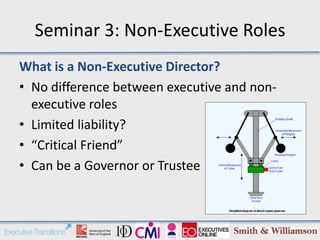
What is a Non-Executive Director?
• No difference between executive and non-
  executive roles
• Limited liability?
• “Critical Friend”
• Can be a Governor or Trustee
Seminar 3: Non-Executive Roles
What do Non-Executive Directors do?
• Strategic Direction
• Monitor Performance
• Communication
• Risk
• Audit
• Remuneration
Seminar 3: Non-Executive Roles
What are the statutory duties of a NED?
• act within powers set out in the memorandum of
  association,
• promote the success of the company,
• take into account the legitimate interests of stakeholders
• exercise independent judgement,
• exercise reasonable care, skill and diligence,
• avoid conflicts of interest,
• not to accept benefits from third parties, and
• declare interests in proposed transactions or arrangements.
Seminar 3: Non-Executive Roles
What skills do Non-Executive Directors need?
• Integrity - high ethical standards
• sound judgement - willingness to challenge
• interpersonal skills – listening, persuasiveness, ability to communicate ideas,
  sensitivity, openness and awareness of non-verbal communication, co-operation
  and team-working, facilitation skills
• leadership and self-awareness, ability to gain respect and attention, confidence
• critical thinking, creativity and strategic awareness - the ability to take the wider,
  strategic view
• business acumen, ability to identify new business opportunities, embrace change
  and innovation
• ability to assimilate, assess and analyse information, especially financial
  information
• political astuteness, diplomatic, able to deal with conflict
• determination, with the tenacity and drive to succeed
• keenness to gain new knowledge and skills to develop competences further
Seminar 3: Non-Executive Roles
How to become a Non-Executive
• You may have to start as a governor or trustee
• There is strong competition for NHS and Housing
  Association posts
• Finding roles
  –   Networking (face to face and social)
  –   Research (Internet – Google Alerts)
  –   Contact Chairs directly
  –   Executive Transitions
Seminar 3: Non-Executive Roles
Case Study
You are a newly appointed NED in a small engineering
company about to attend your first Board meeting. Last year
the company had its best ever year in terms of sales and profit
and all staff and executives received a profit related bonus.
This year, performance has been poor, sales are down and the
company has made a small loss. There is no staff bonus, there
is a pay freeze and some staff have been laid off.
In your Board papers you see that the Remuneration
committee are asking the Board to approve bonus payments
for the executives at the same level as the previous year.
What do you do?
Seminar 3: Non-Executive Roles
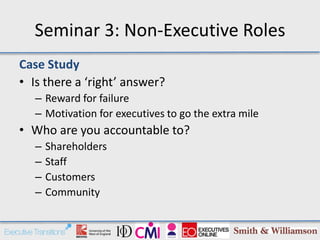
Case Study
• Is there a ‘right’ answer?
   – Reward for failure
   – Motivation for executives to go the extra mile
• Who are you accountable to?
   –   Shareholders
   –   Staff
   –   Customers
   –   Community
Seminar 3: Non-Executive Roles
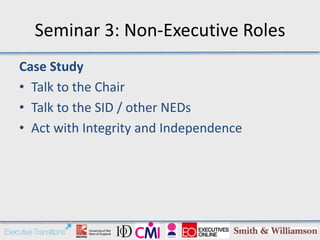
Case Study
• Talk to the Chair
• Talk to the SID / other NEDs
• Act with Integrity and Independence
Seminar 3: Non-Executive Roles
               Thank you

         david@doughtymail.com
   http://daviddoughty.wordpress.com
              @daviddoughty
 http://uk.linkedin.com/in/daviddoughty

Non executive roles

  • 1.
    Portfolio Careers Day Saturday25 February 2012 UWE Conference Centre
  • 2.
    Seminar 3: Non-ExecutiveRoles David Doughty
  • 3.
    Seminar 3: Non-ExecutiveRoles David Doughty • Chartered Director • Chair Thames Valley HIEC • Chair The Centre for Sustainable Healthcare • Non-Executive Director Oxfordshire Learning Disability NHS Trust • Director Oxfordshire Business First
  • 4.
    Seminar 3: Non-ExecutiveRoles What is a Non-Executive Director? • No difference between executive and non- executive roles • Limited liability? • “Critical Friend” • Can be a Governor or Trustee
  • 5.
    Seminar 3: Non-ExecutiveRoles What do Non-Executive Directors do? • Strategic Direction • Monitor Performance • Communication • Risk • Audit • Remuneration
  • 6.
    Seminar 3: Non-ExecutiveRoles What are the statutory duties of a NED? • act within powers set out in the memorandum of association, • promote the success of the company, • take into account the legitimate interests of stakeholders • exercise independent judgement, • exercise reasonable care, skill and diligence, • avoid conflicts of interest, • not to accept benefits from third parties, and • declare interests in proposed transactions or arrangements.
  • 7.
    Seminar 3: Non-ExecutiveRoles What skills do Non-Executive Directors need? • Integrity - high ethical standards • sound judgement - willingness to challenge • interpersonal skills – listening, persuasiveness, ability to communicate ideas, sensitivity, openness and awareness of non-verbal communication, co-operation and team-working, facilitation skills • leadership and self-awareness, ability to gain respect and attention, confidence • critical thinking, creativity and strategic awareness - the ability to take the wider, strategic view • business acumen, ability to identify new business opportunities, embrace change and innovation • ability to assimilate, assess and analyse information, especially financial information • political astuteness, diplomatic, able to deal with conflict • determination, with the tenacity and drive to succeed • keenness to gain new knowledge and skills to develop competences further
  • 8.
    Seminar 3: Non-ExecutiveRoles How to become a Non-Executive • You may have to start as a governor or trustee • There is strong competition for NHS and Housing Association posts • Finding roles – Networking (face to face and social) – Research (Internet – Google Alerts) – Contact Chairs directly – Executive Transitions
  • 9.
    Seminar 3: Non-ExecutiveRoles Case Study You are a newly appointed NED in a small engineering company about to attend your first Board meeting. Last year the company had its best ever year in terms of sales and profit and all staff and executives received a profit related bonus. This year, performance has been poor, sales are down and the company has made a small loss. There is no staff bonus, there is a pay freeze and some staff have been laid off. In your Board papers you see that the Remuneration committee are asking the Board to approve bonus payments for the executives at the same level as the previous year. What do you do?
  • 10.
    Seminar 3: Non-ExecutiveRoles Case Study • Is there a ‘right’ answer? – Reward for failure – Motivation for executives to go the extra mile • Who are you accountable to? – Shareholders – Staff – Customers – Community
  • 11.
    Seminar 3: Non-ExecutiveRoles Case Study • Talk to the Chair • Talk to the SID / other NEDs • Act with Integrity and Independence
  • 12.
    Seminar 3: Non-ExecutiveRoles Thank you david@doughtymail.com http://daviddoughty.wordpress.com @daviddoughty http://uk.linkedin.com/in/daviddoughty