2
Chapter 15
Collective Bargaining and Labor Relations
freesoulproduction/Shutterstock
© 2022 McGraw Hill. All rights reserved. Authorized only for instructor use in the classroom. No reproduction or further distribution permitted without the prior written consent of McGraw Hill.
© McGraw Hill 3
What Do I Need to Know?
LO 15-1 Define unions and labor relations and their role in organizations.
LO 15-2 Identify the labor relations goals of management, labor unions, and society.
LO 15-3 Summarize laws and regulations that affect labor relations.
LO 15-4 Describe the union organizing process.
LO 15-5 Explain how management and unions negotiate contracts.
LO 15-6 Summarize the practice of contract administration.
LO 15-7 Describe new approaches to labor-management relations.
© McGraw Hill 4
Role of Unions and Labor Relations 1
Unions
• Labor unions represent their members’ interests in dealing with employers.
• The collective bargaining process provides a way to manage the conflict.
Labor Relations
• Field emphasizing labor-management cooperation.
• Involves a labor relations strategy, negotiating contracts, and administering contracts.
© McGraw Hill 5
Role of Unions and Labor Relations 2
National and International Unions
Craft union: members have a particular
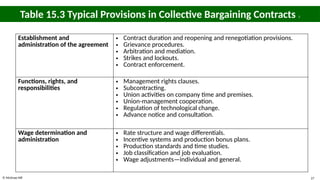
skill or occupation.
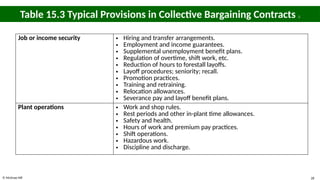
Industrial union: members linked by their
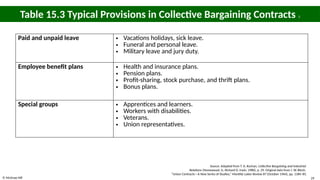
work in a particular industry.
Most national unions are affiliated with
the AFL-CIO.
• Represents labor’s interests in public policy
issues.
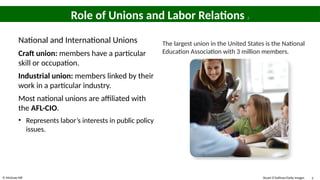
The largest union in the United States is the National
Education Association with 3 million members.
Stuart O’Sullivan/Getty Images
© McGraw Hill 6
Role of Unions and Labor Relations 3
Local Unions
• National unions can consist of multiple local units.
• Most day-to-day interaction between labor and management involves the local
union.
• Membership in a local union depends on its type.
• Members elect officials and vote on resolutions to strike.
• Union steward: elected to represent union and ensures that terms of labor contract
are enforced.
© McGraw Hill 7
Role of Unions and Labor Relations 4
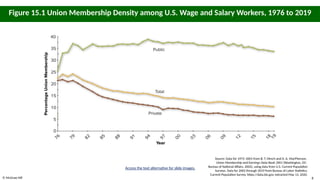
Trends in Union Membership
Peaked in 1950s reaching over one-third of employees.
Now at 10.3% overall; 6.2% of private-sector employment.
Decline in union membership due to many factors:
• Change in structure of economy.
• Management efforts to control costs.
• Human resource practices.
• Government regulation.
© McGraw Hill 8
Figure 15.1 Union Membership Density among U.S. Wage and Salary Workers, 1976 to 2019
Access the text alternative for slide images.
Source: Data for 1973–2001 from B. T. Hirsch and D. A. MacPherson,
Union Membership and Earnings Data Book 2001 (Washington, DC:
Bureau of National Affairs, 2002), using data from U.S. Current Population
Surveys. Data for 2002 through 2019 from Bureau of Labor Statistics,
Current Population Survey, https://data.bls.gov, extracted May 13, 2020.
© McGraw Hill 9
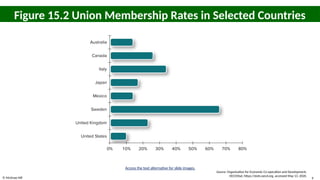
Figure 15.2 Union Membership Rates in Selected Countries
Access the text alternative for slide images.
Source: Organisation for Economic Co-operation and Development,
OECD.Stat, https://stats.oecd.org, accessed May 13, 2020.
© McGraw Hill 10
Role of Unions and Labor Relations 5
Unions in Government
Membership among government workers is strong.
Government regulations and laws support the right of government workers to organize.
• Executive Order 10988 established collective bargaining rights.
Labor relations are different with government workers.
• Strikes illegal for federal and state workers in most states.
• Almost all states prohibit strikes by police/firefighters at local level.
© McGraw Hill 11
Role of Unions and Labor Relations 6
Impact of Unions on Company Performance
• Organizations are concerned about impact of unionization on productivity, profits,
and stock performance.
• Experts have conflicting views.
• Research reflects average effects of unions, not individual companies and innovative
labor relations.
• Skillful labor relations can positively influence outcomes.
© McGraw Hill 12
POLLING
QUESTION
1
With the decline of union memberships, how do you feel about
labor unions in today’s working society?
A. They are not very effective.
B. They are most useful in the private sector.
C. They are most useful in the public sector.
D. More industries should have union representation.
© McGraw Hill 13
Goals of Management, Labor Unions, and Society 1
Management Goals
Increase the organization’s profits.
Keep labor costs low and increase output.
• Limit increases in wages and benefits.
• Retain control over work rules and schedules.
Maintain flexible operations to meet competitive challenges and customer demands.
© McGraw Hill 14
Goals of Management, Labor Unions, and Society 2
Labor Union Goals
Obtain pay and working conditions that satisfy members.
Give members a voice in decisions that affect them.
Membership is linked to better compensation and benefits.
• Two-tier wage structures.
Regular flow of new members is essential to survival; goals are obtained through power
in numbers.
© McGraw Hill 15
Goals of Management, Labor Unions, and Society 3
Labor Unions Goals continued
Negotiating contract provisions.
• Checkoff provision: contract provision under which employer, on behalf of the
union, automatically deducts union dues from employees’ paychecks.
• Membership security.
• Closed shop.
• Union shop.
• Agency shop.
• Maintenance of membership.
© McGraw Hill 16
Goals of Management, Labor Unions, and Society 4
Societal Goals
Union activities take place within context of society.
Societal values drive laws/regulations that affect unions.
• In 2018, the Supreme Court held that public-employee unions may not require workers to pay
dues.
Society’s goal for unions is to ensure that workers have a voice in how they are treated
by their employers.
© McGraw Hill 17
Laws and Regulations Affecting Labor Relations 1
National Labor Relations Act (NLRA)
Protects the activities:
• Union organizing and collective bargaining.
• Joining a union, whether recognized by employer or not.
• Going out on strike.
• Refraining from activity on behalf of the union.
Most employees in private sector are covered by NLRA.
© McGraw Hill 18
Laws and Regulations Affecting Labor Relations 2
Laws Amending the NLRA
Taft-Hartley Act of 1947.
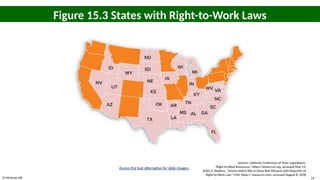
• Allows right-to-work laws: state laws that make union shops, maintenance of membership,
and agency shops illegal.
• Employees free to join a union or not.
• Unions believe that all employees who receive union benefits should pay union dues.
• Can be legally applied to the private sector.
Landrum-Griffin Act of 1959.
• Regulates unions’ actions with regard to their members, including financial disclosure and
conduct of elections.
© McGraw Hill 19
Figure 15.3 States with Right-to-Work Laws
Access the text alternative for slide images.
Sources: National Conference of State Legislatures,
“Right to Work Resources,” https://www.ncsl.org, accessed May 13,
2020; E. Watkins, “Unions Notch Win in Deep-Red Missouri with Rejection of
Right-to-Work Law,” CNN, https:// www.cnn.com, accessed August 8, 2018.
© McGraw Hill 20
Laws and Regulations Affecting Labor Relations 3
National Labor Relations Board (NLRB)
Federal government agency that enforces NLRA.
• Consists of a five-member board, a general counsel, and 52 regional and other field offices.
Conducts and certifies representation elections.
Prevents unfair labor practices.
© McGraw Hill 21
Union Organizing 1
The Process of Organizing
1. Union representatives contact employees.
2. Employees invited to sign authorization card.
• 30 percent must sign for process to continue.
3. If not signed, the NLRB conducts a secret-ballot election.
• Consent election—all parties agree on terms.
• Stipulation election—NLRB dictates the terms.
4. Workers vote for or against union representation.
5. The NLRB certifies the union or holds a runoff election.
© McGraw Hill 22
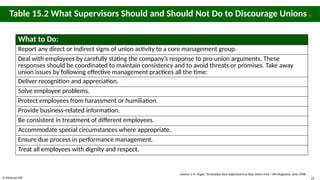
Table 15.2 What Supervisors Should and Should Not Do to Discourage Unions 1
What to Do:
Report any direct or indirect signs of union activity to a core management group.
Deal with employees by carefully stating the company’s response to pro-union arguments. These
responses should be coordinated to maintain consistency and to avoid threats or promises. Take away
union issues by following effective management practices all the time:
Deliver recognition and appreciation.
Solve employee problems.
Protect employees from harassment or humiliation.
Provide business-related information.
Be consistent in treatment of different employees.
Accommodate special circumstances where appropriate.
Ensure due process in performance management.
Treat all employees with dignity and respect.
Source: J. A. Segal, “Unshackle Your Supervisors to Stay Union Free,” HR Magazine, June 1998.
© McGraw Hill 23
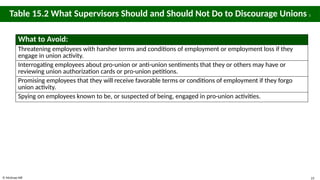
Table 15.2 What Supervisors Should and Should Not Do to Discourage Unions 2
What to Avoid:
Threatening employees with harsher terms and conditions of employment or employment loss if they
engage in union activity.
Interrogating employees about pro-union or anti-union sentiments that they or others may have or
reviewing union authorization cards or pro-union petitions.
Promising employees that they will receive favorable terms or conditions of employment if they forgo
union activity.
Spying on employees known to be, or suspected of being, engaged in pro-union activities.
© McGraw Hill 24
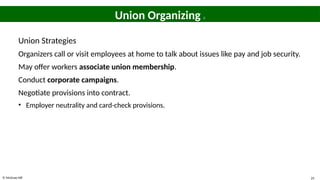
Union Organizing 2
Union Strategies
Organizers call or visit employees at home to talk about issues like pay and job security.
May offer workers associate union membership.
Conduct corporate campaigns.
Negotiate provisions into contract.
• Employer neutrality and card-check provisions.
© McGraw Hill 25
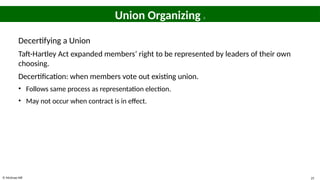
Union Organizing 3
Decertifying a Union
Taft-Hartley Act expanded members’ right to be represented by leaders of their own
choosing.
Decertification: when members vote out existing union.
• Follows same process as representation election.
• May not occur when contract is in effect.
© McGraw Hill 26
Collective Bargaining 1
Collective Bargaining
• Union and management representatives negotiate to arrive at contract defining
conditions of employment.
• Typical contracts include provisions for pay, benefits, work rules, and resolution of
workers’ grievances.
• Bargaining structure varies by situation.
© McGraw Hill 27
Table 15.3 Typical Provisions in Collective Bargaining Contracts 1
Establishment and
administration of the agreement
• Contract duration and reopening and renegotiation provisions.
• Grievance procedures.
• Arbitration and mediation.
• Strikes and lockouts.
• Contract enforcement.
Functions, rights, and
responsibilities
• Management rights clauses.
• Subcontracting.
• Union activities on company time and premises.
• Union-management cooperation.
• Regulation of technological change.
• Advance notice and consultation.
Wage determination and
administration
• Rate structure and wage differentials.
• Incentive systems and production bonus plans.
• Production standards and time studies.
• Job classification and job evaluation.
• Wage adjustments—individual and general.
© McGraw Hill 28
Table 15.3 Typical Provisions in Collective Bargaining Contracts 2
Job or income security • Hiring and transfer arrangements.
• Employment and income guarantees.
• Supplemental unemployment benefit plans.
• Regulation of overtime, shift work, etc.
• Reduction of hours to forestall layoffs.
• Layoff procedures; seniority; recall.
• Promotion practices.
• Training and retraining.
• Relocation allowances.
• Severance pay and layoff benefit plans.
Plant operations • Work and shop rules.
• Rest periods and other in-plant time allowances.
• Safety and health.
• Hours of work and premium pay practices.
• Shift operations.
• Hazardous work.
• Discipline and discharge.
© McGraw Hill 29
Table 15.3 Typical Provisions in Collective Bargaining Contracts 3
Paid and unpaid leave • Vacations holidays, sick leave.
• Funeral and personal leave.
• Military leave and jury duty.
Employee benefit plans • Health and insurance plans.
• Pension plans.
• Profit-sharing, stock purchase, and thrift plans.
• Bonus plans.
Special groups • Apprentices and learners.
• Workers with disabilities.
• Veterans.
• Union representatives.
Source: Adapted from T. A. Kochan, Collective Bargaining and Industrial
Relations (Homewood, IL: Richard D. Irwin, 1980), p. 29. Original data from J. W. Bloch,
“Union Contracts—A New Series of Studies,” Monthly Labor Review 87 (October 1964), pp. 1184–85.
© McGraw Hill 30
Collective Bargaining 2
Bargaining over New Contracts
1. Preparation for bargaining is important.
• Establish objectives for contract, review old contract, gather data, predict likely
demands, establish cost of meeting demands.
2. Union and management present proposals.
3. Each side considers proposals.
4. Union and management attempt to reach agreement.
• When bargaining unsuccessful, work stoppages can ensue.
© McGraw Hill 31
Collective Bargaining 3
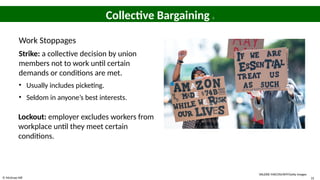
Work Stoppages
Strike: a collective decision by union
members not to work until certain
demands or conditions are met.
• Usually includes picketing.
• Seldom in anyone’s best interests.
Lockout: employer excludes workers from
workplace until they meet certain
conditions.
VALERIE MACON/AFP/Getty Images
© McGraw Hill 32
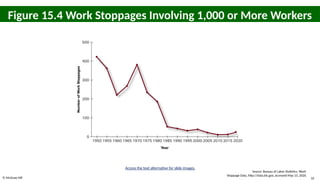
Figure 15.4 Work Stoppages Involving 1,000 or More Workers
Access the text alternative for slide images.
Source: Bureau of Labor Statistics, Work
Stoppage Data, http://data.bls.gov, accessed May 13, 2020.
© McGraw Hill 33
Collective Bargaining 4
Alternatives to Work Stoppages
Mediation.
• Least formal and most widely used.
• Mediator hears the views of both sides and facilitates the negotiation process.
Fact finder.
• Most often used for negotiations with governmental bodies.
Arbitration.
• Settlement is binding.
• Final-offer arbitration.
• Rights arbitration.
© McGraw Hill 34
Contract Administration
Carrying out the terms of the agreement.
Resolving conflicts over interpretation or violations of the agreement.
Grievance procedure.
• Process to resolve union-management conflicts.
• Important means of getting fair treatment in workplace.
• Key influence on contract administration success.
© McGraw Hill 35
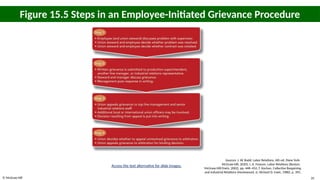
Figure 15.5 Steps in an Employee-Initiated Grievance Procedure
Access the text alternative for slide images.
Sources: J. W. Budd, Labor Relations, 6th ed. (New York:
McGraw-Hill, 2020); J. A. Fossum, Labor Relations (Boston:
McGraw-Hill/Irwin, 2002), pp. 448–452; T. Kochan, Collective Bargaining
and Industrial Relations (Homewood, IL: Richard D. Irwin, 1980), p. 395.
© McGraw Hill 36
POLLING
QUESTION
2
Which statement about labor unions is TRUE?
A. Mediation requires each party to abide by the mediator’s decision.
B. Integrative bargaining involves a win-lose approach because the issues are
considered a fixed pie.
C. A union steward represents the issues concerning union employees and is
elected by them.
D. A strike is when the employer excludes workers from the workplace until
they meet certain conditions.
© McGraw Hill 37
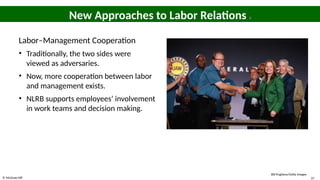
New Approaches to Labor Relations 1
Labor–Management Cooperation
• Traditionally, the two sides were
viewed as adversaries.
• Now, more cooperation between labor
and management exists.
• NLRB supports employees’ involvement
in work teams and decision making.
Bill Pugliano/Getty Images
© McGraw Hill 38
New Approaches to Labor Relations 2
Nonunion Representation Systems
Management-established systems.
• Representatives of employees meet with management to discuss working conditions, wages
and benefits.
• May violate the NLRB.
Worker center.
• Nonprofit organization offering members services such as training, legal advice, lobbying, and
worker advocacy.
39
End of Chapter 15
© 2022 McGraw Hill. All rights reserved. Authorized only for instructor use in the classroom. No reproduction or further distribution permitted without the prior written consent of McGraw Hill.

Noe_FHRM9e_PPT_Ch15_accessible.pptx.shrm

  • 1.
    2 Chapter 15 Collective Bargainingand Labor Relations freesoulproduction/Shutterstock © 2022 McGraw Hill. All rights reserved. Authorized only for instructor use in the classroom. No reproduction or further distribution permitted without the prior written consent of McGraw Hill.
  • 2.
    © McGraw Hill3 What Do I Need to Know? LO 15-1 Define unions and labor relations and their role in organizations. LO 15-2 Identify the labor relations goals of management, labor unions, and society. LO 15-3 Summarize laws and regulations that affect labor relations. LO 15-4 Describe the union organizing process. LO 15-5 Explain how management and unions negotiate contracts. LO 15-6 Summarize the practice of contract administration. LO 15-7 Describe new approaches to labor-management relations.
  • 3.
    © McGraw Hill4 Role of Unions and Labor Relations 1 Unions • Labor unions represent their members’ interests in dealing with employers. • The collective bargaining process provides a way to manage the conflict. Labor Relations • Field emphasizing labor-management cooperation. • Involves a labor relations strategy, negotiating contracts, and administering contracts.
  • 4.
    © McGraw Hill5 Role of Unions and Labor Relations 2 National and International Unions Craft union: members have a particular skill or occupation. Industrial union: members linked by their work in a particular industry. Most national unions are affiliated with the AFL-CIO. • Represents labor’s interests in public policy issues. The largest union in the United States is the National Education Association with 3 million members. Stuart O’Sullivan/Getty Images
  • 5.
    © McGraw Hill6 Role of Unions and Labor Relations 3 Local Unions • National unions can consist of multiple local units. • Most day-to-day interaction between labor and management involves the local union. • Membership in a local union depends on its type. • Members elect officials and vote on resolutions to strike. • Union steward: elected to represent union and ensures that terms of labor contract are enforced.
  • 6.
    © McGraw Hill7 Role of Unions and Labor Relations 4 Trends in Union Membership Peaked in 1950s reaching over one-third of employees. Now at 10.3% overall; 6.2% of private-sector employment. Decline in union membership due to many factors: • Change in structure of economy. • Management efforts to control costs. • Human resource practices. • Government regulation.
  • 7.
    © McGraw Hill8 Figure 15.1 Union Membership Density among U.S. Wage and Salary Workers, 1976 to 2019 Access the text alternative for slide images. Source: Data for 1973–2001 from B. T. Hirsch and D. A. MacPherson, Union Membership and Earnings Data Book 2001 (Washington, DC: Bureau of National Affairs, 2002), using data from U.S. Current Population Surveys. Data for 2002 through 2019 from Bureau of Labor Statistics, Current Population Survey, https://data.bls.gov, extracted May 13, 2020.
  • 8.
    © McGraw Hill9 Figure 15.2 Union Membership Rates in Selected Countries Access the text alternative for slide images. Source: Organisation for Economic Co-operation and Development, OECD.Stat, https://stats.oecd.org, accessed May 13, 2020.
  • 9.
    © McGraw Hill10 Role of Unions and Labor Relations 5 Unions in Government Membership among government workers is strong. Government regulations and laws support the right of government workers to organize. • Executive Order 10988 established collective bargaining rights. Labor relations are different with government workers. • Strikes illegal for federal and state workers in most states. • Almost all states prohibit strikes by police/firefighters at local level.
  • 10.
    © McGraw Hill11 Role of Unions and Labor Relations 6 Impact of Unions on Company Performance • Organizations are concerned about impact of unionization on productivity, profits, and stock performance. • Experts have conflicting views. • Research reflects average effects of unions, not individual companies and innovative labor relations. • Skillful labor relations can positively influence outcomes.
  • 11.
    © McGraw Hill12 POLLING QUESTION 1 With the decline of union memberships, how do you feel about labor unions in today’s working society? A. They are not very effective. B. They are most useful in the private sector. C. They are most useful in the public sector. D. More industries should have union representation.
  • 12.
    © McGraw Hill13 Goals of Management, Labor Unions, and Society 1 Management Goals Increase the organization’s profits. Keep labor costs low and increase output. • Limit increases in wages and benefits. • Retain control over work rules and schedules. Maintain flexible operations to meet competitive challenges and customer demands.
  • 13.
    © McGraw Hill14 Goals of Management, Labor Unions, and Society 2 Labor Union Goals Obtain pay and working conditions that satisfy members. Give members a voice in decisions that affect them. Membership is linked to better compensation and benefits. • Two-tier wage structures. Regular flow of new members is essential to survival; goals are obtained through power in numbers.
  • 14.
    © McGraw Hill15 Goals of Management, Labor Unions, and Society 3 Labor Unions Goals continued Negotiating contract provisions. • Checkoff provision: contract provision under which employer, on behalf of the union, automatically deducts union dues from employees’ paychecks. • Membership security. • Closed shop. • Union shop. • Agency shop. • Maintenance of membership.
  • 15.
    © McGraw Hill16 Goals of Management, Labor Unions, and Society 4 Societal Goals Union activities take place within context of society. Societal values drive laws/regulations that affect unions. • In 2018, the Supreme Court held that public-employee unions may not require workers to pay dues. Society’s goal for unions is to ensure that workers have a voice in how they are treated by their employers.
  • 16.
    © McGraw Hill17 Laws and Regulations Affecting Labor Relations 1 National Labor Relations Act (NLRA) Protects the activities: • Union organizing and collective bargaining. • Joining a union, whether recognized by employer or not. • Going out on strike. • Refraining from activity on behalf of the union. Most employees in private sector are covered by NLRA.
  • 17.
    © McGraw Hill18 Laws and Regulations Affecting Labor Relations 2 Laws Amending the NLRA Taft-Hartley Act of 1947. • Allows right-to-work laws: state laws that make union shops, maintenance of membership, and agency shops illegal. • Employees free to join a union or not. • Unions believe that all employees who receive union benefits should pay union dues. • Can be legally applied to the private sector. Landrum-Griffin Act of 1959. • Regulates unions’ actions with regard to their members, including financial disclosure and conduct of elections.
  • 18.
    © McGraw Hill19 Figure 15.3 States with Right-to-Work Laws Access the text alternative for slide images. Sources: National Conference of State Legislatures, “Right to Work Resources,” https://www.ncsl.org, accessed May 13, 2020; E. Watkins, “Unions Notch Win in Deep-Red Missouri with Rejection of Right-to-Work Law,” CNN, https:// www.cnn.com, accessed August 8, 2018.
  • 19.
    © McGraw Hill20 Laws and Regulations Affecting Labor Relations 3 National Labor Relations Board (NLRB) Federal government agency that enforces NLRA. • Consists of a five-member board, a general counsel, and 52 regional and other field offices. Conducts and certifies representation elections. Prevents unfair labor practices.
  • 20.
    © McGraw Hill21 Union Organizing 1 The Process of Organizing 1. Union representatives contact employees. 2. Employees invited to sign authorization card. • 30 percent must sign for process to continue. 3. If not signed, the NLRB conducts a secret-ballot election. • Consent election—all parties agree on terms. • Stipulation election—NLRB dictates the terms. 4. Workers vote for or against union representation. 5. The NLRB certifies the union or holds a runoff election.
  • 21.
    © McGraw Hill22 Table 15.2 What Supervisors Should and Should Not Do to Discourage Unions 1 What to Do: Report any direct or indirect signs of union activity to a core management group. Deal with employees by carefully stating the company’s response to pro-union arguments. These responses should be coordinated to maintain consistency and to avoid threats or promises. Take away union issues by following effective management practices all the time: Deliver recognition and appreciation. Solve employee problems. Protect employees from harassment or humiliation. Provide business-related information. Be consistent in treatment of different employees. Accommodate special circumstances where appropriate. Ensure due process in performance management. Treat all employees with dignity and respect. Source: J. A. Segal, “Unshackle Your Supervisors to Stay Union Free,” HR Magazine, June 1998.
  • 22.
    © McGraw Hill23 Table 15.2 What Supervisors Should and Should Not Do to Discourage Unions 2 What to Avoid: Threatening employees with harsher terms and conditions of employment or employment loss if they engage in union activity. Interrogating employees about pro-union or anti-union sentiments that they or others may have or reviewing union authorization cards or pro-union petitions. Promising employees that they will receive favorable terms or conditions of employment if they forgo union activity. Spying on employees known to be, or suspected of being, engaged in pro-union activities.
  • 23.
    © McGraw Hill24 Union Organizing 2 Union Strategies Organizers call or visit employees at home to talk about issues like pay and job security. May offer workers associate union membership. Conduct corporate campaigns. Negotiate provisions into contract. • Employer neutrality and card-check provisions.
  • 24.
    © McGraw Hill25 Union Organizing 3 Decertifying a Union Taft-Hartley Act expanded members’ right to be represented by leaders of their own choosing. Decertification: when members vote out existing union. • Follows same process as representation election. • May not occur when contract is in effect.
  • 25.
    © McGraw Hill26 Collective Bargaining 1 Collective Bargaining • Union and management representatives negotiate to arrive at contract defining conditions of employment. • Typical contracts include provisions for pay, benefits, work rules, and resolution of workers’ grievances. • Bargaining structure varies by situation.
  • 26.
    © McGraw Hill27 Table 15.3 Typical Provisions in Collective Bargaining Contracts 1 Establishment and administration of the agreement • Contract duration and reopening and renegotiation provisions. • Grievance procedures. • Arbitration and mediation. • Strikes and lockouts. • Contract enforcement. Functions, rights, and responsibilities • Management rights clauses. • Subcontracting. • Union activities on company time and premises. • Union-management cooperation. • Regulation of technological change. • Advance notice and consultation. Wage determination and administration • Rate structure and wage differentials. • Incentive systems and production bonus plans. • Production standards and time studies. • Job classification and job evaluation. • Wage adjustments—individual and general.
  • 27.
    © McGraw Hill28 Table 15.3 Typical Provisions in Collective Bargaining Contracts 2 Job or income security • Hiring and transfer arrangements. • Employment and income guarantees. • Supplemental unemployment benefit plans. • Regulation of overtime, shift work, etc. • Reduction of hours to forestall layoffs. • Layoff procedures; seniority; recall. • Promotion practices. • Training and retraining. • Relocation allowances. • Severance pay and layoff benefit plans. Plant operations • Work and shop rules. • Rest periods and other in-plant time allowances. • Safety and health. • Hours of work and premium pay practices. • Shift operations. • Hazardous work. • Discipline and discharge.
  • 28.
    © McGraw Hill29 Table 15.3 Typical Provisions in Collective Bargaining Contracts 3 Paid and unpaid leave • Vacations holidays, sick leave. • Funeral and personal leave. • Military leave and jury duty. Employee benefit plans • Health and insurance plans. • Pension plans. • Profit-sharing, stock purchase, and thrift plans. • Bonus plans. Special groups • Apprentices and learners. • Workers with disabilities. • Veterans. • Union representatives. Source: Adapted from T. A. Kochan, Collective Bargaining and Industrial Relations (Homewood, IL: Richard D. Irwin, 1980), p. 29. Original data from J. W. Bloch, “Union Contracts—A New Series of Studies,” Monthly Labor Review 87 (October 1964), pp. 1184–85.
  • 29.
    © McGraw Hill30 Collective Bargaining 2 Bargaining over New Contracts 1. Preparation for bargaining is important. • Establish objectives for contract, review old contract, gather data, predict likely demands, establish cost of meeting demands. 2. Union and management present proposals. 3. Each side considers proposals. 4. Union and management attempt to reach agreement. • When bargaining unsuccessful, work stoppages can ensue.
  • 30.
    © McGraw Hill31 Collective Bargaining 3 Work Stoppages Strike: a collective decision by union members not to work until certain demands or conditions are met. • Usually includes picketing. • Seldom in anyone’s best interests. Lockout: employer excludes workers from workplace until they meet certain conditions. VALERIE MACON/AFP/Getty Images
  • 31.
    © McGraw Hill32 Figure 15.4 Work Stoppages Involving 1,000 or More Workers Access the text alternative for slide images. Source: Bureau of Labor Statistics, Work Stoppage Data, http://data.bls.gov, accessed May 13, 2020.
  • 32.
    © McGraw Hill33 Collective Bargaining 4 Alternatives to Work Stoppages Mediation. • Least formal and most widely used. • Mediator hears the views of both sides and facilitates the negotiation process. Fact finder. • Most often used for negotiations with governmental bodies. Arbitration. • Settlement is binding. • Final-offer arbitration. • Rights arbitration.
  • 33.
    © McGraw Hill34 Contract Administration Contract Administration Carrying out the terms of the agreement. Resolving conflicts over interpretation or violations of the agreement. Grievance procedure. • Process to resolve union-management conflicts. • Important means of getting fair treatment in workplace. • Key influence on contract administration success.
  • 34.
    © McGraw Hill35 Figure 15.5 Steps in an Employee-Initiated Grievance Procedure Access the text alternative for slide images. Sources: J. W. Budd, Labor Relations, 6th ed. (New York: McGraw-Hill, 2020); J. A. Fossum, Labor Relations (Boston: McGraw-Hill/Irwin, 2002), pp. 448–452; T. Kochan, Collective Bargaining and Industrial Relations (Homewood, IL: Richard D. Irwin, 1980), p. 395.
  • 35.
    © McGraw Hill36 POLLING QUESTION 2 Which statement about labor unions is TRUE? A. Mediation requires each party to abide by the mediator’s decision. B. Integrative bargaining involves a win-lose approach because the issues are considered a fixed pie. C. A union steward represents the issues concerning union employees and is elected by them. D. A strike is when the employer excludes workers from the workplace until they meet certain conditions.
  • 36.
    © McGraw Hill37 New Approaches to Labor Relations 1 Labor–Management Cooperation • Traditionally, the two sides were viewed as adversaries. • Now, more cooperation between labor and management exists. • NLRB supports employees’ involvement in work teams and decision making. Bill Pugliano/Getty Images
  • 37.
    © McGraw Hill38 New Approaches to Labor Relations 2 Nonunion Representation Systems Management-established systems. • Representatives of employees meet with management to discuss working conditions, wages and benefits. • May violate the NLRB. Worker center. • Nonprofit organization offering members services such as training, legal advice, lobbying, and worker advocacy.
  • 38.
    39 End of Chapter15 © 2022 McGraw Hill. All rights reserved. Authorized only for instructor use in the classroom. No reproduction or further distribution permitted without the prior written consent of McGraw Hill.

Editor's Notes

  • #1 NOTE TO INSTRUCTORS: If your class has fewer than 40 students per poll, Poll Everywhere is free (as of production of these slides). For current pricing please visit: https://www.polleverywhere.com/plans If you have more than 40 students per poll, please talk to your McGraw-Hill rep as we have negotiated a discount on this tool for you that we are happy to pass on: http://www.mhhe.com/rep.
  • #4 LO 15-1 Define unions and labor relations and their role in organizations. Labor unions are organizations formed for the purpose of representing their members’ interests and resolving conflicts with employers. Labor relations is a field that emphasizes skills that managers and union leaders can use to minimize costly forms of conflict (such as strikes) and seek win-win solutions to disagreements.
  • #5 Craft union is a labor union whose members all have a particular skill or occupation. Industrial union is a labor union whose members are linked by their work in a particular industry. Most national unions in the United States are affiliated with the American Federation of Labor and Congress of Industrial Organizations (AFL-CIO). The AFL-CIO is not a labor union but an association that seeks to advance the shared interests of its member unions at the national level, much as the Chamber of Commerce and the National Association of Manufacturers do for their member employers. Approximately 55 national and international unions are affiliated with the AFL-CIO. An important responsibility of the AFL-CIO is to represent labor’s interests in public policy issues such as labor law, economic policy, and occupational safety and health.
  • #6 Most national unions consist of multiple local units. Individual members participate in local unions in various ways. At meetings of the local union, they elect officials and vote on resolutions to strike. Most of workers’ contact is with the union steward, an employee elected by union members to represent them in ensuring that the terms of the contract are enforced. The union steward helps investigate complaints and represents employees to supervisors and other man-agers when employees file grievances alleging contract violations. When the union deals with several employers, as in the case of a craft union, a business representative performs some of the same functions as a union steward. Because of union stewards’ and business representatives’ close involvement with employees, it is to management’s advantage to cultivate positive working relationships with them.
  • #7 The decline in union membership has been driven by falling union membership in the private sector, while the share of government workers in unions has mostly held steady.
  • #8 Note: Percentage of total, private-sector, and public-sector wage and salary workers who are union members. Beginning in 1977, workers belonging to “an employee association similar to a union” are included as members. As Figure 15.1 indicates, union membership has fallen steadily since the 1980s. The decline has been driven by falling union membership in the private sector, while the share of government workers in unions has mostly held steady.
  • #9 Note: Latest year available (2017 or 2018). As Figure 15.2 indicates, the percentage of U.S. workers who belong to unions is lower than in many other countries. More dramatic is the difference in “coverage”—the percentage of employees whose terms and conditions of employment are governed by a union contract, whether or not the employees are technically union members. In Western Europe, it is common to have coverage rates of 80% to 90%, so the influence of labor unions far outstrips what membership levels would imply. Also, employees in Western Europe tend to have a larger formal role in decision making than in the United States.
  • #10 Union membership in the public sector grew during the 1960s and 1970s and has remained steady ever since. Over one-third of government employees are union members, and a larger share are covered by collective bargaining agreements. Among them are nurses, park rangers, school librarians, corrections officers, and many workers in clerical and other white-collar occupations. One reason for this strength is that government regulations and laws support the right of government workers to organize.
  • #11 Organizations are concerned about whether union organizing and bargaining will hurt their performance, in particular, unions’ impact on productivity, profits, and stock performance. Researchers have studied the general relationship between unionization and these performance measures. Through skillful labor relations, organizations can positively influence outcomes. Many companies depend on unions to recruit and train new workers through apprenticeship programs. here is evidence that unions have both positive and negative effects on productivity. a company’s profits and stock performance may still suffer if unions raise wage and benefits costs by more than the productivity gain. On average, union members receive higher wages and more generous benefits than nonunion workers, and evidence shows that unions have a large negative effect on profits. Union coverage tends to decline faster in companies with a lower return to shareholders. Companies wishing to become more competitive must continually monitor their labor relations strategy.
  • #12 With the decline of union memberships, how do you feel about labor unions in today’s working society? They are not very effective. They are most useful in the private sector. They are most useful in the public sector. More industries should have union representation. Student answers will vary. This can lead to a lively debate of the chapter’s materials.
  • #13 LO 15-2 Identify the labor relations goals of management, labor unions, and society. Managers continue to prefer to keep the organization’s operations flexible, so they can adjust activities to meet competitive challenges and customer demands.
  • #14 In general, labor unions have the goals of obtaining pay and working conditions that satisfy their members and of giving members a voice in decisions that affect them. Traditionally, they obtain these goals by gaining power in numbers. The more workers who belong to a union, the greater the union’s power. More members translates into greater ability to halt or disrupt production. Larger unions also have greater financial resources for continuing a strike; the union can help to make up for the wages the workers lose during a strike.
  • #15 The survival and security of a union depend on its ability to ensure a regular flow of new members and member dues to support the services it provides. Therefore, unions typically place high priority on negotiating two types of contract provisions with an employer that are critical to a union’s security and viability: checkoff provisions and provisions relating to union membership or contribution. Checkoff provision is a contract provision under which the employer, on behalf of the union, automatically deducts union dues from employees’ paychecks. Security provisions: Closed shop is a union security arrangement under which a person must be a union member before being hired; illegal for those covered by the National Labor Relations Act. Union shop is a union security arrangement that requires employees to join the union within a certain amount of time (30 days) after beginning employment. Agency shop is a union security arrangement that requires the payment of union dues but not union membership. Maintenance of membership is a union security rules not requiring union membership but requiring that employees who join the union remain members for a certain period of time.
  • #16 Former Senator Orrin Hatch, described by BusinessWeek as “labor’s archrival on Capitol Hill,” spoke of a need for unions: “There are always going to be people who take advantage of workers. Unions even that out, to their credit. We need them to level the field between labor and management. If you didn’t have unions, it would be very difficult for even enlightened employers not to take advantage of workers on wages and working conditions, because of competition from less enlightened rivals. I’m among the first to say I believe in unions.”
  • #17 LO 15-3 Summarize laws and regulations that affect labor relations. National Labor Relations Act (NLRA) is a federal law that supports collective bargaining and sets out the rights of employees to form unions. NLRA prevents unfair labor practices by educating employers and employees about their rights and responsibilities under the National Labor Relations Act and by responding to complaints. Activities protected under the NLRA include: Union organizing. Joining a union, whether recognized by the employer or not. Going out on strike to secure better working conditions. Refraining from activity on behalf of the union.
  • #18 Originally the NLRA did not list any unfair labor practices by unions. In later amendments to the NLRA—the Taft-Hartley Act of 1947 and the Landrum-Griffin Act of 1959—Congress established some restrictions on union practices deemed unfair to employers and union members. The Taft-Hartley Act also allows the states to pass so-called right-to-work laws, which are state laws that make union shops, maintenance of membership, and agency shops illegal.
  • #19 Figure 15.3 indicates which states currently have right-to-work laws. These laws make union shops, maintenance of membership, and agency shops illegal.
  • #20 National Labor Relations Board (NLRB) is a federal government agency that enforces the NLRA by conducting and certifying representation elections and investigating unfair labor practices. The NLRB has two major functions: to conduct and certify representation elections and to prevent unfair labor practices. It does not initiate either of these actions but responds to requests for action. The NLRB is responsible for ensuring that the organizing process follows certain steps. The NLRB is also responsible for determining the appropriate bargaining unit and the employees who are eligible to participate in organizing activities. The NLRB prevents unfair labor practices by educating employers and employees about their rights and responsibilities under the National Labor Relations Act and by responding to complaints.
  • #21 LO 15-4 Describe the union organizing process. After authorization cards have been signed, a petition for election is made to the regional NLRB office conducts a secret-ballot election. The arrangements are made in one of two ways: 1. For a consent election, the employer and the union seeking representation arrive at an agreement stating the time and place of the election, the choices included on the ballot, and a way to determine who is eligible to vote. For a stipulation election, the parties can-not agree on all of these terms, so NLRB dictates the time and place, ballot choices, and method of determining eligibility. On the ballot, workers vote for or against union representation, and they may also have a choice from among more than one union. If the union (or one of the unions on the ballot) wins a majority of votes, NLRB certifies the union. If the ballot includes more than one union and neither gains a simple majority, NLRB holds a runoff election.
  • #22 Supervisors have the most direct contact with employees. As Table 15.1 indicates, it is critical that they establish good relationships with employees even before there is any attempt at union organizing. Supervisors also must know what not to do if a union drive takes place. They should be trained in the legal principles covered in this chapter.
  • #24 Beyond encouraging workers to sign authorization cards and vote for the union, organizers use some creative alternatives to traditional organizing activities. They sometimes offer workers associate union membership which is not linked to an employee’s workplace and does not provide representation in collective bargaining. Rather, an associate member receives other services, such as discounts on health and life insurance or credit cards. In return for these benefits, the union receives membership dues and a broader base of support for its activities. Associate union membership is an alternative form of union membership in which members receive discounts on insurance and credit cards rather than representation in collective bargaining. Associate membership may be attractive to employees who wish to join a union but cannot because their work-place is not organized by a union. Another alternative to traditional organizing is to conduct corporate campaigns—bringing public, financial, or political pressure on employers during union organization and contract negotiation. Another winning union organizing strategy is to negotiate employer neutrality and card-check provisions into a contract. Under a neutrality provision, the employer pledges not to oppose organizing attempts elsewhere in the company. A card-check provision is an agreement that if a certain percentage—by law, at least a majority—of employees sign an authorization card, the employer will recognize their union representation.
  • #25 The number of decertification elections has increased from about 5% of all elections in the 1950s and 1960s to more than double that rate in recent years. In fiscal year 2018, the NLRB reported that nearly 9% of elections were decertification elections.
  • #26 LO 15-5 Explain how management and unions negotiate contracts. Typical contracts include provisions for pay, benefits, work rules, and resolution of workers’ grievances. Collective bargaining is negotiation between union representatives and management representatives to arrive at a contract defining conditions of employment for the term of the contract and to administer that contract.
  • #27 Table 15.2 shows typical provisions negotiated in collective bargaining contracts.
  • #30 Typical contracts include provisions for pay, benefits, work rules, and resolution of workers’ grievances.
  • #31 If one or both sides determine that negotiation alone will not produce such an agreement, bargaining breaks down. To bring this impasse to an end, work may stop, or the parties may bring in outside help to resolve their differences. A strike is a collective decision by union members not to work until certain demands or conditions are met. Many government employees do not have a right to strike, and their percentage among unionized employees overall has risen in recent decades. A lockout is an employer’s exclusion of workers from a work-place until they meet certain conditions.
  • #32 Note: Because strikes are most likely in large bargaining units, these numbers represent most lost working time in the United States. The number of work stoppages (strikes and lockouts) has plunged since the 1950s, although 2018 and 2019 saw significant increases in work stoppages compared to previous years in the last decade (Figure 15.4).
  • #33 Because work stoppages are so costly and risky, unions and employers generally prefer other methods for resolving conflicts. Three common alternatives rely on a neutral third party, usually provided by the Federal Mediation and Conciliation Service (FMCS). Mediation is a conflict resolution procedure in which a mediator hears the views of both sides and facilitates the negotiation process but has no formal authority to dictate a resolution. Fact finder is a third party to collective bargaining who reports the reasons for a dispute, the views and arguments of both sides, and possibly a recommended settlement, which the parties may decline. Arbitration is a conflict resolution procedure in which an arbitrator or arbitration board determines a binding settlement.
  • #34 LO 15-6 Summarize the practice of contract administration. Vague or inconsistent language in the contract can make administering the contract difficult. The difficulties can create conflict that spills over into the next round of negotiations. Grievance procedure is the process for resolving union-management conflicts over interpretation or violation of a collective bargaining agreement.
  • #35 For grievances launched by an employee, a typical grievance procedure follows the steps shown in Figure 15.5. From the viewpoint of employees, the grievance procedure is an important means of getting fair treatment in the workplace. Its success depends on whether it provides for all kinds of problems that are likely to arise, whether employees feel they can file a grievance without being punished for it, and whether employees believe their union representatives will follow through. Under the National Labor Relations Act, the union has a duty of fair representation, which means the union must give equal representation to all members of the bargaining unit, whether or not they actually belong to the union.
  • #36 Which statement about labor unions is TRUE? Mediation requires each party to abide by the mediator’s decision. False. Arbitration requires that, mediation is just a way to resolve differences using a neutral third party. Integrative bargaining involves a win-lose approach because the issues are considered a fixed pie. False. Integrative bargaining takes a win-win approach, distributive bargaining takes a fixed pie approach. A union steward represents the issues concerning union employees and is elected by them. True. The union steward helps investigate complaints and represents employees to supervisors and other managers when employees file grievances alleging contract violations. A strike is when the employer excludes workers from the workplace until they meet certain conditions. False. In a lockout, the employer excludes workers from the workplace until they meet certain conditions. A strike is a collective decision of the union members not to work until certain demands or conditions are met. Answer: C
  • #37 LO 15-7 Describe new approaches to labor-management relations. The growing role of employee empowerment and the shrinking size of union membership have helped to establish new approaches to labor relations. Among these developments are an emphasis on cooperation between unions and management and the use of nonunion systems for employee representation.
  • #38 Given that only a little more than 10% of workers are now represented by unions, what recourse do the other 89% have if they want someone to represent their interests to management? Employees want some form of representation, which often involves “substitutes” for unions. A recent survey of hundreds of U.S. workers found that 17% were covered by a collective bargaining agreement, and another 28% said they had some form of management-established system to represent them. Another nonunion approach is the worker center, a nonprofit organization offering its members services such as training, legal advice, lobbying, and worker advocacy.