2
Chapter 8
Developing Employees for Future Success
freesoulproduction/Shutterstock
© 2022 McGraw Hill. All rights reserved. Authorized only for instructor use in the classroom. No reproduction or further distribution permitted without the prior written consent of McGraw Hill.
© McGraw Hill 3
What Do I Need to Know?
LO 8-1 Discuss how development is related to training and careers.
LO 8-2 Identify the methods organizations use for employee development.
LO 8-3 Describe how organizations use assessment of personality type, work behaviors, and
job performance to plan employee development.
LO 8-4 Explain how job experiences can be used for developing skills.
LO 8-5 Summarize principles of successful mentoring programs.
LO 8-6 Tell how managers and peers develop employees through coaching.
LO 8-7 Identify the steps in the process of career management.
LO 8-8 Discuss how organizations are meeting the challenges of the “glass ceiling,” succession
planning, and dysfunctional managers.
© McGraw Hill 4
Training, Development, and Career Management 1
Development and Training
Employee development.
• Combination of formal education, job experience, relationships, and assessment of
personality and abilities to help employees prepare for future careers.
• Prepares employees for change in new jobs and responsibilities.
• Prepares employees for changes in their current jobs.
© McGraw Hill 5
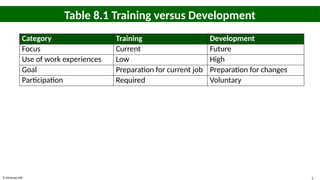
Table 8.1 Training versus Development
Category Training Development
Focus Current Future
Use of work experiences Low High
Goal Preparation for current job Preparation for changes
Participation Required Voluntary
© McGraw Hill 6
Training, Development, and Career Management 2
Development for Careers
Protean career.
• Employees take responsibility for managing their careers.
• Employees are continually developing marketable skills.
Employers and employees need to find matches between:
• Employees’ interests, skills, and weaknesses.
• Development experiences involving jobs, relationships, and formal courses.
• Career management (development planning).
© McGraw Hill 7
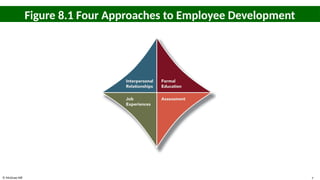
Figure 8.1 Four Approaches to Employee Development
© McGraw Hill 8
Approaches to Employee Development 1
Formal Education
• Includes workshops, short courses, lectures, simulation, business games, experiential
programs, and meetings.
• Many companies have training and development centers.
• Can occur off-site or through the Internet.
© McGraw Hill 9
Approaches to Employee Development 2
Assessment
Collecting information and providing feedback to employees about behavior,
communication, or skills.
Most frequently used to assess managerial potential.
Comes from employees, peers, managers, or customers.
Methods of assessment vary:
• Psychological tests.
• Self, peer, and management ratings.
• Assessment centers.
© McGraw Hill 10
Approaches to Employee Development 3
Assessment continued
Psychological profiles.
• Myers-Briggs Type Indicator (MBTI).
• Measures four areas: energy (introversion or extroversion), information-gathering
(sensing or intuitive), decision making (thinking or feeling), and lifestyle (judging or
perceiving).
• Helps organizations understand the communication, motivation, teamwork, work styles,
and leadership of the people in their groups.
• Research on effectiveness is inconclusive.
© McGraw Hill 11
Approaches to Employee Development 4
Assessment continued
Psychological profiles continued.
• DiSC assessment tool.
• Report describes employees’ behavioral style, preferred environment, and strategies for
effectiveness.
• Categories are dominance, influence, steadiness, and conscientiousness.
© McGraw Hill 12
Approaches to Employee Development 5
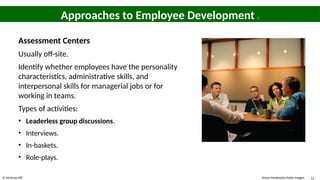
Assessment Centers
Usually off-site.
Identify whether employees have the personality
characteristics, administrative skills, and
interpersonal skills for managerial jobs or for
working in teams.
Types of activities:
• Leaderless group discussions.
• Interviews.
• In-baskets.
• Role-plays.
Karen Moskowitz/Getty Images
© McGraw Hill 13
Approaches to Employee Development 6
Performance Appraisals and 360-Degree Feedback
Performance appraisal is a formal process for measuring employee
performance.
• Identifies causes of performance discrepancy and develops plans for improvement.
360-degree feedback is performance measurement by the employee’s
supervisor, peers, employees, and customers.
© McGraw Hill 14
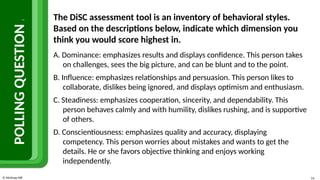
POLLING
QUESTION
1
The DiSC assessment tool is an inventory of behavioral styles.
Based on the descriptions below, indicate which dimension you
think you would score highest in.
A. Dominance: emphasizes results and displays confidence. This person takes
on challenges, sees the big picture, and can be blunt and to the point.
B. Influence: emphasizes relationships and persuasion. This person likes to
collaborate, dislikes being ignored, and displays optimism and enthusiasm.
C. Steadiness: emphasizes cooperation, sincerity, and dependability. This
person behaves calmly and with humility, dislikes rushing, and is supportive
of others.
D. Conscientiousness: emphasizes quality and accuracy, displaying
competency. This person worries about mistakes and wants to get the
details. He or she favors objective thinking and enjoys working
independently.
© McGraw Hill 15
Approaches to Employee Development 7
Job Experiences
• Combination of relationships,
problems, demands, tasks, and other
features of an employee’s job.
• Most employee development occurs
here.
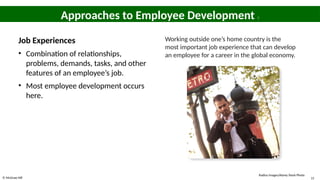
Working outside one’s home country is the
most important job experience that can develop
an employee for a career in the global economy.
Radius Images/Alamy Stock Photo
© McGraw Hill 16
Approaches to Employee Development 8
Types of Job Assignments
Job enlargement.
Job rotation.
Transfer, promotions, and downward moves.
Temporary assignments with other organizations.
• Externship.
• Sabbatical.
© McGraw Hill 17
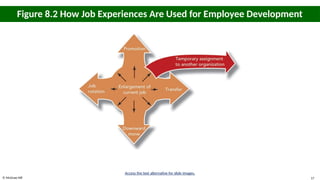
Figure 8.2 How Job Experiences Are Used for Employee Development
Access the text alternative for slide images.
© McGraw Hill 18
Approaches to Employee Development 9
Interpersonal Relationships
• Employees can develop skills and increase their knowledge by interacting with
experienced members of organization.
• Mentor: experienced, productive senior employee who helps develop less
experienced employee.
• Coach: peer or manager who motivates employee, helps them develop skills, and
provides reinforcement/feedback.
© McGraw Hill 19
POLLING
QUESTION
2
Gerome starts out at a new company as a sales person. After a
few years, he becomes known as a reliable and hard-working
employee. His boss asks Gerome to be a mentor to new sales
representatives. What type of employee development is
Gerome experiencing?
A. Formal education
B. Job enlargement
C. Job rotation
D. Transfer
© McGraw Hill 20
Systems for Career Management 1
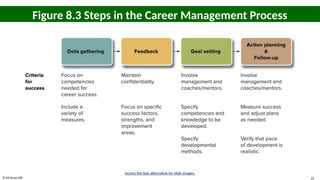
Career Management System
Data gathering.
• Often aimed at providing individual employees with information about themselves.
• Tools for self-assessment (Myers-Briggs Type Indicator, the Strong-Campbell Interest Inventory,
the Self-Directed Search).
Feedback.
• Employee’s responsibility to identify what skills she or he could realistically develop.
• Organization’s responsibility is to communicate the performance evaluation and the
opportunities available to the employee, given the organization’s long-range plans.
© McGraw Hill 21
Systems for Career Management 2
Career Management System continued
Goal setting (long- and short-term).
• Desired positions.
• Level of skill to apply.
• Work setting.
• Skill acquisition.
Action planning and follow-up.
• Prepared by employee.
• Includes steps and timetable to reach goals.
• May result in a career development plan.
© McGraw Hill 22
Figure 8.3 Steps in the Career Management Process
Access the text alternative for slide images.
© McGraw Hill 23
Development-Related Challenges 1
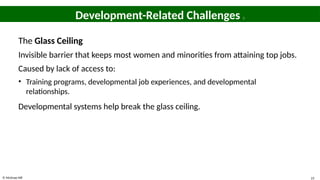
The Glass Ceiling
Invisible barrier that keeps most women and minorities from attaining top jobs.
Caused by lack of access to:
• Training programs, developmental job experiences, and developmental
relationships.
Developmental systems help break the glass ceiling.
© McGraw Hill 24
Development-Related Challenges 2
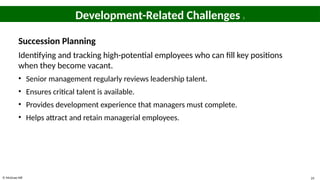
Succession Planning
Identifying and tracking high-potential employees who can fill key positions
when they become vacant.
• Senior management regularly reviews leadership talent.
• Ensures critical talent is available.
• Provides development experience that managers must complete.
• Helps attract and retain managerial employees.
© McGraw Hill 25
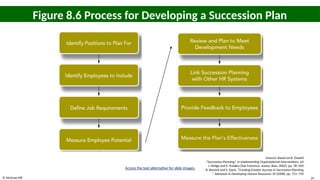
Figure 8.6 Process for Developing a Succession Plan
Access the text alternative for slide images.
Sources: Based on B. Dowell,
“Succession Planning,” in Implementing Organizational Interventions, ed.
J. Hedge and E. Pulakos (San Francisco: Jossey- Bass, 2002), pp. 78–109;
R. Barnett and S. Davis, “Creating Greater Success in Succession Planning,
” Advances in Developing Human Resources 10 (2008), pp. 721–739.
© McGraw Hill 26
Development-Related Challenges 3
Dysfunctional Managers
May engage in behaviors that make them ineffective or “toxic.”
• Insensitivity to others.
• Inability to be a team player.
• Arrogance.
• Poor conflict-management skills.
• Inability to meet business objectives.
• Inability to adapt to change.
27
End of Chapter 8
© 2022 McGraw Hill. All rights reserved. Authorized only for instructor use in the classroom. No reproduction or further distribution permitted without the prior written consent of McGraw Hill.

Noe_FHRM9e_PPT_Ch08_accessible.pptxjgjgg

  • 1.
    2 Chapter 8 Developing Employeesfor Future Success freesoulproduction/Shutterstock © 2022 McGraw Hill. All rights reserved. Authorized only for instructor use in the classroom. No reproduction or further distribution permitted without the prior written consent of McGraw Hill.
  • 2.
    © McGraw Hill3 What Do I Need to Know? LO 8-1 Discuss how development is related to training and careers. LO 8-2 Identify the methods organizations use for employee development. LO 8-3 Describe how organizations use assessment of personality type, work behaviors, and job performance to plan employee development. LO 8-4 Explain how job experiences can be used for developing skills. LO 8-5 Summarize principles of successful mentoring programs. LO 8-6 Tell how managers and peers develop employees through coaching. LO 8-7 Identify the steps in the process of career management. LO 8-8 Discuss how organizations are meeting the challenges of the “glass ceiling,” succession planning, and dysfunctional managers.
  • 3.
    © McGraw Hill4 Training, Development, and Career Management 1 Development and Training Employee development. • Combination of formal education, job experience, relationships, and assessment of personality and abilities to help employees prepare for future careers. • Prepares employees for change in new jobs and responsibilities. • Prepares employees for changes in their current jobs.
  • 4.
    © McGraw Hill5 Table 8.1 Training versus Development Category Training Development Focus Current Future Use of work experiences Low High Goal Preparation for current job Preparation for changes Participation Required Voluntary
  • 5.
    © McGraw Hill6 Training, Development, and Career Management 2 Development for Careers Protean career. • Employees take responsibility for managing their careers. • Employees are continually developing marketable skills. Employers and employees need to find matches between: • Employees’ interests, skills, and weaknesses. • Development experiences involving jobs, relationships, and formal courses. • Career management (development planning).
  • 6.
    © McGraw Hill7 Figure 8.1 Four Approaches to Employee Development
  • 7.
    © McGraw Hill8 Approaches to Employee Development 1 Formal Education • Includes workshops, short courses, lectures, simulation, business games, experiential programs, and meetings. • Many companies have training and development centers. • Can occur off-site or through the Internet.
  • 8.
    © McGraw Hill9 Approaches to Employee Development 2 Assessment Collecting information and providing feedback to employees about behavior, communication, or skills. Most frequently used to assess managerial potential. Comes from employees, peers, managers, or customers. Methods of assessment vary: • Psychological tests. • Self, peer, and management ratings. • Assessment centers.
  • 9.
    © McGraw Hill10 Approaches to Employee Development 3 Assessment continued Psychological profiles. • Myers-Briggs Type Indicator (MBTI). • Measures four areas: energy (introversion or extroversion), information-gathering (sensing or intuitive), decision making (thinking or feeling), and lifestyle (judging or perceiving). • Helps organizations understand the communication, motivation, teamwork, work styles, and leadership of the people in their groups. • Research on effectiveness is inconclusive.
  • 10.
    © McGraw Hill11 Approaches to Employee Development 4 Assessment continued Psychological profiles continued. • DiSC assessment tool. • Report describes employees’ behavioral style, preferred environment, and strategies for effectiveness. • Categories are dominance, influence, steadiness, and conscientiousness.
  • 11.
    © McGraw Hill12 Approaches to Employee Development 5 Assessment Centers Usually off-site. Identify whether employees have the personality characteristics, administrative skills, and interpersonal skills for managerial jobs or for working in teams. Types of activities: • Leaderless group discussions. • Interviews. • In-baskets. • Role-plays. Karen Moskowitz/Getty Images
  • 12.
    © McGraw Hill13 Approaches to Employee Development 6 Performance Appraisals and 360-Degree Feedback Performance appraisal is a formal process for measuring employee performance. • Identifies causes of performance discrepancy and develops plans for improvement. 360-degree feedback is performance measurement by the employee’s supervisor, peers, employees, and customers.
  • 13.
    © McGraw Hill14 POLLING QUESTION 1 The DiSC assessment tool is an inventory of behavioral styles. Based on the descriptions below, indicate which dimension you think you would score highest in. A. Dominance: emphasizes results and displays confidence. This person takes on challenges, sees the big picture, and can be blunt and to the point. B. Influence: emphasizes relationships and persuasion. This person likes to collaborate, dislikes being ignored, and displays optimism and enthusiasm. C. Steadiness: emphasizes cooperation, sincerity, and dependability. This person behaves calmly and with humility, dislikes rushing, and is supportive of others. D. Conscientiousness: emphasizes quality and accuracy, displaying competency. This person worries about mistakes and wants to get the details. He or she favors objective thinking and enjoys working independently.
  • 14.
    © McGraw Hill15 Approaches to Employee Development 7 Job Experiences • Combination of relationships, problems, demands, tasks, and other features of an employee’s job. • Most employee development occurs here. Working outside one’s home country is the most important job experience that can develop an employee for a career in the global economy. Radius Images/Alamy Stock Photo
  • 15.
    © McGraw Hill16 Approaches to Employee Development 8 Types of Job Assignments Job enlargement. Job rotation. Transfer, promotions, and downward moves. Temporary assignments with other organizations. • Externship. • Sabbatical.
  • 16.
    © McGraw Hill17 Figure 8.2 How Job Experiences Are Used for Employee Development Access the text alternative for slide images.
  • 17.
    © McGraw Hill18 Approaches to Employee Development 9 Interpersonal Relationships • Employees can develop skills and increase their knowledge by interacting with experienced members of organization. • Mentor: experienced, productive senior employee who helps develop less experienced employee. • Coach: peer or manager who motivates employee, helps them develop skills, and provides reinforcement/feedback.
  • 18.
    © McGraw Hill19 POLLING QUESTION 2 Gerome starts out at a new company as a sales person. After a few years, he becomes known as a reliable and hard-working employee. His boss asks Gerome to be a mentor to new sales representatives. What type of employee development is Gerome experiencing? A. Formal education B. Job enlargement C. Job rotation D. Transfer
  • 19.
    © McGraw Hill20 Systems for Career Management 1 Career Management System Data gathering. • Often aimed at providing individual employees with information about themselves. • Tools for self-assessment (Myers-Briggs Type Indicator, the Strong-Campbell Interest Inventory, the Self-Directed Search). Feedback. • Employee’s responsibility to identify what skills she or he could realistically develop. • Organization’s responsibility is to communicate the performance evaluation and the opportunities available to the employee, given the organization’s long-range plans.
  • 20.
    © McGraw Hill21 Systems for Career Management 2 Career Management System continued Goal setting (long- and short-term). • Desired positions. • Level of skill to apply. • Work setting. • Skill acquisition. Action planning and follow-up. • Prepared by employee. • Includes steps and timetable to reach goals. • May result in a career development plan.
  • 21.
    © McGraw Hill22 Figure 8.3 Steps in the Career Management Process Access the text alternative for slide images.
  • 22.
    © McGraw Hill23 Development-Related Challenges 1 The Glass Ceiling Invisible barrier that keeps most women and minorities from attaining top jobs. Caused by lack of access to: • Training programs, developmental job experiences, and developmental relationships. Developmental systems help break the glass ceiling.
  • 23.
    © McGraw Hill24 Development-Related Challenges 2 Succession Planning Identifying and tracking high-potential employees who can fill key positions when they become vacant. • Senior management regularly reviews leadership talent. • Ensures critical talent is available. • Provides development experience that managers must complete. • Helps attract and retain managerial employees.
  • 24.
    © McGraw Hill25 Figure 8.6 Process for Developing a Succession Plan Access the text alternative for slide images. Sources: Based on B. Dowell, “Succession Planning,” in Implementing Organizational Interventions, ed. J. Hedge and E. Pulakos (San Francisco: Jossey- Bass, 2002), pp. 78–109; R. Barnett and S. Davis, “Creating Greater Success in Succession Planning, ” Advances in Developing Human Resources 10 (2008), pp. 721–739.
  • 25.
    © McGraw Hill26 Development-Related Challenges 3 Dysfunctional Managers May engage in behaviors that make them ineffective or “toxic.” • Insensitivity to others. • Inability to be a team player. • Arrogance. • Poor conflict-management skills. • Inability to meet business objectives. • Inability to adapt to change.
  • 26.
    27 End of Chapter8 © 2022 McGraw Hill. All rights reserved. Authorized only for instructor use in the classroom. No reproduction or further distribution permitted without the prior written consent of McGraw Hill.

Editor's Notes

  • #1 NOTE TO INSTRUCTORS: If your class has fewer than 40 students per poll, Poll Everywhere is free (as of production of these slides). For current pricing please visit: https://www.polleverywhere.com/plans If you have more than 40 students per poll, please talk to your McGraw-Hill rep as we have negotiated a discount on this tool for you that we are happy to pass on: http://www.mhhe.com/rep.
  • #4 LO 8-1 Discuss how development is related to training and careers. Employee development is the combination of formal education, job experiences, relation-ships, and assessment of personality and abilities to help employees prepare for the future of their careers. Organizations and their employees must constantly expand their knowledge, skills, and behavior to meet customer needs and compete in today’s demanding and rapidly changing business environment. HRM establishes a process for employee development that prepares employees to help the organization meet its goals. Development implies learning that is not necessarily related to the employee’s current job. Instead, it prepares employees for other jobs or positions in the organization and increases their ability to move into jobs that may not yet exist. Development may help employees prepare for changes in responsibilities and requirements in their current jobs, such as changes resulting from new technology, work designs, or customers.
  • #5 Training traditionally focuses on helping employees improve performance of their current jobs. Many organizations have focused on linking training programs to business goals. In these organizations, the distinction between training and development is more blurred. Table 8.1 summarizes the traditional differences.
  • #6 In the past, workers and employees might think of a career as something a person pursues at one company, rising through the ranks. Today, however, the more common model is that of a protean career, one that a person frequently changes based on changes in the person’s interests, abilities, and values and in the work environment. Recently, changes such as downsizing and restructuring have become the norm, so the concept of a career has become more fluid than the traditional view. Beyond knowing job requirements, employees need to understand the business in which they are working and be able to cultivate valuable relationships with co-workers, managers, suppliers, and customers. They also need to follow trends in their field and industry, so they can apply technology and knowledge that will match emerging priorities and needs. More employees will follow a spiral career path in which they cross the boundaries between specialties and organizations. As organizations provide for employee development (and as employees take control of their own careers), they will need to (1) determine their interests, skills, and weaknesses and (2) seek development experiences involving jobs, relationships, and formal courses.
  • #7 The many approaches to employee development fall into four broad categories: formal education, assessment, job experiences, and interpersonal relationships. Figure 8.1 summarizes these four methods. Many organizations combine these approaches.
  • #8 LO 8-2 Identify the methods organizations use for employee development. Organizations may support employee development through a variety of formal educational programs, either at the workplace or off-site.
  • #9 LO 8-3 Describe how organizations use assessment of personality type, work behaviors, and job performance to plan employee development. Assessment refers to collecting information and providing feedback to employees about their behavior, communication style, or skills.
  • #10 Myers-Briggs Type Indicator (MBTI) is a psychological inventory that identifies individuals’ preferences for source of energy, means of information gathering, way of decision making, and lifestyle, providing information for team building and leadership development. The assessment consists of more than 100 questions about how the person feels or prefers to behave in different situations.
  • #11 DiSC is a brand of assessment tool that identifies individuals’ behavioral patterns in terms of dominance, influence, steadiness, and conscientiousness. Dominance means the person emphasizes results and displays confidence. This type of person takes on challenges, sees the big picture, and can be blunt and to the point. Influence means the person emphasizes relationships and persuasion. This type of person likes to collaborate, dislikes being ignored, and displays optimism and enthusiasm. Steadiness means the person emphasizes cooperation, sincerity, and dependability. This type of person behaves calmly and with humility, dislikes rushing, and is supportive of others. Conscientiousness means the person emphasizes quality and accuracy, displaying competency. This type of person worries about mistakes and wants to get the details. He or she favors objective thinking and enjoys working independently.
  • #12 At an assessment center, multiple raters or evaluators (assessors) evaluate employees’ performance on a number of exercises. Leaderless group discussion is an assessment center exercise in which a team of five to seven employees is assigned a problem and must work together to solve it within a certain time period.
  • #13 A recent trend in performance appraisals, also discussed in Chapter 10, is 360-degree feedback—performance measurement by the employee’s supervisor, peers, employees, and customers. Often the feedback involves rating the individual in terms of work-related behaviors. For development purposes, the rater would identify an area of behavior as a strength of that employee or an area requiring further development. The results presented to the employee show how he or she was rated on each item and how self-evaluations differ from other raters’ evaluations. The individual reviews the results, seeks clarification from the raters, and sets specific development goals based on the strengths and weaknesses identified.
  • #14 The DiSC assessment tool is an inventory of behavioral styles. Based on the descriptions below, indicate which dimension you think you would score highest in. Dominance: emphasizes results and displays confidence. This person takes on challenges, sees the big picture, and can be blunt and to the point. Influence: emphasizes relationships and persuasion. This person likes to collaborate, dislikes being ignored, and displays optimism and enthusiasm. Steadiness: emphasizes cooperation, sincerity, and dependability. This person behaves calmly and with humility, dislikes rushing, and is supportive of others. Conscientiousness: emphasizes quality and accuracy, displaying competency. This person worries about mistakes and wants to get the details. He or she favors objective thinking and enjoys working independently. Student answers will vary. This allows students to self-reflect and think about how they would be viewed in the office environment based on their responses.
  • #15 LO 8-4 Explain how job experiences can be used for developing skills. Most employee development occurs through job experiences—the combination of relationships, problems, demands, tasks, and other features of an employee’s jobs. Using job experiences for employee development assumes that development is most likely to occur when the employee’s skills and experiences do not entirely match the skills required for the employee’s current job. Job experiences are used to develop skills needed for teamwork, including conflict resolution, data analysis, and customer service. These experiences may occur when forming a team and when employees switch roles within a team. Various job assignments can provide for employee development.
  • #16 Transfer refers to the assignment of an employee to a position in a different area of the company, usually in a lateral move. Downward move refers to the Assignment of an employee to a position with less responsibility and authority. Promotion refers to the Assignment of an employee to a position with greater challenges, more responsibility, and more authority than in the previous job, usually accompanied by a pay increase. Externship is employee development through a full-time temporary position at another organization. Sabbatical is a leave of absence from an organization to renew or develop skills. The organization may enlarge the employee’s current job or move the employee to different jobs. Lateral moves include job rotation, transfer, or temporary assignment to another organization. The organization may also use downward moves or promotions as a source of job experience.
  • #17 Various job assignments can provide for employee development. The organization may enlarge the employee’s current job or move the employee to different jobs. Lateral moves include job rotation, transfer, or temporary assignment to another organization. The organization may also use downward moves or promotions as a source of job experience. Figure 8.2 summarizes these alternatives.
  • #18 LO 8-5 Summarize principles of successful mentoring programs. LO 8-6 Tell how managers and peers develop employees through coaching. A mentor is an experienced, productive senior employee who helps develop a less experienced employee, called the protégé. Most mentoring relationships develop informally as a result of interests or values shared by the mentor and protégé. According Mentoring relationships also can develop as part of the organization’s planned effort to bring together successful senior employees with less-experienced employees. Formal mentoring programs help ensure access to mentors for all employees, regardless of gender or race. A mentoring program also can ensure that high-potential employees are matched with wise, experienced mentors in key areas. Mentors and protégés can both benefit from a mentoring relationship. Some organizations use group mentoring programs, which assign four to six protégés to a successful senior employee. A coach is a peer or manager who works with an employee to motivate the employee, help him or her develop skills, and provide reinforcement and feedback. Coaches may play one or more of three roles: 1. Working one-on-one with an employee, as when giving feedback. 2. Helping employees learn for themselves—for example, helping them find experts and teaching them to obtain feedback from others. 3. Providing resources such as mentors, courses, or job experiences.
  • #19 Gerome starts out at a new company as a sales person. After a few years, he becomes known as a reliable and hard-working employee. His boss asks Gerome to be a mentor to new sales representatives. What type of employee development is Gerome experiencing? Formal education Job enlargement Job rotation Transfer Answer: B Job enlargement involves adding challenges or new responsibilities to employees’ current jobs. Examples include completing a special project, switching roles within a work team, or researching new ways to serve customers.
  • #20 LO 8-7 Identify the steps in the process of career management. Employee development is most likely to meet the organization’s needs if it is part of a human resource system of career management. Much of the goal setting, action planning, and follow-up are tailored to individual interests and can be quickly changed when conditions change. Self-assessment is the use of information by employees to determine their career interests, values, aptitudes, and behavioral tendencies. Feedback is information employers give employees about their skills and knowledge and where these assets fit into the organization’s plans.
  • #21 Based on the information from the self-assessment and reality check, the employee sets short- and long-term career objectives. These goals usually involve one or more of the following categories: • Desired positions, such as becoming sales manager within three years. • Level of skill to apply—for example, to use one’s budgeting skills to improve the unit’s cash flow problems. • Work setting—for example, to move to corporate marketing within two years. • Skill acquisition, such as learning how to use the company’s human resource information system. During the final step, employees prepare an action plan for how they will achieve their short- and long-term career goals. The employee is responsible for identifying the steps and timetable to reach the goals. The employer should identify resources needed, including courses, work experiences, and relationships. The employee and the manager should meet in the future to discuss progress toward career goals.
  • #22 As shown in Figure 8.3, a basic career management system involves four steps: data gathering, feedback, goal setting, and action planning and follow-up.
  • #23 LO 8-8 Discuss how organizations are meeting the challenges of the “glass ceiling,” succession planning, and dysfunctional managers. Glass ceiling refers to circumstances resembling an invisible barrier that keep most women and minorities from attaining the top jobs in organizations. Although women represent 47% of the U.S. labor force and hold nearly 52% of management, professional, and related positions, their presence falls as position in the organization rises. At the large companies of the S&P 500, just over one-quarter of executive positions are held by women, and 5.8% of CEOs are female.
  • #24 As positions at the top of organizations become vacant, many organizations have determined that their middle managers are fewer and often unprepared for top-level responsibility. This situation has raised awareness of the need for succession planning. Succession planning focuses on high-potential employees, that is, employees the organization believes can succeed in higher-level business positions such as general manager of a business unit, director of a function (such as marketing or finance), or chief executive officer.
  • #25 Figure 8.6 breaks the succession planning process into eight steps. It begins with identifying the positions to be planned for and the employees to be included in the plan. Planning should also include establishing position requirements and deciding how to measure employees’ potential or being able to fill those requirements. The organization also needs to develop a process for reviewing the existing talent. The next step is to link succession planning with other HR systems. Then the organization needs a way to provide employees with feedback about career paths available to them and how well they are progressing toward their goals. Finally, measuring the plan’s effectiveness provides information for continuing or adjusting future succession plans.
  • #26 Organizations can benefit from offering development opportunities to valuable employees with performance problems, not just to star performers. For dysfunctional managers who have the potential to contribute to the organization, the organization may offer development targeted at correcting the areas of dysfunction. The process includes collecting information about the manager’s personality, skills, and interests; providing feedback, training, and counseling; and ensuring that the manager can apply new, functional behaviors on the job.