2
Chapter 1
Managing Human Resources
freesoulproduction/Shutterstock
© 2022 McGraw Hill. All rights reserved. Authorized only for instructor use in the classroom. No reproduction or further distribution permitted without the prior written consent of McGraw Hill.

© McGraw Hill 3
What Do I Need to Know?
LO 1-1 Define human resource management, and explain how H R M contributes to an
organization’s performance.
LO 1-2 Identify the responsibilities of human resource departments.
LO 1-3 Summarize the types of competencies needed for human resource
management.
LO 1-4 Explain the role of supervisors in human resource management.
LO 1-5 Discuss ethical issues in human resource management.
LO 1-6 Describe typical careers in human resource management.
© McGraw Hill 4
POLLING
QUESTION
1
In an organization, who should be concerned with HRM?
A. Only the HR department.
B. Only managers.
C. Only top-level managers.
D. All of these.
© McGraw Hill 5
Human Resource Management (HRM)
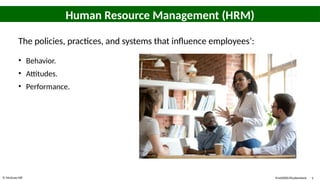
The policies, practices, and systems that influence employees’:
• Behavior.
• Attitudes.
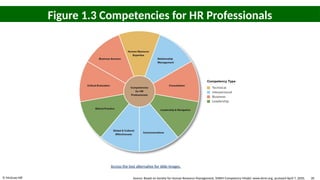
• Performance.
©nd3000/Shutterstock
© McGraw Hill 6
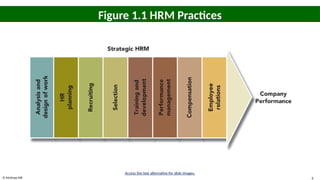
Figure 1.1 HRM Practices
Access the text alternative for slide images.
© McGraw Hill 7
Human Resources and Company Performance 1
Human capital: an organization’s employees described in terms of their:
• Training.
• Experience.
• Judgment.
• Intelligence.
• Relationships.
• Insight.
The concept of HRM implies that employees are resources of the employer.
© McGraw Hill 8
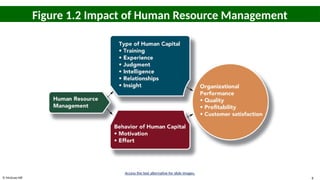
Figure 1.2 Impact of Human Resource Management
Access the text alternative for slide images.
© McGraw Hill 9
Human Resources and Company Performance 2
Sustainable Competitive Advantage
An organization is better than competitors at something and can hold that
advantage over a sustained period of time.
Human resources give organizations advantages because human resources:
• Are valuable.
• Are rare.
• Cannot be imitated.
• Have no good substitutes.
© McGraw Hill 10
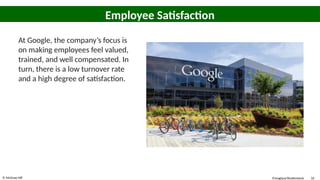
Employee Satisfaction
At Google, the company’s focus is
on making employees feel valued,
trained, and well compensated. In
turn, there is a low turnover rate
and a high degree of satisfaction.
©maglara/Shutterstock
© McGraw Hill 11
Human Resources and Company Performance 3
High-Performance Work System
Technology, organizational structure, people, and processes all work together to
give an organization a competitive advantage.
May include:
• Development of training programs.
• Recruitment of people with new skill sets.
• Establishment of rewards for such behaviors as teamwork, flexibility, and learning.
© McGraw Hill 12
Responsibilities of Human Resource Departments 1
HR Product Lines
• Administrative services and transactions.
• Business partner services.
• Strategic partner.
Responsibilities
• Establishing and administering personnel policies.
• Ensuring compliance with labor laws.
© McGraw Hill 13
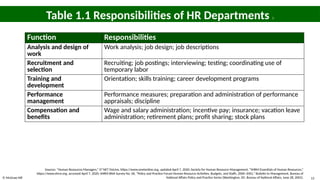
Table 1.1 Responsibilities of HR Departments 1
Function Responsibilities
Analysis and design of
work
Work analysis; job design; job descriptions
Recruitment and
selection
Recruiting; job postings; interviewing; testing; coordinating use of
temporary labor
Training and
development
Orientation; skills training; career development programs
Performance
management
Performance measures; preparation and administration of performance
appraisals; discipline
Compensation and
benefits
Wage and salary administration; incentive pay; insurance; vacation leave
administration; retirement plans; profit sharing; stock plans
Sources: “Human Resources Managers,” O*NET OnLine, https://www.onetonline.org, updated April 7, 2020; Society for Human Resource Management, “SHRM Essentials of Human Resources,”
https://www.shrm.org, accessed April 7, 2020; SHRM-BNA Survey No. 66, “Policy and Practice Forum Human Resource Activities, Budgets, and Staffs, 2000–2001,” Bulletin to Management, Bureau of
National Affairs Policy and Practice Series (Washington, DC: Bureau of National Affairs, June 28, 2001).
© McGraw Hill 14
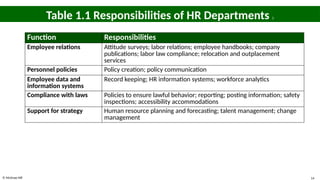
Table 1.1 Responsibilities of HR Departments 2
Function Responsibilities
Employee relations Attitude surveys; labor relations; employee handbooks; company
publications; labor law compliance; relocation and outplacement
services
Personnel policies Policy creation; policy communication
Employee data and
information systems
Record keeping; HR information systems; workforce analytics
Compliance with laws Policies to ensure lawful behavior; reporting; posting information; safety
inspections; accessibility accommodations
Support for strategy Human resource planning and forecasting; talent management; change
management
© McGraw Hill 15
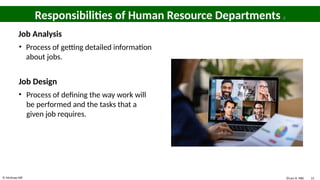
Responsibilities of Human Resource Departments 2
Job Analysis
• Process of getting detailed information
about jobs.
Job Design
• Process of defining the way work will
be performed and the tasks that a
given job requires.
©Lars A. Niki
© McGraw Hill 16
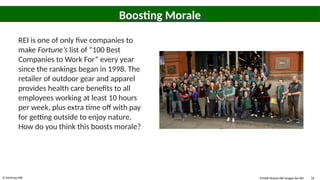
Boosting Morale
REI is one of only five companies to
make Fortune’s list of “100 Best
Companies to Work For” every year
since the rankings began in 1998. The
retailer of outdoor gear and apparel
provides health care benefits to all
employees working at least 10 hours
per week, plus extra time off with pay
for getting outside to enjoy nature.
How do you think this boosts morale?
©Matt Peyton/AP Images for REI
© McGraw Hill 17
Responsibilities of Human Resource Departments 3
Recruitment
• Process through which the organization seeks applicants for potential employment.
Selection
• Process by which the organization identifies applicants with the necessary
knowledge, skills, abilities, and other characteristics that will help the organization
achieve its goals.
© McGraw Hill 18
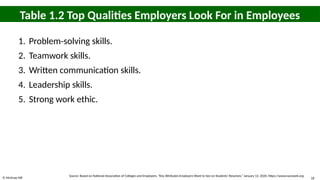
Table 1.2 Top Qualities Employers Look For in Employees
1. Problem-solving skills.
2. Teamwork skills.
3. Written communication skills.
4. Leadership skills.
5. Strong work ethic.
Source: Based on National Association of Colleges and Employers, “Key Attributes Employers Want to See on Students’ Resumes,” January 13, 2020, https://www.naceweb.org
© McGraw Hill 19
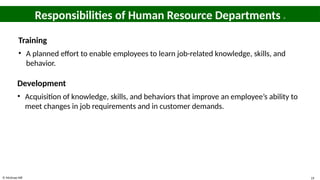
Responsibilities of Human Resource Departments 4
Training
• A planned effort to enable employees to learn job-related knowledge, skills, and
behavior.
Development
• Acquisition of knowledge, skills, and behaviors that improve an employee’s ability to
meet changes in job requirements and in customer demands.
© McGraw Hill 20
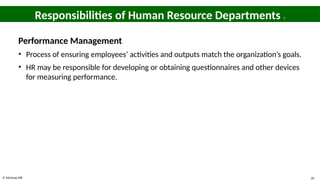
Responsibilities of Human Resource Departments 5
Performance Management
• Process of ensuring employees’ activities and outputs match the organization’s goals.
• HR may be responsible for developing or obtaining questionnaires and other devices
for measuring performance.
© McGraw Hill 21
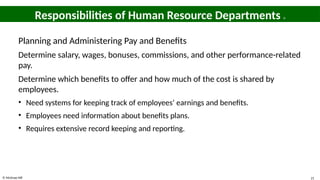
Responsibilities of Human Resource Departments 6
Planning and Administering Pay and Benefits
Determine salary, wages, bonuses, commissions, and other performance-related
pay.
Determine which benefits to offer and how much of the cost is shared by
employees.
• Need systems for keeping track of employees’ earnings and benefits.
• Employees need information about benefits plans.
• Requires extensive record keeping and reporting.
© McGraw Hill 22
Responsibilities of Human Resource Departments 7
Maintaining Positive Employee Relations
• Preparing and distributing employee handbooks and company publications.
• Dealing with and responding to communications from employees.
• Negotiating union contracts and maintaining communication with union
representatives.
© McGraw Hill 23
Responsibilities of Human Resource Departments 8
Establishing and Administering Personnel Policies
• Hiring.
• Discipline.
• Promotions.
• Benefits.
HR personnel communicate through a variety of channels:
• Presentations at meetings, posting documents online, e-mail, social media, etc.
© McGraw Hill 24
Responsibilities of Human Resource Departments 9
Managing and Using Human Resource Data
Handling records while protecting privacy.
Workforce analytics:
• Use of quantitative tools and scientific methods to analyze data from human
resource databases and other sources to make evidence-based decisions that
support business goals.
© McGraw Hill 25
Responsibilities of Human Resource Departments 10
Ensuring Compliance with Labor Laws
Includes equal employment opportunity, employee safety and health, employee
pay and benefits, employee privacy, and job security.
Government requirements include:
• Filing reports and displaying posters.
• Avoiding unlawful behavior.
• Managers depend on HR to help them track these requirements.
Lawsuits continue to influence HRM practices concerning job security.
• Employment at will, age discrimination, etc.
© McGraw Hill 26
Responsibilities of Human Resource Departments 11
Supporting the Organization’s Strategy
• Human resource planning: identifying the numbers and types of employees the
organization requires to meet objectives.
• Talent management: systematic, planned effort to attract, retain, develop, and
motivate highly skilled employees and managers.
• Evidence-based HR: collecting and using data to show human resource practices
have a positive influence on company’s bottom line or key stakeholders.
© McGraw Hill 27
Responsibilities of Human Resource Departments 12
Supporting the Organization’s Strategy continued
Managing change by applying knowledge of human behavior, along with performance
management tools, to help the organization manage change constructively.
Sustainability: ability to profit without depleting resources, including employees,
natural resources, and support of surrounding community.
Stakeholders: parties with an interest in the company’s success.
• Typically includes shareholders, community, customers, and employees.
© McGraw Hill 28
POLLING
QUESTION
2
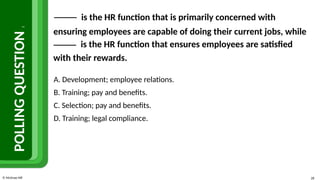
is the HR function that is primarily concerned with
ensuring employees are capable of doing their current jobs, while
is the HR function that ensures employees are satisfied
with their rewards.
A. Development; employee relations.
B. Training; pay and benefits.
C. Selection; pay and benefits.
D. Training; legal compliance.
© McGraw Hill 29
Skills of HRM Professionals
The Society for Human Resource Management (SHRM) HR Success
Competencies.
• Defines knowledge and skills associated with success in HRM.
• Four clusters of competencies:
• Technical (HR expertise).
• Interpersonal (relationship management, communications, and global and cultural
effectiveness).
• Business (consultation, critical evaluation, and business acumen).
• Leadership (;eadership and navigation, and ethical practice).
© McGraw Hill 30
Figure 1.3 Competencies for HR Professionals
Access the text alternative for slide images.
Source: Based on Society for Human Resource Management, SHRM Competency Model, www.shrm.org, accessed April 7, 2020.
© McGraw Hill 31
HR Responsibilities of Supervisors
Supervisors
The company’s founders are the first supervisors.
Supervisors have many HR responsibilities.
• Must consider the ways that decisions and policies will affect their employees.
© McGraw Hill 32
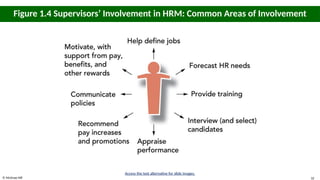
Figure 1.4 Supervisors’ Involvement in HRM: Common Areas of Involvement
Access the text alternative for slide images.
© McGraw Hill 33
Ethics in Human Resource Management 1
Ethics
• Fundamental principles of right and wrong.
• Treatment of employees is a top concern, such as the treatment of women in the
workplace.
Ethical behavior
• Behavior that is consistent with those principles.
Many ethical issues in the workplace involve HRM.
© McGraw Hill 34
Ethics in Human Resource Management 2
Employee Rights
• Free consent.
• Privacy.
• Freedom of conscience.
• Freedom of speech.
• Due process.
© McGraw Hill 35
Ethics in Human Resource Management 3
Standards for Ethical Behavior
Ethical companies act according to four principles:
• Emphasize mutual benefits in relationships with customers, vendors, and clients.
• Employees assume responsibility for the actions of the company.
• Have a sense of purpose or vision that employees value and use in their day-to-day
work.
• Emphasize fairness.
© McGraw Hill 36
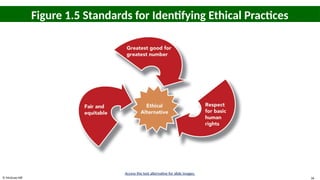
Figure 1.5 Standards for Identifying Ethical Practices
Access the text alternative for slide images.
© McGraw Hill 37
Careers in Human Resource Management
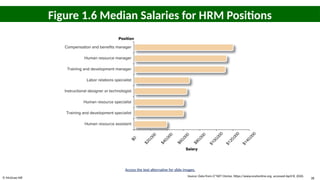
Salaries vary depending on education and experience.
Some positions are generalists, some are specialized.
Most positions require a college degree.
© McGraw Hill 38
Figure 1.6 Median Salaries for HRM Positions
Access the text alternative for slide images.
Source: Data from O*NET OnLine, https://www.onetonline.org, accessed April 8, 2020.
39
End of Chapter 1
© 2022 McGraw Hill. All rights reserved. Authorized only for instructor use in the classroom. No reproduction or further distribution permitted without the prior written consent of McGraw Hill.

Noe_FHRM9e_PPT_Ch01_accessible.pptxnjhbm

  • 1.
    2 Chapter 1 Managing HumanResources freesoulproduction/Shutterstock © 2022 McGraw Hill. All rights reserved. Authorized only for instructor use in the classroom. No reproduction or further distribution permitted without the prior written consent of McGraw Hill.
  • 2.
    © McGraw Hill3 What Do I Need to Know? LO 1-1 Define human resource management, and explain how H R M contributes to an organization’s performance. LO 1-2 Identify the responsibilities of human resource departments. LO 1-3 Summarize the types of competencies needed for human resource management. LO 1-4 Explain the role of supervisors in human resource management. LO 1-5 Discuss ethical issues in human resource management. LO 1-6 Describe typical careers in human resource management.
  • 3.
    © McGraw Hill4 POLLING QUESTION 1 In an organization, who should be concerned with HRM? A. Only the HR department. B. Only managers. C. Only top-level managers. D. All of these.
  • 4.
    © McGraw Hill5 Human Resource Management (HRM) The policies, practices, and systems that influence employees’: • Behavior. • Attitudes. • Performance. ©nd3000/Shutterstock
  • 5.
    © McGraw Hill6 Figure 1.1 HRM Practices Access the text alternative for slide images.
  • 6.
    © McGraw Hill7 Human Resources and Company Performance 1 Human capital: an organization’s employees described in terms of their: • Training. • Experience. • Judgment. • Intelligence. • Relationships. • Insight. The concept of HRM implies that employees are resources of the employer.
  • 7.
    © McGraw Hill8 Figure 1.2 Impact of Human Resource Management Access the text alternative for slide images.
  • 8.
    © McGraw Hill9 Human Resources and Company Performance 2 Sustainable Competitive Advantage An organization is better than competitors at something and can hold that advantage over a sustained period of time. Human resources give organizations advantages because human resources: • Are valuable. • Are rare. • Cannot be imitated. • Have no good substitutes.
  • 9.
    © McGraw Hill10 Employee Satisfaction At Google, the company’s focus is on making employees feel valued, trained, and well compensated. In turn, there is a low turnover rate and a high degree of satisfaction. ©maglara/Shutterstock
  • 10.
    © McGraw Hill11 Human Resources and Company Performance 3 High-Performance Work System Technology, organizational structure, people, and processes all work together to give an organization a competitive advantage. May include: • Development of training programs. • Recruitment of people with new skill sets. • Establishment of rewards for such behaviors as teamwork, flexibility, and learning.
  • 11.
    © McGraw Hill12 Responsibilities of Human Resource Departments 1 HR Product Lines • Administrative services and transactions. • Business partner services. • Strategic partner. Responsibilities • Establishing and administering personnel policies. • Ensuring compliance with labor laws.
  • 12.
    © McGraw Hill13 Table 1.1 Responsibilities of HR Departments 1 Function Responsibilities Analysis and design of work Work analysis; job design; job descriptions Recruitment and selection Recruiting; job postings; interviewing; testing; coordinating use of temporary labor Training and development Orientation; skills training; career development programs Performance management Performance measures; preparation and administration of performance appraisals; discipline Compensation and benefits Wage and salary administration; incentive pay; insurance; vacation leave administration; retirement plans; profit sharing; stock plans Sources: “Human Resources Managers,” O*NET OnLine, https://www.onetonline.org, updated April 7, 2020; Society for Human Resource Management, “SHRM Essentials of Human Resources,” https://www.shrm.org, accessed April 7, 2020; SHRM-BNA Survey No. 66, “Policy and Practice Forum Human Resource Activities, Budgets, and Staffs, 2000–2001,” Bulletin to Management, Bureau of National Affairs Policy and Practice Series (Washington, DC: Bureau of National Affairs, June 28, 2001).
  • 13.
    © McGraw Hill14 Table 1.1 Responsibilities of HR Departments 2 Function Responsibilities Employee relations Attitude surveys; labor relations; employee handbooks; company publications; labor law compliance; relocation and outplacement services Personnel policies Policy creation; policy communication Employee data and information systems Record keeping; HR information systems; workforce analytics Compliance with laws Policies to ensure lawful behavior; reporting; posting information; safety inspections; accessibility accommodations Support for strategy Human resource planning and forecasting; talent management; change management
  • 14.
    © McGraw Hill15 Responsibilities of Human Resource Departments 2 Job Analysis • Process of getting detailed information about jobs. Job Design • Process of defining the way work will be performed and the tasks that a given job requires. ©Lars A. Niki
  • 15.
    © McGraw Hill16 Boosting Morale REI is one of only five companies to make Fortune’s list of “100 Best Companies to Work For” every year since the rankings began in 1998. The retailer of outdoor gear and apparel provides health care benefits to all employees working at least 10 hours per week, plus extra time off with pay for getting outside to enjoy nature. How do you think this boosts morale? ©Matt Peyton/AP Images for REI
  • 16.
    © McGraw Hill17 Responsibilities of Human Resource Departments 3 Recruitment • Process through which the organization seeks applicants for potential employment. Selection • Process by which the organization identifies applicants with the necessary knowledge, skills, abilities, and other characteristics that will help the organization achieve its goals.
  • 17.
    © McGraw Hill18 Table 1.2 Top Qualities Employers Look For in Employees 1. Problem-solving skills. 2. Teamwork skills. 3. Written communication skills. 4. Leadership skills. 5. Strong work ethic. Source: Based on National Association of Colleges and Employers, “Key Attributes Employers Want to See on Students’ Resumes,” January 13, 2020, https://www.naceweb.org
  • 18.
    © McGraw Hill19 Responsibilities of Human Resource Departments 4 Training • A planned effort to enable employees to learn job-related knowledge, skills, and behavior. Development • Acquisition of knowledge, skills, and behaviors that improve an employee’s ability to meet changes in job requirements and in customer demands.
  • 19.
    © McGraw Hill20 Responsibilities of Human Resource Departments 5 Performance Management • Process of ensuring employees’ activities and outputs match the organization’s goals. • HR may be responsible for developing or obtaining questionnaires and other devices for measuring performance.
  • 20.
    © McGraw Hill21 Responsibilities of Human Resource Departments 6 Planning and Administering Pay and Benefits Determine salary, wages, bonuses, commissions, and other performance-related pay. Determine which benefits to offer and how much of the cost is shared by employees. • Need systems for keeping track of employees’ earnings and benefits. • Employees need information about benefits plans. • Requires extensive record keeping and reporting.
  • 21.
    © McGraw Hill22 Responsibilities of Human Resource Departments 7 Maintaining Positive Employee Relations • Preparing and distributing employee handbooks and company publications. • Dealing with and responding to communications from employees. • Negotiating union contracts and maintaining communication with union representatives.
  • 22.
    © McGraw Hill23 Responsibilities of Human Resource Departments 8 Establishing and Administering Personnel Policies • Hiring. • Discipline. • Promotions. • Benefits. HR personnel communicate through a variety of channels: • Presentations at meetings, posting documents online, e-mail, social media, etc.
  • 23.
    © McGraw Hill24 Responsibilities of Human Resource Departments 9 Managing and Using Human Resource Data Handling records while protecting privacy. Workforce analytics: • Use of quantitative tools and scientific methods to analyze data from human resource databases and other sources to make evidence-based decisions that support business goals.
  • 24.
    © McGraw Hill25 Responsibilities of Human Resource Departments 10 Ensuring Compliance with Labor Laws Includes equal employment opportunity, employee safety and health, employee pay and benefits, employee privacy, and job security. Government requirements include: • Filing reports and displaying posters. • Avoiding unlawful behavior. • Managers depend on HR to help them track these requirements. Lawsuits continue to influence HRM practices concerning job security. • Employment at will, age discrimination, etc.
  • 25.
    © McGraw Hill26 Responsibilities of Human Resource Departments 11 Supporting the Organization’s Strategy • Human resource planning: identifying the numbers and types of employees the organization requires to meet objectives. • Talent management: systematic, planned effort to attract, retain, develop, and motivate highly skilled employees and managers. • Evidence-based HR: collecting and using data to show human resource practices have a positive influence on company’s bottom line or key stakeholders.
  • 26.
    © McGraw Hill27 Responsibilities of Human Resource Departments 12 Supporting the Organization’s Strategy continued Managing change by applying knowledge of human behavior, along with performance management tools, to help the organization manage change constructively. Sustainability: ability to profit without depleting resources, including employees, natural resources, and support of surrounding community. Stakeholders: parties with an interest in the company’s success. • Typically includes shareholders, community, customers, and employees.
  • 27.
    © McGraw Hill28 POLLING QUESTION 2 is the HR function that is primarily concerned with ensuring employees are capable of doing their current jobs, while is the HR function that ensures employees are satisfied with their rewards. A. Development; employee relations. B. Training; pay and benefits. C. Selection; pay and benefits. D. Training; legal compliance.
  • 28.
    © McGraw Hill29 Skills of HRM Professionals Skills of HRM Professionals The Society for Human Resource Management (SHRM) HR Success Competencies. • Defines knowledge and skills associated with success in HRM. • Four clusters of competencies: • Technical (HR expertise). • Interpersonal (relationship management, communications, and global and cultural effectiveness). • Business (consultation, critical evaluation, and business acumen). • Leadership (;eadership and navigation, and ethical practice).
  • 29.
    © McGraw Hill30 Figure 1.3 Competencies for HR Professionals Access the text alternative for slide images. Source: Based on Society for Human Resource Management, SHRM Competency Model, www.shrm.org, accessed April 7, 2020.
  • 30.
    © McGraw Hill31 HR Responsibilities of Supervisors Supervisors The company’s founders are the first supervisors. Supervisors have many HR responsibilities. • Must consider the ways that decisions and policies will affect their employees.
  • 31.
    © McGraw Hill32 Figure 1.4 Supervisors’ Involvement in HRM: Common Areas of Involvement Access the text alternative for slide images.
  • 32.
    © McGraw Hill33 Ethics in Human Resource Management 1 Ethics • Fundamental principles of right and wrong. • Treatment of employees is a top concern, such as the treatment of women in the workplace. Ethical behavior • Behavior that is consistent with those principles. Many ethical issues in the workplace involve HRM.
  • 33.
    © McGraw Hill34 Ethics in Human Resource Management 2 Employee Rights • Free consent. • Privacy. • Freedom of conscience. • Freedom of speech. • Due process.
  • 34.
    © McGraw Hill35 Ethics in Human Resource Management 3 Standards for Ethical Behavior Ethical companies act according to four principles: • Emphasize mutual benefits in relationships with customers, vendors, and clients. • Employees assume responsibility for the actions of the company. • Have a sense of purpose or vision that employees value and use in their day-to-day work. • Emphasize fairness.
  • 35.
    © McGraw Hill36 Figure 1.5 Standards for Identifying Ethical Practices Access the text alternative for slide images.
  • 36.
    © McGraw Hill37 Careers in Human Resource Management Salaries vary depending on education and experience. Some positions are generalists, some are specialized. Most positions require a college degree.
  • 37.
    © McGraw Hill38 Figure 1.6 Median Salaries for HRM Positions Access the text alternative for slide images. Source: Data from O*NET OnLine, https://www.onetonline.org, accessed April 8, 2020.
  • 38.
    39 End of Chapter1 © 2022 McGraw Hill. All rights reserved. Authorized only for instructor use in the classroom. No reproduction or further distribution permitted without the prior written consent of McGraw Hill.

Editor's Notes

  • #1 NOTE TO INSTRUCTORS: If your class has fewer than 40 students per poll, Poll Everywhere is free (as of production of these slides). For current pricing please visit: https://www.polleverywhere.com/plans If you have more than 40 students per poll, please talk to your McGraw-Hill rep as we have negotiated a discount on this tool for you that we are happy to pass on: http://www.mhhe.com/rep.
  • #4 In an organization, who should be concerned with HRM? A. Only the HR department B. Only managers C. Only top-level managers D. All of these Answer: D
  • #5 Many companies refer to HRM as involving “people practices.” At companies with effective HRM, employees and customers tend to be more satisfied, and the companies tend to be more innovative, have greater productivity, and develop a more favorable reputation in the community.
  • #6 Figure 1.1 emphasizes several important HRM practices. An organization performs best when all of these practices are managed well.
  • #7 LO 1-1 Define human resource management, and explain how HRM contributes to an organization’s performance. Managers and economists traditionally have seen HRM as a necessary expense, rather than as a source of value to their organizations. However, research has demonstrated that HRM practices can be valuable. Decisions such as whom to hire, what to pay, what training to offer, and how to evaluate employee performance directly affect employees’ motivation and ability to provide goods and services that customers value.
  • #8 For an organization to succeed, it needs employees with certain qualities, training, and experience. Employees are not interchangeable, easily replaced by parts of a system, but a source of the company’s success or failure. By influencing who works for the organization and how these people work, HRM therefore contributes to such basic measures of an organization’s performance, such as as quality, profitability, and customer satisfaction. Figure 1.2 shows this relationship.
  • #9 In terms of business strategy, an organization can succeed if it has a sustainable competitive advantage (is better than competitors at something, and can hold that advantage over a sustained period of time). Organizations need the kind of resources that will give them such an advantage. HR have these necessary qualities: Human resources are valuable. High-quality employees provide a needed service as they perform many critical functions. Human resources are rare in the sense that a person with high levels of the needed skills and knowledge is not common. An organization may spend months looking for a talented and experienced manager or technician. Human resources cannot be imitated. To imitate resources at a high-performing competitor, you would have to figure out which employees are providing the advantage and how. Human resources have no good substitutes. When people are well trained and highly motivated, they learn, develop their abilities, and care about customers. These qualities imply that human resources have enormous potential. An organization realizes this potential through the ways it practices HRM.
  • #11 Effective HRM can form the foundation of a high-performance work system. This is an organization in which technology, organizational structure, people, and processes all work together to give the organization an advantage in the competitive environment. Maintaining a high-performance work system may include development of training programs, recruitment of people with new skill sets, and establishment of rewards for such behaviors as teamwork, flexibility, and learning.
  • #12 LO 1-2 Identify the responsibilities of human resource departments. Think of HR as a business within the company with three product lines: 1. Administrative services and transactions—Handling administrative tasks (for example, hiring employees and answering questions about benefits) efficiently and with a commitment to quality. 2. Business partner services—Developing effective HR systems that help the organization meet its goals for attracting, keeping, and developing people with the skills it needs. To be effective, HR people must understand the business so it can understand what the business needs. 3. Strategic partner—Contributing to the company’s strategy through an understanding of its existing and needed human resources and ways HR practices can give the company a competitive advantage. For strategic ideas to be effective, HR must understand the business, its industry, and its competitors.
  • #13 In all but the smallest organizations, a human resource department is responsible for HRM functions. On average, an organization has one or two full-time HR staff persons for every hundred employees on the payroll. Table 1.1 details the responsibilities of human resource departments. These responsibilities include the practices introduced in Figure 1.1 plus two areas of responsibility that support those practices: (1) establishing and administering personnel policies, and (2) ensuring compliance with labor laws. No two HR departments have precisely the same roles because of differences in organization sizes and characteristics of the workforce, the industry, and management’s value.
  • #15 To produce their given product or service (or set of products or services) companies require that a number of tasks be performed. Tasks are grouped together in various combinations to form jobs that help the organization to operate efficiently and to obtain people with the right qualifications to do the jobs well. This function involves the activities of job analysis and job design.
  • #17 Based on job analysis and design, an organization can determine the kinds of employees it needs. With this knowledge, it carries out the function of recruiting and hiring employees. Approaches to recruiting and selection involve a variety of alternatives. Some organizations may actively recruit from many external sources, such as Internet job postings, online social networks, and college recruiting events. Other organizations may rely heavily on promotions from within, applicants referred by current employees, and the availability of in-house people with the necessary skills.
  • #19 Although organizations base hiring decisions on candidates’ existing qualifications, most organizations provide ways for their employees to broaden or deepen their knowledge, skills, and abilities. To do this, organizations provide employee training and development. Decisions related to training and development include whether the organization will emphasize enabling employees to perform their current jobs, preparing them for future jobs, or both. An organization may offer programs to a few employees in whom the organization wants to invest, or it may have a philosophy of investing in the training of all its workers.
  • #20 Managing HR includes keeping track of how well employees are performing relative to objectives such as job descriptions and goals for a particular position. The activities of performance management include specifying the tasks and outcomes of a job that contribute to the organization’s success.
  • #21 The pay and benefits that employees earn play an important role in motivating them. This is especially true when rewards such as bonuses are linked to the individual’s or group’s achievements. Decisions about pay and benefits can also support other aspects of an organization’s strategy. All such decisions have implications for the organization’s bottom line, as well as for employee motivation. Administering pay and benefits is another big responsibility.
  • #22 Organizations often depend on HR professionals to help them maintain positive relations with employees.
  • #23 Developing fair and effective policies requires strong decision-making skills, the ability to think ethically, and a broad understanding of business activities that will be covered by the policies. In addition, for employees to comply with policies, they have to know and understand the policies. Therefore, human resource management requires the ability to communicate through a variety of channels.
  • #24 All HR activities require fair and consistent decisions, and most require substantial record keeping, ensuring accuracy and for balancing privacy concerns with easy access for those who need information and are authorized to see it. Data about employees can show, for example, which of the company’s talent has the most promise for future leadership, what kinds of employees tend to perform best in particular positions, and in which departments the need for hiring will be most pressing. To use the data for answering such questions, many organizations have set up human resource information systems (HRIS). They may engage in workforce analytics, which is the use of quantitative tools and scientific methods to analyze data from human resource databases and other sources to make evidence-based decisions that support business goals.
  • #25 The government has many laws and regulations concerning treatment of employees. These laws govern such matters as equal employment opportunity, employee safety and health, employee pay and benefits, employee privacy, and job security. Ensuring compliance with laws requires that HR personnel keep watch over a rapidly changing legal landscape. Employers will need to review work rules, recruitment practices, and performance evaluation systems, revising them if necessary to ensure that they do not falsely communicate employment agreements the company does not intend to honor (such as lifetime employment) or discriminate on the basis of age. Currently no federal laws outline how to use employee databases in such a way as to protect employees’ privacy.
  • #26 Today’s HR professionals need to understand the organization’s business operations, project how business trends might affect the business, reinforce positive aspects of the organization’s culture, develop talent for present and future needs, craft effective HR strategies, and make a case for them to top management. Using human resource planning estimates, the human resource department helps the organization forecast its needs for hiring, training, and reassigning employees. Human resource planning provides important information for talent management—a systematic, planned effort to attract, retain, develop, and motivate highly skilled employees and managers. HR may help in managing the change process. HR professionals can apply knowledge of human behavior, along with performance management tools, to help the organization manage change constructive. To demonstrate how HR practices align with the organization’s strategy, HRM professionals are measuring how the HR-related practices that are in place (e.g., hiring, promotion process, benefits, development, etc.) promote the company’s success. Evidence-based HR refers to demonstrating how HR practices have a positive influence on the company’s profits or key stake holders (e.g., employees, customers, community, shareholders).
  • #27 Another strategic challenge tackled by a growing number of companies is how to seek profits in ways that communities, customers, and suppliers will support over the long run. This concern is called sustainability—broadly defined as an organization’s ability to profit without depleting its resources, including employees, natural resources, and the support of the surrounding community. Success at sustainability comes from meeting the needs of the organization’s stakeholders, all the parties who have an interest in the organization’s success. Sustainable organizations meet their needs by minimizing their environmental impact, providing high-quality products and services, ensuring workplace safety, offering fair compensation, and delivering an adequate return to investors. Sustainability delivers a strategic advantage when it boosts the organization’s image with customers, opens access to new markets, and helps attract and retain talented employees. In an organization with a sustainable strategy, HR’s focus is on employee development and empowerment rather than short-term costs, on long-term planning rather than smooth turnover and outsourcing, and on justice and fairness over short-term profits.
  • #28 _____ is the HR function that is primarily concerned with ensuring employees are capable of doing their current jobs, while _____ is the HR function that ensures employees are satisfied with their rewards. A. Development; employee relations B. Training; pay and benefits C. Selection; pay and benefits D. Training; legal compliance Answer: B
  • #29 LO 1-3 Summarize the types of skills needed for human resource management. The Society for Human Resource Management (SHRM) has defined sets of knowledge and skills associated with success, grouping these into nine categories it calls HR success competencies. For each competency, the SHRM model provides definitions, specifics, and standards for the behavior necessary for success at every level in an organization. It is not enough to know how to perform tasks specific to human resource management. HR professionals also must be able to work effectively with others, contribute to business success, and lead others ethically.
  • #30 As Figure 1.3 shows, HR knowledge and skills fall into four clusters of competencies: technical, interpersonal, business, and leadership.
  • #31 LO 1-4 Explain the role of supervisors in human resource management. Supervisors typically have responsibilities related to all HR functions. Supervisors can participate in HRM by taking into consideration the ways that decisions and policies will affect their employees. Understanding the principles of communication, motivation, and other elements of human behavior can help supervisors inspire the best from the organization’s human resources.
  • #32 Figure 1.4 shows some HR responsibilities.
  • #33 LO 1-5 Discuss ethical issues in human resource management. Whenever people’s actions affect one another, ethical issues arise, and business decisions are no exception. Business decisions, including HRM decisions, should be ethical.
  • #34 In the context of ethical human resource management, HR managers must view employees as having basic rights. Such a view reflects ethical principles embodied in the U.S. Constitution and Bill of Rights. Right of free consent – People have the right to be treated only as they knowingly and willingly consent to be treated. Right of privacy – People have the right to do as they wish in their private lives, and they have the right to control what they reveal about private activities. Right of freedom of conscience – People have the right to refuse to do what violates their moral beliefs, as long as these beliefs reflect commonly accepted norms. Right of freedom of speech – People have the right to criticize an organization’s ethics, if they do so in good conscience and their criticism does not violate the rights of individuals in the organization. Right to due process – If people believe their rights are being violated, they have the right to a fair and impartial hearing. One way to think about ethics in business is that the morally correct action is the one that minimizes encroachments on and avoids violations of these rights.
  • #35 Ethical and successful companies act according to these four principles.
  • #36 For human resource practices to be considered ethical, they must satisfy the three basic standards summarized in Figure 1.5.
  • #37 LO 1-6 Describe typical careers in human resource management. Some positions involve work in specialized areas of HRM such as recruiting, training, or compensation. The vast majority of HRM professionals have a college degree, and many also have completed post graduate work. HR professionals can increase their career opportunities by taking advantage of training and development programs. Some HRM professionals have a professional certification in HRM, but many more are members of professional associations. The primary professional organization for HRM is the Society for Human Resource Management (SHRM) with more than 250,000 members.