Framework and Enterprise Tools
Business Logic, Persistence and Auth
Agenda
● Sinatra / Connect style frameworks (middleware and composable).
● Working with Express.
● Working with Restify.
● Persistence Layer (ORM, OGM,...).
● Auth: Working with Passport.
● RT: Sockets with Socket.io.
● Architecture Patterns: Multi-tier.
Agenda
● Debugging & REPL.
● Performance with Clustering.
● Security Concerns.
● Error Management.
● Design Patterns.
● Best Practices.
● Dojo Kake: Adding testing to your app.
Connect-style
Frameworks
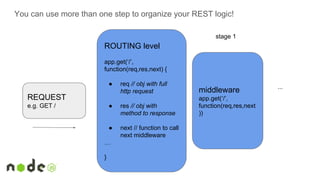
Based on Sinatra, Connect was one of the first frameworks in node.js.
● Oriented to attend TCP / http request.
● Provides routing object.
● Add the middleware concept, as stages of the request.
REQUEST
e.g. GET /
ROUTING level
app.get(‘/’,
function(req,res,next) {
● req // obj with full
http request
● res // obj with
method to response
● next // function to call
next middleware
…
}
middleware
app.get(‘/’,
function(req,res,next
))
...
stage 1
You can use more than one step to organize your REST logic!
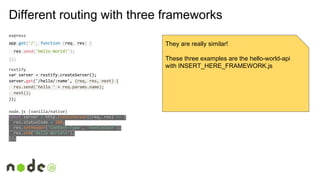
express
app.get('/', function (req, res) {
res.send('Hello World!');
});
restify
var server = restify.createServer();
server.get('/hello/:name', (req, res, next) {
res.send('hello ' + req.params.name);
next();
});
node.js (vanilla/native)
const server = http.createServer((req, res) => {
res.statusCode = 200;
res.setHeader('Content-Type', 'text/plain');
res.end('Hello Worldn');
});
Different routing with three frameworks
They are really similar!
These three examples are the hello-world-api
with INSERT_HERE_FRAMEWORK.js
Working with
Express
Express is one of the most used frameworks in node.js. Its company has been
acquired by IBM recently and it has developed products on top of it.
● De facto Standard.
● Connect-Style with Middleware.
● Great community, lots of documents and plugins.
● Oriented to web (as assets server, web server or api server).
● Router object with full REST support.
Restify is a more lightweight option intended to develop API Gateways.
● Connect-Style with Middleware.
● Great community, lots of documents and plugins.
● More oriented to develop REST services.
● Manual Routing.
● Manual HTTP method PATCH required.
Working with
Restify
Persistence Layer
In order to connect to some databases it’s recommended to use an ORM, but it’s
not the only option.
● Mongoose: MongoDB ODM Object Document Mapper.
● Sequelize: *SQL (PostgreSQL, MySQL, MariaDB, SQLite and MSSQL).
● Vogelz: DynamoDB.
You can also use
● REST API: Neo4j, MongoDB.
● Provides an Abstraction layer.
● Easy Management & use of the entities through its API (entity.save(),...).
● Parameterized Query Statements to avoid SQL injection.
But also…
● Introduces some added complexity.
What are the benefits of using ORM?
Auth with Passport
In order to manage the sessions and auth users, you can use the framework
passport with lots of connectors.
● Easy integration with JWT.
● Lots of providers.
● Simple architecture.
● Easy to extend by made connectors.
● Easy to cache.
● Requires a secure channel between client and server (HTTPS).
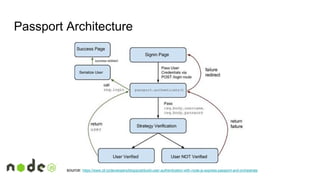
Passport Architecture
source: https://www.ctl.io/developers/blog/post/build-user-authentication-with-node-js-express-passport-and-orchestrate
RT with Socket.io
Oriented to keep a full duplex communication between a client and the server.
Bringing the concept of sockets to web.
● Full duplex.
● Low latency.
● Easy to implement in client side, no plugins necessary.
● DANGER: Difficult to scale horizontally.*
* Requires a HA Proxy to redirect to the specific node in context.
Architecture
Patterns
It’s not about pieces, hardware and stuff, it’s about the global perspective.
● Do I fulfill the needs/requirements?
● How is it going to grow?
● Use the platform.
● Single Responsibility Principle.
● Less Permission Principle.
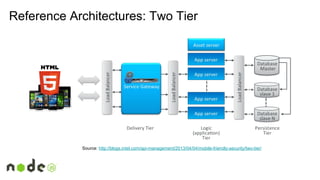
Reference Architectures: Two Tier
Source: http://blogs.intel.com/api-management/2013/04/04/mobile-friendly-security/two-tier/
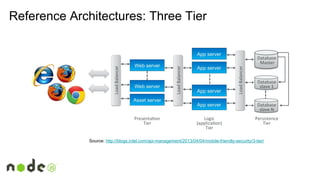
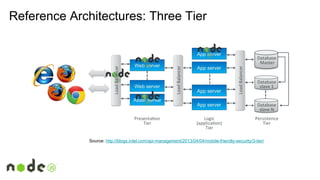
Reference Architectures: Three Tier
Source: http://blogs.intel.com/api-management/2013/04/04/mobile-friendly-security/3-tier/
Reference Architectures: Three Tier
Source: http://blogs.intel.com/api-management/2013/04/04/mobile-friendly-security/3-tier/
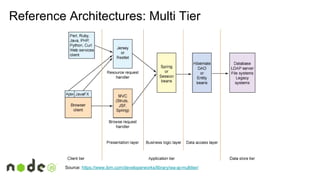
Reference Architectures: Multi Tier
Source: https://www.ibm.com/developerworks/library/wa-aj-multitier/
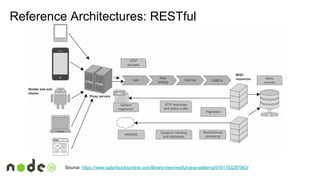
Reference Architectures: RESTful
Source: https://www.safaribooksonline.com/library/view/restful-java-patterns/9781783287963/
Debugging
& REPL
There are different tools and options. Some of them take a lot of time to configure
them, but it is worth making such an effort:
● Jetbrains WebStorm IDE it’s almost Zero Config.
● nodemon or node inspector or debug as third party options.
● REPL to test live.
● Don’t use by default console.log(‘message’), it decreases the
performance.
Performance with
Clustering
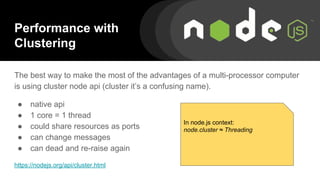
The best way to make the most of the advantages of a multi-processor computer
is using cluster node api (cluster it’s a confusing name).
● native api
● 1 core = 1 thread
● could share resources as ports
● can change messages
● can dead and re-raise again
https://nodejs.org/api/cluster.html
In node.js context:
node.cluster ≈ Threading
Design Patterns
It’s useful to try to implement these patterns with node.js:
● Singletons.
● Observers.
● Factories.
● Dependence Injection.
● Middleware.
● Streams.
Further lecture: https://blog.risingstack.com/fundamental-node-js-design-patterns/
Best Practices
● Add some automated testing!
● Add log to your apps, even more than one level (network & logic app).
● Don’t leave tons of console.logs(‘message’).
● Separate the config and don’t upload them to CVS.
[further reading]
https://12factor.net/
https://github.com/beeva/beeva-best-practices/tree/master/backend/nodejs
Error Management
There’re many ways to control errors during node.js execution:
● CPS if a controlled error happens.
● Try-Catch if it’s possible to detect it.*
● Context Error (pending to be deprecated).
● Node.js API error as event emitter:
https://nodejs.org/api/errors.html
* Good News! Sometimes asynchronicity doesn’t permit this!
Final Exercise
Dojo Kake:
Collaborative 4-layer app
Dojo Kake
We’re going to design a 4 layers architecture by collaborating.
The rules:
● 2/3 people by team.
● One team, one role.
● You can only talk to the team at your left or the one at your right to share api
definition or data.
● 4 layers:
Frontend + Auth Server + Load Balancer + Backend.
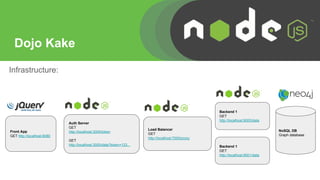
Dojo Kake
Infrastructure:
Front App
GET http://localhost:8080
Auth Server
GET
http://localhost:3000/token
GET
http://localhost:3000/data?token=123...
Load Balancer
GET
http://localhost:7000/proxy
Backend 1
GET
http://localhost:9000/data
Backend 1
GET
http://localhost:9001/data
NoSQL DB
Graph database
Dojo Kake
References & Examples
● Superagent to connect DB API
https://github.com/beeva-manueldepaz/dojo-triple/tree/dojo-01-kata-resolved
● Request to proxify
http://github.com/pelirrojo/https://github.com/Pelirrojo/nodejs-npm-express-ba
sic-with-grunt
● A little SPA frontend with JQuery
https://gist.github.com/Pelirrojo/c537c30952573d3fd62c
● db endpoint is: http://10.10.8.90:7474
Dojo Kake
Solution:
You need to install Docker & node.js to run it:
https://github.com/Pelirrojo/nodejs-dojo-kake-4-layer-node-app
References
● The Best blog about using node.js with production grade
https://blog.risingstack.com/node-hero-tutorial-getting-started-with-node-js/
https://blog.risingstack.com/node-js-tutorial-debugging-async-memory-leaks-cpu-profiling/
https://blog.risingstack.com/node-js-at-scale-node-js-garbage-collection/
https://blog.risingstack.com/fundamental-node-js-design-patterns/
● A place with self-paced labs to learn node.js
nodeschool.io
● The best blog about node.js
howtonode.org
● Some tips from Heroku Doc:
https://devcenter.heroku.com/articles/node-concurrency
https://devcenter.heroku.com/articles/mean-apps-restful-api
Any question?
Manuel E. de Paz Carmona
manuel.depaz.geek@mail.com
Disclaimer
All product names, logos, and brands are property of their respective owners. All company, product and service names
used in this slide deck are for identification purposes only. Use of these names, logos, and brands does not imply
endorsement.
This slide deck is licensed by

Node.js Course 2 of 2 - Advanced techniques

  • 1.
    Framework and EnterpriseTools Business Logic, Persistence and Auth
  • 2.
    Agenda ● Sinatra /Connect style frameworks (middleware and composable). ● Working with Express. ● Working with Restify. ● Persistence Layer (ORM, OGM,...). ● Auth: Working with Passport. ● RT: Sockets with Socket.io. ● Architecture Patterns: Multi-tier.
  • 3.
    Agenda ● Debugging &REPL. ● Performance with Clustering. ● Security Concerns. ● Error Management. ● Design Patterns. ● Best Practices. ● Dojo Kake: Adding testing to your app.
  • 4.
    Connect-style Frameworks Based on Sinatra,Connect was one of the first frameworks in node.js. ● Oriented to attend TCP / http request. ● Provides routing object. ● Add the middleware concept, as stages of the request.
  • 5.
    REQUEST e.g. GET / ROUTINGlevel app.get(‘/’, function(req,res,next) { ● req // obj with full http request ● res // obj with method to response ● next // function to call next middleware … } middleware app.get(‘/’, function(req,res,next )) ... stage 1 You can use more than one step to organize your REST logic!
  • 6.
    express app.get('/', function (req,res) { res.send('Hello World!'); }); restify var server = restify.createServer(); server.get('/hello/:name', (req, res, next) { res.send('hello ' + req.params.name); next(); }); node.js (vanilla/native) const server = http.createServer((req, res) => { res.statusCode = 200; res.setHeader('Content-Type', 'text/plain'); res.end('Hello Worldn'); }); Different routing with three frameworks They are really similar! These three examples are the hello-world-api with INSERT_HERE_FRAMEWORK.js
  • 7.
    Working with Express Express isone of the most used frameworks in node.js. Its company has been acquired by IBM recently and it has developed products on top of it. ● De facto Standard. ● Connect-Style with Middleware. ● Great community, lots of documents and plugins. ● Oriented to web (as assets server, web server or api server). ● Router object with full REST support.
  • 8.
    Restify is amore lightweight option intended to develop API Gateways. ● Connect-Style with Middleware. ● Great community, lots of documents and plugins. ● More oriented to develop REST services. ● Manual Routing. ● Manual HTTP method PATCH required. Working with Restify
  • 9.
    Persistence Layer In orderto connect to some databases it’s recommended to use an ORM, but it’s not the only option. ● Mongoose: MongoDB ODM Object Document Mapper. ● Sequelize: *SQL (PostgreSQL, MySQL, MariaDB, SQLite and MSSQL). ● Vogelz: DynamoDB. You can also use ● REST API: Neo4j, MongoDB.
  • 10.
    ● Provides anAbstraction layer. ● Easy Management & use of the entities through its API (entity.save(),...). ● Parameterized Query Statements to avoid SQL injection. But also… ● Introduces some added complexity. What are the benefits of using ORM?
  • 11.
    Auth with Passport Inorder to manage the sessions and auth users, you can use the framework passport with lots of connectors. ● Easy integration with JWT. ● Lots of providers. ● Simple architecture. ● Easy to extend by made connectors. ● Easy to cache. ● Requires a secure channel between client and server (HTTPS).
  • 12.
  • 13.
    RT with Socket.io Orientedto keep a full duplex communication between a client and the server. Bringing the concept of sockets to web. ● Full duplex. ● Low latency. ● Easy to implement in client side, no plugins necessary. ● DANGER: Difficult to scale horizontally.* * Requires a HA Proxy to redirect to the specific node in context.
  • 14.
    Architecture Patterns It’s not aboutpieces, hardware and stuff, it’s about the global perspective. ● Do I fulfill the needs/requirements? ● How is it going to grow? ● Use the platform. ● Single Responsibility Principle. ● Less Permission Principle.
  • 15.
    Reference Architectures: TwoTier Source: http://blogs.intel.com/api-management/2013/04/04/mobile-friendly-security/two-tier/
  • 16.
    Reference Architectures: ThreeTier Source: http://blogs.intel.com/api-management/2013/04/04/mobile-friendly-security/3-tier/
  • 17.
    Reference Architectures: ThreeTier Source: http://blogs.intel.com/api-management/2013/04/04/mobile-friendly-security/3-tier/
  • 18.
    Reference Architectures: MultiTier Source: https://www.ibm.com/developerworks/library/wa-aj-multitier/
  • 19.
    Reference Architectures: RESTful Source:https://www.safaribooksonline.com/library/view/restful-java-patterns/9781783287963/
  • 20.
    Debugging & REPL There aredifferent tools and options. Some of them take a lot of time to configure them, but it is worth making such an effort: ● Jetbrains WebStorm IDE it’s almost Zero Config. ● nodemon or node inspector or debug as third party options. ● REPL to test live. ● Don’t use by default console.log(‘message’), it decreases the performance.
  • 21.
    Performance with Clustering The bestway to make the most of the advantages of a multi-processor computer is using cluster node api (cluster it’s a confusing name). ● native api ● 1 core = 1 thread ● could share resources as ports ● can change messages ● can dead and re-raise again https://nodejs.org/api/cluster.html In node.js context: node.cluster ≈ Threading
  • 22.
    Design Patterns It’s usefulto try to implement these patterns with node.js: ● Singletons. ● Observers. ● Factories. ● Dependence Injection. ● Middleware. ● Streams. Further lecture: https://blog.risingstack.com/fundamental-node-js-design-patterns/
  • 23.
    Best Practices ● Addsome automated testing! ● Add log to your apps, even more than one level (network & logic app). ● Don’t leave tons of console.logs(‘message’). ● Separate the config and don’t upload them to CVS. [further reading] https://12factor.net/ https://github.com/beeva/beeva-best-practices/tree/master/backend/nodejs
  • 24.
    Error Management There’re manyways to control errors during node.js execution: ● CPS if a controlled error happens. ● Try-Catch if it’s possible to detect it.* ● Context Error (pending to be deprecated). ● Node.js API error as event emitter: https://nodejs.org/api/errors.html * Good News! Sometimes asynchronicity doesn’t permit this!
  • 25.
  • 26.
    Dojo Kake We’re goingto design a 4 layers architecture by collaborating. The rules: ● 2/3 people by team. ● One team, one role. ● You can only talk to the team at your left or the one at your right to share api definition or data. ● 4 layers: Frontend + Auth Server + Load Balancer + Backend.
  • 27.
    Dojo Kake Infrastructure: Front App GEThttp://localhost:8080 Auth Server GET http://localhost:3000/token GET http://localhost:3000/data?token=123... Load Balancer GET http://localhost:7000/proxy Backend 1 GET http://localhost:9000/data Backend 1 GET http://localhost:9001/data NoSQL DB Graph database
  • 28.
    Dojo Kake References &Examples ● Superagent to connect DB API https://github.com/beeva-manueldepaz/dojo-triple/tree/dojo-01-kata-resolved ● Request to proxify http://github.com/pelirrojo/https://github.com/Pelirrojo/nodejs-npm-express-ba sic-with-grunt ● A little SPA frontend with JQuery https://gist.github.com/Pelirrojo/c537c30952573d3fd62c ● db endpoint is: http://10.10.8.90:7474
  • 29.
    Dojo Kake Solution: You needto install Docker & node.js to run it: https://github.com/Pelirrojo/nodejs-dojo-kake-4-layer-node-app
  • 30.
    References ● The Bestblog about using node.js with production grade https://blog.risingstack.com/node-hero-tutorial-getting-started-with-node-js/ https://blog.risingstack.com/node-js-tutorial-debugging-async-memory-leaks-cpu-profiling/ https://blog.risingstack.com/node-js-at-scale-node-js-garbage-collection/ https://blog.risingstack.com/fundamental-node-js-design-patterns/ ● A place with self-paced labs to learn node.js nodeschool.io ● The best blog about node.js howtonode.org ● Some tips from Heroku Doc: https://devcenter.heroku.com/articles/node-concurrency https://devcenter.heroku.com/articles/mean-apps-restful-api
  • 31.
    Any question? Manuel E.de Paz Carmona manuel.depaz.geek@mail.com
  • 32.
    Disclaimer All product names,logos, and brands are property of their respective owners. All company, product and service names used in this slide deck are for identification purposes only. Use of these names, logos, and brands does not imply endorsement. This slide deck is licensed by