





Oscar Renalias
Getting started with Node.js
October 11, 2013

Organizers

Top Media Partner

Media Partner

Supporter
About me

@oscarrenalias
github.com/oscarrenalias
oscar.renalias@accenture.com

oscar@renalias.net
Server-side
Javascript
•

Dynamically typed

•

Supports functions/closures

•

Object-oriented with prototype-based inheritance

•

Standardized as ECMAScript
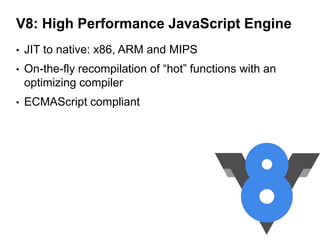
V8: High Performance JavaScript Engine
•

JIT to native: x86, ARM and MIPS

•

On-the-fly recompilation of “hot” functions with an
optimizing compiler

•

ECMAScript compliant
Single threaded??
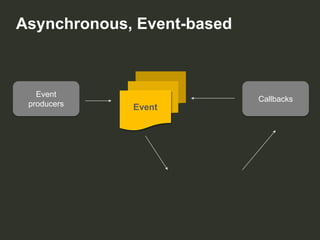
Asynchronous, Event-based

Event
producers

Event
Event

Event

Callbacks
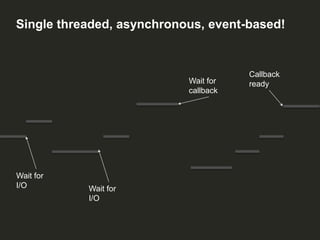
Single threaded, asynchronous, event-based!

Wait for
callback

Wait for
I/O

Wait for
I/O

Callback
ready
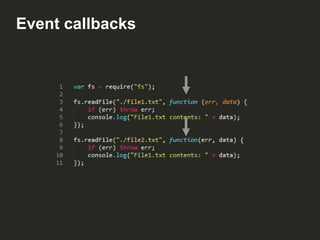
Event callbacks
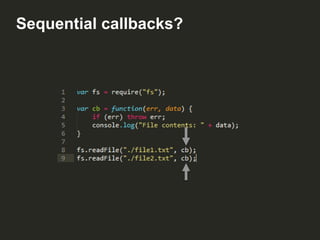
Sequential callbacks?
So why are async and events good?
•

Easier to write

•

Scales better

•

Lower memory, CPU overhead
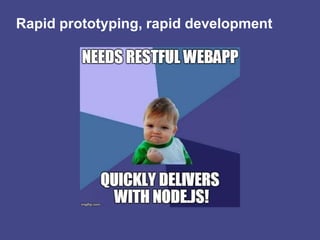
Rapid prototyping, rapid development
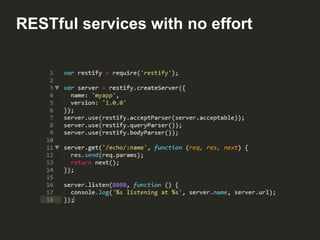
RESTful services with no effort
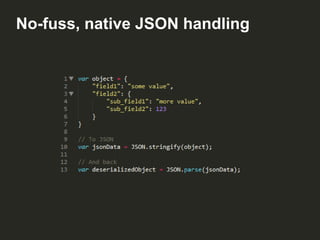
No-fuss, native JSON handling
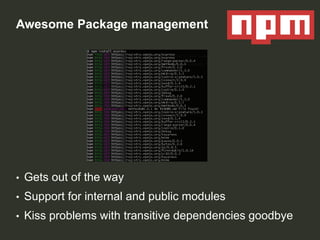
Awesome Package management

•

Gets out of the way

•

Support for internal and public modules

•

Kiss problems with transitive dependencies goodbye
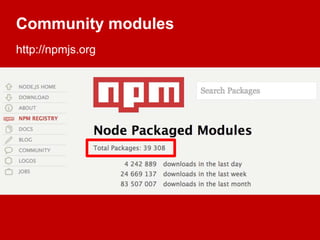
Community modules
http://npmjs.org
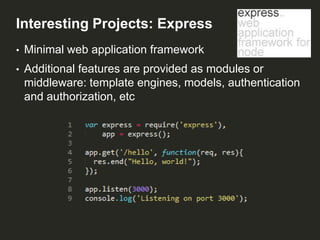
Interesting Projects: Express
•

Minimal web application framework

•

Additional features are provided as modules or
middleware: template engines, models, authentication
and authorization, etc
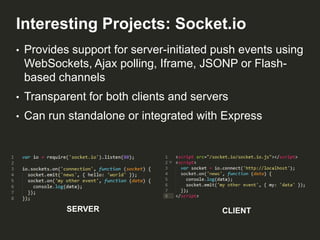
Interesting Projects: Socket.io
•

Provides support for server-initiated push events using
WebSockets, Ajax polling, Iframe, JSONP or Flashbased channels

•

Transparent for both clients and servers

•

Can run standalone or integrated with Express

SERVER

CLIENT
Interesting Projects: Meteor
•

Next-gen framework for real-time collaborative web
applications

•

Live page updates

•

Support for offline databases with subsequent
synchronization
When to use Node.js
•

REST+JSON APIs

•

Backend for single-page web apps: same language in
client and server

•

Real-time web apps with Socket.io and Meteor

•

Quick prototyping

•

Rapidly evolving applications: media sites, marketing,
etc
When not to use Node.js
•

CPU-bound tasks

•

Multi-threaded applications

•

Applications that have to process large amounts of
data

•

Boring CRUD-type web apps
Ready for the Enterprise?
Maturity
•

Under development since 2008

•

Node.js 1.0 around the corner

•

Nearly 40000 modules available via npm

•

Awesome community

•

Commercial support
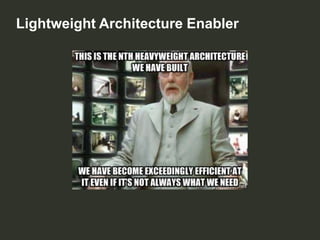
Lightweight Architecture Enabler
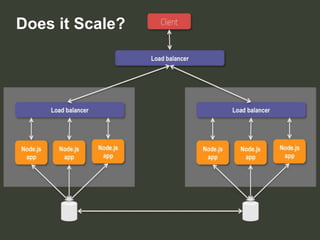
Does it Scale?
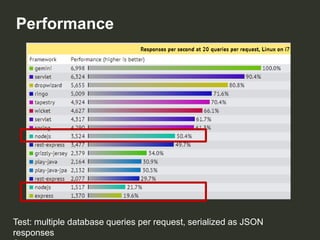
Performance

Test: multiple database queries per request, serialized as JSON
responses
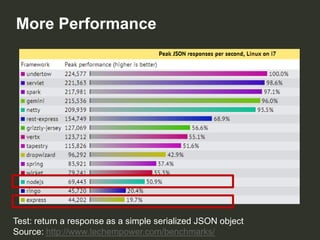
More Performance

Test: return a response as a simple serialized JSON object
Source: http://www.techempower.com/benchmarks/
Not the fastest; does it always
matter?
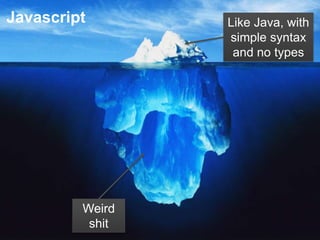
Javascript

Weird
shit

Like Java, with
simple syntax
and no types
JavaScript is quirky different
•

Prototype-based inheritance

•

“==“ versus “===“

•

The meaning of “this”

•

Call, apply and bind in Function.prototype

And more.
Solid development toolset
Toolset
•

Large selection of testing libraries: unit testing,
functional testing, BDD

•

Static code analysis (JsHint)

•

IntelliJ IDEA, Eclipse (Nodeclipse) integration:
highlighting, refactoring, debugging

•

Integration with Jenkins/Hudson, Node.js specific CI
servers

•

NPM supports internal module repositories
Architects have a little bit of extra work
Node.js currently lacks standards; extra effort and
care must be paid to
•

application architecture,

•

development lifecycle,

•

code quality,

And many more.
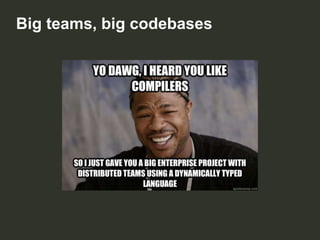
Big teams, big codebases
Where does it run?
Is it commercially supported?
Joyent is the corporate
steward of Node.js, the
world’s best runtime for
today's data-intensive,
real-time applications.
Joyent offers exclusive
debugging and
performance analysis
tools for Node.js
applications.
Anybody using it?

Node.js, for architects - OpenSlava 2013

Editor's Notes

  • #8 Unashamedly inspired by: http://www.slideshare.net/sergimansilla/big-app-design-for-nodejs (slide 11)
  • #10 Other approaches to deal with application parallelism:Onethread per connection – thereisanupperlimittothenumber of concurrentthreads, and thereis a memoryoverhead per threadFork a new process per connection – same as above; limitedbytheoperatingsystemprocessscheduler, and processes are heavierthanthreadsSynchronous – don’tbotherwithparallelprocessingNode.js’ approachtoparallelismscalesbetter and uses lessmemorytoprocess a largeramount of connections – butitrequiresthatwebuildapplicationsthat are not CPU-bound
  • #16 Node-restifyisusedhere, butit can all be accomplishedwithout a frameworktoo.
  • #17 JSON is Javascript’s native serialization formatIntegrates very well with things like JSON-based APIs,MongoDB, etc – things that speak JSON natively
  • #22 http://www.meteor.com
  • #24 Note on “boring CRUD-type web apps”: Node.jsframeworksdon’tmakeitneithereasiernor more difficulttowritetraditional web apps; Node.js and itsframeworksjustsimplymake no differencehere
  • #25 Imagecredit: http://www.allmystery.de/i/bk33NhA_ayZYgl_USS_Enterprise_NCC_1701_A_by_cb93.jpg
  • #26 https://groups.google.com/d/topic/nodejs/9afurRCTlOc/discussion
  • #28 Note: Diagram inspired fromhttp://www.slideshare.net/BenLin2/webconf-nodejsproductionarchitectureNode.js processes are single threaded so scalability within the same server is dependent on the number of node processes that we run.In order to load balance the load within the same server, we can use a traditional load balancer running locally.The next step is to scale multiple servers, for which we need an additional load balanced layer on top of the local instances.Database/storage tier can be scaled according to the type of solution in use.
  • #32 Imagesource: http://drtom.ch/talks/2012/06/jazoon/images/tip_of_the_iceberg.jpgOriginal idea:https://speakerdeck.com/anguscroll/the-politics-of-javascript
  • #33 JavaScript is not better or worse than other languages; but it may look more accessible and easier to learn than it actually is.
  • #34 Grunt = Ant,MavenYeoman = Maven, someparts of itincludingarchetypes (“generators” in Yeomanese)
  • #37 Thereis no substitutefor a compilerNo provensuccess of Node.jsapplications in theenterpriseworld, yet