No-Code vs. Low-Code vs. High-Code
No-code platforms require no
programming experience, low-
code platforms require minimal
coding, while high-code
platforms require advanced
coding skills. Choose the best
for your project needs.
Introduction to
the concept
Low-Code Development
As the name implies, low code is all about giving
developers the chance to quickly construct apps by
fusing the finest aspects of coding and no-code.
Developers now have the option to freely customise
applications while being able to construct them
without writing a single line of code.
In addition, developers can create their own
components by utilising those from pre-existing
libraries, which allows them to express their creative
side.
No-Code Development
As the name implies, this strategy doesn't involve
any coding, and it is quite similar to low coding in
that regard, but with a twist. You don't need to know
how to programme or have a background in
computer science to use this trend.
With no-code development, anyone can create apps
since it provides a visual representation of the
programme and allows users to establish the logic of
the app by utilising simple language or predefined
alternatives. Or they can arrange the app's UI using
point-and-click and drag-and-drop features.
High-Code Development
High code is a term used to describe
conventional programming design, in which
painstakingly written solutions are created
from scratch by expert programmers.
Developers use JavaScript frameworks like
React or Angular since this technique heavily
relies on developers, and they make sure
that material is accessible through a CMS.
No-Code vs Low-Code vs High-Code Differences
Target Audience
Although no-code is for citizen developers
like us all who lack a technical expertise to
construct an app, the Community for low-
code is primarily composed of developers. On
the other hand, high-code development
requires qualified developers with strong
technical writing skills.
No-Code vs Low-Code vs High-Code Differences
Code Accessibility
As no-code is a concept, coding is not
accessible. Only a little amount of
access is permitted for coding in low
code. Coding is a requirement for high-
code development and is available to
everyone.
Quality Assurance
Quality control is not a concern in no-code because every code block is
already well tested. Low-code, on the other hand, requires that you test it
thoroughly on your own because there is room for customization.
To prevent quality problems, there is a thorough testing procedure for high
code.
App Complexity
In all honesty, low code is a little challenging for novice developers whereas
no code is thought of as a simple foundation to run sophisticated corporate
programmes. On the other hand, complex corporate apps can be created
quickly with high code.
No Code/Low Code Use Cases
#1- MVP Building
With a low- or no-code solution, you may
quickly create an app prototype and make it
available to the general public. So, it is ideal
for those who lack the time, finances, or
coding knowledge required to construct a
full programme. Low-code/no-code
solutions are also fantastic for quickly
testing and improving concepts.
High Code Use Cases
#1- Enterprise grade application development
High-code is the best option for you if
your programme has complicated
features, technologies, and other
functionalities.
It aids in the development of complex
apps, helping companies to find
seamless answers to their problems.
#2- Scalability is on your chart
Not every organisation has a set scope; instead, it evolves over time. High-
Code is your go-to platform if your company is one of those with a wider
scope to transform.
#3- Advanced features & Functionalities
With high code development, you can build
an app that is feature-rich and has advanced
functionalities.
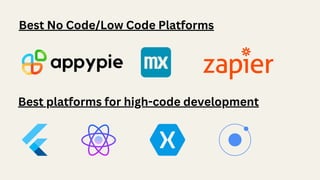
Best No Code/Low Code Platforms
Best platforms for high-code development
Tips to Select the Right Choice for Your Project
Mission-Critical Project
Because a mission-critical app needs internal business specifics, low-code or
no-code app construction platforms are unable to manage this. For the
traditional development procedure, you must spend some time and money
here.
In a similar vein, it is preferable to choose the custom app development
process if your business roadmap will expand over time and have a lot of
features and functionalities.
Detect Budget Constraints
This is a very important factor to take into account. Making a prototype or a
simple app with low-code or no-code is the greatest option if you are short on
time and need to present your project or idea to the stakeholders. But, if your
company needs more features and functionalities, hiring a mobile app
developer and developing a custom app should be your first options.
Check Time-to-Market
Prototyping can be done with no-code or low-code technologies using little
money and time.
For small and medium-sized app requirements, low-code and no-code
development technologies are helpful. They are transforming the
process of creating apps by allowing users to do it quickly and
effectively with no or little coding knowledge.
The Bottomline
Schedule a call with one of Hidden Brains' specialists right away if
you have any additional queries about whether you should choose for
low code or no code instead of custom development.
Phone Number
Email
Website
+1 323-908-3492
biz@hiddenbrains.com
www.hiddenbrains.com

No-Code vs. Low-Code vs. High-Code

  • 1.
    No-Code vs. Low-Codevs. High-Code
  • 2.
    No-code platforms requireno programming experience, low- code platforms require minimal coding, while high-code platforms require advanced coding skills. Choose the best for your project needs. Introduction to the concept
  • 3.
    Low-Code Development As thename implies, low code is all about giving developers the chance to quickly construct apps by fusing the finest aspects of coding and no-code. Developers now have the option to freely customise applications while being able to construct them without writing a single line of code. In addition, developers can create their own components by utilising those from pre-existing libraries, which allows them to express their creative side.
  • 4.
    No-Code Development As thename implies, this strategy doesn't involve any coding, and it is quite similar to low coding in that regard, but with a twist. You don't need to know how to programme or have a background in computer science to use this trend. With no-code development, anyone can create apps since it provides a visual representation of the programme and allows users to establish the logic of the app by utilising simple language or predefined alternatives. Or they can arrange the app's UI using point-and-click and drag-and-drop features.
  • 5.
    High-Code Development High codeis a term used to describe conventional programming design, in which painstakingly written solutions are created from scratch by expert programmers. Developers use JavaScript frameworks like React or Angular since this technique heavily relies on developers, and they make sure that material is accessible through a CMS.
  • 6.
    No-Code vs Low-Codevs High-Code Differences Target Audience Although no-code is for citizen developers like us all who lack a technical expertise to construct an app, the Community for low- code is primarily composed of developers. On the other hand, high-code development requires qualified developers with strong technical writing skills.
  • 7.
    No-Code vs Low-Codevs High-Code Differences Code Accessibility As no-code is a concept, coding is not accessible. Only a little amount of access is permitted for coding in low code. Coding is a requirement for high- code development and is available to everyone.
  • 8.
    Quality Assurance Quality controlis not a concern in no-code because every code block is already well tested. Low-code, on the other hand, requires that you test it thoroughly on your own because there is room for customization. To prevent quality problems, there is a thorough testing procedure for high code. App Complexity In all honesty, low code is a little challenging for novice developers whereas no code is thought of as a simple foundation to run sophisticated corporate programmes. On the other hand, complex corporate apps can be created quickly with high code.
  • 9.
    No Code/Low CodeUse Cases #1- MVP Building With a low- or no-code solution, you may quickly create an app prototype and make it available to the general public. So, it is ideal for those who lack the time, finances, or coding knowledge required to construct a full programme. Low-code/no-code solutions are also fantastic for quickly testing and improving concepts.
  • 10.
    High Code UseCases #1- Enterprise grade application development High-code is the best option for you if your programme has complicated features, technologies, and other functionalities. It aids in the development of complex apps, helping companies to find seamless answers to their problems.
  • 11.
    #2- Scalability ison your chart Not every organisation has a set scope; instead, it evolves over time. High- Code is your go-to platform if your company is one of those with a wider scope to transform. #3- Advanced features & Functionalities With high code development, you can build an app that is feature-rich and has advanced functionalities.
  • 12.
    Best No Code/LowCode Platforms Best platforms for high-code development
  • 13.
    Tips to Selectthe Right Choice for Your Project Mission-Critical Project Because a mission-critical app needs internal business specifics, low-code or no-code app construction platforms are unable to manage this. For the traditional development procedure, you must spend some time and money here. In a similar vein, it is preferable to choose the custom app development process if your business roadmap will expand over time and have a lot of features and functionalities.
  • 14.
    Detect Budget Constraints Thisis a very important factor to take into account. Making a prototype or a simple app with low-code or no-code is the greatest option if you are short on time and need to present your project or idea to the stakeholders. But, if your company needs more features and functionalities, hiring a mobile app developer and developing a custom app should be your first options. Check Time-to-Market Prototyping can be done with no-code or low-code technologies using little money and time.
  • 15.
    For small andmedium-sized app requirements, low-code and no-code development technologies are helpful. They are transforming the process of creating apps by allowing users to do it quickly and effectively with no or little coding knowledge. The Bottomline Schedule a call with one of Hidden Brains' specialists right away if you have any additional queries about whether you should choose for low code or no code instead of custom development.
  • 16.