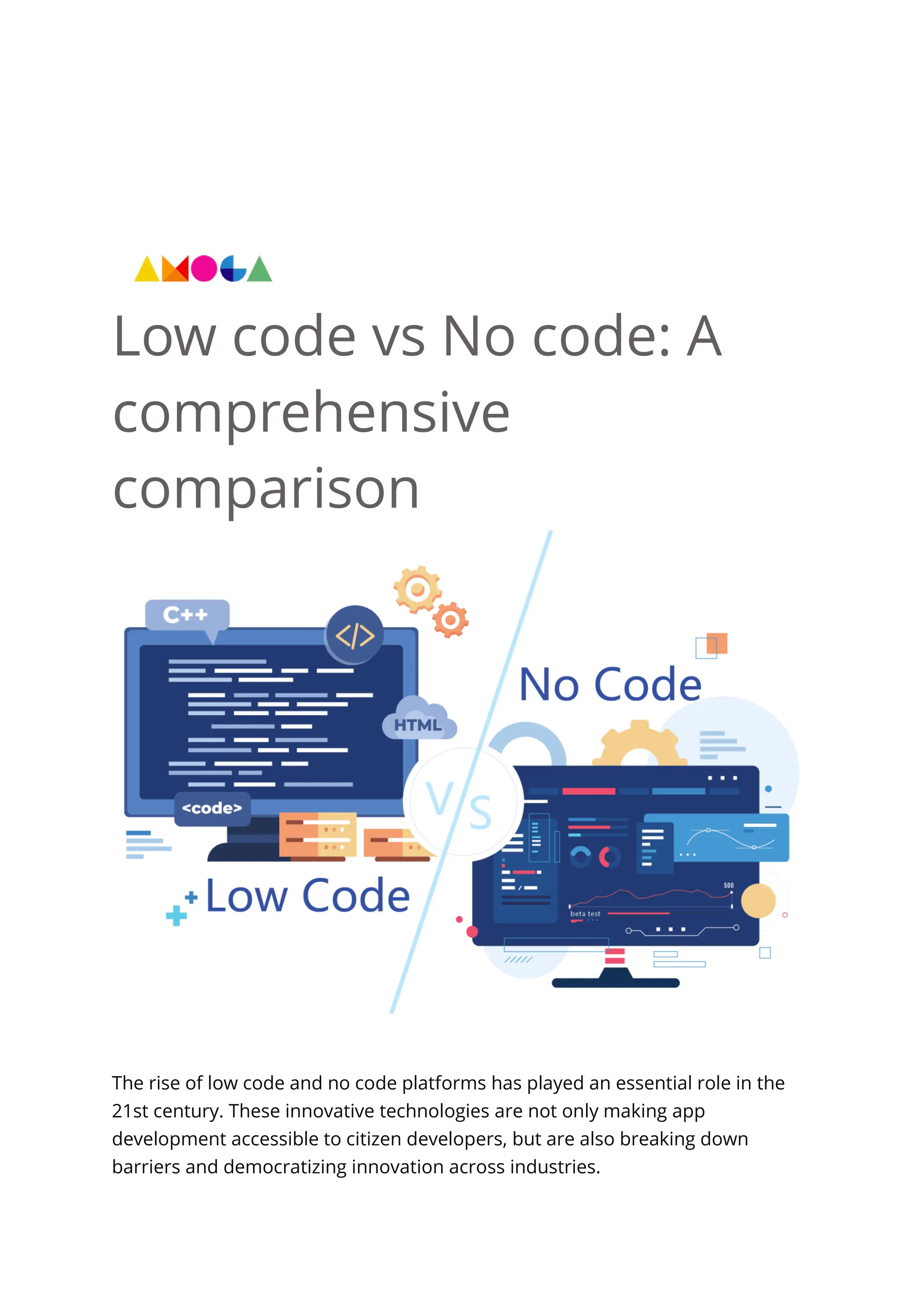
Low code vs No code: A
comprehensive
comparison
The rise of low code and no code platforms has played an essential role in the
21st century. These innovative technologies are not only making app
development accessible to citizen developers, but are also breaking down
barriers and democratizing innovation across industries.
The most common question raised in terms of low code & no code platforms is
what is the difference between the two? Although they aim for the same goal, to
bring speed to the business by decreasing software development time in a go-
to-market approach. Still, there are a number of significant differences between
“low code” and “no code” platforms.
Let’s take a closer look at each approach and understand better –
What is No code?
No code refers to a development tool that empowers non-technical users to
build applications. Instead of writing code, no code platforms offer visual-based
interfaces and pre-built templates, allowing users to simply drag and drop
components into logical sequences to build fully functional business
applications. In the background, the platform automatically generates the
necessary code, making the app functional.
However, no code does have its own downside: while it enables users to build
applications rapidly, they are limited to the provided templates. This limitation
results in reduced flexibility and scalability when attempting to incorporate
highly customized features or integrate with existing systems.
What is Low code?
As the name suggests, low code platform enables developers to write custom
code when necessary to meet specific and complex business requirements.
Unlike no code platforms, low code platforms include automation capabilities,
component reusability, and integration capabilities, making them capable of
handling scalability and ensuring cross-platform compatibility.
In summary, low code offers a middle ground between traditional coding and no
code solutions, making them suitable for a wide range of users, from citizen
developers to software developers.
Low code vs No code: The differences
Now that you have a grasp of both low code and no code platforms, how do you
determine the ideal choice for your needs? While these two simple workflow
applications share many common traits, there are a few fundamental
differences that are crucial to consider.
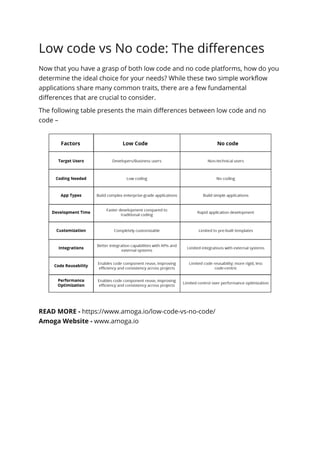
The following table presents the main differences between low code and no
code –
READ MORE - https://www.amoga.io/low-code-vs-no-code/
Amoga Website - www.amoga.io
Low Code Work Platform

Low Code Work Platform

  • 1.
    Low code vsNo code: A comprehensive comparison The rise of low code and no code platforms has played an essential role in the 21st century. These innovative technologies are not only making app development accessible to citizen developers, but are also breaking down barriers and democratizing innovation across industries.
  • 2.
    The most commonquestion raised in terms of low code & no code platforms is what is the difference between the two? Although they aim for the same goal, to bring speed to the business by decreasing software development time in a go- to-market approach. Still, there are a number of significant differences between “low code” and “no code” platforms. Let’s take a closer look at each approach and understand better – What is No code? No code refers to a development tool that empowers non-technical users to build applications. Instead of writing code, no code platforms offer visual-based interfaces and pre-built templates, allowing users to simply drag and drop components into logical sequences to build fully functional business applications. In the background, the platform automatically generates the necessary code, making the app functional. However, no code does have its own downside: while it enables users to build applications rapidly, they are limited to the provided templates. This limitation results in reduced flexibility and scalability when attempting to incorporate highly customized features or integrate with existing systems. What is Low code? As the name suggests, low code platform enables developers to write custom code when necessary to meet specific and complex business requirements. Unlike no code platforms, low code platforms include automation capabilities, component reusability, and integration capabilities, making them capable of handling scalability and ensuring cross-platform compatibility. In summary, low code offers a middle ground between traditional coding and no code solutions, making them suitable for a wide range of users, from citizen developers to software developers.
  • 3.
    Low code vsNo code: The differences Now that you have a grasp of both low code and no code platforms, how do you determine the ideal choice for your needs? While these two simple workflow applications share many common traits, there are a few fundamental differences that are crucial to consider. The following table presents the main differences between low code and no code – READ MORE - https://www.amoga.io/low-code-vs-no-code/ Amoga Website - www.amoga.io