Native
vs
Cross-Platform
App Development
Advanced Frameworks to Craft Apps
Certainly, there are other approaches to create mobile apps, including
cross-platform, native, and hybrid ones, thanks to the development of new
technology.
Choosing an app development approach might be difficult because there
are so many different ways to create apps.
It has been noted that when choosing the best mobile app development
framework to create an app, business executives and developers frequently
get into conflict.
Native or Cross- the Battle Begins
To be more specific, we need first recognize that businesses are faced with
the choice between Native and Cross-platform due to the app stores'
phenomenal growth in the number of apps available.
You can choose a course of action that will help your company if you have a
better understanding of the benefits and drawbacks of each.
In this essay, we'll examine the distinctions between Native and Cross
platforms and compare their advantages and disadvantages.
Native App Development
Native app development is a solution that businesses need require since it
creates a unique user experience.
Native app development offers a number of benefits, including the ability to
create robust app solutions with the potential to increase user engagement
rates.
Developers can create apps that work on a specific platform or device by
utilizing Native. In other words, it can use hardware and software tailored to
certain devices.
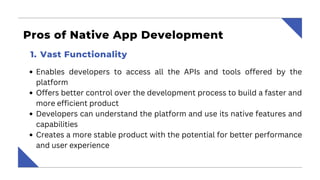
Pros of Native App Development
Enables developers to access all the APIs and tools offered by the
platform
Offers better control over the development process to build a faster and
more efficient product
Developers can understand the platform and use its native features and
capabilities
Creates a more stable product with the potential for better performance
and user experience
Vast Functionality
1.
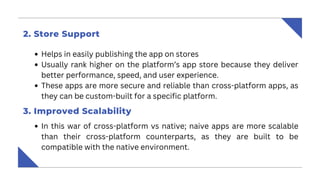
Helps in easily publishing the app on stores
Usually rank higher on the platform’s app store because they deliver
better performance, speed, and user experience.
These apps are more secure and reliable than cross-platform apps, as
they can be custom-built for a specific platform.
2. Store Support
3. Improved Scalability
In this war of cross-platform vs native; naive apps are more scalable
than their cross-platform counterparts, as they are built to be
compatible with the native environment.
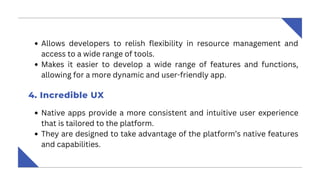
Allows developers to relish flexibility in resource management and
access to a wide range of tools.
Makes it easier to develop a wide range of features and functions,
allowing for a more dynamic and user-friendly app.
4. Incredible UX
Native apps provide a more consistent and intuitive user experience
that is tailored to the platform.
They are designed to take advantage of the platform’s native features
and capabilities.
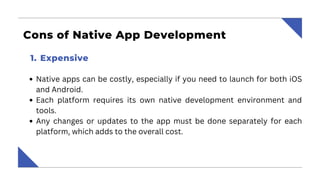
Cons of Native App Development
Native apps can be costly, especially if you need to launch for both iOS
and Android.
Each platform requires its own native development environment and
tools.
Any changes or updates to the app must be done separately for each
platform, which adds to the overall cost.
Expensive
1.
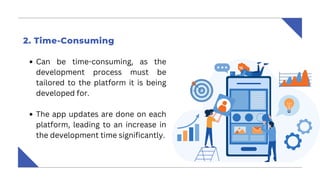
Can be time-consuming, as the
development process must be
tailored to the platform it is being
developed for.
The app updates are done on each
platform, leading to an increase in
the development time significantly.
2‍
. Time-Consuming
Cross-Platform App Development
The process of creating an app that functions across many platforms is
known as cross-platform app development. This indicates that the software
is compatible with a variety of hardware, including smartphones and tablets,
as well as several operating systems, including Android and iOS.
Pros of Cross-Platform App Development
Pocket-Friendly
1.
Offer a streamlined development process, as the same codebase can be
used to create apps for multiple platforms.
2‍
. Faster Development ‍
An efficient way to create an app that runs on multiple platforms.
It saves time, as changes and updates only need to be made once and
applied to all platforms
Fosters faster development and deployment.
‍
3. Single Code Base ‍
It enables developers to create one codebase that can be used across
multiple platforms.
This means that developers only have to write the code once, which
saves time and effort extensively.
2‍
. Faster Development ‍
An efficient way to create an app that runs on multiple platforms.
It saves time, as changes and updates only need to be made once and
applied to all platforms
Fosters faster development and deployment.
‍
3. Single Code Base ‍
It enables developers to create one codebase that can be used across
multiple platforms.
This means that developers only have to write the code once, which
saves time and effort extensively.
Cons of Cross-Platform App Development
Slower App
1.
A cross-platform app is typically slower than a native app.
It requires an additional abstraction layer and rendering process which
can slow down the overall performance of the app.
2‍
. Limited Functionality
In contrast to how a native program can access features like the
microphone, camera, and geolocation, developers frequently struggle to
do so.
limits the functionality of the app and creates barriers to a genuinely
native experience.
The complete spectrum of device-specific functions, such the
accelerometer or NFC, are inaccessible to many cross-platform
frameworks.
‍
3. Not-So Strong UX ‍
Animations, transitions, and gestures are examples of native UX
elements that cross-platform apps are unable to use.
Comparison of Native vs Cross-Platform
In order to answer this, you should be aware that it's crucial to take the
app's aims and expectations into account when determining which
development style is appropriate for your mobile application.
For instance, it would be better to use a native approach if an app needs
complicated device-specific functions like the accelerometer or NFC
because these features are more readily available with a native app.
A cross-platform strategy, on the other hand, can be a preferable choice if
the app simply needs basic capabilities because it is often more
affordable and quicker to construct.
And the WINNER is…
There is no right or wrong answer to this topic; rather, companies must
consider the user experience, cost, and time-to-market when selecting the
best platform to achieve their goals.
Keep in mind that because technology is ever-evolving, it is difficult to
forecast how frameworks will be used in app development in the future.
The drawbacks of the past might no longer apply or might not even be
relevant at all in the future.
As a result, before making a decision, you should do your homework and
consider your company's needs.
Summary
To sum up, it is fair to state that each of these platforms has its own
advantages and disadvantages.
Ultimately, businesses must select the platform that best suits their app's
requirements and provides the best user experience when weighing the
advantages and disadvantages of native and cross-platform apps.
If you're still not sure whether to go with native or cross-platform
development, Hidden Brains, a business that specializes in cross-
platform app development, can offer advice.
Phone Number
Email
Website
+1 323-908-3492
biz@hiddenbrains.com
www.hiddenbrains.com

Native vs. Cross-Platform

  • 1.
  • 2.
    Advanced Frameworks toCraft Apps Certainly, there are other approaches to create mobile apps, including cross-platform, native, and hybrid ones, thanks to the development of new technology. Choosing an app development approach might be difficult because there are so many different ways to create apps. It has been noted that when choosing the best mobile app development framework to create an app, business executives and developers frequently get into conflict.
  • 3.
    Native or Cross-the Battle Begins To be more specific, we need first recognize that businesses are faced with the choice between Native and Cross-platform due to the app stores' phenomenal growth in the number of apps available. You can choose a course of action that will help your company if you have a better understanding of the benefits and drawbacks of each. In this essay, we'll examine the distinctions between Native and Cross platforms and compare their advantages and disadvantages.
  • 4.
    Native App Development Nativeapp development is a solution that businesses need require since it creates a unique user experience. Native app development offers a number of benefits, including the ability to create robust app solutions with the potential to increase user engagement rates. Developers can create apps that work on a specific platform or device by utilizing Native. In other words, it can use hardware and software tailored to certain devices.
  • 5.
    Pros of NativeApp Development Enables developers to access all the APIs and tools offered by the platform Offers better control over the development process to build a faster and more efficient product Developers can understand the platform and use its native features and capabilities Creates a more stable product with the potential for better performance and user experience Vast Functionality 1.
  • 6.
    Helps in easilypublishing the app on stores Usually rank higher on the platform’s app store because they deliver better performance, speed, and user experience. These apps are more secure and reliable than cross-platform apps, as they can be custom-built for a specific platform. 2. Store Support 3. Improved Scalability In this war of cross-platform vs native; naive apps are more scalable than their cross-platform counterparts, as they are built to be compatible with the native environment.
  • 7.
    Allows developers torelish flexibility in resource management and access to a wide range of tools. Makes it easier to develop a wide range of features and functions, allowing for a more dynamic and user-friendly app. 4. Incredible UX Native apps provide a more consistent and intuitive user experience that is tailored to the platform. They are designed to take advantage of the platform’s native features and capabilities.
  • 8.
    Cons of NativeApp Development Native apps can be costly, especially if you need to launch for both iOS and Android. Each platform requires its own native development environment and tools. Any changes or updates to the app must be done separately for each platform, which adds to the overall cost. Expensive 1.
  • 9.
    Can be time-consuming,as the development process must be tailored to the platform it is being developed for. The app updates are done on each platform, leading to an increase in the development time significantly. 2‍ . Time-Consuming
  • 10.
    Cross-Platform App Development Theprocess of creating an app that functions across many platforms is known as cross-platform app development. This indicates that the software is compatible with a variety of hardware, including smartphones and tablets, as well as several operating systems, including Android and iOS. Pros of Cross-Platform App Development Pocket-Friendly 1. Offer a streamlined development process, as the same codebase can be used to create apps for multiple platforms.
  • 11.
    2‍ . Faster Development‍ An efficient way to create an app that runs on multiple platforms. It saves time, as changes and updates only need to be made once and applied to all platforms Fosters faster development and deployment. ‍ 3. Single Code Base ‍ It enables developers to create one codebase that can be used across multiple platforms. This means that developers only have to write the code once, which saves time and effort extensively.
  • 12.
    2‍ . Faster Development‍ An efficient way to create an app that runs on multiple platforms. It saves time, as changes and updates only need to be made once and applied to all platforms Fosters faster development and deployment. ‍ 3. Single Code Base ‍ It enables developers to create one codebase that can be used across multiple platforms. This means that developers only have to write the code once, which saves time and effort extensively.
  • 13.
    Cons of Cross-PlatformApp Development Slower App 1. A cross-platform app is typically slower than a native app. It requires an additional abstraction layer and rendering process which can slow down the overall performance of the app. 2‍ . Limited Functionality In contrast to how a native program can access features like the microphone, camera, and geolocation, developers frequently struggle to do so.
  • 14.
    limits the functionalityof the app and creates barriers to a genuinely native experience. The complete spectrum of device-specific functions, such the accelerometer or NFC, are inaccessible to many cross-platform frameworks. ‍ 3. Not-So Strong UX ‍ Animations, transitions, and gestures are examples of native UX elements that cross-platform apps are unable to use.
  • 15.
    Comparison of Nativevs Cross-Platform In order to answer this, you should be aware that it's crucial to take the app's aims and expectations into account when determining which development style is appropriate for your mobile application. For instance, it would be better to use a native approach if an app needs complicated device-specific functions like the accelerometer or NFC because these features are more readily available with a native app. A cross-platform strategy, on the other hand, can be a preferable choice if the app simply needs basic capabilities because it is often more affordable and quicker to construct.
  • 16.
    And the WINNERis… There is no right or wrong answer to this topic; rather, companies must consider the user experience, cost, and time-to-market when selecting the best platform to achieve their goals. Keep in mind that because technology is ever-evolving, it is difficult to forecast how frameworks will be used in app development in the future. The drawbacks of the past might no longer apply or might not even be relevant at all in the future. As a result, before making a decision, you should do your homework and consider your company's needs.
  • 17.
    Summary To sum up,it is fair to state that each of these platforms has its own advantages and disadvantages. Ultimately, businesses must select the platform that best suits their app's requirements and provides the best user experience when weighing the advantages and disadvantages of native and cross-platform apps. If you're still not sure whether to go with native or cross-platform development, Hidden Brains, a business that specializes in cross- platform app development, can offer advice.
  • 18.