Influence of the Land By: Amber, Stephanie	                           & Dalton
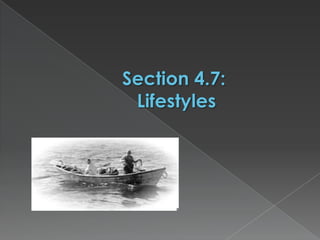
Section 4.7:  Lifestyles
Water-based transportationBoats were the main mode of transportation because most of the settlements were along the coastline of Newfoundland.
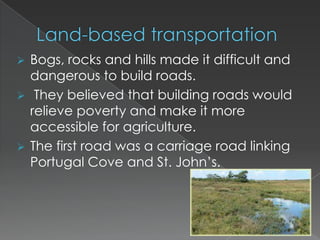
In the second half of the 19th century they started using steam-powered vessels instead of sail boats.Land-based transportationBogs, rocks and hills made it difficult and dangerous to build roads.
 They believed that building roads would relieve poverty and make it more accessible for agriculture.
The first road was a carriage road linking Portugal Cove and St. John’s.Land-based transportationThe first automobile came here in 1903.
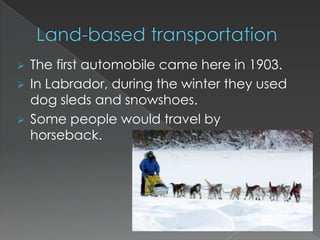
In Labrador, during the winter they used dog sleds and snowshoes.
Some people would travel by horseback. CommunicationTelegraph system allowed news from all over the province to be spread and personal communication enhanced
Radio system also allowed for news to be spread and church services sent to shut-ins and allowed better communication with Labrador
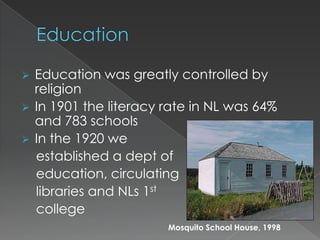
Some places would put out newspapers to inform everyone about what was happening in other parts of the province. EducationEducation was greatly controlled by religion
In 1901 the literacy rate in NL was 64% and 783 schools
In the 1920 we     established a dept of     education, circulating    libraries and NLs 1st    college Mosquito School House, 1998
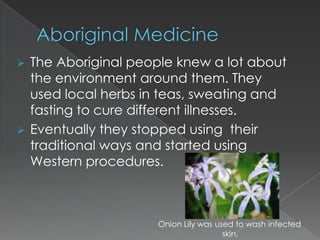
Aboriginal MedicineThe Aboriginal people knew a lot about the environment around them. They used local herbs in teas, sweating and fasting to cure different illnesses.
Eventually they stopped using  their traditional ways and started using Western procedures. Onion Lily was used to wash infected 		skin.
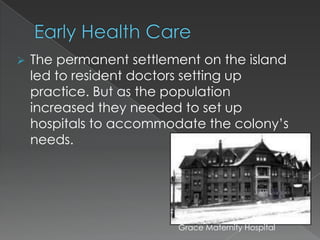
Contact with Europeans When Aboriginal people became in contact with Europeans illnesses started to increase and varied. They came in contact with new illnesses such as influenza, measles, small pox and more.Early Health CareThe permanent settlement on the island led to resident doctors setting up practice. But as the population increased they needed to set up hospitals to accommodate the colony’s needs. Grace Maternity Hospital
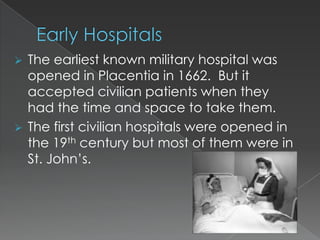
Early Hospitals The earliest known military hospital was opened in Placentia in 1662.  But it accepted civilian patients when they had the time and space to take them.
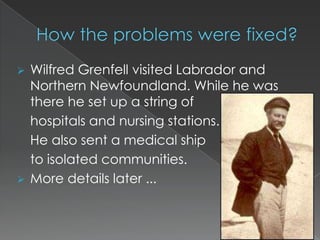
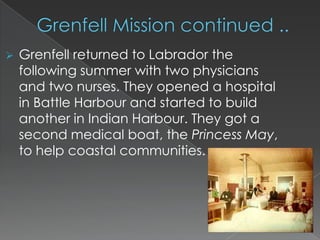
The first civilian hospitals were opened in the 19th century but most of them were in St. John’s. ProblemsA lot of the residents were unable to go to the hospitals due to distance or money so they used folk medicine such as: baking soda for heartburn and cornstarch   for bed sores. How the problems were fixed? Wilfred Grenfell visited Labrador and Northern Newfoundland. While he was there he set up a string of 	hospitals and nursing stations.	He also sent a medical ship 	to isolated communities.More details later ...How the problems were fixed? The smaller places outside St. John’s got a private industry or charitable group to establish hospitals.
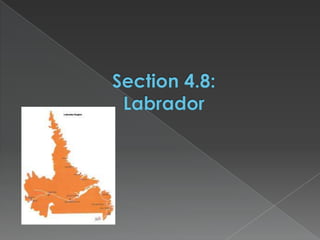
In 1920 a nursing committee called Newfoundland Outport Nursing And Industrial Association (NONIA) was formed.  It brought in nurses from England to station in rural communities. Section 4.8: Labrador
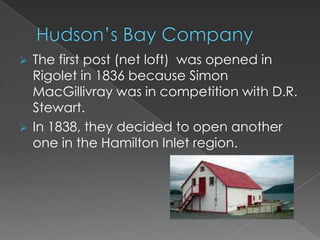
Hudson’s Bay CompanyThe first post (net loft)  was opened in Rigolet in 1836 because Simon MacGillivray was in competition with D.R. Stewart.
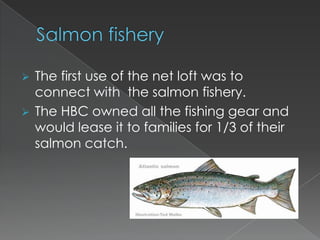
In 1838, they decided to open another one in the Hamilton Inlet region. Salmon fisheryThe first use of the net loft was to connect with  the salmon fishery.
The HBC owned all the fishing gear and would lease it to families for 1/3 of their salmon catch. WorkersThe staff were mainly people from Scotland, Newfoundland and Quebec. But, they had some Norwegians, planters and Inuit for when they were really busy.
They were responsible for repairing fishing gear and distributing it to the families. Grenfell MissionWilfred Grenfell arrived at Labrador in 1892 to investigate living conditions among local fishers. He spent the summer sailing the Labrador coast aboard the medical ship Albert.

NLS Lifestyles & Labrador

  • 1.
    Influence of theLand By: Amber, Stephanie & Dalton
  • 2.
    Section 4.7: Lifestyles
  • 3.
    Water-based transportationBoats werethe main mode of transportation because most of the settlements were along the coastline of Newfoundland.
  • 4.
    In the secondhalf of the 19th century they started using steam-powered vessels instead of sail boats.Land-based transportationBogs, rocks and hills made it difficult and dangerous to build roads.
  • 5.
    They believedthat building roads would relieve poverty and make it more accessible for agriculture.
  • 6.
    The first roadwas a carriage road linking Portugal Cove and St. John’s.Land-based transportationThe first automobile came here in 1903.
  • 7.
    In Labrador, duringthe winter they used dog sleds and snowshoes.
  • 8.
    Some people wouldtravel by horseback. CommunicationTelegraph system allowed news from all over the province to be spread and personal communication enhanced
  • 9.
    Radio system alsoallowed for news to be spread and church services sent to shut-ins and allowed better communication with Labrador
  • 10.
    Some places wouldput out newspapers to inform everyone about what was happening in other parts of the province. EducationEducation was greatly controlled by religion
  • 11.
    In 1901 theliteracy rate in NL was 64% and 783 schools
  • 12.
    In the 1920we established a dept of education, circulating libraries and NLs 1st college Mosquito School House, 1998
  • 13.
    Aboriginal MedicineThe Aboriginalpeople knew a lot about the environment around them. They used local herbs in teas, sweating and fasting to cure different illnesses.
  • 14.
    Eventually they stoppedusing their traditional ways and started using Western procedures. Onion Lily was used to wash infected skin.
  • 15.
    Contact with EuropeansWhen Aboriginal people became in contact with Europeans illnesses started to increase and varied. They came in contact with new illnesses such as influenza, measles, small pox and more.Early Health CareThe permanent settlement on the island led to resident doctors setting up practice. But as the population increased they needed to set up hospitals to accommodate the colony’s needs. Grace Maternity Hospital
  • 16.
    Early Hospitals Theearliest known military hospital was opened in Placentia in 1662. But it accepted civilian patients when they had the time and space to take them.
  • 17.
    The first civilianhospitals were opened in the 19th century but most of them were in St. John’s. ProblemsA lot of the residents were unable to go to the hospitals due to distance or money so they used folk medicine such as: baking soda for heartburn and cornstarch for bed sores. How the problems were fixed? Wilfred Grenfell visited Labrador and Northern Newfoundland. While he was there he set up a string of hospitals and nursing stations. He also sent a medical ship to isolated communities.More details later ...How the problems were fixed? The smaller places outside St. John’s got a private industry or charitable group to establish hospitals.
  • 18.
    In 1920 anursing committee called Newfoundland Outport Nursing And Industrial Association (NONIA) was formed. It brought in nurses from England to station in rural communities. Section 4.8: Labrador
  • 19.
    Hudson’s Bay CompanyThefirst post (net loft) was opened in Rigolet in 1836 because Simon MacGillivray was in competition with D.R. Stewart.
  • 20.
    In 1838, theydecided to open another one in the Hamilton Inlet region. Salmon fisheryThe first use of the net loft was to connect with the salmon fishery.
  • 21.
    The HBC ownedall the fishing gear and would lease it to families for 1/3 of their salmon catch. WorkersThe staff were mainly people from Scotland, Newfoundland and Quebec. But, they had some Norwegians, planters and Inuit for when they were really busy.
  • 22.
    They were responsiblefor repairing fishing gear and distributing it to the families. Grenfell MissionWilfred Grenfell arrived at Labrador in 1892 to investigate living conditions among local fishers. He spent the summer sailing the Labrador coast aboard the medical ship Albert.