Video games
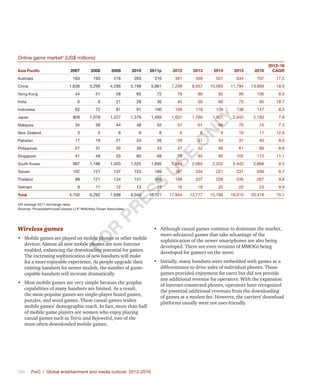
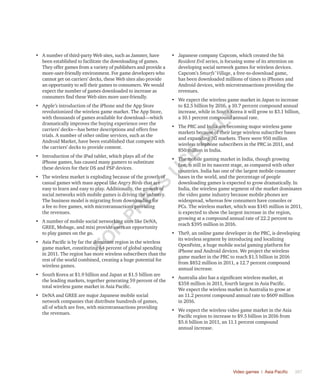
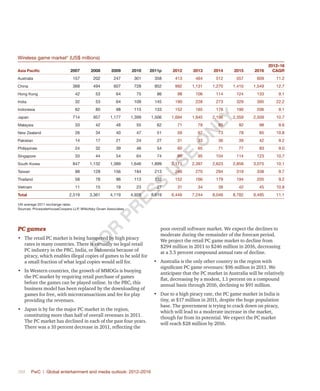
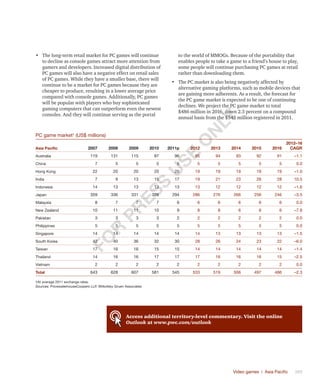
Summary	348
North America	 354
Europe, Middle East, Africa (EMEA)	 365
Asia Pacific	 380
Latin America	 392
Fo
r
Pr
ess
U
se
o
n
ly
348	 PwC | Global entertainment and media outlook: 2012–2016
Market size and
growth by region
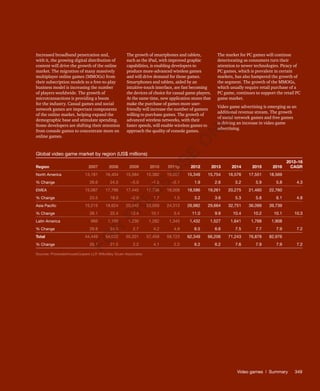
The video game market in North America,
EMEA (Europe, Middle East, Africa), Asia
Pacific, and Latin America will expand from
$58.7 billion in 2011 to $83.0 billion in
2016, growing at a 7.2 percent compound
annual rate. Asia Pacific, with three of
the top four countries in the world, is the
largest region, at $24.3 billion in 2011,
and is projected to be the fastest-growing
region during the next five years, increasing
10.3 percent on a compound annual basis
to $39.7 billion in 2016. Online games and
wireless games, the fastest-growing end-
user components of the video game market,
constitute a larger share of total spending
in Asia Pacific than in other regions and
consequently have a greater influence on
growth. EMEA, the second-largest region in
2011, with $18.0 billion, is projected to grow
by 4.8 percent compounded annually to
$22.8 billion. North America is projected
to increase from $15.1 billion in 2011
to $18.6 billion in 2016, growing by
4.3 percent on a compound annual basis.
Latin America is projected to grow to
$1.9 billion in 2016 from $1.3 billion in
2011, a 7.2 percent compound annual gain.
Market size and
growth by component
Global console games, the largest category,
at $27.5 billion in 2011, will expand at a
2.1 percent compound annual rate to
$30.5 billion in 2016. PC games will con-
tinue to decline, decreasing at a 1.9 percent
rate compounded annually to $3.1 billion
from $3.5 billion in 2011. Online games and
wireless games will be the fastest-growing
end-user categories, with compound annual
increases of 13.3 percent and 10.1 percent,
respectively. Online games will total
$31.4 billion in 2016, and wireless games,
$14.2 billion. As a result, online games will
replace console games as the largest gaming
category in 2016. Video game advertising
will increase from $2.2 billion in 2011 to
$3.7 billion in 2016, growing by 11.2 percent
on a compound annual rate.
Principal drivers
The shift to online and wireless games will
hurt the console game market in the near
term, although new games being marketed
for the current generation of consoles—the
Wii, the Xbox 360, and the PlayStation 3
(PS3)—with improved motion-sensory
technology, which changes the game-play
experience and brings in a wider range of
players, will limit declines. The Wii U is the
only next-generation console that has been
officially announced, though next-generation
consoles from the other manufacturers are
likely to be introduced over the forecast
period, spurring sales of games that take
advantage of the new technologies, although
a dip in sales is to be expected during the
generational transition period for static
consoles. The latest handheld devices—the
Nintendo 3DS and the PlayStation Vita,
which are primarily gaming consoles—will
also continue supporting the market for
console/handheld games.
Deteriorating retail sales of games are
hurting retail stores. If this pattern causes
some retailers to close, it would further
exacerbate the decline in the market for
console and PC games.
Video games
The video game market consists of consumer spending on new console
games (including handheld games), personal computer games, online
games, and wireless games as well as video game advertising. The
category excludes spending on the hardware used for playing the games.
Retail purchases of games are included in either the PC games or console
games category. The online game category includes microtransactions,
which are players’ purchases of accessories and additional game content
that enhance the gaming experience. Oftentimes, online games are first
purchased at retail and then played online. When these games are then
played online for a subscription fee, the subscription fee is counted in the
online game category.
Summary
Fo
r
Pr
ess
U
se
o
n
ly
Video games | Summary	349
Increased broadband penetration and,
with it, the growing digital distribution of
content will drive the growth of the online
market. The migration of many massively
multiplayer online games (MMOGs) from
their subscription models to a free-to-play
business model is increasing the number
of players worldwide. The growth of
microtransactions is providing a boom
for the industry. Casual games and social
network games are important components
of the online market, helping expand the
demographic base and stimulate spending.
Some developers are shifting their attention
from console games to concentrate more on
online games.
The growth of smartphones and tablets,
such as the iPad, with improved graphic
capabilities, is enabling developers to
produce more-advanced wireless games
and will drive demand for those games.
Smartphones and tablets, aided by an
intuitive-touch interface, are fast becoming
the devices of choice for casual game players.
At the same time, new application stores that
make the purchase of games more user-
friendly will increase the number of gamers
willing to purchase games. The growth of
advanced wireless networks, with their
faster speeds, will enable wireless games to
approach the quality of console games.
The market for PC games will continue
deteriorating as consumers turn their
attention to newer technologies. Piracy of
PC games, which is prevalent in certain
markets, has also hampered the growth of
the segment. The growth of the MMOGs,
which usually require retail purchase of a
PC game, continues to support the retail PC
game market.
Video game advertising is emerging as an
additional revenue stream. The growth
of social network games and free games
is driving an increase in video game
advertising.
Global video game market by region (US$ millions)
Region 2007 2008 2009 2010 2011p 2012 2013 2014 2015 2016
2012–16
CAGR
North America 13,181 16,404 15,584 15,382 15,057 15,349 15,754 16,576 17,551 18,569  
% Change 26.6 24.5 –5.0 –1.3 –2.1 1.9 2.6 5.2 5.9 5.8 4.3
EMEA 15,087 17,796 17,445 17,736 18,008 18,586 19,261 20,275 21,460 22,760  
% Change 23.5 18.0 –2.0 1.7 1.5 3.2 3.6 5.3 5.8 6.1 4.8
Asia Pacific 15,215 18,624 20,942 23,059 24,313 26,982 29,664 32,751 36,099 39,739  
% Change 28.1 22.4 12.4 10.1 5.4 11.0 9.9 10.4 10.2 10.1 10.3
Latin America 966 1,198 1,230 1,282 1,345 1,432 1,527 1,641 1,768 1,908  
% Change 29.8 24.0 2.7 4.2 4.9 6.5 6.6 7.5 7.7 7.9 7.2
Total 44,449 54,022 55,201 57,459 58,723 62,349 66,206 71,243 76,878 82,976  
% Change 26.1 21.5 2.2 4.1 2.2 6.2 6.2 7.6 7.9 7.9 7.2
Sources: PricewaterhouseCoopers LLP, Wilkofsky Gruen Associates
Fo
r
Pr
ess
U
se
o
n
ly
350	 PwC | Global entertainment and media outlook: 2012–2016
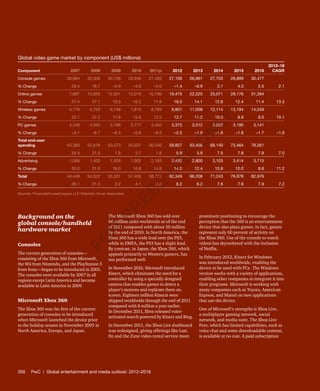
Global video game market by component (US$ millions)
Component 2007 2008 2009 2010 2011p 2012 2013 2014 2015 2016
2012–16
CAGR
Console games 26,964 32,006 30,106 28,946 27,493 27,106 26,861 27,703 28,899 30,477  
% Change 28.4 18.7 –5.9 –3.9 –5.0 –1.4 –0.9 3.1 4.3 5.5 2.1
Online games 7,897 10,829 12,921 15,019 16,796 19,475 22,225 25,071 28,176 31,394  
% Change 37.4 37.1 19.3 16.2 11.8 16.0 14.1 12.8 12.4 11.4 13.3
Wireless games 4,176 5,729 6,748 7,815 8,789 9,901 11,008 12,114 13,194 14,249  
% Change 25.1 37.2 17.8 15.8 12.5 12.7 11.2 10.0 8.9 8.0 10.1
PC games 4,346 4,055 3,798 3,777 3,462 3,375 3,312 3,252 3,195 3,141  
% Change –3.1 –6.7 –6.3 –0.6 –8.3 –2.5 –1.9 –1.8 –1.8 –1.7 –1.9
Total end-user
spending 43,383 52,619 53,573 55,557 56,540 59,857 63,406 68,140 73,464 79,261  
% Change 25.5 21.3 1.8 3.7 1.8 5.9 5.9 7.5 7.8 7.9 7.0
Advertising 1,066 1,403 1,628 1,902 2,183 2,492 2,800 3,103 3,414 3,715  
% Change 55.2 31.6 16.0 16.8 14.8 14.2 12.4 10.8 10.0 8.8 11.2
Total 44,449 54,022 55,201 57,459 58,723 62,349 66,206 71,243 76,878 82,976  
% Change 26.1 21.5 2.2 4.1 2.2 6.2 6.2 7.6 7.9 7.9 7.2
Sources: PricewaterhouseCoopers LLP, Wilkofsky Gruen Associates
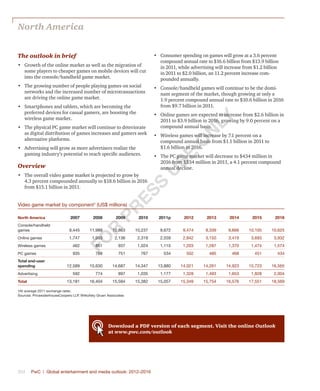
Background on the
global console/handheld
hardware market
Consoles
The current generation of consoles—
consisting of the Xbox 360 from Microsoft,
the Wii from Nintendo, and the PlayStation 3
from Sony—began to be introduced in 2005.
The consoles were available by 2007 in all
regions except Latin America and became
available in Latin America in 2009.
Microsoft Xbox 360
The Xbox 360 was the first of the current
generation of consoles to be introduced
when Microsoft launched the device prior
to the holiday season in November 2005 in
North America, Europe, and Japan.
The Microsoft Xbox 360 has sold over
66 million units worldwide as of the end
of 2011 compared with about 50 million
by the end of 2010. In North America, the
Xbox 360 has a wide lead over the PS3,
while in EMEA, the PS3 has a slight lead.
By contrast, in Japan, the Xbox 360, which
appeals primarily to Western gamers, has
not performed well.
In November 2010, Microsoft introduced
Kinect, which eliminates the need for a
controller by using a specially designed
camera that enables games to detect a
player’s motions and replicate them on-
screen. Eighteen million Kinects were
shipped worldwide through the end of 2011
compared with 8 million a year earlier.
In December 2011, Xbox released voice-
activated search powered by Kinect and Bing.
In December 2011, the Xbox Live dashboard
was redesigned, giving offerings like Last.
fm and the Zune video rental service more
prominent positioning to encourage the
perception that the 360 is an entertainment
device that also plays games. In fact, games
represent only 60 percent of activity on
the Xbox 360. Use of the console to watch
videos has skyrocketed with the inclusion
of Netflix.
In February 2012, Kinect for Windows
was introduced worldwide, enabling the
device to be used with PCs. The Windows
version works with a variety of applications,
enabling other companies to integrate it into
their programs. Microsoft is working with
many companies such as Toyota, American
Express, and Mattel on new applications
that use the device.
One of Microsoft’s strengths is Xbox Live,
a multiplayer gaming network, social
network, and media suite. The Xbox Live
Free, which has limited capabilities, such as
voice chat and some downloadable content,
is available at no cost. A paid subscription
Fo
r
Pr
ess
U
se
o
n
ly
Video games | Summary	351
to the Xbox Live Gold service is required
for multiplayer gaming, accessing social
networks such as Facebook and Twitter,
and accessing content such as ESPN3.
Worldwide, Microsoft has 40 million
subscribers to its online services.
There are rumors about the next Xbox
console that many have called the Xbox 720.
This device, which has not been announced
officially, is expected to integrate with the
Windows Phone. It is expected that the
device will include a much faster processor
and Blu-ray technology. The device is not
likely to be released before the end of 2013.
Nintendo Wii
The Wii, which was launched in November
2006, is marketed mainly as a game machine,
as opposed to the Sony and Microsoft
machines, which are being promoted as
media centers for home entertainment.
Nintendo has expanded the universe of game
players to include younger children, older
adults, and women. Wii is the most popular
console worldwide, having sold over
95 million units due to its wider appeal.
The most popular titles for the Wii are
published by Nintendo. Nintendo does not
have as much support from third-party
publishers as do Microsoft and Sony, though
a number of publishers, such as Electronic
Arts, Ubisoft, and Capcom, continue to
release exclusive titles for the Wii.
The Wii, which originally sold for $250,
saw in 2009 its first price reduction when
the price lowered to $200 in the US and
included a bundle containing a copy of
Wii Sports. In May 2011, the company
introduced its second price cut, lowering
the price to $150 and bundling it with Mario
Kart Wii instead. The lower console price
helped boost device sales. Sales of some of
the popular Wii games also spurred console
sales. For example, more than a million
copies of Legend of Zelda: Skyward Sword
were sold between its November 2011
debut and the end of the year, helping spur
console sales. Similarly, despite launching
in 2010, Just Dance 2 continues to sell well
and was named the biggest third-party Wii
game of all time, with 14 million units sold
worldwide. The Wii sold over 4 million units
in the US in 2011.
The Wii is the only one of the major consoles
that does not display in high-definition
format. Nintendo introduced the Wii
MotionPlus accessory in 2009, enhancing
the Wii’s controller’s motion detection
capabilities, but Sony and Microsoft
responded with their own motion-based
peripherals in 2010: Move and Kinect. The
Wii is not as technologically advanced as
its competitors. As a result, Nintendo was
the first of the three major manufacturers
to introduce its next-generation console,
the Wii U, at the Electronic Entertainment
Expo in June 2011 in Los Angeles. The new
console, which is expected to be launched
in major markets worldwide in time for
the holidays in 2012, will display 1080p
graphics and feature a 6.2-inch touch-screen
controller that interacts with the TV and
also functions as a monitor for continuous
use when the TV is turned off. More details
of the device are expected to be introduced
at this year’s expo and are rumored to
include the ability to act as an e-reader
capable of displaying books, magazines, and
strategy guides for the company’s games.
There will be an app store designed for
the device that will include apps for the
TV screen, with others designed for the
controller itself. The device is expected to
work with multiple sticklike Wii controllers
to enable multiplayer gaming. The app store
and the e-reader will provide new revenue
streams for the company. The Wii U is
expected to be only slightly technologically
superior to its current competitors.
PlayStation 3
The PS3 was launched in November 2006
in the United States, Japan, Hong Kong,
Taiwan, Mexico, and Canada, and in March
2007 in EMEA, Australia, and Singapore,
with subsequent launches, including
launches in the rest of Latin America in
2009. Global sales total around 63 million
units worldwide. As with the Xbox 360,
Sony has introduced a number of different
PS3 models since its introduction, with the
latest 160-gigabyte (GB) version replacing
the 120-GB version. In August 2011, Sony
lowered the price of the 160-GB and 320-
GB versions in the US to $249 and $299,
respectively, with similar price reductions
around the world. The price reductions
helped spur sales of the consoles in the
latter part of 2011. Sales of the PS3 have
grown each year since its launch. During
its 2010 fiscal year, Sony sold 14.3 million
PlayStation 3s worldwide and should hit
15 million by the end of its 2011 fiscal year
in March 2012.
The PS3 is being marketed as the most
advanced home entertainment center, with
a Blu-ray player and DVR capabilities as well
as an outstanding gaming console. The PS3
online environment is free to users and lets
game developers control their own environ-
ments. Additionally, other online content
such as movies can be downloaded. In 2010,
Sony introduced PlayStation Network Plus,
an optional paid upgrade that provides free
games, discounts, and other content. In
February 2012, Sony announced that the
PlayStation Network is being rebranded as
the Sony Entertainment Network.
In October 2010, Sony introduced the Move,
its new motion controller that is similar to
the Wii controller in that it is waved and can
be used in lieu of a sword, a baseball bat, or
many other devices. Unlike the Wii Remote,
the Move also makes use of the PlayStation
Eye camera to track the wand’s position with
greater fidelity and enable added game-
play features such as augmented reality.
In the US, the Move comes bundled with a
copy of Sports Champions or EyePet and the
PlayStation Eye camera. Sony shipped more
than 4 million units worldwide in the first
month. Sports Champions, which is similar
to Wii Sports, is a collection of sports that
show off the controller’s capabilities.
Sony has said there would be no
announcement at the 2012 Electronic
Entertainment Expo regarding a new
PlayStation console. The company said its
current console will have a life span of 10
years. That doesn’t mean a new console
Fo
r
Pr
ess
U
se
o
n
ly
352	 PwC | Global entertainment and media outlook: 2012–2016
cannot be introduced before 2016; rather,
the PS3 will continue to sell for 10 years.
Similarly, the PlayStation 2 continues to
be supported and is still selling well, with
games like Madden NFL 12 and NBA 2K12
among the top games for the PS2 in some
territories. Many of Sony’s first-party games
have long shelf lives because they are not
annual titles like certain other hit games
such as the major sports titles.
Handheld devices
Combined with interest in the current
generation of consoles, the market for
portable game consoles continues to show
strength. The Nintendo DS (dual screen) is
the leading portable device on a worldwide
basis because of its simplicity, which has
broadened its appeal beyond hard-core
gamers. The DS has two screens, providing
players with two views of the action, touch-
screen capabilities, wireless connectivity, and
a built-in microphone, which are innovative
features in handheld game consoles.
The DS has broadened the market, attract-
ing women and older players with its Touch!
Generations brand of games, which includes
a number of games in the Nintendogs and
Brain Training franchises, both of which are
exclusive to the Nintendo DS. There are a
number of different DS models on the
market, including the DSi and the DSi Excel.
Nintendo introduced 3DS, the most anti-
cipated new gaming device of the year,
in February 2011 in Japan, and in the
American and European markets in March
2011. The device enables users to play
games in stereoscopic 3-D without the need
for special glasses. Some of the games that
were available at launch were Capcom’s
Super Street Fighter IV: 3D Edition and
Nintendo’s Pilotwings Resort and Nintendogs
+ Cats. Additionally, since the new device
has backward compatibility, all games
that played on prior DS models also work.
Studios are planning to bring 3-D movies to
the device.
Initial sales of the 3DS were disappointing
as the result of a limited number of titles,
an incomplete online environment at the
time of launch, and poor battery life. At the
end of July 2011, Nintendo announced a
worldwide 3DS price cut that reduced prices
in Japan from ¥25,000 ($314) to ¥15,000
($188) and in the US from $250 to $180,
with comparable decreases worldwide,
and supplied free games to gamers who
purchased the device at full price. Sales of
the device jumped worldwide. The launch of
Mario Kart 7 and Super Mario 3D Land was
quite successful, as they were the first two
3DS titles to reach a million units sold in the
US and they were the two top-selling titles in
Japan in 2011. As a result, the 3DS became
the top-selling device in the world in 2011.
The 3DS sold more than 4 million devices
in the US and Japan in 2011, outpacing the
Wii in its first nine months of sales. Sales are
expected to remain strong in 2012 with the
release of several major titles, including Kid
Icarus: Uprising, Luigi’s Mansion 2, Professor
Layton and the Mask of Miracle, and Metal
Gear Solid: Snake Eater 3D.
The other major game console in the
sophisticated portable market is the Sony
PSP (PlayStation Portable), a handheld
game device equipped with a 4.3-inch LCD
screen that plays music and movies on a
proprietary minidisc called the universal
media disc, which can hold 1.8 GB of data.
The PSP was originally launched in Japan in
December 2004 and in other major markets
in 2005. Since then, a number of different
models were introduced, including a budget
model called the PSP-E1000, which was
launched in 2011.
Sony introduced the PSP Vita, the newest
in its line of handheld devices, in Japan in
December 2011 and launched it worldwide
in February 2012. The Vita is a touch-
interface motion-sensitive handheld device
that is a successor to the PSP. The Vita has
high-definition capabilities and improved
graphics, providing a gaming experience
approaching that of the PS3. It has a five-
inch OLED (organic-light-emitting-diode)
screen running four times the resolution of
the PSP. It also has front and rear touch pads
and cameras. In the US, the Wi-Fi version
sells for $249, and the third-generation (3G)
version sells for $299. Some of the titles that
were available on launch day were Sony’s
Uncharted: Golden Abyss, Square Enix’s
Army Corps of Hell, and Electronic Arts
Sports’ FIFA Soccer. The Vita has a memory
card for physical software as well as the
ability to download games and apps via
the PlayStation Network. Sales of the Vita
trailed off in Japan after the first week. It
remains to be seen how well the device will
sell worldwide.
Sony Ericsson introduced the Xperia PLAY
in 2011. It is an Android-based smartphone
that is part of the PlayStation Certified pro-
gram, meaning that it can play PlayStation
suite games.
The market for dedicated handheld
devices is facing growing competition
from the rapidly increasing capabilities
of smartphones and tablets. Though in
aggregate the dedicated devices have
advantages, such as the quality of the games
being superior to those on a smartphone
and having a controller-type feel to them, a
shrinking number of people are willing to
pay the relatively high prices for the games
when they can purchase much cheaper
games for their smartphones.
In general, the overall gaming experience is
being enhanced by the linking of different
gaming platforms. For example, Xbox Live
allows PC gamers to interact with Xbox
gamers. Additionally, technology advances
are enabling smartphones to act as
controllers for some of the consoles.
Social gaming
Social gaming on sites like Facebook,
Myspace, and Google+ is growing expo-
nentially. Social games are free, widely
available, load in a few seconds, and require
only a few minutes at a time to play. They
use a business model called freemium,
whereby the games are provided free, with
the developers gaining revenues through
microtransactions as well as advertising.
The games grow virally because users can
invite all of their contacts to join them in
playing the game.
Fo
r
Pr
ess
U
se
o
n
ly
Video games | Summary	353
Zynga, the major game developer on
Facebook, is credited with introducing the
first social game, Zynga Poker, in July 2007.
Zynga’s Farmville, which was launched on
Facebook in June 2009, was the fastest-
growing game of all time, with more than
84 million monthly users at its peak. Since
then, CityVille, another game from Zynga,
which launched in December 2010, hit
88.4 million players within a month of its
release and has since reached more than
100 million visitors. It was the first time
that Zynga launched a game worldwide
simultaneously that is localized for specific
regions. In November 2010, Zynga acquired
Newtoy Inc., developer of Words With
Friends, a very popular game online as well
as on mobile devices. Since then, Zynga has
developed other games in the With Friends
series, including Hanging With Friends and
Scramble With Friends.
Cloud computing
In June 2010, OnLive introduced a
gaming-on-demand service based on cloud
computing in the US. At its launch, OnLive
had 10 games in its inventory and now has
more than 200 games available. Instead
of offering games for purchase online and
letting them download to a computer, the
on-demand service maintains the processing
of the games on its servers and enables users
to play the games via cloud computing.
This levels the playing field for all players
regardless of the computer they’re playing on,
and as a result, gamers using computers with
low-end processing capabilities experience
the games in the same way as those using
high-end machines, because the actual game
processing is taking place on the OnLive
servers and not on the gamers’ hardware.
Games are treated as a service, with the
business model being either a subscription
or a rental that targets nontraditional
demographics, a growing trend in the
market. The service will not replace a high-
end PC or console for core gamers, but it will
add more casual gamers to the market.
The service is being supported by major
publishers like Take Two, Electronic Arts (EA),
THQ, and Ubisoft to reach people who do
not normally buy games. Other advantages
of the service are that it will cut down
on piracy because the games are never
actually downloaded and it enables the
game developers to more easily update their
games. By contrast, game download services
like Valve’s Steam and EA’s Origin provide
digital distribution of a game but require
gamers to have powerful computers and
significant hard disk drive capacity to save
the games as well as the time to download
them. These two companies are the major
digital distribution platforms, though Valve’s
Steam is still much more established. Cloud-
computing models will contribute to overall
growth in online games. OnLive introduced
an all-you-can-play flat-fee subscription
service called PlayPack plan, which allows
unlimited access to the majority of its older
games. It is similar to the Netflix streaming
service for movies. OnLive was initially
available for PCs and Macs.
In December 2010, OnLive introduced a
game system that includes a MicroConsole
TV adapter, a free game, and a wireless
controller that can be connected to a TV via
Ethernet or Wi-Fi. In this way, games can be
played on a television without the need for
an expensive game console system. OnLive
expanded to the UK in September 2011.
In December 2011, OnLive introduced an
app for Apple and Android phones, enabling
them to run full versions of games. The
app works with Wi-Fi-enabled phones and
those that use fourth generation (4G). The
games cost more than mobile games but are
more advanced than typical mobile games.
Since the games are based in the cloud,
gamers can begin playing on a PC, switch
to a mobile device, and then switch back
to the PC.
Gaikai launched a similar cloud-based
game service in February 2011. Currently,
EA, Capcom, and Ubisoft have signed
agreements to supply many of their titles,
and Gaikai is negotiating with other
publishers to join the service. Players can try
the games for free on any connected device
and then purchase the games, which are
streamed to a PC or tablet.
OnLive is available on all Internet-connected
smart TVs running the Google TV platform;
Gaikai comes installed on a number of new
LG TVs.
In the near term, cloud-based services con-
tinue to face competition from companies
that are already established in the digital
distribution of games, such as Direct2Drive
and Shockwave. They are trying to sell their
products to a market whose consumers
are already equipped with the required
technology. Additionally, since the pricing
is not that much different from the current
pricing of the download companies, there’s
little incentive to switch to cloud gaming.
Since multiplayer gaming is becoming a
more important segment of the market,
these companies must develop strategies that
minimize the latency of playing games on a
remote server. The business model for the
cloud gaming companies has a better chance
for success in the future, when consumers
are faced with the choice of buying the
next generation of new consoles or playing
games from the cloud. Cloud computing
will have an impact on many segments of
the market, including having a negative
effect on the retail sales of console games
and PC games while having a positive effect
on the subscription-based online game
segment. Since cloud users save game data
and history in the cloud, this will make the
service stickier. Cloud services also will have
a positive impact on advertising because ads
can be easily updated in the cloud.
Fo
r
Pr
ess
U
se
o
n
ly
354	 PwC | Global entertainment and media outlook: 2012–2016
The outlook in brief
•	 Growth of the online market as well as the migration of
some players to cheaper games on mobile devices will cut
into the console/handheld game market.
•	 The growing number of people playing games on social
networks and the increased number of microtransactions
are driving the online game market.
•	 Smartphones and tablets, which are becoming the
preferred devices for casual gamers, are boosting the
wireless game market.
•	 The physical PC game market will continue to deteriorate
as digital distribution of games increases and gamers seek
alternative platforms.
•	 Advertising will grow as more advertisers realize the
gaming industry’s potential to reach specific audiences.
Overview
•	 The overall video game market is projected to grow by
4.3 percent compounded annually to $18.6 billion in 2016
from $15.1 billion in 2011.
•	 Consumer spending on games will grow at a 3.6 percent
compound annual rate to $16.6 billion from $13.9 billion
in 2011, while advertising will increase from $1.2 billion
in 2011 to $2.0 billion, an 11.2 percent increase com-
pounded annually.
•	 Console/handheld games will continue to be the domi-
nant segment of the market, though growing at only a
1.9 percent compound annual rate to $10.6 billion in 2016
from $9.7 billion in 2011.
•	 Online games are expected to increase from $2.6 billion in
2011 to $3.9 billion in 2016, growing by 9.0 percent on a
compound annual basis.
•	 Wireless games will increase by 7.1 percent on a
compound annual basis from $1.1 billion in 2011 to
$1.6 billion in 2016.
•	 The PC game market will decrease to $434 million in
2016 from $534 million in 2011, a 4.1 percent compound
annual decline.
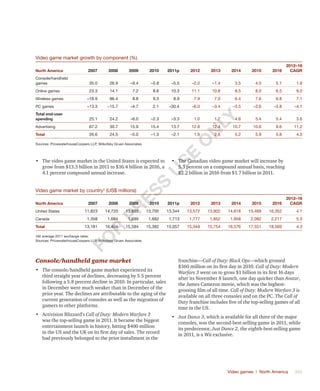
Video game market by component†
(US$ millions)
North America 2007 2008 2009 2010 2011p 2012 2013 2014 2015 2016
Console/handheld
games 9,445 11,988 10,863 10,237 9,672 9,474 9,339 9,666 10,105 10,625
Online games 1,747 1,993 2,136 2,319 2,559 2,842 3,150 3,419 3,693 3,932
Wireless games 462 861 937 1,024 1,115 1,203 1,287 1,370 1,474 1,574
PC games 935 788 751 767 534 502 485 468 451 434
Total end-user
spending 12,589 15,630 14,687 14,347 13,880 14,021 14,261 14,923 15,723 16,565
Advertising 592 774 897 1,035 1,177 1,328 1,493 1,653 1,828 2,004
Total 13,181 16,404 15,584 15,382 15,057 15,349 15,754 16,576 17,551 18,569
†At average 2011 exchange rates.
Sources: PricewaterhouseCoopers LLP, Wilkofsky Gruen Associates
North America
Download a PDF version of each segment. Visit the online Outlook
at www.pwc.com/outlook
Fo
r
Pr
ess
U
se
o
n
ly
Video games | North America	 355
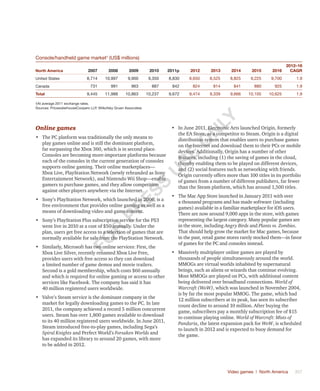
Video game market growth by component (%)
North America 2007 2008 2009 2010 2011p 2012 2013 2014 2015 2016
2012–16
CAGR
Console/handheld
games 35.0 26.9 –9.4 –5.8 –5.5 –2.0 –1.4 3.5 4.5 5.1 1.9
Online games 23.3 14.1 7.2 8.6 10.3 11.1 10.8 8.5 8.0 6.5 9.0
Wireless games –18.9 86.4 8.8 9.3 8.9 7.9 7.0 6.4 7.6 6.8 7.1
PC games –13.3 –15.7 –4.7 2.1 –30.4 –6.0 –3.4 –3.5 –3.6 –3.8 –4.1
Total end-user
spending 25.1 24.2 –6.0 –2.3 –3.3 1.0 1.7 4.6 5.4 5.4 3.6
Advertising 67.2 30.7 15.9 15.4 13.7 12.8 12.4 10.7 10.6 9.6 11.2
Total 26.6 24.5 –5.0 –1.3 –2.1 1.9 2.6 5.2 5.9 5.8 4.3
Sources: PricewaterhouseCoopers LLP, Wilkofsky Gruen Associates
•	 The video game market in the United States is expected to
grow from $13.3 billion in 2011 to $16.4 billion in 2016, a
4.1 percent compound annual increase.
•	 The Canadian video game market will increase by
5.3 percent on a compound annual basis, reaching
$2.2 billion in 2016 from $1.7 billion in 2011.
Video game market by country†
(US$ millions)
North America 2007 2008 2009 2010 2011p 2012 2013 2014 2015 2016
2012–16
CAGR
United States 11,823 14,720 13,885 13,700 13,344 13,572 13,902 14,618 15,469 16,352 4.1
Canada 1,358 1,684 1,699 1,682 1,713 1,777 1,852 1,958 2,082 2,217 5.3
Total 13,181 16,404 15,584 15,382 15,057 15,349 15,754 16,576 17,551 18,569 4.3
†At average 2011 exchange rates.
Sources: PricewaterhouseCoopers LLP, Wilkofsky Gruen Associates
Console/handheld game market
•	 The console/handheld game market experienced its
third straight year of declines, decreasing by 5.5 percent
following a 5.8 percent decline in 2010. In particular, sales
in December were much weaker than in December of the
prior year. The declines are attributable to the aging of the
current generation of consoles as well as the migration of
gamers to other platforms.
•	 Activision Blizzard’s Call of Duty: Modern Warfare 3
was the top-selling game in 2011. It became the biggest
entertainment launch in history, hitting $400 million
in the US and the UK on its first day of sales. The record
had previously belonged to the prior installment in the
franchise—Call of Duty: Black Ops—which grossed
$360 million on its first day in 2010. Call of Duty: Modern
Warfare 3 went on to gross $1 billion in its first 16 days
after its November 8 launch, one day quicker than Avatar,
the James Cameron movie, which was the highest-
grossing film of all time. Call of Duty: Modern Warfare 3 is
available on all three consoles and on the PC. The Call of
Duty franchise includes five of the top-selling games of all
time in the US.
•	 Just Dance 3, which is available for all three of the major
consoles, was the second-best-selling game in 2011, while
its predecessor, Just Dance 2, the eighth-best-selling game
in 2011, is a Wii exclusive.
Fo
r
Pr
ess
U
se
o
n
ly
356	 PwC | Global entertainment and media outlook: 2012–2016
•	 Gears of War 3, which is exclusive to the Xbox 360, was the
only other exclusive game among the top 10 in 2011. Two
other top games—Madden NFL 12 and Call of Duty: Black
Ops—are available for all three consoles. Call of Duty:
Black Ops is also available on the DS—among the top 10,
the only title available for that device.
•	 Skylanders: Spyro’s Adventure was a hit kids’ game that
gained extra revenues through the sale of figures that
could be transported and played with multiple consoles,
thereby enabling children to take them to their friends’
houses and play with them regardless of the console they
were using.
•	 Super Mario 3D Land and Mario Kart 7 were the fastest-
selling portable games in 2011 and the first 3DS titles to
top 1 million in unit sales.
•	 A number of highly anticipated games are scheduled for
launch in 2012, including BioShock Infinite, the follow-up
to the outstanding 2007 first-person shooter BioShock;
Grand Theft Auto V, the latest in the hit series; and Mass
Effect 3, the third of the sci-fi trilogy that started in 2007.
All of these games will be available on the PS3 and the
Xbox 360. The Last Guardian will be one of the exclusive
PS3 titles to debut in 2012, while Halo 4 will likely be a
major exclusive title for the Xbox 360.
•	 Sony launched Uncharted: Golden Abyss for the PS Vita
in February 2012. Resident Evil: Revelations is the most-
anticipated game for the 3DS. It plays just like the console
version, allowing fans of Resident Evil 4 to have an
equivalent experience on a portable device.
•	 Although it has not been announced officially, Activision
is anticipated to continue its pattern of launching major
titles at the end of the year to take advantage of holiday
sales, with the introduction of Call of Duty: Black Ops 2 as
the next installment of the hit series.
•	 Canada passed the UK to become the third-largest
developer of video games in the world, surpassed only by
the US and Japan. Canada is the home of a number of top
video game developers, including Ubisoft in Montreal,
which developed Tom Clancy’s Splinter Cell series of
games; BioWare in Alberta; and Electronics Arts in
Burnaby, British Colombia, which developed FIFA Soccer,
one of the most popular games in the world. Around 20
percent of the top-selling games in North America are
developed in Canada.
•	 Two factors that are helping make Canada a major
game-developing center are (1) the large pool of talent
as a result of many colleges with game development
departments and (2) government policies that support
the industry through tax credits and incentives. Provincial
governments in Canada are revamping their tax credit
systems to attract game developers. Ubisoft, for example,
is making a significant investment in Ontario because
of an attractive tax package. These incentives make it
cheaper and easier to develop games in Canada than in
the United States and Europe. The Canada Media Fund,
which traditionally supported television production, now
requires funded projects to have interactive components.
This is driving all content creators to develop video games
or interactive Web sites.
•	 The console/handheld game market declined in 2011 by
5.5 percent, reflecting the aging of the current generation
of consoles. The launch of Mario Kart 7 and Super
Mario 3D for the 3DS buoyed the market for handheld
games. There is a migration to more-casual and mobile
gaming, which is hurting the console game market. We
anticipate modest declines in 2012 and 2013 followed by
a turnaround in 2014, when it is expected that all three
next-generation consoles will be on the market. Until
then, new games developed to take advantage of the
motion controllers of the PS3 and Xbox 360 as well as
new games for the 3DS, PSP Vita, and Wii U should have
a positive effect on the market, minimizing the decline.
Even with the new consoles, due to competition from
digital platforms we do not expect the console/handheld
game market to show the large increases of the past.
•	 The console/handheld game market in the United States
is expected to grow by 1.9 percent on a compound annual
basis from $8.8 billion in 2011 to $9.7 billion in 2016.
•	 A similar pattern is expected for the Canadian console/
handheld game market, with revenues increasing 1.9 per-
cent on a compound annual basis from $842 million in
2011 to $925 million in 2016.
•	 Overall spending in North America will increase from
$9.7 billion in 2011 to $10.6 billion in 2016, a 1.9 percent
compound annual increase.
Fo
r
Pr
ess
U
se
o
n
ly
Video games | North America	 357
Console/handheld game market†
(US$ millions)
North America 2007 2008 2009 2010 2011p 2012 2013 2014 2015 2016
2012–16
CAGR
United States 8,714 10,997 9,900 9,350 8,830 8,650 8,525 8,825 9,225 9,700 1.9
Canada 731 991 963 887 842 824 814 841 880 925 1.9
Total 9,445 11,988 10,863 10,237 9,672 9,474 9,339 9,666 10,105 10,625 1.9
†At average 2011 exchange rates.
Sources: PricewaterhouseCoopers LLP, Wilkofsky Gruen Associates
Online games
•	 The PC platform was traditionally the only means to
play games online and is still the dominant platform,
far surpassing the Xbox 360, which is in second place.
Consoles are becoming more-important platforms because
each of the consoles in the current generation of consoles
supports online gaming. Their online marketplaces—
Xbox Live, PlayStation Network (newly rebranded as Sony
Entertainment Network), and Nintendo Wii Shop—enable
gamers to purchase games, and they allow competition
against other players anywhere via the Internet.
•	 Sony’s PlayStation Network, which launched in 2006, is a
free environment that provides online gaming as well as a
means of downloading video and game content.
•	 Sony’s PlayStation Plus subscription service for the PS3
went live in 2010 at a cost of $50 annually. Under the
plan, users get free access to a selection of games that are
normally available for sale from the PlayStation Network.
•	 Similarly, Microsoft has two online services: First, the
Xbox Live Silver, recently renamed Xbox Live Free,
provides users with free access so they can download
a limited number of game demos and movie trailers.
Second is a gold membership, which costs $60 annually
and which is required for online gaming or access to other
services like Facebook. The company has said it has
40 million registered users worldwide.
•	 Valve’s Steam service is the dominant company in the
market for legally downloading games to the PC. In late
2011, the company achieved a record 5 million concurrent
users. Steam has over 1,800 games available to download
to its 40 million registered users worldwide. In June 2011,
Steam introduced free-to-play games, including Sega’s
Spiral Knights and Perfect World’s Forsaken Worlds and
has expanded its library to around 20 games, with more
to be added in 2012.
•	 In June 2011, Electronic Arts launched Origin, formerly
the EA Store, as a competitor to Steam. Origin is a digital
distribution system that enables users to purchase games
on the Internet and download them to their PCs or mobile
devices. Additionally, Origin has a number of other
features, including (1) the saving of games in the cloud,
thereby enabling them to be played on different devices,
and (2) social features such as networking with friends.
Origin currently offers more than 100 titles in its portfolio
of games from a number of different publishers, far fewer
than the Steam platform, which has around 1,500 titles.
•	 The Mac App Store launched in January 2011 with over
a thousand programs and has made software (including
games) available in a familiar marketplace for iOS users.
There are now around 9,000 apps in the store, with games
representing the largest category. Many popular games are
in the store, including Angry Birds and Plants vs. Zombies.
That should help grow the market for Mac games, because
in the past, retail game stores rarely stocked them—in favor
of games for the PC and consoles instead.
•	 Massively multiplayer online games are played by
thousands of people simultaneously around the world.
MMOGs are virtual worlds inhabited by supernatural
beings, such as aliens or wizards that continue evolving.
Most MMOGs are played on PCs, with additional content
being delivered over broadband connections. World of
Warcraft (WoW), which was launched in November 2004,
is by far the most popular MMOG. The game, which had
12 million subscribers at its peak, has seen its subscriber
count decline to around 10 million. After buying the
game, subscribers pay a monthly subscription fee of $15
to continue playing online. World of Warcraft: Mists of
Pandaria, the latest expansion pack for WoW, is scheduled
to launch in 2012 and is expected to buoy demand for
the game.
Fo
r
Pr
ess
U
se
o
n
ly
358	 PwC | Global entertainment and media outlook: 2012–2016
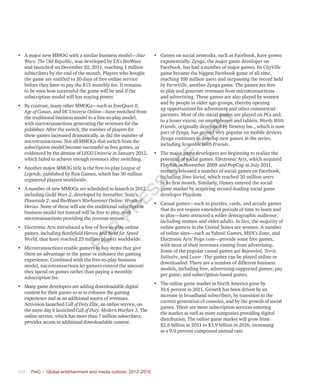
•	 A major new MMOG with a similar business model—Star
Wars: The Old Republic, was developed by EA’s BioWare
and launched on December 20, 2011, reaching 1 million
subscribers by the end of the month. Players who bought
the game are entitled to 30 days of free online service
before they have to pay the $15 monthly fee. It remains
to be seen how successful the game will be and if the
subscription model still has staying power.
•	 By contrast, many other MMOGs—such as EverQuest II,
Age of Conan, and DC Universe Online—have switched from
the traditional business model to a free-to-play model,
with microtransactions generating the revenues for the
publisher. After the switch, the number of players for
these games increased dramatically, as did the number of
microtransactions. Not all MMOGs that switch from the
subscription model become successful as free games, as
evidenced by the demise of LEGO Universe in January 2012,
which failed to achieve enough revenues after switching.
•	 Another major MMOG title is the free-to-play League of
Legends, published by Riot Games, which has 30 million
registered players worldwide.
•	 A number of new MMOGs are scheduled to launch in 2012,
including Guild Wars 2, developed by ArenaNet; Sony’s
Planetside 2; and BioWare’s Warhammer Online: Wrath of
Heroes. None of these will use the traditional subscription
business model but instead will be free to play, with
microtransactions providing the revenue stream.
•	 Electronic Arts introduced a line of free-to-play online
games, including Battlefield Heroes and Need for Speed
World, that have reached 25 million players worldwide.
•	 Microtransactions enable gamers to buy items that give
them an advantage in the game or enhance the gaming
experience. Combined with the free-to-play business
model, microtransactions let gamers control the amount
they spend on games rather than paying a monthly
subscription fee.
•	 Many game developers are adding downloadable digital
content for their games so as to enhance the gaming
experience and as an additional source of revenues.
Activision launched Call of Duty Elite, an online service, on
the same day it launched Call of Duty: Modern Warfare 3. The
online service, which has more than 7 million subscribers,
provides access to additional downloadable content.
•	 Games on social networks, such as Facebook, have grown
exponentially. Zynga, the major game developer on
Facebook, has had a number of major games. Its CityVille
game became the biggest Facebook game of all time,
reaching 100 million users and surpassing the record held
by FarmVille, another Zynga game. The games are free
to play and generate revenues from microtransactions
and advertising. These games are also played by women
and by people in older age-groups, thereby opening
up opportunities for advertisers and other commercial
partners. Most of the social games are played on PCs and,
to a lesser extent, on smartphones and tablets. Words With
Friends, originally developed by Newtoy Inc., which is now
part of Zynga, has proved very popular on mobile devices.
Zynga continues to develop new games in the series,
including Scramble With Friends.
•	 The major game developers are beginning to realize the
potential of social games. Electronic Arts, which acquired
Playfish in November 2009 and PopCap in July 2011,
recently released a number of social games on Facebook,
including Sims Social, which reached 30 million users
in its first month. Similarly, Disney entered the social
game market by acquiring second-leading social game
developer Playdom.
•	 Casual games—such as puzzles, cards, and arcade games
that do not require extended periods of time to learn and
to play—have attracted a wider demographic audience,
including women and older adults. In fact, the majority of
online gamers in the United States are women. A number
of online sites—such as Yahoo! Games, MSN’s Zone, and
Electronic Arts’ Pogo.com—provide some free games,
with most of their revenues coming from advertising.
Some of the popular casual games are Bejeweled, Tetris,
Solitaire, and Luxor. The games can be played online or
downloaded. There are a number of different business
models, including free, advertising-supported games; pay
per game; and subscription-based games.
•	 The online game market in North America grew by
10.6 percent in 2011. Growth has been driven by an
increase in broadband subscribers, by transition to the
current generation of consoles, and by the growth of social
games. There are more subscription services entering
the market as well as more companies providing digital
distribution. The online game market will grow from
$2.6 billion in 2011 to $3.9 billion in 2016, increasing
at a 9.0 percent compound annual rate.
Fo
r
Pr
ess
U
se
o
n
ly
Video games | North America	 359
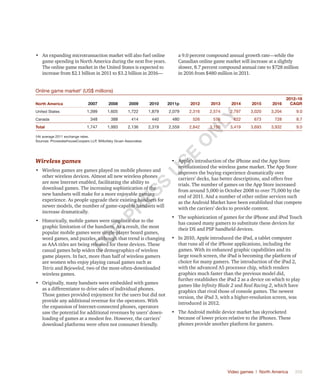
•	 An expanding microtransaction market will also fuel online
game spending in North America during the next five years.
The online game market in the United States is expected to
increase from $2.1 billion in 2011 to $3.2 billion in 2016—
a 9.0 percent compound annual growth rate—while the
Canadian online game market will increase at a slightly
slower, 8.7 percent compound annual rate to $728 million
in 2016 from $480 million in 2011.
Online game market†
(US$ millions)
North America 2007 2008 2009 2010 2011p 2012 2013 2014 2015 2016
2012–16
CAGR
United States 1,399 1,605 1,722 1,879 2,079 2,316 2,574 2,797 3,020 3,204 9.0
Canada 348 388 414 440 480 526 576 622 673 728 8.7
Total 1,747 1,993 2,136 2,319 2,559 2,842 3,150 3,419 3,693 3,932 9.0
†At average 2011 exchange rates.
Sources: PricewaterhouseCoopers LLP, Wilkofsky Gruen Associates
Wireless games
•	 Wireless games are games played on mobile phones and
other wireless devices. Almost all new wireless phones
are now Internet enabled, facilitating the ability to
download games. The increasing sophistication of the
new handsets will make for a more enjoyable gaming
experience. As people upgrade their existing handsets for
newer models, the number of game-capable handsets will
increase dramatically.
•	 Historically, mobile games were simplistic due to the
graphic limitation of the handsets. As a result, the most
popular mobile games were single-player board games,
word games, and puzzles, although that trend is changing
as AAA titles are being released for these devices. These
casual games help widen the demographics of wireless
game players. In fact, more than half of wireless gamers
are women who enjoy playing casual games such as
Tetris and Bejeweled, two of the most-often-downloaded
wireless games.
•	 Originally, many handsets were embedded with games
as a differentiator to drive sales of individual phones.
Those games provided enjoyment for the users but did not
provide any additional revenue for the operators. With
the expansion of Internet-connected phones, operators
saw the potential for additional revenues by users’ down-
loading of games at a modest fee. However, the carriers’
download platforms were often not consumer friendly.
•	 Apple’s introduction of the iPhone and the App Store
revolutionized the wireless game market. The App Store
improves the buying experience dramatically over
carriers’ decks, has better descriptions, and offers free
trials. The number of games on the App Store increased
from around 5,000 in October 2008 to over 75,000 by the
end of 2011. And a number of other online services such
as the Android Market have been established that compete
with the carriers’ decks to provide content.
•	 The sophistication of games for the iPhone and iPod Touch
has caused many gamers to substitute these devices for
their DS and PSP handheld devices.
•	 In 2010, Apple introduced the iPad, a tablet computer
that runs all of the iPhone applications, including the
games. With its enhanced graphic capabilities and its
large touch screen, the iPad is becoming the platform of
choice for many gamers. The introduction of the iPad 2,
with the advanced A5 processor chip, which renders
graphics much faster than the previous model did,
further establishes the iPad 2 as a device on which to play
games like Infinity Blade 2 and Real Racing 2, which have
graphics that rival those of console games. The newest
version, the iPad 3, with a higher-resolution screen, was
introduced in 2012.
•	 The Android mobile device market has skyrocketed
because of lower prices relative to the iPhones. These
phones provide another platform for gamers.
Fo
r
Pr
ess
U
se
o
n
ly
360	 PwC | Global entertainment and media outlook: 2012–2016
•	 Although casual games continue to dominate the market,
more-advanced games that take advantage of the
sophistication of the newer smartphones are also being
developed. Even wireless versions of MMOGs are being
developed for gamers on the go. These games will become
more prevalent as the number of technically advanced
handsets proliferates.
•	 There are a growing number of mobile games, both because
of the rising penetration by smartphones and because the
games are significantly cheaper than console games. Mobile
gaming provides an enjoyable experience for short periods
of time, as when waiting for a bus or train.
•	 The business model for mobile games is moving from the
pay to download to the freemium model whereby the
games are downloaded for free, with microtransactions
and advertising providing the necessary revenues. In
fact, it’s estimated that in-game purchases will outpace
download fees in the near future. Angry Birds was a
hugely successful game as a paid download but has now
garnered more fans as a free download.
•	 Social network games are finding their way to mobile
phones, with microtransactions and advertising providing
the requisite revenue streams.
•	 In December 2011, Microsoft introduced an Xbox Live
app for Windows phones and Apple devices that enables
users to track and compare their achievements and
send messages to Xbox Live friends. Microsoft is also
developing apps that will enable users to play Xbox Live
games on their devices.
•	 Electronic Arts Mobile, the world’s leading mobile game
developer, is headquartered in California, with a major
studio in Canada, and is best known for turning big-name
titles like Monopoly, Scrabble, and Tetris into mobile games.
Electronic Arts’ major position resulted from its purchase of
Jamdat in 2006. Jamdat had been the largest mobile game
developer in the world. EA Mobile continues acquiring
smaller studios to enhance its position as the industry
leader. In 2010, it acquired Chillingo, a leading publisher
of iOS games, including the iOS version of Angry Birds. In
2011, EA acquired Australian game developer Firemint,
developer of Flight Control, Real Racing, and SpyMouse. In
2011, EA launched a mobile version of its popular Facebook
social game Sims FreePlay for Apple devices.
•	 Zynga, the online game developer famous for its games
on Facebook such as CityVille, is developing a series
of games for mobile devices to expand its user base. It
recently introduced its Scramble With Friends word game
to join Words With Friends and Hanging With Friends in the
wireless segment.
•	 The wireless game market is expected to continue growing
as the penetration by smartphones and tablets expands.
More people will be playing games, including casual
games, social games, and more-advanced multiplayer
games. The market will also grow as more gamers get
accustomed to making microtransactions in order to
enhance their gaming experience.
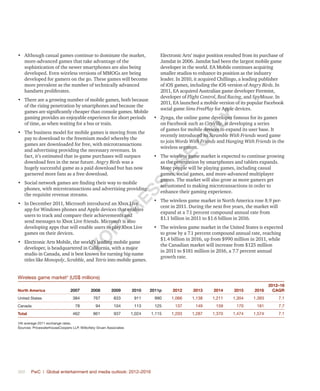
•	 The wireless game market in North America rose 8.9 per-
cent in 2011. During the next five years, the market will
expand at a 7.1 percent compound annual rate from
$1.1 billion in 2011 to $1.6 billion in 2016.
•	 The wireless game market in the United States is expected
to grow by a 7.1 percent compound annual rate, reaching
$1.4 billion in 2016, up from $990 million in 2011, while
the Canadian market will increase from $125 million
in 2011 to $181 million in 2016, a 7.7 percent annual
growth rate.
Wireless game market†
(US$ millions)
North America 2007 2008 2009 2010 2011p 2012 2013 2014 2015 2016
2012–16
CAGR
United States 384 767 833 911 990 1,066 1,138 1,211 1,304 1,393 7.1
Canada 78 94 104 113 125 137 149 159 170 181 7.7
Total 462 861 937 1,024 1,115 1,203 1,287 1,370 1,474 1,574 7.1
†At average 2011 exchange rates.
Sources: PricewaterhouseCoopers LLP, Wilkofsky Gruen Associates
Fo
r
Pr
ess
U
se
o
n
ly
Video games | North America	 361
PC games
•	 The PC game market declined in 2011, returning to its
normal pattern of deterioration. This follows a one-year
aberration, when the sale of boxed PC games increased for
the first time in recent years as revenues got boosted by
large sales of World of Warcraft: Cataclysm and StarCraft II.
With just a few exceptions, the retail market for PC games
has been in decline for a number of years because the
rise of the consoles has shifted the market away from
the PC. It must be noted that this section deals only with
retail sales of PC games and does not include digital
distribution of PC games, subscriptions to online games,
or microtransactions that take place in online games.
Those revenue streams are growing in importance and are
included in the online game category.
•	 Retail sales of PC games have been deteriorating for a
number of reasons: Developers are producing fewer PC
games because of the fear of piracy. Consumers have been
migrating from PC games to those played on the current
generation of consoles. Retailers do not make the same
effort to market PC games, often relegating them to the
backs of their stores. And the move to digital distribution
of games makes downloading them directly to the PC an
easier alternative to purchasing games at retail.
•	 Despite recent sales declines, PC games do have a solid fan
base. PCs give gamers a superior method to play certain
game genres such as strategy games and MMOGs, because
a keyboard and mouse provide better means of interacting
with the games than a console controller does. PC games
also provide superior graphics. The most-advanced games
are often PC based because the open platform, with no
certification necessary, as is required with console games,
facilitates more-efficient development of games.
•	 PCs are offering better graphics than the aging consoles
are. The high-end graphics processing unit (GPU) from
NVIDIA is selling well as hard-core gamers upgrade their
computers to play games like Battlefield 3 and Elder Scrolls
V: Skyrim.
•	 The growth of MMOGs is aiding the retail PC game market
because most MMOGs require retail purchase of the game,
after which the gamer can play the game online.
•	 World of Warcraft: Cataclysm, the third expansion pack
for the MMOG, sold 3.3 million copies worldwide on its
first day of availability—December 7, 2010—making it
the fastest-selling PC game of all time. It beat the previous
record holder, World of Warcraft: Wrath of the Lich King,
the second expansion pack, which sold 2.8 million copies
the first day. Despite losing subscribers recently, World
of Warcraft is still quite popular around the world, and
expectations are that the next expansion pack, World of
Warcraft: Mists of Pandaria, scheduled to debut in 2012,
will help spur PC game sales.
•	 Star Wars: The Old Republic, a major new MMOG, launched
in late December 2011, quickly rose up the sales charts
to become one of the most popular PC games of the year.
Another new major MMOG was League of Legends.
•	 Steam is the major player in the PC game download market,
with around 70 percent of the market. Direct2Drive,
EA.com, Blizzard.com, and Big Fish Games are among
the other download services. PC game downloads are not
included in PC gaming spending and effectively compete
with PC games.
•	 In addition to World of Warcraft, the other major franchise
that continues to support PC game sales comprises the
various Sims games. Sims 3, launched in June 2009,
continues to be a major-selling PC game franchise. The
Sims 3 Showtime expansion pack was released in 2012.
•	 The new PC games expected in 2012 include Guild Wars 2
and StarCraft II: Heart of the Swarm.
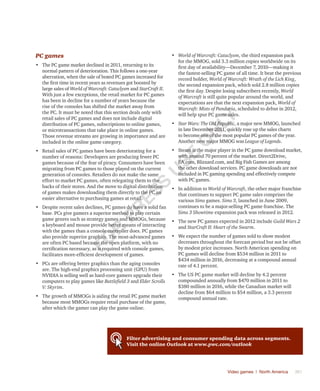
•	 We expect the number of games sold to show modest
decreases throughout the forecast period but not be offset
by modest price increases. North American spending on
PC games will decline from $534 million in 2011 to
$434 million in 2016, decreasing at a compound annual
rate of 4.1 percent.
•	 The US PC game market will decline by 4.2 percent
compounded annually from $470 million in 2011 to
$380 million in 2016, while the Canadian market will
decline from $64 million to $54 million, a 3.3 percent
compound annual rate.
Filter advertising and consumer spending data across segments.
Visit the online Outlook at www.pwc.com/outlook
Fo
r
Pr
ess
U
se
o
n
ly
362	 PwC | Global entertainment and media outlook: 2012–2016
PC game market†
(US$ millions)
North America 2007 2008 2009 2010 2011p 2012 2013 2014 2015 2016
2012–16
CAGR
United States 826 701 680 700 470 440 425 410 395 380 –4.2
Canada 109 87 71 67 64 62 60 58 56 54 –3.3
Total 935 788 751 767 534 502 485 468 451 434 –4.1
†At average 2011 exchange rates.
Sources: PricewaterhouseCoopers LLP, Wilkofsky Gruen Associates
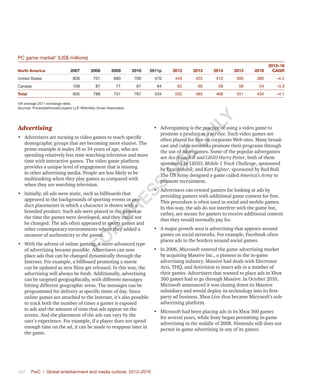
Advertising
•	 Advertisers are turning to video games to reach specific
demographic groups that are becoming more elusive. The
prime example is males 18 to 34 years of age, who are
spending relatively less time watching television and more
time with interactive games. The video game platform
provides a unique level of engagement that is missing
in other advertising media. People are less likely to be
multitasking when they play games as compared with
when they are watching television.
•	 Initially, all ads were static, such as billboards that
appeared in the backgrounds of sporting events or pro-
duct placements in which a character is shown with a
branded product. Such ads were placed in the games at
the time the games were developed, and they could not
be changed. The ads often appeared in sports games and
other contemporary environments where they added a
measure of authenticity to the games.
•	 With the advent of online gaming, a more-advanced type
of advertising became possible. Advertisers can now
place ads that can be changed dynamically through the
Internet. For example, a billboard promoting a movie
can be updated as new films get released. In this way, the
advertising will always be fresh. Additionally, advertising
can be targeted geographically, with different messages
hitting different geographic areas. The messages can be
programmed for delivery at specific times of day. Since
online games are attached to the Internet, it’s also possible
to track both the number of times a gamer is exposed
to ads and the amount of time that ads appear on the
screen. And the placement of the ads can vary by the
user’s experience. For example, if a player does not spend
enough time on the ad, it can be made to reappear later in
the game.
•	 Advergaming is the practice of using a video game to
promote a product or a service. Such video games are
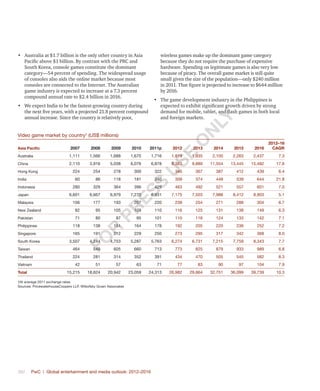
often played for free on corporate Web sites. Many broad-
cast and cable networks promote their programs through
the use of advergames. Some of the popular advergames
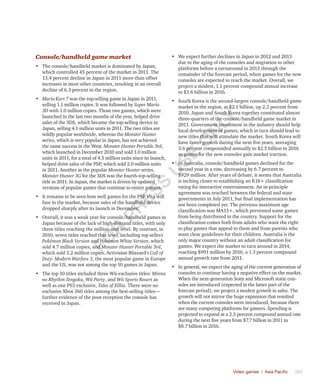
are Ace Assault II and LEGO Harry Potter, both of them
sponsored by LEGO; Mobile 1 Track Challenge, sponsored
by ExxonMobil; and Kart Fighter, sponsored by Red Bull.
The US Army designed a game called America’s Army to
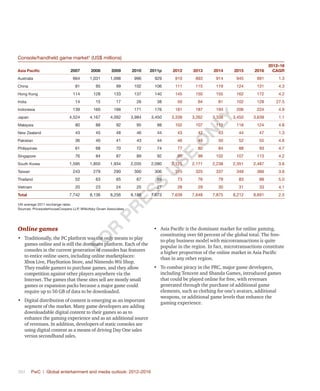
promote recruitment.
•	 Advertisers can reward gamers for looking at ads by
providing gamers with additional game content for free.
This procedure is often used in social and mobile games.
In this way, the ads do not interfere with the game but,
rather, are means for gamers to receive additional content
that they would normally pay for.
•	 A major growth area is advertising that appears around
games on social networks. For example, Facebook often
places ads in the borders around social games.
•	 In 2006, Microsoft entered the game advertising market
by acquiring Massive Inc., a pioneer in the in-game
advertising industry. Massive had deals with Electronic
Arts, THQ, and Activision to insert ads in a number of
their games. Advertisers that wanted to place ads in Xbox
360 games had to go through Massive. In October 2010,
Microsoft announced it was closing down its Massive
subsidiary and would deploy its technology into its first-
party ad business. Xbox Live thus became Microsoft’s sole
advertising platform.
•	 Microsoft had been placing ads in its Xbox 360 games
for several years, while Sony began permitting in-game
advertising in the middle of 2008. Nintendo still does not
permit in-game advertising in any of its games.
Fo
r
Pr
ess
U
se
o
n
ly
Video games | North America	 363
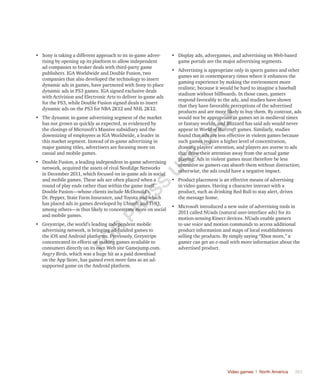
•	 Sony is taking a different approach to its in-game adver-
tising by opening up its platform to allow independent
ad companies to broker deals with third-party game
publishers. IGA Worldwide and Double Fusion, two
companies that also developed the technology to insert
dynamic ads in games, have partnered with Sony to place
dynamic ads in PS3 games. IGA signed exclusive deals
with Activision and Electronic Arts to deliver in-game ads
for the PS3, while Double Fusion signed deals to insert
dynamic ads on the PS3 for NBA 2K12 and NHL 2K12.
•	 The dynamic in-game advertising segment of the market
has not grown as quickly as expected, as evidenced by
the closings of Microsoft’s Massive subsidiary and the
downsizing of employees at IGA Worldwide, a leader in
this market segment. Instead of in-game advertising in
major gaming titles, advertisers are focusing more on
casual and mobile games.
•	 Double Fusion, a leading independent in-game advertising
network, acquired the assets of rival NeoEdge Networks
in December 2011, which focused on in-game ads in social
and mobile games. These ads are often placed when a
round of play ends rather than within the game itself.
Double Fusion—whose clients include McDonald’s,
Dr. Pepper, State Farm Insurance, and Toyota and which
has placed ads in games developed by Ubisoft and THQ,
among others—is thus likely to concentrate more on social
and mobile games.
•	 Greystripe, the world’s leading independent mobile
advertising network, is bringing ad-funded games to
the iOS and Android platforms. Previously, Greystripe
concentrated its efforts on making games available to
consumers directly on its own Web site Gamejump.com.
Angry Birds, which was a huge hit as a paid download
on the App Store, has gained even more fans as an ad-
supported game on the Android platform.
•	 Display ads, advergames, and advertising on Web-based
game portals are the major advertising segments.
•	 Advertising is appropriate only in sports games and other
games set in contemporary times where it enhances the
gaming experience by making the environment more
realistic, because it would be hard to imagine a baseball
stadium without billboards. In those cases, gamers
respond favorably to the ads, and studies have shown
that they have favorable perceptions of the advertised
products and are more likely to buy them. By contrast, ads
would not be appropriate in games set in medieval times
or fantasy worlds, and Blizzard has said ads would never
appear in World of Warcraft games. Similarly, studies
found that ads are less effective in violent games because
such games require a higher level of concentration,
drawing players’ attention, and players are averse to ads
that draw their attention away from the actual game
playing. Ads in violent games must therefore be less
obtrusive so gamers can absorb them without distraction;
otherwise, the ads could have a negative impact.
•	 Product placement is an effective means of advertising
in video games. Having a character interact with a
product, such as drinking Red Bull to stay alert, drives
the message home.
•	 Microsoft introduced a new suite of advertising tools in
2011 called NUads (natural user-interface ads) for its
motion-sensing Kinect devices. NUads enable gamers
to use voice and motion commands to access additional
product information and maps of local establishments
selling the products. By simply saying “Xbox more,” a
gamer can get an e-mail with more information about the
advertised product.
Fo
r
Pr
ess
U
se
o
n
ly
364	 PwC | Global entertainment and media outlook: 2012–2016
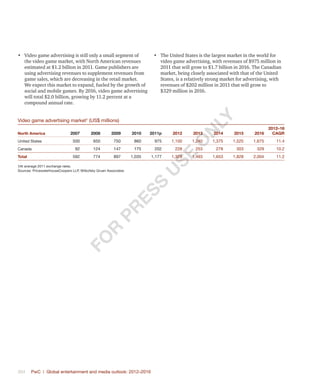
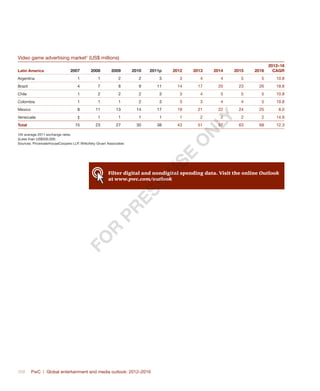
•	 Video game advertising is still only a small segment of
the video game market, with North American revenues
estimated at $1.2 billion in 2011. Game publishers are
using advertising revenues to supplement revenues from
game sales, which are decreasing in the retail market.
We expect this market to expand, fueled by the growth of
social and mobile games. By 2016, video game advertising
will total $2.0 billion, growing by 11.2 percent at a
compound annual rate.
•	 The United States is the largest market in the world for
video game advertising, with revenues of $975 million in
2011 that will grow to $1.7 billion in 2016. The Canadian
market, being closely associated with that of the United
States, is a relatively strong market for advertising, with
revenues of $202 million in 2011 that will grow to
$329 million in 2016.
Video game advertising market†
(US$ millions)
North America 2007 2008 2009 2010 2011p 2012 2013 2014 2015 2016
2012–16
CAGR
United States 500 650 750 860 975 1,100 1,240 1,375 1,525 1,675 11.4
Canada 92 124 147 175 202 228 253 278 303 329 10.2
Total 592 774 897 1,035 1,177 1,328 1,493 1,653 1,828 2,004 11.2
†At average 2011 exchange rates.
Sources: PricewaterhouseCoopers LLP, Wilkofsky Gruen Associates
Fo
r
Pr
ess
U
se
o
n
ly
Video games | EMEA	 365
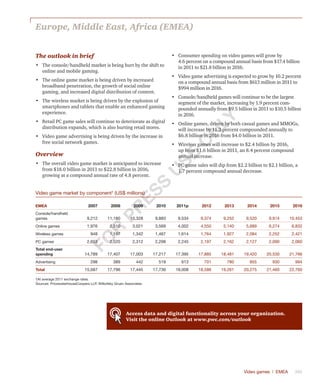
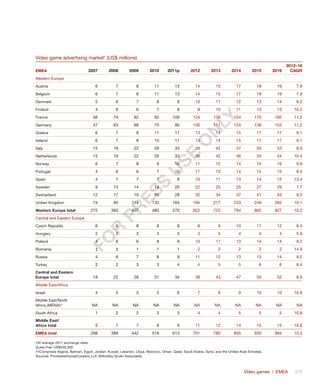
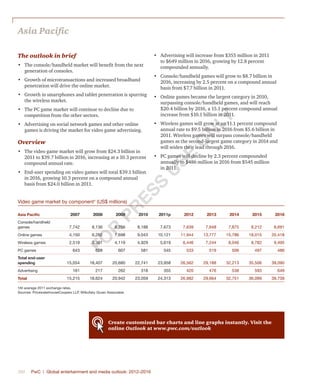
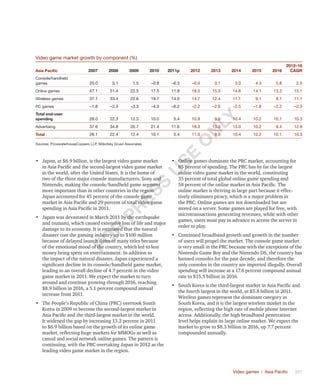
The outlook in brief
•	 The console/handheld market is being hurt by the shift to
online and mobile gaming.
•	 The online game market is being driven by increased
broadband penetration, the growth of social online
gaming, and increased digital distribution of content.
•	 The wireless market is being driven by the explosion of
smartphones and tablets that enable an enhanced gaming
experience.
•	 Retail PC game sales will continue to deteriorate as digital
distribution expands, which is also hurting retail stores.
•	 Video game advertising is being driven by the increase in
free social network games.
Overview
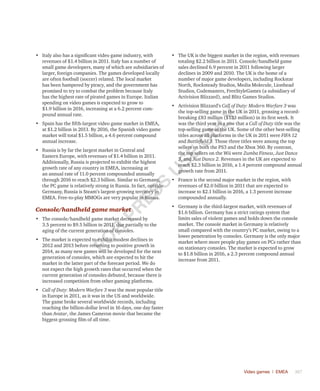
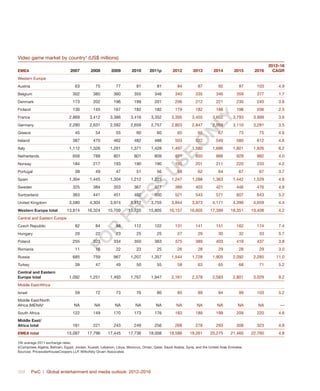
•	 The overall video game market is anticipated to increase
from $18.0 billion in 2011 to $22.8 billion in 2016,
growing at a compound annual rate of 4.8 percent.
•	 Consumer spending on video games will grow by
4.6 percent on a compound annual basis from $17.4 billion
in 2011 to $21.8 billion in 2016.
•	 Video game advertising is expected to grow by 10.2 percent
on a compound annual basis from $613 million in 2011 to
$994 million in 2016.
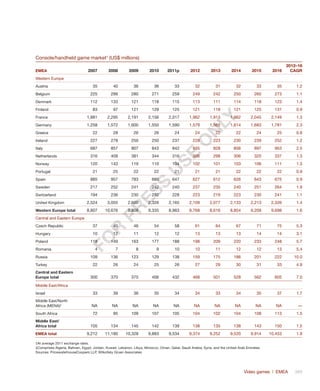
•	 Console/handheld games will continue to be the largest
segment of the market, increasing by 1.9 percent com-
pounded annually from $9.5 billion in 2011 to $10.5 billion
in 2016.
•	 Online games, driven by both casual games and MMOGs,
will increase by 11.3 percent compounded annually to
$6.8 billion in 2016 from $4.0 billion in 2011.
•	 Wireless games will increase to $2.4 billion by 2016,
up from $1.6 billion in 2011, an 8.4 percent compound
annual increase.
•	 PC game sales will dip from $2.2 billion to $2.1 billion, a
1.7 percent compound annual decrease.
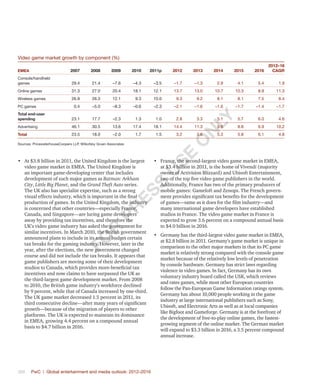
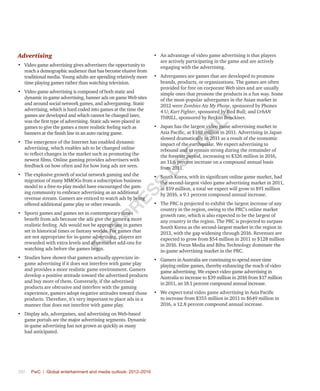
Video game market by component†
(US$ millions)
EMEA 2007 2008 2009 2010 2011p 2012 2013 2014 2015 2016
Console/handheld
games 9,212 11,180 10,328 9,883 9,534 9,374 9,252 9,520 9,914 10,453
Online games 1,976 2,510 3,021 3,569 4,002 4,550 5,140 5,689 6,274 6,832
Wireless games 948 1,197 1,342 1,467 1,614 1,764 1,927 2,084 2,252 2,421
PC games 2,653 2,520 2,312 2,298 2,245 2,197 2,162 2,127 2,090 2,060
Total end-user
spending 14,789 17,407 17,003 17,217 17,395 17,885 18,481 19,420 20,530 21,766
Advertising 298 389 442 519 613 701 780 855 930 994
Total 15,087 17,796 17,445 17,736 18,008 18,586 19,261 20,275 21,460 22,760
†At average 2011 exchange rates.
Sources: PricewaterhouseCoopers LLP, Wilkofsky Gruen Associates
Europe, Middle East, Africa (EMEA)
Access data and digital functionality across your organization.
Visit the online Outlook at www.pwc.com/outlook
Fo
r
Pr
ess
U
se
o
n
ly
366	 PwC | Global entertainment and media outlook: 2012–2016
Video game market growth by component (%)
EMEA 2007 2008 2009 2010 2011p 2012 2013 2014 2015 2016
2012–16
CAGR
Console/handheld
games 29.4 21.4 –7.6 –4.3 –3.5 –1.7 –1.3 2.9 4.1 5.4 1.9
Online games 31.3 27.0 20.4 18.1 12.1 13.7 13.0 10.7 10.3 8.9 11.3
Wireless games 26.9 26.3 12.1 9.3 10.0 9.3 9.2 8.1 8.1 7.5 8.4
PC games 0.4 –5.0 –8.3 –0.6 –2.3 –2.1 –1.6 –1.6 –1.7 –1.4 –1.7
Total end-user
spending 23.1 17.7 –2.3 1.3 1.0 2.8 3.3 5.1 5.7 6.0 4.6
Advertising 46.1 30.5 13.6 17.4 18.1 14.4 11.3 9.6 8.8 6.9 10.2
Total 23.5 18.0 –2.0 1.7 1.5 3.2 3.6 5.3 5.8 6.1 4.8
Sources: PricewaterhouseCoopers LLP, Wilkofsky Gruen Associates
•	 At $3.8 billion in 2011, the United Kingdom is the largest
video game market in EMEA. The United Kingdom is
an important game-developing center that includes
development of such major games as Batman: Arkham
City, Little Big Planet, and the Grand Theft Auto series.
The UK also has specialist expertise, such as a strong
visual effects industry, which is important in the final
production of games. In the United Kingdom, the industry
is concerned that other countries—especially France,
Canada, and Singapore—are luring game developers
away by providing tax incentives, and therefore the
UK’s video game industry has asked the government for
similar incentives. In March 2010, the British government
announced plans to include in its annual budget certain
tax breaks for the gaming industry. However, later in the
year, after the elections, the new government changed
course and did not include the tax breaks. It appears that
game publishers are moving some of their development
studios to Canada, which provides more-beneficial tax
incentives and now claims to have surpassed the UK as
the third-largest game development market. From 2008
to 2010, the British game industry’s workforce declined
by 9 percent, while that of Canada increased by one-third.
The UK game market decreased 1.5 percent in 2011, its
third consecutive decline—after many years of significant
growth—because of the migration of players to other
platforms. The UK is expected to maintain its dominance
in EMEA, growing 4.4 percent on a compound annual
basis to $4.7 billion in 2016.
•	 France, the second-largest video game market in EMEA,
at $3.4 billion in 2011, is the home of Vivendi (majority
owner of Activision Blizzard) and Ubisoft Entertainment,
two of the top five video game publishers in the world.
Additionally, France has two of the primary producers of
mobile games: Gameloft and Zenops. The French govern-
ment provides significant tax benefits for the development
of games—same as it does for the film industry—and
many international game developers have established
studios in France. The video game market in France is
expected to grow 3.6 percent on a compound annual basis
to $4.0 billion in 2016.
•	 Germany has the third-largest video game market in EMEA,
at $2.8 billion in 2011. Germany’s game market is unique in
comparison to the other major markets in that its PC game
market is relatively strong compared with the console game
market because of the relatively low levels of penetration
by console hardware. Germany has strict laws regarding
violence in video games. In fact, Germany has its own
voluntary industry board called the USK, which reviews
and rates games, while most other European countries
follow the Pan-European Game Information ratings system.
Germany has about 10,000 people working in the game
industry at large international publishers such as Sony,
Ubisoft, and Electronic Arts as well as at local companies
like Bigfoot and Gameforge. Germany is at the forefront of
the development of free-to-play online games, the fastest-
growing segment of the online market. The German market
will expand to $3.3 billion in 2016, a 3.5 percent compound
annual increase.
Fo
r
Pr
ess
U
se
o
n
ly
Video games | EMEA	 367
•	 Italy also has a significant video game industry, with
revenues of $1.4 billion in 2011. Italy has a number of
small game developers, many of which are subsidiaries of
larger, foreign companies. The games developed locally
are often football (soccer) related. The local market
has been hampered by piracy, and the government has
promised to try to combat the problem because Italy
has the highest rate of pirated games in Europe. Italian
spending on video games is expected to grow to
$1.9 billion in 2016, increasing at a 6.2 percent com-
pound annual rate.
•	 Spain has the fifth-largest video game market in EMEA,
at $1.2 billion in 2011. By 2016, the Spanish video game
market will total $1.5 billion, a 4.6 percent compound
annual increase.
•	 Russia is by far the largest market in Central and
Eastern Europe, with revenues of $1.4 billion in 2011.
Additionally, Russia is projected to exhibit the highest
growth rate of any country in EMEA, increasing at
an annual rate of 11.0 percent compounded annually
through 2016 to reach $2.3 billion. Similar to Germany,
the PC game is relatively strong in Russia. In fact, outside
Germany, Russia is Steam’s largest-growing territory in
EMEA. Free-to-play MMOGs are very popular in Russia.
Console/handheld game market
•	 The console/handheld game market decreased by
3.5 percent to $9.5 billion in 2011, due partially to the
aging of the current generation of consoles.
•	 The market is expected to exhibit modest declines in
2012 and 2013 before returning to positive growth in
2014, as many new games will be developed for the next
generation of consoles, which are expected to hit the
market in the latter part of the forecast period. We do
not expect the high growth rates that occurred when the
current generation of consoles debuted, because there is
increased competition from other gaming platforms.
•	 Call of Duty: Modern Warfare 3 was the most popular title
in Europe in 2011, as it was in the US and worldwide.
The game broke several worldwide records, including
reaching the billion-dollar level in 16 days, one day faster
than Avatar, the James Cameron movie that became the
biggest-grossing film of all time.
•	 The UK is the biggest market in the region, with revenues
totaling $2.2 billion in 2011. Console/handheld game
sales declined 6.9 percent in 2011 following larger
declines in 2009 and 2010. The UK is the home of a
number of major game developers, including Rockstar
North, Rocksteady Studios, Media Molecule, Lionhead
Studios, Codemasters, FreeStyleGames (a subsidiary of
Activision Blizzard), and Blitz Games Studios.
•	 Activision Blizzard’s Call of Duty: Modern Warfare 3 was
the top-selling game in the UK in 2011, grossing a record-
breaking £83 million ($133 million) in its first week. It
was the third year in a row that a Call of Duty title was the
top-selling game in the UK. Some of the other best-selling
titles across all platforms in the UK in 2011 were FIFA 12
and Battlefield 3. Those three titles were among the top
sellers on both the PS3 and the Xbox 360. By contrast,
the top sellers on the Wii were Zumba Fitness, Just Dance
3, and Just Dance 2. Revenues in the UK are expected to
reach $2.3 billion in 2016, a 1.4 percent compound annual
growth rate from 2011.
•	 France is the second major market in the region, with
revenues of $2.0 billion in 2011 that are expected to
increase to $2.1 billion in 2016, a 1.3 percent increase
compounded annually.
•	 Germany is the third-largest market, with revenues of
$1.6 billion. Germany has a strict ratings system that
limits sales of violent games and holds down the console
market. The console market in Germany is relatively
small compared with the country’s PC market, owing to a
lower penetration by consoles. Germany is the only major
market where more people play games on PCs rather than
on stationary consoles. The market is expected to grow
to $1.8 billion in 2016, a 2.3 percent compound annual
increase from 2011.
Fo
r
Pr
ess
U
se
o
n
ly
368	 PwC | Global entertainment and media outlook: 2012–2016
Video game market by country†
(US$ millions)
EMEA 2007 2008 2009 2010 2011p 2012 2013 2014 2015 2016
2012–16
CAGR
Western Europe                    
Austria 63 75 77 81 81 84 87 92 97 103 4.9
Belgium 302 380 360 355 346 340 335 346 359 377 1.7
Denmark 173 202 196 199 201 206 212 221 230 240 3.6
Finland 130 145 167 182 182 179 182 188 198 206 2.5
France 2,869 3,412 3,386 3,416 3,352 3,395 3,455 3,602 3,793 3,999 3.6
Germany 2,280 2,631 2,592 2,659 2,757 2,803 2,847 2,959 3,110 3,281 3.5
Greece 45 54 55 60 60 65 65 67 73 75 4.6
Ireland 387 470 462 482 488 503 522 549 580 612 4.6
Italy 1,112 1,326 1,291 1,371 1,428 1,497 1,580 1,686 1,801 1,926 6.2
Netherlands 658 789 801 801 809 831 850 888 929 982 4.0
Norway 184 217 193 190 190 195 201 211 220 233 4.2
Portugal 39 49 47 51 56 58 62 64 67 67 3.7
Spain 1,304 1,445 1,304 1,212 1,223 1,247 1,288 1,363 1,442 1,529 4.6
Sweden 325 384 353 367 377 389 403 421 446 476 4.8
Switzerland 363 441 451 482 500 521 543 571 607 643 5.2
United Kingdom 3,580 4,304 3,974 3,812 3,755 3,844 3,973 4,171 4,399 4,659 4.4
Western Europe total 13,814 16,324 15,709 15,720 15,805 16,157 16,605 17,399 18,351 19,408 4.2
Central and Eastern Europe                   
Czech Republic 82 84 98 112 122 131 141 151 162 174 7.4
Hungary 20 22 23 25 25 27 29 30 32 33 5.7
Poland 255 323 334 350 363 375 389 403 419 437 3.8
Romania 11 16 22 23 25 26 28 29 28 29 3.0
Russia 685 759 967 1,207 1,357 1,544 1,728 1,905 2,092 2,285 11.0
Turkey 39 47 49 50 55 58 63 65 68 71 5.2
Central and Eastern
Europe total 1,092 1,251 1,493 1,767 1,947 2,161 2,378 2,583 2,801 3,029 9.2
Middle East/Africa                    
Israel 59 72 73 76 80 85 89 94 99 103 5.2
Middle East/North
Africa (MENA)‡
NA NA NA NA NA NA NA NA NA NA —
South Africa 122 149 170 173 176 183 189 199 209 220 4.6
Middle East/
Africa total 181 221 243 249 256 268 278 293 308 323 4.8
EMEA total 15,087 17,796 17,445 17,736 18,008 18,586 19,261 20,275 21,460 22,760 4.8
†At average 2011 exchange rates.
‡Comprises Algeria, Bahrain, Egypt, Jordan, Kuwait, Lebanon, Libya, Morocco, Oman, Qatar, Saudi Arabia, Syria, and the United Arab Emirates.
Sources: PricewaterhouseCoopers LLP, Wilkofsky Gruen Associates
Fo
r
Pr
ess
U
se
o
n
ly
Video games | EMEA	 369
Console/handheld game market†
(US$ millions)
EMEA 2007 2008 2009 2010 2011p 2012 2013 2014 2015 2016
2012–16
CAGR
Western Europe                    
Austria 35 40 36 36 33 32 31 32 33 35 1.2
Belgium 225 299 280 271 259 249 242 250 260 273 1.1
Denmark 112 133 121 118 115 113 111 114 118 123 1.4
Finland 83 97 121 129 125 121 118 121 125 131 0.9
France 1,881 2,295 2,191 2,156 2,017 1,962 1,913 1,962 2,045 2,149 1.3
Germany 1,258 1,572 1,600 1,550 1,590 1,579 1,565 1,614 1,683 1,781 2.3
Greece 22 28 26 26 24 24 22 22 24 25 0.8
Ireland 227 278 250 250 237 228 223 230 239 252 1.2
Italy 687 857 807 843 842 835 828 856 897 953 2.5
Netherlands 316 409 381 344 316 306 298 306 320 337 1.3
Norway 120 143 119 110 104 102 101 103 106 111 1.3
Portugal 21 25 22 22 21 21 21 22 22 22 0.9
Spain 885 957 783 680 647 627 612 626 643 675 0.9
Sweden 217 252 241 242 240 237 235 240 251 264 1.9
Switzerland 194 236 230 232 228 223 219 223 230 241 1.1
United Kingdom 2,524 3,055 2,600 2,326 2,165 2,109 2,077 2,133 2,213 2,326 1.4
Western Europe total 8,807 10,676 9,808 9,335 8,963 8,768 8,616 8,854 9,209 9,698 1.6
Central and Eastern Europe                   
Czech Republic 37 40 46 54 58 61 64 67 71 75 5.3
Hungary 10 12 11 12 12 13 13 13 14 14 3.1
Poland 118 149 163 177 188 198 209 220 233 248 5.7
Romania 4 7 8 9 10 10 11 12 12 13 5.4
Russia 109 136 123 129 138 159 175 186 201 222 10.0
Turkey 22 26 24 25 26 27 29 30 31 33 4.9
Central and Eastern
Europe total 300 370 375 406 432 468 501 528 562 605 7.0
Middle East/Africa                    
Israel 33 39 36 35 34 34 33 34 35 37 1.7
Middle East/North
Africa (MENA)‡
NA NA NA NA NA NA NA NA NA NA —
South Africa 72 95 109 107 105 104 102 104 108 113 1.5
Middle East/
Africa total 105 134 145 142 139 138 135 138 143 150 1.5
EMEA total 9,212 11,180 10,328 9,883 9,534 9,374 9,252 9,520 9,914 10,453 1.9
†At average 2011 exchange rates.
‡Comprises Algeria, Bahrain, Egypt, Jordan, Kuwait, Lebanon, Libya, Morocco, Oman, Qatar, Saudi Arabia, Syria, and the United Arab Emirates.
Sources: PricewaterhouseCoopers LLP, Wilkofsky Gruen Associates
Fo
r
Pr
ess
U
se
o
n
ly
370	 PwC | Global entertainment and media outlook: 2012–2016
Online games
•	 The PC platform has traditionally been the only means of
playing games online and is still the dominant platform
for online games, far surpassing the Xbox 360, which
is in second place. The major console manufacturers—
Sony, Microsoft, and Nintendo—have introduced online
marketplaces (PlayStation Network, Xbox Live, and
Nintendo Wii Shop) that enable gamers to purchase games
and other content and that facilitate competition against
other players anywhere in the world via the Internet.
•	 Digital distribution of content is emerging as an important
segment of the market. In addition to full games, players
can also download additional game content to enhance
their playing experience.
•	 The online game market is composed of several segments.
Massively multiplayer online games are usually role-playing
games that take place in fantasy or medieval worlds and
can be played over long periods of time. After purchasing
copies of the game at retail stores, players often pay
monthly fees to participate, sometimes making additional
purchases to buy online equipment and accessories. The
microtransactions associated with MMOGs are major
drivers of online gaming revenue growth. Currently, these
games are played primarily on PCs. World of Warcraft is the
leading MMOG in EMEA and is expected to maintain its
lead with its new expansion pack—World of Warcraft: Mists
of Pandaria—scheduled for release in 2012.
•	 As in many other regions, the free-to-play business model
is taking hold in EMEA, with microtransactions supplying
the requisite revenues. Many popular MMOGs, including
EverQuest II, recently switched to the free-to-play model
and have experienced growth in number of users
and spending.
•	 Rapid growth in social gaming is also driving spending on
microtransactions. Many social games are free, but gamers
buy virtual goods to give them an edge or otherwise
improve the gaming experience.
•	 Another segment of the online market consists of casual
gamers who go to a Web site and play strategy games
or puzzle games—often at no charge—with advertising
supplying the requisite revenues. Casual game sites like
RealGames.com, King.com, and PopCap.com reach two-
thirds of European gaming households. These casual
game sites expand the demographics of gamers. For
example, in France the majority of gamers using online
game portals are women. In Germany, GMX.net is a major
game portal for casual games. In general, game portals are
usually language specific.
•	 OnLive and Gaikai are two cloud-based gaming services
that let players play traditional disk-based PC games on
entry-level computers, because the processing takes place
on the companies’ servers. With cloud gaming, there’s no
need to download the games or own the physical media.
OnLive has also developed a low-cost console, enabling
games to be played on a television. In September 2011,
OnLive expanded to the UK, making it the first overseas
expansion since launching the service in the US in June
2010. Gaikai has partnered with Eurogamer, a leading
consumer game site, to become its first media affiliate in
Europe, enabling gamers to stream Gaikai-powered games
across Europe in local languages.
•	 The increased penetration of broadband households is a
major driver of online games because the faster speeds
make for a more enjoyable experience. The number of
broadband subscribers in EMEA surpassed the 100-million
mark in 2006, grew to over 170 million in 2011, and is
expected to exceed 240 million by 2016, providing a
strong impetus for the online market.
•	 Online game revenues rose by 12.1 percent in 2011 to
$4.0 billion. We expect online games during the next five
years to increase by 11.3 percent compounded annually to
$6.8 billion in 2016.
•	 The UK, the largest market in EMEA, at $802 million
in 2011, will increase at a compound annual rate of
10.1 percent to $1.3 billion in 2016. World of Warcraft is
the most popular MMOG in the UK, as it is in most other
countries in Europe.
Fo
r
Pr
ess
U
se
o
n
ly
Video games | EMEA	 371
•	 Russia is second, at $736 million, and is expected to show
the sharpest increase in EMEA, growing by 16.1 percent
compounded annually to $1.6 billion in 2016. The down-
loading of PC games is quite popular in Russia, as is the
downloading of free-to-play MMOGs. In Russia, Facebook
does not have a dominant position; instead, local social
networks, such as VKontakte, are very important.
•	 France is next, with revenues of $554 million in 2011,
which will grow by 10.3 percent annually to reach
$904 million in 2016. In January 2012, Bouygues Telecom
and Playcast Media partnered to launch a new cloud
gaming service called Bbox games. Bouygues is the first
French telecom company to bring high-profile game
franchises directly to gamers’ TVs with an easy-to-use
interface. Playcast is currently providing a similar service
in Portugal and Spain.
•	 Germany is the home of Bigpoint and Gameforge, two
rising players in the hybrid free-to-play/pay online market,
a segment led on a worldwide basis by Zynga. Online
revenues are projected to grow to $675 million in 2016,
increasing by 10.1 percent on a compound annual basis
from $417 million in 2011.
•	 Italy had the fifth-largest online game market, at $364 mil-
lion in 2011, and is expected to show the largest increase
of any country in Western Europe, growing at a compound
annual rate of 13.4 percent to reach $682 million in 2016,
making it the third-largest market in that year. The large
increase is due to strong growth in numbers of broadband
subscribers (the highest gain in Western Europe) combined
with higher penetration of online gamers.
•	 The Netherlands has one of the most active online markets
in Europe, with revenues of $334 million in 2011 due to its
high broadband penetration, which surpassed 80 percent.
Both MMOGs and casual games are very popular in the
Netherlands and are driving overall spending. Netherlands-
based Spil Games is a global leader in online casual games,
with numerous game sites in 19 languages around the
world and over 4,000 games in its portfolio. A number
of other Dutch companies are developing online game
portals, including Zylom, which delivers casual games to
12 European countries and YoudaGames, which has over
2,000 games on its portal. Online revenues are projected to
reach $452 million in 2016, a 6.2 percent compound annual
increase from their 2011 level.
View data in your local currency. Visit the online Outlook at
www.pwc.com/outlook
Fo
r
Pr
ess
U
se
o
n
ly
372	 PwC | Global entertainment and media outlook: 2012–2016
Online game market†
(US$ millions)
EMEA 2007 2008 2009 2010 2011p 2012 2013 2014 2015 2016
2012–16
CAGR
Western Europe                    
Austria 8 11 14 14 15 17 18 19 21 22 8.0
Belgium 11 15 17 19 22 24 25 26 29 31 7.1
Denmark 20 24 28 31 33 37 42 44 46 48 7.8
Finland 8 11 13 15 17 18 21 22 24 25 8.0
France 301 398 462 509 554 620 697 762 835 904 10.3
Germany 257 309 291 371 417 465 511 559 620 675 10.1
Greece 7 8 10 11 11 13 14 15 17 18 10.4
Ireland 54 71 81 89 97 109 121 129 138 146 8.5
Italy 220 259 282 317 364 423 498 563 626 682 13.4
Netherlands 209 243 282 309 334 358 378 401 422 452 6.2
Norway 19 26 30 33 36 40 45 49 52 56 9.2
Portugal 4 7 7 8 10 11 11 11 13 13 5.4
Spain 146 186 214 227 246 267 295 327 362 390 9.7
Sweden 32 46 53 57 64 71 78 85 92 100 9.3
Switzerland 87 113 129 145 162 183 206 224 246 265 10.3
United Kingdom 446 581 674 741 802 898 1,007 1,103 1,203 1,299 10.1
Western Europe total 1,829 2,308 2,587 2,896 3,184 3,554 3,967 4,339 4,746 5,126 10.0
Central and Eastern Europe                   
Czech Republic 18 14 17 20 23 26 29 32 35 39 11.1
Hungary 3 3 4 5 5 6 7 8 9 10 14.9
Poland 7 10 11 12 13 15 16 18 20 23 12.1
Romania NA NA NA NA NA NA NA NA NA NA —
Russia 102 151 372 601 736 900 1,064 1,227 1,391 1,555 16.1
Turkey 6 8 10 10 11 13 14 15 16 17 9.1
Central and Eastern
Europe total 136 186 414 648 788 960 1,130 1,300 1,471 1,644 15.8
Middle East/Africa                    
Israel 8 10 12 14 16 18 20 22 24 25 9.3
Middle East/North
Africa (MENA)‡
NA NA NA NA NA NA NA NA NA NA —
South Africa 3 6 8 11 14 18 23 28 33 37 21.5
Middle East/
Africa total 11 16 20 25 30 36 43 50 57 62 15.6
EMEA total 1,976 2,510 3,021 3,569 4,002 4,550 5,140 5,689 6,274 6,832 11.3
†At average 2011 exchange rates.
‡Comprises Algeria, Bahrain, Egypt, Jordan, Kuwait, Lebanon, Libya, Morocco, Oman, Qatar, Saudi Arabia, Syria, and the United Arab Emirates.
Sources: PricewaterhouseCoopers LLP, Wilkofsky Gruen Associates
Fo
r
Pr
ess
U
se
o
n
ly
Video games | EMEA	 373
Wireless games
•	 EMEA has a large wireless telephone subscriber base, and
high-speed wireless data technology is also advanced in
much of the region. Western Europe is at the forefront
in the deployment of 3G/4G LTE (Long-Term-Evolution)
technology, which provides wireless high-speed Internet
access comparable to the high-speed access provided
by wired digital subscriber lines. MMOGs are being
developed for the wireless market to take advantage of the
speed of the advanced wireless networks.
•	 Casual games continue to dominate the market because
they’re quick to learn and easy to play. The most popular
mobile games are single-player board games, puzzles, and
word games. These casual games widen wireless games’
demographic reach.
•	 Initially, the only games people could play were those
embedded in their phones. Currently, Internet-connected
phones enable additional games to be downloaded either
for free or for a modest fee.
•	 With emergence of the app stores, such as for Apple
and Android devices, the market for wireless games has
exploded. App stores have thousands of games available
for download. Additionally, app stores improve the
buying experience dramatically over the carriers’ decks by
offering better descriptions, user reviews, and free trials.
Additionally, new forms of payment, such as the iTunes
Account, are facilitating the purchase of games.
•	 Introduction of the iPad in 2010 and its newer version, the
iPad 2, with its faster A5 processor, is driving the market
because of its large screen, superior graphics, and familiar
ecosystem. In addition to the iPads are many Android
tablets, such as the Samsung Galaxy Tab 10.1 and the
Sony Tablet S, which are providing a wonderful gaming
experience. And smartphones and tablets have become
substitutes for traditional portable devices like the DS
and PSP.
•	 In addition to casual games, more-sophisticated games
are being developed for the wireless market. In fact, there
are cloud gaming companies that are delivering console-
quality games to wireless devices. Of course, these games
are much more expensive than typical wireless games
that cost as little as 99 cents. Development costs of these
games are accelerating, causing pressure in a market that
values low-cost games.
•	 The business model for wireless games is changing.
Originally, the market consisted of onetime payments
for the downloading of games. A growing number of
games are being offered for free, with microtransactions
and advertising providing the requisite revenues for
publishers. Angry Birds, a hugely successful game
worldwide as a paid download, gained even more
followers as a free, advertiser-supported game. By
providing games for free, publishers are able to expand
the number of players and reap their revenues from the
microtransactions. Additionally, exposing people to the
wireless gaming experience increases the likelihood of
these gamers’ also downloading paid games.
•	 There are a growing number of mobile gamers, both
because of the rising penetration by smartphones and
because the games are significantly cheaper to develop
and hence cost much less than console games. Mobile
gaming provides an enjoyable experience for short periods
of time, as when waiting for a train or bus.
•	 Wireless penetration in much of EMEA is at a saturation
point, with penetration above 100 percent in many
countries. As a result, future growth will come not from
more wireless subscribers but, rather, from a higher
percentage of subscribers who play games and pay to play
those games. We expect the newer phones and the more-
advanced networks to facilitate that growth.
•	 We expect the market for wireless games to continue
growing with the increased penetration by smartphones
and tablets. Additionally, the growing variety of games
being developed to take advantage of the features of the
new devices will spur the market. The wireless market in
EMEA is expected to increase 8.4 percent on a compound
annual basis from $1.6 billion in 2011 to $2.4 billion
in 2016.
•	 The UK is the largest market for wireless gaming in EMEA.
Almost half of the UK’s 8 million mobile gamers pay for
games. As in most other countries, puzzle games, arcade
games, and strategy games are the most-popular types of
mobile games in the UK. Wireless game revenues were
$330 million in 2011 and are projected to increase to
$504 million in 2016, an 8.8 percent compound
annual increase.
Fo
r
Pr
ess
U
se
o
n
ly
374	 PwC | Global entertainment and media outlook: 2012–2016
•	 Wireless game revenues in Spain were $262 million in
2011 and are expected to grow 8.6 percent annually to
reach $396 million by 2016. Mobile gamers in Spain are
spending more per capita on microtransactions than are
mobile gamers in many other Western countries.
•	 France, with two of the top mobile game publishers,
Gameloft and Zenops, was the third-largest market in
the region, with revenues totaling $234 million. Revenues
are expected to increase by 8.4 percent annually to
$351 million. Games for iPhones and iPads are driving the
revenues for Gameloft, as they are for many of the major
publishers. Adictiz, a French company that makes games
for smartphones and Facebook, developed Paf le Chien,
which is available on both platforms and was the most
downloaded game in France in 2011, garnering over
3 million downloads between the two platforms.
•	 Wireless game revenues in Germany were relatively low
in 2011, at $51 million. However, as a result of starting
from a very low base, Germany is expected to show the
largest percentage increase in the region, growing by
16.4 percent on a compound annual basis to reach
$109 million in 2016.
•	 Italy has one of the highest numbers of wireless subscri-
bers of any country in Europe. Its wireless game market
was $136 million in 2011 and will increase by 7.6 percent
compounded annually to $196 million in 2016. In 2011,
Italy launched a mobile payment system to make the
purchasing of wireless games easier.
Build personalized data sets by segment, component, and territory.
Visit the online Outlook at www.pwc.com/outlook
Fo
r
Pr
ess
U
se
o
n
ly
Video games | EMEA	 375
Wireless game market†
(US$ millions)
EMEA 2007 2008 2009 2010 2011p 2012 2013 2014 2015 2016
2012–16
CAGR
Western Europe                    
Austria 8 11 13 14 14 15 17 18 19 21 8.4
Belgium 11 14 17 18 19 22 24 25 26 28 8.1
Denmark 14 17 18 20 22 24 26 29 31 33 8.4
Finland 6 7 8 10 11 13 14 15 17 18 10.4
France 134 171 192 211 234 256 278 301 326 351 8.4
Germany 36 46 58 47 51 58 67 79 96 109 16.4
Greece 6 7 7 8 10 11 11 11 11 11 1.9
Ireland 58 74 83 93 103 113 124 135 146 157 8.8
Italy 102 114 113 127 136 150 163 174 185 196 7.6
Netherlands 39 51 60 67 75 79 83 88 92 96 5.1
Norway 14 18 20 22 25 27 29 31 33 36 7.6
Portugal 6 7 8 10 11 11 13 13 13 13 3.4
Spain 154 198 221 237 262 285 313 341 369 396 8.6
Sweden 26 32 38 43 46 52 58 64 69 76 10.6
Switzerland 25 33 35 39 43 45 48 52 55 59 6.5
United Kingdom 191 244 273 302 330 361 395 428 465 504 8.8
Western Europe total 830 1,044 1,164 1,268 1,392 1,522 1,663 1,804 1,953 2,104 8.6
Central and Eastern Europe                   
Czech Republic 11 14 17 20 23 26 29 32 35 38 10.6
Hungary 3 3 3 3 3 3 3 3 3 3 0.0
Poland 8 10 12 14 16 17 19 20 22 24 8.4
Romania NA NA NA NA NA NA NA NA NA NA —
Russia 66 85 97 108 119 130 141 150 160 170 7.4
Turkey 5 7 8 8 10 10 11 11 11 11 1.9
Central and Eastern
Europe total 93 119 137 153 171 186 203 216 231 246 7.5
Middle East/Africa                    
Israel 8 12 14 16 18 20 22 23 24 25 6.8
Middle East/North
Africa (MENA)‡
NA NA NA NA NA NA NA NA NA NA —
South Africa 17 22 27 30 33 36 39 41 44 46 6.9
Middle East/
Africa total 25 34 41 46 51 56 61 64 68 71 6.8
EMEA total 948 1,197 1,342 1,467 1,614 1,764 1,927 2,084 2,252 2,421 8.4
†At average 2011 exchange rates.
‡Comprises Algeria, Bahrain, Egypt, Jordan, Kuwait, Lebanon, Libya, Morocco, Oman, Qatar, Saudi Arabia, Syria, and the United Arab Emirates.
Sources: PricewaterhouseCoopers LLP, Wilkofsky Gruen Associates
Fo
r
Pr
ess
U
se
o
n
ly
376	 PwC | Global entertainment and media outlook: 2012–2016
PC games
•	 PC game revenues reflect the retail sales of packaged PC
games and do not include online distribution of game
content or subscription fees to play PC games online, both
of which are covered in the “Online Games” section.
•	 Revenues for PC games decreased 2.3 percent in 2011
to $2.2 billion. The market for boxed PC games has been
in decline in recent years, as more attention has been
focused on console games. Additionally, the digital
distribution of PC games by companies like Valve has
been cutting into the retail market for PC games. Retailers
have been providing less shelf space for PC games, often
relegating them to the backs of their stores. The pattern
of modest decline is expected to continue, with revenues
projected to decrease to $2.1 billion in 2016, a 1.7 percent
compound annual decrease.
•	 MMOGs are providing a positive influence on the market
because many of them require retail purchase of games
before they can be played online. For example, World of
Warcraft, with its various expansion packs, has provided
a boost for the retail PC market. The next expansion pack,
WoW: Mists of Pandaria, is scheduled to be launched in
2012. The new MMOG Star Wars: The Old Republic was the
top-selling PC game in the world in 2011.
•	 In addition to the MMOGs, the PC game market continues
to be maintained by the various Sims games, including
The Sims 3, which was launched in 2009 but continues to
sell well.
•	 PCs represent the preferred platform for hard-core gamers
because a keyboard and mouse provide a better interface
for complex commands than console controllers do.
Additionally, high-end computers with graphics cards
from companies like NVIDIA provide a visual experience
superior to that provided by the consoles.
•	 The PC game market also benefits from more-casual gamers
who do not want to purchase expensive game consoles and
are satisfied using their computers to play games.
•	 On one hand, many console games are also developed
for the PC in order to broaden the number of possible
customers. On the other hand, some games such as those
in the StarCraft series are made exclusively for the PC
in order to take advantage of the platform’s superior
processing power and mouse-and-keyboard interface.
•	 Germany had the largest PC game market in EMEA, at
$609 million, in 2011. Germany’s strong PC game market
is directly correlated with the fact that the country has
a relatively weak console market. In fact, unlike in most
other countries, more people in Germany play games on
PCs than they do on stationary consoles. Nevertheless,
the console market is expanding in Germany, and the
PC market has declined in three of the past four years.
We expect that trend to continue and project spending
to decline to $563 million in 2016, a 1.6 percent decline
compounded annually.
•	 France is expected to maintain its position as the second-
leading market, with revenues decreasing to $410 million
in 2016, a modest, 1.3 percent decrease on an annual basis
from the $438 million registered in 2011.
•	 The PC game market in the UK was down slightly in 2011,
falling below the $300-million level for the first time to
$294 million, and is expected to decline 2.1 percent on a
compound annual basis to $265 million by 2016. Football
Manager 2012 and Football Manager 2011 were the two
top-selling PC games in 2011, followed by Elder Scrolls V:
Skyrim and Sims 3.
•	 In Italy, the PC game market is relatively small both
because PC penetration in Italy lags behind that in many
other European countries and because there are high
levels of PC game piracy in Italy. PC game revenues were
$53 million and are expected to decrease by 4.5 percent
annually to $42 million. The increase in PC penetration
will partially offset the long-term trend of declining PC
game sales.
•	 Russia exhibits the strongest PC game market in Central
and Eastern Europe, with revenues of $355 million in
2011. In fact, the Russian market is the third largest
in EMEA, surpassed only by Germany and France.
Nonetheless, we expect the Russian PC market to exhibit
a pattern similar to that of the rest of the countries in
EMEA, decreasing 1.8 percent on an annual basis to
$324 million in 2016 and reflecting the impact of
competition from other platforms.
Fo
r
Pr
ess
U
se
o
n
ly
Video games | EMEA	 377
PC game market†
(US$ millions)
EMEA 2007 2008 2009 2010 2011p 2012 2013 2014 2015 2016
2012–16
CAGR
Western Europe                    
Austria 6 6 6 6 6 6 6 6 6 6 0.0
Belgium 49 45 38 36 33 31 29 28 26 26 –4.7
Denmark 22 22 22 22 22 22 22 22 22 22 0.0
Finland 29 24 19 21 21 19 19 19 19 19 –2.0
France 497 474 459 448 438 433 428 423 417 410 –1.3
Germany 682 641 575 616 609 601 593 583 573 563 –1.6
Greece 4 4 4 4 4 4 4 4 4 4 0.0
Ireland 42 40 40 40 40 40 40 40 40 40 0.0
Italy 88 77 67 56 53 51 49 46 43 42 –4.5
Netherlands 79 67 56 53 51 50 49 47 45 43 –3.4
Norway 25 23 16 16 15 15 14 14 14 14 –1.4
Portugal 4 4 4 4 4 4 4 4 4 4 0.0
Spain 115 97 79 61 60 58 57 56 54 53 –2.5
Sweden 41 41 7 7 7 7 7 7 7 7 0.0
Switzerland 45 42 38 41 39 38 36 35 35 35 –2.1
United Kingdom 345 329 313 310 294 282 277 274 269 265 –2.1
Western Europe total 2,073 1,936 1,743 1,741 1,696 1,661 1,634 1,608 1,578 1,553 –1.7
Central and Eastern Europe                   
Czech Republic 10 10 10 10 10 10 10 10 10 10 0.0
Hungary 2 2 2 2 2 2 2 2 2 2 0.0
Poland 118 148 142 139 137 135 134 132 130 128 –1.3
Romania 7 9 13 13 14 14 15 15 14 14 0.0
Russia 404 381 368 361 355 344 336 329 327 324 –1.8
Turkey 4 4 4 4 4 4 4 4 4 4 0.0
Central and Eastern
Europe total 545 554 539 529 522 509 501 492 487 482 –1.6
Middle East/Africa                    
Israel 6 6 6 6 6 6 6 6 6 6 0.0
Middle East/North
Africa (MENA)‡
NA NA NA NA NA NA NA NA NA NA —
South Africa 29 24 24 22 21 21 21 21 19 19 –2.0
Middle East/
Africa total 35 30 30 28 27 27 27 27 25 25 –1.5
EMEA total 2,653 2,520 2,312 2,298 2,245 2,197 2,162 2,127 2,090 2,060 –1.7
†At average 2011 exchange rates.
‡Comprises Algeria, Bahrain, Egypt, Jordan, Kuwait, Lebanon, Libya, Morocco, Oman, Qatar, Saudi Arabia, Syria, and the United Arab Emirates.
Sources: PricewaterhouseCoopers LLP, Wilkofsky Gruen Associates
Fo
r
Pr
ess
U
se
o
n
ly
378	 PwC | Global entertainment and media outlook: 2012–2016
Advertising
•	 As the number of video game players continues increasing,
advertisers are turning to games as a means of reaching
specific demographic groups that are becoming more
elusive. In particular, young adult males are spending less
time watching television and more time playing games.
Video games offer a unique level of engagement that is
missing in other advertising media. Consumers are less
likely to be multitasking while playing games than when
they’re watching television or listening to the radio.
•	 There are a number of different segments that make up
the video game advertising market: static ads, dynamic
ads, advertising on game portals, advertising around
games on social networks, and advergaming.
•	 Initially, video game advertising consisted primarily of
static ads that were hard coded in games when the games
were developed. The ads could include billboards that
appeared in the background of sporting events or could
be product placements within the game. Such ads had a
few shortcomings: they had to be planned well in advance
during the development of the game; once inserted, they
could not be changed; and the advertiser had no measure
of how often the ads were seen.
•	 With the advent of online gaming, a more-advanced type
of advertising became possible. Advertisers can now
place ads that can be changed dynamically through the
Internet. For example, a billboard promoting a movie
could be updated as new movies hit the box office, thereby
providing the games with a current feel. Additionally,
advertising can be geographically targeted, with online
players in the UK seeing a different ad from players in
Germany. The placements of these ads get planned while
the games are being developed, but the actual ads can
be changed via the Internet. Since the online games are
attached to the Internet, it’s possible to track the number
of times a gamer is exposed to the ads and the amount of
time that ads appear on the screen.
•	 In-game advertising is appropriate only in sports games or
other games that are set in the contemporary real world;
ads would not be appropriate in games set in medieval
times or fantasy worlds. In those cases, advertisers can
reward players with extra levels of play or with additional
content by viewing ads before a game begins.
•	 Studies have found that gamers like advertising because
it gives the games a more realistic feel. In fact, gamers
generally develop more-favorable attitudes toward the
products in games. Positive feelings are associated with
products that are integrated into the game play, while
negative feelings are often associated with ads that
interfere with the gaming experience.
•	 The growth of free social games is being driven partially
by banner ads that appear around the games. Similar
banner ads also appear on casual-game Web sites.
•	 Advergaming is the practice of using a video game to
promote brands, products, or organizations. These games
are often played for free on corporate Web sites. Many
different advertisers are experimenting with games to
get their messages across. Some of the most-popular
advergames in 2012 are Ace Assault II and LEGO Harry
Potter, developed by LEGO to promote its toys; Kart Fighter,
sponsored by Red Bull; and Mobil 1 Track Challenge,
sponsored by ExxonMobil.
•	 Currently, display ads and advergames are the most
prevalent. Dynamic in-game advertising has not grown as
quickly as expected.
•	 The growth of social gaming in particular is a driving
force for video game advertising. We project video game
advertising revenues to grow cumulatively by more than
60 percent over the next five years, reaching $994 million
in 2016, up from $613 million in 2011, a 10.2 percent
compound annual increase. Advertising is still only a small
portion of the overall video game market.
•	 The UK accounts for more than a quarter of the EMEA video
game advertising market, with revenues of $164 million in
2011, followed by France with $109 million and Germany
with $90 million.
Fo
r
Pr
ess
U
se
o
n
ly
Video games | EMEA	 379
Video game advertising market†
(US$ millions)
EMEA 2007 2008 2009 2010 2011p 2012 2013 2014 2015 2016
2012–16
CAGR
Western Europe                    
Austria 6 7 8 11 13 14 15 17 18 19 7.9
Belgium 6 7 8 11 13 14 15 17 18 19 7.9
Denmark 5 6 7 8 9 10 11 12 13 14 9.2
Finland 4 6 6 7 8 8 10 11 13 13 10.2
France 56 74 82 92 109 124 139 154 170 185 11.2
Germany 47 63 68 75 90 100 111 124 138 153 11.2
Greece 6 7 8 11 11 13 14 15 17 17 9.1
Ireland 6 7 8 10 11 13 14 15 17 17 9.1
Italy 15 19 22 28 33 38 42 47 50 53 9.9
Netherlands 15 19 22 28 33 38 42 46 50 54 10.4
Norway 6 7 8 9 10 11 12 14 15 16 9.9
Portugal 4 6 6 7 10 11 13 14 15 15 8.4
Spain 4 7 7 7 8 10 11 13 14 15 13.4
Sweden 9 13 14 18 20 22 25 25 27 29 7.7
Switzerland 12 17 19 25 28 32 34 37 41 43 9.0
United Kingdom 74 95 114 133 164 194 217 233 249 265 10.1
Western Europe total 275 360 407 480 570 652 725 794 865 927 10.2
Central and Eastern Europe                   
Czech Republic 6 6 8 8 8 8 9 10 11 12 8.4
Hungary 2 2 3 3 3 3 4 4 4 4 5.9
Poland 4 6 6 8 9 10 11 13 14 14 9.2
Romania ‡ ‡ 1 1 1 2 2 2 2 2 14.9
Russia 4 6 7 8 9 11 12 13 13 14 9.2
Turkey 2 2 3 3 4 4 5 5 6 6 8.4
Central and Eastern
Europe total 18 22 28 31 34 38 43 47 50 52 8.9
Middle East/Africa                    
Israel 4 5 5 5 6 7 8 9 10 10 10.8
Middle East/North
Africa (MENA)††
NA NA NA NA NA NA NA NA NA NA NA
South Africa 1 2 2 3 3 4 4 5 5 5 10.8
Middle East/
Africa total 5 7 7 8 9 11 12 14 15 15 10.8
EMEA total 298 389 442 519 613 701 780 855 930 994 10.2
†At average 2011 exchange rates. 
‡Less than US$500,000.
††Comprises Algeria, Bahrain, Egypt, Jordan, Kuwait, Lebanon, Libya, Morocco, Oman, Qatar, Saudi Arabia, Syria, and the United Arab Emirates.
Sources: PricewaterhouseCoopers LLP, Wilkofsky Gruen Associates
Fo
r
Pr
ess
U
se
o
n
ly
380	 PwC | Global entertainment and media outlook: 2012–2016
Asia Pacific
The outlook in brief
•	 The console/handheld market will benefit from the next
generation of consoles.
•	 Growth of microtransactions and increased broadband
penetration will drive the online market.
•	 Growth in smartphones and tablet penetration is spurring
the wireless market.
•	 The PC game market will continue to decline due to
competition from the other sectors.
•	 Advertising on social network games and other online
games is driving the market for video game advertising.
Overview
•	 The video game market will grow from $24.3 billion in
2011 to $39.7 billion in 2016, increasing at a 10.3 percent
compound annual rate.
•	 End-user spending on video games will total $39.1 billion
in 2016, growing 10.3 percent on a compound annual
basis from $24.0 billion in 2011.
•	 Advertising will increase from $355 million in 2011
to $649 million in 2016, growing by 12.8 percent
compounded annually.
•	 Console/handheld games will grow to $8.7 billion in
2016, increasing by 2.5 percent on a compound annual
basis from $7.7 billion in 2011.
•	 Online games became the largest category in 2010,
surpassing console/handheld games, and will reach
$20.4 billion by 2016, a 15.1 percent compound annual
increase from $10.1 billion in 2011.
•	 Wireless games will grow at an 11.1 percent compound
annual rate to $9.5 billion in 2016 from $5.6 billion in
2011. Wireless games will surpass console/handheld
games as the second-largest game category in 2014 and
will widen their lead through 2016.
•	 PC games will decline by 2.3 percent compounded
annually to $486 million in 2016 from $545 million
in 2011.
Video game market by component†
(US$ millions)
Asia Pacific 2007 2008 2009 2010 2011p 2012 2013 2014 2015 2016
Console/handheld
games 7,742 8,136 8,256 8,188 7,673 7,639 7,648 7,875 8,212 8,691
Online games 4,150 6,282 7,698 9,043 10,121 11,944 13,777 15,786 18,015 20,418
Wireless games 2,519 3,361 4,119 4,929 5,619 6,446 7,244 8,046 8,782 9,495
PC games 643 628 607 581 545 533 519 506 497 486
Total end-user
spending 15,054 18,407 20,680 22,741 23,958 26,562 29,188 32,213 35,506 39,090
Advertising 161 217 262 318 355 420 476 538 593 649
Total 15,215 18,624 20,942 23,059 24,313 26,982 29,664 32,751 36,099 39,739
†At average 2011 exchange rates.
Sources: PricewaterhouseCoopers LLP, Wilkofsky Gruen Associates
Create customized bar charts and line graphs instantly. Visit the
online Outlook at www.pwc.com/outlook
Fo
r
Pr
ess
U
se
o
n
ly
Video games | Asia Pacific	 381
Video game market growth by component (%)
Asia Pacific 2007 2008 2009 2010 2011p 2012 2013 2014 2015 2016
2012–16
CAGR
Console/handheld
games 20.0 5.1 1.5 –0.8 –6.3 –0.4 0.1 3.0 4.3 5.8 2.5
Online games 47.1 51.4 22.5 17.5 11.9 18.0 15.3 14.6 14.1 13.3 15.1
Wireless games 37.1 33.4 22.6 19.7 14.0 14.7 12.4 11.1 9.1 8.1 11.1
PC games –1.8 –2.3 –3.3 –4.3 –6.2 –2.2 –2.6 –2.5 –1.8 –2.2 –2.3
Total end-user
spending 28.0 22.3 12.3 10.0 5.4 10.9 9.9 10.4 10.2 10.1 10.3
Advertising 37.6 34.8 20.7 21.4 11.6 18.3 13.3 13.0 10.2 9.4 12.8
Total 28.1 22.4 12.4 10.1 5.4 11.0 9.9 10.4 10.2 10.1 10.3
Sources: PricewaterhouseCoopers LLP, Wilkofsky Gruen Associates
•	 Japan, at $6.9 billion, is the largest video game market
in Asia Pacific and the second-largest video game market
in the world, after the United States. It is the home of
two of the three major console manufacturers, Sony and
Nintendo, making the console/handheld game segment
more important than in other countries in the region.
Japan accounted for 45 percent of the console game
market in Asia Pacific and 29 percent of total video game
spending in Asia Pacific in 2011.
•	 Japan was devastated in March 2011 by the earthquake
and tsunami, which caused extensive loss of life and major
damage to its economy. It is estimated that the natural
disaster cost the gaming industry up to $100 million
because of delayed launch dates of many titles because
of the emotional mood of the country, which led to less
money being spent on entertainment. In addition to
the impact of the natural disaster, Japan experienced a
significant decline in its console/handheld game market,
leading to an overall decline of 4.7 percent in the video
game market in 2011. We expect the market to turn
around and continue growing through 2016, reaching
$8.9 billion in 2016, a 5.1 percent compound annual
increase from 2011.
•	 The People’s Republic of China (PRC) overtook South
Korea in 2009 to become the second-largest market in
Asia Pacific and the third-largest market in the world.
It widened the gap by increasing 13.2 percent in 2011
to $6.9 billion based on the growth of its online game
market, reflecting huge markets for MMOGs as well as
casual and social network online games. The pattern is
continuing, with the PRC overtaking Japan in 2012 as the
leading video game market in the region.
•	 Online games dominate the PRC market, accounting for
85 percent of spending. The PRC has by far the largest
online video game market in the world, constituting
35 percent of total global online game spending and
58 percent of the online market in Asia Pacific. The
online market is thriving in large part because it effec-
tively eliminates piracy, which is a major problem in
the PRC. Online games are not downloaded but are
stored on a server. Some games are played for free, with
microtransactions generating revenues, while with other
games, users must pay in advance to access the server in
order to play.
•	 Continued broadband growth and growth in the number
of users will propel the market. The console game market
is very small in the PRC because with the exceptions of the
Nintendo Game Boy and the Nintendo DS, the country has
banned consoles for the past decade, and therefore the
only consoles in the country are imported illegally. Overall
spending will increase at a 17.6 percent compound annual
rate to $15.5 billion in 2016.
•	 South Korea is the third-largest market in Asia Pacific and
the fourth largest in the world, at $5.8 billion in 2011.
Wireless games represent the dominant category in
South Korea, and it is the largest wireless market in the
region, reflecting the high rate of mobile phone Internet
access. Additionally, the high broadband penetration
level helps explain its large online market. We expect the
market to grow to $8.3 billion in 2016, up 7.7 percent
compounded annually.
Fo
r
Pr
ess
U
se
o
n
ly
382	 PwC | Global entertainment and media outlook: 2012–2016
•	 Australia at $1.7 billion is the only other country in Asia
Pacific above $1 billion. By contrast with the PRC and
South Korea, console games constitute the dominant
category—54 percent of spending. The widespread usage
of consoles also aids the online market because most
consoles are connected to the Internet. The Australian
game industry is expected to increase at a 7.3 percent
compound annual rate to $2.4 billion in 2016.
•	 We expect India to be the fastest-growing country during
the next five years, with a projected 21.8 percent compound
annual increase. Since the country is relatively poor,
wireless games make up the dominant game category
because they do not require the purchase of expensive
hardware. Spending on legitimate games is also very low
because of piracy. The overall game market is still quite
small given the size of the population—only $240 million
in 2011. That figure is projected to increase to $644 million
by 2016.
•	 The game development industry in the Philippines is
expected to exhibit significant growth driven by strong
demand for mobile, tablet, and flash games in both local
and foreign markets.
Video game market by country†
(US$ millions)
Asia Pacific 2007 2008 2009 2010 2011p 2012 2013 2014 2015 2016
2012–16
CAGR
Australia 1,111 1,566 1,688 1,670 1,716 1,819 1,935 2,100 2,263 2,437 7.3
China 2,110 3,916 5,038 6,076 6,878 8,383 9,889 11,554 13,445 15,482 17.6
Hong Kong 224 254 278 300 322 346 367 387 412 439 6.4
India 60 86 118 181 240 309 374 449 539 644 21.8
Indonesia 280 329 364 396 429 463 492 521 557 601 7.0
Japan 6,601 6,667 6,979 7,270 6,931 7,175 7,503 7,988 8,412 8,903 5.1
Malaysia 156 177 193 207 220 238 254 271 288 304 6.7
New Zealand 82 95 105 109 110 116 125 131 138 149 6.3
Pakistan 71 80 87 95 101 110 116 124 133 142 7.1
Philippines 118 138 151 164 178 192 205 220 236 252 7.2
Singapore 165 191 212 229 250 273 295 317 342 368 8.0
South Korea 3,507 4,244 4,753 5,287 5,763 6,274 6,731 7,215 7,759 8,343 7.7
Taiwan 464 549 605 660 713 773 825 879 933 989 6.8
Thailand 224 281 314 352 391 434 470 505 545 582 8.3
Vietnam 42 51 57 63 71 77 83 90 97 104 7.9
Total 15,215 18,624 20,942 23,059 24,313 26,982 29,664 32,751 36,099 39,739 10.3
†At average 2011 exchange rates.
Sources: PricewaterhouseCoopers LLP, Wilkofsky Gruen Associates
Fo
r
Pr
ess
U
se
o
n
ly
Video games | Asia Pacific	 383
Console/handheld game market
•	 The console/handheld market is dominated by Japan,
which controlled 45 percent of the market in 2011. The
13.4 percent decline in Japan in 2011 more than offset
increases in most other countries, resulting in an overall
decline of 6.3 percent in the region.
•	 Mario Kart 7 was the top-selling game in Japan in 2011,
selling 1.1 million copies. It was followed by Super Mario
3D with 1.0 million copies. Those two games, which were
launched in the last two months of the year, helped drive
sales of the 3DS, which became the top-selling device in
Japan, selling 4.1 million units in 2011. The two titles are
wildly popular worldwide, whereas the Monster Hunter
series, which is very popular in Japan, has not achieved
the same success in the West. Monster Hunter Portable 3rd,
which launched in December 2010 and sold 1.0 million
units in 2011, for a total of 4.5 million units since its launch,
helped drive sales of the PSP, which sold 2.0 million units
in 2011. Another in the popular Monster Hunter series,
Monster Hunter 3G for the 3DS was the fourth-top-selling
title in 2011. In Japan, the market is driven by updated
versions of popular games that continue to entice gamers.
•	 It remains to be seen how well games for the PSP Vita will
fare in the market, because sales of the handheld device
dropped sharply after its launch in December.
•	 Overall, it was a weak year for console/handheld games in
Japan because of the lack of high-demand titles, with only
three titles reaching the million-unit level. By contrast, in
2010, seven titles reached that level, including top sellers
Pokémon Black Version and Pokémon White Version, which
sold 4.7 million copies, and Monster Hunter Portable 3rd,
which sold 3.2 million copies. Activision Blizzard’s Call of
Duty: Modern Warfare 3, the most popular game in Europe
and the US, was not among the top 10 games in Japan.
•	 The top 10 titles included three Wii-exclusive titles: Minna
no Rhythm Tengoku, Wii Party, and Wii Sports Resort as
well as one PS3 exclusive, Tales of Xillia. There were no
exclusive Xbox 360 titles among the best-selling titles—
further evidence of the poor reception the console has
received in Japan.
•	 We expect further declines in Japan in 2012 and 2013
due to the aging of the consoles and migration to other
platforms before a turnaround in 2013 through the
remainder of the forecast period, when games for the new
consoles are expected to reach the market. Overall, we
project a modest, 1.1 percent compound annual increase
to $3.6 billion in 2016.
•	 South Korea is the second-largest console/handheld game
market in the region, at $2.1 billion, up 2.2 percent from
2010. Japan and South Korea together constituted almost
three-quarters of the console/handheld game market in
2011. Government investment in the industry should help
local development of games, which in turn should lead to
new titles that will stimulate the market. South Korea will
have faster growth during the next five years, averaging
3.6 percent compounded annually to $2.5 billion in 2016
as games for the new consoles gain market traction.
•	 In Australia, console/handheld games declined for the
second year in a row, decreasing by 6.7 percent to
$929 million. After years of debate, it seems that Australia
is inching closer to establishing an R18+ classification
rating for interactive entertainment. An in-principle
agreement was reached between the federal and state
governments in July 2011, but final implementation has
not been completed yet. The previous maximum age
classification was MA15+, which prevented some games
from being distributed in the country. Support for the
classification comes both from adults who want the right
to play games that appeal to them and from parents who
want clear guidelines for their children. Australia is the
only major country without an adult classification for
games. We expect the market to turn around in 2014,
reaching $991 million by 2016, a 1.3 percent compound
annual growth rate from 2011.
•	 In general, we expect the aging of the current generation of
consoles to continue having a negative effect on the market.
When the next-generation Sony and Microsoft static con-
soles are introduced (expected in the latter part of the
forecast period), we project a modest growth in sales. The
growth will not mirror the huge expansion that resulted
when the current consoles were introduced, because there
are many competing platforms for gamers. Spending is
projected to expand at a 2.5 percent compound annual rate
during the next five years from $7.7 billion in 2011 to
$8.7 billion in 2016.
Fo
r
Pr
ess
U
se
o
n
ly
384	 PwC | Global entertainment and media outlook: 2012–2016
Console/handheld game market†
(US$ millions)
Asia Pacific 2007 2008 2009 2010 2011p 2012 2013 2014 2015 2016
2012–16
CAGR
Australia 664 1,031 1,098 996 929 910 893 914 945 991 1.3
China 81 95 99 102 106 111 115 119 124 131 4.3
Hong Kong 114 128 133 137 140 145 150 155 162 172 4.2
India 14 15 17 26 38 50 64 81 102 128 27.5
Indonesia 139 160 166 171 176 181 187 193 206 224 4.9
Japan 4,524 4,167 4,092 3,984 3,450 3,338 3,262 3,338 3,450 3,639 1.1
Malaysia 80 88 92 95 98 102 107 112 118 124 4.8
New Zealand 43 45 48 46 44 43 42 43 44 47 1.3
Pakistan 36 40 41 43 44 46 48 50 52 55 4.6
Philippines 61 68 70 72 74 77 80 84 88 93 4.7
Singapore 76 84 87 89 92 95 99 102 107 113 4.2
South Korea 1,595 1,850 1,934 2,035 2,080 2,125 2,171 2,238 2,351 2,487 3.6
Taiwan 243 279 290 300 306 315 325 337 349 366 3.6
Thailand 52 63 65 67 69 73 76 79 83 88 5.0
Vietnam 20 23 24 25 27 28 29 30 31 33 4.1
Total 7,742 8,136 8,256 8,188 7,673 7,639 7,648 7,875 8,212 8,691 2.5
†At average 2011 exchange rates.
Sources: PricewaterhouseCoopers LLP, Wilkofsky Gruen Associates
Online games
•	 Traditionally, the PC platform was the only means to play
games online and is still the dominant platform. Each of the
consoles in the current generation of consoles has features
to entice online users, including online marketplaces:
Xbox Live, PlayStation Store, and Nintendo Wii Shop.
They enable gamers to purchase games, and they allow
competition against other players anywhere via the
Internet. The games that these sites sell are mostly small
games or expansion packs because a major game could
require up to 50 GB of data to be downloaded.
•	 Digital distribution of content is emerging as an important
segment of the market. Many game developers are adding
downloadable digital content to their games so as to
enhance the gaming experience and as an additional source
of revenues. In addition, developers of static consoles are
using digital content as a means of driving Day One sales
versus secondhand sales.
•	 Asia Pacific is the dominant market for online gaming,
constituting over 60 percent of the global total. The free-
to-play business model with microtransactions is quite
popular in the region. In fact, microtransactions constitute
a higher proportion of the online market in Asia Pacific
than in any other region.
•	 To combat piracy in the PRC, major game developers,
including Tencent and Shanda Games, introduced games
that could be played online for free, with revenues
generated through the purchase of additional game
elements, such as clothing for one’s avatars, additional
weapons, or additional game levels that enhance the
gaming experience.
Fo
r
Pr
ess
U
se
o
n
ly
Video games | Asia Pacific	 385
•	 MMOGs are games played by thousands of players world-
wide simultaneously. These games are very popular in
Asia Pacific and in particular in the PRC and South Korea.
Unlike the situation with gamers in the US and other
Western countries, who pay a monthly subscription fee
to play World of Warcraft—the most popular MMOG in
the world, with 10 million players—in the PRC, players
purchase prepaid cards and pay as they play the game.
Activision Blizzard announced in October 2011 that it had
struck a deal with Thailand-based AsiaSoft to distribute
several of its games, including WoW, in Southeast Asia,
including Thailand, Malaysia, and Singapore.
•	 Although MMOGs get the most publicity, it’s actually
casual games such as puzzles, cards, and arcade games
that attract the greatest numbers of players. These games
are simple to learn and do not require extended periods
of time to learn and to play. Casual games have expanded
the demographic audience of the gaming industry to
include more women and older adults. Many of the casual
games are played for free, with banner ads around the
games supplying the requisite revenues.
•	 Social network games are emerging as a huge market for
publishers. These free-to-play games have grown expo-
nentially over the past few years, with microtransactions
serving as the source of revenues.
•	 Online games represented the second-fastest-growing
component of the video game market in 2011, with an
11.9 percent increase to $10.1 billion. The PRC is the
dominant market, at $5.9 billion in 2011, of which over
50 percent came from the country’s own game developers,
followed by South Korea at $1.7 billion and Japan at
$1.5 billion. Together those three countries account for
nearly 90 percent of the market in Asia Pacific.
•	 Spending in the PRC rose by 12.8 percent in 2011. Growth
was fueled by rising broadband penetration and a surging
user base. The leading online companies include Tencent,
Shanda, Perfect World, Giant Interactive, Sohu, NetEase,
and The9.
•	 In the PRC, social network games are very popular on
Qzone, Renren, and Kaixin, among others. Facebook is
currently blocked by the government. These and most other
online games are played on PCs. We expect 75 million new
broadband households in the PRC during the next five
years, which should significantly expand the user base.
We project spending to reach $13.7 billion by 2016, an
18.5 percent compound annual increase from 2011.
•	 South Korea has the second-highest broadband pene-
tration in the region, approaching 100 percent in 2011
and surpassed only by Singapore. This helps explain
the popularity of online games, with spending totaling
$1.7 billion in 2011—more than in Japan, whose
population is more than double that of South Korea.
South Korea has a very strong online-game publishing
industry, and many games are exported to surrounding
countries. The government helps support the industry
by funding the research and development of games. We
expect South Korea to maintain its position as second-
leading market in the region, growing by 9.5 percent
annually to reach $2.7 billion in 2016.
•	 Japan is the home of the second-largest number of
broadband households in the region, with 35.0 million
homes in 2011 providing a potential source for online
gaming. Since piracy is not as much a factor in Japan as
it is in the PRC, the retail market for games is very strong
there. Conversely, the online market is relatively weak.
The online market is projected to increase 7.9 percent on
a compound annual basis to reach $2.2 billion in 2016, up
from $1.5 billion in 2011.
•	 Australia is the next-largest market, with revenues of
$316 million in 2011. We project the online market
to grow by 17.5 percent on a compound annual basis,
reaching $707 million by 2016 and spurred by continued
growth in broadband households, with penetration
reaching 86 percent in 2016. The online distribution of
games and additional content is growing in Australia,
with established online distribution systems for PC game
services such as Steam, Direct2Drive, and GameTree
Online. Limiting factors, such as relatively high broadband
prices, download limits, and relatively expensive storage
costs are being addressed gradually. Social gaming is
growing on popular sites like Facebook, with such popular
games as Happy Aquarium and Pet Society attracting a
growing number of players.
•	 The online market will be driven by further growth in
the broadband market, which we project will rise by a
cumulative 58 percent during the next five years. We
project spending to increase to $20.4 billion by 2016, a
15.1 percent compound annual gain. Online games will
continue to be the fastest-growing category. Its share of
total end-user spending will increase to 51 percent in 2016
from 42 percent in 2011.
Fo
r
Pr
ess
U
se
o
n
ly
386	 PwC | Global entertainment and media outlook: 2012–2016
Online game market†
(US$ millions)
Asia Pacific 2007 2008 2009 2010 2011p 2012 2013 2014 2015 2016
2012–16
CAGR
Australia 163 193 218 263 316 381 459 551 634 707 17.5
China 1,638 3,299 4,296 5,198 5,861 7,209 8,557 10,063 11,794 13,669 18.5
Hong Kong 44 51 58 65 72 79 86 92 99 106 8.0
India 6 8 21 28 36 45 56 66 75 85 18.7
Indonesia 62 72 81 91 100 109 119 128 138 147 8.0
Japan 909 1,078 1,227 1,379 1,493 1,631 1,769 1,907 2,045 2,183 7.9
Malaysia 34 39 44 48 52 57 61 66 70 74 7.3
New Zealand 3 5 6 6 6 6 8 9 10 11 12.9
Pakistan 17 19 21 24 26 29 31 34 37 40 9.0
Philippines 27 31 35 39 43 47 52 56 61 66 8.9
Singapore 41 48 55 60 68 76 85 95 105 115 11.1
South Korea 997 1,186 1,353 1,525 1,695 1,884 2,065 2,252 2,442 2,668 9.5
Taiwan 102 121 137 153 169 187 204 221 237 256 8.7
Thailand 98 121 134 151 169 188 207 226 246 267 9.6
Vietnam 9 11 12 13 15 16 18 20 22 24 9.9
Total 4,150 6,282 7,698 9,043 10,121 11,944 13,777 15,786 18,015 20,418 15.1
†At average 2011 exchange rates.
Sources: PricewaterhouseCoopers LLP, Wilkofsky Gruen Associates
Wireless games
•	 Mobile games are played on mobile phones or other mobile
devices. Almost all new mobile phones are now Internet
enabled, enhancing the downloading potential for games.
The increasing sophistication of new handsets will make
for a more enjoyable experience. As people upgrade their
existing handsets for newer models, the number of game-
capable handsets will increase dramatically.
•	 Most mobile games are very simple because the graphic
capabilities of many handsets are limited. As a result,
the most-popular games are single-player board games,
puzzles, and word games. These casual games widen
mobile games’ demographic reach. In fact, more than half
of mobile game players are women who enjoy playing
casual games such as Tetris and Bejeweled, two of the
most-often-downloaded mobile games.
•	 Although casual games continue to dominate the market,
more-advanced games that take advantage of the
sophistication of the newer smartphones are also being
developed. There are even versions of MMOGs being
developed for gamers on the move.
•	 Initially, many handsets were embedded with games as a
differentiator to drive sales of individual phones. Those
games provided enjoyment for users but did not provide
any additional revenue for operators. With the expansion
of Internet-connected phones, operators have recognized
the potential additional revenues from the downloading
of games at a modest fee. However, the carriers’ download
platforms usually were not user-friendly.
Fo
r
Pr
ess
U
se
o
n
ly
Video games | Asia Pacific	 387
•	 A number of third-party Web sites, such as Jamster, have
been established to facilitate the downloading of games.
They offer games from a variety of publishers and provide a
more-user-friendly environment. For game developers who
cannot get on carriers’ decks, these Web sites also provide
an opportunity to sell their games to consumers. We would
expect the number of games downloaded to increase as
consumers find these Web sites more user-friendly.
•	 Apple’s introduction of the iPhone and the App Store
revolutionized the wireless game market. The App Store,
with thousands of games available for download—which
dramatically improves the buying experience over the
carriers’ decks—has better descriptions and offers free
trials. A number of other online services, such as the
Android Market, have been established that compete with
the carriers’ decks to provide content.
•	 Introduction of the iPad tablet, which plays all of the
iPhone games, has caused many gamers to substitute
these devices for their DS and PSP devices.
•	 The wireless market is exploding because of the growth of
casual games with mass appeal like Angry Birds that are
easy to learn and easy to play. Additionally, the growth of
social networks with mobile games is driving the industry.
The business model is migrating from downloading for
a fee to free games, with microtransactions providing
the revenues.
•	 A number of mobile social networking sites like DeNA,
GREE, Mobage, and mixi provide users an opportunity
to play games on the go.
•	 Asia Pacific is by far the dominant region in the wireless
game market, constituting 64 percent of global spending
in 2011. The region has more wireless subscribers than the
rest of the world combined, creating a huge potential for
wireless games.
•	 South Korea at $1.9 billion and Japan at $1.5 billion are
the leading markets, together generating 59 percent of the
total wireless game market in Asia Pacific.
•	 DeNA and GREE are major Japanese mobile social
network companies that distribute hundreds of games,
all of which are free, with microtransactions providing
the revenues.
•	 Japanese company Capcom, which created the hit
Resident Evil series, is focusing some of its attention on
developing social network games for wireless devices.
Capcom’s Smurfs’ Village, a free-to-download game,
has been downloaded millions of times to iPhones and
Android devices, with microtransactions providing the
revenues.
•	 We expect the wireless game market in Japan to increase
to $2.5 billion by 2016, a 10.7 percent compound annual
increase, while in South Korea it will grow to $3.1 billion,
a 10.1 percent compound annual rate.
•	 The PRC and India are becoming major wireless game
markets because of their large wireless subscriber bases
and expanding 3G markets. There were 950 million
wireless telephone subscribers in the PRC in 2011, and
850 million in India.
•	 The mobile gaming market in India, though growing
fast, is still in its nascent stage, as compared with other
countries. India has one of the largest mobile consumer
bases in the world, and the percentage of people
downloading games is expected to grow dramatically. In
India, the wireless game segment of the market dominates
the video game industry because mobile phones are
widespread, whereas few consumers have consoles or
PCs. The wireless market, which was $145 million in 2011,
is expected to show the largest increase in the region,
growing at a compound annual rate of 22.2 percent to
reach $395 million in 2016.
•	 The9, an online game developer in the PRC, is developing
its wireless segment by introducing and localizing
OpenFeint, a huge mobile social gaming platform for
iPhone and Android devices. We project the wireless
game market in the PRC to reach $1.5 billion in 2016
from $852 million in 2011, a 12.7 percent compound
annual increase.
•	 Australia also has a significant wireless market, at
$358 million in 2011, fourth largest in Asia Pacific.
We expect the wireless market in Australia to grow at
an 11.2 percent compound annual rate to $609 million
in 2016.
•	 We expect the wireless video game market in the Asia
Pacific region to increase to $9.5 billion in 2016 from
$5.6 billion in 2011, an 11.1 percent compound
annual increase.
Fo
r
Pr
ess
U
se
o
n
ly
388	 PwC | Global entertainment and media outlook: 2012–2016
Wireless game market†
(US$ millions)
Asia Pacific 2007 2008 2009 2010 2011p 2012 2013 2014 2015 2016
2012–16
CAGR
Australia 157 202 247 301 358 413 464 512 557 609 11.2
China 368 494 607 728 852 992 1,131 1,270 1,410 1,549 12.7
Hong Kong 42 53 64 75 86 98 106 114 124 133 9.1
India 32 53 64 109 145 190 228 273 329 395 22.2
Indonesia 62 80 98 115 133 152 165 178 190 206 9.1
Japan 714 957 1,177 1,399 1,506 1,694 1,945 2,196 2,359 2,509 10.7
Malaysia 33 42 48 55 62 71 78 85 92 98 9.6
New Zealand 26 34 40 47 51 59 67 73 78 85 10.8
Pakistan 14 17 21 24 27 31 33 36 39 42 9.2
Philippines 24 32 39 46 54 60 65 71 77 83 9.0
Singapore 33 44 54 64 74 86 95 104 114 123 10.7
South Korea 847 1,132 1,389 1,646 1,899 2,171 2,397 2,623 2,858 3,075 10.1
Taiwan 98 128 156 184 213 246 270 294 319 338 9.7
Thailand 58 78 96 113 132 152 166 179 194 205 9.2
Vietnam 11 15 19 23 27 31 34 38 42 45 10.8
Total 2,519 3,361 4,119 4,929 5,619 6,446 7,244 8,046 8,782 9,495 11.1
†At average 2011 exchange rates.
Sources: PricewaterhouseCoopers LLP, Wilkofsky Gruen Associates
PC games
•	 The retail PC market is being hampered by high piracy
rates in many countries. There is virtually no legal retail
PC industry in the PRC, India, or Indonesia because of
piracy, which enables illegal copies of games to be sold for
a small fraction of what legal copies would sell for.
•	 In Western countries, the growth of MMOGs is buoying
the PC market by requiring retail purchase of games
before the games can be played online. In the PRC, this
business model has been replaced by the downloading of
games for free, with microtransactions and fee for play
providing the revenues.
•	 Japan is by far the major PC market in the region,
constituting more than half of overall revenues in 2011.
The PC market has declined in each of the past four years.
There was a 10 percent decrease in 2011, reflecting the
poor overall software market. We expect the declines to
moderate during the remainder of the forecast period.
We project the retail PC game market to decline from
$294 million in 2011 to $246 million in 2016, decreasing
at a 3.5 percent compound annual rate of decline.
•	 Australia is the only other country in the region with
significant PC game revenues: $96 million in 2011. We
anticipate that the PC market in Australia will be relatively
flat, decreasing by a modest, 1.1 percent on a compound
annual basis through 2016, declining to $91 million.
•	 Due to a high piracy rate, the PC game market in India is
tiny, at $17 million in 2011, despite the huge population
base. The government is trying to crack down on piracy,
which will lead to a moderate increase in the market,
though far from its potential. We expect the PC market
will reach $28 million by 2016.
Fo
r
Pr
ess
U
se
o
n
ly
Video games | Asia Pacific	 389
•	 The long-term retail market for PC games will continue
to decline as console games attract more attention from
gamers and developers. Increased digital distribution of
PC games will also have a negative effect on retail sales
of PC games. While they have a smaller base, there will
continue to be a market for PC games because they are
cheaper to produce, resulting in a lower average price
compared with console games. Additionally, PC games
will be popular with players who buy sophisticated
gaming computers that can outperform even the newest
consoles. And they will continue serving as the portal
to the world of MMOGs. Because of the portability that
enables people to take a game to a friend’s house to play,
some people will continue purchasing PC games at retail
rather than downloading them.
•	 The PC market is also being negatively affected by
alternative gaming platforms, such as mobile devices that
are gaining more adherents. As a result, the forecast for
the PC game market is expected to be one of continuing
declines. We project the PC game market to total
$486 million in 2016, down 2.3 percent on a compound
annual basis from the $545 million registered in 2011.
PC game market†
(US$ millions)
Asia Pacific 2007 2008 2009 2010 2011p 2012 2013 2014 2015 2016
2012–16
CAGR
Australia 119 131 115 97 96 95 94 93 92 91 –1.1
China 7 5 5 5 5 5 5 5 5 5 0.0
Hong Kong 22 20 20 20 20 19 19 19 19 19 –1.0
India 7 9 13 15 17 19 21 23 26 28 10.5
Indonesia 14 13 13 13 13 13 12 12 12 12 –1.6
Japan 359 336 331 326 294 286 276 266 256 246 –3.5
Malaysia 8 7 7 7 6 6 6 6 6 6 0.0
New Zealand 10 11 11 10 9 8 8 6 6 6 –7.8
Pakistan 3 3 3 3 2 2 2 2 2 2 0.0
Philippines 5 5 5 5 5 5 5 5 5 5 0.0
Singapore 14 14 14 14 14 14 13 13 13 13 –1.5
South Korea 42 40 36 32 30 28 26 24 23 22 –6.0
Taiwan 17 16 16 15 15 14 14 14 14 14 –1.4
Thailand 14 16 16 17 17 17 16 16 16 15 –2.5
Vietnam 2 2 2 2 2 2 2 2 2 2 0.0
Total 643 628 607 581 545 533 519 506 497 486 –2.3
†At average 2011 exchange rates.
Sources: PricewaterhouseCoopers LLP, Wilkofsky Gruen Associates
Access additional territory-level commentary. Visit the online
Outlook at www.pwc.com/outlook
Fo
r
Pr
ess
U
se
o
n
ly
390	 PwC | Global entertainment and media outlook: 2012–2016
Advertising
•	 Video game advertising gives advertisers the opportunity to
reach a demographic audience that has become elusive from
traditional media. Young adults are spending relatively more
time playing games rather than watching television.
•	 Video game advertising is composed of both static and
dynamic in-game advertising, banner ads on game Web sites
and around social network games, and advergaming. Static
advertising, which is hard coded into games at the time the
games are developed and which cannot be changed later,
was the first type of advertising. Static ads were placed in
games to give the games a more realistic feeling such as
banners at the finish line in an auto racing game.
•	 The emergence of the Internet has enabled dynamic
advertising, which enables ads to be changed online
to reflect changes in the market such as promoting the
newest films. Online gaming provides advertisers with
feedback on how often and for how long ads are seen.
•	 The explosive growth of social network gaming and the
migration of many MMOGs from a subscription business
model to a free-to-play model have encouraged the gam-
ing community to embrace advertising as an additional
revenue stream. Gamers are enticed to watch ads by being
offered additional game play or other rewards.
•	 Sports games and games set in contemporary times
benefit from ads because the ads give the games a more
realistic feeling. Ads would not be appropriate in games
set in historical times or fantasy worlds. For games that
are not appropriate for in-game advertising, players are
rewarded with extra levels and aftermarket add-ons for
watching ads before the games begin.
•	 Studies have shown that gamers actually appreciate in-
game advertising if it does not interfere with game play
and provides a more realistic game environment. Gamers
develop a positive attitude toward the advertised products
and buy more of them. Conversely, if the advertised
products are obtrusive and interfere with the gaming
experience, gamers adopt negative attitudes toward those
products. Therefore, it’s very important to place ads in a
manner that does not interfere with game play.
•	 Display ads, advergames, and advertising on Web-based
game portals are the major advertising segments. Dynamic
in-game advertising has not grown as quickly as many
had anticipated.
•	 An advantage of video game advertising is that players
are actively participating in the game and are actively
engaging with the advertising.
•	 Advergames are games that are developed to promote
brands, products, or organizations. The games are often
provided for free on corporate Web sites and are usually
simple ones that promote the products in a fun way. Some
of the most-popular advergames in the Asian market in
2012 were Zombies Ate My Phone, sponsored by Phones
4 U; Kart Fighter, sponsored by Red Bull; and UrbAN
THRILL, sponsored by Reckitt Benckiser.
•	 Japan has the largest video game advertising market in
Asia Pacific, at $188 million in 2011. Advertising in Japan
slowed dramatically in 2011 as a result of the economic
impact of the earthquake. We expect advertising to
rebound and to remain strong during the remainder of
the forecast period, increasing to $326 million in 2016,
an 11.6 percent increase on a compound annual basis
from 2011.
•	 South Korea, with its significant online game market, had
the second-largest video game advertising market in 2011,
at $59 million, a total we expect will grow to $91 million
by 2016, a 9.1 percent compound annual increase.
•	 The PRC is projected to exhibit the largest increase of any
country in the region, owing to the PRC’s online market
growth rate, which is also expected to be the largest of
any country in the region. The PRC is projected to surpass
South Korea as the second-largest market in the region in
2013, with the gap widening through 2016. Revenues are
expected to grow from $54 million in 2011 to $128 million
in 2016. Focus Media and Bihu Technology dominate the
in-game advertising market in the PRC.
•	 Gamers in Australia are continuing to spend more time
playing online games, thereby enhancing the reach of video
game advertising. We expect video game advertising in
Australia to increase to $39 million in 2016 from $17 million
in 2011, an 18.1 percent compound annual increase.
•	 We expect total video game advertising in Asia Pacific
to increase from $355 million in 2011 to $649 million in
2016, a 12.8 percent compound annual increase.
Fo
r
Pr
ess
U
se
o
n
ly
Video games | Asia Pacific	 391
Video game advertising market†
(US$ millions)
Asia Pacific 2007 2008 2009 2010 2011p 2012 2013 2014 2015 2016
2012–16
CAGR
Australia 8 9 10 13 17 20 25 30 35 39 18.1
China 16 23 31 43 54 66 81 97 112 128 18.8
Hong Kong 2 2 3 3 4 5 6 7 8 9 17.6
India 1 1 3 3 4 5 5 6 7 8 14.9
Indonesia 3 4 6 6 7 8 9 10 11 12 11.4
Japan 95 129 152 182 188 226 251 281 302 326 11.6
Malaysia 1 1 2 2 2 2 2 2 2 2 0.0
New Zealand ‡ ‡ ‡ ‡ ‡ ‡ ‡ ‡ ‡ ‡ 1.0
Pakistan 1 1 1 1 2 2 2 2 3 3 8.4
Philippines 1 2 2 2 2 3 3 4 5 5 20.1
Singapore 1 1 2 2 2 2 3 3 3 4 14.9
South Korea 26 36 41 49 59 66 72 78 85 91 9.1
Taiwan 4 5 6 8 10 11 12 13 14 15 8.4
Thailand 2 3 3 4 4 4 5 5 6 7 11.8
Vietnam ‡ ‡ ‡ ‡ ‡ ‡ ‡ ‡ ‡ ‡ 1.0
Total 161 217 262 318 355 420 476 538 593 649 12.8
†At average 2011 exchange rates.
‡Less than US$500,000.
Sources: PricewaterhouseCoopers LLP, Wilkofsky Gruen Associates
Fo
r
Pr
ess
U
se
o
n
ly
392	 PwC | Global entertainment and media outlook: 2012–2016
The outlook in brief
•	 High piracy rates and expensive consoles will limit the
console game market.
•	 The PC game market will be limited by piracy and the
increased digital distribution of games.
•	 Increased penetration by smartphones as well as
improvements to wireless networks will drive the wireless
game market.
•	 The online market is being driven by the increase in
broadband penetration, the growth of social network
games, and increased digital distribution of games.
•	 Video game advertising is growing as a result of the
increase in the online game market.
Overview
•	 The overall video game market in Latin America is
projected to grow by 7.2 percent compounded annually
from $1.3 billion in 2011 to $1.9 billion in 2016.
•	 End-user spending will grow to $1.8 billion in 2016,
increasing at a 7.1 percent compound annual rate.
•	 Console/handheld games will grow by 2.9 percent
compounded annually from $614 million in 2011 to
$708 million in 2016.
•	 The PC game market is expected to reach $161 million in
2016 from $138 million in 2011, a 3.1 percent compound
annual increase.
•	 The wireless game market will increase from $441 million
in 2011 to $759 million in 2016, growing at 11.5 percent
on a compound annual basis.
•	 The online game market will reach $212 million in 2016
from $114 million in 2011, growing by 13.2 percent on a
compound annual basis.
•	 Advertising is expected to grow at a 12.3 percent compound
annual rate from $38 million to $68 million in 2016.
Video game market by component†
(US$ millions)
Latin America 2007 2008 2009 2010 2011p 2012 2013 2014 2015 2016
Console/handheld
games 565 702 659 638 614 619 622 642 668 708
Online games 24 44 66 88 114 139 158 177 194 212
Wireless games 247 310 350 395 441 488 550 614 686 759
PC games 115 119 128 131 138 143 146 151 157 161
Total end-user
spending 951 1,175 1,203 1,252 1,307 1,389 1,476 1,584 1,705 1,840
Advertising 15 23 27 30 38 43 51 57 63 68
Total 966 1,198 1,230 1,282 1,345 1,432 1,527 1,641 1,768 1,908
†At average 2011 exchange rates.
Sources: PricewaterhouseCoopers LLP, Wilkofsky Gruen Associates
Latin America
Export your own data selections to Excel and PDF. Visit the online
Outlook at www.pwc.com/outlook
Fo
r
Pr
ess
U
se
o
n
ly
Video games | Latin America	 393
Video game market growth by component (%)
Latin America 2007 2008 2009 2010 2011p 2012 2013 2014 2015 2016
2012–16
CAGR
Console/handheld
games 29.9 24.2 –6.1 –3.2 –3.8 0.8 0.5 3.2 4.0 6.0 2.9
Online games 500.0 83.3 50.0 33.3 29.5 21.9 13.7 12.0 9.6 9.3 13.2
Wireless games 34.2 25.5 12.9 12.9 11.6 10.7 12.7 11.6 11.7 10.6 11.5
PC games 5.5 3.5 7.6 2.3 5.3 3.6 2.1 3.4 4.0 2.5 3.1
Total end-user
spending 29.9 23.6 2.4 4.1 4.4 6.3 6.3 7.3 7.6 7.9 7.1
Advertising 25.0 53.3 17.4 11.1 26.7 13.2 18.6 11.8 10.5 7.9 12.3
Total 29.8 24.0 2.7 4.2 4.9 6.5 6.6 7.5 7.7 7.9 7.2
Sources: PricewaterhouseCoopers LLP, Wilkofsky Gruen Associates
•	 A small but growing number of companies are developing
games in Latin America. For example, QB9 is one of around
65 video game companies in Argentina. The company has
introduced a popular online children’s game called Mundo
Gaturro, which has a million registered users.
•	 Latin American game developers are gaining the attention
of international game companies. Chilean game developer
Atakama Labs was acquired by Japanese online services
company DeNA, and Argentina’s Three Melons was
acquired by social games company Playdom, now part
of Disney.
•	 A number of countries, including Argentina and Brazil, are
realizing the growing value of the gaming industry and
have started providing some small government incentives
to help the industry develop.
•	 Mexico has the largest video game market of the region, at
$636 million in 2011, 47 percent of the total, with Brazil
next, at $420 million, 31 percent of the market. Of the
countries in Latin America, the Mexican game industry
is closest to that of the US in that the console/handheld
segment is the dominant segment of the market. Sony
introduced its consoles in Mexico before it did in other
countries in the region, in part accounting for Mexico’s
dominant position. By contrast, online and mobile games
dominate in the other countries in Latin America.
•	 Brazil has very high taxes on video games, causing
consoles and games to cost up to three times what they
cost in the US. This helps explain why the video game
market is much stronger in Mexico, a significantly smaller
country. The high tax rate in Brazil also contributes to
piracy, which further dampens investment in the industry.
The government is beginning to offer support so as to
promote development of the gaming industry.
•	 Brazil has the potential to be the largest market for video
games, a position held by Mexico. A plan is being evalu-
ated to reduce the tax burden on games in Brazil, but it
has been under evaluation since 2006. Game developers
in Brazil include Tectoy, Hoplon Infotainment, and
Continuum Entertainment.
•	 The Brazilian game market has been limited by its inability
to monetize its large number of players—especially
because of a lack of credit cards. That’s beginning to
change with the expansion of prepaid gaming cards that
are purchased for cash at retail outlets.
Fo
r
Pr
ess
U
se
o
n
ly
394	 PwC | Global entertainment and media outlook: 2012–2016
Video game market by country†
(US$ millions)
Latin America 2007 2008 2009 2010 2011p 2012 2013 2014 2015 2016
2012–16
CAGR
Argentina 63 78 80 82 87 94 100 107 115 123 7.2
Brazil 289 360 374 391 420 457 495 541 587 640 8.8
Chile 71 88 90 92 95 103 110 119 126 135 7.3
Colombia 60 72 72 74 77 82 87 92 96 103 6.0
Mexico 460 572 587 616 636 664 701 747 806 867 6.4
Venezuela 23 28 27 27 30 32 34 35 38 40 5.9
Total 966 1,198 1,230 1,282 1,345 1,432 1,527 1,641 1,768 1,908 7.2
†At average 2011 exchange rates.
Sources: PricewaterhouseCoopers LLP, Wilkofsky Gruen Associates
Console/handheld game market
•	 Gamers in Latin America are at a disadvantage relative to
players in the rest of the world in that console games arrive
in Latin America later than in most other regions and are
typically priced much higher than in other regions.
•	 The retail market for console games is hampered by
piracy as well as a strong market in used games. Legally
purchased retail boxed console games constitute only a
small minority of the console/handheld game market.
•	 The growth of the console/handheld game market in
Mexico is being hurt by the relatively high cost of games in
Mexico, which are often 30 to 50 percent more expensive
than the same games sold in the US. This helps explain
the high rate of illegally acquired games. Xbox games do
relatively better than PS3 games in Mexico because the
Xbox console is relatively cheaper.
•	 Sony is beginning to focus more on the Latin American mar-
ket by localizing its key titles for the Latin American market.
•	 For the forecast period as a whole, we expect spending
to grow at a 2.9 percent compound annual rate to
$708 million in 2016 from $614 million in 2011.
•	 Mexico will continue to be the largest market in the region
despite growing only 1.8 percent on a compound annual
basis from $298 million in 2011 to $326 million in 2016.
Console/handheld game market†
(US$ millions)
Latin America 2007 2008 2009 2010 2011p 2012 2013 2014 2015 2016
2012–16
CAGR
Argentina 37 46 43 41 39 40 41 42 44 47 3.8
Brazil 165 204 192 185 184 189 193 201 210 225 4.1
Chile 43 52 48 45 42 43 44 46 48 51 4.0
Colombia 37 45 40 38 37 38 38 39 39 41 2.1
Mexico 269 338 321 315 298 294 290 298 310 326 1.8
Venezuela 14 17 15 14 14 15 16 16 17 18 5.2
Total 565 702 659 638 614 619 622 642 668 708 2.9
†At average 2011 exchange rates.
Sources: PricewaterhouseCoopers LLP, Wilkofsky Gruen Associates
Fo
r
Pr
ess
U
se
o
n
ly
Video games | Latin America	 395
PC game market
•	 Piracy, which is estimated to be as high as 90 percent in
some countries, is the major factor hindering growth of
the retail PC game market. Despite that fact, Latin America
is the only region where the PC game market continues
to expand because of lack of a strong competing console
market. In 2011, spending on PC games rose by 5.3 percent.
•	 Growing penetration by PCs and an expanding broadband
market will widen the potential base for PC games,
including games purchased to play online.
•	 On balance, we expect the PC game market to continue
expanding but at slower rates than during the past five years.
•	 We project the PC game market to grow 3.1 percent
compounded annually from $138 million in 2011 to
$161 million in 2016.
PC game market†
(US$ millions)
Latin America 2007 2008 2009 2010 2011p 2012 2013 2014 2015 2016
2012–16
CAGR
Argentina 8 8 8 8 9 9 9 9 10 10 2.1
Brazil 33 34 37 38 41 43 44 46 48 50 4.0
Chile 8 8 9 9 9 9 9 10 10 10 2.1
Colombia 7 7 8 8 8 9 9 9 9 9 2.4
Mexico 56 59 63 65 68 70 72 74 77 79 3.0
Venezuela 3 3 3 3 3 3 3 3 3 3 0.0
Total 115 119 128 131 138 143 146 151 157 161 3.1
†At average 2011 exchange rates.
Sources: PricewaterhouseCoopers LLP, Wilkofsky Gruen Associates
Wireless games
•	 Wireless games have high potential in Latin America.
Wireless penetration averaged around 100 percent in 2011
compared with 34 percent for broadband, and wireless
carriers are upgrading their networks to 3G.
•	 The mobile game environment will continue to become
more and more enjoyable as wireless markets expand in
much of Latin America both in terms of coverage and with
the deployment of 3G networks.
•	 Mobile games, with their free-to-play business models,
are growing in Brazil, with microtransactions generating
the requisite revenues. Angry Birds was a major hit on the
iPhone, but the game has generated even more players
since its adoption of a free-to-play model on GetJar and
the Android Market.
•	 A number of major mobile game developers, such as
Glu Mobile and Gameloft, are gaining traction in Latin
America, helping further expand the market.
•	 Spending on wireless games rose by 11.6 percent in 2011
to $441 million. We expect similar increases during the
next five years, averaging 11.5 percent compounded
annually to $759 million in 2016.
Fo
r
Pr
ess
U
se
o
n
ly
396	 PwC | Global entertainment and media outlook: 2012–2016
Wireless game market†
(US$ millions)
Latin America 2007 2008 2009 2010 2011p 2012 2013 2014 2015 2016
2012–16
CAGR
Argentina 16 20 22 25 29 33 36 40 44 48 10.6
Brazil 77 98 113 129 144 162 183 207 231 255 12.1
Chile 17 22 24 27 30 34 38 42 46 51 11.2
Colombia 14 17 20 22 24 26 29 32 35 38 9.6
Mexico 117 147 164 185 205 223 254 282 318 354 11.5
Venezuela 6 6 7 7 9 10 10 11 12 13 7.6
Total 247 310 350 395 441 488 550 614 686 759 11.5
†At average 2011 exchange rates.
Sources: PricewaterhouseCoopers LLP, Wilkofsky Gruen Associates
Online games
•	 The online game market has been hampered by low broad-
band penetration and fewer consoles that are connected
to the Internet. Online spending totaled only $114 million
in 2011, just 8.7 percent of end-user spending on video
games. In North America and EMEA, online games con-
stituted 18.4 percent and 22.5 percent, respectively, of
total end-user spending on video games; in Asia Pacific,
the online share was 41.9 percent.
•	 Historically, the Latin American market has had the low-
est broadband penetration rate, which has stymied the
growth of the online game market. However, broadband
penetration in Latin America is expected to show tremen-
dous growth over the next five years, which is expected to
have a strong impact on the online game market.
•	 Social network Orkut, which is similar to Facebook and
is operated by Google, is quite popular in Brazil. In fact,
around 60 percent of Orkut’s worldwide users are located
in Brazil. Games on Orkut are attracting a growing number
of Brazilians. Google’s Orkut had been the most popular
social network in Brazil. However, the number of Facebook
users tripled in 2011, surpassing Orkut for the first time.
•	 Latin America does not monetize online games well
because of the lack of credit cards. Leading online gaming
company Zynga is partnering with leading Brazilian
social game publisher Mentez to sell prepaid social game
cards at numerous locations in Brazil and Mexico and
is planning to sell the cards in other Latin American
countries. Mentez operates a Paymentez network that
enables users to purchase virtual goods using a personal
identification number they purchase from retail stores.
Mentez publishes Playdom games in Latin America and
also has a number of its own games on Orkut.
•	 The digital distribution of games through systems like
Steam is quite popular in Latin America.
•	 Browser-based MMOGs and social games are becoming
increasingly popular in Latin America.
•	 In many countries, especially Argentina, a large number of
male youth visit locutorios, the Latin American versions of
Internet cafés, to play games. Most often these are free-
to-play games, with microtransactions and advertising
providing the revenues. Since most gamers play at public
Internet cafés, there is very little downloading of games.
•	 Brazil is the fastest-growing online game market in Latin
America, owing to the explosion of social network games,
with microtransactions accounting for the bulk of the
revenues. Additionally, Brazil is the home of numerous
Internet cafés where many gamers play MMOGs. The
growing penetration of broadband households is increas-
ing the number of gamers who play games at home. The
online game market is expected to grow 16.0 percent on
a compound annual basis from $40 million in 2011 to
$84 million in 2016.
•	 Government intervention has limited the growth of online
games. In Brazil, for example, several popular online
games like Counter-Strike, Bully, and EverQuest have been
banned because of their impact on youth.
Fo
r
Pr
ess
U
se
o
n
ly
Video games | Latin America	 397
•	 The online game market is relatively weak in Mexico com-
pared with the country’s console game market. The market
will grow with increased broadband penetration. Revenues
are projected to reach $83 million in 2016, up from $48 mil-
lion in 2011, an 11.6 percent compound increase.
•	 The broadband household universe in Latin America also
is expanding. During the past three years, the number
of broadband households almost doubled, and during
the next five years, we expect it will more than double.
By 2016, two-thirds of households in Latin America will
have broadband connections compared with 34 percent
in 2011 and only 13 percent as recently as 2007.
•	 These developments will support substantial growth in
online gaming. We project the online game market will
rise to $212 million by 2016, growing at a 13.2 percent
compound annual rate. The online game market is thus
expected to show the largest increase of any segment of
the video game market.
Online game market†
(US$ millions)
Latin America 2007 2008 2009 2010 2011p 2012 2013 2014 2015 2016
2012–16
CAGR
Argentina 1 3 5 6 7 9 10 12 12 13 13.2
Brazil 10 17 24 30 40 49 58 67 75 84 16.0
Chile 2 4 7 9 11 14 15 16 17 18 10.4
Colombia 1 2 3 4 5 6 8 8 9 10 14.9
Mexico 10 17 26 37 48 58 64 71 77 83 11.6
Venezuela ‡ 1 1 2 3 3 3 3 4 4 5.9
Total 24 44 66 88 114 139 158 177 194 212 13.2
†At average 2011 exchange rates.
‡Less than US$500,000.
Sources: PricewaterhouseCoopers LLP, Wilkofsky Gruen Associates
Advertising
•	 Video game advertising has been limited in Latin America
due to the relatively small size of the video game industry.
•	 In-game advertising has been limited by slow growth of
the console game market.
•	 In the future, growth of the online and mobile game
segments—associated primarily with the rise of casual
games on those platforms—will drive the video game
advertising market. Additionally, advertising is a significant
portion of revenues for social network games, which are
growing dramatically.
•	 We project video game advertising to increase from
$38 million in 2011 to $68 million in 2016, a 12.3 percent
compound annual increase.
Fo
r
Pr
ess
U
se
o
n
ly
398	 PwC | Global entertainment and media outlook: 2012–2016
Video game advertising market†
(US$ millions)
Latin America 2007 2008 2009 2010 2011p 2012 2013 2014 2015 2016
2012–16
CAGR
Argentina 1 1 2 2 3 3 4 4 5 5 10.8
Brazil 4 7 8 9 11 14 17 20 23 26 18.8
Chile 1 2 2 2 3 3 4 5 5 5 10.8
Colombia 1 1 1 2 3 3 3 4 4 5 10.8
Mexico 8 11 13 14 17 19 21 22 24 25 8.0
Venezuela ‡ 1 1 1 1 1 2 2 2 2 14.9
Total 15 23 27 30 38 43 51 57 63 68 12.3
†At average 2011 exchange rates.
‡Less than US$500,000.
Sources: PricewaterhouseCoopers LLP, Wilkofsky Gruen Associates
Filter digital and nondigital spending data. Visit the online Outlook
at www.pwc.com/outlook
Fo
r
Pr
ess
U
se
o
n
ly

Global game industry outlook 2012-2016

  • 1.
    Video games Summary 348 North America 354 Europe, Middle East, Africa (EMEA) 365 Asia Pacific 380 Latin America 392 Fo r Pr ess U se o n ly
  • 2.
    348 PwC |Global entertainment and media outlook: 2012–2016 Market size and growth by region The video game market in North America, EMEA (Europe, Middle East, Africa), Asia Pacific, and Latin America will expand from $58.7 billion in 2011 to $83.0 billion in 2016, growing at a 7.2 percent compound annual rate. Asia Pacific, with three of the top four countries in the world, is the largest region, at $24.3 billion in 2011, and is projected to be the fastest-growing region during the next five years, increasing 10.3 percent on a compound annual basis to $39.7 billion in 2016. Online games and wireless games, the fastest-growing end- user components of the video game market, constitute a larger share of total spending in Asia Pacific than in other regions and consequently have a greater influence on growth. EMEA, the second-largest region in 2011, with $18.0 billion, is projected to grow by 4.8 percent compounded annually to $22.8 billion. North America is projected to increase from $15.1 billion in 2011 to $18.6 billion in 2016, growing by 4.3 percent on a compound annual basis. Latin America is projected to grow to $1.9 billion in 2016 from $1.3 billion in 2011, a 7.2 percent compound annual gain. Market size and growth by component Global console games, the largest category, at $27.5 billion in 2011, will expand at a 2.1 percent compound annual rate to $30.5 billion in 2016. PC games will con- tinue to decline, decreasing at a 1.9 percent rate compounded annually to $3.1 billion from $3.5 billion in 2011. Online games and wireless games will be the fastest-growing end-user categories, with compound annual increases of 13.3 percent and 10.1 percent, respectively. Online games will total $31.4 billion in 2016, and wireless games, $14.2 billion. As a result, online games will replace console games as the largest gaming category in 2016. Video game advertising will increase from $2.2 billion in 2011 to $3.7 billion in 2016, growing by 11.2 percent on a compound annual rate. Principal drivers The shift to online and wireless games will hurt the console game market in the near term, although new games being marketed for the current generation of consoles—the Wii, the Xbox 360, and the PlayStation 3 (PS3)—with improved motion-sensory technology, which changes the game-play experience and brings in a wider range of players, will limit declines. The Wii U is the only next-generation console that has been officially announced, though next-generation consoles from the other manufacturers are likely to be introduced over the forecast period, spurring sales of games that take advantage of the new technologies, although a dip in sales is to be expected during the generational transition period for static consoles. The latest handheld devices—the Nintendo 3DS and the PlayStation Vita, which are primarily gaming consoles—will also continue supporting the market for console/handheld games. Deteriorating retail sales of games are hurting retail stores. If this pattern causes some retailers to close, it would further exacerbate the decline in the market for console and PC games. Video games The video game market consists of consumer spending on new console games (including handheld games), personal computer games, online games, and wireless games as well as video game advertising. The category excludes spending on the hardware used for playing the games. Retail purchases of games are included in either the PC games or console games category. The online game category includes microtransactions, which are players’ purchases of accessories and additional game content that enhance the gaming experience. Oftentimes, online games are first purchased at retail and then played online. When these games are then played online for a subscription fee, the subscription fee is counted in the online game category. Summary Fo r Pr ess U se o n ly
  • 3.
    Video games |Summary 349 Increased broadband penetration and, with it, the growing digital distribution of content will drive the growth of the online market. The migration of many massively multiplayer online games (MMOGs) from their subscription models to a free-to-play business model is increasing the number of players worldwide. The growth of microtransactions is providing a boom for the industry. Casual games and social network games are important components of the online market, helping expand the demographic base and stimulate spending. Some developers are shifting their attention from console games to concentrate more on online games. The growth of smartphones and tablets, such as the iPad, with improved graphic capabilities, is enabling developers to produce more-advanced wireless games and will drive demand for those games. Smartphones and tablets, aided by an intuitive-touch interface, are fast becoming the devices of choice for casual game players. At the same time, new application stores that make the purchase of games more user- friendly will increase the number of gamers willing to purchase games. The growth of advanced wireless networks, with their faster speeds, will enable wireless games to approach the quality of console games. The market for PC games will continue deteriorating as consumers turn their attention to newer technologies. Piracy of PC games, which is prevalent in certain markets, has also hampered the growth of the segment. The growth of the MMOGs, which usually require retail purchase of a PC game, continues to support the retail PC game market. Video game advertising is emerging as an additional revenue stream. The growth of social network games and free games is driving an increase in video game advertising. Global video game market by region (US$ millions) Region 2007 2008 2009 2010 2011p 2012 2013 2014 2015 2016 2012–16 CAGR North America 13,181 16,404 15,584 15,382 15,057 15,349 15,754 16,576 17,551 18,569   % Change 26.6 24.5 –5.0 –1.3 –2.1 1.9 2.6 5.2 5.9 5.8 4.3 EMEA 15,087 17,796 17,445 17,736 18,008 18,586 19,261 20,275 21,460 22,760   % Change 23.5 18.0 –2.0 1.7 1.5 3.2 3.6 5.3 5.8 6.1 4.8 Asia Pacific 15,215 18,624 20,942 23,059 24,313 26,982 29,664 32,751 36,099 39,739   % Change 28.1 22.4 12.4 10.1 5.4 11.0 9.9 10.4 10.2 10.1 10.3 Latin America 966 1,198 1,230 1,282 1,345 1,432 1,527 1,641 1,768 1,908   % Change 29.8 24.0 2.7 4.2 4.9 6.5 6.6 7.5 7.7 7.9 7.2 Total 44,449 54,022 55,201 57,459 58,723 62,349 66,206 71,243 76,878 82,976   % Change 26.1 21.5 2.2 4.1 2.2 6.2 6.2 7.6 7.9 7.9 7.2 Sources: PricewaterhouseCoopers LLP, Wilkofsky Gruen Associates Fo r Pr ess U se o n ly
  • 4.
    350 PwC |Global entertainment and media outlook: 2012–2016 Global video game market by component (US$ millions) Component 2007 2008 2009 2010 2011p 2012 2013 2014 2015 2016 2012–16 CAGR Console games 26,964 32,006 30,106 28,946 27,493 27,106 26,861 27,703 28,899 30,477   % Change 28.4 18.7 –5.9 –3.9 –5.0 –1.4 –0.9 3.1 4.3 5.5 2.1 Online games 7,897 10,829 12,921 15,019 16,796 19,475 22,225 25,071 28,176 31,394   % Change 37.4 37.1 19.3 16.2 11.8 16.0 14.1 12.8 12.4 11.4 13.3 Wireless games 4,176 5,729 6,748 7,815 8,789 9,901 11,008 12,114 13,194 14,249   % Change 25.1 37.2 17.8 15.8 12.5 12.7 11.2 10.0 8.9 8.0 10.1 PC games 4,346 4,055 3,798 3,777 3,462 3,375 3,312 3,252 3,195 3,141   % Change –3.1 –6.7 –6.3 –0.6 –8.3 –2.5 –1.9 –1.8 –1.8 –1.7 –1.9 Total end-user spending 43,383 52,619 53,573 55,557 56,540 59,857 63,406 68,140 73,464 79,261   % Change 25.5 21.3 1.8 3.7 1.8 5.9 5.9 7.5 7.8 7.9 7.0 Advertising 1,066 1,403 1,628 1,902 2,183 2,492 2,800 3,103 3,414 3,715   % Change 55.2 31.6 16.0 16.8 14.8 14.2 12.4 10.8 10.0 8.8 11.2 Total 44,449 54,022 55,201 57,459 58,723 62,349 66,206 71,243 76,878 82,976   % Change 26.1 21.5 2.2 4.1 2.2 6.2 6.2 7.6 7.9 7.9 7.2 Sources: PricewaterhouseCoopers LLP, Wilkofsky Gruen Associates Background on the global console/handheld hardware market Consoles The current generation of consoles— consisting of the Xbox 360 from Microsoft, the Wii from Nintendo, and the PlayStation 3 from Sony—began to be introduced in 2005. The consoles were available by 2007 in all regions except Latin America and became available in Latin America in 2009. Microsoft Xbox 360 The Xbox 360 was the first of the current generation of consoles to be introduced when Microsoft launched the device prior to the holiday season in November 2005 in North America, Europe, and Japan. The Microsoft Xbox 360 has sold over 66 million units worldwide as of the end of 2011 compared with about 50 million by the end of 2010. In North America, the Xbox 360 has a wide lead over the PS3, while in EMEA, the PS3 has a slight lead. By contrast, in Japan, the Xbox 360, which appeals primarily to Western gamers, has not performed well. In November 2010, Microsoft introduced Kinect, which eliminates the need for a controller by using a specially designed camera that enables games to detect a player’s motions and replicate them on- screen. Eighteen million Kinects were shipped worldwide through the end of 2011 compared with 8 million a year earlier. In December 2011, Xbox released voice- activated search powered by Kinect and Bing. In December 2011, the Xbox Live dashboard was redesigned, giving offerings like Last. fm and the Zune video rental service more prominent positioning to encourage the perception that the 360 is an entertainment device that also plays games. In fact, games represent only 60 percent of activity on the Xbox 360. Use of the console to watch videos has skyrocketed with the inclusion of Netflix. In February 2012, Kinect for Windows was introduced worldwide, enabling the device to be used with PCs. The Windows version works with a variety of applications, enabling other companies to integrate it into their programs. Microsoft is working with many companies such as Toyota, American Express, and Mattel on new applications that use the device. One of Microsoft’s strengths is Xbox Live, a multiplayer gaming network, social network, and media suite. The Xbox Live Free, which has limited capabilities, such as voice chat and some downloadable content, is available at no cost. A paid subscription Fo r Pr ess U se o n ly
  • 5.
    Video games |Summary 351 to the Xbox Live Gold service is required for multiplayer gaming, accessing social networks such as Facebook and Twitter, and accessing content such as ESPN3. Worldwide, Microsoft has 40 million subscribers to its online services. There are rumors about the next Xbox console that many have called the Xbox 720. This device, which has not been announced officially, is expected to integrate with the Windows Phone. It is expected that the device will include a much faster processor and Blu-ray technology. The device is not likely to be released before the end of 2013. Nintendo Wii The Wii, which was launched in November 2006, is marketed mainly as a game machine, as opposed to the Sony and Microsoft machines, which are being promoted as media centers for home entertainment. Nintendo has expanded the universe of game players to include younger children, older adults, and women. Wii is the most popular console worldwide, having sold over 95 million units due to its wider appeal. The most popular titles for the Wii are published by Nintendo. Nintendo does not have as much support from third-party publishers as do Microsoft and Sony, though a number of publishers, such as Electronic Arts, Ubisoft, and Capcom, continue to release exclusive titles for the Wii. The Wii, which originally sold for $250, saw in 2009 its first price reduction when the price lowered to $200 in the US and included a bundle containing a copy of Wii Sports. In May 2011, the company introduced its second price cut, lowering the price to $150 and bundling it with Mario Kart Wii instead. The lower console price helped boost device sales. Sales of some of the popular Wii games also spurred console sales. For example, more than a million copies of Legend of Zelda: Skyward Sword were sold between its November 2011 debut and the end of the year, helping spur console sales. Similarly, despite launching in 2010, Just Dance 2 continues to sell well and was named the biggest third-party Wii game of all time, with 14 million units sold worldwide. The Wii sold over 4 million units in the US in 2011. The Wii is the only one of the major consoles that does not display in high-definition format. Nintendo introduced the Wii MotionPlus accessory in 2009, enhancing the Wii’s controller’s motion detection capabilities, but Sony and Microsoft responded with their own motion-based peripherals in 2010: Move and Kinect. The Wii is not as technologically advanced as its competitors. As a result, Nintendo was the first of the three major manufacturers to introduce its next-generation console, the Wii U, at the Electronic Entertainment Expo in June 2011 in Los Angeles. The new console, which is expected to be launched in major markets worldwide in time for the holidays in 2012, will display 1080p graphics and feature a 6.2-inch touch-screen controller that interacts with the TV and also functions as a monitor for continuous use when the TV is turned off. More details of the device are expected to be introduced at this year’s expo and are rumored to include the ability to act as an e-reader capable of displaying books, magazines, and strategy guides for the company’s games. There will be an app store designed for the device that will include apps for the TV screen, with others designed for the controller itself. The device is expected to work with multiple sticklike Wii controllers to enable multiplayer gaming. The app store and the e-reader will provide new revenue streams for the company. The Wii U is expected to be only slightly technologically superior to its current competitors. PlayStation 3 The PS3 was launched in November 2006 in the United States, Japan, Hong Kong, Taiwan, Mexico, and Canada, and in March 2007 in EMEA, Australia, and Singapore, with subsequent launches, including launches in the rest of Latin America in 2009. Global sales total around 63 million units worldwide. As with the Xbox 360, Sony has introduced a number of different PS3 models since its introduction, with the latest 160-gigabyte (GB) version replacing the 120-GB version. In August 2011, Sony lowered the price of the 160-GB and 320- GB versions in the US to $249 and $299, respectively, with similar price reductions around the world. The price reductions helped spur sales of the consoles in the latter part of 2011. Sales of the PS3 have grown each year since its launch. During its 2010 fiscal year, Sony sold 14.3 million PlayStation 3s worldwide and should hit 15 million by the end of its 2011 fiscal year in March 2012. The PS3 is being marketed as the most advanced home entertainment center, with a Blu-ray player and DVR capabilities as well as an outstanding gaming console. The PS3 online environment is free to users and lets game developers control their own environ- ments. Additionally, other online content such as movies can be downloaded. In 2010, Sony introduced PlayStation Network Plus, an optional paid upgrade that provides free games, discounts, and other content. In February 2012, Sony announced that the PlayStation Network is being rebranded as the Sony Entertainment Network. In October 2010, Sony introduced the Move, its new motion controller that is similar to the Wii controller in that it is waved and can be used in lieu of a sword, a baseball bat, or many other devices. Unlike the Wii Remote, the Move also makes use of the PlayStation Eye camera to track the wand’s position with greater fidelity and enable added game- play features such as augmented reality. In the US, the Move comes bundled with a copy of Sports Champions or EyePet and the PlayStation Eye camera. Sony shipped more than 4 million units worldwide in the first month. Sports Champions, which is similar to Wii Sports, is a collection of sports that show off the controller’s capabilities. Sony has said there would be no announcement at the 2012 Electronic Entertainment Expo regarding a new PlayStation console. The company said its current console will have a life span of 10 years. That doesn’t mean a new console Fo r Pr ess U se o n ly
  • 6.
    352 PwC |Global entertainment and media outlook: 2012–2016 cannot be introduced before 2016; rather, the PS3 will continue to sell for 10 years. Similarly, the PlayStation 2 continues to be supported and is still selling well, with games like Madden NFL 12 and NBA 2K12 among the top games for the PS2 in some territories. Many of Sony’s first-party games have long shelf lives because they are not annual titles like certain other hit games such as the major sports titles. Handheld devices Combined with interest in the current generation of consoles, the market for portable game consoles continues to show strength. The Nintendo DS (dual screen) is the leading portable device on a worldwide basis because of its simplicity, which has broadened its appeal beyond hard-core gamers. The DS has two screens, providing players with two views of the action, touch- screen capabilities, wireless connectivity, and a built-in microphone, which are innovative features in handheld game consoles. The DS has broadened the market, attract- ing women and older players with its Touch! Generations brand of games, which includes a number of games in the Nintendogs and Brain Training franchises, both of which are exclusive to the Nintendo DS. There are a number of different DS models on the market, including the DSi and the DSi Excel. Nintendo introduced 3DS, the most anti- cipated new gaming device of the year, in February 2011 in Japan, and in the American and European markets in March 2011. The device enables users to play games in stereoscopic 3-D without the need for special glasses. Some of the games that were available at launch were Capcom’s Super Street Fighter IV: 3D Edition and Nintendo’s Pilotwings Resort and Nintendogs + Cats. Additionally, since the new device has backward compatibility, all games that played on prior DS models also work. Studios are planning to bring 3-D movies to the device. Initial sales of the 3DS were disappointing as the result of a limited number of titles, an incomplete online environment at the time of launch, and poor battery life. At the end of July 2011, Nintendo announced a worldwide 3DS price cut that reduced prices in Japan from ¥25,000 ($314) to ¥15,000 ($188) and in the US from $250 to $180, with comparable decreases worldwide, and supplied free games to gamers who purchased the device at full price. Sales of the device jumped worldwide. The launch of Mario Kart 7 and Super Mario 3D Land was quite successful, as they were the first two 3DS titles to reach a million units sold in the US and they were the two top-selling titles in Japan in 2011. As a result, the 3DS became the top-selling device in the world in 2011. The 3DS sold more than 4 million devices in the US and Japan in 2011, outpacing the Wii in its first nine months of sales. Sales are expected to remain strong in 2012 with the release of several major titles, including Kid Icarus: Uprising, Luigi’s Mansion 2, Professor Layton and the Mask of Miracle, and Metal Gear Solid: Snake Eater 3D. The other major game console in the sophisticated portable market is the Sony PSP (PlayStation Portable), a handheld game device equipped with a 4.3-inch LCD screen that plays music and movies on a proprietary minidisc called the universal media disc, which can hold 1.8 GB of data. The PSP was originally launched in Japan in December 2004 and in other major markets in 2005. Since then, a number of different models were introduced, including a budget model called the PSP-E1000, which was launched in 2011. Sony introduced the PSP Vita, the newest in its line of handheld devices, in Japan in December 2011 and launched it worldwide in February 2012. The Vita is a touch- interface motion-sensitive handheld device that is a successor to the PSP. The Vita has high-definition capabilities and improved graphics, providing a gaming experience approaching that of the PS3. It has a five- inch OLED (organic-light-emitting-diode) screen running four times the resolution of the PSP. It also has front and rear touch pads and cameras. In the US, the Wi-Fi version sells for $249, and the third-generation (3G) version sells for $299. Some of the titles that were available on launch day were Sony’s Uncharted: Golden Abyss, Square Enix’s Army Corps of Hell, and Electronic Arts Sports’ FIFA Soccer. The Vita has a memory card for physical software as well as the ability to download games and apps via the PlayStation Network. Sales of the Vita trailed off in Japan after the first week. It remains to be seen how well the device will sell worldwide. Sony Ericsson introduced the Xperia PLAY in 2011. It is an Android-based smartphone that is part of the PlayStation Certified pro- gram, meaning that it can play PlayStation suite games. The market for dedicated handheld devices is facing growing competition from the rapidly increasing capabilities of smartphones and tablets. Though in aggregate the dedicated devices have advantages, such as the quality of the games being superior to those on a smartphone and having a controller-type feel to them, a shrinking number of people are willing to pay the relatively high prices for the games when they can purchase much cheaper games for their smartphones. In general, the overall gaming experience is being enhanced by the linking of different gaming platforms. For example, Xbox Live allows PC gamers to interact with Xbox gamers. Additionally, technology advances are enabling smartphones to act as controllers for some of the consoles. Social gaming Social gaming on sites like Facebook, Myspace, and Google+ is growing expo- nentially. Social games are free, widely available, load in a few seconds, and require only a few minutes at a time to play. They use a business model called freemium, whereby the games are provided free, with the developers gaining revenues through microtransactions as well as advertising. The games grow virally because users can invite all of their contacts to join them in playing the game. Fo r Pr ess U se o n ly
  • 7.
    Video games |Summary 353 Zynga, the major game developer on Facebook, is credited with introducing the first social game, Zynga Poker, in July 2007. Zynga’s Farmville, which was launched on Facebook in June 2009, was the fastest- growing game of all time, with more than 84 million monthly users at its peak. Since then, CityVille, another game from Zynga, which launched in December 2010, hit 88.4 million players within a month of its release and has since reached more than 100 million visitors. It was the first time that Zynga launched a game worldwide simultaneously that is localized for specific regions. In November 2010, Zynga acquired Newtoy Inc., developer of Words With Friends, a very popular game online as well as on mobile devices. Since then, Zynga has developed other games in the With Friends series, including Hanging With Friends and Scramble With Friends. Cloud computing In June 2010, OnLive introduced a gaming-on-demand service based on cloud computing in the US. At its launch, OnLive had 10 games in its inventory and now has more than 200 games available. Instead of offering games for purchase online and letting them download to a computer, the on-demand service maintains the processing of the games on its servers and enables users to play the games via cloud computing. This levels the playing field for all players regardless of the computer they’re playing on, and as a result, gamers using computers with low-end processing capabilities experience the games in the same way as those using high-end machines, because the actual game processing is taking place on the OnLive servers and not on the gamers’ hardware. Games are treated as a service, with the business model being either a subscription or a rental that targets nontraditional demographics, a growing trend in the market. The service will not replace a high- end PC or console for core gamers, but it will add more casual gamers to the market. The service is being supported by major publishers like Take Two, Electronic Arts (EA), THQ, and Ubisoft to reach people who do not normally buy games. Other advantages of the service are that it will cut down on piracy because the games are never actually downloaded and it enables the game developers to more easily update their games. By contrast, game download services like Valve’s Steam and EA’s Origin provide digital distribution of a game but require gamers to have powerful computers and significant hard disk drive capacity to save the games as well as the time to download them. These two companies are the major digital distribution platforms, though Valve’s Steam is still much more established. Cloud- computing models will contribute to overall growth in online games. OnLive introduced an all-you-can-play flat-fee subscription service called PlayPack plan, which allows unlimited access to the majority of its older games. It is similar to the Netflix streaming service for movies. OnLive was initially available for PCs and Macs. In December 2010, OnLive introduced a game system that includes a MicroConsole TV adapter, a free game, and a wireless controller that can be connected to a TV via Ethernet or Wi-Fi. In this way, games can be played on a television without the need for an expensive game console system. OnLive expanded to the UK in September 2011. In December 2011, OnLive introduced an app for Apple and Android phones, enabling them to run full versions of games. The app works with Wi-Fi-enabled phones and those that use fourth generation (4G). The games cost more than mobile games but are more advanced than typical mobile games. Since the games are based in the cloud, gamers can begin playing on a PC, switch to a mobile device, and then switch back to the PC. Gaikai launched a similar cloud-based game service in February 2011. Currently, EA, Capcom, and Ubisoft have signed agreements to supply many of their titles, and Gaikai is negotiating with other publishers to join the service. Players can try the games for free on any connected device and then purchase the games, which are streamed to a PC or tablet. OnLive is available on all Internet-connected smart TVs running the Google TV platform; Gaikai comes installed on a number of new LG TVs. In the near term, cloud-based services con- tinue to face competition from companies that are already established in the digital distribution of games, such as Direct2Drive and Shockwave. They are trying to sell their products to a market whose consumers are already equipped with the required technology. Additionally, since the pricing is not that much different from the current pricing of the download companies, there’s little incentive to switch to cloud gaming. Since multiplayer gaming is becoming a more important segment of the market, these companies must develop strategies that minimize the latency of playing games on a remote server. The business model for the cloud gaming companies has a better chance for success in the future, when consumers are faced with the choice of buying the next generation of new consoles or playing games from the cloud. Cloud computing will have an impact on many segments of the market, including having a negative effect on the retail sales of console games and PC games while having a positive effect on the subscription-based online game segment. Since cloud users save game data and history in the cloud, this will make the service stickier. Cloud services also will have a positive impact on advertising because ads can be easily updated in the cloud. Fo r Pr ess U se o n ly
  • 8.
    354 PwC |Global entertainment and media outlook: 2012–2016 The outlook in brief • Growth of the online market as well as the migration of some players to cheaper games on mobile devices will cut into the console/handheld game market. • The growing number of people playing games on social networks and the increased number of microtransactions are driving the online game market. • Smartphones and tablets, which are becoming the preferred devices for casual gamers, are boosting the wireless game market. • The physical PC game market will continue to deteriorate as digital distribution of games increases and gamers seek alternative platforms. • Advertising will grow as more advertisers realize the gaming industry’s potential to reach specific audiences. Overview • The overall video game market is projected to grow by 4.3 percent compounded annually to $18.6 billion in 2016 from $15.1 billion in 2011. • Consumer spending on games will grow at a 3.6 percent compound annual rate to $16.6 billion from $13.9 billion in 2011, while advertising will increase from $1.2 billion in 2011 to $2.0 billion, an 11.2 percent increase com- pounded annually. • Console/handheld games will continue to be the domi- nant segment of the market, though growing at only a 1.9 percent compound annual rate to $10.6 billion in 2016 from $9.7 billion in 2011. • Online games are expected to increase from $2.6 billion in 2011 to $3.9 billion in 2016, growing by 9.0 percent on a compound annual basis. • Wireless games will increase by 7.1 percent on a compound annual basis from $1.1 billion in 2011 to $1.6 billion in 2016. • The PC game market will decrease to $434 million in 2016 from $534 million in 2011, a 4.1 percent compound annual decline. Video game market by component† (US$ millions) North America 2007 2008 2009 2010 2011p 2012 2013 2014 2015 2016 Console/handheld games 9,445 11,988 10,863 10,237 9,672 9,474 9,339 9,666 10,105 10,625 Online games 1,747 1,993 2,136 2,319 2,559 2,842 3,150 3,419 3,693 3,932 Wireless games 462 861 937 1,024 1,115 1,203 1,287 1,370 1,474 1,574 PC games 935 788 751 767 534 502 485 468 451 434 Total end-user spending 12,589 15,630 14,687 14,347 13,880 14,021 14,261 14,923 15,723 16,565 Advertising 592 774 897 1,035 1,177 1,328 1,493 1,653 1,828 2,004 Total 13,181 16,404 15,584 15,382 15,057 15,349 15,754 16,576 17,551 18,569 †At average 2011 exchange rates. Sources: PricewaterhouseCoopers LLP, Wilkofsky Gruen Associates North America Download a PDF version of each segment. Visit the online Outlook at www.pwc.com/outlook Fo r Pr ess U se o n ly
  • 9.
    Video games |North America 355 Video game market growth by component (%) North America 2007 2008 2009 2010 2011p 2012 2013 2014 2015 2016 2012–16 CAGR Console/handheld games 35.0 26.9 –9.4 –5.8 –5.5 –2.0 –1.4 3.5 4.5 5.1 1.9 Online games 23.3 14.1 7.2 8.6 10.3 11.1 10.8 8.5 8.0 6.5 9.0 Wireless games –18.9 86.4 8.8 9.3 8.9 7.9 7.0 6.4 7.6 6.8 7.1 PC games –13.3 –15.7 –4.7 2.1 –30.4 –6.0 –3.4 –3.5 –3.6 –3.8 –4.1 Total end-user spending 25.1 24.2 –6.0 –2.3 –3.3 1.0 1.7 4.6 5.4 5.4 3.6 Advertising 67.2 30.7 15.9 15.4 13.7 12.8 12.4 10.7 10.6 9.6 11.2 Total 26.6 24.5 –5.0 –1.3 –2.1 1.9 2.6 5.2 5.9 5.8 4.3 Sources: PricewaterhouseCoopers LLP, Wilkofsky Gruen Associates • The video game market in the United States is expected to grow from $13.3 billion in 2011 to $16.4 billion in 2016, a 4.1 percent compound annual increase. • The Canadian video game market will increase by 5.3 percent on a compound annual basis, reaching $2.2 billion in 2016 from $1.7 billion in 2011. Video game market by country† (US$ millions) North America 2007 2008 2009 2010 2011p 2012 2013 2014 2015 2016 2012–16 CAGR United States 11,823 14,720 13,885 13,700 13,344 13,572 13,902 14,618 15,469 16,352 4.1 Canada 1,358 1,684 1,699 1,682 1,713 1,777 1,852 1,958 2,082 2,217 5.3 Total 13,181 16,404 15,584 15,382 15,057 15,349 15,754 16,576 17,551 18,569 4.3 †At average 2011 exchange rates. Sources: PricewaterhouseCoopers LLP, Wilkofsky Gruen Associates Console/handheld game market • The console/handheld game market experienced its third straight year of declines, decreasing by 5.5 percent following a 5.8 percent decline in 2010. In particular, sales in December were much weaker than in December of the prior year. The declines are attributable to the aging of the current generation of consoles as well as the migration of gamers to other platforms. • Activision Blizzard’s Call of Duty: Modern Warfare 3 was the top-selling game in 2011. It became the biggest entertainment launch in history, hitting $400 million in the US and the UK on its first day of sales. The record had previously belonged to the prior installment in the franchise—Call of Duty: Black Ops—which grossed $360 million on its first day in 2010. Call of Duty: Modern Warfare 3 went on to gross $1 billion in its first 16 days after its November 8 launch, one day quicker than Avatar, the James Cameron movie, which was the highest- grossing film of all time. Call of Duty: Modern Warfare 3 is available on all three consoles and on the PC. The Call of Duty franchise includes five of the top-selling games of all time in the US. • Just Dance 3, which is available for all three of the major consoles, was the second-best-selling game in 2011, while its predecessor, Just Dance 2, the eighth-best-selling game in 2011, is a Wii exclusive. Fo r Pr ess U se o n ly
  • 10.
    356 PwC |Global entertainment and media outlook: 2012–2016 • Gears of War 3, which is exclusive to the Xbox 360, was the only other exclusive game among the top 10 in 2011. Two other top games—Madden NFL 12 and Call of Duty: Black Ops—are available for all three consoles. Call of Duty: Black Ops is also available on the DS—among the top 10, the only title available for that device. • Skylanders: Spyro’s Adventure was a hit kids’ game that gained extra revenues through the sale of figures that could be transported and played with multiple consoles, thereby enabling children to take them to their friends’ houses and play with them regardless of the console they were using. • Super Mario 3D Land and Mario Kart 7 were the fastest- selling portable games in 2011 and the first 3DS titles to top 1 million in unit sales. • A number of highly anticipated games are scheduled for launch in 2012, including BioShock Infinite, the follow-up to the outstanding 2007 first-person shooter BioShock; Grand Theft Auto V, the latest in the hit series; and Mass Effect 3, the third of the sci-fi trilogy that started in 2007. All of these games will be available on the PS3 and the Xbox 360. The Last Guardian will be one of the exclusive PS3 titles to debut in 2012, while Halo 4 will likely be a major exclusive title for the Xbox 360. • Sony launched Uncharted: Golden Abyss for the PS Vita in February 2012. Resident Evil: Revelations is the most- anticipated game for the 3DS. It plays just like the console version, allowing fans of Resident Evil 4 to have an equivalent experience on a portable device. • Although it has not been announced officially, Activision is anticipated to continue its pattern of launching major titles at the end of the year to take advantage of holiday sales, with the introduction of Call of Duty: Black Ops 2 as the next installment of the hit series. • Canada passed the UK to become the third-largest developer of video games in the world, surpassed only by the US and Japan. Canada is the home of a number of top video game developers, including Ubisoft in Montreal, which developed Tom Clancy’s Splinter Cell series of games; BioWare in Alberta; and Electronics Arts in Burnaby, British Colombia, which developed FIFA Soccer, one of the most popular games in the world. Around 20 percent of the top-selling games in North America are developed in Canada. • Two factors that are helping make Canada a major game-developing center are (1) the large pool of talent as a result of many colleges with game development departments and (2) government policies that support the industry through tax credits and incentives. Provincial governments in Canada are revamping their tax credit systems to attract game developers. Ubisoft, for example, is making a significant investment in Ontario because of an attractive tax package. These incentives make it cheaper and easier to develop games in Canada than in the United States and Europe. The Canada Media Fund, which traditionally supported television production, now requires funded projects to have interactive components. This is driving all content creators to develop video games or interactive Web sites. • The console/handheld game market declined in 2011 by 5.5 percent, reflecting the aging of the current generation of consoles. The launch of Mario Kart 7 and Super Mario 3D for the 3DS buoyed the market for handheld games. There is a migration to more-casual and mobile gaming, which is hurting the console game market. We anticipate modest declines in 2012 and 2013 followed by a turnaround in 2014, when it is expected that all three next-generation consoles will be on the market. Until then, new games developed to take advantage of the motion controllers of the PS3 and Xbox 360 as well as new games for the 3DS, PSP Vita, and Wii U should have a positive effect on the market, minimizing the decline. Even with the new consoles, due to competition from digital platforms we do not expect the console/handheld game market to show the large increases of the past. • The console/handheld game market in the United States is expected to grow by 1.9 percent on a compound annual basis from $8.8 billion in 2011 to $9.7 billion in 2016. • A similar pattern is expected for the Canadian console/ handheld game market, with revenues increasing 1.9 per- cent on a compound annual basis from $842 million in 2011 to $925 million in 2016. • Overall spending in North America will increase from $9.7 billion in 2011 to $10.6 billion in 2016, a 1.9 percent compound annual increase. Fo r Pr ess U se o n ly
  • 11.
    Video games |North America 357 Console/handheld game market† (US$ millions) North America 2007 2008 2009 2010 2011p 2012 2013 2014 2015 2016 2012–16 CAGR United States 8,714 10,997 9,900 9,350 8,830 8,650 8,525 8,825 9,225 9,700 1.9 Canada 731 991 963 887 842 824 814 841 880 925 1.9 Total 9,445 11,988 10,863 10,237 9,672 9,474 9,339 9,666 10,105 10,625 1.9 †At average 2011 exchange rates. Sources: PricewaterhouseCoopers LLP, Wilkofsky Gruen Associates Online games • The PC platform was traditionally the only means to play games online and is still the dominant platform, far surpassing the Xbox 360, which is in second place. Consoles are becoming more-important platforms because each of the consoles in the current generation of consoles supports online gaming. Their online marketplaces— Xbox Live, PlayStation Network (newly rebranded as Sony Entertainment Network), and Nintendo Wii Shop—enable gamers to purchase games, and they allow competition against other players anywhere via the Internet. • Sony’s PlayStation Network, which launched in 2006, is a free environment that provides online gaming as well as a means of downloading video and game content. • Sony’s PlayStation Plus subscription service for the PS3 went live in 2010 at a cost of $50 annually. Under the plan, users get free access to a selection of games that are normally available for sale from the PlayStation Network. • Similarly, Microsoft has two online services: First, the Xbox Live Silver, recently renamed Xbox Live Free, provides users with free access so they can download a limited number of game demos and movie trailers. Second is a gold membership, which costs $60 annually and which is required for online gaming or access to other services like Facebook. The company has said it has 40 million registered users worldwide. • Valve’s Steam service is the dominant company in the market for legally downloading games to the PC. In late 2011, the company achieved a record 5 million concurrent users. Steam has over 1,800 games available to download to its 40 million registered users worldwide. In June 2011, Steam introduced free-to-play games, including Sega’s Spiral Knights and Perfect World’s Forsaken Worlds and has expanded its library to around 20 games, with more to be added in 2012. • In June 2011, Electronic Arts launched Origin, formerly the EA Store, as a competitor to Steam. Origin is a digital distribution system that enables users to purchase games on the Internet and download them to their PCs or mobile devices. Additionally, Origin has a number of other features, including (1) the saving of games in the cloud, thereby enabling them to be played on different devices, and (2) social features such as networking with friends. Origin currently offers more than 100 titles in its portfolio of games from a number of different publishers, far fewer than the Steam platform, which has around 1,500 titles. • The Mac App Store launched in January 2011 with over a thousand programs and has made software (including games) available in a familiar marketplace for iOS users. There are now around 9,000 apps in the store, with games representing the largest category. Many popular games are in the store, including Angry Birds and Plants vs. Zombies. That should help grow the market for Mac games, because in the past, retail game stores rarely stocked them—in favor of games for the PC and consoles instead. • Massively multiplayer online games are played by thousands of people simultaneously around the world. MMOGs are virtual worlds inhabited by supernatural beings, such as aliens or wizards that continue evolving. Most MMOGs are played on PCs, with additional content being delivered over broadband connections. World of Warcraft (WoW), which was launched in November 2004, is by far the most popular MMOG. The game, which had 12 million subscribers at its peak, has seen its subscriber count decline to around 10 million. After buying the game, subscribers pay a monthly subscription fee of $15 to continue playing online. World of Warcraft: Mists of Pandaria, the latest expansion pack for WoW, is scheduled to launch in 2012 and is expected to buoy demand for the game. Fo r Pr ess U se o n ly
  • 12.
    358 PwC |Global entertainment and media outlook: 2012–2016 • A major new MMOG with a similar business model—Star Wars: The Old Republic, was developed by EA’s BioWare and launched on December 20, 2011, reaching 1 million subscribers by the end of the month. Players who bought the game are entitled to 30 days of free online service before they have to pay the $15 monthly fee. It remains to be seen how successful the game will be and if the subscription model still has staying power. • By contrast, many other MMOGs—such as EverQuest II, Age of Conan, and DC Universe Online—have switched from the traditional business model to a free-to-play model, with microtransactions generating the revenues for the publisher. After the switch, the number of players for these games increased dramatically, as did the number of microtransactions. Not all MMOGs that switch from the subscription model become successful as free games, as evidenced by the demise of LEGO Universe in January 2012, which failed to achieve enough revenues after switching. • Another major MMOG title is the free-to-play League of Legends, published by Riot Games, which has 30 million registered players worldwide. • A number of new MMOGs are scheduled to launch in 2012, including Guild Wars 2, developed by ArenaNet; Sony’s Planetside 2; and BioWare’s Warhammer Online: Wrath of Heroes. None of these will use the traditional subscription business model but instead will be free to play, with microtransactions providing the revenue stream. • Electronic Arts introduced a line of free-to-play online games, including Battlefield Heroes and Need for Speed World, that have reached 25 million players worldwide. • Microtransactions enable gamers to buy items that give them an advantage in the game or enhance the gaming experience. Combined with the free-to-play business model, microtransactions let gamers control the amount they spend on games rather than paying a monthly subscription fee. • Many game developers are adding downloadable digital content for their games so as to enhance the gaming experience and as an additional source of revenues. Activision launched Call of Duty Elite, an online service, on the same day it launched Call of Duty: Modern Warfare 3. The online service, which has more than 7 million subscribers, provides access to additional downloadable content. • Games on social networks, such as Facebook, have grown exponentially. Zynga, the major game developer on Facebook, has had a number of major games. Its CityVille game became the biggest Facebook game of all time, reaching 100 million users and surpassing the record held by FarmVille, another Zynga game. The games are free to play and generate revenues from microtransactions and advertising. These games are also played by women and by people in older age-groups, thereby opening up opportunities for advertisers and other commercial partners. Most of the social games are played on PCs and, to a lesser extent, on smartphones and tablets. Words With Friends, originally developed by Newtoy Inc., which is now part of Zynga, has proved very popular on mobile devices. Zynga continues to develop new games in the series, including Scramble With Friends. • The major game developers are beginning to realize the potential of social games. Electronic Arts, which acquired Playfish in November 2009 and PopCap in July 2011, recently released a number of social games on Facebook, including Sims Social, which reached 30 million users in its first month. Similarly, Disney entered the social game market by acquiring second-leading social game developer Playdom. • Casual games—such as puzzles, cards, and arcade games that do not require extended periods of time to learn and to play—have attracted a wider demographic audience, including women and older adults. In fact, the majority of online gamers in the United States are women. A number of online sites—such as Yahoo! Games, MSN’s Zone, and Electronic Arts’ Pogo.com—provide some free games, with most of their revenues coming from advertising. Some of the popular casual games are Bejeweled, Tetris, Solitaire, and Luxor. The games can be played online or downloaded. There are a number of different business models, including free, advertising-supported games; pay per game; and subscription-based games. • The online game market in North America grew by 10.6 percent in 2011. Growth has been driven by an increase in broadband subscribers, by transition to the current generation of consoles, and by the growth of social games. There are more subscription services entering the market as well as more companies providing digital distribution. The online game market will grow from $2.6 billion in 2011 to $3.9 billion in 2016, increasing at a 9.0 percent compound annual rate. Fo r Pr ess U se o n ly
  • 13.
    Video games |North America 359 • An expanding microtransaction market will also fuel online game spending in North America during the next five years. The online game market in the United States is expected to increase from $2.1 billion in 2011 to $3.2 billion in 2016— a 9.0 percent compound annual growth rate—while the Canadian online game market will increase at a slightly slower, 8.7 percent compound annual rate to $728 million in 2016 from $480 million in 2011. Online game market† (US$ millions) North America 2007 2008 2009 2010 2011p 2012 2013 2014 2015 2016 2012–16 CAGR United States 1,399 1,605 1,722 1,879 2,079 2,316 2,574 2,797 3,020 3,204 9.0 Canada 348 388 414 440 480 526 576 622 673 728 8.7 Total 1,747 1,993 2,136 2,319 2,559 2,842 3,150 3,419 3,693 3,932 9.0 †At average 2011 exchange rates. Sources: PricewaterhouseCoopers LLP, Wilkofsky Gruen Associates Wireless games • Wireless games are games played on mobile phones and other wireless devices. Almost all new wireless phones are now Internet enabled, facilitating the ability to download games. The increasing sophistication of the new handsets will make for a more enjoyable gaming experience. As people upgrade their existing handsets for newer models, the number of game-capable handsets will increase dramatically. • Historically, mobile games were simplistic due to the graphic limitation of the handsets. As a result, the most popular mobile games were single-player board games, word games, and puzzles, although that trend is changing as AAA titles are being released for these devices. These casual games help widen the demographics of wireless game players. In fact, more than half of wireless gamers are women who enjoy playing casual games such as Tetris and Bejeweled, two of the most-often-downloaded wireless games. • Originally, many handsets were embedded with games as a differentiator to drive sales of individual phones. Those games provided enjoyment for the users but did not provide any additional revenue for the operators. With the expansion of Internet-connected phones, operators saw the potential for additional revenues by users’ down- loading of games at a modest fee. However, the carriers’ download platforms were often not consumer friendly. • Apple’s introduction of the iPhone and the App Store revolutionized the wireless game market. The App Store improves the buying experience dramatically over carriers’ decks, has better descriptions, and offers free trials. The number of games on the App Store increased from around 5,000 in October 2008 to over 75,000 by the end of 2011. And a number of other online services such as the Android Market have been established that compete with the carriers’ decks to provide content. • The sophistication of games for the iPhone and iPod Touch has caused many gamers to substitute these devices for their DS and PSP handheld devices. • In 2010, Apple introduced the iPad, a tablet computer that runs all of the iPhone applications, including the games. With its enhanced graphic capabilities and its large touch screen, the iPad is becoming the platform of choice for many gamers. The introduction of the iPad 2, with the advanced A5 processor chip, which renders graphics much faster than the previous model did, further establishes the iPad 2 as a device on which to play games like Infinity Blade 2 and Real Racing 2, which have graphics that rival those of console games. The newest version, the iPad 3, with a higher-resolution screen, was introduced in 2012. • The Android mobile device market has skyrocketed because of lower prices relative to the iPhones. These phones provide another platform for gamers. Fo r Pr ess U se o n ly
  • 14.
    360 PwC |Global entertainment and media outlook: 2012–2016 • Although casual games continue to dominate the market, more-advanced games that take advantage of the sophistication of the newer smartphones are also being developed. Even wireless versions of MMOGs are being developed for gamers on the go. These games will become more prevalent as the number of technically advanced handsets proliferates. • There are a growing number of mobile games, both because of the rising penetration by smartphones and because the games are significantly cheaper than console games. Mobile gaming provides an enjoyable experience for short periods of time, as when waiting for a bus or train. • The business model for mobile games is moving from the pay to download to the freemium model whereby the games are downloaded for free, with microtransactions and advertising providing the necessary revenues. In fact, it’s estimated that in-game purchases will outpace download fees in the near future. Angry Birds was a hugely successful game as a paid download but has now garnered more fans as a free download. • Social network games are finding their way to mobile phones, with microtransactions and advertising providing the requisite revenue streams. • In December 2011, Microsoft introduced an Xbox Live app for Windows phones and Apple devices that enables users to track and compare their achievements and send messages to Xbox Live friends. Microsoft is also developing apps that will enable users to play Xbox Live games on their devices. • Electronic Arts Mobile, the world’s leading mobile game developer, is headquartered in California, with a major studio in Canada, and is best known for turning big-name titles like Monopoly, Scrabble, and Tetris into mobile games. Electronic Arts’ major position resulted from its purchase of Jamdat in 2006. Jamdat had been the largest mobile game developer in the world. EA Mobile continues acquiring smaller studios to enhance its position as the industry leader. In 2010, it acquired Chillingo, a leading publisher of iOS games, including the iOS version of Angry Birds. In 2011, EA acquired Australian game developer Firemint, developer of Flight Control, Real Racing, and SpyMouse. In 2011, EA launched a mobile version of its popular Facebook social game Sims FreePlay for Apple devices. • Zynga, the online game developer famous for its games on Facebook such as CityVille, is developing a series of games for mobile devices to expand its user base. It recently introduced its Scramble With Friends word game to join Words With Friends and Hanging With Friends in the wireless segment. • The wireless game market is expected to continue growing as the penetration by smartphones and tablets expands. More people will be playing games, including casual games, social games, and more-advanced multiplayer games. The market will also grow as more gamers get accustomed to making microtransactions in order to enhance their gaming experience. • The wireless game market in North America rose 8.9 per- cent in 2011. During the next five years, the market will expand at a 7.1 percent compound annual rate from $1.1 billion in 2011 to $1.6 billion in 2016. • The wireless game market in the United States is expected to grow by a 7.1 percent compound annual rate, reaching $1.4 billion in 2016, up from $990 million in 2011, while the Canadian market will increase from $125 million in 2011 to $181 million in 2016, a 7.7 percent annual growth rate. Wireless game market† (US$ millions) North America 2007 2008 2009 2010 2011p 2012 2013 2014 2015 2016 2012–16 CAGR United States 384 767 833 911 990 1,066 1,138 1,211 1,304 1,393 7.1 Canada 78 94 104 113 125 137 149 159 170 181 7.7 Total 462 861 937 1,024 1,115 1,203 1,287 1,370 1,474 1,574 7.1 †At average 2011 exchange rates. Sources: PricewaterhouseCoopers LLP, Wilkofsky Gruen Associates Fo r Pr ess U se o n ly
  • 15.
    Video games |North America 361 PC games • The PC game market declined in 2011, returning to its normal pattern of deterioration. This follows a one-year aberration, when the sale of boxed PC games increased for the first time in recent years as revenues got boosted by large sales of World of Warcraft: Cataclysm and StarCraft II. With just a few exceptions, the retail market for PC games has been in decline for a number of years because the rise of the consoles has shifted the market away from the PC. It must be noted that this section deals only with retail sales of PC games and does not include digital distribution of PC games, subscriptions to online games, or microtransactions that take place in online games. Those revenue streams are growing in importance and are included in the online game category. • Retail sales of PC games have been deteriorating for a number of reasons: Developers are producing fewer PC games because of the fear of piracy. Consumers have been migrating from PC games to those played on the current generation of consoles. Retailers do not make the same effort to market PC games, often relegating them to the backs of their stores. And the move to digital distribution of games makes downloading them directly to the PC an easier alternative to purchasing games at retail. • Despite recent sales declines, PC games do have a solid fan base. PCs give gamers a superior method to play certain game genres such as strategy games and MMOGs, because a keyboard and mouse provide better means of interacting with the games than a console controller does. PC games also provide superior graphics. The most-advanced games are often PC based because the open platform, with no certification necessary, as is required with console games, facilitates more-efficient development of games. • PCs are offering better graphics than the aging consoles are. The high-end graphics processing unit (GPU) from NVIDIA is selling well as hard-core gamers upgrade their computers to play games like Battlefield 3 and Elder Scrolls V: Skyrim. • The growth of MMOGs is aiding the retail PC game market because most MMOGs require retail purchase of the game, after which the gamer can play the game online. • World of Warcraft: Cataclysm, the third expansion pack for the MMOG, sold 3.3 million copies worldwide on its first day of availability—December 7, 2010—making it the fastest-selling PC game of all time. It beat the previous record holder, World of Warcraft: Wrath of the Lich King, the second expansion pack, which sold 2.8 million copies the first day. Despite losing subscribers recently, World of Warcraft is still quite popular around the world, and expectations are that the next expansion pack, World of Warcraft: Mists of Pandaria, scheduled to debut in 2012, will help spur PC game sales. • Star Wars: The Old Republic, a major new MMOG, launched in late December 2011, quickly rose up the sales charts to become one of the most popular PC games of the year. Another new major MMOG was League of Legends. • Steam is the major player in the PC game download market, with around 70 percent of the market. Direct2Drive, EA.com, Blizzard.com, and Big Fish Games are among the other download services. PC game downloads are not included in PC gaming spending and effectively compete with PC games. • In addition to World of Warcraft, the other major franchise that continues to support PC game sales comprises the various Sims games. Sims 3, launched in June 2009, continues to be a major-selling PC game franchise. The Sims 3 Showtime expansion pack was released in 2012. • The new PC games expected in 2012 include Guild Wars 2 and StarCraft II: Heart of the Swarm. • We expect the number of games sold to show modest decreases throughout the forecast period but not be offset by modest price increases. North American spending on PC games will decline from $534 million in 2011 to $434 million in 2016, decreasing at a compound annual rate of 4.1 percent. • The US PC game market will decline by 4.2 percent compounded annually from $470 million in 2011 to $380 million in 2016, while the Canadian market will decline from $64 million to $54 million, a 3.3 percent compound annual rate. Filter advertising and consumer spending data across segments. Visit the online Outlook at www.pwc.com/outlook Fo r Pr ess U se o n ly
  • 16.
    362 PwC |Global entertainment and media outlook: 2012–2016 PC game market† (US$ millions) North America 2007 2008 2009 2010 2011p 2012 2013 2014 2015 2016 2012–16 CAGR United States 826 701 680 700 470 440 425 410 395 380 –4.2 Canada 109 87 71 67 64 62 60 58 56 54 –3.3 Total 935 788 751 767 534 502 485 468 451 434 –4.1 †At average 2011 exchange rates. Sources: PricewaterhouseCoopers LLP, Wilkofsky Gruen Associates Advertising • Advertisers are turning to video games to reach specific demographic groups that are becoming more elusive. The prime example is males 18 to 34 years of age, who are spending relatively less time watching television and more time with interactive games. The video game platform provides a unique level of engagement that is missing in other advertising media. People are less likely to be multitasking when they play games as compared with when they are watching television. • Initially, all ads were static, such as billboards that appeared in the backgrounds of sporting events or pro- duct placements in which a character is shown with a branded product. Such ads were placed in the games at the time the games were developed, and they could not be changed. The ads often appeared in sports games and other contemporary environments where they added a measure of authenticity to the games. • With the advent of online gaming, a more-advanced type of advertising became possible. Advertisers can now place ads that can be changed dynamically through the Internet. For example, a billboard promoting a movie can be updated as new films get released. In this way, the advertising will always be fresh. Additionally, advertising can be targeted geographically, with different messages hitting different geographic areas. The messages can be programmed for delivery at specific times of day. Since online games are attached to the Internet, it’s also possible to track both the number of times a gamer is exposed to ads and the amount of time that ads appear on the screen. And the placement of the ads can vary by the user’s experience. For example, if a player does not spend enough time on the ad, it can be made to reappear later in the game. • Advergaming is the practice of using a video game to promote a product or a service. Such video games are often played for free on corporate Web sites. Many broad- cast and cable networks promote their programs through the use of advergames. Some of the popular advergames are Ace Assault II and LEGO Harry Potter, both of them sponsored by LEGO; Mobile 1 Track Challenge, sponsored by ExxonMobil; and Kart Fighter, sponsored by Red Bull. The US Army designed a game called America’s Army to promote recruitment. • Advertisers can reward gamers for looking at ads by providing gamers with additional game content for free. This procedure is often used in social and mobile games. In this way, the ads do not interfere with the game but, rather, are means for gamers to receive additional content that they would normally pay for. • A major growth area is advertising that appears around games on social networks. For example, Facebook often places ads in the borders around social games. • In 2006, Microsoft entered the game advertising market by acquiring Massive Inc., a pioneer in the in-game advertising industry. Massive had deals with Electronic Arts, THQ, and Activision to insert ads in a number of their games. Advertisers that wanted to place ads in Xbox 360 games had to go through Massive. In October 2010, Microsoft announced it was closing down its Massive subsidiary and would deploy its technology into its first- party ad business. Xbox Live thus became Microsoft’s sole advertising platform. • Microsoft had been placing ads in its Xbox 360 games for several years, while Sony began permitting in-game advertising in the middle of 2008. Nintendo still does not permit in-game advertising in any of its games. Fo r Pr ess U se o n ly
  • 17.
    Video games |North America 363 • Sony is taking a different approach to its in-game adver- tising by opening up its platform to allow independent ad companies to broker deals with third-party game publishers. IGA Worldwide and Double Fusion, two companies that also developed the technology to insert dynamic ads in games, have partnered with Sony to place dynamic ads in PS3 games. IGA signed exclusive deals with Activision and Electronic Arts to deliver in-game ads for the PS3, while Double Fusion signed deals to insert dynamic ads on the PS3 for NBA 2K12 and NHL 2K12. • The dynamic in-game advertising segment of the market has not grown as quickly as expected, as evidenced by the closings of Microsoft’s Massive subsidiary and the downsizing of employees at IGA Worldwide, a leader in this market segment. Instead of in-game advertising in major gaming titles, advertisers are focusing more on casual and mobile games. • Double Fusion, a leading independent in-game advertising network, acquired the assets of rival NeoEdge Networks in December 2011, which focused on in-game ads in social and mobile games. These ads are often placed when a round of play ends rather than within the game itself. Double Fusion—whose clients include McDonald’s, Dr. Pepper, State Farm Insurance, and Toyota and which has placed ads in games developed by Ubisoft and THQ, among others—is thus likely to concentrate more on social and mobile games. • Greystripe, the world’s leading independent mobile advertising network, is bringing ad-funded games to the iOS and Android platforms. Previously, Greystripe concentrated its efforts on making games available to consumers directly on its own Web site Gamejump.com. Angry Birds, which was a huge hit as a paid download on the App Store, has gained even more fans as an ad- supported game on the Android platform. • Display ads, advergames, and advertising on Web-based game portals are the major advertising segments. • Advertising is appropriate only in sports games and other games set in contemporary times where it enhances the gaming experience by making the environment more realistic, because it would be hard to imagine a baseball stadium without billboards. In those cases, gamers respond favorably to the ads, and studies have shown that they have favorable perceptions of the advertised products and are more likely to buy them. By contrast, ads would not be appropriate in games set in medieval times or fantasy worlds, and Blizzard has said ads would never appear in World of Warcraft games. Similarly, studies found that ads are less effective in violent games because such games require a higher level of concentration, drawing players’ attention, and players are averse to ads that draw their attention away from the actual game playing. Ads in violent games must therefore be less obtrusive so gamers can absorb them without distraction; otherwise, the ads could have a negative impact. • Product placement is an effective means of advertising in video games. Having a character interact with a product, such as drinking Red Bull to stay alert, drives the message home. • Microsoft introduced a new suite of advertising tools in 2011 called NUads (natural user-interface ads) for its motion-sensing Kinect devices. NUads enable gamers to use voice and motion commands to access additional product information and maps of local establishments selling the products. By simply saying “Xbox more,” a gamer can get an e-mail with more information about the advertised product. Fo r Pr ess U se o n ly
  • 18.
    364 PwC |Global entertainment and media outlook: 2012–2016 • Video game advertising is still only a small segment of the video game market, with North American revenues estimated at $1.2 billion in 2011. Game publishers are using advertising revenues to supplement revenues from game sales, which are decreasing in the retail market. We expect this market to expand, fueled by the growth of social and mobile games. By 2016, video game advertising will total $2.0 billion, growing by 11.2 percent at a compound annual rate. • The United States is the largest market in the world for video game advertising, with revenues of $975 million in 2011 that will grow to $1.7 billion in 2016. The Canadian market, being closely associated with that of the United States, is a relatively strong market for advertising, with revenues of $202 million in 2011 that will grow to $329 million in 2016. Video game advertising market† (US$ millions) North America 2007 2008 2009 2010 2011p 2012 2013 2014 2015 2016 2012–16 CAGR United States 500 650 750 860 975 1,100 1,240 1,375 1,525 1,675 11.4 Canada 92 124 147 175 202 228 253 278 303 329 10.2 Total 592 774 897 1,035 1,177 1,328 1,493 1,653 1,828 2,004 11.2 †At average 2011 exchange rates. Sources: PricewaterhouseCoopers LLP, Wilkofsky Gruen Associates Fo r Pr ess U se o n ly
  • 19.
    Video games |EMEA 365 The outlook in brief • The console/handheld market is being hurt by the shift to online and mobile gaming. • The online game market is being driven by increased broadband penetration, the growth of social online gaming, and increased digital distribution of content. • The wireless market is being driven by the explosion of smartphones and tablets that enable an enhanced gaming experience. • Retail PC game sales will continue to deteriorate as digital distribution expands, which is also hurting retail stores. • Video game advertising is being driven by the increase in free social network games. Overview • The overall video game market is anticipated to increase from $18.0 billion in 2011 to $22.8 billion in 2016, growing at a compound annual rate of 4.8 percent. • Consumer spending on video games will grow by 4.6 percent on a compound annual basis from $17.4 billion in 2011 to $21.8 billion in 2016. • Video game advertising is expected to grow by 10.2 percent on a compound annual basis from $613 million in 2011 to $994 million in 2016. • Console/handheld games will continue to be the largest segment of the market, increasing by 1.9 percent com- pounded annually from $9.5 billion in 2011 to $10.5 billion in 2016. • Online games, driven by both casual games and MMOGs, will increase by 11.3 percent compounded annually to $6.8 billion in 2016 from $4.0 billion in 2011. • Wireless games will increase to $2.4 billion by 2016, up from $1.6 billion in 2011, an 8.4 percent compound annual increase. • PC game sales will dip from $2.2 billion to $2.1 billion, a 1.7 percent compound annual decrease. Video game market by component† (US$ millions) EMEA 2007 2008 2009 2010 2011p 2012 2013 2014 2015 2016 Console/handheld games 9,212 11,180 10,328 9,883 9,534 9,374 9,252 9,520 9,914 10,453 Online games 1,976 2,510 3,021 3,569 4,002 4,550 5,140 5,689 6,274 6,832 Wireless games 948 1,197 1,342 1,467 1,614 1,764 1,927 2,084 2,252 2,421 PC games 2,653 2,520 2,312 2,298 2,245 2,197 2,162 2,127 2,090 2,060 Total end-user spending 14,789 17,407 17,003 17,217 17,395 17,885 18,481 19,420 20,530 21,766 Advertising 298 389 442 519 613 701 780 855 930 994 Total 15,087 17,796 17,445 17,736 18,008 18,586 19,261 20,275 21,460 22,760 †At average 2011 exchange rates. Sources: PricewaterhouseCoopers LLP, Wilkofsky Gruen Associates Europe, Middle East, Africa (EMEA) Access data and digital functionality across your organization. Visit the online Outlook at www.pwc.com/outlook Fo r Pr ess U se o n ly
  • 20.
    366 PwC |Global entertainment and media outlook: 2012–2016 Video game market growth by component (%) EMEA 2007 2008 2009 2010 2011p 2012 2013 2014 2015 2016 2012–16 CAGR Console/handheld games 29.4 21.4 –7.6 –4.3 –3.5 –1.7 –1.3 2.9 4.1 5.4 1.9 Online games 31.3 27.0 20.4 18.1 12.1 13.7 13.0 10.7 10.3 8.9 11.3 Wireless games 26.9 26.3 12.1 9.3 10.0 9.3 9.2 8.1 8.1 7.5 8.4 PC games 0.4 –5.0 –8.3 –0.6 –2.3 –2.1 –1.6 –1.6 –1.7 –1.4 –1.7 Total end-user spending 23.1 17.7 –2.3 1.3 1.0 2.8 3.3 5.1 5.7 6.0 4.6 Advertising 46.1 30.5 13.6 17.4 18.1 14.4 11.3 9.6 8.8 6.9 10.2 Total 23.5 18.0 –2.0 1.7 1.5 3.2 3.6 5.3 5.8 6.1 4.8 Sources: PricewaterhouseCoopers LLP, Wilkofsky Gruen Associates • At $3.8 billion in 2011, the United Kingdom is the largest video game market in EMEA. The United Kingdom is an important game-developing center that includes development of such major games as Batman: Arkham City, Little Big Planet, and the Grand Theft Auto series. The UK also has specialist expertise, such as a strong visual effects industry, which is important in the final production of games. In the United Kingdom, the industry is concerned that other countries—especially France, Canada, and Singapore—are luring game developers away by providing tax incentives, and therefore the UK’s video game industry has asked the government for similar incentives. In March 2010, the British government announced plans to include in its annual budget certain tax breaks for the gaming industry. However, later in the year, after the elections, the new government changed course and did not include the tax breaks. It appears that game publishers are moving some of their development studios to Canada, which provides more-beneficial tax incentives and now claims to have surpassed the UK as the third-largest game development market. From 2008 to 2010, the British game industry’s workforce declined by 9 percent, while that of Canada increased by one-third. The UK game market decreased 1.5 percent in 2011, its third consecutive decline—after many years of significant growth—because of the migration of players to other platforms. The UK is expected to maintain its dominance in EMEA, growing 4.4 percent on a compound annual basis to $4.7 billion in 2016. • France, the second-largest video game market in EMEA, at $3.4 billion in 2011, is the home of Vivendi (majority owner of Activision Blizzard) and Ubisoft Entertainment, two of the top five video game publishers in the world. Additionally, France has two of the primary producers of mobile games: Gameloft and Zenops. The French govern- ment provides significant tax benefits for the development of games—same as it does for the film industry—and many international game developers have established studios in France. The video game market in France is expected to grow 3.6 percent on a compound annual basis to $4.0 billion in 2016. • Germany has the third-largest video game market in EMEA, at $2.8 billion in 2011. Germany’s game market is unique in comparison to the other major markets in that its PC game market is relatively strong compared with the console game market because of the relatively low levels of penetration by console hardware. Germany has strict laws regarding violence in video games. In fact, Germany has its own voluntary industry board called the USK, which reviews and rates games, while most other European countries follow the Pan-European Game Information ratings system. Germany has about 10,000 people working in the game industry at large international publishers such as Sony, Ubisoft, and Electronic Arts as well as at local companies like Bigfoot and Gameforge. Germany is at the forefront of the development of free-to-play online games, the fastest- growing segment of the online market. The German market will expand to $3.3 billion in 2016, a 3.5 percent compound annual increase. Fo r Pr ess U se o n ly
  • 21.
    Video games |EMEA 367 • Italy also has a significant video game industry, with revenues of $1.4 billion in 2011. Italy has a number of small game developers, many of which are subsidiaries of larger, foreign companies. The games developed locally are often football (soccer) related. The local market has been hampered by piracy, and the government has promised to try to combat the problem because Italy has the highest rate of pirated games in Europe. Italian spending on video games is expected to grow to $1.9 billion in 2016, increasing at a 6.2 percent com- pound annual rate. • Spain has the fifth-largest video game market in EMEA, at $1.2 billion in 2011. By 2016, the Spanish video game market will total $1.5 billion, a 4.6 percent compound annual increase. • Russia is by far the largest market in Central and Eastern Europe, with revenues of $1.4 billion in 2011. Additionally, Russia is projected to exhibit the highest growth rate of any country in EMEA, increasing at an annual rate of 11.0 percent compounded annually through 2016 to reach $2.3 billion. Similar to Germany, the PC game is relatively strong in Russia. In fact, outside Germany, Russia is Steam’s largest-growing territory in EMEA. Free-to-play MMOGs are very popular in Russia. Console/handheld game market • The console/handheld game market decreased by 3.5 percent to $9.5 billion in 2011, due partially to the aging of the current generation of consoles. • The market is expected to exhibit modest declines in 2012 and 2013 before returning to positive growth in 2014, as many new games will be developed for the next generation of consoles, which are expected to hit the market in the latter part of the forecast period. We do not expect the high growth rates that occurred when the current generation of consoles debuted, because there is increased competition from other gaming platforms. • Call of Duty: Modern Warfare 3 was the most popular title in Europe in 2011, as it was in the US and worldwide. The game broke several worldwide records, including reaching the billion-dollar level in 16 days, one day faster than Avatar, the James Cameron movie that became the biggest-grossing film of all time. • The UK is the biggest market in the region, with revenues totaling $2.2 billion in 2011. Console/handheld game sales declined 6.9 percent in 2011 following larger declines in 2009 and 2010. The UK is the home of a number of major game developers, including Rockstar North, Rocksteady Studios, Media Molecule, Lionhead Studios, Codemasters, FreeStyleGames (a subsidiary of Activision Blizzard), and Blitz Games Studios. • Activision Blizzard’s Call of Duty: Modern Warfare 3 was the top-selling game in the UK in 2011, grossing a record- breaking £83 million ($133 million) in its first week. It was the third year in a row that a Call of Duty title was the top-selling game in the UK. Some of the other best-selling titles across all platforms in the UK in 2011 were FIFA 12 and Battlefield 3. Those three titles were among the top sellers on both the PS3 and the Xbox 360. By contrast, the top sellers on the Wii were Zumba Fitness, Just Dance 3, and Just Dance 2. Revenues in the UK are expected to reach $2.3 billion in 2016, a 1.4 percent compound annual growth rate from 2011. • France is the second major market in the region, with revenues of $2.0 billion in 2011 that are expected to increase to $2.1 billion in 2016, a 1.3 percent increase compounded annually. • Germany is the third-largest market, with revenues of $1.6 billion. Germany has a strict ratings system that limits sales of violent games and holds down the console market. The console market in Germany is relatively small compared with the country’s PC market, owing to a lower penetration by consoles. Germany is the only major market where more people play games on PCs rather than on stationary consoles. The market is expected to grow to $1.8 billion in 2016, a 2.3 percent compound annual increase from 2011. Fo r Pr ess U se o n ly
  • 22.
    368 PwC |Global entertainment and media outlook: 2012–2016 Video game market by country† (US$ millions) EMEA 2007 2008 2009 2010 2011p 2012 2013 2014 2015 2016 2012–16 CAGR Western Europe                     Austria 63 75 77 81 81 84 87 92 97 103 4.9 Belgium 302 380 360 355 346 340 335 346 359 377 1.7 Denmark 173 202 196 199 201 206 212 221 230 240 3.6 Finland 130 145 167 182 182 179 182 188 198 206 2.5 France 2,869 3,412 3,386 3,416 3,352 3,395 3,455 3,602 3,793 3,999 3.6 Germany 2,280 2,631 2,592 2,659 2,757 2,803 2,847 2,959 3,110 3,281 3.5 Greece 45 54 55 60 60 65 65 67 73 75 4.6 Ireland 387 470 462 482 488 503 522 549 580 612 4.6 Italy 1,112 1,326 1,291 1,371 1,428 1,497 1,580 1,686 1,801 1,926 6.2 Netherlands 658 789 801 801 809 831 850 888 929 982 4.0 Norway 184 217 193 190 190 195 201 211 220 233 4.2 Portugal 39 49 47 51 56 58 62 64 67 67 3.7 Spain 1,304 1,445 1,304 1,212 1,223 1,247 1,288 1,363 1,442 1,529 4.6 Sweden 325 384 353 367 377 389 403 421 446 476 4.8 Switzerland 363 441 451 482 500 521 543 571 607 643 5.2 United Kingdom 3,580 4,304 3,974 3,812 3,755 3,844 3,973 4,171 4,399 4,659 4.4 Western Europe total 13,814 16,324 15,709 15,720 15,805 16,157 16,605 17,399 18,351 19,408 4.2 Central and Eastern Europe                    Czech Republic 82 84 98 112 122 131 141 151 162 174 7.4 Hungary 20 22 23 25 25 27 29 30 32 33 5.7 Poland 255 323 334 350 363 375 389 403 419 437 3.8 Romania 11 16 22 23 25 26 28 29 28 29 3.0 Russia 685 759 967 1,207 1,357 1,544 1,728 1,905 2,092 2,285 11.0 Turkey 39 47 49 50 55 58 63 65 68 71 5.2 Central and Eastern Europe total 1,092 1,251 1,493 1,767 1,947 2,161 2,378 2,583 2,801 3,029 9.2 Middle East/Africa                     Israel 59 72 73 76 80 85 89 94 99 103 5.2 Middle East/North Africa (MENA)‡ NA NA NA NA NA NA NA NA NA NA — South Africa 122 149 170 173 176 183 189 199 209 220 4.6 Middle East/ Africa total 181 221 243 249 256 268 278 293 308 323 4.8 EMEA total 15,087 17,796 17,445 17,736 18,008 18,586 19,261 20,275 21,460 22,760 4.8 †At average 2011 exchange rates. ‡Comprises Algeria, Bahrain, Egypt, Jordan, Kuwait, Lebanon, Libya, Morocco, Oman, Qatar, Saudi Arabia, Syria, and the United Arab Emirates. Sources: PricewaterhouseCoopers LLP, Wilkofsky Gruen Associates Fo r Pr ess U se o n ly
  • 23.
    Video games |EMEA 369 Console/handheld game market† (US$ millions) EMEA 2007 2008 2009 2010 2011p 2012 2013 2014 2015 2016 2012–16 CAGR Western Europe                     Austria 35 40 36 36 33 32 31 32 33 35 1.2 Belgium 225 299 280 271 259 249 242 250 260 273 1.1 Denmark 112 133 121 118 115 113 111 114 118 123 1.4 Finland 83 97 121 129 125 121 118 121 125 131 0.9 France 1,881 2,295 2,191 2,156 2,017 1,962 1,913 1,962 2,045 2,149 1.3 Germany 1,258 1,572 1,600 1,550 1,590 1,579 1,565 1,614 1,683 1,781 2.3 Greece 22 28 26 26 24 24 22 22 24 25 0.8 Ireland 227 278 250 250 237 228 223 230 239 252 1.2 Italy 687 857 807 843 842 835 828 856 897 953 2.5 Netherlands 316 409 381 344 316 306 298 306 320 337 1.3 Norway 120 143 119 110 104 102 101 103 106 111 1.3 Portugal 21 25 22 22 21 21 21 22 22 22 0.9 Spain 885 957 783 680 647 627 612 626 643 675 0.9 Sweden 217 252 241 242 240 237 235 240 251 264 1.9 Switzerland 194 236 230 232 228 223 219 223 230 241 1.1 United Kingdom 2,524 3,055 2,600 2,326 2,165 2,109 2,077 2,133 2,213 2,326 1.4 Western Europe total 8,807 10,676 9,808 9,335 8,963 8,768 8,616 8,854 9,209 9,698 1.6 Central and Eastern Europe                    Czech Republic 37 40 46 54 58 61 64 67 71 75 5.3 Hungary 10 12 11 12 12 13 13 13 14 14 3.1 Poland 118 149 163 177 188 198 209 220 233 248 5.7 Romania 4 7 8 9 10 10 11 12 12 13 5.4 Russia 109 136 123 129 138 159 175 186 201 222 10.0 Turkey 22 26 24 25 26 27 29 30 31 33 4.9 Central and Eastern Europe total 300 370 375 406 432 468 501 528 562 605 7.0 Middle East/Africa                     Israel 33 39 36 35 34 34 33 34 35 37 1.7 Middle East/North Africa (MENA)‡ NA NA NA NA NA NA NA NA NA NA — South Africa 72 95 109 107 105 104 102 104 108 113 1.5 Middle East/ Africa total 105 134 145 142 139 138 135 138 143 150 1.5 EMEA total 9,212 11,180 10,328 9,883 9,534 9,374 9,252 9,520 9,914 10,453 1.9 †At average 2011 exchange rates. ‡Comprises Algeria, Bahrain, Egypt, Jordan, Kuwait, Lebanon, Libya, Morocco, Oman, Qatar, Saudi Arabia, Syria, and the United Arab Emirates. Sources: PricewaterhouseCoopers LLP, Wilkofsky Gruen Associates Fo r Pr ess U se o n ly
  • 24.
    370 PwC |Global entertainment and media outlook: 2012–2016 Online games • The PC platform has traditionally been the only means of playing games online and is still the dominant platform for online games, far surpassing the Xbox 360, which is in second place. The major console manufacturers— Sony, Microsoft, and Nintendo—have introduced online marketplaces (PlayStation Network, Xbox Live, and Nintendo Wii Shop) that enable gamers to purchase games and other content and that facilitate competition against other players anywhere in the world via the Internet. • Digital distribution of content is emerging as an important segment of the market. In addition to full games, players can also download additional game content to enhance their playing experience. • The online game market is composed of several segments. Massively multiplayer online games are usually role-playing games that take place in fantasy or medieval worlds and can be played over long periods of time. After purchasing copies of the game at retail stores, players often pay monthly fees to participate, sometimes making additional purchases to buy online equipment and accessories. The microtransactions associated with MMOGs are major drivers of online gaming revenue growth. Currently, these games are played primarily on PCs. World of Warcraft is the leading MMOG in EMEA and is expected to maintain its lead with its new expansion pack—World of Warcraft: Mists of Pandaria—scheduled for release in 2012. • As in many other regions, the free-to-play business model is taking hold in EMEA, with microtransactions supplying the requisite revenues. Many popular MMOGs, including EverQuest II, recently switched to the free-to-play model and have experienced growth in number of users and spending. • Rapid growth in social gaming is also driving spending on microtransactions. Many social games are free, but gamers buy virtual goods to give them an edge or otherwise improve the gaming experience. • Another segment of the online market consists of casual gamers who go to a Web site and play strategy games or puzzle games—often at no charge—with advertising supplying the requisite revenues. Casual game sites like RealGames.com, King.com, and PopCap.com reach two- thirds of European gaming households. These casual game sites expand the demographics of gamers. For example, in France the majority of gamers using online game portals are women. In Germany, GMX.net is a major game portal for casual games. In general, game portals are usually language specific. • OnLive and Gaikai are two cloud-based gaming services that let players play traditional disk-based PC games on entry-level computers, because the processing takes place on the companies’ servers. With cloud gaming, there’s no need to download the games or own the physical media. OnLive has also developed a low-cost console, enabling games to be played on a television. In September 2011, OnLive expanded to the UK, making it the first overseas expansion since launching the service in the US in June 2010. Gaikai has partnered with Eurogamer, a leading consumer game site, to become its first media affiliate in Europe, enabling gamers to stream Gaikai-powered games across Europe in local languages. • The increased penetration of broadband households is a major driver of online games because the faster speeds make for a more enjoyable experience. The number of broadband subscribers in EMEA surpassed the 100-million mark in 2006, grew to over 170 million in 2011, and is expected to exceed 240 million by 2016, providing a strong impetus for the online market. • Online game revenues rose by 12.1 percent in 2011 to $4.0 billion. We expect online games during the next five years to increase by 11.3 percent compounded annually to $6.8 billion in 2016. • The UK, the largest market in EMEA, at $802 million in 2011, will increase at a compound annual rate of 10.1 percent to $1.3 billion in 2016. World of Warcraft is the most popular MMOG in the UK, as it is in most other countries in Europe. Fo r Pr ess U se o n ly
  • 25.
    Video games |EMEA 371 • Russia is second, at $736 million, and is expected to show the sharpest increase in EMEA, growing by 16.1 percent compounded annually to $1.6 billion in 2016. The down- loading of PC games is quite popular in Russia, as is the downloading of free-to-play MMOGs. In Russia, Facebook does not have a dominant position; instead, local social networks, such as VKontakte, are very important. • France is next, with revenues of $554 million in 2011, which will grow by 10.3 percent annually to reach $904 million in 2016. In January 2012, Bouygues Telecom and Playcast Media partnered to launch a new cloud gaming service called Bbox games. Bouygues is the first French telecom company to bring high-profile game franchises directly to gamers’ TVs with an easy-to-use interface. Playcast is currently providing a similar service in Portugal and Spain. • Germany is the home of Bigpoint and Gameforge, two rising players in the hybrid free-to-play/pay online market, a segment led on a worldwide basis by Zynga. Online revenues are projected to grow to $675 million in 2016, increasing by 10.1 percent on a compound annual basis from $417 million in 2011. • Italy had the fifth-largest online game market, at $364 mil- lion in 2011, and is expected to show the largest increase of any country in Western Europe, growing at a compound annual rate of 13.4 percent to reach $682 million in 2016, making it the third-largest market in that year. The large increase is due to strong growth in numbers of broadband subscribers (the highest gain in Western Europe) combined with higher penetration of online gamers. • The Netherlands has one of the most active online markets in Europe, with revenues of $334 million in 2011 due to its high broadband penetration, which surpassed 80 percent. Both MMOGs and casual games are very popular in the Netherlands and are driving overall spending. Netherlands- based Spil Games is a global leader in online casual games, with numerous game sites in 19 languages around the world and over 4,000 games in its portfolio. A number of other Dutch companies are developing online game portals, including Zylom, which delivers casual games to 12 European countries and YoudaGames, which has over 2,000 games on its portal. Online revenues are projected to reach $452 million in 2016, a 6.2 percent compound annual increase from their 2011 level. View data in your local currency. Visit the online Outlook at www.pwc.com/outlook Fo r Pr ess U se o n ly
  • 26.
    372 PwC |Global entertainment and media outlook: 2012–2016 Online game market† (US$ millions) EMEA 2007 2008 2009 2010 2011p 2012 2013 2014 2015 2016 2012–16 CAGR Western Europe                     Austria 8 11 14 14 15 17 18 19 21 22 8.0 Belgium 11 15 17 19 22 24 25 26 29 31 7.1 Denmark 20 24 28 31 33 37 42 44 46 48 7.8 Finland 8 11 13 15 17 18 21 22 24 25 8.0 France 301 398 462 509 554 620 697 762 835 904 10.3 Germany 257 309 291 371 417 465 511 559 620 675 10.1 Greece 7 8 10 11 11 13 14 15 17 18 10.4 Ireland 54 71 81 89 97 109 121 129 138 146 8.5 Italy 220 259 282 317 364 423 498 563 626 682 13.4 Netherlands 209 243 282 309 334 358 378 401 422 452 6.2 Norway 19 26 30 33 36 40 45 49 52 56 9.2 Portugal 4 7 7 8 10 11 11 11 13 13 5.4 Spain 146 186 214 227 246 267 295 327 362 390 9.7 Sweden 32 46 53 57 64 71 78 85 92 100 9.3 Switzerland 87 113 129 145 162 183 206 224 246 265 10.3 United Kingdom 446 581 674 741 802 898 1,007 1,103 1,203 1,299 10.1 Western Europe total 1,829 2,308 2,587 2,896 3,184 3,554 3,967 4,339 4,746 5,126 10.0 Central and Eastern Europe                    Czech Republic 18 14 17 20 23 26 29 32 35 39 11.1 Hungary 3 3 4 5 5 6 7 8 9 10 14.9 Poland 7 10 11 12 13 15 16 18 20 23 12.1 Romania NA NA NA NA NA NA NA NA NA NA — Russia 102 151 372 601 736 900 1,064 1,227 1,391 1,555 16.1 Turkey 6 8 10 10 11 13 14 15 16 17 9.1 Central and Eastern Europe total 136 186 414 648 788 960 1,130 1,300 1,471 1,644 15.8 Middle East/Africa                     Israel 8 10 12 14 16 18 20 22 24 25 9.3 Middle East/North Africa (MENA)‡ NA NA NA NA NA NA NA NA NA NA — South Africa 3 6 8 11 14 18 23 28 33 37 21.5 Middle East/ Africa total 11 16 20 25 30 36 43 50 57 62 15.6 EMEA total 1,976 2,510 3,021 3,569 4,002 4,550 5,140 5,689 6,274 6,832 11.3 †At average 2011 exchange rates. ‡Comprises Algeria, Bahrain, Egypt, Jordan, Kuwait, Lebanon, Libya, Morocco, Oman, Qatar, Saudi Arabia, Syria, and the United Arab Emirates. Sources: PricewaterhouseCoopers LLP, Wilkofsky Gruen Associates Fo r Pr ess U se o n ly
  • 27.
    Video games |EMEA 373 Wireless games • EMEA has a large wireless telephone subscriber base, and high-speed wireless data technology is also advanced in much of the region. Western Europe is at the forefront in the deployment of 3G/4G LTE (Long-Term-Evolution) technology, which provides wireless high-speed Internet access comparable to the high-speed access provided by wired digital subscriber lines. MMOGs are being developed for the wireless market to take advantage of the speed of the advanced wireless networks. • Casual games continue to dominate the market because they’re quick to learn and easy to play. The most popular mobile games are single-player board games, puzzles, and word games. These casual games widen wireless games’ demographic reach. • Initially, the only games people could play were those embedded in their phones. Currently, Internet-connected phones enable additional games to be downloaded either for free or for a modest fee. • With emergence of the app stores, such as for Apple and Android devices, the market for wireless games has exploded. App stores have thousands of games available for download. Additionally, app stores improve the buying experience dramatically over the carriers’ decks by offering better descriptions, user reviews, and free trials. Additionally, new forms of payment, such as the iTunes Account, are facilitating the purchase of games. • Introduction of the iPad in 2010 and its newer version, the iPad 2, with its faster A5 processor, is driving the market because of its large screen, superior graphics, and familiar ecosystem. In addition to the iPads are many Android tablets, such as the Samsung Galaxy Tab 10.1 and the Sony Tablet S, which are providing a wonderful gaming experience. And smartphones and tablets have become substitutes for traditional portable devices like the DS and PSP. • In addition to casual games, more-sophisticated games are being developed for the wireless market. In fact, there are cloud gaming companies that are delivering console- quality games to wireless devices. Of course, these games are much more expensive than typical wireless games that cost as little as 99 cents. Development costs of these games are accelerating, causing pressure in a market that values low-cost games. • The business model for wireless games is changing. Originally, the market consisted of onetime payments for the downloading of games. A growing number of games are being offered for free, with microtransactions and advertising providing the requisite revenues for publishers. Angry Birds, a hugely successful game worldwide as a paid download, gained even more followers as a free, advertiser-supported game. By providing games for free, publishers are able to expand the number of players and reap their revenues from the microtransactions. Additionally, exposing people to the wireless gaming experience increases the likelihood of these gamers’ also downloading paid games. • There are a growing number of mobile gamers, both because of the rising penetration by smartphones and because the games are significantly cheaper to develop and hence cost much less than console games. Mobile gaming provides an enjoyable experience for short periods of time, as when waiting for a train or bus. • Wireless penetration in much of EMEA is at a saturation point, with penetration above 100 percent in many countries. As a result, future growth will come not from more wireless subscribers but, rather, from a higher percentage of subscribers who play games and pay to play those games. We expect the newer phones and the more- advanced networks to facilitate that growth. • We expect the market for wireless games to continue growing with the increased penetration by smartphones and tablets. Additionally, the growing variety of games being developed to take advantage of the features of the new devices will spur the market. The wireless market in EMEA is expected to increase 8.4 percent on a compound annual basis from $1.6 billion in 2011 to $2.4 billion in 2016. • The UK is the largest market for wireless gaming in EMEA. Almost half of the UK’s 8 million mobile gamers pay for games. As in most other countries, puzzle games, arcade games, and strategy games are the most-popular types of mobile games in the UK. Wireless game revenues were $330 million in 2011 and are projected to increase to $504 million in 2016, an 8.8 percent compound annual increase. Fo r Pr ess U se o n ly
  • 28.
    374 PwC |Global entertainment and media outlook: 2012–2016 • Wireless game revenues in Spain were $262 million in 2011 and are expected to grow 8.6 percent annually to reach $396 million by 2016. Mobile gamers in Spain are spending more per capita on microtransactions than are mobile gamers in many other Western countries. • France, with two of the top mobile game publishers, Gameloft and Zenops, was the third-largest market in the region, with revenues totaling $234 million. Revenues are expected to increase by 8.4 percent annually to $351 million. Games for iPhones and iPads are driving the revenues for Gameloft, as they are for many of the major publishers. Adictiz, a French company that makes games for smartphones and Facebook, developed Paf le Chien, which is available on both platforms and was the most downloaded game in France in 2011, garnering over 3 million downloads between the two platforms. • Wireless game revenues in Germany were relatively low in 2011, at $51 million. However, as a result of starting from a very low base, Germany is expected to show the largest percentage increase in the region, growing by 16.4 percent on a compound annual basis to reach $109 million in 2016. • Italy has one of the highest numbers of wireless subscri- bers of any country in Europe. Its wireless game market was $136 million in 2011 and will increase by 7.6 percent compounded annually to $196 million in 2016. In 2011, Italy launched a mobile payment system to make the purchasing of wireless games easier. Build personalized data sets by segment, component, and territory. Visit the online Outlook at www.pwc.com/outlook Fo r Pr ess U se o n ly
  • 29.
    Video games |EMEA 375 Wireless game market† (US$ millions) EMEA 2007 2008 2009 2010 2011p 2012 2013 2014 2015 2016 2012–16 CAGR Western Europe                     Austria 8 11 13 14 14 15 17 18 19 21 8.4 Belgium 11 14 17 18 19 22 24 25 26 28 8.1 Denmark 14 17 18 20 22 24 26 29 31 33 8.4 Finland 6 7 8 10 11 13 14 15 17 18 10.4 France 134 171 192 211 234 256 278 301 326 351 8.4 Germany 36 46 58 47 51 58 67 79 96 109 16.4 Greece 6 7 7 8 10 11 11 11 11 11 1.9 Ireland 58 74 83 93 103 113 124 135 146 157 8.8 Italy 102 114 113 127 136 150 163 174 185 196 7.6 Netherlands 39 51 60 67 75 79 83 88 92 96 5.1 Norway 14 18 20 22 25 27 29 31 33 36 7.6 Portugal 6 7 8 10 11 11 13 13 13 13 3.4 Spain 154 198 221 237 262 285 313 341 369 396 8.6 Sweden 26 32 38 43 46 52 58 64 69 76 10.6 Switzerland 25 33 35 39 43 45 48 52 55 59 6.5 United Kingdom 191 244 273 302 330 361 395 428 465 504 8.8 Western Europe total 830 1,044 1,164 1,268 1,392 1,522 1,663 1,804 1,953 2,104 8.6 Central and Eastern Europe                    Czech Republic 11 14 17 20 23 26 29 32 35 38 10.6 Hungary 3 3 3 3 3 3 3 3 3 3 0.0 Poland 8 10 12 14 16 17 19 20 22 24 8.4 Romania NA NA NA NA NA NA NA NA NA NA — Russia 66 85 97 108 119 130 141 150 160 170 7.4 Turkey 5 7 8 8 10 10 11 11 11 11 1.9 Central and Eastern Europe total 93 119 137 153 171 186 203 216 231 246 7.5 Middle East/Africa                     Israel 8 12 14 16 18 20 22 23 24 25 6.8 Middle East/North Africa (MENA)‡ NA NA NA NA NA NA NA NA NA NA — South Africa 17 22 27 30 33 36 39 41 44 46 6.9 Middle East/ Africa total 25 34 41 46 51 56 61 64 68 71 6.8 EMEA total 948 1,197 1,342 1,467 1,614 1,764 1,927 2,084 2,252 2,421 8.4 †At average 2011 exchange rates. ‡Comprises Algeria, Bahrain, Egypt, Jordan, Kuwait, Lebanon, Libya, Morocco, Oman, Qatar, Saudi Arabia, Syria, and the United Arab Emirates. Sources: PricewaterhouseCoopers LLP, Wilkofsky Gruen Associates Fo r Pr ess U se o n ly
  • 30.
    376 PwC |Global entertainment and media outlook: 2012–2016 PC games • PC game revenues reflect the retail sales of packaged PC games and do not include online distribution of game content or subscription fees to play PC games online, both of which are covered in the “Online Games” section. • Revenues for PC games decreased 2.3 percent in 2011 to $2.2 billion. The market for boxed PC games has been in decline in recent years, as more attention has been focused on console games. Additionally, the digital distribution of PC games by companies like Valve has been cutting into the retail market for PC games. Retailers have been providing less shelf space for PC games, often relegating them to the backs of their stores. The pattern of modest decline is expected to continue, with revenues projected to decrease to $2.1 billion in 2016, a 1.7 percent compound annual decrease. • MMOGs are providing a positive influence on the market because many of them require retail purchase of games before they can be played online. For example, World of Warcraft, with its various expansion packs, has provided a boost for the retail PC market. The next expansion pack, WoW: Mists of Pandaria, is scheduled to be launched in 2012. The new MMOG Star Wars: The Old Republic was the top-selling PC game in the world in 2011. • In addition to the MMOGs, the PC game market continues to be maintained by the various Sims games, including The Sims 3, which was launched in 2009 but continues to sell well. • PCs represent the preferred platform for hard-core gamers because a keyboard and mouse provide a better interface for complex commands than console controllers do. Additionally, high-end computers with graphics cards from companies like NVIDIA provide a visual experience superior to that provided by the consoles. • The PC game market also benefits from more-casual gamers who do not want to purchase expensive game consoles and are satisfied using their computers to play games. • On one hand, many console games are also developed for the PC in order to broaden the number of possible customers. On the other hand, some games such as those in the StarCraft series are made exclusively for the PC in order to take advantage of the platform’s superior processing power and mouse-and-keyboard interface. • Germany had the largest PC game market in EMEA, at $609 million, in 2011. Germany’s strong PC game market is directly correlated with the fact that the country has a relatively weak console market. In fact, unlike in most other countries, more people in Germany play games on PCs than they do on stationary consoles. Nevertheless, the console market is expanding in Germany, and the PC market has declined in three of the past four years. We expect that trend to continue and project spending to decline to $563 million in 2016, a 1.6 percent decline compounded annually. • France is expected to maintain its position as the second- leading market, with revenues decreasing to $410 million in 2016, a modest, 1.3 percent decrease on an annual basis from the $438 million registered in 2011. • The PC game market in the UK was down slightly in 2011, falling below the $300-million level for the first time to $294 million, and is expected to decline 2.1 percent on a compound annual basis to $265 million by 2016. Football Manager 2012 and Football Manager 2011 were the two top-selling PC games in 2011, followed by Elder Scrolls V: Skyrim and Sims 3. • In Italy, the PC game market is relatively small both because PC penetration in Italy lags behind that in many other European countries and because there are high levels of PC game piracy in Italy. PC game revenues were $53 million and are expected to decrease by 4.5 percent annually to $42 million. The increase in PC penetration will partially offset the long-term trend of declining PC game sales. • Russia exhibits the strongest PC game market in Central and Eastern Europe, with revenues of $355 million in 2011. In fact, the Russian market is the third largest in EMEA, surpassed only by Germany and France. Nonetheless, we expect the Russian PC market to exhibit a pattern similar to that of the rest of the countries in EMEA, decreasing 1.8 percent on an annual basis to $324 million in 2016 and reflecting the impact of competition from other platforms. Fo r Pr ess U se o n ly
  • 31.
    Video games |EMEA 377 PC game market† (US$ millions) EMEA 2007 2008 2009 2010 2011p 2012 2013 2014 2015 2016 2012–16 CAGR Western Europe                     Austria 6 6 6 6 6 6 6 6 6 6 0.0 Belgium 49 45 38 36 33 31 29 28 26 26 –4.7 Denmark 22 22 22 22 22 22 22 22 22 22 0.0 Finland 29 24 19 21 21 19 19 19 19 19 –2.0 France 497 474 459 448 438 433 428 423 417 410 –1.3 Germany 682 641 575 616 609 601 593 583 573 563 –1.6 Greece 4 4 4 4 4 4 4 4 4 4 0.0 Ireland 42 40 40 40 40 40 40 40 40 40 0.0 Italy 88 77 67 56 53 51 49 46 43 42 –4.5 Netherlands 79 67 56 53 51 50 49 47 45 43 –3.4 Norway 25 23 16 16 15 15 14 14 14 14 –1.4 Portugal 4 4 4 4 4 4 4 4 4 4 0.0 Spain 115 97 79 61 60 58 57 56 54 53 –2.5 Sweden 41 41 7 7 7 7 7 7 7 7 0.0 Switzerland 45 42 38 41 39 38 36 35 35 35 –2.1 United Kingdom 345 329 313 310 294 282 277 274 269 265 –2.1 Western Europe total 2,073 1,936 1,743 1,741 1,696 1,661 1,634 1,608 1,578 1,553 –1.7 Central and Eastern Europe                    Czech Republic 10 10 10 10 10 10 10 10 10 10 0.0 Hungary 2 2 2 2 2 2 2 2 2 2 0.0 Poland 118 148 142 139 137 135 134 132 130 128 –1.3 Romania 7 9 13 13 14 14 15 15 14 14 0.0 Russia 404 381 368 361 355 344 336 329 327 324 –1.8 Turkey 4 4 4 4 4 4 4 4 4 4 0.0 Central and Eastern Europe total 545 554 539 529 522 509 501 492 487 482 –1.6 Middle East/Africa                     Israel 6 6 6 6 6 6 6 6 6 6 0.0 Middle East/North Africa (MENA)‡ NA NA NA NA NA NA NA NA NA NA — South Africa 29 24 24 22 21 21 21 21 19 19 –2.0 Middle East/ Africa total 35 30 30 28 27 27 27 27 25 25 –1.5 EMEA total 2,653 2,520 2,312 2,298 2,245 2,197 2,162 2,127 2,090 2,060 –1.7 †At average 2011 exchange rates. ‡Comprises Algeria, Bahrain, Egypt, Jordan, Kuwait, Lebanon, Libya, Morocco, Oman, Qatar, Saudi Arabia, Syria, and the United Arab Emirates. Sources: PricewaterhouseCoopers LLP, Wilkofsky Gruen Associates Fo r Pr ess U se o n ly
  • 32.
    378 PwC |Global entertainment and media outlook: 2012–2016 Advertising • As the number of video game players continues increasing, advertisers are turning to games as a means of reaching specific demographic groups that are becoming more elusive. In particular, young adult males are spending less time watching television and more time playing games. Video games offer a unique level of engagement that is missing in other advertising media. Consumers are less likely to be multitasking while playing games than when they’re watching television or listening to the radio. • There are a number of different segments that make up the video game advertising market: static ads, dynamic ads, advertising on game portals, advertising around games on social networks, and advergaming. • Initially, video game advertising consisted primarily of static ads that were hard coded in games when the games were developed. The ads could include billboards that appeared in the background of sporting events or could be product placements within the game. Such ads had a few shortcomings: they had to be planned well in advance during the development of the game; once inserted, they could not be changed; and the advertiser had no measure of how often the ads were seen. • With the advent of online gaming, a more-advanced type of advertising became possible. Advertisers can now place ads that can be changed dynamically through the Internet. For example, a billboard promoting a movie could be updated as new movies hit the box office, thereby providing the games with a current feel. Additionally, advertising can be geographically targeted, with online players in the UK seeing a different ad from players in Germany. The placements of these ads get planned while the games are being developed, but the actual ads can be changed via the Internet. Since the online games are attached to the Internet, it’s possible to track the number of times a gamer is exposed to the ads and the amount of time that ads appear on the screen. • In-game advertising is appropriate only in sports games or other games that are set in the contemporary real world; ads would not be appropriate in games set in medieval times or fantasy worlds. In those cases, advertisers can reward players with extra levels of play or with additional content by viewing ads before a game begins. • Studies have found that gamers like advertising because it gives the games a more realistic feel. In fact, gamers generally develop more-favorable attitudes toward the products in games. Positive feelings are associated with products that are integrated into the game play, while negative feelings are often associated with ads that interfere with the gaming experience. • The growth of free social games is being driven partially by banner ads that appear around the games. Similar banner ads also appear on casual-game Web sites. • Advergaming is the practice of using a video game to promote brands, products, or organizations. These games are often played for free on corporate Web sites. Many different advertisers are experimenting with games to get their messages across. Some of the most-popular advergames in 2012 are Ace Assault II and LEGO Harry Potter, developed by LEGO to promote its toys; Kart Fighter, sponsored by Red Bull; and Mobil 1 Track Challenge, sponsored by ExxonMobil. • Currently, display ads and advergames are the most prevalent. Dynamic in-game advertising has not grown as quickly as expected. • The growth of social gaming in particular is a driving force for video game advertising. We project video game advertising revenues to grow cumulatively by more than 60 percent over the next five years, reaching $994 million in 2016, up from $613 million in 2011, a 10.2 percent compound annual increase. Advertising is still only a small portion of the overall video game market. • The UK accounts for more than a quarter of the EMEA video game advertising market, with revenues of $164 million in 2011, followed by France with $109 million and Germany with $90 million. Fo r Pr ess U se o n ly
  • 33.
    Video games |EMEA 379 Video game advertising market† (US$ millions) EMEA 2007 2008 2009 2010 2011p 2012 2013 2014 2015 2016 2012–16 CAGR Western Europe                     Austria 6 7 8 11 13 14 15 17 18 19 7.9 Belgium 6 7 8 11 13 14 15 17 18 19 7.9 Denmark 5 6 7 8 9 10 11 12 13 14 9.2 Finland 4 6 6 7 8 8 10 11 13 13 10.2 France 56 74 82 92 109 124 139 154 170 185 11.2 Germany 47 63 68 75 90 100 111 124 138 153 11.2 Greece 6 7 8 11 11 13 14 15 17 17 9.1 Ireland 6 7 8 10 11 13 14 15 17 17 9.1 Italy 15 19 22 28 33 38 42 47 50 53 9.9 Netherlands 15 19 22 28 33 38 42 46 50 54 10.4 Norway 6 7 8 9 10 11 12 14 15 16 9.9 Portugal 4 6 6 7 10 11 13 14 15 15 8.4 Spain 4 7 7 7 8 10 11 13 14 15 13.4 Sweden 9 13 14 18 20 22 25 25 27 29 7.7 Switzerland 12 17 19 25 28 32 34 37 41 43 9.0 United Kingdom 74 95 114 133 164 194 217 233 249 265 10.1 Western Europe total 275 360 407 480 570 652 725 794 865 927 10.2 Central and Eastern Europe                    Czech Republic 6 6 8 8 8 8 9 10 11 12 8.4 Hungary 2 2 3 3 3 3 4 4 4 4 5.9 Poland 4 6 6 8 9 10 11 13 14 14 9.2 Romania ‡ ‡ 1 1 1 2 2 2 2 2 14.9 Russia 4 6 7 8 9 11 12 13 13 14 9.2 Turkey 2 2 3 3 4 4 5 5 6 6 8.4 Central and Eastern Europe total 18 22 28 31 34 38 43 47 50 52 8.9 Middle East/Africa                     Israel 4 5 5 5 6 7 8 9 10 10 10.8 Middle East/North Africa (MENA)†† NA NA NA NA NA NA NA NA NA NA NA South Africa 1 2 2 3 3 4 4 5 5 5 10.8 Middle East/ Africa total 5 7 7 8 9 11 12 14 15 15 10.8 EMEA total 298 389 442 519 613 701 780 855 930 994 10.2 †At average 2011 exchange rates.  ‡Less than US$500,000. ††Comprises Algeria, Bahrain, Egypt, Jordan, Kuwait, Lebanon, Libya, Morocco, Oman, Qatar, Saudi Arabia, Syria, and the United Arab Emirates. Sources: PricewaterhouseCoopers LLP, Wilkofsky Gruen Associates Fo r Pr ess U se o n ly
  • 34.
    380 PwC |Global entertainment and media outlook: 2012–2016 Asia Pacific The outlook in brief • The console/handheld market will benefit from the next generation of consoles. • Growth of microtransactions and increased broadband penetration will drive the online market. • Growth in smartphones and tablet penetration is spurring the wireless market. • The PC game market will continue to decline due to competition from the other sectors. • Advertising on social network games and other online games is driving the market for video game advertising. Overview • The video game market will grow from $24.3 billion in 2011 to $39.7 billion in 2016, increasing at a 10.3 percent compound annual rate. • End-user spending on video games will total $39.1 billion in 2016, growing 10.3 percent on a compound annual basis from $24.0 billion in 2011. • Advertising will increase from $355 million in 2011 to $649 million in 2016, growing by 12.8 percent compounded annually. • Console/handheld games will grow to $8.7 billion in 2016, increasing by 2.5 percent on a compound annual basis from $7.7 billion in 2011. • Online games became the largest category in 2010, surpassing console/handheld games, and will reach $20.4 billion by 2016, a 15.1 percent compound annual increase from $10.1 billion in 2011. • Wireless games will grow at an 11.1 percent compound annual rate to $9.5 billion in 2016 from $5.6 billion in 2011. Wireless games will surpass console/handheld games as the second-largest game category in 2014 and will widen their lead through 2016. • PC games will decline by 2.3 percent compounded annually to $486 million in 2016 from $545 million in 2011. Video game market by component† (US$ millions) Asia Pacific 2007 2008 2009 2010 2011p 2012 2013 2014 2015 2016 Console/handheld games 7,742 8,136 8,256 8,188 7,673 7,639 7,648 7,875 8,212 8,691 Online games 4,150 6,282 7,698 9,043 10,121 11,944 13,777 15,786 18,015 20,418 Wireless games 2,519 3,361 4,119 4,929 5,619 6,446 7,244 8,046 8,782 9,495 PC games 643 628 607 581 545 533 519 506 497 486 Total end-user spending 15,054 18,407 20,680 22,741 23,958 26,562 29,188 32,213 35,506 39,090 Advertising 161 217 262 318 355 420 476 538 593 649 Total 15,215 18,624 20,942 23,059 24,313 26,982 29,664 32,751 36,099 39,739 †At average 2011 exchange rates. Sources: PricewaterhouseCoopers LLP, Wilkofsky Gruen Associates Create customized bar charts and line graphs instantly. Visit the online Outlook at www.pwc.com/outlook Fo r Pr ess U se o n ly
  • 35.
    Video games |Asia Pacific 381 Video game market growth by component (%) Asia Pacific 2007 2008 2009 2010 2011p 2012 2013 2014 2015 2016 2012–16 CAGR Console/handheld games 20.0 5.1 1.5 –0.8 –6.3 –0.4 0.1 3.0 4.3 5.8 2.5 Online games 47.1 51.4 22.5 17.5 11.9 18.0 15.3 14.6 14.1 13.3 15.1 Wireless games 37.1 33.4 22.6 19.7 14.0 14.7 12.4 11.1 9.1 8.1 11.1 PC games –1.8 –2.3 –3.3 –4.3 –6.2 –2.2 –2.6 –2.5 –1.8 –2.2 –2.3 Total end-user spending 28.0 22.3 12.3 10.0 5.4 10.9 9.9 10.4 10.2 10.1 10.3 Advertising 37.6 34.8 20.7 21.4 11.6 18.3 13.3 13.0 10.2 9.4 12.8 Total 28.1 22.4 12.4 10.1 5.4 11.0 9.9 10.4 10.2 10.1 10.3 Sources: PricewaterhouseCoopers LLP, Wilkofsky Gruen Associates • Japan, at $6.9 billion, is the largest video game market in Asia Pacific and the second-largest video game market in the world, after the United States. It is the home of two of the three major console manufacturers, Sony and Nintendo, making the console/handheld game segment more important than in other countries in the region. Japan accounted for 45 percent of the console game market in Asia Pacific and 29 percent of total video game spending in Asia Pacific in 2011. • Japan was devastated in March 2011 by the earthquake and tsunami, which caused extensive loss of life and major damage to its economy. It is estimated that the natural disaster cost the gaming industry up to $100 million because of delayed launch dates of many titles because of the emotional mood of the country, which led to less money being spent on entertainment. In addition to the impact of the natural disaster, Japan experienced a significant decline in its console/handheld game market, leading to an overall decline of 4.7 percent in the video game market in 2011. We expect the market to turn around and continue growing through 2016, reaching $8.9 billion in 2016, a 5.1 percent compound annual increase from 2011. • The People’s Republic of China (PRC) overtook South Korea in 2009 to become the second-largest market in Asia Pacific and the third-largest market in the world. It widened the gap by increasing 13.2 percent in 2011 to $6.9 billion based on the growth of its online game market, reflecting huge markets for MMOGs as well as casual and social network online games. The pattern is continuing, with the PRC overtaking Japan in 2012 as the leading video game market in the region. • Online games dominate the PRC market, accounting for 85 percent of spending. The PRC has by far the largest online video game market in the world, constituting 35 percent of total global online game spending and 58 percent of the online market in Asia Pacific. The online market is thriving in large part because it effec- tively eliminates piracy, which is a major problem in the PRC. Online games are not downloaded but are stored on a server. Some games are played for free, with microtransactions generating revenues, while with other games, users must pay in advance to access the server in order to play. • Continued broadband growth and growth in the number of users will propel the market. The console game market is very small in the PRC because with the exceptions of the Nintendo Game Boy and the Nintendo DS, the country has banned consoles for the past decade, and therefore the only consoles in the country are imported illegally. Overall spending will increase at a 17.6 percent compound annual rate to $15.5 billion in 2016. • South Korea is the third-largest market in Asia Pacific and the fourth largest in the world, at $5.8 billion in 2011. Wireless games represent the dominant category in South Korea, and it is the largest wireless market in the region, reflecting the high rate of mobile phone Internet access. Additionally, the high broadband penetration level helps explain its large online market. We expect the market to grow to $8.3 billion in 2016, up 7.7 percent compounded annually. Fo r Pr ess U se o n ly
  • 36.
    382 PwC |Global entertainment and media outlook: 2012–2016 • Australia at $1.7 billion is the only other country in Asia Pacific above $1 billion. By contrast with the PRC and South Korea, console games constitute the dominant category—54 percent of spending. The widespread usage of consoles also aids the online market because most consoles are connected to the Internet. The Australian game industry is expected to increase at a 7.3 percent compound annual rate to $2.4 billion in 2016. • We expect India to be the fastest-growing country during the next five years, with a projected 21.8 percent compound annual increase. Since the country is relatively poor, wireless games make up the dominant game category because they do not require the purchase of expensive hardware. Spending on legitimate games is also very low because of piracy. The overall game market is still quite small given the size of the population—only $240 million in 2011. That figure is projected to increase to $644 million by 2016. • The game development industry in the Philippines is expected to exhibit significant growth driven by strong demand for mobile, tablet, and flash games in both local and foreign markets. Video game market by country† (US$ millions) Asia Pacific 2007 2008 2009 2010 2011p 2012 2013 2014 2015 2016 2012–16 CAGR Australia 1,111 1,566 1,688 1,670 1,716 1,819 1,935 2,100 2,263 2,437 7.3 China 2,110 3,916 5,038 6,076 6,878 8,383 9,889 11,554 13,445 15,482 17.6 Hong Kong 224 254 278 300 322 346 367 387 412 439 6.4 India 60 86 118 181 240 309 374 449 539 644 21.8 Indonesia 280 329 364 396 429 463 492 521 557 601 7.0 Japan 6,601 6,667 6,979 7,270 6,931 7,175 7,503 7,988 8,412 8,903 5.1 Malaysia 156 177 193 207 220 238 254 271 288 304 6.7 New Zealand 82 95 105 109 110 116 125 131 138 149 6.3 Pakistan 71 80 87 95 101 110 116 124 133 142 7.1 Philippines 118 138 151 164 178 192 205 220 236 252 7.2 Singapore 165 191 212 229 250 273 295 317 342 368 8.0 South Korea 3,507 4,244 4,753 5,287 5,763 6,274 6,731 7,215 7,759 8,343 7.7 Taiwan 464 549 605 660 713 773 825 879 933 989 6.8 Thailand 224 281 314 352 391 434 470 505 545 582 8.3 Vietnam 42 51 57 63 71 77 83 90 97 104 7.9 Total 15,215 18,624 20,942 23,059 24,313 26,982 29,664 32,751 36,099 39,739 10.3 †At average 2011 exchange rates. Sources: PricewaterhouseCoopers LLP, Wilkofsky Gruen Associates Fo r Pr ess U se o n ly
  • 37.
    Video games |Asia Pacific 383 Console/handheld game market • The console/handheld market is dominated by Japan, which controlled 45 percent of the market in 2011. The 13.4 percent decline in Japan in 2011 more than offset increases in most other countries, resulting in an overall decline of 6.3 percent in the region. • Mario Kart 7 was the top-selling game in Japan in 2011, selling 1.1 million copies. It was followed by Super Mario 3D with 1.0 million copies. Those two games, which were launched in the last two months of the year, helped drive sales of the 3DS, which became the top-selling device in Japan, selling 4.1 million units in 2011. The two titles are wildly popular worldwide, whereas the Monster Hunter series, which is very popular in Japan, has not achieved the same success in the West. Monster Hunter Portable 3rd, which launched in December 2010 and sold 1.0 million units in 2011, for a total of 4.5 million units since its launch, helped drive sales of the PSP, which sold 2.0 million units in 2011. Another in the popular Monster Hunter series, Monster Hunter 3G for the 3DS was the fourth-top-selling title in 2011. In Japan, the market is driven by updated versions of popular games that continue to entice gamers. • It remains to be seen how well games for the PSP Vita will fare in the market, because sales of the handheld device dropped sharply after its launch in December. • Overall, it was a weak year for console/handheld games in Japan because of the lack of high-demand titles, with only three titles reaching the million-unit level. By contrast, in 2010, seven titles reached that level, including top sellers Pokémon Black Version and Pokémon White Version, which sold 4.7 million copies, and Monster Hunter Portable 3rd, which sold 3.2 million copies. Activision Blizzard’s Call of Duty: Modern Warfare 3, the most popular game in Europe and the US, was not among the top 10 games in Japan. • The top 10 titles included three Wii-exclusive titles: Minna no Rhythm Tengoku, Wii Party, and Wii Sports Resort as well as one PS3 exclusive, Tales of Xillia. There were no exclusive Xbox 360 titles among the best-selling titles— further evidence of the poor reception the console has received in Japan. • We expect further declines in Japan in 2012 and 2013 due to the aging of the consoles and migration to other platforms before a turnaround in 2013 through the remainder of the forecast period, when games for the new consoles are expected to reach the market. Overall, we project a modest, 1.1 percent compound annual increase to $3.6 billion in 2016. • South Korea is the second-largest console/handheld game market in the region, at $2.1 billion, up 2.2 percent from 2010. Japan and South Korea together constituted almost three-quarters of the console/handheld game market in 2011. Government investment in the industry should help local development of games, which in turn should lead to new titles that will stimulate the market. South Korea will have faster growth during the next five years, averaging 3.6 percent compounded annually to $2.5 billion in 2016 as games for the new consoles gain market traction. • In Australia, console/handheld games declined for the second year in a row, decreasing by 6.7 percent to $929 million. After years of debate, it seems that Australia is inching closer to establishing an R18+ classification rating for interactive entertainment. An in-principle agreement was reached between the federal and state governments in July 2011, but final implementation has not been completed yet. The previous maximum age classification was MA15+, which prevented some games from being distributed in the country. Support for the classification comes both from adults who want the right to play games that appeal to them and from parents who want clear guidelines for their children. Australia is the only major country without an adult classification for games. We expect the market to turn around in 2014, reaching $991 million by 2016, a 1.3 percent compound annual growth rate from 2011. • In general, we expect the aging of the current generation of consoles to continue having a negative effect on the market. When the next-generation Sony and Microsoft static con- soles are introduced (expected in the latter part of the forecast period), we project a modest growth in sales. The growth will not mirror the huge expansion that resulted when the current consoles were introduced, because there are many competing platforms for gamers. Spending is projected to expand at a 2.5 percent compound annual rate during the next five years from $7.7 billion in 2011 to $8.7 billion in 2016. Fo r Pr ess U se o n ly
  • 38.
    384 PwC |Global entertainment and media outlook: 2012–2016 Console/handheld game market† (US$ millions) Asia Pacific 2007 2008 2009 2010 2011p 2012 2013 2014 2015 2016 2012–16 CAGR Australia 664 1,031 1,098 996 929 910 893 914 945 991 1.3 China 81 95 99 102 106 111 115 119 124 131 4.3 Hong Kong 114 128 133 137 140 145 150 155 162 172 4.2 India 14 15 17 26 38 50 64 81 102 128 27.5 Indonesia 139 160 166 171 176 181 187 193 206 224 4.9 Japan 4,524 4,167 4,092 3,984 3,450 3,338 3,262 3,338 3,450 3,639 1.1 Malaysia 80 88 92 95 98 102 107 112 118 124 4.8 New Zealand 43 45 48 46 44 43 42 43 44 47 1.3 Pakistan 36 40 41 43 44 46 48 50 52 55 4.6 Philippines 61 68 70 72 74 77 80 84 88 93 4.7 Singapore 76 84 87 89 92 95 99 102 107 113 4.2 South Korea 1,595 1,850 1,934 2,035 2,080 2,125 2,171 2,238 2,351 2,487 3.6 Taiwan 243 279 290 300 306 315 325 337 349 366 3.6 Thailand 52 63 65 67 69 73 76 79 83 88 5.0 Vietnam 20 23 24 25 27 28 29 30 31 33 4.1 Total 7,742 8,136 8,256 8,188 7,673 7,639 7,648 7,875 8,212 8,691 2.5 †At average 2011 exchange rates. Sources: PricewaterhouseCoopers LLP, Wilkofsky Gruen Associates Online games • Traditionally, the PC platform was the only means to play games online and is still the dominant platform. Each of the consoles in the current generation of consoles has features to entice online users, including online marketplaces: Xbox Live, PlayStation Store, and Nintendo Wii Shop. They enable gamers to purchase games, and they allow competition against other players anywhere via the Internet. The games that these sites sell are mostly small games or expansion packs because a major game could require up to 50 GB of data to be downloaded. • Digital distribution of content is emerging as an important segment of the market. Many game developers are adding downloadable digital content to their games so as to enhance the gaming experience and as an additional source of revenues. In addition, developers of static consoles are using digital content as a means of driving Day One sales versus secondhand sales. • Asia Pacific is the dominant market for online gaming, constituting over 60 percent of the global total. The free- to-play business model with microtransactions is quite popular in the region. In fact, microtransactions constitute a higher proportion of the online market in Asia Pacific than in any other region. • To combat piracy in the PRC, major game developers, including Tencent and Shanda Games, introduced games that could be played online for free, with revenues generated through the purchase of additional game elements, such as clothing for one’s avatars, additional weapons, or additional game levels that enhance the gaming experience. Fo r Pr ess U se o n ly
  • 39.
    Video games |Asia Pacific 385 • MMOGs are games played by thousands of players world- wide simultaneously. These games are very popular in Asia Pacific and in particular in the PRC and South Korea. Unlike the situation with gamers in the US and other Western countries, who pay a monthly subscription fee to play World of Warcraft—the most popular MMOG in the world, with 10 million players—in the PRC, players purchase prepaid cards and pay as they play the game. Activision Blizzard announced in October 2011 that it had struck a deal with Thailand-based AsiaSoft to distribute several of its games, including WoW, in Southeast Asia, including Thailand, Malaysia, and Singapore. • Although MMOGs get the most publicity, it’s actually casual games such as puzzles, cards, and arcade games that attract the greatest numbers of players. These games are simple to learn and do not require extended periods of time to learn and to play. Casual games have expanded the demographic audience of the gaming industry to include more women and older adults. Many of the casual games are played for free, with banner ads around the games supplying the requisite revenues. • Social network games are emerging as a huge market for publishers. These free-to-play games have grown expo- nentially over the past few years, with microtransactions serving as the source of revenues. • Online games represented the second-fastest-growing component of the video game market in 2011, with an 11.9 percent increase to $10.1 billion. The PRC is the dominant market, at $5.9 billion in 2011, of which over 50 percent came from the country’s own game developers, followed by South Korea at $1.7 billion and Japan at $1.5 billion. Together those three countries account for nearly 90 percent of the market in Asia Pacific. • Spending in the PRC rose by 12.8 percent in 2011. Growth was fueled by rising broadband penetration and a surging user base. The leading online companies include Tencent, Shanda, Perfect World, Giant Interactive, Sohu, NetEase, and The9. • In the PRC, social network games are very popular on Qzone, Renren, and Kaixin, among others. Facebook is currently blocked by the government. These and most other online games are played on PCs. We expect 75 million new broadband households in the PRC during the next five years, which should significantly expand the user base. We project spending to reach $13.7 billion by 2016, an 18.5 percent compound annual increase from 2011. • South Korea has the second-highest broadband pene- tration in the region, approaching 100 percent in 2011 and surpassed only by Singapore. This helps explain the popularity of online games, with spending totaling $1.7 billion in 2011—more than in Japan, whose population is more than double that of South Korea. South Korea has a very strong online-game publishing industry, and many games are exported to surrounding countries. The government helps support the industry by funding the research and development of games. We expect South Korea to maintain its position as second- leading market in the region, growing by 9.5 percent annually to reach $2.7 billion in 2016. • Japan is the home of the second-largest number of broadband households in the region, with 35.0 million homes in 2011 providing a potential source for online gaming. Since piracy is not as much a factor in Japan as it is in the PRC, the retail market for games is very strong there. Conversely, the online market is relatively weak. The online market is projected to increase 7.9 percent on a compound annual basis to reach $2.2 billion in 2016, up from $1.5 billion in 2011. • Australia is the next-largest market, with revenues of $316 million in 2011. We project the online market to grow by 17.5 percent on a compound annual basis, reaching $707 million by 2016 and spurred by continued growth in broadband households, with penetration reaching 86 percent in 2016. The online distribution of games and additional content is growing in Australia, with established online distribution systems for PC game services such as Steam, Direct2Drive, and GameTree Online. Limiting factors, such as relatively high broadband prices, download limits, and relatively expensive storage costs are being addressed gradually. Social gaming is growing on popular sites like Facebook, with such popular games as Happy Aquarium and Pet Society attracting a growing number of players. • The online market will be driven by further growth in the broadband market, which we project will rise by a cumulative 58 percent during the next five years. We project spending to increase to $20.4 billion by 2016, a 15.1 percent compound annual gain. Online games will continue to be the fastest-growing category. Its share of total end-user spending will increase to 51 percent in 2016 from 42 percent in 2011. Fo r Pr ess U se o n ly
  • 40.
    386 PwC |Global entertainment and media outlook: 2012–2016 Online game market† (US$ millions) Asia Pacific 2007 2008 2009 2010 2011p 2012 2013 2014 2015 2016 2012–16 CAGR Australia 163 193 218 263 316 381 459 551 634 707 17.5 China 1,638 3,299 4,296 5,198 5,861 7,209 8,557 10,063 11,794 13,669 18.5 Hong Kong 44 51 58 65 72 79 86 92 99 106 8.0 India 6 8 21 28 36 45 56 66 75 85 18.7 Indonesia 62 72 81 91 100 109 119 128 138 147 8.0 Japan 909 1,078 1,227 1,379 1,493 1,631 1,769 1,907 2,045 2,183 7.9 Malaysia 34 39 44 48 52 57 61 66 70 74 7.3 New Zealand 3 5 6 6 6 6 8 9 10 11 12.9 Pakistan 17 19 21 24 26 29 31 34 37 40 9.0 Philippines 27 31 35 39 43 47 52 56 61 66 8.9 Singapore 41 48 55 60 68 76 85 95 105 115 11.1 South Korea 997 1,186 1,353 1,525 1,695 1,884 2,065 2,252 2,442 2,668 9.5 Taiwan 102 121 137 153 169 187 204 221 237 256 8.7 Thailand 98 121 134 151 169 188 207 226 246 267 9.6 Vietnam 9 11 12 13 15 16 18 20 22 24 9.9 Total 4,150 6,282 7,698 9,043 10,121 11,944 13,777 15,786 18,015 20,418 15.1 †At average 2011 exchange rates. Sources: PricewaterhouseCoopers LLP, Wilkofsky Gruen Associates Wireless games • Mobile games are played on mobile phones or other mobile devices. Almost all new mobile phones are now Internet enabled, enhancing the downloading potential for games. The increasing sophistication of new handsets will make for a more enjoyable experience. As people upgrade their existing handsets for newer models, the number of game- capable handsets will increase dramatically. • Most mobile games are very simple because the graphic capabilities of many handsets are limited. As a result, the most-popular games are single-player board games, puzzles, and word games. These casual games widen mobile games’ demographic reach. In fact, more than half of mobile game players are women who enjoy playing casual games such as Tetris and Bejeweled, two of the most-often-downloaded mobile games. • Although casual games continue to dominate the market, more-advanced games that take advantage of the sophistication of the newer smartphones are also being developed. There are even versions of MMOGs being developed for gamers on the move. • Initially, many handsets were embedded with games as a differentiator to drive sales of individual phones. Those games provided enjoyment for users but did not provide any additional revenue for operators. With the expansion of Internet-connected phones, operators have recognized the potential additional revenues from the downloading of games at a modest fee. However, the carriers’ download platforms usually were not user-friendly. Fo r Pr ess U se o n ly
  • 41.
    Video games |Asia Pacific 387 • A number of third-party Web sites, such as Jamster, have been established to facilitate the downloading of games. They offer games from a variety of publishers and provide a more-user-friendly environment. For game developers who cannot get on carriers’ decks, these Web sites also provide an opportunity to sell their games to consumers. We would expect the number of games downloaded to increase as consumers find these Web sites more user-friendly. • Apple’s introduction of the iPhone and the App Store revolutionized the wireless game market. The App Store, with thousands of games available for download—which dramatically improves the buying experience over the carriers’ decks—has better descriptions and offers free trials. A number of other online services, such as the Android Market, have been established that compete with the carriers’ decks to provide content. • Introduction of the iPad tablet, which plays all of the iPhone games, has caused many gamers to substitute these devices for their DS and PSP devices. • The wireless market is exploding because of the growth of casual games with mass appeal like Angry Birds that are easy to learn and easy to play. Additionally, the growth of social networks with mobile games is driving the industry. The business model is migrating from downloading for a fee to free games, with microtransactions providing the revenues. • A number of mobile social networking sites like DeNA, GREE, Mobage, and mixi provide users an opportunity to play games on the go. • Asia Pacific is by far the dominant region in the wireless game market, constituting 64 percent of global spending in 2011. The region has more wireless subscribers than the rest of the world combined, creating a huge potential for wireless games. • South Korea at $1.9 billion and Japan at $1.5 billion are the leading markets, together generating 59 percent of the total wireless game market in Asia Pacific. • DeNA and GREE are major Japanese mobile social network companies that distribute hundreds of games, all of which are free, with microtransactions providing the revenues. • Japanese company Capcom, which created the hit Resident Evil series, is focusing some of its attention on developing social network games for wireless devices. Capcom’s Smurfs’ Village, a free-to-download game, has been downloaded millions of times to iPhones and Android devices, with microtransactions providing the revenues. • We expect the wireless game market in Japan to increase to $2.5 billion by 2016, a 10.7 percent compound annual increase, while in South Korea it will grow to $3.1 billion, a 10.1 percent compound annual rate. • The PRC and India are becoming major wireless game markets because of their large wireless subscriber bases and expanding 3G markets. There were 950 million wireless telephone subscribers in the PRC in 2011, and 850 million in India. • The mobile gaming market in India, though growing fast, is still in its nascent stage, as compared with other countries. India has one of the largest mobile consumer bases in the world, and the percentage of people downloading games is expected to grow dramatically. In India, the wireless game segment of the market dominates the video game industry because mobile phones are widespread, whereas few consumers have consoles or PCs. The wireless market, which was $145 million in 2011, is expected to show the largest increase in the region, growing at a compound annual rate of 22.2 percent to reach $395 million in 2016. • The9, an online game developer in the PRC, is developing its wireless segment by introducing and localizing OpenFeint, a huge mobile social gaming platform for iPhone and Android devices. We project the wireless game market in the PRC to reach $1.5 billion in 2016 from $852 million in 2011, a 12.7 percent compound annual increase. • Australia also has a significant wireless market, at $358 million in 2011, fourth largest in Asia Pacific. We expect the wireless market in Australia to grow at an 11.2 percent compound annual rate to $609 million in 2016. • We expect the wireless video game market in the Asia Pacific region to increase to $9.5 billion in 2016 from $5.6 billion in 2011, an 11.1 percent compound annual increase. Fo r Pr ess U se o n ly
  • 42.
    388 PwC |Global entertainment and media outlook: 2012–2016 Wireless game market† (US$ millions) Asia Pacific 2007 2008 2009 2010 2011p 2012 2013 2014 2015 2016 2012–16 CAGR Australia 157 202 247 301 358 413 464 512 557 609 11.2 China 368 494 607 728 852 992 1,131 1,270 1,410 1,549 12.7 Hong Kong 42 53 64 75 86 98 106 114 124 133 9.1 India 32 53 64 109 145 190 228 273 329 395 22.2 Indonesia 62 80 98 115 133 152 165 178 190 206 9.1 Japan 714 957 1,177 1,399 1,506 1,694 1,945 2,196 2,359 2,509 10.7 Malaysia 33 42 48 55 62 71 78 85 92 98 9.6 New Zealand 26 34 40 47 51 59 67 73 78 85 10.8 Pakistan 14 17 21 24 27 31 33 36 39 42 9.2 Philippines 24 32 39 46 54 60 65 71 77 83 9.0 Singapore 33 44 54 64 74 86 95 104 114 123 10.7 South Korea 847 1,132 1,389 1,646 1,899 2,171 2,397 2,623 2,858 3,075 10.1 Taiwan 98 128 156 184 213 246 270 294 319 338 9.7 Thailand 58 78 96 113 132 152 166 179 194 205 9.2 Vietnam 11 15 19 23 27 31 34 38 42 45 10.8 Total 2,519 3,361 4,119 4,929 5,619 6,446 7,244 8,046 8,782 9,495 11.1 †At average 2011 exchange rates. Sources: PricewaterhouseCoopers LLP, Wilkofsky Gruen Associates PC games • The retail PC market is being hampered by high piracy rates in many countries. There is virtually no legal retail PC industry in the PRC, India, or Indonesia because of piracy, which enables illegal copies of games to be sold for a small fraction of what legal copies would sell for. • In Western countries, the growth of MMOGs is buoying the PC market by requiring retail purchase of games before the games can be played online. In the PRC, this business model has been replaced by the downloading of games for free, with microtransactions and fee for play providing the revenues. • Japan is by far the major PC market in the region, constituting more than half of overall revenues in 2011. The PC market has declined in each of the past four years. There was a 10 percent decrease in 2011, reflecting the poor overall software market. We expect the declines to moderate during the remainder of the forecast period. We project the retail PC game market to decline from $294 million in 2011 to $246 million in 2016, decreasing at a 3.5 percent compound annual rate of decline. • Australia is the only other country in the region with significant PC game revenues: $96 million in 2011. We anticipate that the PC market in Australia will be relatively flat, decreasing by a modest, 1.1 percent on a compound annual basis through 2016, declining to $91 million. • Due to a high piracy rate, the PC game market in India is tiny, at $17 million in 2011, despite the huge population base. The government is trying to crack down on piracy, which will lead to a moderate increase in the market, though far from its potential. We expect the PC market will reach $28 million by 2016. Fo r Pr ess U se o n ly
  • 43.
    Video games |Asia Pacific 389 • The long-term retail market for PC games will continue to decline as console games attract more attention from gamers and developers. Increased digital distribution of PC games will also have a negative effect on retail sales of PC games. While they have a smaller base, there will continue to be a market for PC games because they are cheaper to produce, resulting in a lower average price compared with console games. Additionally, PC games will be popular with players who buy sophisticated gaming computers that can outperform even the newest consoles. And they will continue serving as the portal to the world of MMOGs. Because of the portability that enables people to take a game to a friend’s house to play, some people will continue purchasing PC games at retail rather than downloading them. • The PC market is also being negatively affected by alternative gaming platforms, such as mobile devices that are gaining more adherents. As a result, the forecast for the PC game market is expected to be one of continuing declines. We project the PC game market to total $486 million in 2016, down 2.3 percent on a compound annual basis from the $545 million registered in 2011. PC game market† (US$ millions) Asia Pacific 2007 2008 2009 2010 2011p 2012 2013 2014 2015 2016 2012–16 CAGR Australia 119 131 115 97 96 95 94 93 92 91 –1.1 China 7 5 5 5 5 5 5 5 5 5 0.0 Hong Kong 22 20 20 20 20 19 19 19 19 19 –1.0 India 7 9 13 15 17 19 21 23 26 28 10.5 Indonesia 14 13 13 13 13 13 12 12 12 12 –1.6 Japan 359 336 331 326 294 286 276 266 256 246 –3.5 Malaysia 8 7 7 7 6 6 6 6 6 6 0.0 New Zealand 10 11 11 10 9 8 8 6 6 6 –7.8 Pakistan 3 3 3 3 2 2 2 2 2 2 0.0 Philippines 5 5 5 5 5 5 5 5 5 5 0.0 Singapore 14 14 14 14 14 14 13 13 13 13 –1.5 South Korea 42 40 36 32 30 28 26 24 23 22 –6.0 Taiwan 17 16 16 15 15 14 14 14 14 14 –1.4 Thailand 14 16 16 17 17 17 16 16 16 15 –2.5 Vietnam 2 2 2 2 2 2 2 2 2 2 0.0 Total 643 628 607 581 545 533 519 506 497 486 –2.3 †At average 2011 exchange rates. Sources: PricewaterhouseCoopers LLP, Wilkofsky Gruen Associates Access additional territory-level commentary. Visit the online Outlook at www.pwc.com/outlook Fo r Pr ess U se o n ly
  • 44.
    390 PwC |Global entertainment and media outlook: 2012–2016 Advertising • Video game advertising gives advertisers the opportunity to reach a demographic audience that has become elusive from traditional media. Young adults are spending relatively more time playing games rather than watching television. • Video game advertising is composed of both static and dynamic in-game advertising, banner ads on game Web sites and around social network games, and advergaming. Static advertising, which is hard coded into games at the time the games are developed and which cannot be changed later, was the first type of advertising. Static ads were placed in games to give the games a more realistic feeling such as banners at the finish line in an auto racing game. • The emergence of the Internet has enabled dynamic advertising, which enables ads to be changed online to reflect changes in the market such as promoting the newest films. Online gaming provides advertisers with feedback on how often and for how long ads are seen. • The explosive growth of social network gaming and the migration of many MMOGs from a subscription business model to a free-to-play model have encouraged the gam- ing community to embrace advertising as an additional revenue stream. Gamers are enticed to watch ads by being offered additional game play or other rewards. • Sports games and games set in contemporary times benefit from ads because the ads give the games a more realistic feeling. Ads would not be appropriate in games set in historical times or fantasy worlds. For games that are not appropriate for in-game advertising, players are rewarded with extra levels and aftermarket add-ons for watching ads before the games begin. • Studies have shown that gamers actually appreciate in- game advertising if it does not interfere with game play and provides a more realistic game environment. Gamers develop a positive attitude toward the advertised products and buy more of them. Conversely, if the advertised products are obtrusive and interfere with the gaming experience, gamers adopt negative attitudes toward those products. Therefore, it’s very important to place ads in a manner that does not interfere with game play. • Display ads, advergames, and advertising on Web-based game portals are the major advertising segments. Dynamic in-game advertising has not grown as quickly as many had anticipated. • An advantage of video game advertising is that players are actively participating in the game and are actively engaging with the advertising. • Advergames are games that are developed to promote brands, products, or organizations. The games are often provided for free on corporate Web sites and are usually simple ones that promote the products in a fun way. Some of the most-popular advergames in the Asian market in 2012 were Zombies Ate My Phone, sponsored by Phones 4 U; Kart Fighter, sponsored by Red Bull; and UrbAN THRILL, sponsored by Reckitt Benckiser. • Japan has the largest video game advertising market in Asia Pacific, at $188 million in 2011. Advertising in Japan slowed dramatically in 2011 as a result of the economic impact of the earthquake. We expect advertising to rebound and to remain strong during the remainder of the forecast period, increasing to $326 million in 2016, an 11.6 percent increase on a compound annual basis from 2011. • South Korea, with its significant online game market, had the second-largest video game advertising market in 2011, at $59 million, a total we expect will grow to $91 million by 2016, a 9.1 percent compound annual increase. • The PRC is projected to exhibit the largest increase of any country in the region, owing to the PRC’s online market growth rate, which is also expected to be the largest of any country in the region. The PRC is projected to surpass South Korea as the second-largest market in the region in 2013, with the gap widening through 2016. Revenues are expected to grow from $54 million in 2011 to $128 million in 2016. Focus Media and Bihu Technology dominate the in-game advertising market in the PRC. • Gamers in Australia are continuing to spend more time playing online games, thereby enhancing the reach of video game advertising. We expect video game advertising in Australia to increase to $39 million in 2016 from $17 million in 2011, an 18.1 percent compound annual increase. • We expect total video game advertising in Asia Pacific to increase from $355 million in 2011 to $649 million in 2016, a 12.8 percent compound annual increase. Fo r Pr ess U se o n ly
  • 45.
    Video games |Asia Pacific 391 Video game advertising market† (US$ millions) Asia Pacific 2007 2008 2009 2010 2011p 2012 2013 2014 2015 2016 2012–16 CAGR Australia 8 9 10 13 17 20 25 30 35 39 18.1 China 16 23 31 43 54 66 81 97 112 128 18.8 Hong Kong 2 2 3 3 4 5 6 7 8 9 17.6 India 1 1 3 3 4 5 5 6 7 8 14.9 Indonesia 3 4 6 6 7 8 9 10 11 12 11.4 Japan 95 129 152 182 188 226 251 281 302 326 11.6 Malaysia 1 1 2 2 2 2 2 2 2 2 0.0 New Zealand ‡ ‡ ‡ ‡ ‡ ‡ ‡ ‡ ‡ ‡ 1.0 Pakistan 1 1 1 1 2 2 2 2 3 3 8.4 Philippines 1 2 2 2 2 3 3 4 5 5 20.1 Singapore 1 1 2 2 2 2 3 3 3 4 14.9 South Korea 26 36 41 49 59 66 72 78 85 91 9.1 Taiwan 4 5 6 8 10 11 12 13 14 15 8.4 Thailand 2 3 3 4 4 4 5 5 6 7 11.8 Vietnam ‡ ‡ ‡ ‡ ‡ ‡ ‡ ‡ ‡ ‡ 1.0 Total 161 217 262 318 355 420 476 538 593 649 12.8 †At average 2011 exchange rates. ‡Less than US$500,000. Sources: PricewaterhouseCoopers LLP, Wilkofsky Gruen Associates Fo r Pr ess U se o n ly
  • 46.
    392 PwC |Global entertainment and media outlook: 2012–2016 The outlook in brief • High piracy rates and expensive consoles will limit the console game market. • The PC game market will be limited by piracy and the increased digital distribution of games. • Increased penetration by smartphones as well as improvements to wireless networks will drive the wireless game market. • The online market is being driven by the increase in broadband penetration, the growth of social network games, and increased digital distribution of games. • Video game advertising is growing as a result of the increase in the online game market. Overview • The overall video game market in Latin America is projected to grow by 7.2 percent compounded annually from $1.3 billion in 2011 to $1.9 billion in 2016. • End-user spending will grow to $1.8 billion in 2016, increasing at a 7.1 percent compound annual rate. • Console/handheld games will grow by 2.9 percent compounded annually from $614 million in 2011 to $708 million in 2016. • The PC game market is expected to reach $161 million in 2016 from $138 million in 2011, a 3.1 percent compound annual increase. • The wireless game market will increase from $441 million in 2011 to $759 million in 2016, growing at 11.5 percent on a compound annual basis. • The online game market will reach $212 million in 2016 from $114 million in 2011, growing by 13.2 percent on a compound annual basis. • Advertising is expected to grow at a 12.3 percent compound annual rate from $38 million to $68 million in 2016. Video game market by component† (US$ millions) Latin America 2007 2008 2009 2010 2011p 2012 2013 2014 2015 2016 Console/handheld games 565 702 659 638 614 619 622 642 668 708 Online games 24 44 66 88 114 139 158 177 194 212 Wireless games 247 310 350 395 441 488 550 614 686 759 PC games 115 119 128 131 138 143 146 151 157 161 Total end-user spending 951 1,175 1,203 1,252 1,307 1,389 1,476 1,584 1,705 1,840 Advertising 15 23 27 30 38 43 51 57 63 68 Total 966 1,198 1,230 1,282 1,345 1,432 1,527 1,641 1,768 1,908 †At average 2011 exchange rates. Sources: PricewaterhouseCoopers LLP, Wilkofsky Gruen Associates Latin America Export your own data selections to Excel and PDF. Visit the online Outlook at www.pwc.com/outlook Fo r Pr ess U se o n ly
  • 47.
    Video games |Latin America 393 Video game market growth by component (%) Latin America 2007 2008 2009 2010 2011p 2012 2013 2014 2015 2016 2012–16 CAGR Console/handheld games 29.9 24.2 –6.1 –3.2 –3.8 0.8 0.5 3.2 4.0 6.0 2.9 Online games 500.0 83.3 50.0 33.3 29.5 21.9 13.7 12.0 9.6 9.3 13.2 Wireless games 34.2 25.5 12.9 12.9 11.6 10.7 12.7 11.6 11.7 10.6 11.5 PC games 5.5 3.5 7.6 2.3 5.3 3.6 2.1 3.4 4.0 2.5 3.1 Total end-user spending 29.9 23.6 2.4 4.1 4.4 6.3 6.3 7.3 7.6 7.9 7.1 Advertising 25.0 53.3 17.4 11.1 26.7 13.2 18.6 11.8 10.5 7.9 12.3 Total 29.8 24.0 2.7 4.2 4.9 6.5 6.6 7.5 7.7 7.9 7.2 Sources: PricewaterhouseCoopers LLP, Wilkofsky Gruen Associates • A small but growing number of companies are developing games in Latin America. For example, QB9 is one of around 65 video game companies in Argentina. The company has introduced a popular online children’s game called Mundo Gaturro, which has a million registered users. • Latin American game developers are gaining the attention of international game companies. Chilean game developer Atakama Labs was acquired by Japanese online services company DeNA, and Argentina’s Three Melons was acquired by social games company Playdom, now part of Disney. • A number of countries, including Argentina and Brazil, are realizing the growing value of the gaming industry and have started providing some small government incentives to help the industry develop. • Mexico has the largest video game market of the region, at $636 million in 2011, 47 percent of the total, with Brazil next, at $420 million, 31 percent of the market. Of the countries in Latin America, the Mexican game industry is closest to that of the US in that the console/handheld segment is the dominant segment of the market. Sony introduced its consoles in Mexico before it did in other countries in the region, in part accounting for Mexico’s dominant position. By contrast, online and mobile games dominate in the other countries in Latin America. • Brazil has very high taxes on video games, causing consoles and games to cost up to three times what they cost in the US. This helps explain why the video game market is much stronger in Mexico, a significantly smaller country. The high tax rate in Brazil also contributes to piracy, which further dampens investment in the industry. The government is beginning to offer support so as to promote development of the gaming industry. • Brazil has the potential to be the largest market for video games, a position held by Mexico. A plan is being evalu- ated to reduce the tax burden on games in Brazil, but it has been under evaluation since 2006. Game developers in Brazil include Tectoy, Hoplon Infotainment, and Continuum Entertainment. • The Brazilian game market has been limited by its inability to monetize its large number of players—especially because of a lack of credit cards. That’s beginning to change with the expansion of prepaid gaming cards that are purchased for cash at retail outlets. Fo r Pr ess U se o n ly
  • 48.
    394 PwC |Global entertainment and media outlook: 2012–2016 Video game market by country† (US$ millions) Latin America 2007 2008 2009 2010 2011p 2012 2013 2014 2015 2016 2012–16 CAGR Argentina 63 78 80 82 87 94 100 107 115 123 7.2 Brazil 289 360 374 391 420 457 495 541 587 640 8.8 Chile 71 88 90 92 95 103 110 119 126 135 7.3 Colombia 60 72 72 74 77 82 87 92 96 103 6.0 Mexico 460 572 587 616 636 664 701 747 806 867 6.4 Venezuela 23 28 27 27 30 32 34 35 38 40 5.9 Total 966 1,198 1,230 1,282 1,345 1,432 1,527 1,641 1,768 1,908 7.2 †At average 2011 exchange rates. Sources: PricewaterhouseCoopers LLP, Wilkofsky Gruen Associates Console/handheld game market • Gamers in Latin America are at a disadvantage relative to players in the rest of the world in that console games arrive in Latin America later than in most other regions and are typically priced much higher than in other regions. • The retail market for console games is hampered by piracy as well as a strong market in used games. Legally purchased retail boxed console games constitute only a small minority of the console/handheld game market. • The growth of the console/handheld game market in Mexico is being hurt by the relatively high cost of games in Mexico, which are often 30 to 50 percent more expensive than the same games sold in the US. This helps explain the high rate of illegally acquired games. Xbox games do relatively better than PS3 games in Mexico because the Xbox console is relatively cheaper. • Sony is beginning to focus more on the Latin American mar- ket by localizing its key titles for the Latin American market. • For the forecast period as a whole, we expect spending to grow at a 2.9 percent compound annual rate to $708 million in 2016 from $614 million in 2011. • Mexico will continue to be the largest market in the region despite growing only 1.8 percent on a compound annual basis from $298 million in 2011 to $326 million in 2016. Console/handheld game market† (US$ millions) Latin America 2007 2008 2009 2010 2011p 2012 2013 2014 2015 2016 2012–16 CAGR Argentina 37 46 43 41 39 40 41 42 44 47 3.8 Brazil 165 204 192 185 184 189 193 201 210 225 4.1 Chile 43 52 48 45 42 43 44 46 48 51 4.0 Colombia 37 45 40 38 37 38 38 39 39 41 2.1 Mexico 269 338 321 315 298 294 290 298 310 326 1.8 Venezuela 14 17 15 14 14 15 16 16 17 18 5.2 Total 565 702 659 638 614 619 622 642 668 708 2.9 †At average 2011 exchange rates. Sources: PricewaterhouseCoopers LLP, Wilkofsky Gruen Associates Fo r Pr ess U se o n ly
  • 49.
    Video games |Latin America 395 PC game market • Piracy, which is estimated to be as high as 90 percent in some countries, is the major factor hindering growth of the retail PC game market. Despite that fact, Latin America is the only region where the PC game market continues to expand because of lack of a strong competing console market. In 2011, spending on PC games rose by 5.3 percent. • Growing penetration by PCs and an expanding broadband market will widen the potential base for PC games, including games purchased to play online. • On balance, we expect the PC game market to continue expanding but at slower rates than during the past five years. • We project the PC game market to grow 3.1 percent compounded annually from $138 million in 2011 to $161 million in 2016. PC game market† (US$ millions) Latin America 2007 2008 2009 2010 2011p 2012 2013 2014 2015 2016 2012–16 CAGR Argentina 8 8 8 8 9 9 9 9 10 10 2.1 Brazil 33 34 37 38 41 43 44 46 48 50 4.0 Chile 8 8 9 9 9 9 9 10 10 10 2.1 Colombia 7 7 8 8 8 9 9 9 9 9 2.4 Mexico 56 59 63 65 68 70 72 74 77 79 3.0 Venezuela 3 3 3 3 3 3 3 3 3 3 0.0 Total 115 119 128 131 138 143 146 151 157 161 3.1 †At average 2011 exchange rates. Sources: PricewaterhouseCoopers LLP, Wilkofsky Gruen Associates Wireless games • Wireless games have high potential in Latin America. Wireless penetration averaged around 100 percent in 2011 compared with 34 percent for broadband, and wireless carriers are upgrading their networks to 3G. • The mobile game environment will continue to become more and more enjoyable as wireless markets expand in much of Latin America both in terms of coverage and with the deployment of 3G networks. • Mobile games, with their free-to-play business models, are growing in Brazil, with microtransactions generating the requisite revenues. Angry Birds was a major hit on the iPhone, but the game has generated even more players since its adoption of a free-to-play model on GetJar and the Android Market. • A number of major mobile game developers, such as Glu Mobile and Gameloft, are gaining traction in Latin America, helping further expand the market. • Spending on wireless games rose by 11.6 percent in 2011 to $441 million. We expect similar increases during the next five years, averaging 11.5 percent compounded annually to $759 million in 2016. Fo r Pr ess U se o n ly
  • 50.
    396 PwC |Global entertainment and media outlook: 2012–2016 Wireless game market† (US$ millions) Latin America 2007 2008 2009 2010 2011p 2012 2013 2014 2015 2016 2012–16 CAGR Argentina 16 20 22 25 29 33 36 40 44 48 10.6 Brazil 77 98 113 129 144 162 183 207 231 255 12.1 Chile 17 22 24 27 30 34 38 42 46 51 11.2 Colombia 14 17 20 22 24 26 29 32 35 38 9.6 Mexico 117 147 164 185 205 223 254 282 318 354 11.5 Venezuela 6 6 7 7 9 10 10 11 12 13 7.6 Total 247 310 350 395 441 488 550 614 686 759 11.5 †At average 2011 exchange rates. Sources: PricewaterhouseCoopers LLP, Wilkofsky Gruen Associates Online games • The online game market has been hampered by low broad- band penetration and fewer consoles that are connected to the Internet. Online spending totaled only $114 million in 2011, just 8.7 percent of end-user spending on video games. In North America and EMEA, online games con- stituted 18.4 percent and 22.5 percent, respectively, of total end-user spending on video games; in Asia Pacific, the online share was 41.9 percent. • Historically, the Latin American market has had the low- est broadband penetration rate, which has stymied the growth of the online game market. However, broadband penetration in Latin America is expected to show tremen- dous growth over the next five years, which is expected to have a strong impact on the online game market. • Social network Orkut, which is similar to Facebook and is operated by Google, is quite popular in Brazil. In fact, around 60 percent of Orkut’s worldwide users are located in Brazil. Games on Orkut are attracting a growing number of Brazilians. Google’s Orkut had been the most popular social network in Brazil. However, the number of Facebook users tripled in 2011, surpassing Orkut for the first time. • Latin America does not monetize online games well because of the lack of credit cards. Leading online gaming company Zynga is partnering with leading Brazilian social game publisher Mentez to sell prepaid social game cards at numerous locations in Brazil and Mexico and is planning to sell the cards in other Latin American countries. Mentez operates a Paymentez network that enables users to purchase virtual goods using a personal identification number they purchase from retail stores. Mentez publishes Playdom games in Latin America and also has a number of its own games on Orkut. • The digital distribution of games through systems like Steam is quite popular in Latin America. • Browser-based MMOGs and social games are becoming increasingly popular in Latin America. • In many countries, especially Argentina, a large number of male youth visit locutorios, the Latin American versions of Internet cafés, to play games. Most often these are free- to-play games, with microtransactions and advertising providing the revenues. Since most gamers play at public Internet cafés, there is very little downloading of games. • Brazil is the fastest-growing online game market in Latin America, owing to the explosion of social network games, with microtransactions accounting for the bulk of the revenues. Additionally, Brazil is the home of numerous Internet cafés where many gamers play MMOGs. The growing penetration of broadband households is increas- ing the number of gamers who play games at home. The online game market is expected to grow 16.0 percent on a compound annual basis from $40 million in 2011 to $84 million in 2016. • Government intervention has limited the growth of online games. In Brazil, for example, several popular online games like Counter-Strike, Bully, and EverQuest have been banned because of their impact on youth. Fo r Pr ess U se o n ly
  • 51.
    Video games |Latin America 397 • The online game market is relatively weak in Mexico com- pared with the country’s console game market. The market will grow with increased broadband penetration. Revenues are projected to reach $83 million in 2016, up from $48 mil- lion in 2011, an 11.6 percent compound increase. • The broadband household universe in Latin America also is expanding. During the past three years, the number of broadband households almost doubled, and during the next five years, we expect it will more than double. By 2016, two-thirds of households in Latin America will have broadband connections compared with 34 percent in 2011 and only 13 percent as recently as 2007. • These developments will support substantial growth in online gaming. We project the online game market will rise to $212 million by 2016, growing at a 13.2 percent compound annual rate. The online game market is thus expected to show the largest increase of any segment of the video game market. Online game market† (US$ millions) Latin America 2007 2008 2009 2010 2011p 2012 2013 2014 2015 2016 2012–16 CAGR Argentina 1 3 5 6 7 9 10 12 12 13 13.2 Brazil 10 17 24 30 40 49 58 67 75 84 16.0 Chile 2 4 7 9 11 14 15 16 17 18 10.4 Colombia 1 2 3 4 5 6 8 8 9 10 14.9 Mexico 10 17 26 37 48 58 64 71 77 83 11.6 Venezuela ‡ 1 1 2 3 3 3 3 4 4 5.9 Total 24 44 66 88 114 139 158 177 194 212 13.2 †At average 2011 exchange rates. ‡Less than US$500,000. Sources: PricewaterhouseCoopers LLP, Wilkofsky Gruen Associates Advertising • Video game advertising has been limited in Latin America due to the relatively small size of the video game industry. • In-game advertising has been limited by slow growth of the console game market. • In the future, growth of the online and mobile game segments—associated primarily with the rise of casual games on those platforms—will drive the video game advertising market. Additionally, advertising is a significant portion of revenues for social network games, which are growing dramatically. • We project video game advertising to increase from $38 million in 2011 to $68 million in 2016, a 12.3 percent compound annual increase. Fo r Pr ess U se o n ly
  • 52.
    398 PwC |Global entertainment and media outlook: 2012–2016 Video game advertising market† (US$ millions) Latin America 2007 2008 2009 2010 2011p 2012 2013 2014 2015 2016 2012–16 CAGR Argentina 1 1 2 2 3 3 4 4 5 5 10.8 Brazil 4 7 8 9 11 14 17 20 23 26 18.8 Chile 1 2 2 2 3 3 4 5 5 5 10.8 Colombia 1 1 1 2 3 3 3 4 4 5 10.8 Mexico 8 11 13 14 17 19 21 22 24 25 8.0 Venezuela ‡ 1 1 1 1 1 2 2 2 2 14.9 Total 15 23 27 30 38 43 51 57 63 68 12.3 †At average 2011 exchange rates. ‡Less than US$500,000. Sources: PricewaterhouseCoopers LLP, Wilkofsky Gruen Associates Filter digital and nondigital spending data. Visit the online Outlook at www.pwc.com/outlook Fo r Pr ess U se o n ly