Influencing GPP - An NGO perspective
Carsten Wachholz
Senior Policy Officer
Resource conservation and Product Policy
Who we are
“The EEB is the environmental voice of
European citizens, standing for environmental
justice, sustainable development and participatory democracy.
We want the EU to ensure all people a healthy environment and
rich biodiversity.”
• The EEB was created in 1974 to represent environmental
NGOs’ interests vis-à-vis the EU Institutions.
• It is a federation of more than 150 environmental citizens
organisations based in all EU Member States, potential new
Member States and a few neighbouring countries.
• Main bodies: AGM (Annual General Meeting), Board (One
Board Member per country where EEB has a full member
plus other networks)
26/04/2017 2
Our work programme
26/04/2017 3
Why we engage in the field of GPP
• Creating a critical mass of greener products and services
available on the European market
• Reinforcing the demand side to promote (public) purchase of less
environmental harmful and more resource efficient, reusable,
repairable as well as recyclable products
• Mainstreaming new business models for a circular economy such
as leasing or sharing schemes through adequate procurement
processes
• Ensuring a more consistent policy framework with other EU
product legislation such as Ecodesign, Energy Labelling, Ecolabel,
Extended Producer Responsibilities, etc.
• Supporting our EEB members to enhance the uptake and use of
GPP criteria and instruments on national, regional or local level
26/04/2017 4
• In order to implement a life-cycle approach, tackling
environmental impacts from sourcing of materials to the
design and use phase of products up to the end-of-life, we
need to align policies dealt with under different EU directives.
• Integrating our expertise from other policy areas and
potential horizontal criteria e.g. on biodiversity, agriculture,
hazardous chemicals, energy efficiency, circular economy –
so that we can focus on the main environmental hotspots to
reduce negative impacts of production and consumption.
• We can build on the EU Ecolabel criteria and Environmental
Certification schemes as benchmarking and verification tools.
How it fits with our other EU policy work
26/04/2017 5
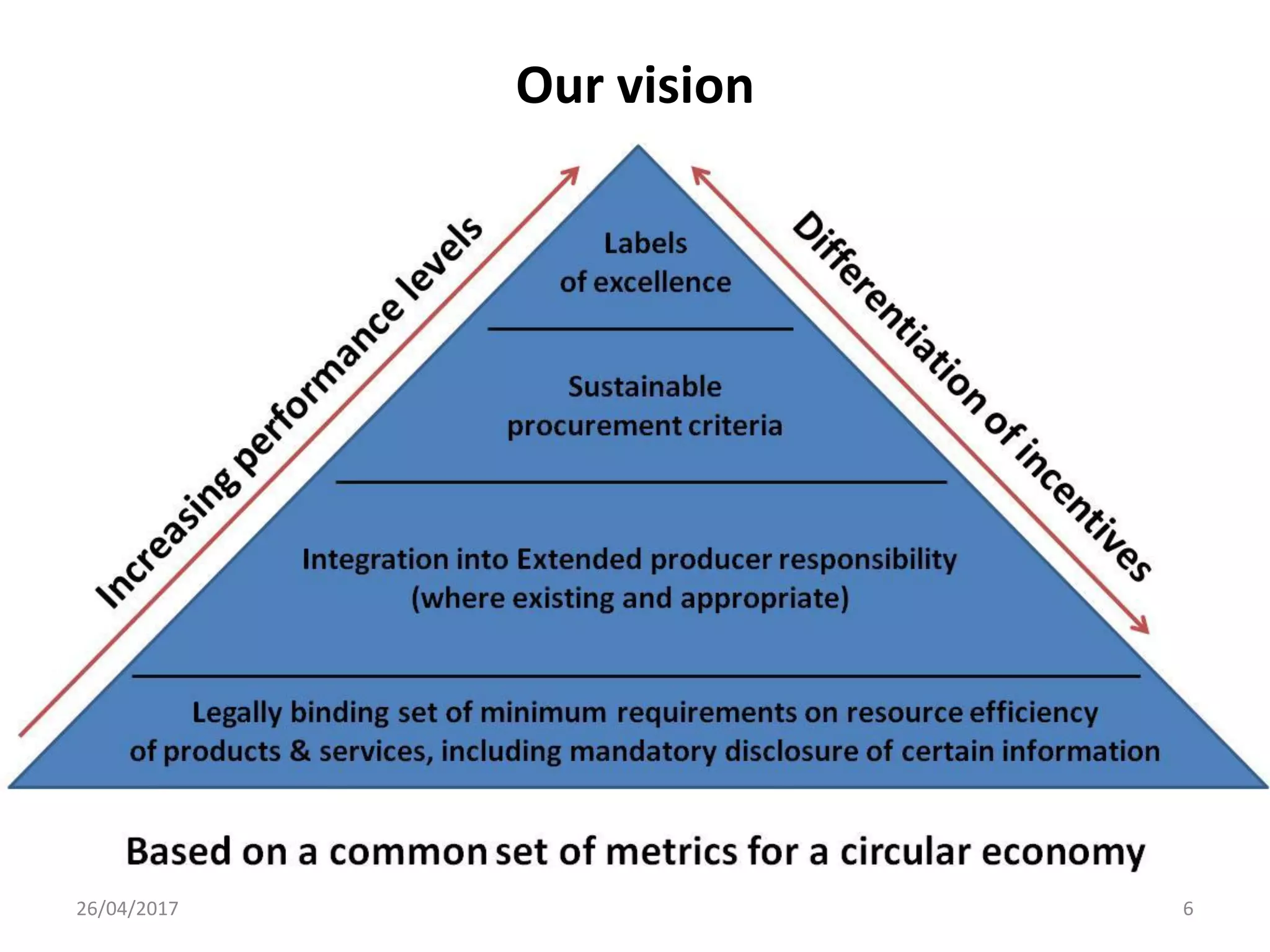
Our vision
26/04/2017 6
• Inform EEB members and other environmental NGOs about ongoing
EU GPP Criteria Development Processes and liaise actively with
them to provide feedback with regard to their areas of interest and
expertise
• Nominate technical representatives to attend the AHWG meetings
on behalf of environmental NGOs and prepare a preliminary set of
comments for consultation with other environmental NGOs in
advance of the AHWG meetings
• Raise and discuss GPP related issues of concern to environmental
NGOs during the meetings and submit written comments and
positions on them after another round of consultation with
interested EEB members and other environmental NGOs
• Update and summarize written NGO positions and expert input to
the GPP documents for the final written stakeholder consultation
and participate in GPP Advisory Board meetings as required
What we are doing on GPP at EU level
26/04/2017 7
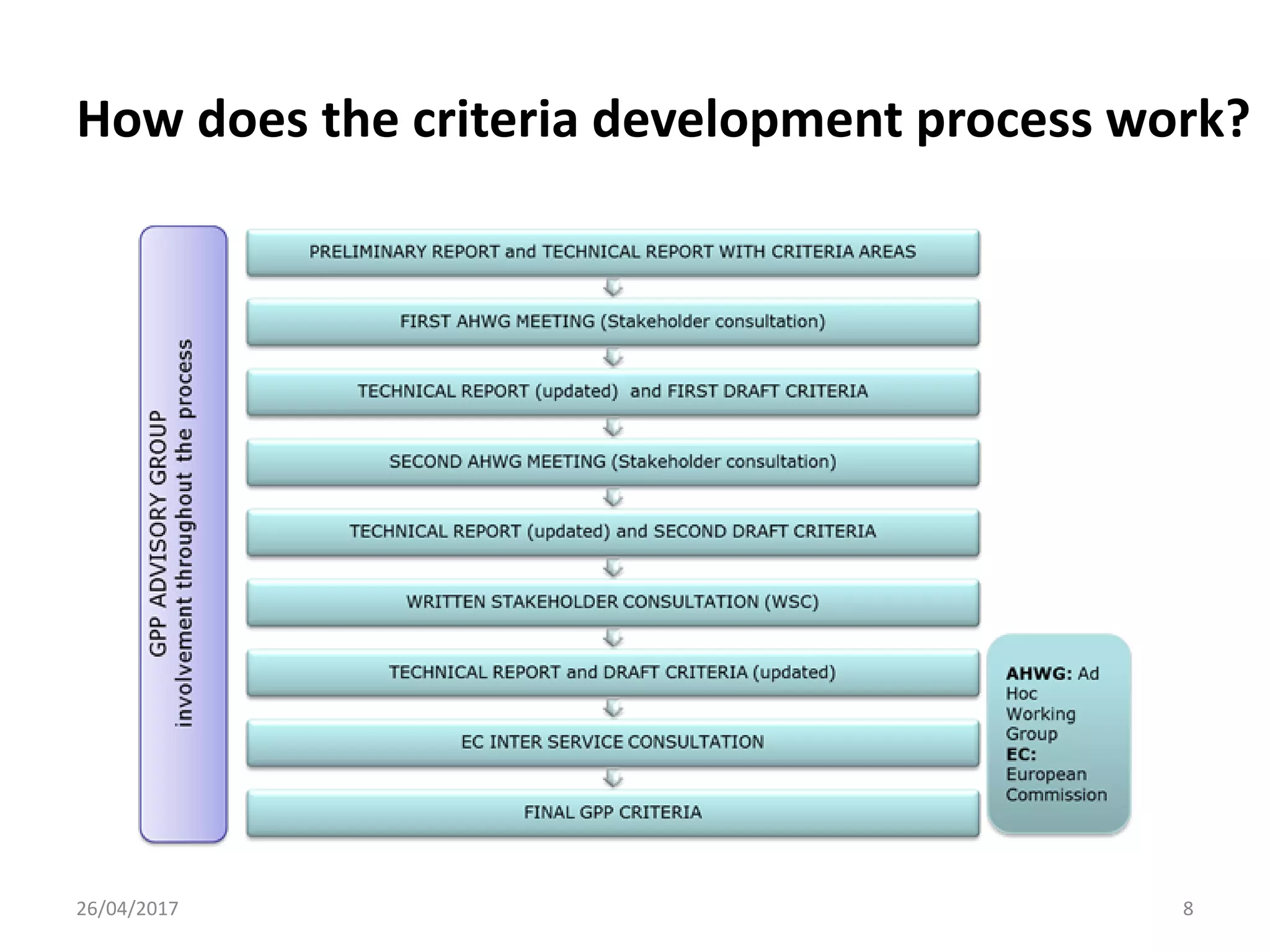
How does the criteria development process work?
26/04/2017 8
Format and content of written EEB comments
• We will prepare a Word template for draft comments on the EU
GPP Criteria Development Process in order to facilitate consultation
and feedback from EEB members and other environmental NGOs.
• These comments contain our rationale and argumentation on key
issues that need to be addressed by the preliminary and/or
technical reports plus our recommendations on the proposed EU
GPP Criteria which have been identified of high relevance to
environmental NGOs.
• The document will updated after each AHWG, including concrete
amendments to the proposals on the table, and uploaded as PDF on
the EEB website.
• In addition, we will submit our comments via the HTML version of
the JRC documents through the BATIS system.
• For the final round of written consultation, we will provide a brief
summary of our positions taken so far in the process plus any
additional amendments proposed by NGOs at this stage.
26/04/2017 9
What is our added value?
• Many years of experience in monitoring EU implementation
processes under the Ecodesign, Energy Labelling and Ecolabel
Directives
• Large network of internal and external experts working on specific
product groups, sectors and environmental policies
• Member of the Steering Committee and Technical Advisory Board
of the Environmental Footprint Pilot Phase
• Broad expertise in all major fields of EU environmental policies
• Synergies with other EEB projects and activities related to
enhancing the environmental integrity and effectiveness of
the EU Circular Economy Package
• Close coordination with our work on the EU Ecolabel scheme and
with the network of the Coolproducts.eu Campaign focusing on
Ecodesign
26/04/2017 10
List of EEB experts contracted for work on GPP
26/04/2017 11
Sustainable food production and
consumption and catering services
Dr. Jennifer Teufel
Oeko-Institute
Germany
Sustainable street lighting solutions Michael Joseph Scholand
N14 Energy Limited Consulting
United Kingdom
Low-impact transport technologies Dr. Julia Hildermeier
Transport & Environment
Belgium
Resource-efficient data centres Dr. Marc-Andree Wolf
maki Consulting GmbH
Germany
Low environmental impact maintenance
of public spaces
Maria Wendela Losman
Ecoplan AB
Sweden
EU GPP Work Programme for 2017-18
Revision/New Product group Status Lead Target for
completion date
R Indoor/ outdoor
paints, varnishes
and road markings
In progress JRC 2nd quarter 2017
R Textiles In progress JRC 2nd quarter 2017
R Furniture In progress JRC 2nd quarter 2017
R Cleaning services In progress JRC End of 2017
R Food and catering
services
In progress JRC End of 2017
R Transport In progress JRC Early 2018
R Road Lighting In progress JRC Early 2018
N Data Centres In progress JRC End of 2018
N Maintenance of
Public Spaces
In progress JRC End of 2018
26/04/2017 12
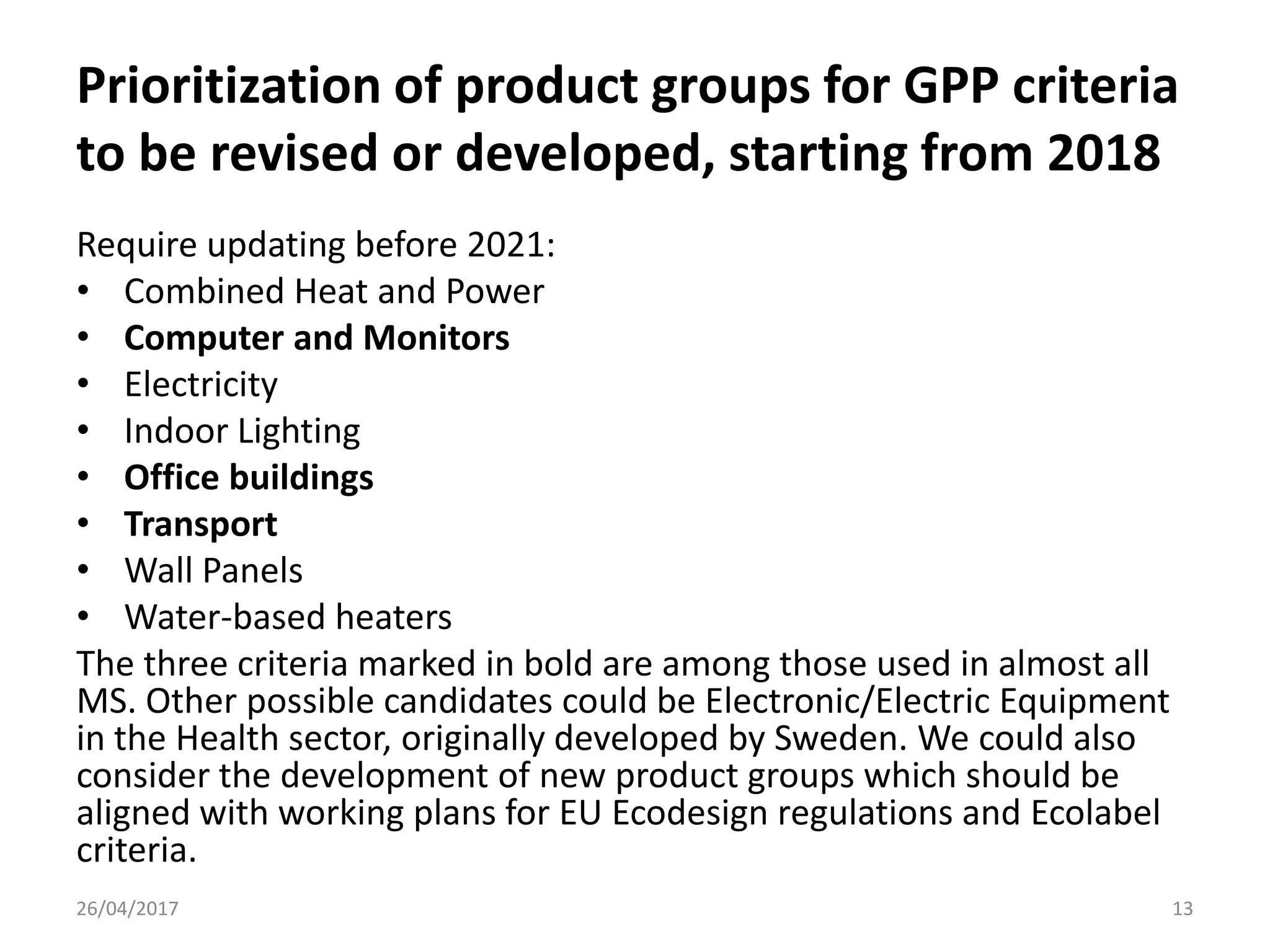
Prioritization of product groups for GPP criteria
to be revised or developed, starting from 2018
Require updating before 2021:
• Combined Heat and Power
• Computer and Monitors
• Electricity
• Indoor Lighting
• Office buildings
• Transport
• Wall Panels
• Water-based heaters
The three criteria marked in bold are among those used in almost all
MS. Other possible candidates could be Electronic/Electric Equipment
in the Health sector, originally developed by Sweden. We could also
consider the development of new product groups which should be
aligned with working plans for EU Ecodesign regulations and Ecolabel
criteria.
26/04/2017 13
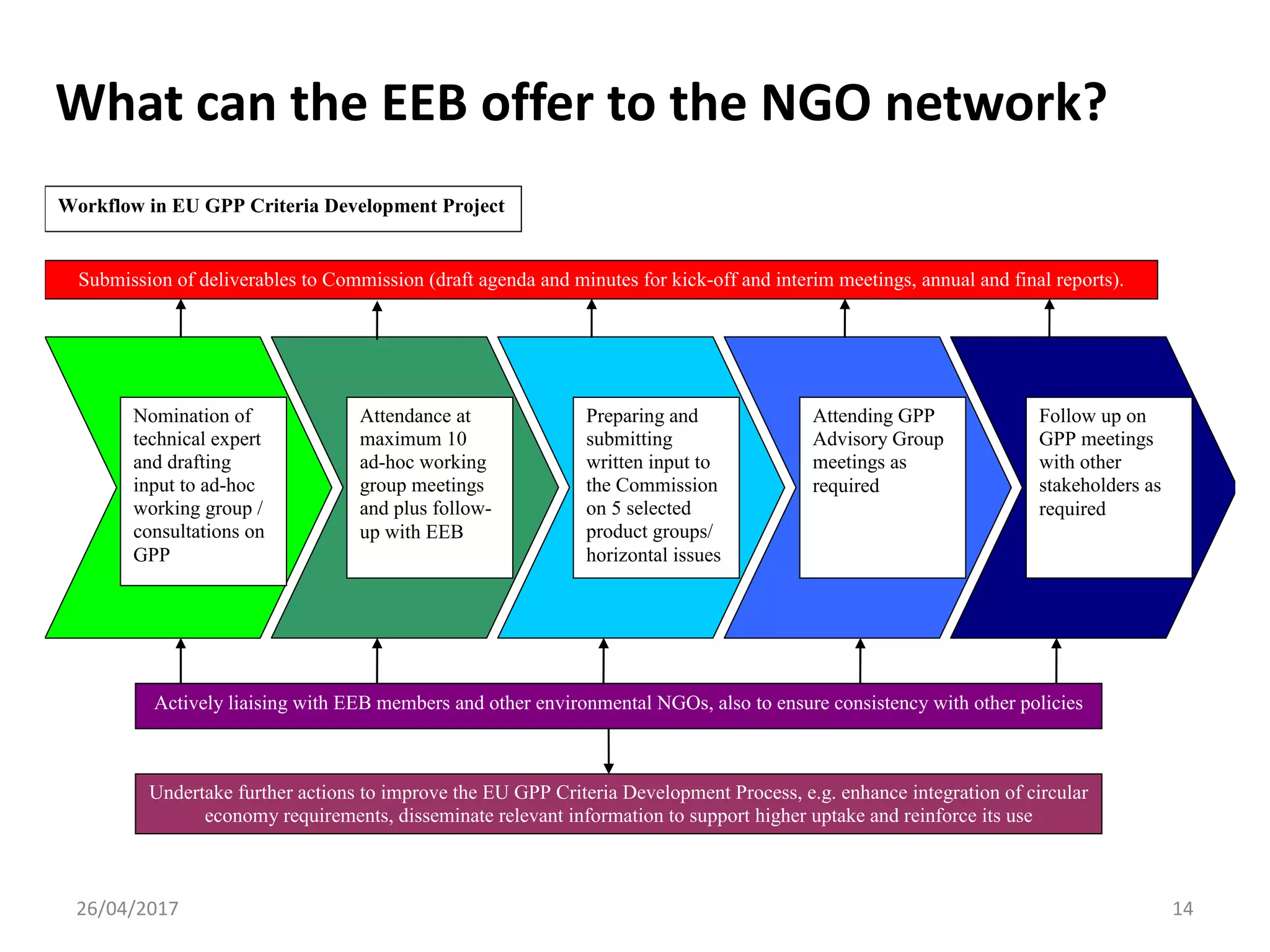
What can the EEB offer to the NGO network?
Nomination of
technical expert
and drafting
input to ad-hoc
working group /
consultations on
GPP
Attendance at
maximum 10
ad-hoc working
group meetings
and plus follow-
up with EEB
Preparing and
submitting
written input to
the Commission
on 5 selected
product groups/
horizontal issues
Attending GPP
Advisory Group
meetings as
required
Follow up on
GPP meetings
with other
stakeholders as
required
Actively liaising with EEB members and other environmental NGOs, also to ensure consistency with other policies
Submission of deliverables to Commission (draft agenda and minutes for kick-off and interim meetings, annual and final reports).
Undertake further actions to improve the EU GPP Criteria Development Process, e.g. enhance integration of circular
economy requirements, disseminate relevant information to support higher uptake and reinforce its use
Workflow in EU GPP Criteria Development Project
26/04/2017 14
Which other options do we see for NGOs
to engage on GPP policies?
• Advocate for making GPP criteria mandatory at national level
(see Italian example)
• Develop own proposals for GPP with a focus on key products
(e.g. clean vehicles) or horizontal topics (phasing out single-
use plastic items)
• Build up a personal relationship or even joint projects with
key public entities and consult with them on improving their
procurement (e.g. schools, hospitals, waste operators)
• Organise experience-sharing and trainings on how to
implement greener procurement, involving both the topic
experts and the responsible procurers
26/04/2017 15
Your contacts at EEB
26/04/2017 16
Stephane Arditi
Circular Economy: Product and Waste Policy Manager
stephane.arditi@eeb.org
Blanca Morales
EU Ecolabel Coordinator for EEB and BEUC
blanca.morales@eeb.org / Blanca.Morales@beuc.eu
Carsten Wachholz
Senior Policy Officer
Resource Conservation and Product Policy
carsten.wachholz@eeb.org

NGOs engaging in the field of Green Public Procurement (GPP)

  • 1.
    Influencing GPP -An NGO perspective Carsten Wachholz Senior Policy Officer Resource conservation and Product Policy
  • 2.
    Who we are “TheEEB is the environmental voice of European citizens, standing for environmental justice, sustainable development and participatory democracy. We want the EU to ensure all people a healthy environment and rich biodiversity.” • The EEB was created in 1974 to represent environmental NGOs’ interests vis-à-vis the EU Institutions. • It is a federation of more than 150 environmental citizens organisations based in all EU Member States, potential new Member States and a few neighbouring countries. • Main bodies: AGM (Annual General Meeting), Board (One Board Member per country where EEB has a full member plus other networks) 26/04/2017 2
  • 3.
  • 4.
    Why we engagein the field of GPP • Creating a critical mass of greener products and services available on the European market • Reinforcing the demand side to promote (public) purchase of less environmental harmful and more resource efficient, reusable, repairable as well as recyclable products • Mainstreaming new business models for a circular economy such as leasing or sharing schemes through adequate procurement processes • Ensuring a more consistent policy framework with other EU product legislation such as Ecodesign, Energy Labelling, Ecolabel, Extended Producer Responsibilities, etc. • Supporting our EEB members to enhance the uptake and use of GPP criteria and instruments on national, regional or local level 26/04/2017 4
  • 5.
    • In orderto implement a life-cycle approach, tackling environmental impacts from sourcing of materials to the design and use phase of products up to the end-of-life, we need to align policies dealt with under different EU directives. • Integrating our expertise from other policy areas and potential horizontal criteria e.g. on biodiversity, agriculture, hazardous chemicals, energy efficiency, circular economy – so that we can focus on the main environmental hotspots to reduce negative impacts of production and consumption. • We can build on the EU Ecolabel criteria and Environmental Certification schemes as benchmarking and verification tools. How it fits with our other EU policy work 26/04/2017 5
  • 6.
  • 7.
    • Inform EEBmembers and other environmental NGOs about ongoing EU GPP Criteria Development Processes and liaise actively with them to provide feedback with regard to their areas of interest and expertise • Nominate technical representatives to attend the AHWG meetings on behalf of environmental NGOs and prepare a preliminary set of comments for consultation with other environmental NGOs in advance of the AHWG meetings • Raise and discuss GPP related issues of concern to environmental NGOs during the meetings and submit written comments and positions on them after another round of consultation with interested EEB members and other environmental NGOs • Update and summarize written NGO positions and expert input to the GPP documents for the final written stakeholder consultation and participate in GPP Advisory Board meetings as required What we are doing on GPP at EU level 26/04/2017 7
  • 8.
    How does thecriteria development process work? 26/04/2017 8
  • 9.
    Format and contentof written EEB comments • We will prepare a Word template for draft comments on the EU GPP Criteria Development Process in order to facilitate consultation and feedback from EEB members and other environmental NGOs. • These comments contain our rationale and argumentation on key issues that need to be addressed by the preliminary and/or technical reports plus our recommendations on the proposed EU GPP Criteria which have been identified of high relevance to environmental NGOs. • The document will updated after each AHWG, including concrete amendments to the proposals on the table, and uploaded as PDF on the EEB website. • In addition, we will submit our comments via the HTML version of the JRC documents through the BATIS system. • For the final round of written consultation, we will provide a brief summary of our positions taken so far in the process plus any additional amendments proposed by NGOs at this stage. 26/04/2017 9
  • 10.
    What is ouradded value? • Many years of experience in monitoring EU implementation processes under the Ecodesign, Energy Labelling and Ecolabel Directives • Large network of internal and external experts working on specific product groups, sectors and environmental policies • Member of the Steering Committee and Technical Advisory Board of the Environmental Footprint Pilot Phase • Broad expertise in all major fields of EU environmental policies • Synergies with other EEB projects and activities related to enhancing the environmental integrity and effectiveness of the EU Circular Economy Package • Close coordination with our work on the EU Ecolabel scheme and with the network of the Coolproducts.eu Campaign focusing on Ecodesign 26/04/2017 10
  • 11.
    List of EEBexperts contracted for work on GPP 26/04/2017 11 Sustainable food production and consumption and catering services Dr. Jennifer Teufel Oeko-Institute Germany Sustainable street lighting solutions Michael Joseph Scholand N14 Energy Limited Consulting United Kingdom Low-impact transport technologies Dr. Julia Hildermeier Transport & Environment Belgium Resource-efficient data centres Dr. Marc-Andree Wolf maki Consulting GmbH Germany Low environmental impact maintenance of public spaces Maria Wendela Losman Ecoplan AB Sweden
  • 12.
    EU GPP WorkProgramme for 2017-18 Revision/New Product group Status Lead Target for completion date R Indoor/ outdoor paints, varnishes and road markings In progress JRC 2nd quarter 2017 R Textiles In progress JRC 2nd quarter 2017 R Furniture In progress JRC 2nd quarter 2017 R Cleaning services In progress JRC End of 2017 R Food and catering services In progress JRC End of 2017 R Transport In progress JRC Early 2018 R Road Lighting In progress JRC Early 2018 N Data Centres In progress JRC End of 2018 N Maintenance of Public Spaces In progress JRC End of 2018 26/04/2017 12
  • 13.
    Prioritization of productgroups for GPP criteria to be revised or developed, starting from 2018 Require updating before 2021: • Combined Heat and Power • Computer and Monitors • Electricity • Indoor Lighting • Office buildings • Transport • Wall Panels • Water-based heaters The three criteria marked in bold are among those used in almost all MS. Other possible candidates could be Electronic/Electric Equipment in the Health sector, originally developed by Sweden. We could also consider the development of new product groups which should be aligned with working plans for EU Ecodesign regulations and Ecolabel criteria. 26/04/2017 13
  • 14.
    What can theEEB offer to the NGO network? Nomination of technical expert and drafting input to ad-hoc working group / consultations on GPP Attendance at maximum 10 ad-hoc working group meetings and plus follow- up with EEB Preparing and submitting written input to the Commission on 5 selected product groups/ horizontal issues Attending GPP Advisory Group meetings as required Follow up on GPP meetings with other stakeholders as required Actively liaising with EEB members and other environmental NGOs, also to ensure consistency with other policies Submission of deliverables to Commission (draft agenda and minutes for kick-off and interim meetings, annual and final reports). Undertake further actions to improve the EU GPP Criteria Development Process, e.g. enhance integration of circular economy requirements, disseminate relevant information to support higher uptake and reinforce its use Workflow in EU GPP Criteria Development Project 26/04/2017 14
  • 15.
    Which other optionsdo we see for NGOs to engage on GPP policies? • Advocate for making GPP criteria mandatory at national level (see Italian example) • Develop own proposals for GPP with a focus on key products (e.g. clean vehicles) or horizontal topics (phasing out single- use plastic items) • Build up a personal relationship or even joint projects with key public entities and consult with them on improving their procurement (e.g. schools, hospitals, waste operators) • Organise experience-sharing and trainings on how to implement greener procurement, involving both the topic experts and the responsible procurers 26/04/2017 15
  • 16.
    Your contacts atEEB 26/04/2017 16 Stephane Arditi Circular Economy: Product and Waste Policy Manager stephane.arditi@eeb.org Blanca Morales EU Ecolabel Coordinator for EEB and BEUC blanca.morales@eeb.org / Blanca.Morales@beuc.eu Carsten Wachholz Senior Policy Officer Resource Conservation and Product Policy carsten.wachholz@eeb.org