NGO
by-https://mahi.aimtonline.in/
● Introduction
A non-governmental organization (NGO) is a group that functions independently of any
government with the objective of improving social conditions. NGOs are typically non-profit
institutions. They are sometimes called civil society organizations and are established on
community, national, and international levels to serve a social or political goal such as a
humanitarian cause or the protection of the .
For example, NGOs might focus on activities in areas involving health or health
emergencies, education, infrastructure, advocacy of minority rights, support of the poor,
and the reduction of crime.
NGO HISTORY
1. Nongovernmental organization (NGO), voluntary group of individuals or
organizations, usually not with any government, that is formed to provide services or to
advocate a public policy. Although some NGOs are for-profit corporations, the vast majority are
nonprofit organizations. Some NGOs, particularly those based in countries, may be created or
controlled by governments. By most definitions, political parties and criminal or violent
guerrilla organizations are not considered NGOs. The issues addressed by NGOs run the gamut
of human concerns (e.g., environmental protection, disaster relief, and development
assistance), and the scope of their activities may be local, national, or international. Some
NGOs fulfill quasi-governmental functions for ethnic groups that lack a state of their own. NGOs
may be financed by private donations, , governments, or a combination of these.
Advantage
● They have the ability to experiment freely with innovative approaches and, if necessary, to take risks.
● They are flexible in adapting to local situations and responding to local needs and therefore able to
develop integrated projects, as well as sectoral projects.
● They enjoygood rapport with people and can render micro-assistance to very poor peope as they can
identify those who are most in need and tailor assistance to their needs.
● They have the ability to communicate at all levels, from the neighbourhood to the top levels of
government.
● They are able to recruit both experts and highly motivated staff with fewer restrictions than the
government.
>
Disadvantage
● Paternalistic attitudes restrict the degree of participation in programme/project design.
● Restricted/constrained ways of apporach to a problem or area.
● Redued replicability of an idea, due to non-representativeness of the project or selected area,
relatively small project coverage, dependence on outside financial resources, etc.
● "Territorial possessiveness" of an area or project reduces cooperation between agencies,
seen as threatening or competitive.
Structure
Function
NGOs worldwide perform a wide range of services aimed towards human wellbeing and social welfare.
These organizations relentlessly work towards development and bringing a positive change in the society.
NGOs may have different structures, activities and policies, but all NGOs are committed towards their cause
and perform their functions to achieve their respective goals.
NGOs facilitate government policies to reach remote areas and enhance the overall effectiveness of social
welfare schemes. As discussed in the section above, NGOs perform a variety of services for social
wellbeing either through implementing development projects or through policy advocacy
The important function of NGO has positively affected the
given below sectory
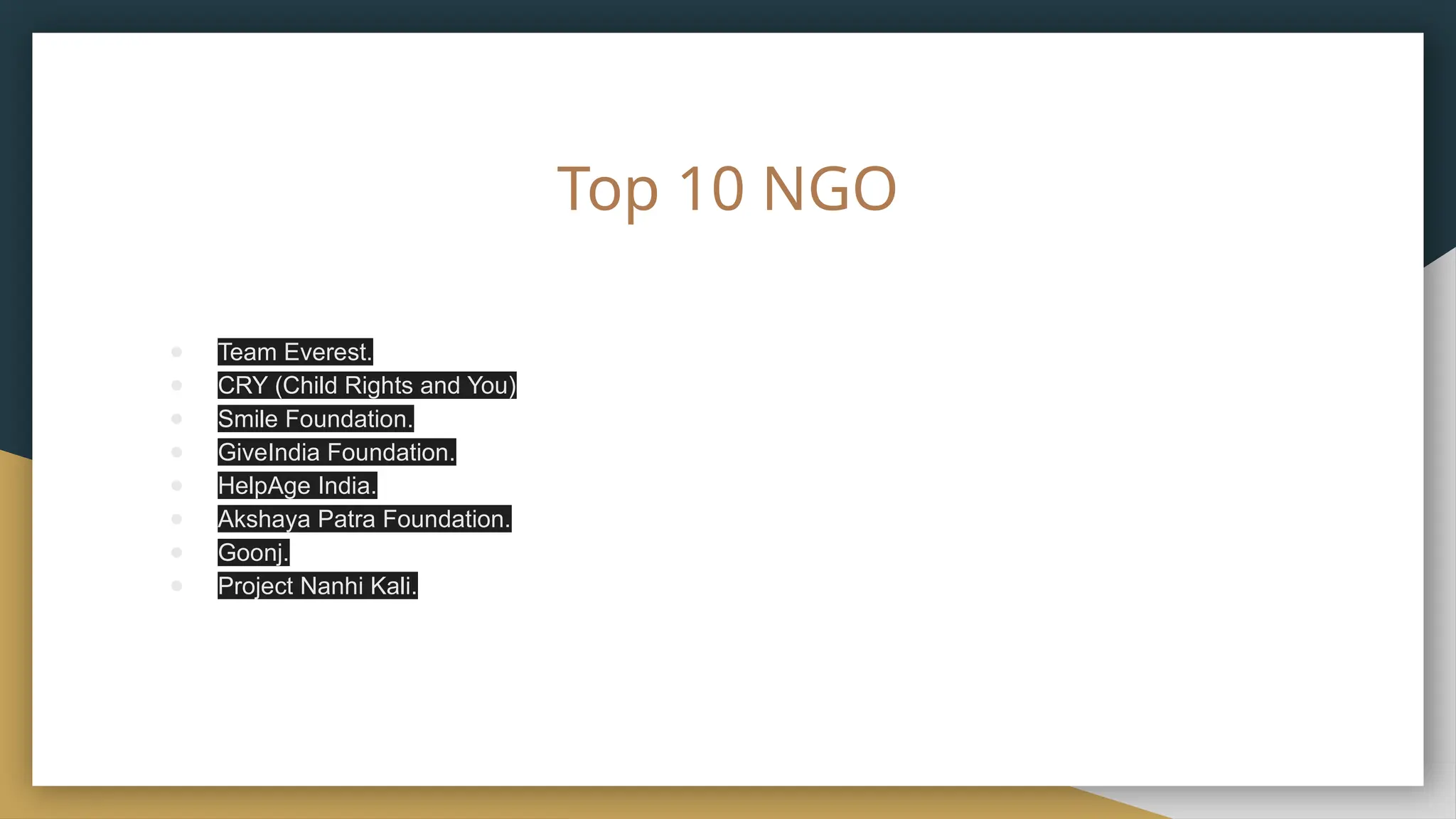
Top 10 NGO
● Team Everest.
● CRY (Child Rights and You)
● Smile Foundation.
● GiveIndia Foundation.
● HelpAge India.
● Akshaya Patra Foundation.
● Goonj.
● Project Nanhi Kali.
.
NAME = MAHI BARGALI
WEBSITE=https://mahi.aimtonline.in/
EMAIL= mahibargali253@gmail.com

NGO INTRODUCTION ,STRUCTURE FUNCTION AND MANY MORE

  • 1.
  • 2.
    ● Introduction A non-governmentalorganization (NGO) is a group that functions independently of any government with the objective of improving social conditions. NGOs are typically non-profit institutions. They are sometimes called civil society organizations and are established on community, national, and international levels to serve a social or political goal such as a humanitarian cause or the protection of the . For example, NGOs might focus on activities in areas involving health or health emergencies, education, infrastructure, advocacy of minority rights, support of the poor, and the reduction of crime.
  • 3.
    NGO HISTORY 1. Nongovernmentalorganization (NGO), voluntary group of individuals or organizations, usually not with any government, that is formed to provide services or to advocate a public policy. Although some NGOs are for-profit corporations, the vast majority are nonprofit organizations. Some NGOs, particularly those based in countries, may be created or controlled by governments. By most definitions, political parties and criminal or violent guerrilla organizations are not considered NGOs. The issues addressed by NGOs run the gamut of human concerns (e.g., environmental protection, disaster relief, and development assistance), and the scope of their activities may be local, national, or international. Some NGOs fulfill quasi-governmental functions for ethnic groups that lack a state of their own. NGOs may be financed by private donations, , governments, or a combination of these.
  • 4.
    Advantage ● They havethe ability to experiment freely with innovative approaches and, if necessary, to take risks. ● They are flexible in adapting to local situations and responding to local needs and therefore able to develop integrated projects, as well as sectoral projects. ● They enjoygood rapport with people and can render micro-assistance to very poor peope as they can identify those who are most in need and tailor assistance to their needs. ● They have the ability to communicate at all levels, from the neighbourhood to the top levels of government. ● They are able to recruit both experts and highly motivated staff with fewer restrictions than the government. >
  • 5.
    Disadvantage ● Paternalistic attitudesrestrict the degree of participation in programme/project design. ● Restricted/constrained ways of apporach to a problem or area. ● Redued replicability of an idea, due to non-representativeness of the project or selected area, relatively small project coverage, dependence on outside financial resources, etc. ● "Territorial possessiveness" of an area or project reduces cooperation between agencies, seen as threatening or competitive.
  • 6.
  • 7.
    Function NGOs worldwide performa wide range of services aimed towards human wellbeing and social welfare. These organizations relentlessly work towards development and bringing a positive change in the society. NGOs may have different structures, activities and policies, but all NGOs are committed towards their cause and perform their functions to achieve their respective goals. NGOs facilitate government policies to reach remote areas and enhance the overall effectiveness of social welfare schemes. As discussed in the section above, NGOs perform a variety of services for social wellbeing either through implementing development projects or through policy advocacy
  • 8.
    The important functionof NGO has positively affected the given below sectory
  • 9.
    Top 10 NGO ●Team Everest. ● CRY (Child Rights and You) ● Smile Foundation. ● GiveIndia Foundation. ● HelpAge India. ● Akshaya Patra Foundation. ● Goonj. ● Project Nanhi Kali.
  • 10.
    . NAME = MAHIBARGALI WEBSITE=https://mahi.aimtonline.in/ EMAIL= mahibargali253@gmail.com