Integrated SDN/NFV Framework for
Transitioning to Application Delivery Model
Mallik Tatipamula
Vice President, Service Provider and Cloud Solutions
May 8th, 2015
m.tatipamula@f5.com
© F5 Networks, Inc 2
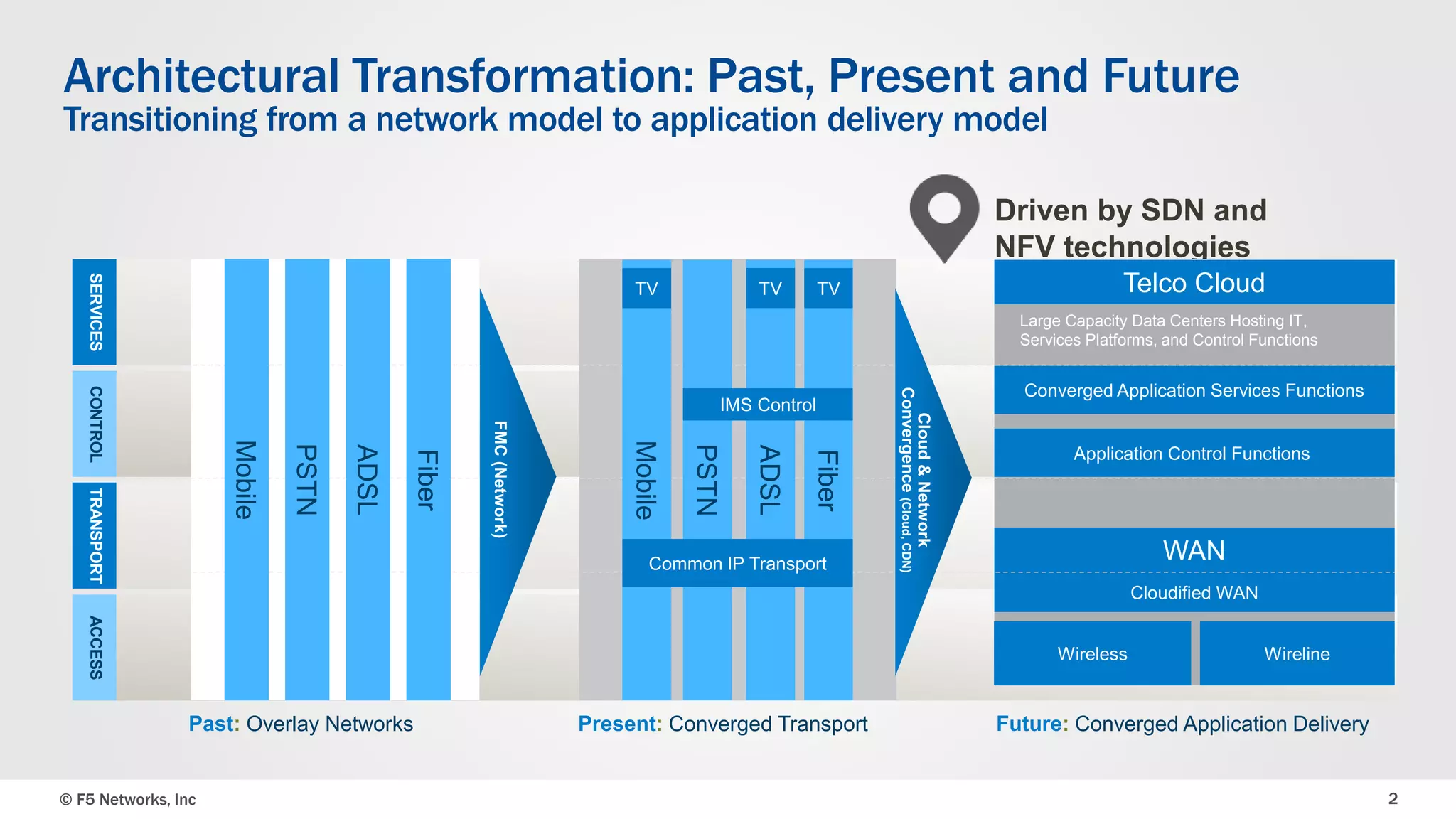
Architectural Transformation: Past, Present and Future
Transitioning from a network model to application delivery model
Driven by SDN and
NFV technologies
CONTROLACCESS
Overlay Networks Converged Transport
Telco Cloud
Large Capacity Data Centers Hosting IT,
Services Platforms, and Control Functions
Converged Application Services Functions
Application Control Functions
Converged Application Delivery
Cloudified WAN
Wireless Wireline
Mobile
PSTN
ADSL
Fiber
TV TV TV
IMS Control
Common IP Transport
Mobile
PSTN
ADSL
Fiber
Telco Cloud
WAN
© F5 Networks, Inc 3
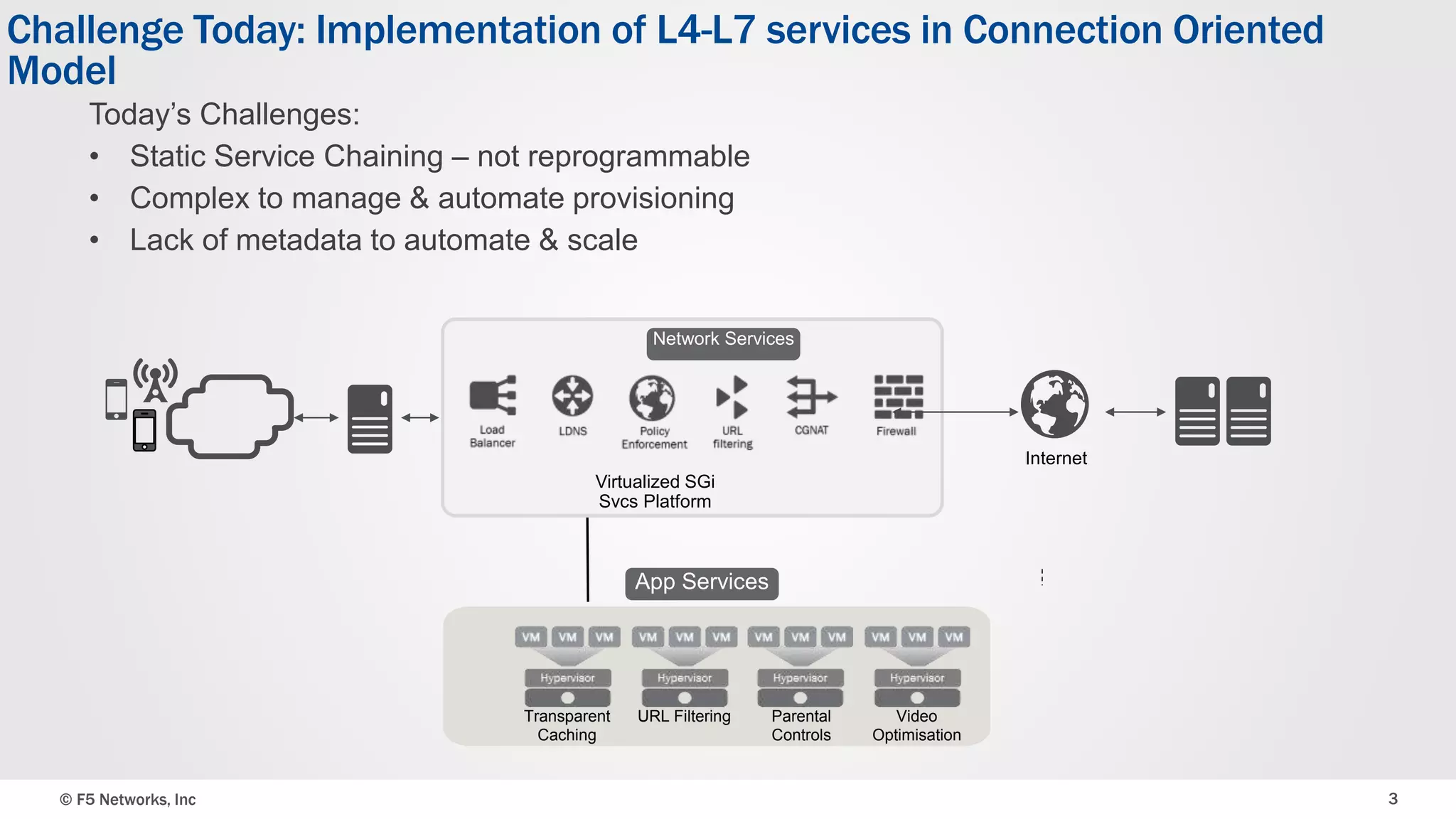
Challenge Today: Implementation of L4-L7 services in Connection Oriented
Model
Internet
Virtualized SGi
Svcs Platform
App Services
Video
Optimisation
Transparent
Caching
URL Filtering Parental
Controls
Today’s Challenges:
• Static Service Chaining – not reprogrammable
• Complex to manage & automate provisioning
• Lack of metadata to automate & scale
Network Services
© F5 Networks, Inc 4
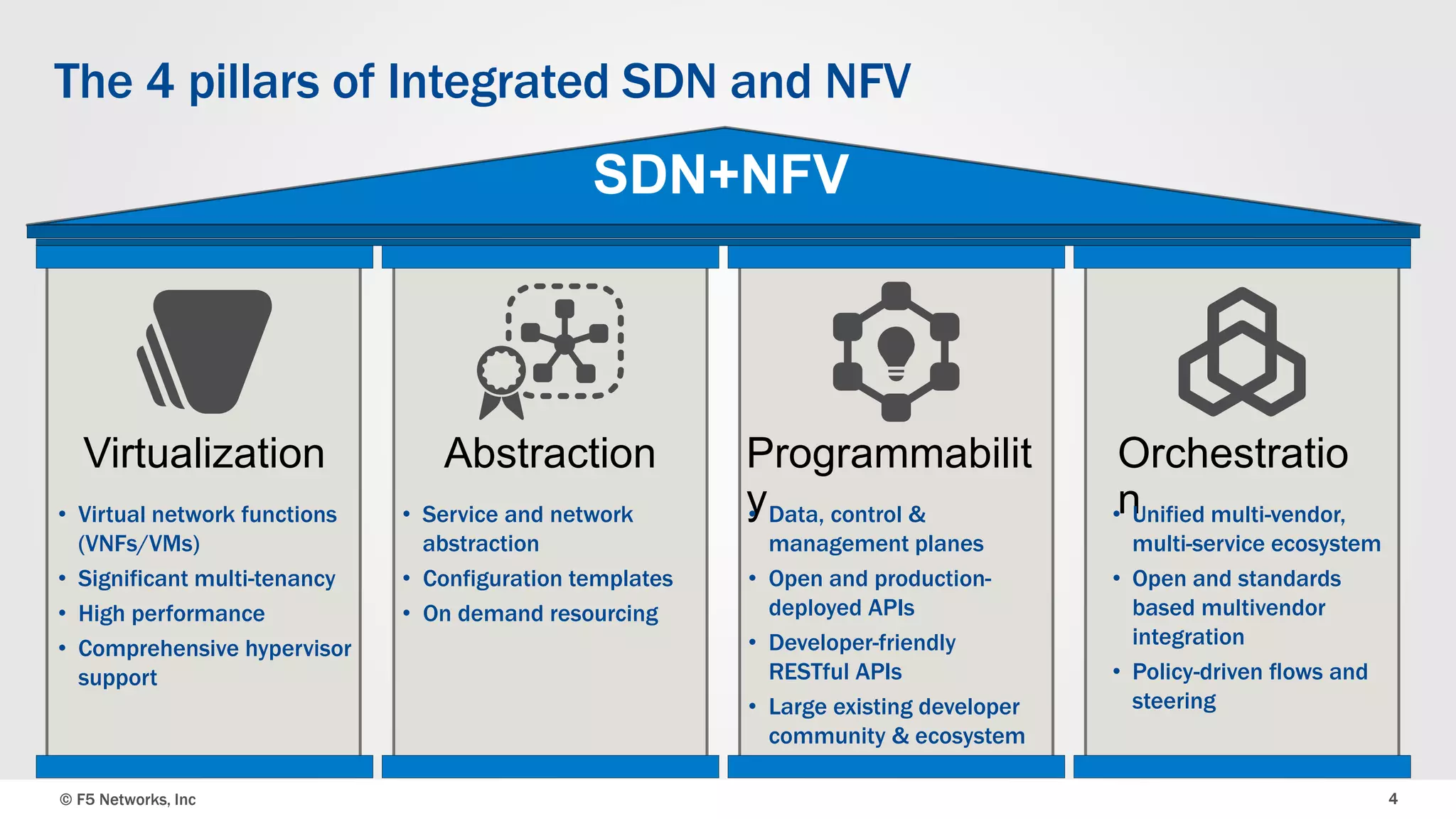
The 4 pillars of Integrated SDN and NFV
SDN+NFV
Virtualization
• Virtual network functions
(VNFs/VMs)
• Significant multi-tenancy
• High performance
• Comprehensive hypervisor
support
Abstraction
• Service and network
abstraction
• Configuration templates
• On demand resourcing
Programmabilit
y• Data, control &
management planes
• Open and production-
deployed APIs
• Developer-friendly
RESTful APIs
• Large existing developer
community & ecosystem
Orchestratio
n• Unified multi-vendor,
multi-service ecosystem
• Open and standards
based multivendor
integration
• Policy-driven flows and
steering
© F5 Networks, Inc 5
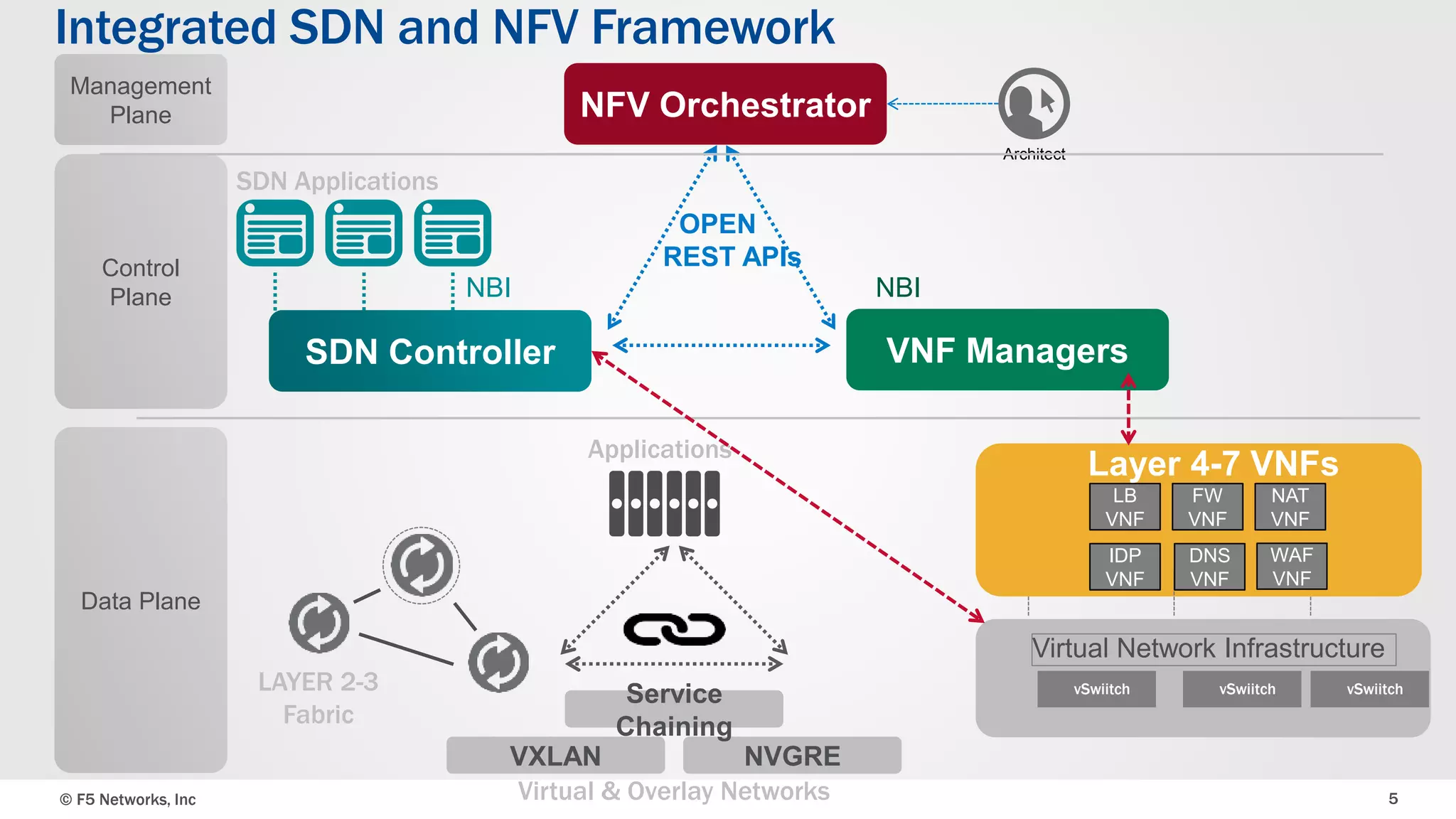
Integrated SDN and NFV Framework
Control
Plane
Data Plane
NBI NBI
VNF Managers
NFV Orchestrator
OPEN
REST APIs
SDN Controller
SDN Applications
LAYER 2-3
Fabric
Applications
NVGREVXLAN
Service
Chaining
Virtual & Overlay Networks
Architect
Management
Plane
vSwiitch vSwiitch vSwiitch
Virtual Network Infrastructure
FW
VNF
NAT
VNF
IDP
VNF
DNS
VNF
WAF
VNF
LB
VNF
Layer 4-7 VNFs
© F5 Networks, Inc 6
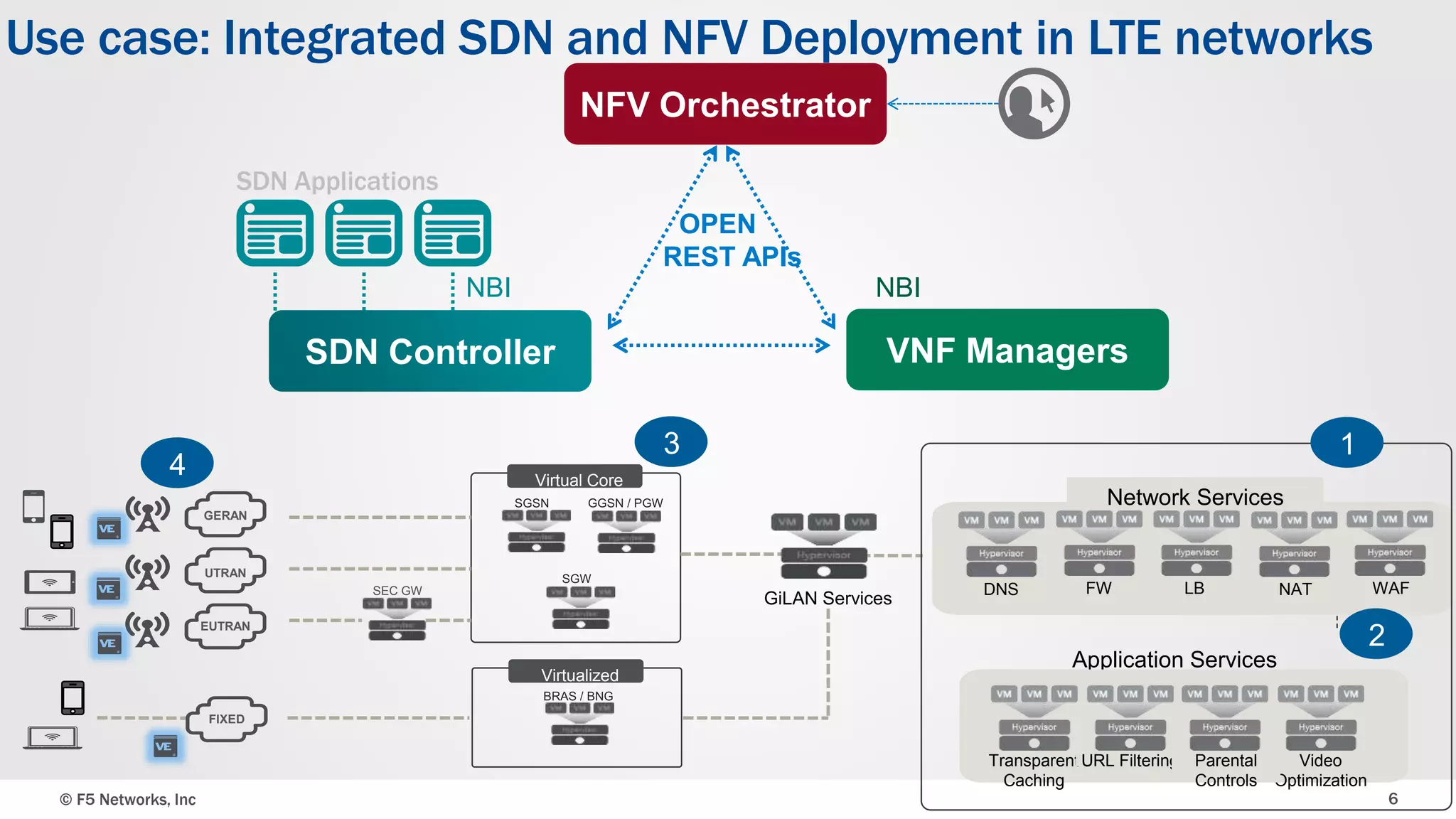
Use case: Integrated SDN and NFV Deployment in LTE networks
NBI NBI
VNF Managers
NFV Orchestrator
OPEN
REST APIs
SDN Controller
SDN Applications
GERAN
UTRAN
EUTRAN
Virtual Core
SEC GW
GiLAN Services
Virtualized
Core
FIXED
Network Services
DNS FW LB WAFNAT
Application Services
4
2
3 1
Video
Optimization
Transparent
Caching
URL Filtering Parental
Controls
© F5 Networks, Inc 7
Virtual
Infrastructure
Manager
NFV
Orchestrator
VNF
Manager
Underlay Network
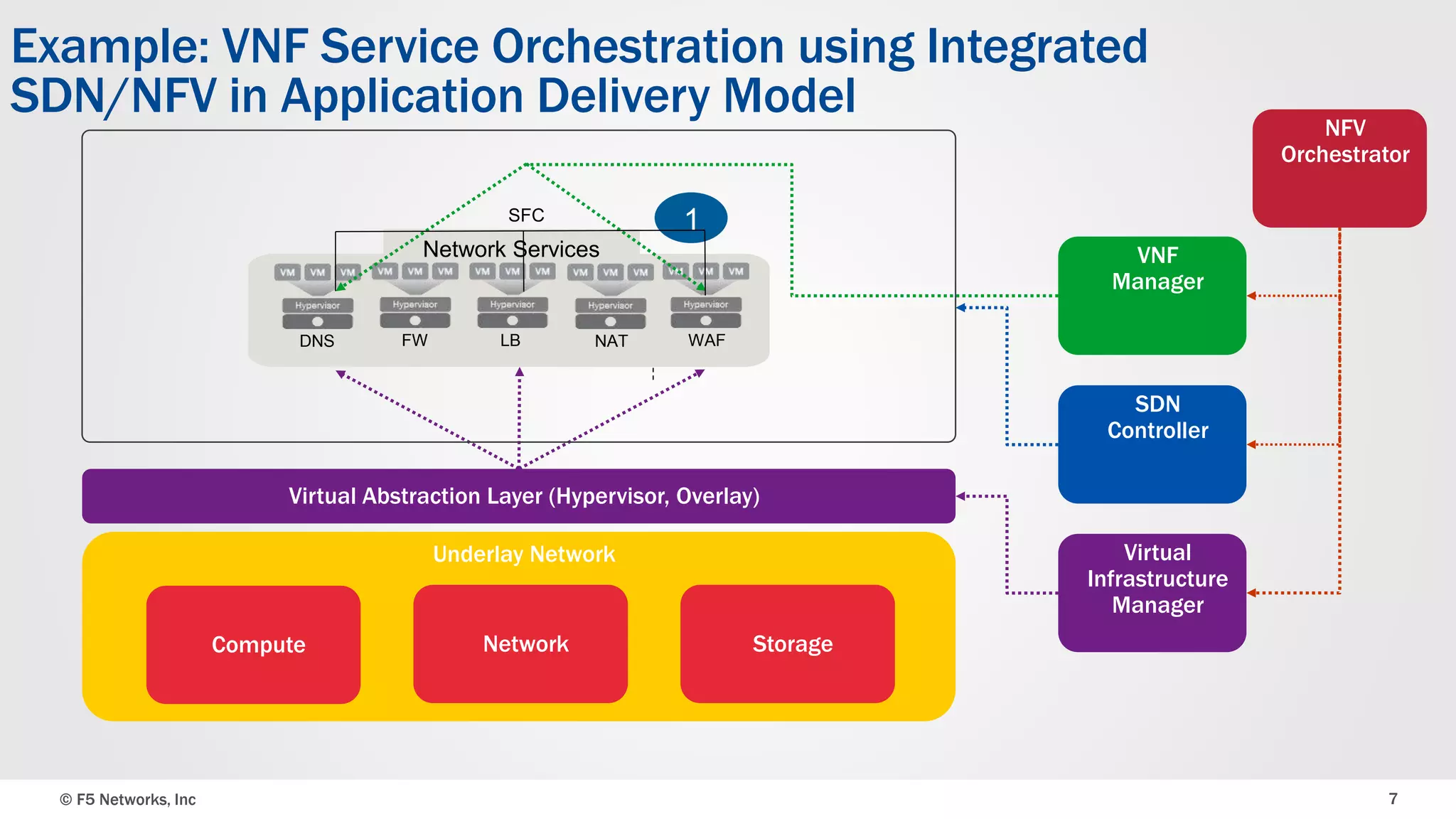
Example: VNF Service Orchestration using Integrated
SDN/NFV in Application Delivery Model
Virtual Abstraction Layer (Hypervisor, Overlay)
Compute Network Storage
SDN
Controller
Network Services
DNS FW LB WAFNAT
1SFC
www.F5.com/ServiceProvider
© F5 Networks, Inc 14
VNFs
VNFsBIGIP-VE
(VNFs)
SDN
CONTROLLER
NFV ORCHESTRATION (NFV-O)
VNF
MANAGER
(VNF-M)
Load Balancing
Network Firewall Application Layer Firewall
Policy Enforcement
Traffic Classification
Carrier Grade NAT
Scalable DNS
IPv6
Diameter Routing
Protocol Gateway
Service Chaining & Orchestration with F5 VNFs

Integrated SDN/NFV Framework for Transitioning to Application Delivery Model

  • 1.
    Integrated SDN/NFV Frameworkfor Transitioning to Application Delivery Model Mallik Tatipamula Vice President, Service Provider and Cloud Solutions May 8th, 2015 m.tatipamula@f5.com
  • 2.
    © F5 Networks,Inc 2 Architectural Transformation: Past, Present and Future Transitioning from a network model to application delivery model Driven by SDN and NFV technologies CONTROLACCESS Overlay Networks Converged Transport Telco Cloud Large Capacity Data Centers Hosting IT, Services Platforms, and Control Functions Converged Application Services Functions Application Control Functions Converged Application Delivery Cloudified WAN Wireless Wireline Mobile PSTN ADSL Fiber TV TV TV IMS Control Common IP Transport Mobile PSTN ADSL Fiber Telco Cloud WAN
  • 3.
    © F5 Networks,Inc 3 Challenge Today: Implementation of L4-L7 services in Connection Oriented Model Internet Virtualized SGi Svcs Platform App Services Video Optimisation Transparent Caching URL Filtering Parental Controls Today’s Challenges: • Static Service Chaining – not reprogrammable • Complex to manage & automate provisioning • Lack of metadata to automate & scale Network Services
  • 4.
    © F5 Networks,Inc 4 The 4 pillars of Integrated SDN and NFV SDN+NFV Virtualization • Virtual network functions (VNFs/VMs) • Significant multi-tenancy • High performance • Comprehensive hypervisor support Abstraction • Service and network abstraction • Configuration templates • On demand resourcing Programmabilit y• Data, control & management planes • Open and production- deployed APIs • Developer-friendly RESTful APIs • Large existing developer community & ecosystem Orchestratio n• Unified multi-vendor, multi-service ecosystem • Open and standards based multivendor integration • Policy-driven flows and steering
  • 5.
    © F5 Networks,Inc 5 Integrated SDN and NFV Framework Control Plane Data Plane NBI NBI VNF Managers NFV Orchestrator OPEN REST APIs SDN Controller SDN Applications LAYER 2-3 Fabric Applications NVGREVXLAN Service Chaining Virtual & Overlay Networks Architect Management Plane vSwiitch vSwiitch vSwiitch Virtual Network Infrastructure FW VNF NAT VNF IDP VNF DNS VNF WAF VNF LB VNF Layer 4-7 VNFs
  • 6.
    © F5 Networks,Inc 6 Use case: Integrated SDN and NFV Deployment in LTE networks NBI NBI VNF Managers NFV Orchestrator OPEN REST APIs SDN Controller SDN Applications GERAN UTRAN EUTRAN Virtual Core SEC GW GiLAN Services Virtualized Core FIXED Network Services DNS FW LB WAFNAT Application Services 4 2 3 1 Video Optimization Transparent Caching URL Filtering Parental Controls
  • 7.
    © F5 Networks,Inc 7 Virtual Infrastructure Manager NFV Orchestrator VNF Manager Underlay Network Example: VNF Service Orchestration using Integrated SDN/NFV in Application Delivery Model Virtual Abstraction Layer (Hypervisor, Overlay) Compute Network Storage SDN Controller Network Services DNS FW LB WAFNAT 1SFC
  • 8.
  • 9.
    © F5 Networks,Inc 14 VNFs VNFsBIGIP-VE (VNFs) SDN CONTROLLER NFV ORCHESTRATION (NFV-O) VNF MANAGER (VNF-M) Load Balancing Network Firewall Application Layer Firewall Policy Enforcement Traffic Classification Carrier Grade NAT Scalable DNS IPv6 Diameter Routing Protocol Gateway Service Chaining & Orchestration with F5 VNFs

Editor's Notes

  • #3 Need an understanding of the destination to chart the course. There has been a fair amount of work done to define this end state. NFV is a key technology component of the much larger migration to application delivery model. We are seeing a significant architectural transformation underway in many service provider networks around the world. Service providers are shifting from connectivity to experience providers – and need to understand & better manage services, from new applications from mHealth to m-commerce Network evolution – siloed infrastructure in the past (Mobile, voice, data and fiber) each providing different access, transport, control & services. Now there are some elements that have been converged, from IP transport, IMS control and Internet services (IM/chat apps, web apps, IPTV, etc.) to flow from one device to another. Moving to cloud oriented architecture – where apps are hosted in the cloud, there are fully converged services platforms and control functions, where you abstract out wireless/wireline infrastructure in a cloudified WAN, and introduce new technologies in the network such as virtualization and programmability with SDN and NFV. Disruptive innovation will require brand new equipment and brand new vendors that unleash core competencies that intersect with major trends: Layer 4-7 intelligence, virtualization, programmability, multifunction platforms, policy.
  • #4 Once the services are defined and consolidated, it becomes possible to virtualize these services utilizing VM technologies and hypervisor integration to create an orchestration ecosystem to analyze and manage the SGi network infrastructure. The orchestration engine can spin up resources as needed and remove them to make the COTS hardware available for future service needs. 1 VM per service or 1 VM per cluster of subscriber – architectural choice for SPs to make…..
  • #5 More than just virtualization! Definitions:
  • #6 SDDC Orchestrator is a symbol for all higher-order orchestrators that are needed to provision everything. It could be Chef/Puppet, OpenStack, VMware, Cisco APIC, whatever… IMO Service Chaining and VXLAN, etc. are related technologies to accomplish the same concept of virtual wiring differing only in the implementation. Red arrow shows that we have orchestration components for our SDAS Fabric and that the SDAS Fabric can feed telemetry back to the control plane.
  • #7 SDDC Orchestrator is a symbol for all higher-order orchestrators that are needed to provision everything. It could be Chef/Puppet, OpenStack, VMware, Cisco APIC, whatever… IMO Service Chaining and VXLAN, etc. are related technologies to accomplish the same concept of virtual wiring differing only in the implementation. Red arrow shows that we have orchestration components for our SDAS Fabric and that the SDAS Fabric can feed telemetry back to the control plane.
  • #8 1st Click – The NFV Orchestrator makes an API call to the VIM. *Click* 2nd Click – The VIM provisions the virtual machines and configure the virtual abstraction layer that they interface on with the appropriate resources. *Click* 3rd Click –The NFV Orchestrator makes an API call to the SDN Controller. *Click* 4th Click - The SDN Controller to stitches together the layer 2 or layer 3 overlay network with the hypervisor networking to create the service chain of the three VNFs. *Click* 5th Click - The NFV Orchestrator then makes an API call to the VNF Manager. *Click* 6th Click – The VNF Manager finishes the configuration of the generic VNF images with the appropriate networking, policy, and security. In this case we create a VNF that does outbound security on user traffic to check for malware. It then chains that traffic chain that to a service provider gateway. And finally configure an internet edge firewall to secure the user from malicious internet traffic. *Click* 7th Click – At this point the customer can send and receive secured traffic from the internet. *Click*
  • #11 VNFaaS: Provide internet connectivity for VPN customers and apply NAT and Firewall policies per customer. VNF = Customer Service Request (CSR) per customer VRF instance Service Chaining: Chain depends on the CSR