ISSUE BRIEF
Expanding Contraceptive Choices: Natural Family Planning
USAID is committed to offering couples in developing countries a wide
range of effective contraceptive methods. Since 1985, the Agency has
supported the development of modern and effective methods of natural
family planning to broaden the mix of methods and to meet the needs of
couples who prefer natural methods.

Natural Methods Increase Options for Women and Couples
Natural family planning (NFP) refers to various modern methods used to
plan or prevent pregnancy based on determining fertile days or relying on
postpartum amenorrhea (the absence of menstrual periods). NFP options
are based on sound biological principles and have been tested in scientifically recognized clinical trials. NFP methods developed
by USAID educate women to understand fertility, enhance communication with their partners, and be responsible for their own
reproductive health. NFP methods do not require contraceptive supplies and are low in cost for continuing users.(1) Natural
methods can be provided by a clinic but also at the
community level, which makes them more accessible.           It is estimated that two thirds of women of reproductive age in
The effectiveness and significant advantages of NFP          sub-Saharan Africa would like to either stop childbearing or
address the needs of diverse populations with varied         delay the birth of their next child, but cannot do so because
religious and ethical beliefs. They also provide an          they have an unmet need for effective contraceptives.(2)
alternative for women who want to use natural
methods for medical or personal reasons.                     Demographic and Health Survey data show that 15 percent of
                                                             family planning users worldwide report using “periodic
Standard Days Method (SDM). Developed by the                 abstinence” and other traditional methods to avoid pregnancy.
USAID-funded Institute of Reproductive Health (IRH)          The data also shows that the vast majority of those using
at Georgetown University, SDM is a new and highly            periodic abstinence do not know on which days of a menstrual
effective natural method of family planning. To help         cycle pregnancy is most likely.(3)
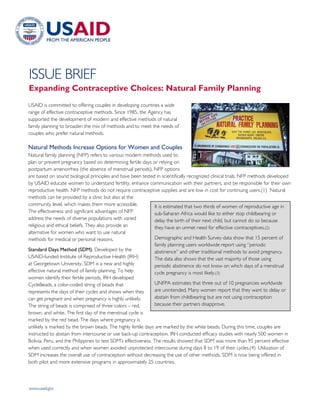
women identify their fertile periods, IRH developed
CycleBeads, a color-coded string of beads that               UNFPA estimates that three out of 10 pregnancies worldwide
represents the days of their cycles and shows when they      are unintended. Many women report that they want to delay or
can get pregnant and when pregnancy is highly unlikely.      abstain from childbearing but are not using contraception
The string of beads is comprised of three colors – red,      because their partners disapprove.
brown, and white. The first day of the menstrual cycle is
marked by the red bead. The days where pregnancy is
unlikely is marked by the brown beads. The highly fertile days are marked by the white beads. During this time, couples are
instructed to abstain from intercourse or use back-up contraception. IRH conducted efficacy studies with nearly 500 women in
Bolivia, Peru, and the Philippines to test SDM’s effectiveness. The results showed that SDM was more than 95 percent effective
when used correctly and when women avoided unprotected intercourse during days 8 to 19 of their cycles.(4) Utilization of
SDM increases the overall use of contraception without decreasing the use of other methods. SDM is now being offered in
both pilot and more extensive programs in approximately 25 countries.


www.usaid.gov
Lactational Amenorrhea Method (LAM). LAM is based on the natural infertility that results from full-time or nearly full-time
breastfeeding in the absence of menstrual periods in the first six months after delivery. This method is effective as long as the
woman is amenorrheic, is fully breastfeeding, and the child is less than 6 months old. If any of these three conditions change
and the woman wants to avoid another pregnancy, then she must adopt another family planning method in a timely manner.
Typically used, LAM is 98 percent effective, has no side effects, can begin immediately after delivery, is cost-effective, and
contributes to optimal breastfeeding practices that enhance maternal and infant health.(5)
Two-Day Method (TDM). TDM is a new approach to NFP, helping women identify when they are fertile based on the
presence or absence of cervical secretions. When used correctly, the method is 96 percent effective.(6) TDM is considered
the simplest NFP method to teach, learn, and use.

USAID Programs Promote Natural Family Planning
Latin America and the Caribbean
In all five Central American/Caribbean countries where Georgetown’s IRH is working (El Salvador, Guatemala, Honduras, Haiti,
and Nicaragua), the public sector is increasingly assuming “ownership” of SDM. The method has been included in national
norms, and government programs are implementing strategies to expand access to SDM despite decreasing resources for family
planning in the region. The SDM programs in South America (Bolivia, Ecuador, and Peru) are well on their way to maturity and
increased sustainability. National norms and service delivery protocols include SDM, and country activities now focus on national
scale-up as well as testing strategies that maybe applicable regionwide. In Ecuador, SDM is being scaled up to all 22 departments
in the country, and in Peru, SDM is available in 340 Ministry of Health (MOH) facilities in San Martin.
Africa
The African region has experienced the greatest growth of interest in SDM from both USAID Missions and partners. This
method expands the response to the high unmet need and low contraceptive prevalence in much of sub-Saharan Africa.
USAID’s efforts to reposition family planning are also playing an important role in building acceptance for SDM and helping
to give it a longer-term programmatic focus. SDM programs in Africa range from large programs working with a number of
partners and operating in several regions, as in the Democratic Republic of the Congo (DRC), to a nationwide program in a
small country (Rwanda) to a relatively small program operating in a few clinics in one area (Angola). Five USAID Missions
(Uganda, Benin, DRC, Kenya, and Rwanda) have included SDM as an essential element in Requests for Applications to partners
issued in 2005, representing a new milestone for SDM integration in Africa.(6)
Jordan
USAID partnered with LINKAGES to integrate LAM into Jordan’s reproductive health care programs. With the help of the
MOH, LINKAGES expanded LAM services to 351 maternal child health (MCH) centers. The MOH/MCH clinics collect LAM
use data monthly, as they do for all other modern methods. According to MOH data, the number of women using LAM in the
health centers increased from 45 in 1999 to 2,441 in 2002. (7)


                                                                                                                               Updated March 2006

(1) Jennings, V., & Gribble, J. (2003). The Standard Days Method: An Innovative Approach to Family Planning. Global Health Link, 119, 12-13. (2) Singh, S.,
Darrock, J., Vlassoff, M., & Nadaeu, J. (2004). Adding It Up: The Benefits of Investing in Sexual and Reproductive Health Care. New York: UNFPA and the Allan
Guttmacher Institute. (3) Che, Y., Cleland,J., & Ali, M. (2004). Periodic Abstinence in Developing Countries: An Assessment of Failure Rates and
Consequences. Contraception 69. (4) IRH. (2003). The Standard Days Method: A New Effective Method of Family Planning. IRH Field Notes. (5) The
LINKAGES Project. (2001). Lactational Amenorrhea Method (LAM): Frequently Asked Questions. FAQ Sheet 3. (6) IRH. (2006). The AWARENESS Project
Performance Review. (7) The LINKAGES Project. (2002). Jordan. World Linkages.

Nfp (Ipil)

  • 1.
    ISSUE BRIEF Expanding ContraceptiveChoices: Natural Family Planning USAID is committed to offering couples in developing countries a wide range of effective contraceptive methods. Since 1985, the Agency has supported the development of modern and effective methods of natural family planning to broaden the mix of methods and to meet the needs of couples who prefer natural methods. Natural Methods Increase Options for Women and Couples Natural family planning (NFP) refers to various modern methods used to plan or prevent pregnancy based on determining fertile days or relying on postpartum amenorrhea (the absence of menstrual periods). NFP options are based on sound biological principles and have been tested in scientifically recognized clinical trials. NFP methods developed by USAID educate women to understand fertility, enhance communication with their partners, and be responsible for their own reproductive health. NFP methods do not require contraceptive supplies and are low in cost for continuing users.(1) Natural methods can be provided by a clinic but also at the community level, which makes them more accessible. It is estimated that two thirds of women of reproductive age in The effectiveness and significant advantages of NFP sub-Saharan Africa would like to either stop childbearing or address the needs of diverse populations with varied delay the birth of their next child, but cannot do so because religious and ethical beliefs. They also provide an they have an unmet need for effective contraceptives.(2) alternative for women who want to use natural methods for medical or personal reasons. Demographic and Health Survey data show that 15 percent of family planning users worldwide report using “periodic Standard Days Method (SDM). Developed by the abstinence” and other traditional methods to avoid pregnancy. USAID-funded Institute of Reproductive Health (IRH) The data also shows that the vast majority of those using at Georgetown University, SDM is a new and highly periodic abstinence do not know on which days of a menstrual effective natural method of family planning. To help cycle pregnancy is most likely.(3) women identify their fertile periods, IRH developed CycleBeads, a color-coded string of beads that UNFPA estimates that three out of 10 pregnancies worldwide represents the days of their cycles and shows when they are unintended. Many women report that they want to delay or can get pregnant and when pregnancy is highly unlikely. abstain from childbearing but are not using contraception The string of beads is comprised of three colors – red, because their partners disapprove. brown, and white. The first day of the menstrual cycle is marked by the red bead. The days where pregnancy is unlikely is marked by the brown beads. The highly fertile days are marked by the white beads. During this time, couples are instructed to abstain from intercourse or use back-up contraception. IRH conducted efficacy studies with nearly 500 women in Bolivia, Peru, and the Philippines to test SDM’s effectiveness. The results showed that SDM was more than 95 percent effective when used correctly and when women avoided unprotected intercourse during days 8 to 19 of their cycles.(4) Utilization of SDM increases the overall use of contraception without decreasing the use of other methods. SDM is now being offered in both pilot and more extensive programs in approximately 25 countries. www.usaid.gov
  • 2.
    Lactational Amenorrhea Method(LAM). LAM is based on the natural infertility that results from full-time or nearly full-time breastfeeding in the absence of menstrual periods in the first six months after delivery. This method is effective as long as the woman is amenorrheic, is fully breastfeeding, and the child is less than 6 months old. If any of these three conditions change and the woman wants to avoid another pregnancy, then she must adopt another family planning method in a timely manner. Typically used, LAM is 98 percent effective, has no side effects, can begin immediately after delivery, is cost-effective, and contributes to optimal breastfeeding practices that enhance maternal and infant health.(5) Two-Day Method (TDM). TDM is a new approach to NFP, helping women identify when they are fertile based on the presence or absence of cervical secretions. When used correctly, the method is 96 percent effective.(6) TDM is considered the simplest NFP method to teach, learn, and use. USAID Programs Promote Natural Family Planning Latin America and the Caribbean In all five Central American/Caribbean countries where Georgetown’s IRH is working (El Salvador, Guatemala, Honduras, Haiti, and Nicaragua), the public sector is increasingly assuming “ownership” of SDM. The method has been included in national norms, and government programs are implementing strategies to expand access to SDM despite decreasing resources for family planning in the region. The SDM programs in South America (Bolivia, Ecuador, and Peru) are well on their way to maturity and increased sustainability. National norms and service delivery protocols include SDM, and country activities now focus on national scale-up as well as testing strategies that maybe applicable regionwide. In Ecuador, SDM is being scaled up to all 22 departments in the country, and in Peru, SDM is available in 340 Ministry of Health (MOH) facilities in San Martin. Africa The African region has experienced the greatest growth of interest in SDM from both USAID Missions and partners. This method expands the response to the high unmet need and low contraceptive prevalence in much of sub-Saharan Africa. USAID’s efforts to reposition family planning are also playing an important role in building acceptance for SDM and helping to give it a longer-term programmatic focus. SDM programs in Africa range from large programs working with a number of partners and operating in several regions, as in the Democratic Republic of the Congo (DRC), to a nationwide program in a small country (Rwanda) to a relatively small program operating in a few clinics in one area (Angola). Five USAID Missions (Uganda, Benin, DRC, Kenya, and Rwanda) have included SDM as an essential element in Requests for Applications to partners issued in 2005, representing a new milestone for SDM integration in Africa.(6) Jordan USAID partnered with LINKAGES to integrate LAM into Jordan’s reproductive health care programs. With the help of the MOH, LINKAGES expanded LAM services to 351 maternal child health (MCH) centers. The MOH/MCH clinics collect LAM use data monthly, as they do for all other modern methods. According to MOH data, the number of women using LAM in the health centers increased from 45 in 1999 to 2,441 in 2002. (7) Updated March 2006 (1) Jennings, V., & Gribble, J. (2003). The Standard Days Method: An Innovative Approach to Family Planning. Global Health Link, 119, 12-13. (2) Singh, S., Darrock, J., Vlassoff, M., & Nadaeu, J. (2004). Adding It Up: The Benefits of Investing in Sexual and Reproductive Health Care. New York: UNFPA and the Allan Guttmacher Institute. (3) Che, Y., Cleland,J., & Ali, M. (2004). Periodic Abstinence in Developing Countries: An Assessment of Failure Rates and Consequences. Contraception 69. (4) IRH. (2003). The Standard Days Method: A New Effective Method of Family Planning. IRH Field Notes. (5) The LINKAGES Project. (2001). Lactational Amenorrhea Method (LAM): Frequently Asked Questions. FAQ Sheet 3. (6) IRH. (2006). The AWARENESS Project Performance Review. (7) The LINKAGES Project. (2002). Jordan. World Linkages.