Neo	Technology	
Polyglot	Architectures
September	2016	
Stefan	Kolmar	
Director	Field	Engineering
Agenda	
•  Drivers	for	change	in	enterprises	
•  Requirements	created	for	polyglot	architecture	
•  Tradi<onal	approaches	
•  Benefits	of	using	graph	technology		
•  Neo4j	as	na<ve	GraphDB	
•  Architectures	and	Ecosystems	
•  Case	studies	
•  Conclusions	
Admin
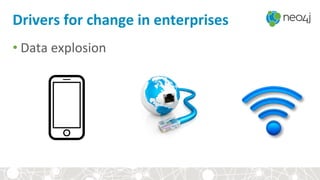
Drivers	for	change	in	enterprises	
• Data	explosion	
Admin
Drivers	for	change	in	enterprises	
• Data	explosion	
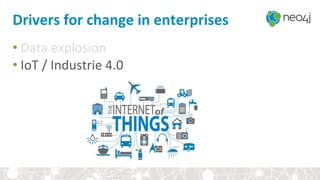
• IoT	/	Industrie	4.0	
Admin
Drivers	for	change	in	enterprises	
• Data	explosion	
• IoT	/	Industrie	4.0	
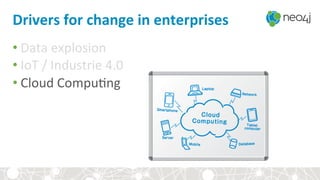
• Cloud	Compu<ng	
Admin
Drivers	for	change	in	enterprises	
• Data	explosion	
• IoT	/	Industrie	4.0	
• Cloud	Compu<ng	
• Need	to	use	Connected	Data	 Admin
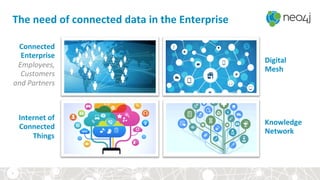
The	need	of	connected	data	in	the	Enterprise	
Connected	
Enterprise		
Employees,	
Customers	
	and	Partners	
Digital	
Mesh	
Internet	of		
Connected	
Things	
Knowledge	
Network	
7
Requirements	created	for	polyglot	architecture	
•  Ability	to	handle	large	scale	data	volumes	
•  High	availability	24x7	
•  Open	interfaces	
•  Structure	data	to	take	advantage	of	connec<ons	
•  Ability	to	query	connected	data	on	demand	
•  Flexibility	to	connect	and	query	data	with	different	schema	
->	Using	the	technology	which	fits	best	doing	the	job	
Admin
TradiBonal	approaches	
•  Using	RDBMS	systems:	
•  En<ty	rela<onship	models	
•  Logical	and	physical	Schema	
•  SQL	queries	
Admin
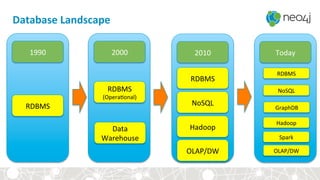
Database	Landscape	
1990	
RDBMS	
2000	
RDBMS	
(Opera<onal)	
Data	
Warehouse	
2010	
RDBMS	
Hadoop	
NoSQL	
OLAP/DW	
Today	
RDBMS	
Hadoop	
NoSQL	
OLAP/DW	
GraphDB	
Spark
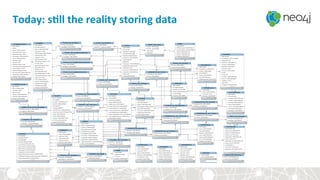
Today:	sBll	the	reality	storing	data
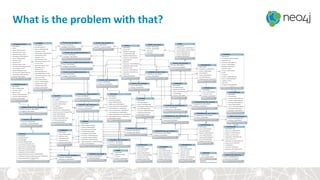
What	is	the	problem	with	that?
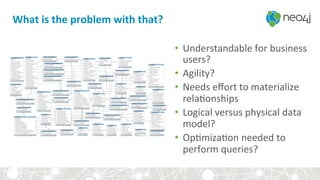
What	is	the	problem	with	that?	
•  Understandable	for	business	
users?	
•  Agility?	
•  Needs	effort	to	materialize	
rela<onships	
•  Logical	versus	physical	data	
model?	
•  Op<miza<on	needed	to	
perform	queries?
Case	Studies
What is the most powerful
database in the world?
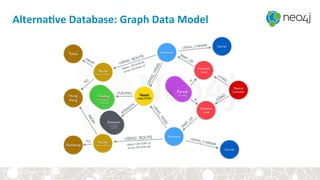
AlternaBve	Database:	Graph	Data	Model
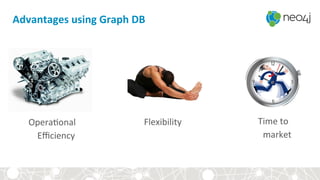
Advantages	using	Graph	DB	
Time	to		
market		
Flexibility	Opera<onal		
Efficiency
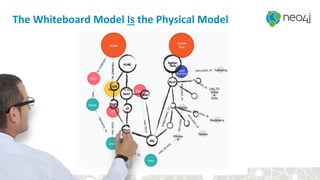
The	Whiteboard	Model	Is	the	Physical	Model
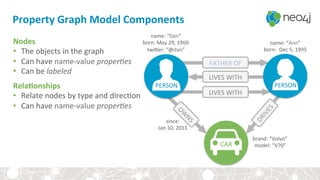
CAR	
name:	“Dan”	
born:	May	29,	1960	
twifer:	“@dan”	
name:	“Ann”	
born:		Dec	5,	1995	
since:		
Jan	10,	2011	
brand:	“Volvo”	
model:	“V70”	
Property	Graph	Model	Components	
Nodes	
•  The	objects	in	the	graph	
•  Can	have	name-value	proper@es	
•  Can	be	labeled	
RelaBonships	
•  Relate	nodes	by	type	and	direc<on	
•  Can	have	name-value	proper@es	
FATHER	OF	
LIVES	WITH	
LIVES	WITH	
PERSON	 PERSON
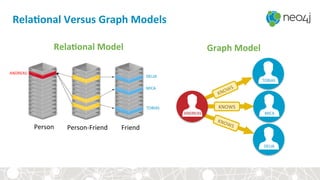
RelaBonal	Versus	Graph	Models	
RelaBonal	Model	 Graph	Model	
KNOWS	
ANDREAS	
TOBIAS	
MICA	
DELIA	
Person	 Friend	Person-Friend	
ANDREAS	
DELIA	
TOBIAS	
MICA
Cypher:	Powerful	and	Expressive	Query	Language	
KNOWS	
Dan	 Ann	
MATCH	(:Person	{	name:“Dan”}	)	-[:KNOWS]->	(:Person	{	name:“Ann”}	)		
LABEL	 PROPERTY	
NODE	 NODE	
LABEL	 PROPERTY
MATCH	(boss)-[:MANAGES*0..3]->(sub),	
						(sub)-[:MANAGES*1..3]->(report)	
WHERE	boss.name	=	“John	Doe”	
RETURN	sub.name	AS	Subordinate,		
		count(report)	AS	Total	
Express	Complex	Queries	Easily	with	Cypher	
Find	all	direct	reports	and	how	
many	people	they	manage,		
up	to	3	levels	down	
Cypher	Query	
SQL	Query
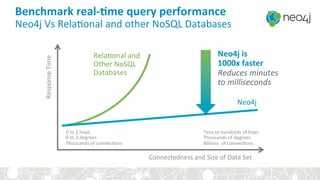
Connectedness	and	Size	of	Data	Set	
Response	Time	
0	to	2	hops	
0	to	3	degrees	
Thousands	of	connec<ons	
Tens	to	hundreds	of	hops	
Thousands	of	degrees	
Billions		of	connec<ons	
Rela<onal	and	
Other	NoSQL	
Databases	
Neo4j	
Neo4j	is		
1000x	faster	
Reduces	minutes		
to	milliseconds	
Benchmark	real-Bme	query	performance	
Neo4j	Vs	Rela<onal	and	other	NoSQL	Databases
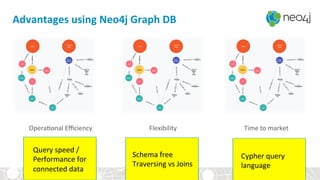
Advantages	using	Neo4j	Graph	DB	
Time	to	market		Flexibility	Opera<onal	Efficiency	
Query	speed	/		
Performance	for		
connected	data	
Schema	free	
Traversing	vs	Joins	
Cypher	query		
language
What	is	a	NaBve	Graph	Database?	
Applica<on	
MATCH	(:Person	{	name:“Dan”}	)		
-[:KNOWS]->		
(:Person	{	name:“Ann”}	)		
Processing	
Engine
Agenda	
•  Drivers	for	change	in	enterprises	
•  Requirements	created	for	polyglot	architecture	
•  Tradi<onal	approaches	
•  Benefits	of	using	graph	technology		
•  Neo4j	as	na<ve	GraphDB	
•  Architectures	and	Ecosystems	
•  Case	studies	
•  Conclusions	
Admin
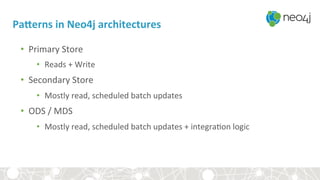
PaTerns	in	Neo4j	architectures	
•  Primary	Store	
•  Reads	+	Write	
•  Secondary	Store	
•  Mostly	read,	scheduled	batch	updates	
•  ODS	/	MDS	
•  Mostly	read,	scheduled	batch	updates	+	integra<on	logic
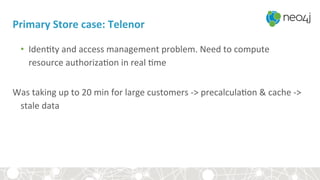
Primary	Store	case:	Telenor	
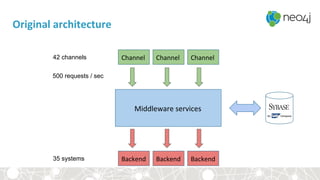
•  Iden<ty	and	access	management	problem.	Need	to	compute	
resource	authoriza<on	in	real	<me		
	
Was	taking	up	to	20	min	for	large	customers	->	precalcula<on	&	cache	->	
stale	data
Original	architecture	
500 requests / sec
Middleware	services	
Backend	 Backend	 Backend	
Channel	 Channel	 Channel	42 channels
35 systems
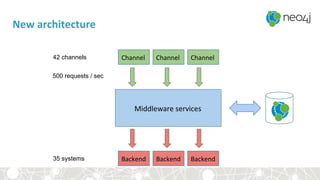
New	architecture	
500 requests / sec
Middleware	services	
Backend	 Backend	 Backend	
Channel	 Channel	 Channel	42 channels
35 systems
Did	it	work?	
•  Response	<mes	reduced	to	seconds	and	milliseconds	
•  Code	maintainability	improved.	Access	rules	in	Cypher	as	graph	
paferns.	
	
"The	Neo4j	graph	database	gives	us	dras@cally	improved	
performance	and	a	simple	language	to	query	our	connected	
data"	–	Sebas<an	Verheughe,	Architect	&	Developer
Secondary	Store	Use	Case	:	Shutl/eBay	
Wanted	to	come	up	with	quotes	for	delivery	slots.		
	
It	took	2	seconds	to	come	up	with	a	quote	for	a	single	delivery	slot	and	
they	wanted	to	extend	the	service	to	show	20	poten<al	delivery	slots	
	
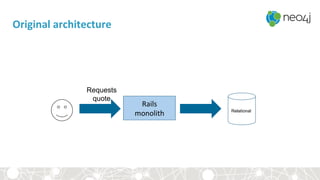
Original	architecture	was	a	monolith	based	on	rails
Original	architecture	
Requests
quote
Rails	
monolith	 Relational
SoluBon	
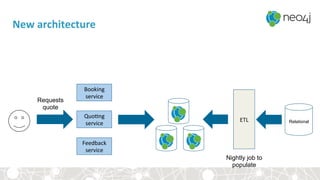
Broke	applica<on	up	into	services	e.g.	quo<ng,	booking,	feedback.		
Key	goal	was	to	improve	the	speed	of	quo<ng	and	neo4j	backed	this	
service
New	architecture	
Requests
quote
Quo<ng	
service	 Relational
Booking	
service	
Feedback	
service	
Nightly job to
populate
ETL
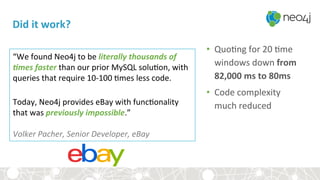
Did	it	work?	
•  Quo<ng	for	20	<me	
windows	down	from	
82,000	ms	to	80ms	
•  Code	complexity	
much	reduced	
“We	found	Neo4j	to	be	literally	thousands	of	
0mes	faster	than	our	prior	MySQL	solu<on,	with	
queries	that	require	10-100	<mes	less	code.		
		
Today,	Neo4j	provides	eBay	with	func<onality	
that	was	previously	impossible.”	
	
Volker	Pacher,	Senior	Developer,	eBay
Who	else	uses	Neo4j	as	a	data	source	to	feed	mission	
criBcal	applicaBons?	
•  World’s	largest	parcel	service	
•  They	no<ced	that	they	would	not	have	been	able	to	deliver	packages	
by	Christmas	2013		
•  Hierarchical	rou<ng	system	(RDBMS	backed)	
•  Replaced	it	with	Neo4j	using	lateral	rou<ng		
•  Value:	
•  Minimized	<me	
•  Maximized	usage	of	road	network	
•  Recommenda<on	engines	
•  Fraud	detec<on	/	preven<on	architectures
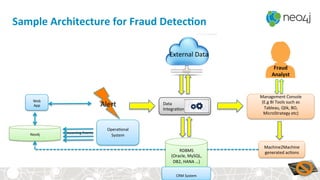
Neo4j	
Web	
App	 Data	
Integra<on	
RDBMS	
(Oracle,	MySQL,	
DB2,	HANA	…)	
Management	Console	
(E.g	BI	Tools	such	as		
Tableau,	Qlik,	BO,	
MicroStrategy	etc)	
Fraud	
Analyst	
Machine2Machine		
generated	ac<ons	
Alert	
Incoming	Events	
CRM	System	


Opera<onal	
System	
	
External	Data	
Sample	Architecture	for	Fraud	DetecBon
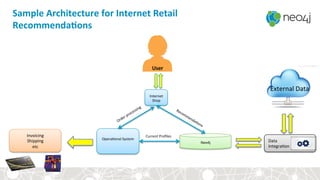
Sample	Architecture	for	Internet	Retail	
RecommendaBons	
Neo4j	
Internet	
Shop	
Data	
Integra<on	
Invoicing	
Shipping	
etc	
	
User	


Opera<onal	System	
	
	
External	Data	
Current	Profiles
ODS	/	MDS	case:	Gov.	Agency	
•  The	graph	integrates	data	from	mul<ple	sources	
•  ODS:	Addi<onal	opera<ons	on	the	integrated	data	
•  MDS:	Provide	reference	data	to	other	opera<onal	systems	
•  European	government	agencies
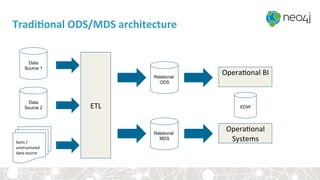
TradiBonal	ODS/MDS	architecture	
Relational
ODS
Data
Source 1
Data
Source 2
Semi	/		
unstructured	
data	source	
ETL	
	
Opera<onal	BI	
	
	
Relational
MDS
EDW
	
Opera<onal		
Systems
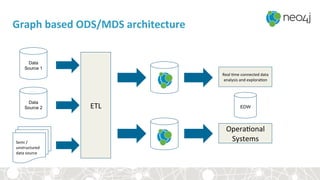
Graph	based	ODS/MDS	architecture	
ETL	
Real	<me	connected	data	
analysis	and	explora<on	
EDW
	
Opera<onal		
Systems	
	
Data
Source 1
Data
Source 2
Semi	/		
unstructured	
data	source
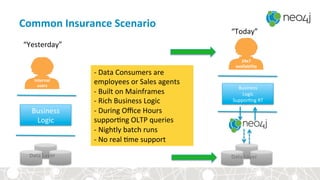
Common	Insurance	Scenario	
Internal	
users	
Data	Layer	
Business	
Logic	
-	Data	Consumers	are	
employees	or	Sales	agents	
-	Built	on	Mainframes	
-	Rich	Business	Logic	
-	During	Office	Hours	
suppor<ng	OLTP	queries	
-	Nightly	batch	runs	
-	No	real	<me	support	
24x7	
availability	
Business	
Logic	
Suppor<ng	RT	
Data	Layer	
“Yesterday”	
“Today”
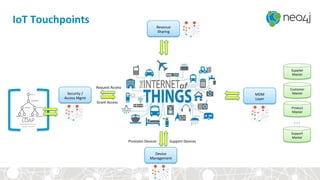
IoT	Touchpoints	
Device	
Management	
Support	Devices	Provision	Devices	
Security	/	
Access	Mgmt	
Grant	Access	
Request	Access	
MDM	
Layer	
Supplier	
Master	
Customer	
Master	
Product	
Master	
Support	
Master	
…	
Revenue	
Sharing
Conclusions:	
•  Polyglot	architectures	are	required	to	sa<sfy	the	needs	exis<ng	and	coming	
•  Neo4j	na<ve	graph	database	provides	a	compete<ve	edge:	
•  Agility	
•  Flexibility	
•  Opera<onal	Efficiency	
•  Time	to	Market	
•  More	informa<on:	
•  www.neo4j.com	
•  Stefan.Kolmar@neo4j.com
Neo	Technology	
The	Graph	Database	Leader	
	
September	2016	
Stefan	Kolmar	
Director	Field	Engineering

Next generation Polyglot Architectures using Neo4j by Stefan Kolmar