Dr. Philip Gardner
Collegiate Employment
Research Institute
ceri.msu.edu
Today’s Agenda
• Overview of the College Labor Market
  – Snapshot of past three years
  – Focus on this year
• The transition into the workplace
  – All about skills
• The gatekeeper: internships
• Workforce readiness project for the BV
It’s was a very good year – except still not enough jobs

A REVIEW OF YEARS PAST
• Strong group of
                    outliers: big &
                    small
                  • No tail:
                    clustered
                    around no
                    change
                  • All majors in
                    play
                  • Tech fields slow;
                    marketing &
Highlights from     sales
  2010-2011       • West lagged
                    behind
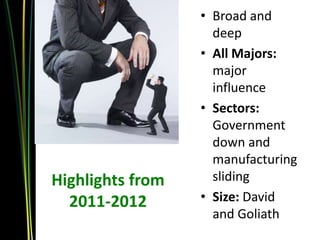
• Broad and
                    deep
                  • All Majors:
                    major
                    influence
                  • Sectors:
                    Government
                    down and
                    manufacturing
Highlights from     sliding
  2011-2012       • Size: David
                    and Goliath
SETTING THE STAGE FOR 2012-2013
Macro & Micro Events

    • Big Events
      –   European slide
      –   China: internal adjustments
      –   Energy: US back in the game
      –   Inflation
    • Fiscal Cliff
    • Micro events
      – Jobs
      – Consumers
      – Supply: too many
THE YEAR 2012-2013
Sitting On the Fence
• Winners                • Losers
  – Hospitals              –   Big Banks
  – Health care            –   Coal
  – Construction: Home     –   Big Energy
  – Construction:          –   Defense contractors
    Infrastructure         –   Luxury Goods Retailers
  – Alternative energy     –   Casinos
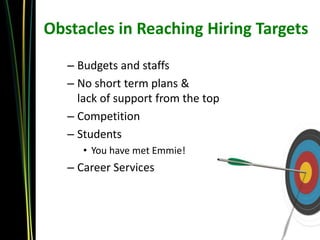
Obstacles in Reaching Hiring Targets
   – Budgets and staffs
   – No short term plans &
     lack of support from the top
   – Competition
   – Students
      • You have met Emmie!
   – Career Services
N-S-E-W

• Direction hiring is expected to take
  – Big shift from last year
  – Employer outlook continues to improve
  – My grass is greener than your grass!
  – Only 24% with definite plans (last year 42%)
  – 45% will increase the number of Bachelor
    hires this year – stays about the same
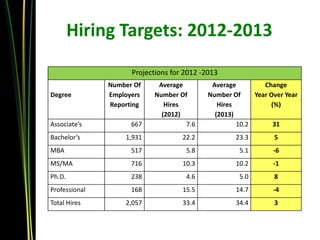
Hiring Targets: 2012-2013
                     Projections for 2012 -2013
               Number Of    Average          Average         Change
Degree         Employers   Number Of        Number Of     Year Over Year
               Reporting      Hires            Hires           (%)
                             (2012)           (2013)
Associate’s          667            7.6              10.2       31
Bachelor’s         1,931            22.2            23.3        5
MBA                  517             5.8             5.1        -6
MS/MA                716            10.3            10.2        -1
Ph.D.                238             4.6             5.0        8
Professional         168            15.5            14.7        -4
Total Hires        2,057            33.4            34.4        3
Good News: In Certain Places
• Organizational Size
  – Thanks for the little guy
  – Middle holds
  – Large companies sitting on the fence
• Economic Sector
  – Leading the charge: Oil, Financial Services,
    Wholesale, Construction, Retail, Transportation
  – Falling behind: Utilities, Ag (short-term),
    Information Services, Manufacturing, Health
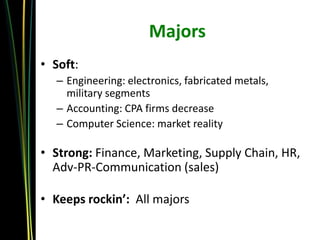
Majors
• Soft:
  – Engineering: electronics, fabricated metals,
    military segments
  – Accounting: CPA firms decrease
  – Computer Science: market reality

• Strong: Finance, Marketing, Supply Chain, HR,
  Adv-PR-Communication (sales)

• Keeps rockin’: All majors
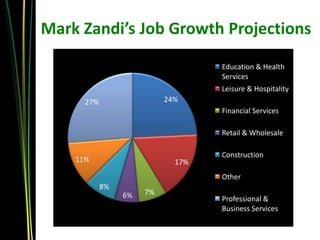
Mark Zandi’s Job Growth Projections
                                   Education & Health
                                   Services
                                   Leisure & Hospitality
      27%                  24%
                                   Financial Services

                                   Retail & Wholesale

                                   Construction
    11%                      17%
                                   Other
            8%
                 6%   7%
                                   Professional &
                                   Business Services
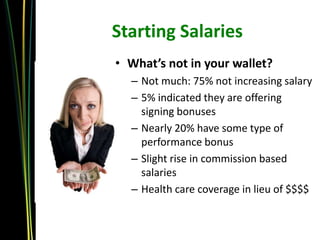
Starting Salaries
• What’s not in your wallet?
  – Not much: 75% not increasing salary
  – 5% indicated they are offering
    signing bonuses
  – Nearly 20% have some type of
    performance bonus
  – Slight rise in commission based
    salaries
  – Health care coverage in lieu of $$$$
Key Recruiting Strategies
• Internships
• Career Fairs
  – Mostly for finding interns
• Alumni from target schools (Bronco
  network)
• Social media
Internships

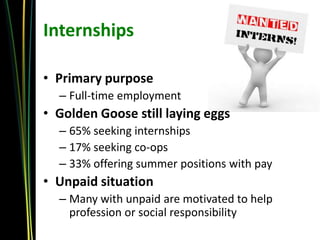
• Primary purpose
  – Full-time employment
• Golden Goose still laying eggs
  – 65% seeking internships
  – 17% seeking co-ops
  – 33% offering summer positions with pay
• Unpaid situation
  – Many with unpaid are motivated to help
    profession or social responsibility
Handling the skills shortage
• Training
• Technology (the next tragedy)
• Recruiting (the new time dimension)
Critical Issues
• Faculty
• Skills
• Attitudes and Behaviors
Employers’ Takes on Academia


Academic professors do not understand the critical
    business skills needed and provide poor
         counseling/advice to students.

      …many new grads are having difficulty
articulating the relevance of their study to the job
               they have applied to.
Employers’ Takes on the Skills Gap


      We need people who know how to
  use Excel and other professional programs,
        write professional documents,
    communicate in a professional manner,
        and have a basic knowledge of
     how a professional organization acts
Employers’ Takes on Attitude
   There is an overinflated sense of self and abilities…

College students have an attitude of entitlement that they
    are owed a job, and it should be at a specific dollar
 amount, even though they do not have a basis for that
                     dollar amount.

       Many candidates don’t project that they are
  interested, optimistic, and want to help the company
                          succeed.

[We have] retention issues because candidates resign due
 to business challenges being more than they expected or
              are willing to try to accomplish.
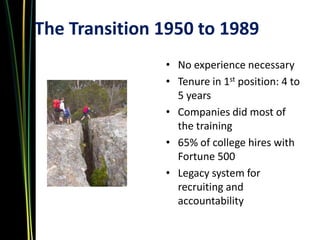
The Transition 1950 to 1989
               • No experience necessary
               • Tenure in 1st position: 4 to
                 5 years
               • Companies did most of
                 the training
               • 65% of college hires with
                 Fortune 500
               • Legacy system for
                 recruiting and
                 accountability
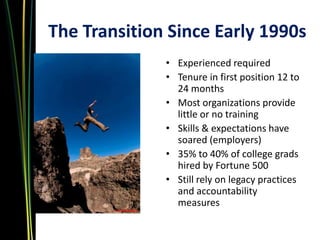
The Transition Since Early 1990s
              • Experienced required
              • Tenure in first position 12 to
                24 months
              • Most organizations provide
                little or no training
              • Skills & expectations have
                soared (employers)
              • 35% to 40% of college grads
                hired by Fortune 500
              • Still rely on legacy practices
                and accountability
                measures
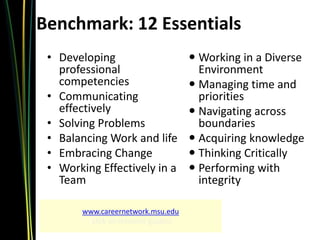
Benchmark: 12 Essentials
 • Developing                          Working in a Diverse
   professional                         Environment
   competencies                        Managing time and
 • Communicating                        priorities
   effectively                         Navigating across
 • Solving Problems                     boundaries
 • Balancing Work and life             Acquiring knowledge
 • Embracing Change                    Thinking Critically
 • Working Effectively in a            Performing with
   Team                                 integrity

        www.careernetwork.msu.edu
         (click on resource guides)
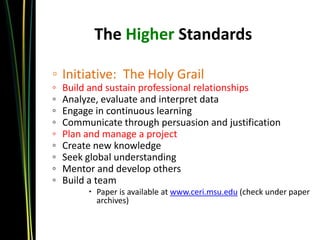
The Higher Standards

◦ Initiative: The Holy Grail
◦   Build and sustain professional relationships
◦   Analyze, evaluate and interpret data
◦   Engage in continuous learning
◦   Communicate through persuasion and justification
◦   Plan and manage a project
◦   Create new knowledge
◦   Seek global understanding
◦   Mentor and develop others
◦   Build a team
          Paper is available at www.ceri.msu.edu (check under paper
           archives)
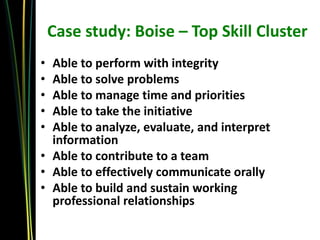
Case study: Boise – Top Skill Cluster
• Able to perform with integrity
• Able to solve problems
• Able to manage time and priorities
• Able to take the initiative
• Able to analyze, evaluate, and interpret
  information
• Able to contribute to a team
• Able to effectively communicate orally
• Able to build and sustain working
  professional relationships
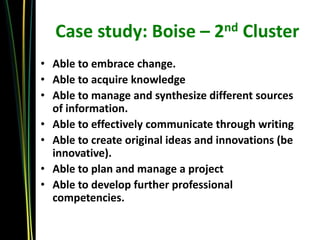
Case study: Boise – 2nd Cluster
• Able to embrace change.
• Able to acquire knowledge
• Able to manage and synthesize different sources
  of information.
• Able to effectively communicate through writing
• Able to create original ideas and innovations (be
  innovative).
• Able to plan and manage a project
• Able to develop further professional
  competencies.
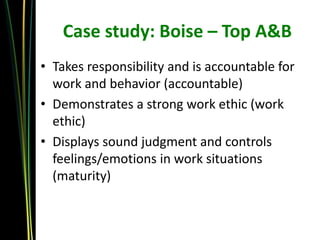
Case study: Boise – Top A&B
• Takes responsibility and is accountable for
  work and behavior (accountable)
• Demonstrates a strong work ethic (work
  ethic)
• Displays sound judgment and controls
  feelings/emotions in work situations
  (maturity)
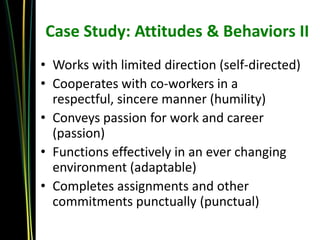
Case Study: Attitudes & Behaviors II
• Works with limited direction (self-directed)
• Cooperates with co-workers in a
  respectful, sincere manner (humility)
• Conveys passion for work and career
  (passion)
• Functions effectively in an ever changing
  environment (adaptable)
• Completes assignments and other
  commitments punctually (punctual)
WORKFORCE READINESS PROJECT
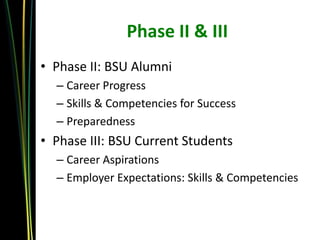
Phase II & III
• Phase II: BSU Alumni
  – Career Progress
  – Skills & Competencies for Success
  – Preparedness
• Phase III: BSU Current Students
  – Career Aspirations
  – Employer Expectations: Skills & Competencies
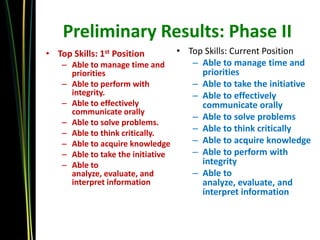
Preliminary Results: Phase II
• Top Skills: 1st Position          • Top Skills: Current Position
    –   Able to manage time and        – Able to manage time and
        priorities                       priorities
    –   Able to perform with           – Able to take the initiative
        integrity.                     – Able to effectively
    –   Able to effectively              communicate orally
        communicate orally
                                       – Able to solve problems
    –   Able to solve problems.
    –   Able to think critically.      – Able to think critically
    –   Able to acquire knowledge      – Able to acquire knowledge
    –   Able to take the initiative    – Able to perform with
    –   Able to                          integrity
        analyze, evaluate, and         – Able to
        interpret information            analyze, evaluate, and
                                         interpret information
Time to share

QUESTIONS & THOUGHTS
ceri.msu.edu

Boise trends 2013

  • 1.
    Dr. Philip Gardner CollegiateEmployment Research Institute ceri.msu.edu
  • 2.
    Today’s Agenda • Overviewof the College Labor Market – Snapshot of past three years – Focus on this year • The transition into the workplace – All about skills • The gatekeeper: internships • Workforce readiness project for the BV
  • 3.
    It’s was avery good year – except still not enough jobs A REVIEW OF YEARS PAST
  • 4.
    • Strong groupof outliers: big & small • No tail: clustered around no change • All majors in play • Tech fields slow; marketing & Highlights from sales 2010-2011 • West lagged behind
  • 5.
    • Broad and deep • All Majors: major influence • Sectors: Government down and manufacturing Highlights from sliding 2011-2012 • Size: David and Goliath
  • 6.
    SETTING THE STAGEFOR 2012-2013
  • 7.
    Macro & MicroEvents • Big Events – European slide – China: internal adjustments – Energy: US back in the game – Inflation • Fiscal Cliff • Micro events – Jobs – Consumers – Supply: too many
  • 9.
  • 10.
    Sitting On theFence • Winners • Losers – Hospitals – Big Banks – Health care – Coal – Construction: Home – Big Energy – Construction: – Defense contractors Infrastructure – Luxury Goods Retailers – Alternative energy – Casinos
  • 12.
    Obstacles in ReachingHiring Targets – Budgets and staffs – No short term plans & lack of support from the top – Competition – Students • You have met Emmie! – Career Services
  • 13.
    N-S-E-W • Direction hiringis expected to take – Big shift from last year – Employer outlook continues to improve – My grass is greener than your grass! – Only 24% with definite plans (last year 42%) – 45% will increase the number of Bachelor hires this year – stays about the same
  • 14.
    Hiring Targets: 2012-2013 Projections for 2012 -2013 Number Of Average Average Change Degree Employers Number Of Number Of Year Over Year Reporting Hires Hires (%) (2012) (2013) Associate’s 667 7.6 10.2 31 Bachelor’s 1,931 22.2 23.3 5 MBA 517 5.8 5.1 -6 MS/MA 716 10.3 10.2 -1 Ph.D. 238 4.6 5.0 8 Professional 168 15.5 14.7 -4 Total Hires 2,057 33.4 34.4 3
  • 15.
    Good News: InCertain Places • Organizational Size – Thanks for the little guy – Middle holds – Large companies sitting on the fence • Economic Sector – Leading the charge: Oil, Financial Services, Wholesale, Construction, Retail, Transportation – Falling behind: Utilities, Ag (short-term), Information Services, Manufacturing, Health
  • 16.
    Majors • Soft: – Engineering: electronics, fabricated metals, military segments – Accounting: CPA firms decrease – Computer Science: market reality • Strong: Finance, Marketing, Supply Chain, HR, Adv-PR-Communication (sales) • Keeps rockin’: All majors
  • 17.
    Mark Zandi’s JobGrowth Projections Education & Health Services Leisure & Hospitality 27% 24% Financial Services Retail & Wholesale Construction 11% 17% Other 8% 6% 7% Professional & Business Services
  • 18.
    Starting Salaries • What’snot in your wallet? – Not much: 75% not increasing salary – 5% indicated they are offering signing bonuses – Nearly 20% have some type of performance bonus – Slight rise in commission based salaries – Health care coverage in lieu of $$$$
  • 19.
    Key Recruiting Strategies •Internships • Career Fairs – Mostly for finding interns • Alumni from target schools (Bronco network) • Social media
  • 20.
    Internships • Primary purpose – Full-time employment • Golden Goose still laying eggs – 65% seeking internships – 17% seeking co-ops – 33% offering summer positions with pay • Unpaid situation – Many with unpaid are motivated to help profession or social responsibility
  • 21.
    Handling the skillsshortage • Training • Technology (the next tragedy) • Recruiting (the new time dimension)
  • 22.
    Critical Issues • Faculty •Skills • Attitudes and Behaviors
  • 23.
    Employers’ Takes onAcademia Academic professors do not understand the critical business skills needed and provide poor counseling/advice to students. …many new grads are having difficulty articulating the relevance of their study to the job they have applied to.
  • 24.
    Employers’ Takes onthe Skills Gap We need people who know how to use Excel and other professional programs, write professional documents, communicate in a professional manner, and have a basic knowledge of how a professional organization acts
  • 25.
    Employers’ Takes onAttitude There is an overinflated sense of self and abilities… College students have an attitude of entitlement that they are owed a job, and it should be at a specific dollar amount, even though they do not have a basis for that dollar amount. Many candidates don’t project that they are interested, optimistic, and want to help the company succeed. [We have] retention issues because candidates resign due to business challenges being more than they expected or are willing to try to accomplish.
  • 26.
    The Transition 1950to 1989 • No experience necessary • Tenure in 1st position: 4 to 5 years • Companies did most of the training • 65% of college hires with Fortune 500 • Legacy system for recruiting and accountability
  • 27.
    The Transition SinceEarly 1990s • Experienced required • Tenure in first position 12 to 24 months • Most organizations provide little or no training • Skills & expectations have soared (employers) • 35% to 40% of college grads hired by Fortune 500 • Still rely on legacy practices and accountability measures
  • 28.
    Benchmark: 12 Essentials • Developing  Working in a Diverse professional Environment competencies  Managing time and • Communicating priorities effectively  Navigating across • Solving Problems boundaries • Balancing Work and life  Acquiring knowledge • Embracing Change  Thinking Critically • Working Effectively in a  Performing with Team integrity www.careernetwork.msu.edu (click on resource guides)
  • 29.
    The Higher Standards ◦Initiative: The Holy Grail ◦ Build and sustain professional relationships ◦ Analyze, evaluate and interpret data ◦ Engage in continuous learning ◦ Communicate through persuasion and justification ◦ Plan and manage a project ◦ Create new knowledge ◦ Seek global understanding ◦ Mentor and develop others ◦ Build a team  Paper is available at www.ceri.msu.edu (check under paper archives)
  • 30.
    Case study: Boise– Top Skill Cluster • Able to perform with integrity • Able to solve problems • Able to manage time and priorities • Able to take the initiative • Able to analyze, evaluate, and interpret information • Able to contribute to a team • Able to effectively communicate orally • Able to build and sustain working professional relationships
  • 31.
    Case study: Boise– 2nd Cluster • Able to embrace change. • Able to acquire knowledge • Able to manage and synthesize different sources of information. • Able to effectively communicate through writing • Able to create original ideas and innovations (be innovative). • Able to plan and manage a project • Able to develop further professional competencies.
  • 32.
    Case study: Boise– Top A&B • Takes responsibility and is accountable for work and behavior (accountable) • Demonstrates a strong work ethic (work ethic) • Displays sound judgment and controls feelings/emotions in work situations (maturity)
  • 33.
    Case Study: Attitudes& Behaviors II • Works with limited direction (self-directed) • Cooperates with co-workers in a respectful, sincere manner (humility) • Conveys passion for work and career (passion) • Functions effectively in an ever changing environment (adaptable) • Completes assignments and other commitments punctually (punctual)
  • 34.
  • 35.
    Phase II &III • Phase II: BSU Alumni – Career Progress – Skills & Competencies for Success – Preparedness • Phase III: BSU Current Students – Career Aspirations – Employer Expectations: Skills & Competencies
  • 36.
    Preliminary Results: PhaseII • Top Skills: 1st Position • Top Skills: Current Position – Able to manage time and – Able to manage time and priorities priorities – Able to perform with – Able to take the initiative integrity. – Able to effectively – Able to effectively communicate orally communicate orally – Able to solve problems – Able to solve problems. – Able to think critically. – Able to think critically – Able to acquire knowledge – Able to acquire knowledge – Able to take the initiative – Able to perform with – Able to integrity analyze, evaluate, and – Able to interpret information analyze, evaluate, and interpret information
  • 37.
  • 38.