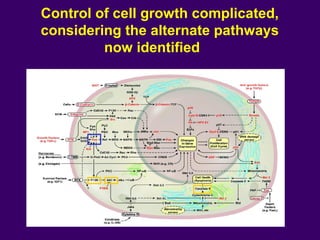
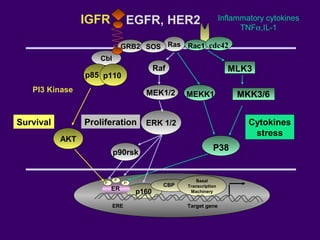
Control of cell growth complicated,
considering the alternate pathways
now identified
Src kinase activity
is essential for
focal adhesion
turnover
Focal adhesion
complex
Tumour
invasion
Cell-cell adhesion
weakening
Cadherins
Increased Src activity
Pre-invasive
tumour cell
growth
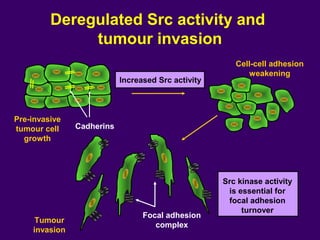
Deregulated Src activity and
tumour invasion
Gene Therapy
Gene therapy is still experimental
Gene therapy aims to supply defective
cells with healthy copies of missing or
altered genes.
If research proves successful, gene
therapy may be used in cancer and other
types of diseases
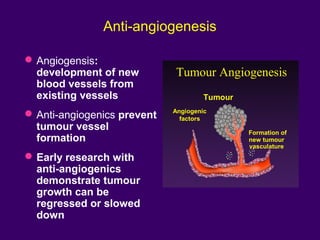
Anti-angiogenesis
Angiogensis:
development of new
blood vessels from
existing vessels
Anti-angiogenics prevent
tumour vessel
formation
Early research with
anti-angiogenics
demonstrate tumour
growth can be
regressed or slowed
down
Tumour Angiogenesis
Formation of
new tumour
vasculature
Tumour
Angiogenic
factors
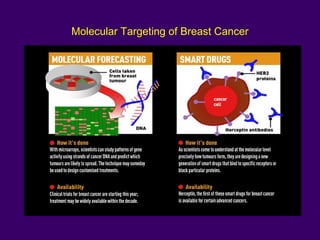
Molecular Targeting of Breast Cancer
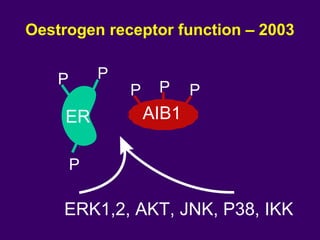
Oestrogen receptor function – 2003
ER
PP
P
P PP
AIB1
ERK1,2, AKT, JNK, P38, IKK
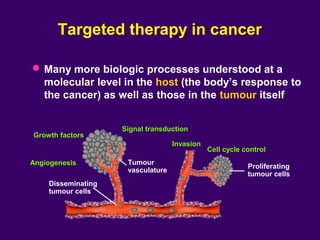
Targeted therapy in cancer
Many more biologic processes understood at a
molecular level in the host (the body’s response to
the cancer) as well as those in the tumour itself
Growth factors
Tumour
vasculature
Disseminating
tumour cells
Invasion
Cell cycle control
Proliferating
tumour cells
Angiogenesis
Signal transduction
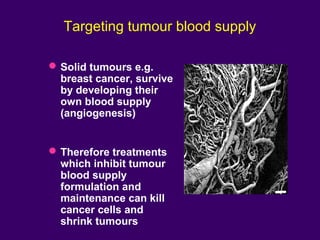
Targeting tumour blood supply
Solid tumours e.g.
breast cancer, survive
by developing their
own blood supply
(angiogenesis)
Therefore treatments
which inhibit tumour
blood supply
formulation and
maintenance can kill
cancer cells and
shrink tumours
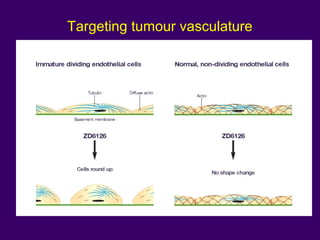
Targeting tumour vasculature
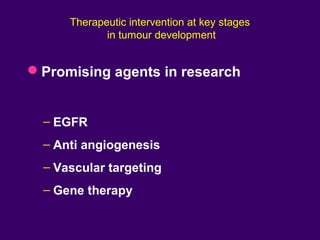
Therapeutic intervention at key stages
in tumour development
Promising agents in research
– EGFR
– Anti angiogenesis
– Vascular targeting
– Gene therapy
EGFR, HER2
Raf
MEK1/2
Ras
ERK 1/2
p90rsk
Cbl
AKT
GRB2 SOS
p110
PI3 Kinase
p85
p160ER
CBP
Basal
Transcription
Machinery
ERE Target gene
P
P
P
Rac1 cdc42
MLK3
MKK3/6MEKK1
P38
Survival
Inflammatory cytokines
TNFα,IL-1
IGFR
Proliferation Cytokines
stress

Newtargetsfortherapy

  • 1.
    Control of cellgrowth complicated, considering the alternate pathways now identified
  • 2.
    Src kinase activity isessential for focal adhesion turnover Focal adhesion complex Tumour invasion Cell-cell adhesion weakening Cadherins Increased Src activity Pre-invasive tumour cell growth Deregulated Src activity and tumour invasion
  • 3.
    Gene Therapy Gene therapyis still experimental Gene therapy aims to supply defective cells with healthy copies of missing or altered genes. If research proves successful, gene therapy may be used in cancer and other types of diseases
  • 4.
    Anti-angiogenesis Angiogensis: development of new bloodvessels from existing vessels Anti-angiogenics prevent tumour vessel formation Early research with anti-angiogenics demonstrate tumour growth can be regressed or slowed down Tumour Angiogenesis Formation of new tumour vasculature Tumour Angiogenic factors
  • 5.
  • 6.
    Oestrogen receptor function– 2003 ER PP P P PP AIB1 ERK1,2, AKT, JNK, P38, IKK
  • 7.
    Targeted therapy incancer Many more biologic processes understood at a molecular level in the host (the body’s response to the cancer) as well as those in the tumour itself Growth factors Tumour vasculature Disseminating tumour cells Invasion Cell cycle control Proliferating tumour cells Angiogenesis Signal transduction
  • 8.
    Targeting tumour bloodsupply Solid tumours e.g. breast cancer, survive by developing their own blood supply (angiogenesis) Therefore treatments which inhibit tumour blood supply formulation and maintenance can kill cancer cells and shrink tumours
  • 9.
  • 10.
    Therapeutic intervention atkey stages in tumour development Promising agents in research – EGFR – Anti angiogenesis – Vascular targeting – Gene therapy
  • 11.
    EGFR, HER2 Raf MEK1/2 Ras ERK 1/2 p90rsk Cbl AKT GRB2SOS p110 PI3 Kinase p85 p160ER CBP Basal Transcription Machinery ERE Target gene P P P Rac1 cdc42 MLK3 MKK3/6MEKK1 P38 Survival Inflammatory cytokines TNFα,IL-1 IGFR Proliferation Cytokines stress

Editor's Notes

  • #3 <number>
  • #8 <number>