FULLER CENTER FOR HOUSING ___________________________BUILDING ON HIGHER GROUND Issue 101
11
Fuller Center
for Housing
___________________________
Building on Higher Ground
26.01.2014
KNOW HOW IN THIS ISSUE
Why is it important that you and the people you
manage or supervise should know what the
world’s best practice methodologies are, with
regard to environmental monitoring in your
industry sector?
Protecting the environment is a priority for all
members of our society.
Increasingly, governments, industry and
community organisations are working as
partners to protect our environment for present
and future generations.
The concept of best practice is simply the best
way of working sustainably at a given site.
Present-day attitudes to environmental
protection are represented in the proposal of the
concept of sustainable development, of "triple
bottom line accounting", of cleaner production,
of life-cycle assessment to assess potential
impacts, of the precautionary principle as
defined in the Environment Protection and
Biodiversity Conservation Act 1999, and of
environmental impact assessment to advise
decision-makers and the broader community on
the potential negative as well as positive
outcomes of a proposed development. All of
these are relevant to the construction industry,
and extend from the pre-build planning phase,
through construction, equipping, and handover
to post-build stewardship.
The benefits of best practice include preventing
harmful environmental and social impacts,
greater certainty of outcomes in the project
application stage, lower risk of non-compliance,
greater acceptance/less resistance from key
stakeholders (in particular local communities
and nearby land owners), lower financial
burdens in development and construction
phases, and lower risk of significant liabilities
post-dedication and handover.
Costs of environmental management are
commonly lower when measures are
incorporated at the planning stage instead of
retrofitting and redesigning systems later in the
life of the mine. Whilst it is not easy to quantify
the costs of best practice, it is easy to see that
the up-front costs of incorporating best practice
into a project reaps long term gains for the
individual project in terms of regulatory
performance and lower potential liabilities.
At the broader level, widespread adoption of
best practice environmental management
techniques will translate into long term gains for
the industry through greater certainty for access
to land and project approvals, improved
relationships with regulatory authorities,
acceptance by the community, and lower levels
of risk to the environment. More info at:
http://www.environment.gov.au/settlements/
Doing Better Doing Good
How volunteering impacts on what people do in
their everyday working lives.
Page #
Toolkit for TQM
What you need to know to do the best you can for the
people who matter in your life
Page #
Schools In
What you will learn at Fuller Center 101
Page #
Best Practices
How you can be resourceful
Page #
Valuable Vollys
We value our volunteers
Page #
Best Practice Methodologies
by Rod Hyatt
FULLER CENTER FOR HOUSING ___________________________BUILDING ON HIGHER GROUND | Issue 101 2
Goals are the basis of an effective life.
There are two key elements to consider
when developing goals. First, are your
goals written clearly and objectively?
Second, are they directly contributing to
the achievement of your life?
Providing visibility to goals set furthers
alignment.
Goals should be set that not only address
what is expected, but also how it will be
achieved. For example, the "what" covers
quality or quantity expected, deadlines to
be met, cost to deliver, etc. The "how"
refers to the behaviour that will achieve
outcomes.
A framework to use to help you write
effective goals is the "SMART" goal:
S – Specific,
M – Measurable,
A - Achievable/Attainable,
R - Results oriented/Realistic/Relevant,
T - Time bound
Making a goal specific, measurable, and
time bound contributes to the ability to
make progress on the goal and track that
progress. Some choose to further define
goals with a start and finish date with
milestones in between.
As we have mentioned, goals must be
achievable and realistic. An unachievable
goal is just that.
You know deep down when you don’t
stand a chance of reaching it, and your
efforts to achieve the goal will be
affected. In addition, goals must reflect
conditions that are under your control
and the R's (results oriented, realistic and
relevant) should definitely consider these
conditions. Sometimes the focus on the
outcome of the goals can overshadow the
necessary steps to achieve them.
Action plans to support each goal can
include documentation of the steps
necessary to achieve a goal. By keeping
goals relevant, you reinforce the
importance of linking to strategic
objectives and communicating why the
goal is important.
We welcome SMART volunteers whose
goals are aligned with ours and trust that
your life will be enriched through your
volunteer experience with Fuller Center
for Housing.
JOIN US
A learning experience that will equip you
for life …
FULLER CENTER 101
Colint296@gmail.com
Volunteers come from all walks of life. You never
know why they come or who will be wielding a paint
brush or a hammer beside you on site. It could be an
Ex-President or a Rock Star.
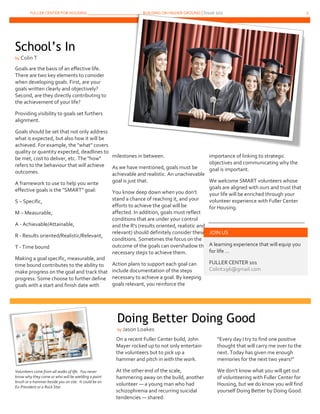
On a recent Fuller Center build, John
Mayer rocked up to not only entertain
the volunteers but to pick up a
hammer and pitch in with the work.
At the other end of the scale,
hammering away on the build, another
volunteer — a young man who had
schizophrenia and recurring suicidal
tendencies — shared:
“Every day I try to find one positive
thought that will carry me over to the
next. Today has given me enough
memories for the next two years!”
We don’t know what you will get out
of volunteering with Fuller Center for
Housing, but we do know you will find
yourself Doing Better by Doing Good.
School’s In
by Colin T
Doing Better Doing Good
by Jason Loakes
FULLER CENTER FOR HOUSING ___________________________BUILDING ON HIGHER GROUND | Issue 101 3
Don’t Trash It!
A few common Recyclable materials:
Glass, paper, cardboard, metal, plastic,
textiles, organics, and electronics.
FIGURE IT OUT
68%68% less energy is required to recycle
paper compared with making it from raw
materials, and think about all the trees
that would stay alive.
42%
Recycling to save resources!
How can we define RECYCLING?
Recycling involves processing used
materials into new products in order to
prevent waste of potentially useful
materials, reduce the consumption of
fresh raw materials, reduce energy
usage, reduce air pollution (from
incineration) and water pollution (from
land filling) by reducing the need for
"conventional" waste disposal, and
lower greenhouse gas emissions as
compared to virgin production.
Recycling is a key component of modern
waste management and is the third
component of the Reduce, Reuse,
Recycle" waste hierarchy. .
Unfortunately, most of the provided raw
materials on Planet Earth are not usable
as they appear in Nature and are spread
globally in deposits.
Workers need to use a lot of energy and
resources to produce the materials we
need. They collect, clean, concentrate,
and transform these resources to
generate materials that are usable for
people and industry. Using recycled
materials reduces the amount of
materials we have to dig out and the
amount of energy needed!
Most of all things we use can be
recycled!
Most of what we throw away is made
from materials that are slowly running
out or cannot be replaced quickly
enough because of the amount we
consume.
Many of the products we throw into
landfills have a value and can be used /
recycled again.
How much do you know
about Recycling?
Do you know
Recycling can lower
your gasoline
prices?
Most of all metals,
most of all glass,
most of all
plastics, most of
all paper products, most
of all organic materials can
be recycled!
When you recycle organic waste on a
compost pile you can make compost
from kitchen and garden. Composting
green waste saves valuable space in
landfills which is running out.
Making new goods out of recycled
material saves energy. Making new
aluminium cans from recycled cans uses
20 times less energy than making cans
from the raw material.
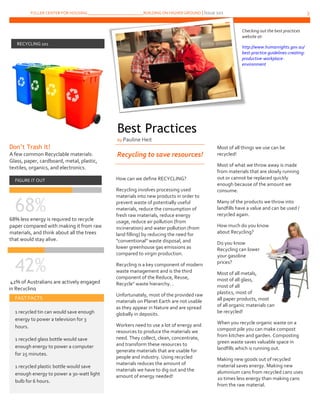
RECYCLING 101
FAST FACTS
1 recycled tin can would save enough
energy to power a television for 3
hours.
1 recycled glass bottle would save
enough energy to power a computer
for 25 minutes.
1 recycled plastic bottle would save
enough energy to power a 30-watt light
bulb for 6 hours.
Best Practices
by Pauline Heit
42% of Australians are actively engaged
in Recycling
Checking out the best practices
website at:
http://www.humanrights.gov.au/
best-practice-guidelines-creating-
productive-workplace-
environment
FULLER CENTER FOR HOUSING ___________________________BUILDING ON HIGHER GROUND | Issue 101 4
Continuous improvement, based on a
Japanese concept “kaizen”, is the philosophy
of continually seeking ways to improve
processes. It involves identifying benchmarks
of excellent practice and instilling a sense of
worker ownership in the process. The bases
of continuous improvement philosophy are
the beliefs that virtually any aspect of a
process can be improved and that the people
most closely associated with a process are in
the best position to identify changes that
should be made.
An approach in problem solving with
continuous improvement in mind is the plan-
do-study-act cycle, also known as the
Deming Wheel.
Valuable Vollys
by Andy Graham
A Guide for the Confused
FCHQA is a NFP NGO that helps the PAN by
building ADH. There are many ways for VAH
to support the cause. You can give $$$, GIK
or get involved physically by joining a CHB or
maybe you would like to be a SHARP or wield
a BWK. If overseas is more your style you can
join a GB trip to Sri Lanka or one of 16 other
OSC in which FCHQA operates; or in October
you could become a part of a JCWP with our
sister organisation HFHI. If you are a
younger person you can be involved through
a CC or a SB. For the grey nomads there is
CAV: for those of the female persuasion
there are WBs and for those interested in CR
there are ABs, FB s and even IFB s. All our
HOPs need HE and this is where you can lend
your teaching skills, or you might like to be
involved in outreach through being a GT or a
GS for SACCs. If you are comfortable around
CTs and PDs then you can be involved in LAD
or CSR programs. Of course when disaster
strikes we can all be involved in DR to RRR
and get behind FR efforts.
The cycle comprises the following steps:
Plan - the team selects a process that needs
improvement. The team then documents the
selected process, sets qualitative goals for
improvement, and discusses various ways to
achieve the goals. After assessing the
benefits and costs of the alternatives, the
team develops a plan with quantifiable
measures for improvement.
Do - the team implements the plan and
monitors progress. Data is collected
continuously to measure the improvements
in the process. Any changes in the process
are documented and further revisions are
made as needed.
FCHQA Fuller Center for Housing,
Queensland, Australia
NFP Not for Profit
NGO Non Government
Organisation
PAN Poor and Needy
ADH Affordable Decent Homes
VAH Volunteers and Helpers
GIK Gifts In Kind
CHB Community House Build
SHARP Seniors Helping Aged Retired
Persons
FUG Fuller Urban Gardener
BWK Brush with Kindness
GB Global Builders
OSC Overseas Communities
Study - the team analyses the data collected
during the ‘do' step to find out how closely
the results correspond to the goals set in the
plan step. If major shortcomings exist, the
team re-evaluates the plan or ceases the
project.
Act - if the results are successful, the team
documents the revised process so that it
becomes the standard procedure for all who
may use it. The team may then instruct other
workers in the use of the revised process
.
JCWP Jimmy
Carter Work Project
HFHI Habitat For
Humanity
CC Campus
Chapter
SB Student
Builders
CAV Care-a-
Vanners
WB Women
Build
CR Church
Relations
AB Apostle Build
FB Faith Build
IFB Inter Faith Build
HOP Home Owner Partner
HE Homeowner Education
GT Guest Teacher
GS Guest Speaker
SACC Service & Community Clubs
CT Corporate Type
PD Property Developer
LAD Land Acquisition &
Development
CSR Corporate Social
Responsibility
DR Disaster Response
RRR Restore, Rebuild and Recycle
FR Fund Raising
FOR MORE INFORMATION
Need to know more about how TQM can
improve every area of your life?
EMAIL
Macmckenna72@gmail.com
Toolkit for TQM
by Mal McKenna
FULLER CENTER FOR HOUSING ___________________________BUILDING ON HIGHER GROUND | Issue 101 5
VOLUNTEERS IN ACTION
Safety Briefing
All volunteers are briefed on the build and
checked out on safety issues before work
starts.
Campus Chapters
Students at Universities in Brisbane can
start or join Campus Chapters to get
involved in Fundraising, Advocacy and
training for builds.
FAST FACTS
98%Volunteers who love our onsite catering
8%Volunteers who have special diet needs
FOR MORE INFORMATION
Dietician Joyce has had a lifetime
interest in making sure volunteers
are well nourished.
foodsthegame@hotmail.com
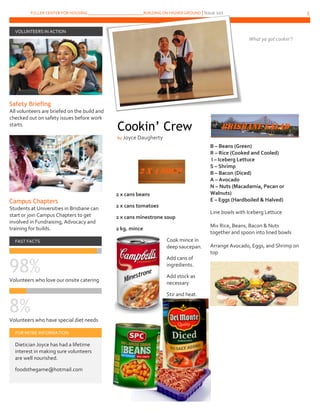
2 x 4 Soup
2 x cans beans
2 x cans tomatoes
2 x cans minestrone soup
2 kg. mince
Cook mince in
deep saucepan.
Add cans of
ingredients.
Add stock as
necessary
Stir and heat.
Cookin’ Crew
by Joyce Daugherty
What ya got cookin’?
Brisbane Salad
B – Beans (Green)
R – Rice (Cooked and Cooled)
I – Iceberg Lettuce
S – Shrimp
B – Bacon (Diced)
A – Avocado
N – Nuts (Macadamia, Pecan or
Walnuts)
E – Eggs (Hardboiled & Halved)
Line bowls with Iceberg Lettuce
Mix Rice, Beans, Bacon & Nuts
together and spoon into lined bowls
Arrange Avocado, Eggs, and Shrimp on
top
FULLER CENTER FOR HOUSING ___________________________BUILDING ON HIGHER GROUND Issue 101
11
Fuller Center for Housing
___________________________
Building on Higher Ground
Brisbane, Queensland,
4000, Australia
To:
Fuller Center for Housing
MISSION STATEMENT
The Fuller Center for Housing, faith driven and Christ centered, promotes collaborative
and innovative partnerships with individuals and organizations in an unrelenting quest
to provide adequate shelter for all people in need worldwide.
FOUNDATIONAL PRINCIPLES
We at the Fuller Center for Housing believe that:
 We are part of a God movement, and movements don't just stop.
 We have been called to this housing ministry; we didn't just stumble into it.
 We are unashamedly Christian, and enthusiastically ecumenical.
 We aren't a church but we are a servant of the Church.
 We are faith driven, knowing that after we've done all we can do the Lord will
help finish the job—something that requires us to stretch beyond our rational
reach.
 We are a grassroots ministry, recognizing that the real work happens on the
ground in communities around the world through our covenant partners, so a
large, overseeing bureaucracy isn’t needed.
 We try to follow the teachings of the Bible and believe that it says that we
shouldn't charge interest of the poor, so we don't.
 Government has a role in our work in helping set the stage, but that we
shouldn’t look to it as a means to fund the building of home.

Newsletter1

  • 1.
    FULLER CENTER FORHOUSING ___________________________BUILDING ON HIGHER GROUND Issue 101 11 Fuller Center for Housing ___________________________ Building on Higher Ground 26.01.2014 KNOW HOW IN THIS ISSUE Why is it important that you and the people you manage or supervise should know what the world’s best practice methodologies are, with regard to environmental monitoring in your industry sector? Protecting the environment is a priority for all members of our society. Increasingly, governments, industry and community organisations are working as partners to protect our environment for present and future generations. The concept of best practice is simply the best way of working sustainably at a given site. Present-day attitudes to environmental protection are represented in the proposal of the concept of sustainable development, of "triple bottom line accounting", of cleaner production, of life-cycle assessment to assess potential impacts, of the precautionary principle as defined in the Environment Protection and Biodiversity Conservation Act 1999, and of environmental impact assessment to advise decision-makers and the broader community on the potential negative as well as positive outcomes of a proposed development. All of these are relevant to the construction industry, and extend from the pre-build planning phase, through construction, equipping, and handover to post-build stewardship. The benefits of best practice include preventing harmful environmental and social impacts, greater certainty of outcomes in the project application stage, lower risk of non-compliance, greater acceptance/less resistance from key stakeholders (in particular local communities and nearby land owners), lower financial burdens in development and construction phases, and lower risk of significant liabilities post-dedication and handover. Costs of environmental management are commonly lower when measures are incorporated at the planning stage instead of retrofitting and redesigning systems later in the life of the mine. Whilst it is not easy to quantify the costs of best practice, it is easy to see that the up-front costs of incorporating best practice into a project reaps long term gains for the individual project in terms of regulatory performance and lower potential liabilities. At the broader level, widespread adoption of best practice environmental management techniques will translate into long term gains for the industry through greater certainty for access to land and project approvals, improved relationships with regulatory authorities, acceptance by the community, and lower levels of risk to the environment. More info at: http://www.environment.gov.au/settlements/ Doing Better Doing Good How volunteering impacts on what people do in their everyday working lives. Page # Toolkit for TQM What you need to know to do the best you can for the people who matter in your life Page # Schools In What you will learn at Fuller Center 101 Page # Best Practices How you can be resourceful Page # Valuable Vollys We value our volunteers Page # Best Practice Methodologies by Rod Hyatt
  • 2.
    FULLER CENTER FORHOUSING ___________________________BUILDING ON HIGHER GROUND | Issue 101 2 Goals are the basis of an effective life. There are two key elements to consider when developing goals. First, are your goals written clearly and objectively? Second, are they directly contributing to the achievement of your life? Providing visibility to goals set furthers alignment. Goals should be set that not only address what is expected, but also how it will be achieved. For example, the "what" covers quality or quantity expected, deadlines to be met, cost to deliver, etc. The "how" refers to the behaviour that will achieve outcomes. A framework to use to help you write effective goals is the "SMART" goal: S – Specific, M – Measurable, A - Achievable/Attainable, R - Results oriented/Realistic/Relevant, T - Time bound Making a goal specific, measurable, and time bound contributes to the ability to make progress on the goal and track that progress. Some choose to further define goals with a start and finish date with milestones in between. As we have mentioned, goals must be achievable and realistic. An unachievable goal is just that. You know deep down when you don’t stand a chance of reaching it, and your efforts to achieve the goal will be affected. In addition, goals must reflect conditions that are under your control and the R's (results oriented, realistic and relevant) should definitely consider these conditions. Sometimes the focus on the outcome of the goals can overshadow the necessary steps to achieve them. Action plans to support each goal can include documentation of the steps necessary to achieve a goal. By keeping goals relevant, you reinforce the importance of linking to strategic objectives and communicating why the goal is important. We welcome SMART volunteers whose goals are aligned with ours and trust that your life will be enriched through your volunteer experience with Fuller Center for Housing. JOIN US A learning experience that will equip you for life … FULLER CENTER 101 Colint296@gmail.com Volunteers come from all walks of life. You never know why they come or who will be wielding a paint brush or a hammer beside you on site. It could be an Ex-President or a Rock Star. On a recent Fuller Center build, John Mayer rocked up to not only entertain the volunteers but to pick up a hammer and pitch in with the work. At the other end of the scale, hammering away on the build, another volunteer — a young man who had schizophrenia and recurring suicidal tendencies — shared: “Every day I try to find one positive thought that will carry me over to the next. Today has given me enough memories for the next two years!” We don’t know what you will get out of volunteering with Fuller Center for Housing, but we do know you will find yourself Doing Better by Doing Good. School’s In by Colin T Doing Better Doing Good by Jason Loakes
  • 3.
    FULLER CENTER FORHOUSING ___________________________BUILDING ON HIGHER GROUND | Issue 101 3 Don’t Trash It! A few common Recyclable materials: Glass, paper, cardboard, metal, plastic, textiles, organics, and electronics. FIGURE IT OUT 68%68% less energy is required to recycle paper compared with making it from raw materials, and think about all the trees that would stay alive. 42% Recycling to save resources! How can we define RECYCLING? Recycling involves processing used materials into new products in order to prevent waste of potentially useful materials, reduce the consumption of fresh raw materials, reduce energy usage, reduce air pollution (from incineration) and water pollution (from land filling) by reducing the need for "conventional" waste disposal, and lower greenhouse gas emissions as compared to virgin production. Recycling is a key component of modern waste management and is the third component of the Reduce, Reuse, Recycle" waste hierarchy. . Unfortunately, most of the provided raw materials on Planet Earth are not usable as they appear in Nature and are spread globally in deposits. Workers need to use a lot of energy and resources to produce the materials we need. They collect, clean, concentrate, and transform these resources to generate materials that are usable for people and industry. Using recycled materials reduces the amount of materials we have to dig out and the amount of energy needed! Most of all things we use can be recycled! Most of what we throw away is made from materials that are slowly running out or cannot be replaced quickly enough because of the amount we consume. Many of the products we throw into landfills have a value and can be used / recycled again. How much do you know about Recycling? Do you know Recycling can lower your gasoline prices? Most of all metals, most of all glass, most of all plastics, most of all paper products, most of all organic materials can be recycled! When you recycle organic waste on a compost pile you can make compost from kitchen and garden. Composting green waste saves valuable space in landfills which is running out. Making new goods out of recycled material saves energy. Making new aluminium cans from recycled cans uses 20 times less energy than making cans from the raw material. RECYCLING 101 FAST FACTS 1 recycled tin can would save enough energy to power a television for 3 hours. 1 recycled glass bottle would save enough energy to power a computer for 25 minutes. 1 recycled plastic bottle would save enough energy to power a 30-watt light bulb for 6 hours. Best Practices by Pauline Heit 42% of Australians are actively engaged in Recycling Checking out the best practices website at: http://www.humanrights.gov.au/ best-practice-guidelines-creating- productive-workplace- environment
  • 4.
    FULLER CENTER FORHOUSING ___________________________BUILDING ON HIGHER GROUND | Issue 101 4 Continuous improvement, based on a Japanese concept “kaizen”, is the philosophy of continually seeking ways to improve processes. It involves identifying benchmarks of excellent practice and instilling a sense of worker ownership in the process. The bases of continuous improvement philosophy are the beliefs that virtually any aspect of a process can be improved and that the people most closely associated with a process are in the best position to identify changes that should be made. An approach in problem solving with continuous improvement in mind is the plan- do-study-act cycle, also known as the Deming Wheel. Valuable Vollys by Andy Graham A Guide for the Confused FCHQA is a NFP NGO that helps the PAN by building ADH. There are many ways for VAH to support the cause. You can give $$$, GIK or get involved physically by joining a CHB or maybe you would like to be a SHARP or wield a BWK. If overseas is more your style you can join a GB trip to Sri Lanka or one of 16 other OSC in which FCHQA operates; or in October you could become a part of a JCWP with our sister organisation HFHI. If you are a younger person you can be involved through a CC or a SB. For the grey nomads there is CAV: for those of the female persuasion there are WBs and for those interested in CR there are ABs, FB s and even IFB s. All our HOPs need HE and this is where you can lend your teaching skills, or you might like to be involved in outreach through being a GT or a GS for SACCs. If you are comfortable around CTs and PDs then you can be involved in LAD or CSR programs. Of course when disaster strikes we can all be involved in DR to RRR and get behind FR efforts. The cycle comprises the following steps: Plan - the team selects a process that needs improvement. The team then documents the selected process, sets qualitative goals for improvement, and discusses various ways to achieve the goals. After assessing the benefits and costs of the alternatives, the team develops a plan with quantifiable measures for improvement. Do - the team implements the plan and monitors progress. Data is collected continuously to measure the improvements in the process. Any changes in the process are documented and further revisions are made as needed. FCHQA Fuller Center for Housing, Queensland, Australia NFP Not for Profit NGO Non Government Organisation PAN Poor and Needy ADH Affordable Decent Homes VAH Volunteers and Helpers GIK Gifts In Kind CHB Community House Build SHARP Seniors Helping Aged Retired Persons FUG Fuller Urban Gardener BWK Brush with Kindness GB Global Builders OSC Overseas Communities Study - the team analyses the data collected during the ‘do' step to find out how closely the results correspond to the goals set in the plan step. If major shortcomings exist, the team re-evaluates the plan or ceases the project. Act - if the results are successful, the team documents the revised process so that it becomes the standard procedure for all who may use it. The team may then instruct other workers in the use of the revised process . JCWP Jimmy Carter Work Project HFHI Habitat For Humanity CC Campus Chapter SB Student Builders CAV Care-a- Vanners WB Women Build CR Church Relations AB Apostle Build FB Faith Build IFB Inter Faith Build HOP Home Owner Partner HE Homeowner Education GT Guest Teacher GS Guest Speaker SACC Service & Community Clubs CT Corporate Type PD Property Developer LAD Land Acquisition & Development CSR Corporate Social Responsibility DR Disaster Response RRR Restore, Rebuild and Recycle FR Fund Raising FOR MORE INFORMATION Need to know more about how TQM can improve every area of your life? EMAIL Macmckenna72@gmail.com Toolkit for TQM by Mal McKenna
  • 5.
    FULLER CENTER FORHOUSING ___________________________BUILDING ON HIGHER GROUND | Issue 101 5 VOLUNTEERS IN ACTION Safety Briefing All volunteers are briefed on the build and checked out on safety issues before work starts. Campus Chapters Students at Universities in Brisbane can start or join Campus Chapters to get involved in Fundraising, Advocacy and training for builds. FAST FACTS 98%Volunteers who love our onsite catering 8%Volunteers who have special diet needs FOR MORE INFORMATION Dietician Joyce has had a lifetime interest in making sure volunteers are well nourished. foodsthegame@hotmail.com 2 x 4 Soup 2 x cans beans 2 x cans tomatoes 2 x cans minestrone soup 2 kg. mince Cook mince in deep saucepan. Add cans of ingredients. Add stock as necessary Stir and heat. Cookin’ Crew by Joyce Daugherty What ya got cookin’? Brisbane Salad B – Beans (Green) R – Rice (Cooked and Cooled) I – Iceberg Lettuce S – Shrimp B – Bacon (Diced) A – Avocado N – Nuts (Macadamia, Pecan or Walnuts) E – Eggs (Hardboiled & Halved) Line bowls with Iceberg Lettuce Mix Rice, Beans, Bacon & Nuts together and spoon into lined bowls Arrange Avocado, Eggs, and Shrimp on top
  • 6.
    FULLER CENTER FORHOUSING ___________________________BUILDING ON HIGHER GROUND Issue 101 11 Fuller Center for Housing ___________________________ Building on Higher Ground Brisbane, Queensland, 4000, Australia To: Fuller Center for Housing MISSION STATEMENT The Fuller Center for Housing, faith driven and Christ centered, promotes collaborative and innovative partnerships with individuals and organizations in an unrelenting quest to provide adequate shelter for all people in need worldwide. FOUNDATIONAL PRINCIPLES We at the Fuller Center for Housing believe that:  We are part of a God movement, and movements don't just stop.  We have been called to this housing ministry; we didn't just stumble into it.  We are unashamedly Christian, and enthusiastically ecumenical.  We aren't a church but we are a servant of the Church.  We are faith driven, knowing that after we've done all we can do the Lord will help finish the job—something that requires us to stretch beyond our rational reach.  We are a grassroots ministry, recognizing that the real work happens on the ground in communities around the world through our covenant partners, so a large, overseeing bureaucracy isn’t needed.  We try to follow the teachings of the Bible and believe that it says that we shouldn't charge interest of the poor, so we don't.  Government has a role in our work in helping set the stage, but that we shouldn’t look to it as a means to fund the building of home.