By: Dahlia Reinn P. Rosales
Make sure your article is well written.
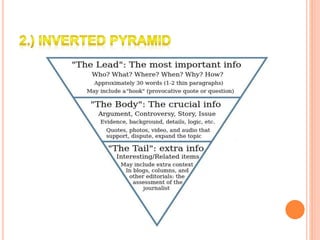
Follow the “Inverted Pyramid”.
Answer the questions; who, what,
where, why, when and how.
Always make 5-7 paragraphs
Compile your facts
Create an article outline
Find the right angle
Always put periods and comma’s in
right positions
Who – “who was involved?”
What – “what happened?”
Where – “where did it happen?”
Why – “why did it happen?”
When – “when did it happen?”
How – “how did it happen?”
COMPILE YOUR FACTS:
GET SOME FACTS ABOUT THE NEWS YOU ARE
MAKING.
CREATE AN OUTLINE:
YOU NEED TO CREATE AN OUTLINE OF YOUR
WORK IN ORDER TO SEQUENCE THE RIGHT
INFORMATION.
FINDING THE RIGHT ANGLE:
JUST BEFORE YOU WRITE, THINK ABOUT YOUR
TOPIC SO YOU WILL BE IN SHAPE, ADJUST IF
YOU HAVE ANY CORRECTIONS.
KINDS OF NEWS LEADS
 “How lead” - begins with the how of the
story. Used often.
 “Why lead” - begins with the cause the
story. Used often.
 “What lead” - begins with the fact of the
story. Used often.
 Don't write anything you wouldn't want someone to
read.
 Don't write gossips and lies. That will hurt people's
feelings and you might get in trouble for it.
 Edit carefully, no one wants to read something that
is full of spelling errors and bad grammar.
 Checklist for News Stories
 Are the most important and recent facts
first?
 Is the story accurate?
 Are the sources identified fully?
 Are the paragraphs full enough?
 Is the sentence structure varied in the
story?
 Is the story neat and double-spaced so that
it is easy to read?
 Does your story flow? Did you use the
transition/ quote formula?
 Did you use active voice?
News making (in journalism)

News making (in journalism)

  • 1.
    By: Dahlia ReinnP. Rosales
  • 2.
    Make sure yourarticle is well written. Follow the “Inverted Pyramid”. Answer the questions; who, what, where, why, when and how. Always make 5-7 paragraphs Compile your facts Create an article outline Find the right angle Always put periods and comma’s in right positions
  • 5.
    Who – “whowas involved?” What – “what happened?” Where – “where did it happen?” Why – “why did it happen?” When – “when did it happen?” How – “how did it happen?”
  • 6.
    COMPILE YOUR FACTS: GETSOME FACTS ABOUT THE NEWS YOU ARE MAKING. CREATE AN OUTLINE: YOU NEED TO CREATE AN OUTLINE OF YOUR WORK IN ORDER TO SEQUENCE THE RIGHT INFORMATION. FINDING THE RIGHT ANGLE: JUST BEFORE YOU WRITE, THINK ABOUT YOUR TOPIC SO YOU WILL BE IN SHAPE, ADJUST IF YOU HAVE ANY CORRECTIONS.
  • 7.
    KINDS OF NEWSLEADS  “How lead” - begins with the how of the story. Used often.  “Why lead” - begins with the cause the story. Used often.  “What lead” - begins with the fact of the story. Used often.
  • 8.
     Don't writeanything you wouldn't want someone to read.  Don't write gossips and lies. That will hurt people's feelings and you might get in trouble for it.  Edit carefully, no one wants to read something that is full of spelling errors and bad grammar.
  • 9.
     Checklist forNews Stories  Are the most important and recent facts first?  Is the story accurate?  Are the sources identified fully?  Are the paragraphs full enough?  Is the sentence structure varied in the story?  Is the story neat and double-spaced so that it is easy to read?  Does your story flow? Did you use the transition/ quote formula?  Did you use active voice?