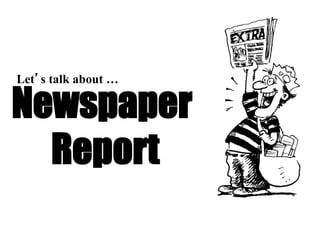
Newspaper
Report
Let’s talk about …
News Writing …
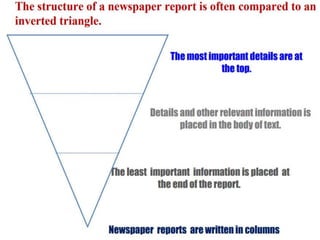
gives the reader information that will
impact them in some way. It usually
flows from most important to least
important.
“What is news? It is information only.” -
Walter Cronkite, former CBS News
anchor
Checklist for News Stories
 Are the most important and recent facts first?
 Is the story accurate? Are the sources identified
fully?
 Are the paragraphs short?
 Is the sentence structure varied in the story?
 Is the story neat and double-spaced so that it is easy
to read?
Does your story flow? Did you use the
transition/quote formula?
 Did you use active voice?
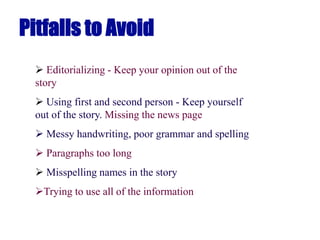
Pitfalls to Avoid
 Editorializing - Keep your opinion out of the
story
 Using first and second person - Keep yourself
out of the story. Missing the news page
 Messy handwriting, poor grammar and spelling
 Paragraphs too long
 Misspelling names in the story
Trying to use all of the information
Let’s start at
the beginning
with … LEADS.
Leads
Let’s talk about
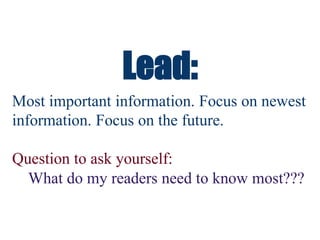
Lead:
Most important information. Focus on newest
information. Focus on the future.
Question to ask yourself:
What do my readers need to know most???
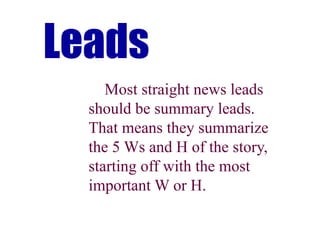
Leads
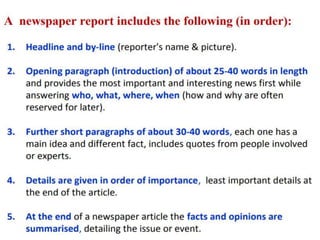
Most straight news leads
should be summary leads.
That means they summarize
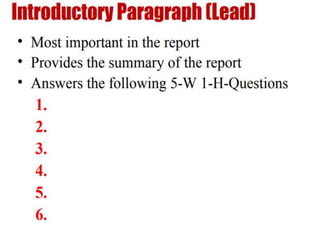
the 5 Ws and H of the story,
starting off with the most
important W or H.
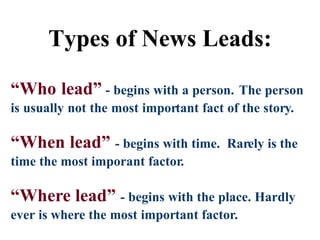
Types of News Leads:
Rarely use these...
“Who lead” - begins with a person. The person
is usually not the most important fact of the story.
“When lead” - begins with time. Rarely is the
time the most imporant factor.
“Where lead” - begins with the place. Hardly
ever is where the most important factor.
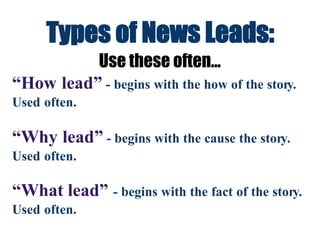
Types of News Leads:
Use these often...
“How lead” - begins with the how of the story.
Used often.
“Why lead” - begins with the cause the story.
Used often.
“What lead” - begins with the fact of the story.
Used often.
Direct
Quotes
Let’s talk about
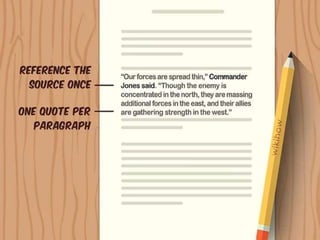
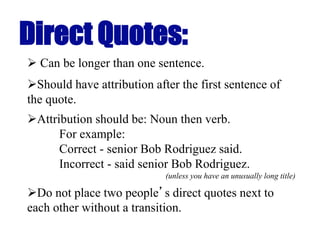
 Can be longer than one sentence.
Direct Quotes:
Should have attribution after the first sentence of
the quote.
Attribution should be: Noun then verb.
For example:
Correct - senior Bob Rodriguez said.
Incorrect - said senior Bob Rodriguez.
(unless you have an unusually long title)
Do not place two people’s direct quotes next to
each other without a transition.
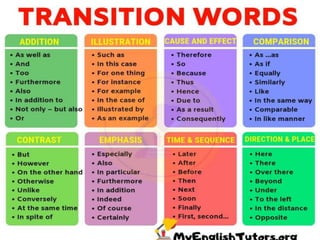
Transitions
Let’s talk about
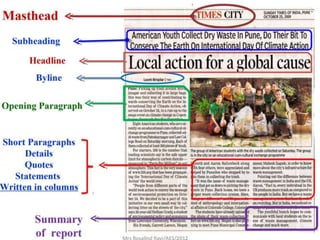
Newspaper Report
Newspaper Report
Newspaper Report
Newspaper Report

Newspaper Report

  • 1.
  • 2.
    News Writing … givesthe reader information that will impact them in some way. It usually flows from most important to least important. “What is news? It is information only.” - Walter Cronkite, former CBS News anchor
  • 4.
    Checklist for NewsStories  Are the most important and recent facts first?  Is the story accurate? Are the sources identified fully?  Are the paragraphs short?  Is the sentence structure varied in the story?  Is the story neat and double-spaced so that it is easy to read? Does your story flow? Did you use the transition/quote formula?  Did you use active voice?
  • 5.
    Pitfalls to Avoid Editorializing - Keep your opinion out of the story  Using first and second person - Keep yourself out of the story. Missing the news page  Messy handwriting, poor grammar and spelling  Paragraphs too long  Misspelling names in the story Trying to use all of the information
  • 13.
    Let’s start at thebeginning with … LEADS.
  • 14.
  • 15.
    Lead: Most important information.Focus on newest information. Focus on the future. Question to ask yourself: What do my readers need to know most???
  • 16.
    Leads Most straight newsleads should be summary leads. That means they summarize the 5 Ws and H of the story, starting off with the most important W or H.
  • 17.
    Types of NewsLeads: Rarely use these... “Who lead” - begins with a person. The person is usually not the most important fact of the story. “When lead” - begins with time. Rarely is the time the most imporant factor. “Where lead” - begins with the place. Hardly ever is where the most important factor. Types of News Leads:
  • 18.
    Types of NewsLeads: Use these often... “How lead” - begins with the how of the story. Used often. “Why lead” - begins with the cause the story. Used often. “What lead” - begins with the fact of the story. Used often.
  • 19.
  • 21.
     Can belonger than one sentence. Direct Quotes: Should have attribution after the first sentence of the quote. Attribution should be: Noun then verb. For example: Correct - senior Bob Rodriguez said. Incorrect - said senior Bob Rodriguez. (unless you have an unusually long title) Do not place two people’s direct quotes next to each other without a transition.
  • 22.