To Infinity and Beyond with the
Right Mathematics Pathway
New Mathways
Jeff Shaver, Course Program Specialist
The Charles A. Dana Center
Paula Talley, Veteran NMP Faculty
Temple College
#AACC2016	
  
•  What Math Pathways and the New
Mathways Project (NMP) are
•  The impact this pioneering redesign model
is making on students
•  Best practices, lessons learned, and
recommendations for institutions
embarking on their own redesign journeys
2
The Places We’ll Go
Today’s presentation will cover:
#AACC2016	
  
•  What Math Pathways and the New
Mathways Project (NMP) are
•  The impact this pioneering redesign model
is making on students
•  Best practices, lessons learned, and
recommendations for institutions
embarking on their own redesign journeys
3
The Places We’ll Go
Today’s presentation will cover:
#AACC2016 4
Noun │ math · path · way │  math  ‘path-,wā 


Definition:
A mathematics course or sequence of courses that
students take to meet the requirements of their
program of study.
The concept of math pathways applies to pathways for
college-ready and underprepared students.
1:
Math Pathway
#AACC2016 5
National Organizations
Supporting Mathematics Pathways
#AACC2016 6
The Case for Math Pathways
Mathematics is a barrier for students
80%
45%
40%
Of the 4.6 million community college students placed in remedial
math sequences fail to complete them and their gateway math
course.
Of students fail college algebra with even higher failure rates for
minority students, 58% for African Americans and 51% for Hispanics
Of students entering college with an interest in STEM fields
complete a degree
EdSource. (2012, February). Passing when it counts: Math courses present barriers to student success in California
community colleges. Retrieved from http://edsource.org/wp-content/publications/pub12-Math2012Final.pdf
#AACC2016 7
A Common Visions
For the Undergraduate Math
Program in 2025
“Mathematics courses are the most significant barrier
to degree completion in both STEM and non-STEM
fields. For example, each year only 50 percent of
students attain a grade of A, B, or C in college algebra,
and fewer than 10 percent of the students who pass this
class enroll in a calculus course.”	


#AACC2016 8
Unfortunately, there is often a serious mismatch
between the original rationale for a college
algebra requirement and the actual needs of
students who take the course.
A critically important task…is to clarify the rationale
for requirements, determine the needs of students,
and ensure that department’s courses are aligned
with these findings.
Mathematics Association of America,
Committee on the Undergraduate Program in Mathematics, 2004
Tackling the Disconnect
“
“
#AACC2016 9
What is the “Right” Math?
Require
Calculus
20%
Do not
require
Calculus
80%
Community College Student
Enrollment into Programs of Study
Require
Calculus
28%
Do not
require
Calculus
72%
Four-Year Student Enrollment into
Programs of Study
Burdman, P. (2015). Degrees of freedom: Diversifying math requirements for college readiness and
graduation. Oakland CA: Learning Works and Policy Analysis for California Education.
#AACC2016 10
Aligned Pathways
#AACC2016
NATIONAL
STATE
INSTITUTIONAL
FACULTY & CLASSROOM
11
1
2
3
4
Multiple pathways aligned
to specific fields of study
Acceleration that allows most students
to complete a college-level math
course in one year or less
Intentional use of strategies to help
students develop skills as learners
Curriculum design and pedagogy
based on proven practice
utdanacenter.org
New Mathways Project Model
A	
  systemic	
  approach	
  to	
  improving	
  student	
  success	
  
and	
  completion	
  by	
  reforming	
  developmental	
  and	
  
gateway	
  mathematics,	
  based	
  on	
  four	
  principles.	
  
#AACC2016 12
Scaling the NMP Model
in Texas
2012 2013 2014 2015
Colleges
engaged in
training and
coaching
Colleges
implementing
the NMP
Model
9
21
31
40
23
34
9
#AACC2016 13
Students Supported by NMP
Or Other Accelerated Math Pathways
Fall 2013
244 Students
Fall 2014
1,306 Students
Fall 2015
4,558 Students
= 50 students, NMP
model with curriculum
= 50 students, NMP model
#AACC2016 14
NMP Courses
Supporting Math Pathways
Recommendedtobetaken
concurrently(1item)
Foundations of
Mathematical Reasoning
Recommended 4 contact
hours; non-transferable course
Frameworks for Mathematics
and Collegiate Learning
Quantitative
Reasoning
(1 item)
Statistical Reasoning
Recommended 4
contact hours (1 item)
Reasoning with
Functions I
Recommended 5
contact hours (1 item)
Reasoning with
Functions II
Recommended 5
contact hours (1 item)
STEM-Prep Pathway
Students enter Calculus sequence
#AACC2016	
  
•  What Math Pathways and the New
Mathways Project (NMP) are
•  The impact this pioneering redesign
model is making on students
•  Best practices, lessons learned, and
recommendations for institutions
embarking on their own redesign journeys
15
The Places We’ll Go
Today’s presentation will cover:
#AACC2016 16
NMP Emerging Results
Developmental
Education
Completion
Gateway Course
Completion
24%
In one year
(n=32,624)
8%
In one year
64%
In one semester
(n=1,306)
23%
In one year
43%
In one year
All FTIC, Community
College Students
AY 2013 AY 2014
Subset Using Back-
to-Back Math
AY 2013
#AACC2016 17
Why the NMP:
A Student’s Perspective
#AACC2016 18
NMP: A Student’s Perspective
#AACC2016 19
Building Evidence
NMP Evaluation
MDRC and the Community College Research Center are conducting a
rigorous evaluation of the New Mathways Project course sequence.
#AACC2016 20
Building Evidence
NMP Evaluation
MDRC and the Community College Research Center are conducting a
rigorous evaluation of the New Mathways Project course sequence.
Timeline:
Spring
2015
Fall
2015
Spring
2016
Fall
2016
Spring
2017
Fall
2017
Spring
2018
2019
Enrollment of students for random
assignment evaluation
Tracking of student outcomes and dissemination
of findings
Final
Report
#AACC2016 21
Building Evidence
NMP Evaluation
Critical Areas:
•  Advising
•  Curriculum & Pedagogy
•  Alignment
•  Scalability
•  Transferability
#AACC2016 22
0
10
20
30
40
50
60
70
80
90
100
2013-2014 Fall 2013 Spring 2014 Fall 2014 Spring 2015
Percentage Completing Developmental Math
%
%
%
%
%
%
%
%
%
%
%
1 Year 1 Semester 1 Semester 1 Semester 1 Semester
24%
Of all TX Dev
Ed Students
65%
Of 244 NMP
Students
64%
Of 110 NMP
Students
63%
Of 915 NMP
Students
62%
Of 570 NMP
Students
Building Evidence
Foundations
curriculum has
doubled the
completion
rates in half
the time.
#AACC2016 23
0
10
20
30
40
50
60
70
80
90
100
2013-2014
%
%
%
%
%
%
%
%
%
%
1 Year
8%
Of all FTIC TX
Dev Ed Students
30%
Of 233 NMP
Students
Building Evidence
%
Percentage Completing College-level Courses
#AACC2016 24
0
10
20
30
40
50
60
70
80
90
100
2013-2014
%
%
%
%
%
%
%
%
%
%
1 Year
8%
Of all FTIC TX
Dev Ed Students
30%
Of 233 NMP
Students
Building Evidence
%
Percentage Completing College-level Courses
49%
Of 136 NMP
Students
Dev Course
Lined to
College
Course
#AACC2016 25
Staying the Course
NMP students were
more likely to…
•  Complete developmental math
requirements
•  Enroll in a college-level math
course
•  Pass a college-level math course
NMP Texas Student Outcomes
#AACC2016 26
Students	
  and	
  faculty	
  reported	
  that	
  students	
  
were	
  highly	
  engaged	
  with	
  math	
  content	
  and	
  
students	
  built	
  stronger	
  learning	
  communi2es.	
  
NMP Texas Student Outcomes
#AACC2016	
  
•  What Math Pathways and the New
Mathways Project (NMP) are
•  The impact this pioneering redesign model
is making on students
•  Best practices, lessons learned, and
recommendations for institutions
embarking on their own redesign
journeys
27
The Places We’ll Go
Today’s presentation will cover:
#AACC2016 28
Defining Back-to-Back Math
Recommendedtobetaken
concurrently(1item)
Foundations of Mathematical
Reasoning
Recommended 4 contact hours;
non-transferable course
Frameworks for Mathematics and
Collegiate Learning
Quantitative
Reasoning
(1 item)
Statistical Reasoning
Recommended 4
contact hours (1 item)
Reasoning with
Functions I
Recommended 5
contact hours (1 item)
Reasoning with
Functions II
Recommended 5
contact hours (1 item)
STEM-Prep Pathway
Students enter
Calculus sequence
Back-to-Back Math: Encouraging students to enroll in a college-level math
course in the semester immediately following the completion of their
developmental coursework.
#AACC2016 29
Strategies for Promoting
1.  Establish a culture of successive semester enrollment with clear,
timely, and consistent communication.
2.  Make successive semester enrollment easy and appealing.
3.  Encourage students to enroll as a cohort.
Advisors Faculty Administrators
•  Communicate to
establish the
expectation of 2-
semester course
•  Student contracts
•  Build enrollment into
class activities (time,
assignments,
connection to
curricular materials)
•  Use the strength of
relationships to
encourage enrollment
•  Use parallel and
“prime-time”
scheduling
•  Permit early
registration
•  Offer small, targeted
scholarships
Back-to-Back Math
#AACC2016 30
Regional Transfer Agreements
Transfer Champions
•  Stephen F. Austin State University
•  Texas Tech University
•  University of Houston-Downtown
•  University of North Texas
•  The University of Texas at Austin
•  The University of Texas-Pan
American
•  The University of Texas at Tyler
#AACC2016 31
Selecting Math
Pathways Curricula
Consider:
•  Students/programs served by each pathway
•  Learning outcomes for each step in the pathway
•  Who is leading and who is involved in the work of setting
or reviewing learning outcomes?
•  Who is leading and who is involved in the work of
selecting or revising curricular materials?
#AACC2016 32
Emerging TX Math Pathways
Meta-Major Math Pathway
#AACC2016 33
Emerging TX Math Pathways
Meta-Major Math Pathway
#AACC2016 34
The needs of
“metamajors”
Type and content
of gateway
mathematics
courses
Learning
outcomes of
developmental
math courses
Backward Mapping
To Define Content
#AACC2016 35
Backward Mapping
#AACC2016 36
Defining the content of prerequisite and
co-requisite courses:
•  How do we take students from where they are to a level
of preparedness for the college-level course?
•  Rather than requiring prerequisite or co-requisite
courses that are historical artifacts, consider what is
essential to success in the college-level course.
Supporting the Desired
Student Experience
#AACC2016 37
Course Structures
A variety of methods can accelerate students to and through
a college-level course, increase access, and support student
learning.
Examples of acceleration and delivery methods:
Acceleration Models Delivery Methods
Modularization Classroom-based
Year-long or 2 semester pathways Online synchronous/asynchronous
1 semester co-requisites Self-paced instruction
Compressed courses Hybrid courses
#AACC2016 38
•  Structure and organization of curricular materials
•  Active learning
•  Constructive perseverance
•  Problem solving
•  Context and interdisciplinary connections
•  Use of terminology
•  Reading and writing
•  Technology
NMP Curriculum Design
Standards
#AACC2016 39
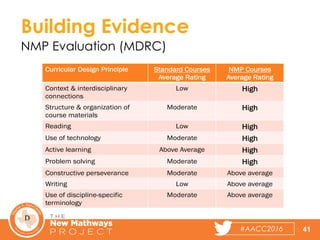
Curricular Design Principle Standard Courses
Average Rating
NMP Courses
Average Rating
Context & interdisciplinary
connections
Low High
Structure & organization of
course materials
Moderate High
Reading Low High
Use of technology Moderate High
Active learning Above Average High
Problem solving Moderate High
Constructive perseverance Moderate Above average
Writing Low Above average
Use of discipline-specific
terminology
Moderate Above average
Building Evidence
NMP Evaluation (MDRC)
#AACC2016 40
Curricular Design Principle Standard Courses
Average Rating
NMP Courses
Average Rating
Context & interdisciplinary
connections
Low High
Structure & organization of
course materials
Moderate High
Reading Low High
Use of technology Moderate High
Active learning Above Average High
Problem solving Moderate High
Constructive perseverance Moderate Above average
Writing Low Above average
Use of discipline-specific
terminology
Moderate Above average
Building Evidence
NMP Evaluation (MDRC)
#AACC2016 41
Curricular Design Principle Standard Courses
Average Rating
NMP Courses
Average Rating
Context & interdisciplinary
connections
Low High
Structure & organization of
course materials
Moderate High
Reading Low High
Use of technology Moderate High
Active learning Above Average High
Problem solving Moderate High
Constructive perseverance Moderate Above average
Writing Low Above average
Use of discipline-specific
terminology
Moderate Above average
Building Evidence
NMP Evaluation (MDRC)
#AACC2016 42
Selecting Math Pathways
Curricula
•  Dana Center NMP courses on Pearson
•  Carnegie Foundation Statway and Quantway
•  Commercial textbooks
•  Develop your own
#AACC2016 43
Selecting Math Pathways
Curricula
Dana Center NMP Courses from Pearson
#AACC2016 44
Founda'ons	
  of	
  Mathema'cal	
  Reasoning:	
  0134310977	


Quan'ta've	
  Reasoning:	
  0134391373	


Reasoning	
  with	
  Func'ons	
  I:	
  0134446348	


Reasoning	
  with	
  Func'ons	
  II:	
  contact	
  Pearson	
  rep.	


Sta's'cal	
  Reasoning:	
  0134391683	
  
Accessing NMP Courses on
MyMathLab or MyStatLab
#AACC2016 45
•  NMP Institutional Scaling Toolkit, includes:
•  Readiness Assessment
•  Sample Math Pathways List
•  High Impact Practices Resource
•  Back-to-Back Mathematics Brief
•  Modernizing Mathematics Pathways at
Texas Universities: Insights from the New
Mathways Project Transfer Champions
•  NMP Curriculum available via Pearson’s
MyMathLab & MyStatLab
NMP Resources to Explore
www.utdanacenter.org
#AACC2016 46
#AACC2016 47
•  General information about the Dana Center:
www.utdanacenter.org
•  Higher Education work:
www.utdanacenter.org/higher-education/
•  For questions or to receive monthly updates about the NMP,
contact us at: mathways@austin.utexas.edu
Contact Information
#AACC2016 48
About	
  the	
  Dana	
  Center	
  
The	
  Charles	
  A.	
  Dana	
  Center	
  at	
  The	
  University	
  of	
  Texas	
  at	
  AusFn	
  
works	
  with	
  our	
  naFon’s	
  educaFon	
  systems	
  to	
  ensure	
  that	
  every	
  
student	
  leaves	
  school	
  prepared	
  for	
  success	
  in	
  postsecondary	
  
educaFon	
  and	
  the	
  contemporary	
  workplace.	
  
Our	
  work,	
  based	
  on	
  research	
  and	
  two	
  decades	
  of	
  experience,	
  
focuses	
  on	
  K–16	
  mathemaFcs	
  and	
  science	
  educaFon	
  with	
  an	
  
emphasis	
  on	
  strategies	
  for	
  improving	
  student	
  engagement,	
  
moFvaFon,	
  persistence,	
  and	
  achievement.	
  	
  
We	
  develop	
  innovaFve	
  curricula,	
  tools,	
  protocols,	
  and	
  instrucFonal	
  
supports	
  and	
  deliver	
  powerful	
  instrucFonal	
  and	
  leadership	
  
development.	


#AACC2016
Dana Center’s State Mobilization
49
www.utdanacenter.org	
  

New_Mathways_AACC_Session_Deck_js_041116

  • 1.
    To Infinity andBeyond with the Right Mathematics Pathway New Mathways Jeff Shaver, Course Program Specialist The Charles A. Dana Center Paula Talley, Veteran NMP Faculty Temple College
  • 2.
    #AACC2016   •  WhatMath Pathways and the New Mathways Project (NMP) are •  The impact this pioneering redesign model is making on students •  Best practices, lessons learned, and recommendations for institutions embarking on their own redesign journeys 2 The Places We’ll Go Today’s presentation will cover:
  • 3.
    #AACC2016   •  WhatMath Pathways and the New Mathways Project (NMP) are •  The impact this pioneering redesign model is making on students •  Best practices, lessons learned, and recommendations for institutions embarking on their own redesign journeys 3 The Places We’ll Go Today’s presentation will cover:
  • 4.
    #AACC2016 4 Noun │math · path · way │ math ‘path-,wā     Definition: A mathematics course or sequence of courses that students take to meet the requirements of their program of study. The concept of math pathways applies to pathways for college-ready and underprepared students. 1: Math Pathway
  • 5.
  • 6.
    #AACC2016 6 The Casefor Math Pathways Mathematics is a barrier for students 80% 45% 40% Of the 4.6 million community college students placed in remedial math sequences fail to complete them and their gateway math course. Of students fail college algebra with even higher failure rates for minority students, 58% for African Americans and 51% for Hispanics Of students entering college with an interest in STEM fields complete a degree EdSource. (2012, February). Passing when it counts: Math courses present barriers to student success in California community colleges. Retrieved from http://edsource.org/wp-content/publications/pub12-Math2012Final.pdf
  • 7.
    #AACC2016 7 A CommonVisions For the Undergraduate Math Program in 2025 “Mathematics courses are the most significant barrier to degree completion in both STEM and non-STEM fields. For example, each year only 50 percent of students attain a grade of A, B, or C in college algebra, and fewer than 10 percent of the students who pass this class enroll in a calculus course.”    
  • 8.
    #AACC2016 8 Unfortunately, thereis often a serious mismatch between the original rationale for a college algebra requirement and the actual needs of students who take the course. A critically important task…is to clarify the rationale for requirements, determine the needs of students, and ensure that department’s courses are aligned with these findings. Mathematics Association of America, Committee on the Undergraduate Program in Mathematics, 2004 Tackling the Disconnect “ “
  • 9.
    #AACC2016 9 What isthe “Right” Math? Require Calculus 20% Do not require Calculus 80% Community College Student Enrollment into Programs of Study Require Calculus 28% Do not require Calculus 72% Four-Year Student Enrollment into Programs of Study Burdman, P. (2015). Degrees of freedom: Diversifying math requirements for college readiness and graduation. Oakland CA: Learning Works and Policy Analysis for California Education.
  • 10.
  • 11.
    #AACC2016 NATIONAL STATE INSTITUTIONAL FACULTY & CLASSROOM 11 1 2 3 4 Multiplepathways aligned to specific fields of study Acceleration that allows most students to complete a college-level math course in one year or less Intentional use of strategies to help students develop skills as learners Curriculum design and pedagogy based on proven practice utdanacenter.org New Mathways Project Model A  systemic  approach  to  improving  student  success   and  completion  by  reforming  developmental  and   gateway  mathematics,  based  on  four  principles.  
  • 12.
    #AACC2016 12 Scaling theNMP Model in Texas 2012 2013 2014 2015 Colleges engaged in training and coaching Colleges implementing the NMP Model 9 21 31 40 23 34 9
  • 13.
    #AACC2016 13 Students Supportedby NMP Or Other Accelerated Math Pathways Fall 2013 244 Students Fall 2014 1,306 Students Fall 2015 4,558 Students = 50 students, NMP model with curriculum = 50 students, NMP model
  • 14.
    #AACC2016 14 NMP Courses SupportingMath Pathways Recommendedtobetaken concurrently(1item) Foundations of Mathematical Reasoning Recommended 4 contact hours; non-transferable course Frameworks for Mathematics and Collegiate Learning Quantitative Reasoning (1 item) Statistical Reasoning Recommended 4 contact hours (1 item) Reasoning with Functions I Recommended 5 contact hours (1 item) Reasoning with Functions II Recommended 5 contact hours (1 item) STEM-Prep Pathway Students enter Calculus sequence
  • 15.
    #AACC2016   •  WhatMath Pathways and the New Mathways Project (NMP) are •  The impact this pioneering redesign model is making on students •  Best practices, lessons learned, and recommendations for institutions embarking on their own redesign journeys 15 The Places We’ll Go Today’s presentation will cover:
  • 16.
    #AACC2016 16 NMP EmergingResults Developmental Education Completion Gateway Course Completion 24% In one year (n=32,624) 8% In one year 64% In one semester (n=1,306) 23% In one year 43% In one year All FTIC, Community College Students AY 2013 AY 2014 Subset Using Back- to-Back Math AY 2013
  • 17.
    #AACC2016 17 Why theNMP: A Student’s Perspective
  • 18.
    #AACC2016 18 NMP: AStudent’s Perspective
  • 19.
    #AACC2016 19 Building Evidence NMPEvaluation MDRC and the Community College Research Center are conducting a rigorous evaluation of the New Mathways Project course sequence.
  • 20.
    #AACC2016 20 Building Evidence NMPEvaluation MDRC and the Community College Research Center are conducting a rigorous evaluation of the New Mathways Project course sequence. Timeline: Spring 2015 Fall 2015 Spring 2016 Fall 2016 Spring 2017 Fall 2017 Spring 2018 2019 Enrollment of students for random assignment evaluation Tracking of student outcomes and dissemination of findings Final Report
  • 21.
    #AACC2016 21 Building Evidence NMPEvaluation Critical Areas: •  Advising •  Curriculum & Pedagogy •  Alignment •  Scalability •  Transferability
  • 22.
    #AACC2016 22 0 10 20 30 40 50 60 70 80 90 100 2013-2014 Fall2013 Spring 2014 Fall 2014 Spring 2015 Percentage Completing Developmental Math % % % % % % % % % % % 1 Year 1 Semester 1 Semester 1 Semester 1 Semester 24% Of all TX Dev Ed Students 65% Of 244 NMP Students 64% Of 110 NMP Students 63% Of 915 NMP Students 62% Of 570 NMP Students Building Evidence Foundations curriculum has doubled the completion rates in half the time.
  • 23.
    #AACC2016 23 0 10 20 30 40 50 60 70 80 90 100 2013-2014 % % % % % % % % % % 1 Year 8% Ofall FTIC TX Dev Ed Students 30% Of 233 NMP Students Building Evidence % Percentage Completing College-level Courses
  • 24.
    #AACC2016 24 0 10 20 30 40 50 60 70 80 90 100 2013-2014 % % % % % % % % % % 1 Year 8% Ofall FTIC TX Dev Ed Students 30% Of 233 NMP Students Building Evidence % Percentage Completing College-level Courses 49% Of 136 NMP Students Dev Course Lined to College Course
  • 25.
    #AACC2016 25 Staying theCourse NMP students were more likely to… •  Complete developmental math requirements •  Enroll in a college-level math course •  Pass a college-level math course NMP Texas Student Outcomes
  • 26.
    #AACC2016 26 Students  and  faculty  reported  that  students   were  highly  engaged  with  math  content  and   students  built  stronger  learning  communi2es.   NMP Texas Student Outcomes
  • 27.
    #AACC2016   •  WhatMath Pathways and the New Mathways Project (NMP) are •  The impact this pioneering redesign model is making on students •  Best practices, lessons learned, and recommendations for institutions embarking on their own redesign journeys 27 The Places We’ll Go Today’s presentation will cover:
  • 28.
    #AACC2016 28 Defining Back-to-BackMath Recommendedtobetaken concurrently(1item) Foundations of Mathematical Reasoning Recommended 4 contact hours; non-transferable course Frameworks for Mathematics and Collegiate Learning Quantitative Reasoning (1 item) Statistical Reasoning Recommended 4 contact hours (1 item) Reasoning with Functions I Recommended 5 contact hours (1 item) Reasoning with Functions II Recommended 5 contact hours (1 item) STEM-Prep Pathway Students enter Calculus sequence Back-to-Back Math: Encouraging students to enroll in a college-level math course in the semester immediately following the completion of their developmental coursework.
  • 29.
    #AACC2016 29 Strategies forPromoting 1.  Establish a culture of successive semester enrollment with clear, timely, and consistent communication. 2.  Make successive semester enrollment easy and appealing. 3.  Encourage students to enroll as a cohort. Advisors Faculty Administrators •  Communicate to establish the expectation of 2- semester course •  Student contracts •  Build enrollment into class activities (time, assignments, connection to curricular materials) •  Use the strength of relationships to encourage enrollment •  Use parallel and “prime-time” scheduling •  Permit early registration •  Offer small, targeted scholarships Back-to-Back Math
  • 30.
    #AACC2016 30 Regional TransferAgreements Transfer Champions •  Stephen F. Austin State University •  Texas Tech University •  University of Houston-Downtown •  University of North Texas •  The University of Texas at Austin •  The University of Texas-Pan American •  The University of Texas at Tyler
  • 31.
    #AACC2016 31 Selecting Math PathwaysCurricula Consider: •  Students/programs served by each pathway •  Learning outcomes for each step in the pathway •  Who is leading and who is involved in the work of setting or reviewing learning outcomes? •  Who is leading and who is involved in the work of selecting or revising curricular materials?
  • 32.
    #AACC2016 32 Emerging TXMath Pathways Meta-Major Math Pathway
  • 33.
    #AACC2016 33 Emerging TXMath Pathways Meta-Major Math Pathway
  • 34.
    #AACC2016 34 The needsof “metamajors” Type and content of gateway mathematics courses Learning outcomes of developmental math courses Backward Mapping To Define Content
  • 35.
  • 36.
    #AACC2016 36 Defining thecontent of prerequisite and co-requisite courses: •  How do we take students from where they are to a level of preparedness for the college-level course? •  Rather than requiring prerequisite or co-requisite courses that are historical artifacts, consider what is essential to success in the college-level course. Supporting the Desired Student Experience
  • 37.
    #AACC2016 37 Course Structures Avariety of methods can accelerate students to and through a college-level course, increase access, and support student learning. Examples of acceleration and delivery methods: Acceleration Models Delivery Methods Modularization Classroom-based Year-long or 2 semester pathways Online synchronous/asynchronous 1 semester co-requisites Self-paced instruction Compressed courses Hybrid courses
  • 38.
    #AACC2016 38 •  Structureand organization of curricular materials •  Active learning •  Constructive perseverance •  Problem solving •  Context and interdisciplinary connections •  Use of terminology •  Reading and writing •  Technology NMP Curriculum Design Standards
  • 39.
    #AACC2016 39 Curricular DesignPrinciple Standard Courses Average Rating NMP Courses Average Rating Context & interdisciplinary connections Low High Structure & organization of course materials Moderate High Reading Low High Use of technology Moderate High Active learning Above Average High Problem solving Moderate High Constructive perseverance Moderate Above average Writing Low Above average Use of discipline-specific terminology Moderate Above average Building Evidence NMP Evaluation (MDRC)
  • 40.
    #AACC2016 40 Curricular DesignPrinciple Standard Courses Average Rating NMP Courses Average Rating Context & interdisciplinary connections Low High Structure & organization of course materials Moderate High Reading Low High Use of technology Moderate High Active learning Above Average High Problem solving Moderate High Constructive perseverance Moderate Above average Writing Low Above average Use of discipline-specific terminology Moderate Above average Building Evidence NMP Evaluation (MDRC)
  • 41.
    #AACC2016 41 Curricular DesignPrinciple Standard Courses Average Rating NMP Courses Average Rating Context & interdisciplinary connections Low High Structure & organization of course materials Moderate High Reading Low High Use of technology Moderate High Active learning Above Average High Problem solving Moderate High Constructive perseverance Moderate Above average Writing Low Above average Use of discipline-specific terminology Moderate Above average Building Evidence NMP Evaluation (MDRC)
  • 42.
    #AACC2016 42 Selecting MathPathways Curricula •  Dana Center NMP courses on Pearson •  Carnegie Foundation Statway and Quantway •  Commercial textbooks •  Develop your own
  • 43.
    #AACC2016 43 Selecting MathPathways Curricula Dana Center NMP Courses from Pearson
  • 44.
    #AACC2016 44 Founda'ons  of  Mathema'cal  Reasoning:  0134310977     Quan'ta've  Reasoning:  0134391373     Reasoning  with  Func'ons  I:  0134446348     Reasoning  with  Func'ons  II:  contact  Pearson  rep.     Sta's'cal  Reasoning:  0134391683   Accessing NMP Courses on MyMathLab or MyStatLab
  • 45.
    #AACC2016 45 •  NMPInstitutional Scaling Toolkit, includes: •  Readiness Assessment •  Sample Math Pathways List •  High Impact Practices Resource •  Back-to-Back Mathematics Brief •  Modernizing Mathematics Pathways at Texas Universities: Insights from the New Mathways Project Transfer Champions •  NMP Curriculum available via Pearson’s MyMathLab & MyStatLab NMP Resources to Explore www.utdanacenter.org
  • 46.
  • 47.
    #AACC2016 47 •  Generalinformation about the Dana Center: www.utdanacenter.org •  Higher Education work: www.utdanacenter.org/higher-education/ •  For questions or to receive monthly updates about the NMP, contact us at: mathways@austin.utexas.edu Contact Information
  • 48.
    #AACC2016 48 About  the  Dana  Center   The  Charles  A.  Dana  Center  at  The  University  of  Texas  at  AusFn   works  with  our  naFon’s  educaFon  systems  to  ensure  that  every   student  leaves  school  prepared  for  success  in  postsecondary   educaFon  and  the  contemporary  workplace.   Our  work,  based  on  research  and  two  decades  of  experience,   focuses  on  K–16  mathemaFcs  and  science  educaFon  with  an   emphasis  on  strategies  for  improving  student  engagement,   moFvaFon,  persistence,  and  achievement.     We  develop  innovaFve  curricula,  tools,  protocols,  and  instrucFonal   supports  and  deliver  powerful  instrucFonal  and  leadership   development.      
  • 49.
    #AACC2016 Dana Center’s StateMobilization 49 www.utdanacenter.org