

Lesson 11: “He Spake Many
Things unto Them in Parables”
To help us develop “ears to
hear” so we can understand
how Jesus’ parables apply to
us (Matthew 13:9).
wrench?
bowling pin?
snail
mask and snorkels
People in the same situation do not
always observe the same things.
Likewise, not all the people who heard
Jesus teach in parables understood
how the parables applied to them.
This lesson will discuss how we can
understand and apply Jesus’ parables.
What is a parable?
A symbolic story that teaches gospel truths by comparing
them to earthly things.
What did Jesus say was his purpose in teaching with
parables?
To simultaneously teach his message to his disciples and
conceal it from unbelievers. See Matthew 13:10–13; note
JST Matthew 13:12 in footnote 12a.)
12 For whosoever hath, to him shall be
given, and he shall have more
abundance: but whosoever hath not, from
him shall be taken away even that he
hath.
12a For whosoever receiveth, to him
shall be given, and he shall have more
abundance: but whosoever continueth
not to receive, from him shall be taken
away even that he hath.
9 Who hath ears to hear, let him hear.
13 Therefore speak I to them in parables: because they seeing see not; and
hearing they hear not, neither do they understand.
14 And in them is fulfilled the prophecy of Esaias, which saith, By hearing
ye shall hear, and shall not understand; and seeing ye shall see, and shall
not perceive:
15 For this people’s heart is waxed gross, and their ears are dull of hearing,
and their eyes they have closed; lest at any time they should see with their
eyes, and hear with their ears, and should understand with their heart, and
should be converted, and I should heal them.
“The multitude … received not His saying …
because they were not willing to see with their
eyes, and hear with their ears; not because they
could not, and were not privileged to see and hear,
but because their hearts were full of iniquity and
abominations. … The very reason why the
multitude … did not receive an explanation upon
His parables, was because of unbelief” (Teachings
of the Prophet Joseph Smith, sel. Joseph Fielding
Smith [1976], 96–97).
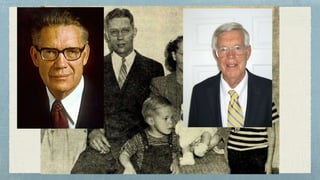
Bruce R. McConkie taught that:
Parables are a call to investigate the truth; to learn more; to
inquire into the spiritual realities, which, through them, are but
dimly viewed. Parables start truth seekers out in the direction of
further light and knowledge and understanding; they invite men to
ponder such truths as they are able to bear in the hope of learning
more. Parables are a call to come unto Christ, to believe his
doctrines, to live his laws, and to be saved in his kingdom. They
teach arithmetic to those who have the capacity to learn calculus
in due course. They are the mild milk of the word that prepares
our spiritual digestive processes to feast upon the doctrinal meat
of the kingdom. (The Mortal Messiah, Vol.2, p.245)
The Greek word from which our word
“parable” is derived means to throw beside.
Thus a parable is really two stories; the
one being told and the one being thrown
or placed beside it the one being taught.
The challenge in studying parables is to
make that connection. We must derive from
the elements of the parable the gospel
message which it is intended to teach. I
have sometimes found it helpful in my own
study to list those elements on one side of a
paper.
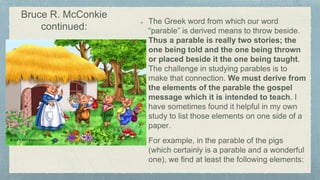
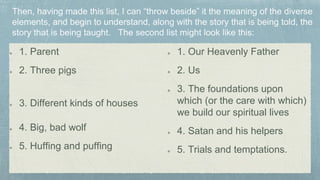
For example, in the parable of the pigs
(which certainly is a parable and a wonderful
one), we find at least the following elements:
Bruce R. McConkie
continued:
1. Parent
2. Three pigs
3. Different kinds of houses
4. Big, bad wolf
5. Huffing and puffing
1. Our Heavenly Father
2. Us
3. The foundations upon
which (or the care with which)
we build our spiritual lives
4. Satan and his helpers
5. Trials and temptations.
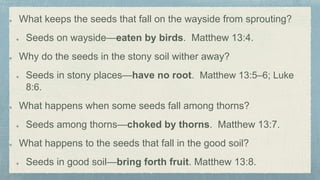
What keeps the seeds that fall on the wayside from sprouting?
Seeds on wayside—eaten by birds. Matthew 13:4.
Why do the seeds in the stony soil wither away?
Seeds in stony places—have no root. Matthew 13:5–6; Luke
8:6.
What happens when some seeds fall among thorns?
Seeds among thorns—choked by thorns. Matthew 13:7.
What happens to the seeds that fall in the good soil?
Seeds in good soil—bring forth fruit. Matthew 13:8.
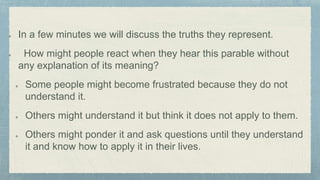
In a few minutes we will discuss the truths they represent.
How might people react when they hear this parable without
any explanation of its meaning?
Some people might become frustrated because they do not
understand it.
Others might understand it but think it does not apply to them.
Others might ponder it and ask questions until they understand
it and know how to apply it in their lives.
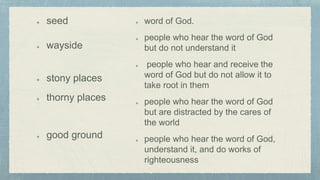
seed
wayside
stony places
thorny places
good ground
word of God.
people who hear the word of God
but do not understand it
people who hear and receive the
word of God but do not allow it to
take root in them
people who hear the word of God
but are distracted by the cares of
the world
people who hear the word of God,
understand it, and do works of
righteousness
What could be done to help the unproductive areas produce fruit?
The wayside could be plowed and fertilized, the stones could be
removed, and the thorns could be uprooted.
How can this apply to our efforts to be more receptive to
God’s word?
Why do you think the parable of the sower focuses more on the
ground than on the sower or the seed?
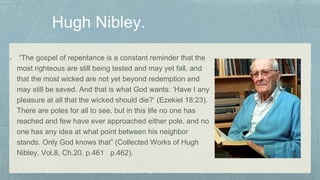
“The gospel of repentance is a constant reminder that the
most righteous are still being tested and may yet fall, and
that the most wicked are not yet beyond redemption and
may still be saved. And that is what God wants: ‘Have I any
pleasure at all that the wicked should die?’ (Ezekiel 18:23).
There are poles for all to see, but in this life no one has
reached and few have ever approached either pole, and no
one has any idea at what point between his neighbor
stands. Only God knows that” (Collected Works of Hugh
Nibley, Vol.8, Ch.20, p.461 p.462).
We must not be too hasty to uproot and destroy those plants that do not appear to be
wheat. Without revelation, it is impossible to be sure. And, as we discussed above, it is a
most serious matter to refuse to sow when the opportunity presents itself.
The Savior gave an explanation of this parable in D&C 86:1-7:
Notice that in both accounts, Matthew and the Doctrine and Covenants, the Lord has had
to restrain the servants and angels from immediately removing the tares from the field.
Neal Maxwell said of this:
“Years ago, I wondered over the scriptural imagery of angels waiting "day and night" for
"the great command" to come down and reap the tares in a wicked and suffering world; it
seemed rather eager to me (see D&C 38:12; 86:5). Given such massive, needless human
suffering, I don't wonder anymore!
“Even so, the final reaping will occur only when the Father determines that the world is
‘fully ripe.’ Meanwhile, brothers and sisters, the challenge is surviving spiritually in a
deteriorating ‘wheat and tares world’” (D&C 86:7).
D&C 86:1-7:
“Verily, thus saith the Lord unto you my servants, concerning the parable of the wheat and of the tares:
“Behold, verily I say, the field was the world, and the apostles were the sowers of the seed;
“And after they have fallen asleep the great persecutor of the church, the apostate, the whore, even
Babylon, that maketh all nations to drink of her cup, in whose hearts the enemy, even Satan, sitteth to
reign behold he soweth the tares; wherefore, the tares choke the wheat and drive the church into the
wilderness.
“But behold, in the last days, even now while the Lord is beginning to bring forth the word, and the blade is
springing up and is yet tender
“Behold, verily I say unto you, the angels are crying unto the Lord day and night, who are ready and waiting
to be sent forth to reap down the fields;
“But the Lord saith unto them, pluck not up the tares while the blade is yet tender (for verily your faith is
weak), lest you destroy the wheat also.
“Therefore, let the wheat and the tares grow together until the harvest is fully ripe; then ye shall first gather
out the wheat from among the tares, and after the gathering of the wheat, behold and lo, the tares are
bound in bundles, and the field remaineth to be burned.”
Even though the “final reaping” must wait for the world to become fully ripe, the preliminary reaping has
begun. Wilford Woodruff testified of this fact in 1894:
“We have fourteen million people on this earth, and over them all there hangs a cloud of darkness almost
entirely upon their shoulders. Can you tell me where the people are who will be shielded and protected from
these great calamities and judgments which are even now at our doors? I'll tell you. The priesthood of God
who honor their priesthood, and who are worthy of their blessings are the only ones who shall have this safety
and protection. They are the only mortal beings. No other people have a right to be shielded from these
judgments. They are at our very doors; not even this people will escape them entirely. They will come down
like the judgments of Sodom and Gomorrah. And none but the priesthood will be safe from their fury. God has
held the angels of destruction for many years, lest they should reap down the wheat with the tares. But I want
to tell you now, that those angels have left the portals of heaven, and they stand over this people and this
nation now, and are hovering over the earth waiting to pour out the judgments. And from this very day they
shall be poured out. Calamities and troubles are increasing in the earth, and there is a meaning to these
things. Remember this, and reflect upon these matters. If you do your duty, and I do my duty, we'll have
protection, and shall pass through the afflictions in peace and in safety. Read the scriptures and the
revelations. They will tell you about all these things. Great changes are at our doors. The next twenty years
will see mighty changes among the nations of the earth. You will live to see these things, whether I do or not. I
have felt oppressed with the weight of these matters, and I felt I must speak of them here. It's by the power of
the Gospel that we shall escape” (Wilford Woodruff: Collected Discourses, vol 4, June 24, 1894).
Twenty years and one month later, World War I broke out.
In the rest of this chapter, Christ compares the Kingdom of
Heaven (the Church; see Bible Dictionary under Kingdom of
Heaven) to a mustard seed, to leaven, to a treasure hidden in a
field, to a merchant man seeking pearls, and to a fisherman’s
net. Each of these parables teaches great lessons, lessons to
be learned by true disciples. But learning them reaches deeper
than the intellectual exercise of study
Why did the sower refuse to allow his servants to gather the tares, which had
been sown by an enemy, immediately? (Matthew 13:25-29).
Have you ever weeded a garden and pulled out a useful plant by mistake?
How long are the wheat and tares to be allowed to grow together?
(Matthew 13:30).
I learned the lesson of this parable during my first seminary experience. I
was a brand new teacher in a one-man seminary in Arizona. A young lady
came to class occasionally (in fact, I thought, far too often), and made my job
nearly impossible. She challenged me on many points of doctrine and
interpretation. She contradicted my conclusions and laughed at my
testimony. How grateful I am that I was too inexperienced to have the
courage to kick her out. And I had her in my class for three years! I cannot
express the relief I felt when she graduated from High School and seminary.
Years passed. I moved to Utah and enrolled in BYU to work on
an advanced degree. One day in the Bookstore, I saw her. She
was dressed in a lovely outfit with a black, plastic identification
badge pinned to blouse, and was with another young lady
dressed the same manner. She was at the MTC preparing to
serve a mission. Our eyes met and she walked to me without
hesitation and took my hand. I was surprised by the firmness of
her grip and by the sudden tears. She held my hand and my
eyes and whispered “I’m sorry. I’m so sorry for the way I
behaved. Thank you for your patience and kindness in letting
me stay. I do not know what would have happened if you had
terminated my opportunity to study the scriptures with those
great young people who were my friends.”
Matthew 13:24-30:
24. Another parable put he forth unto them, saying, The kingdom of heaven is likened unto a
man which sowed good seed in his field:
25. But while men slept, his enemy came and sowed tares among the wheat, and went his
way.
26. But when the blade was sprung up, and brought forth fruit, then appeared the tares also.
27. So the servants of the householder came and said unto him, Sir, didst not thou sow good
seed in thy field? from whence then hath it tares?
28. He said unto them, An enemy hath done this. The servants said unto him, Wilt thou then
that we go and gather them up?
29. But he said, Nay; lest while ye gather up the tares, ye root up also the wheat with them.
30. Let both grow together until the harvest: and in the time of harvest I will say to the reapers,
Gather ye together first the tares, and bind them in bundles to burn them: but gather the wheat
into my barn.
A group of religion instructors [were] taking a summer course of the life of the Savior and focusing
particularly on the parables. The following story re lated by President James E. Faust may be
useful at this point in helping you understand the difference between studying the parables and
applying them. “When the final exam
came . . . the students arrived at the classroom to find a note that the exam would be given in
another building across campus. Moreover, the note said, it must be finished within the two-hour
time period that was starting almost at that moment.
“The students hurried across campus. On the way, they passed a little girl crying over a flat tire on
her new bike. An old man hobbled painfully toward the library with a cane in one hand, spilling
books from a stack he was trying to manage with the other. On a bench by the union building sat a
shabbily dressed, bearded man [in obvious distress].
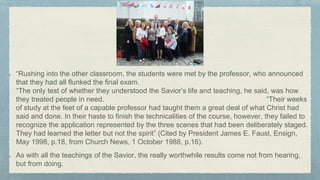
“Rushing into the other classroom, the students were met by the professor, who announced
that they had all flunked the final exam.
“The only test of whether they understood the Savior’s life and teaching, he said, was how
they treated people in need. “Their weeks
of study at the feet of a capable professor had taught them a great deal of what Christ had
said and done. In their haste to finish the technicalities of the course, however, they failed to
recognize the application represented by the three scenes that had been deliberately staged.
They had learned the letter but not the spirit” (Cited by President James E. Faust, Ensign,
May 1998, p.18, from Church News, 1 October 1988, p.16).
As with all the teachings of the Savior, the really worthwhile results come not from hearing,
but from doing.
Conclusion
Jesus explained his parables to those who sought
understanding. As we study Jesus’ parables with a sincere
desire to understand, we will see how they apply in our day.
3. Jesus uses parables to teach about the kingdom of heaven on earth (the Church of Jesus
Christ).
The Prophet Joseph Smith taught that the parables of the mustard seed and the leaven are about
The Church of Jesus Christ of Latter-day Saints (Teachings of the Prophet Joseph Smith, sel.
Joseph Fielding Smith [1976], 98–100). What can we learn about the restored Church from the
Savior’s comparing it to a mustard seed? (See Matthew 13:31–32.) To leaven? (See Matthew
13:33. Explain that leaven is an ingredient, such as yeast or baking powder, that causes bread to
rise.) How have you seen the work of God increase as illustrated by these parables?
What can we learn from the parables of the treasure and the pearl of great price? (See Matthew
13:44–46.) What sacrifices should we be willing to make to obtain the treasure of the gospel?
What sacrifices have you or those you know made for the gospel? What blessings have resulted
from those sacrifices?
What does the net represent in the parable of the net cast into the sea? (See Matthew 13:47.)
What does it mean to be gathered into the net? What is represented by the action of gathering the
good into vessels and casting the bad away? (See Matthew 13:48–50. You may want to use
Joseph Smith—Matthew 1:4 to explain that “the end of the world” in verse 49 refers to the
destruction of the wicked.) What can we do to help us stay faithful in the Church and to help others
do the same?

New testament lesson 11 parables

  • 1.
    Lesson 11: “HeSpake Many Things unto Them in Parables”
  • 2.
    To help usdevelop “ears to hear” so we can understand how Jesus’ parables apply to us (Matthew 13:9).
  • 4.
  • 6.
    People in thesame situation do not always observe the same things. Likewise, not all the people who heard Jesus teach in parables understood how the parables applied to them. This lesson will discuss how we can understand and apply Jesus’ parables.
  • 7.
    What is aparable? A symbolic story that teaches gospel truths by comparing them to earthly things. What did Jesus say was his purpose in teaching with parables? To simultaneously teach his message to his disciples and conceal it from unbelievers. See Matthew 13:10–13; note JST Matthew 13:12 in footnote 12a.)
  • 8.
    12 For whosoeverhath, to him shall be given, and he shall have more abundance: but whosoever hath not, from him shall be taken away even that he hath. 12a For whosoever receiveth, to him shall be given, and he shall have more abundance: but whosoever continueth not to receive, from him shall be taken away even that he hath.
  • 10.
    9 Who hathears to hear, let him hear. 13 Therefore speak I to them in parables: because they seeing see not; and hearing they hear not, neither do they understand. 14 And in them is fulfilled the prophecy of Esaias, which saith, By hearing ye shall hear, and shall not understand; and seeing ye shall see, and shall not perceive: 15 For this people’s heart is waxed gross, and their ears are dull of hearing, and their eyes they have closed; lest at any time they should see with their eyes, and hear with their ears, and should understand with their heart, and should be converted, and I should heal them.
  • 11.
    “The multitude …received not His saying … because they were not willing to see with their eyes, and hear with their ears; not because they could not, and were not privileged to see and hear, but because their hearts were full of iniquity and abominations. … The very reason why the multitude … did not receive an explanation upon His parables, was because of unbelief” (Teachings of the Prophet Joseph Smith, sel. Joseph Fielding Smith [1976], 96–97).
  • 13.
    Bruce R. McConkietaught that: Parables are a call to investigate the truth; to learn more; to inquire into the spiritual realities, which, through them, are but dimly viewed. Parables start truth seekers out in the direction of further light and knowledge and understanding; they invite men to ponder such truths as they are able to bear in the hope of learning more. Parables are a call to come unto Christ, to believe his doctrines, to live his laws, and to be saved in his kingdom. They teach arithmetic to those who have the capacity to learn calculus in due course. They are the mild milk of the word that prepares our spiritual digestive processes to feast upon the doctrinal meat of the kingdom. (The Mortal Messiah, Vol.2, p.245)
  • 15.
    The Greek wordfrom which our word “parable” is derived means to throw beside. Thus a parable is really two stories; the one being told and the one being thrown or placed beside it the one being taught. The challenge in studying parables is to make that connection. We must derive from the elements of the parable the gospel message which it is intended to teach. I have sometimes found it helpful in my own study to list those elements on one side of a paper. For example, in the parable of the pigs (which certainly is a parable and a wonderful one), we find at least the following elements: Bruce R. McConkie continued:
  • 16.
    1. Parent 2. Threepigs 3. Different kinds of houses 4. Big, bad wolf 5. Huffing and puffing 1. Our Heavenly Father 2. Us 3. The foundations upon which (or the care with which) we build our spiritual lives 4. Satan and his helpers 5. Trials and temptations.
  • 18.
    What keeps theseeds that fall on the wayside from sprouting? Seeds on wayside—eaten by birds. Matthew 13:4. Why do the seeds in the stony soil wither away? Seeds in stony places—have no root. Matthew 13:5–6; Luke 8:6. What happens when some seeds fall among thorns? Seeds among thorns—choked by thorns. Matthew 13:7. What happens to the seeds that fall in the good soil? Seeds in good soil—bring forth fruit. Matthew 13:8.
  • 19.
    In a fewminutes we will discuss the truths they represent. How might people react when they hear this parable without any explanation of its meaning? Some people might become frustrated because they do not understand it. Others might understand it but think it does not apply to them. Others might ponder it and ask questions until they understand it and know how to apply it in their lives.
  • 21.
    seed wayside stony places thorny places goodground word of God. people who hear the word of God but do not understand it people who hear and receive the word of God but do not allow it to take root in them people who hear the word of God but are distracted by the cares of the world people who hear the word of God, understand it, and do works of righteousness
  • 22.
    What could bedone to help the unproductive areas produce fruit? The wayside could be plowed and fertilized, the stones could be removed, and the thorns could be uprooted. How can this apply to our efforts to be more receptive to God’s word? Why do you think the parable of the sower focuses more on the ground than on the sower or the seed?
  • 24.
    “The gospel ofrepentance is a constant reminder that the most righteous are still being tested and may yet fall, and that the most wicked are not yet beyond redemption and may still be saved. And that is what God wants: ‘Have I any pleasure at all that the wicked should die?’ (Ezekiel 18:23). There are poles for all to see, but in this life no one has reached and few have ever approached either pole, and no one has any idea at what point between his neighbor stands. Only God knows that” (Collected Works of Hugh Nibley, Vol.8, Ch.20, p.461 p.462).
  • 25.
    We must notbe too hasty to uproot and destroy those plants that do not appear to be wheat. Without revelation, it is impossible to be sure. And, as we discussed above, it is a most serious matter to refuse to sow when the opportunity presents itself. The Savior gave an explanation of this parable in D&C 86:1-7: Notice that in both accounts, Matthew and the Doctrine and Covenants, the Lord has had to restrain the servants and angels from immediately removing the tares from the field. Neal Maxwell said of this: “Years ago, I wondered over the scriptural imagery of angels waiting "day and night" for "the great command" to come down and reap the tares in a wicked and suffering world; it seemed rather eager to me (see D&C 38:12; 86:5). Given such massive, needless human suffering, I don't wonder anymore! “Even so, the final reaping will occur only when the Father determines that the world is ‘fully ripe.’ Meanwhile, brothers and sisters, the challenge is surviving spiritually in a deteriorating ‘wheat and tares world’” (D&C 86:7).
  • 26.
    D&C 86:1-7: “Verily, thussaith the Lord unto you my servants, concerning the parable of the wheat and of the tares: “Behold, verily I say, the field was the world, and the apostles were the sowers of the seed; “And after they have fallen asleep the great persecutor of the church, the apostate, the whore, even Babylon, that maketh all nations to drink of her cup, in whose hearts the enemy, even Satan, sitteth to reign behold he soweth the tares; wherefore, the tares choke the wheat and drive the church into the wilderness. “But behold, in the last days, even now while the Lord is beginning to bring forth the word, and the blade is springing up and is yet tender “Behold, verily I say unto you, the angels are crying unto the Lord day and night, who are ready and waiting to be sent forth to reap down the fields; “But the Lord saith unto them, pluck not up the tares while the blade is yet tender (for verily your faith is weak), lest you destroy the wheat also. “Therefore, let the wheat and the tares grow together until the harvest is fully ripe; then ye shall first gather out the wheat from among the tares, and after the gathering of the wheat, behold and lo, the tares are bound in bundles, and the field remaineth to be burned.”
  • 27.
    Even though the“final reaping” must wait for the world to become fully ripe, the preliminary reaping has begun. Wilford Woodruff testified of this fact in 1894: “We have fourteen million people on this earth, and over them all there hangs a cloud of darkness almost entirely upon their shoulders. Can you tell me where the people are who will be shielded and protected from these great calamities and judgments which are even now at our doors? I'll tell you. The priesthood of God who honor their priesthood, and who are worthy of their blessings are the only ones who shall have this safety and protection. They are the only mortal beings. No other people have a right to be shielded from these judgments. They are at our very doors; not even this people will escape them entirely. They will come down like the judgments of Sodom and Gomorrah. And none but the priesthood will be safe from their fury. God has held the angels of destruction for many years, lest they should reap down the wheat with the tares. But I want to tell you now, that those angels have left the portals of heaven, and they stand over this people and this nation now, and are hovering over the earth waiting to pour out the judgments. And from this very day they shall be poured out. Calamities and troubles are increasing in the earth, and there is a meaning to these things. Remember this, and reflect upon these matters. If you do your duty, and I do my duty, we'll have protection, and shall pass through the afflictions in peace and in safety. Read the scriptures and the revelations. They will tell you about all these things. Great changes are at our doors. The next twenty years will see mighty changes among the nations of the earth. You will live to see these things, whether I do or not. I have felt oppressed with the weight of these matters, and I felt I must speak of them here. It's by the power of the Gospel that we shall escape” (Wilford Woodruff: Collected Discourses, vol 4, June 24, 1894).
  • 28.
    Twenty years andone month later, World War I broke out. In the rest of this chapter, Christ compares the Kingdom of Heaven (the Church; see Bible Dictionary under Kingdom of Heaven) to a mustard seed, to leaven, to a treasure hidden in a field, to a merchant man seeking pearls, and to a fisherman’s net. Each of these parables teaches great lessons, lessons to be learned by true disciples. But learning them reaches deeper than the intellectual exercise of study
  • 29.
    Why did thesower refuse to allow his servants to gather the tares, which had been sown by an enemy, immediately? (Matthew 13:25-29). Have you ever weeded a garden and pulled out a useful plant by mistake? How long are the wheat and tares to be allowed to grow together? (Matthew 13:30). I learned the lesson of this parable during my first seminary experience. I was a brand new teacher in a one-man seminary in Arizona. A young lady came to class occasionally (in fact, I thought, far too often), and made my job nearly impossible. She challenged me on many points of doctrine and interpretation. She contradicted my conclusions and laughed at my testimony. How grateful I am that I was too inexperienced to have the courage to kick her out. And I had her in my class for three years! I cannot express the relief I felt when she graduated from High School and seminary.
  • 30.
    Years passed. Imoved to Utah and enrolled in BYU to work on an advanced degree. One day in the Bookstore, I saw her. She was dressed in a lovely outfit with a black, plastic identification badge pinned to blouse, and was with another young lady dressed the same manner. She was at the MTC preparing to serve a mission. Our eyes met and she walked to me without hesitation and took my hand. I was surprised by the firmness of her grip and by the sudden tears. She held my hand and my eyes and whispered “I’m sorry. I’m so sorry for the way I behaved. Thank you for your patience and kindness in letting me stay. I do not know what would have happened if you had terminated my opportunity to study the scriptures with those great young people who were my friends.”
  • 32.
    Matthew 13:24-30: 24. Anotherparable put he forth unto them, saying, The kingdom of heaven is likened unto a man which sowed good seed in his field: 25. But while men slept, his enemy came and sowed tares among the wheat, and went his way. 26. But when the blade was sprung up, and brought forth fruit, then appeared the tares also. 27. So the servants of the householder came and said unto him, Sir, didst not thou sow good seed in thy field? from whence then hath it tares? 28. He said unto them, An enemy hath done this. The servants said unto him, Wilt thou then that we go and gather them up? 29. But he said, Nay; lest while ye gather up the tares, ye root up also the wheat with them. 30. Let both grow together until the harvest: and in the time of harvest I will say to the reapers, Gather ye together first the tares, and bind them in bundles to burn them: but gather the wheat into my barn.
  • 33.
    A group ofreligion instructors [were] taking a summer course of the life of the Savior and focusing particularly on the parables. The following story re lated by President James E. Faust may be useful at this point in helping you understand the difference between studying the parables and applying them. “When the final exam came . . . the students arrived at the classroom to find a note that the exam would be given in another building across campus. Moreover, the note said, it must be finished within the two-hour time period that was starting almost at that moment. “The students hurried across campus. On the way, they passed a little girl crying over a flat tire on her new bike. An old man hobbled painfully toward the library with a cane in one hand, spilling books from a stack he was trying to manage with the other. On a bench by the union building sat a shabbily dressed, bearded man [in obvious distress].
  • 34.
    “Rushing into theother classroom, the students were met by the professor, who announced that they had all flunked the final exam. “The only test of whether they understood the Savior’s life and teaching, he said, was how they treated people in need. “Their weeks of study at the feet of a capable professor had taught them a great deal of what Christ had said and done. In their haste to finish the technicalities of the course, however, they failed to recognize the application represented by the three scenes that had been deliberately staged. They had learned the letter but not the spirit” (Cited by President James E. Faust, Ensign, May 1998, p.18, from Church News, 1 October 1988, p.16). As with all the teachings of the Savior, the really worthwhile results come not from hearing, but from doing.
  • 35.
    Conclusion Jesus explained hisparables to those who sought understanding. As we study Jesus’ parables with a sincere desire to understand, we will see how they apply in our day.
  • 36.
    3. Jesus usesparables to teach about the kingdom of heaven on earth (the Church of Jesus Christ). The Prophet Joseph Smith taught that the parables of the mustard seed and the leaven are about The Church of Jesus Christ of Latter-day Saints (Teachings of the Prophet Joseph Smith, sel. Joseph Fielding Smith [1976], 98–100). What can we learn about the restored Church from the Savior’s comparing it to a mustard seed? (See Matthew 13:31–32.) To leaven? (See Matthew 13:33. Explain that leaven is an ingredient, such as yeast or baking powder, that causes bread to rise.) How have you seen the work of God increase as illustrated by these parables? What can we learn from the parables of the treasure and the pearl of great price? (See Matthew 13:44–46.) What sacrifices should we be willing to make to obtain the treasure of the gospel? What sacrifices have you or those you know made for the gospel? What blessings have resulted from those sacrifices? What does the net represent in the parable of the net cast into the sea? (See Matthew 13:47.) What does it mean to be gathered into the net? What is represented by the action of gathering the good into vessels and casting the bad away? (See Matthew 13:48–50. You may want to use Joseph Smith—Matthew 1:4 to explain that “the end of the world” in verse 49 refers to the destruction of the wicked.) What can we do to help us stay faithful in the Church and to help others do the same?