“He Spake Many Things Unto Them in
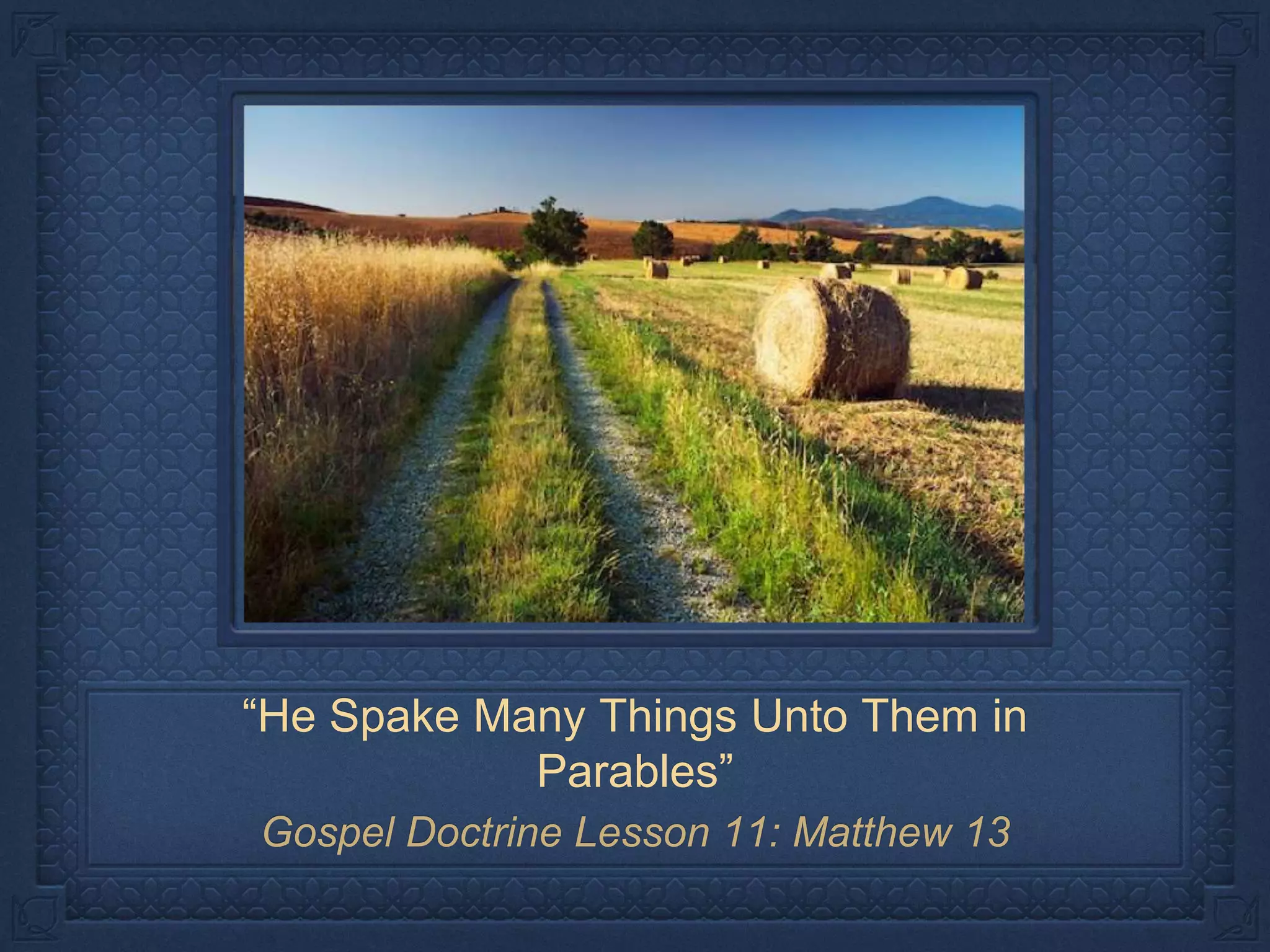
Parables”
Gospel Doctrine Lesson 11: Matthew 13
Introduction
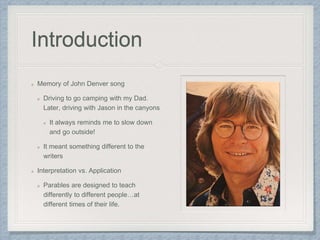
Memory of John Denver song
Driving to go camping with my Dad.
Later, driving with Jason in the canyons
It always reminds me to slow down
and go outside!
It meant something different to the
writers
Interpretation vs. Application
Parables are designed to teach
differently to different people…at
different times of their life.
What is a Parable?
Parable: Greek, means “to throw beside”. A symbolic story that imparts truths
by comparing them to earthly things.
Bruce R. McConkie
“Parables are a call to investigate the truth; to learn more; to inquire into the
spiritual realities, which, through them, are but dimly viewed. Parables start
truth seekers out in the direction of further light and knowledge and
understanding; they invite men to ponder such truths as they are able to
bear in the hope of learning more. Parables are a call to come unto Christ,
to believe his doctrines, to live his laws, and to be saved in his kingdom.
They teach arithmetic to those who have the capacity to learn calculus in
due course. They are the mild milk of the word that prepares our spiritual
digestive processes to feast upon the doctrinal meat of the kingdom.”
Why Teach in Parables?
Rewards
They can be applied to different groups of people at
different levels of understanding.
There is 2% literacy rate, no method of recording
doctrine
Why does he use them? Matt 13:10-13, JST on vs 12
Their stubbornness is similar to Amulek (Alma 10:6)
Bruce R. McConkie: “Parables form a reservoir of
knowledge (to ponder on)…”
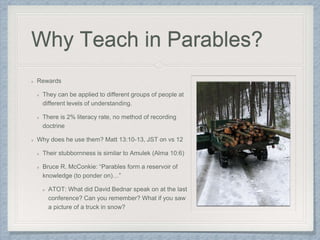
ATOT: What did David Bednar speak on at the last
conference? Can you remember? What if you saw
a picture of a truck in snow?
The Parable of the Sower
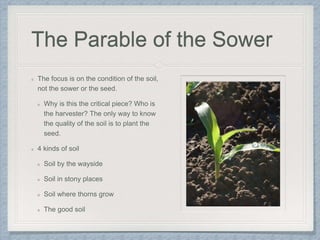
The focus is on the condition of the soil,
not the sower or the seed.
Why is this the critical piece? Who is
the harvester? The only way to know
the quality of the soil is to plant the
seed.
4 kinds of soil
Soil by the wayside
Soil in stony places
Soil where thorns grow
The good soil
The soil by the wayside
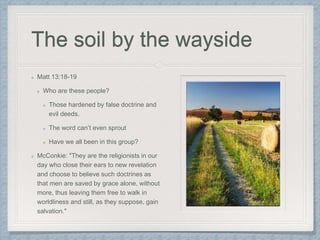
Matt 13:18-19
Who are these people?
Those hardened by false doctrine and
evil deeds.
The word can’t even sprout
Have we all been in this group?
McConkie: "They are the religionists in our
day who close their ears to new revelation
and choose to believe such doctrines as
that men are saved by grace alone, without
more, thus leaving them free to walk in
worldliness and still, as they suppose, gain
salvation."
The soil in stony places
Matt 13:20-21
Who are these people?
They who believe the word but
do not press forward.
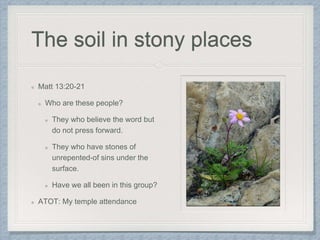
They who have stones of
unrepented-of sins under the
surface.
Have we all been in this group?
ATOT: My temple attendance
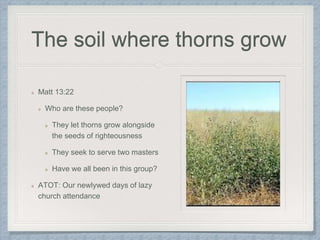
The soil where thorns grow
Matt 13:22
Who are these people?
They let thorns grow alongside
the seeds of righteousness
They seek to serve two masters
Have we all been in this group?
ATOT: Our newlywed days of lazy
church attendance
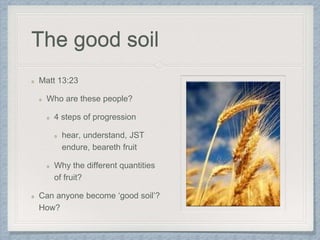
The good soil
Matt 13:23
Who are these people?
4 steps of progression
hear, understand, JST
endure, beareth fruit
Why the different quantities
of fruit?
Can anyone become ‘good soil’?
How?
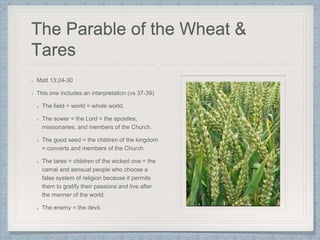
The Parable of the Wheat &
Tares
Matt 13:24-30
This one includes an interpretation (vs 37-39)
The field = world = whole world.
The sower = the Lord = the apostles,
missionaries, and members of the Church.
The good seed = the children of the kingdom
= converts and members of the Church.
The tares = children of the wicked one = the
carnal and sensual people who choose a
false system of religion because it permits
them to gratify their passions and live after
the manner of the world.
The enemy = the devil.
Why does he allow both to
grow?
2 Nephi 2:11, Opposition in all things
ATOT: Weeding my flower beds, my neighbor pointed
out that I was ripping out all the ‘plants’ with the
weeds.
ATOT: Prison therapist, “Tigers change their stripes
everyday here.”
If we tore out the unfamiliar we would risk
misjudging who is a tare - only God knows that.
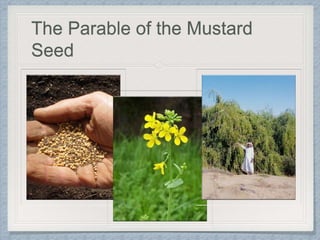
The Parable of the Mustard
Seed
The Parable of the Mustard
Seed
Both the seed and the tree would have been well know by these listeners. Hyperbole.
Joseph Smith
"Now we can discover plainly that this figure is given to represent the Church as it shall come
forth in the last days. Behold, the Kingdom of Heaven is likened unto it. Now, what is like unto it?
Let us take the Book of Mormon, which a man took and hid in his field, securing it by his faith, to
spring up in the last days, or in due time; let us behold it coming forth out of the ground, which is
indeed accounted the least of all seeds, but behold it branching forth, yea, even towering, with
lofty branches, and God-like majesty, until it, like the mustard seed, becomes the greatest of all
herbs. And it is truth, and it has sprouted and come forth out of the earth, and righteousness
begins to look down from heaven, and God is sending down His powers, gifts and angels, to
lodge in the branches thereof.
The Kingdom of Heaven is like unto a mustard seed. Behold, then is not this the Kingdom of
Heaven that is raising its head in the last days in the majesty of God, even the Church of the
Latter-day Saints"
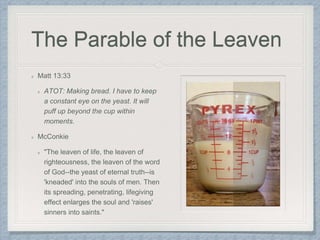
The Parable of the Leaven
Matt 13:33
ATOT: Making bread. I have to keep
a constant eye on the yeast. It will
puff up beyond the cup within
moments.
McConkie
"The leaven of life, the leaven of
righteousness, the leaven of the word
of God--the yeast of eternal truth--is
'kneaded' into the souls of men. Then
its spreading, penetrating, lifegiving
effect enlarges the soul and 'raises'
sinners into saints."
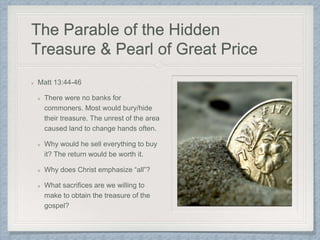
The Parable of the Hidden
Treasure & Pearl of Great Price
Matt 13:44-46
There were no banks for
commoners. Most would bury/hide
their treasure. The unrest of the area
caused land to change hands often.
Why would he sell everything to buy
it? The return would be worth it.
Why does Christ emphasize “all”?
What sacrifices are we willing to
make to obtain the treasure of the
gospel?
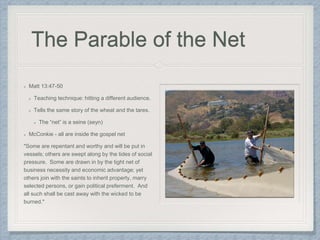
The Parable of the Net
Matt 13:47-50
Teaching technique: hitting a different audience.
Tells the same story of the wheat and the tares.
The “net” is a seine (seyn)
McConkie - all are inside the gospel net
"Some are repentant and worthy and will be put in
vessels; others are swept along by the tides of social
pressure. Some are drawn in by the tight net of
business necessity and economic advantage; yet
others join with the saints to inherit property, marry
selected persons, or gain political preferment. And
all such shall be cast away with the wicked to be
burned."

GD NT 11: MeckMom LDS Gospel Doctrine New Testament Lesson 11

  • 1.
    “He Spake ManyThings Unto Them in Parables” Gospel Doctrine Lesson 11: Matthew 13
  • 2.
    Introduction Memory of JohnDenver song Driving to go camping with my Dad. Later, driving with Jason in the canyons It always reminds me to slow down and go outside! It meant something different to the writers Interpretation vs. Application Parables are designed to teach differently to different people…at different times of their life.
  • 3.
    What is aParable? Parable: Greek, means “to throw beside”. A symbolic story that imparts truths by comparing them to earthly things. Bruce R. McConkie “Parables are a call to investigate the truth; to learn more; to inquire into the spiritual realities, which, through them, are but dimly viewed. Parables start truth seekers out in the direction of further light and knowledge and understanding; they invite men to ponder such truths as they are able to bear in the hope of learning more. Parables are a call to come unto Christ, to believe his doctrines, to live his laws, and to be saved in his kingdom. They teach arithmetic to those who have the capacity to learn calculus in due course. They are the mild milk of the word that prepares our spiritual digestive processes to feast upon the doctrinal meat of the kingdom.”
  • 4.
    Why Teach inParables? Rewards They can be applied to different groups of people at different levels of understanding. There is 2% literacy rate, no method of recording doctrine Why does he use them? Matt 13:10-13, JST on vs 12 Their stubbornness is similar to Amulek (Alma 10:6) Bruce R. McConkie: “Parables form a reservoir of knowledge (to ponder on)…” ATOT: What did David Bednar speak on at the last conference? Can you remember? What if you saw a picture of a truck in snow?
  • 5.
    The Parable ofthe Sower The focus is on the condition of the soil, not the sower or the seed. Why is this the critical piece? Who is the harvester? The only way to know the quality of the soil is to plant the seed. 4 kinds of soil Soil by the wayside Soil in stony places Soil where thorns grow The good soil
  • 6.
    The soil bythe wayside Matt 13:18-19 Who are these people? Those hardened by false doctrine and evil deeds. The word can’t even sprout Have we all been in this group? McConkie: "They are the religionists in our day who close their ears to new revelation and choose to believe such doctrines as that men are saved by grace alone, without more, thus leaving them free to walk in worldliness and still, as they suppose, gain salvation."
  • 7.
    The soil instony places Matt 13:20-21 Who are these people? They who believe the word but do not press forward. They who have stones of unrepented-of sins under the surface. Have we all been in this group? ATOT: My temple attendance
  • 8.
    The soil wherethorns grow Matt 13:22 Who are these people? They let thorns grow alongside the seeds of righteousness They seek to serve two masters Have we all been in this group? ATOT: Our newlywed days of lazy church attendance
  • 9.
    The good soil Matt13:23 Who are these people? 4 steps of progression hear, understand, JST endure, beareth fruit Why the different quantities of fruit? Can anyone become ‘good soil’? How?
  • 10.
    The Parable ofthe Wheat & Tares Matt 13:24-30 This one includes an interpretation (vs 37-39) The field = world = whole world. The sower = the Lord = the apostles, missionaries, and members of the Church. The good seed = the children of the kingdom = converts and members of the Church. The tares = children of the wicked one = the carnal and sensual people who choose a false system of religion because it permits them to gratify their passions and live after the manner of the world. The enemy = the devil.
  • 11.
    Why does heallow both to grow? 2 Nephi 2:11, Opposition in all things ATOT: Weeding my flower beds, my neighbor pointed out that I was ripping out all the ‘plants’ with the weeds. ATOT: Prison therapist, “Tigers change their stripes everyday here.” If we tore out the unfamiliar we would risk misjudging who is a tare - only God knows that.
  • 12.
    The Parable ofthe Mustard Seed
  • 13.
    The Parable ofthe Mustard Seed Both the seed and the tree would have been well know by these listeners. Hyperbole. Joseph Smith "Now we can discover plainly that this figure is given to represent the Church as it shall come forth in the last days. Behold, the Kingdom of Heaven is likened unto it. Now, what is like unto it? Let us take the Book of Mormon, which a man took and hid in his field, securing it by his faith, to spring up in the last days, or in due time; let us behold it coming forth out of the ground, which is indeed accounted the least of all seeds, but behold it branching forth, yea, even towering, with lofty branches, and God-like majesty, until it, like the mustard seed, becomes the greatest of all herbs. And it is truth, and it has sprouted and come forth out of the earth, and righteousness begins to look down from heaven, and God is sending down His powers, gifts and angels, to lodge in the branches thereof. The Kingdom of Heaven is like unto a mustard seed. Behold, then is not this the Kingdom of Heaven that is raising its head in the last days in the majesty of God, even the Church of the Latter-day Saints"
  • 14.
    The Parable ofthe Leaven Matt 13:33 ATOT: Making bread. I have to keep a constant eye on the yeast. It will puff up beyond the cup within moments. McConkie "The leaven of life, the leaven of righteousness, the leaven of the word of God--the yeast of eternal truth--is 'kneaded' into the souls of men. Then its spreading, penetrating, lifegiving effect enlarges the soul and 'raises' sinners into saints."
  • 15.
    The Parable ofthe Hidden Treasure & Pearl of Great Price Matt 13:44-46 There were no banks for commoners. Most would bury/hide their treasure. The unrest of the area caused land to change hands often. Why would he sell everything to buy it? The return would be worth it. Why does Christ emphasize “all”? What sacrifices are we willing to make to obtain the treasure of the gospel?
  • 16.
    The Parable ofthe Net Matt 13:47-50 Teaching technique: hitting a different audience. Tells the same story of the wheat and the tares. The “net” is a seine (seyn) McConkie - all are inside the gospel net "Some are repentant and worthy and will be put in vessels; others are swept along by the tides of social pressure. Some are drawn in by the tight net of business necessity and economic advantage; yet others join with the saints to inherit property, marry selected persons, or gain political preferment. And all such shall be cast away with the wicked to be burned."