The Ministry of
Jesus
The later stages of Galilean
Ministry
The synoptic gospels continue to deal with
Jesus’ ministry topically at this time - and
that is the simplest way for us to follow:
Parables Mk 4:1-34
Miracles Mk 4:34-6:6, 6:30-56
Sending out the 12 will be discussed
afterwards and the death of JTB has already
been dealt with
Withdrawal from Galilee Mk 7:1-9:50 -
critique of Jewish traditions (going north and
east) and then brief return before the journey
to Jerusalem
Parables
Parables
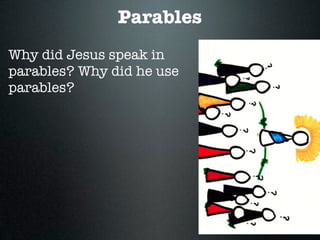
Why did Jesus speak in
parables? Why did he use
parables?
Parables
Why did Jesus speak in
parables? Why did he use
parables?
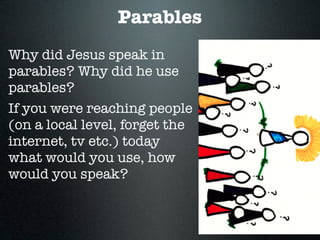
If you were reaching people
(on a local level, forget the
internet, tv etc.) today
what would you use, how
would you speak?
Parables
Why did Jesus speak in
parables? Why did he use
parables?
If you were reaching people
(on a local level, forget the
internet, tv etc.) today
what would you use, how
would you speak?
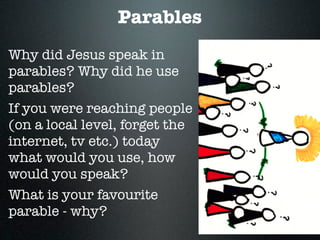
What is your favourite
parable - why?
The Greek word from which we
get ‘parable” means “to throw
alongside” - giving us an idea
that a parable has two
meanings one of which might be
symbolic or analogical - in
simplicity a story with two
meanings.
Whilst it is not the object of this
course to talk about parables
and Jesus’ use of them we
should note that historically
Christians have approached
parables in differing ways.
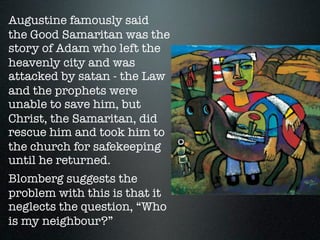
Augustine famously said
the Good Samaritan was the
story of Adam who left the
heavenly city and was
attacked by satan - the Law
and the prophets were
unable to save him, but
Christ, the Samaritan, did
rescue him and took him to
the church for safekeeping
until he returned.
Blomberg suggests the
problem with this is that it
neglects the question, “Who
is my neighbour?”
A movement led by Julicher at
the end of the 19th cent. brought
this allegorical interpretation to
an end and led people to see
more that parables involved
lifelike description of 1st century
Palestine, had a point of
application and illustrated
truths about the KOG.
In more recent times a
movement has grown suggesting
that there is some allegorical
aspect to the parables and that
parables do not necc. contain one
central truth.
What is the
following parable:
what does it tell
you?
Again Jesus began to teach by the lake. The crowd
that gathered round him was so large that he got
into a boat and sat in it out on the lake, while all
the people were along the shore at the water’s
edge.2 He taught them many things by parables,
and in his teaching said: 3 ‘Listen! A farmer went
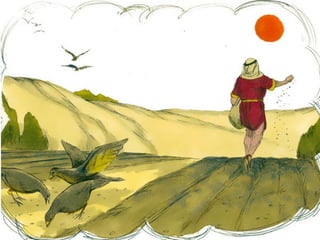
out to sow his seed. 4 As he was scattering the
seed, some fell along the path, and the birds came
and ate it up.5 Some fell on rocky places, where it
did not have much soil. It sprang up quickly,
because the soil was shallow. 6 But when the sun
came up, the plants were scorched, and they
withered because they had no root.
7 Other seed fell among thorns, which grew up
and choked the plants, so that they did not bear
grain. 8 Still other seed fell on good soil. It came
up, grew and produced a crop, some multiplying
thirty, some sixty, some a hundred times.’
9 Then Jesus said, ‘Whoever has ears to hear, let
them hear.’
10 When he was alone, the Twelve and the others
around him asked him about the parables. 11 He
told them, ‘The secret of the kingdom of God has
been given to you. But to those on the outside
everything is said in parables 12 so that,
‘“they may be ever seeing but never perceiving,
    and ever hearing but never understanding;
otherwise they might turn and be forgiven!”’
13 Then Jesus said to them,‘Don’t you understand
this parable? How then will you understand any
parable?14 The farmer sows the word. 15 Some
people are like seed along the path, where the
word is sown. As soon as they hear it, Satan
comes and takes away the word that was sown in
them. 16 Others, like seed sown on rocky places,
hear the word and at once receive it with joy.
17 But since they have no root, they last only a
short time. When trouble or persecution comes
because of the word, they quickly fall away.
18 Still others, like seed sown among thorns, hear
the word;19 but the worries of this life, the
deceitfulness of wealth and the desires for other
things come in and choke the word, making it
unfruitful. 20 Others, like seed sown on good soil,
hear the word, accept it, and produce a crop –
some thirty, some sixty, some a hundred times
what was sown.’
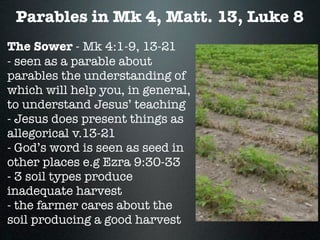
Parables in Mk 4, Matt. 13, Luke 8
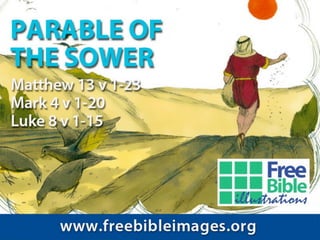
The Sower - Mk 4:1-9, 13-21
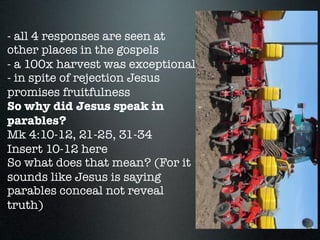
- seen as a parable about
parables the understanding of
which will help you, in general,
to understand Jesus’ teaching
- Jesus does present things as
allegorical v.13-21
- God’s word is seen as seed in
other places e.g Ezra 9:30-33
- 3 soil types produce
inadequate harvest
- the farmer cares about the
soil producing a good harvest
- all 4 responses are seen at
other places in the gospels
- a 100x harvest was exceptional
- in spite of rejection Jesus
promises fruitfulness
So why did Jesus speak in
parables?
Mk 4:10-12, 21-25, 31-34
Insert 10-12 here
So what does that mean? (For it
sounds like Jesus is saying
parables conceal not reveal
truth)
Blomberg suggests we
consider:
1. True spiritual
understanding in the Bible is
never simply in the mind but
also in the will and actions -
unless you act as a disciple
would you have no
understanding
2. Parables (when
understood) either attract or
repel - so either their effect is
to produce repentance or to
drive people further from
Jesus
3. Isa 6:9-10 is in the context
of God pronouncing
judgement yet at the end of
the chapter there is still hope
in a remnant reemerging. God
never so exercises judgement
in this life as to prevent
anyone who wants to move
from being an “outsider” to
“insider” so doing
Blomberg concludes by
suggesting Jesus is now
revealing secrets not
previously understood about
God’s plan for his people
- 24-25 suggests that those
already out of touch with
God’s plan will be more
alienated
- v33 for those open to Jesus a
new way of discipleship and
understanding follows
Pop quiz
Pop quiz
23
Place the following 10 events
from the life of Jesus Christ in
the correct order
•Clearing of the Temple
•Jesus and Nicodemus
•Rejection at Nazareth
•Jesus Walks on Water
•Temptation of Jesus
•Raising of Lazarus
•Crucifixion
•Water into Wine
•The Woman at the Well
•John Baptizes Jesus
24
24
1. John Baptizes Jesus
24
1. John Baptizes Jesus
2. Temptation of Jesus
24
1. John Baptizes Jesus
2. Temptation of Jesus
3. Jesus Turns Water into Wine
24
1. John Baptizes Jesus
2. Temptation of Jesus
3. Jesus Turns Water into Wine
4. Clearing of the Temple
24
1. John Baptizes Jesus
2. Temptation of Jesus
3. Jesus Turns Water into Wine
4. Clearing of the Temple
5. Jesus and Nicodemus
24
1. John Baptizes Jesus
2. Temptation of Jesus
3. Jesus Turns Water into Wine
4. Clearing of the Temple
5. Jesus and Nicodemus
6. The Woman at the Well
24
1. John Baptizes Jesus
2. Temptation of Jesus
3. Jesus Turns Water into Wine
4. Clearing of the Temple
5. Jesus and Nicodemus
6. The Woman at the Well
7. Rejection at Nazareth
24
1. John Baptizes Jesus
2. Temptation of Jesus
3. Jesus Turns Water into Wine
4. Clearing of the Temple
5. Jesus and Nicodemus
6. The Woman at the Well
7. Rejection at Nazareth
8. Jesus Walks on Water
24
1. John Baptizes Jesus
2. Temptation of Jesus
3. Jesus Turns Water into Wine
4. Clearing of the Temple
5. Jesus and Nicodemus
6. The Woman at the Well
7. Rejection at Nazareth
8. Jesus Walks on Water
9. Raising of Lazarus
24
1. John Baptizes Jesus
2. Temptation of Jesus
3. Jesus Turns Water into Wine
4. Clearing of the Temple
5. Jesus and Nicodemus
6. The Woman at the Well
7. Rejection at Nazareth
8. Jesus Walks on Water
9. Raising of Lazarus
10.Crucifixion
What are the
following parables -
what do they tell
you?
The parable of the seed growing
secretly Mk 4:26-29
- 2 elements, the farmer, the seed
- farmer is always uncertain of
the harvest - it depends on nature
- the good seed guarantees a
harvest due to the sovereignty of
God
France, “Despite appearances to
the contrary, [the kingdom of God
is growing], and the harvest will
come. It will come in God’s time
and in God’s way, not by human
effort or in accordance with
human logic”
He also said, ‘This is what the
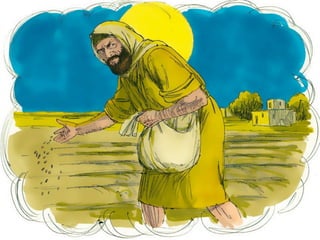
kingdom of God is like. A man
scatters seed on the ground.
27 Night and day, whether he
sleeps or gets up, the seed
sprouts and grows, though he
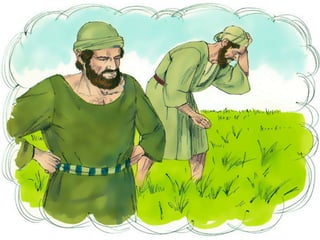
does not know how. 28 All by
itself the soil produces corn –
first the stalk, then the ear,
then the full grain in the ear.
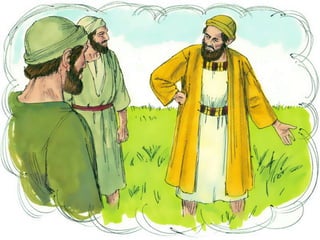
29 As soon as the corn is ripe,
he puts the sickle to it,
because the harvest has
come.’
The parable of the seed growing
secretly Mk 4:26-29
- 2 elements, the farmer, the seed
- farmer is always uncertain of
the harvest - it depends on nature
- the good seed guarantees a
harvest due to the sovereignty of
God
France, “Despite appearances to
the contrary, [the kingdom of God
is growing], and the harvest will
come. It will come in God’s time
and in God’s way, not by human
effort or in accordance with
human logic”
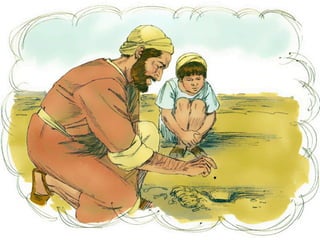
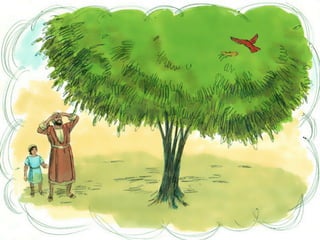
The mustard seed and the yeast Mk 4:30-32
Both of these contrast the idea of great results
from small beginnings
- some say a mustard seed could become only a
medium sized bush, in that case the result here
is amazing growth, it becomes a tree!
- considering the initial group of followers that
Jesus had we can see amazing results there too
- although yeast is not seen favorably in some
instances e.g. Passover it seems here it is
‘What shall we say the kingdom of God is like, or
what parable shall we use to describe it? 31 It is
like a mustard seed, which is the smallest of all
seeds on earth. 32 Yet when planted, it grows
and becomes the largest of all garden plants,
with such big branches that the birds can perch
in its shade.’
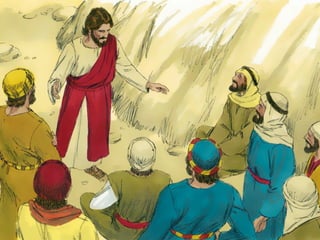
33 With many similar parables Jesus spoke
the word to them, as much as they could
understand.34 He did not say anything to them
without using a parable. But when he was alone
with his own disciples, he explained everything.
The mustard seed and the yeast Mk 4:30-32
Both of these contrast the idea of great results
from small beginnings
- some say a mustard seed could become only a
medium sized bush, in that case the result here
is amazing growth, it becomes a tree!
- considering the initial group of followers that
Jesus had we can see amazing results there too
- although yeast is not seen favorably in some
instances e.g. Passover it seems here it is
‘What shall we say the kingdom of God is like, or
what parable shall we use to describe it? 31 It is
like a mustard seed, which is the smallest of all
seeds on earth. 32 Yet when planted, it grows
and becomes the largest of all garden plants,
with such big branches that the birds can perch
in its shade.’
33 With many similar parables Jesus spoke
the word to them, as much as they could
understand.34 He did not say anything to them
without using a parable. But when he was alone
with his own disciples, he explained everything.
The mustard seed and the yeast Mk 4:30-32
Both of these contrast the idea of great results
from small beginnings
- some say a mustard seed could become only a
medium sized bush, in that case the result here
is amazing growth, it becomes a tree!
- considering the initial group of followers that
Jesus had we can see amazing results there too
- although yeast is not seen favorably in some
instances e.g. Passover it seems here it is
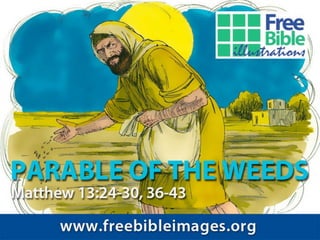
The parable of the weeds and the net - Matt
13:24-30, 36-43, 47-50
- the weeds parable also has a long explanation
(cf sower)
- God and satan are opponents with farmer, seed
and weeds being the focus for a while
- initially the weeds seem to be winning
- then the wheat survives and grows
- on judgement day all will be sorted out properly
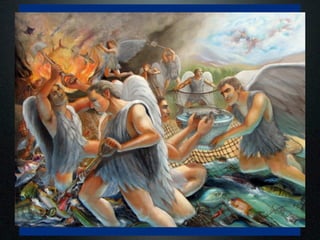
- similarly in the net we see good and bad fish as
well as fishers (angels)
47 ‘Once again, the kingdom of heaven is like a
net that was let down into the lake and caught
all kinds of fish.48 When it was full, the
fishermen pulled it up on the shore. Then they
sat down and collected the good fish in baskets,
but threw the bad away. 49 This is how it will be
at the end of the age. The angels will come and
separate the wicked from the righteous50 and
throw them into the blazing furnace, where
there will be weeping and gnashing of teeth.
The parable of the weeds and the net - Matt
13:24-30, 36-43, 47-50
- the weeds parable also has a long explanation
(cf sower)
- God and satan are opponents with farmer, seed
and weeds being the focus for a while
- initially the weeds seem to be winning
- then the wheat survives and grows
- on judgement day all will be sorted out properly
- similarly in the net we see good and bad fish as
well as fishers (angels)
47 ‘Once again, the kingdom of heaven is like a
net that was let down into the lake and caught
all kinds of fish.48 When it was full, the
fishermen pulled it up on the shore. Then they
sat down and collected the good fish in baskets,
but threw the bad away. 49 This is how it will be
at the end of the age. The angels will come and
separate the wicked from the righteous50 and
throw them into the blazing furnace, where
there will be weeping and gnashing of teeth.
The parable of the weeds and the net - Matt
13:24-30, 36-43, 47-50
- the weeds parable also has a long explanation
(cf sower)
- God and satan are opponents with farmer, seed
and weeds being the focus for a while
- initially the weeds seem to be winning
- then the wheat survives and grows
- on judgement day all will be sorted out properly
- similarly in the net we see good and bad fish as
well as fishers (angels)
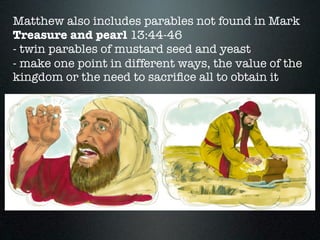
Matthew also includes parables not found in Mark
Treasure and pearl 13:44-46
- twin parables of mustard seed and yeast
- make one point in different ways, the value of the
kingdom or the need to sacrifice all to obtain it
‘The kingdom of heaven is like treasure hidden in a
field. When a man found it, he hid it again, and then in
his joy went and sold all he had and bought that field.
45 ‘Again, the kingdom of heaven is like a merchant
looking for fine pearls.46 When he found one of great
value, he went away and sold everything he had and
bought it.
Matthew also includes parables not found in Mark
Treasure and pearl 13:44-46
- twin parables of mustard seed and yeast
- make one point in different ways, the value of the
kingdom or the need to sacrifice all to obtain it
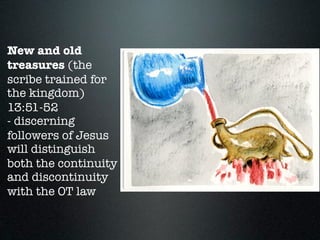
New and old
treasures (the
scribe trained for
the kingdom)
13:51-52
- discerning
followers of Jesus
will distinguish
both the continuity
and discontinuity
with the OT law
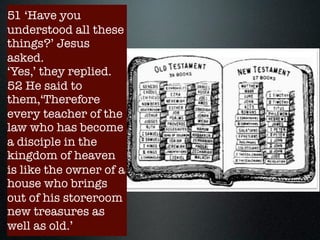
51 ‘Have you
understood all these
things?’ Jesus
asked.
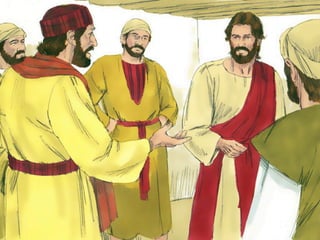
‘Yes,’ they replied.
52 He said to
them,‘Therefore
every teacher of the
law who has become
a disciple in the
kingdom of heaven
is like the owner of a
house who brings
out of his storeroom
new treasures as
well as old.’
New and old
treasures (the
scribe trained for
the kingdom)
13:51-52
- discerning
followers of Jesus
will distinguish
both the continuity
and discontinuity
with the OT law
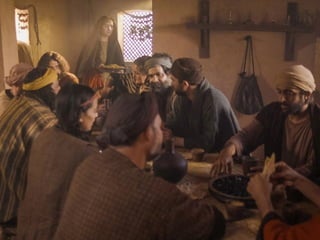
36 When one of the Pharisees invited Jesus to
have dinner with him, he went to the Pharisee’s
house and reclined at the table. 37 A woman in
that town who lived a sinful life learned that
Jesus was eating at the Pharisee’s house, so she
came there with an alabaster jar of perfume.
38 As she stood behind him at his feet weeping,
she began to wet his feet with her tears. Then she
wiped them with her hair, kissed them and
poured perfume on them.
39 When the Pharisee who had invited him saw
this, he said to himself, ‘If this man were a
prophet, he would know who is touching him and
what kind of woman she is – that she is a sinner.’
40 Jesus answered him,‘Simon, I have something to
tell you.’ ‘Tell me, teacher,’ he said.
41 ‘Two people owed money to a certain money-
lender. One owed him five hundred denarii,[c] and
the other fifty. 42 Neither of them had the money to
pay him back, so he forgave the debts of both. Now
which of them will love him more?’
43 Simon replied, ‘I suppose the one who had the
bigger debt forgiven.’
‘You have judged correctly,’Jesus said.
44 Then he turned towards the woman and said to
Simon, ‘Do you see this woman? I came into your
house.
You did not give me any water for my feet, but she
wet my feet with her tears and wiped them with her
hair. 45 You did not give me a kiss, but this woman,
from the time I entered, has not stopped kissing my
feet. 46 You did not put oil on my head, but she has
poured perfume on my feet. 47 Therefore, I tell you,
her many sins have been forgiven – as her great love
has shown. But whoever has been forgiven little
loves little.’
48 Then Jesus said to her,‘Your sins are forgiven.’
49 The other guests began to say among themselves,
‘Who is this who even forgives sins?’
50 Jesus said to the woman,‘Your faith has saved
you; go in peace.”
One other parable is found in Luke 7:36-8:3
Jesus is found at the home of Simon, a Pharisee
and is the subject of attention for a woman
(sinner v37) who weeps, wets his feet with her
tears, kisses his feet, wipes them with her hair
and finally anoints his feet with expensive oil
- Jesus tells a parable of two debtors owing
differing amounts and asks who will be more
grateful - the obvious answer, the one who is
forgiven more
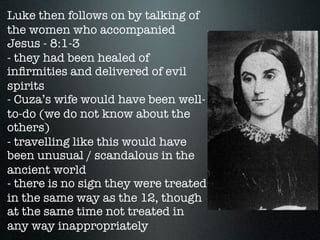
Luke then follows on by talking of
the women who accompanied
Jesus - 8:1-3
- they had been healed of
infirmities and delivered of evil
spirits
- Cuza’s wife would have been well-
to-do (we do not know about the
others)
- travelling like this would have
been unusual / scandalous in the
ancient world
- there is no sign they were treated
in the same way as the 12, though
at the same time not treated in
any way inappropriately
Luke then follows on by talking of
the women who accompanied
Jesus - 8:1-3
- they had been healed of
infirmities and delivered of evil
spirits
- Cuza’s wife would have been well-
to-do (we do not know about the
others)
- travelling like this would have
been unusual / scandalous in the
ancient world
- there is no sign they were treated
in the same way as the 12, though
at the same time not treated in
any way inappropriately
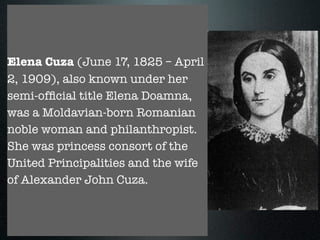
Elena Cuza (June 17, 1825 – April
2, 1909), also known under her
semi-official title Elena Doamna,
was a Moldavian-born Romanian
noble woman and philanthropist.
She was princess consort of the
United Principalities and the wife
of Alexander John Cuza.
Life of Christ, Section 7: Later Galilean Ministry

Life of Christ, Section 7: Later Galilean Ministry

  • 1.
    The Ministry of Jesus Thelater stages of Galilean Ministry
  • 3.
    The synoptic gospelscontinue to deal with Jesus’ ministry topically at this time - and that is the simplest way for us to follow: Parables Mk 4:1-34 Miracles Mk 4:34-6:6, 6:30-56 Sending out the 12 will be discussed afterwards and the death of JTB has already been dealt with Withdrawal from Galilee Mk 7:1-9:50 - critique of Jewish traditions (going north and east) and then brief return before the journey to Jerusalem
  • 4.
  • 5.
    Parables Why did Jesusspeak in parables? Why did he use parables?
  • 6.
    Parables Why did Jesusspeak in parables? Why did he use parables? If you were reaching people (on a local level, forget the internet, tv etc.) today what would you use, how would you speak?
  • 7.
    Parables Why did Jesusspeak in parables? Why did he use parables? If you were reaching people (on a local level, forget the internet, tv etc.) today what would you use, how would you speak? What is your favourite parable - why?
  • 8.
    The Greek wordfrom which we get ‘parable” means “to throw alongside” - giving us an idea that a parable has two meanings one of which might be symbolic or analogical - in simplicity a story with two meanings. Whilst it is not the object of this course to talk about parables and Jesus’ use of them we should note that historically Christians have approached parables in differing ways.
  • 9.
    Augustine famously said theGood Samaritan was the story of Adam who left the heavenly city and was attacked by satan - the Law and the prophets were unable to save him, but Christ, the Samaritan, did rescue him and took him to the church for safekeeping until he returned. Blomberg suggests the problem with this is that it neglects the question, “Who is my neighbour?”
  • 10.
    A movement ledby Julicher at the end of the 19th cent. brought this allegorical interpretation to an end and led people to see more that parables involved lifelike description of 1st century Palestine, had a point of application and illustrated truths about the KOG. In more recent times a movement has grown suggesting that there is some allegorical aspect to the parables and that parables do not necc. contain one central truth.
  • 11.
    What is the followingparable: what does it tell you?
  • 18.
    Again Jesus beganto teach by the lake. The crowd that gathered round him was so large that he got into a boat and sat in it out on the lake, while all the people were along the shore at the water’s edge.2 He taught them many things by parables, and in his teaching said: 3 ‘Listen! A farmer went out to sow his seed. 4 As he was scattering the seed, some fell along the path, and the birds came and ate it up.5 Some fell on rocky places, where it did not have much soil. It sprang up quickly, because the soil was shallow. 6 But when the sun came up, the plants were scorched, and they withered because they had no root.
  • 19.
    7 Other seed fellamong thorns, which grew up and choked the plants, so that they did not bear grain. 8 Still other seed fell on good soil. It came up, grew and produced a crop, some multiplying thirty, some sixty, some a hundred times.’ 9 Then Jesus said, ‘Whoever has ears to hear, let them hear.’ 10 When he was alone, the Twelve and the others around him asked him about the parables. 11 He told them, ‘The secret of the kingdom of God has been given to you. But to those on the outside everything is said in parables 12 so that, ‘“they may be ever seeing but never perceiving,     and ever hearing but never understanding; otherwise they might turn and be forgiven!”’
  • 20.
    13 Then Jesus saidto them,‘Don’t you understand this parable? How then will you understand any parable?14 The farmer sows the word. 15 Some people are like seed along the path, where the word is sown. As soon as they hear it, Satan comes and takes away the word that was sown in them. 16 Others, like seed sown on rocky places, hear the word and at once receive it with joy. 17 But since they have no root, they last only a short time. When trouble or persecution comes because of the word, they quickly fall away.
  • 21.
    18 Still others, likeseed sown among thorns, hear the word;19 but the worries of this life, the deceitfulness of wealth and the desires for other things come in and choke the word, making it unfruitful. 20 Others, like seed sown on good soil, hear the word, accept it, and produce a crop – some thirty, some sixty, some a hundred times what was sown.’
  • 22.
    Parables in Mk4, Matt. 13, Luke 8 The Sower - Mk 4:1-9, 13-21 - seen as a parable about parables the understanding of which will help you, in general, to understand Jesus’ teaching - Jesus does present things as allegorical v.13-21 - God’s word is seen as seed in other places e.g Ezra 9:30-33 - 3 soil types produce inadequate harvest - the farmer cares about the soil producing a good harvest
  • 23.
    - all 4responses are seen at other places in the gospels - a 100x harvest was exceptional - in spite of rejection Jesus promises fruitfulness So why did Jesus speak in parables? Mk 4:10-12, 21-25, 31-34 Insert 10-12 here So what does that mean? (For it sounds like Jesus is saying parables conceal not reveal truth)
  • 24.
    Blomberg suggests we consider: 1.True spiritual understanding in the Bible is never simply in the mind but also in the will and actions - unless you act as a disciple would you have no understanding 2. Parables (when understood) either attract or repel - so either their effect is to produce repentance or to drive people further from Jesus
  • 25.
    3. Isa 6:9-10is in the context of God pronouncing judgement yet at the end of the chapter there is still hope in a remnant reemerging. God never so exercises judgement in this life as to prevent anyone who wants to move from being an “outsider” to “insider” so doing Blomberg concludes by suggesting Jesus is now revealing secrets not previously understood about God’s plan for his people
  • 26.
    - 24-25 suggeststhat those already out of touch with God’s plan will be more alienated - v33 for those open to Jesus a new way of discipleship and understanding follows
  • 27.
  • 28.
  • 29.
    23 Place the following10 events from the life of Jesus Christ in the correct order •Clearing of the Temple •Jesus and Nicodemus •Rejection at Nazareth •Jesus Walks on Water •Temptation of Jesus •Raising of Lazarus •Crucifixion •Water into Wine •The Woman at the Well •John Baptizes Jesus
  • 30.
  • 31.
  • 32.
    24 1. John BaptizesJesus 2. Temptation of Jesus
  • 33.
    24 1. John BaptizesJesus 2. Temptation of Jesus 3. Jesus Turns Water into Wine
  • 34.
    24 1. John BaptizesJesus 2. Temptation of Jesus 3. Jesus Turns Water into Wine 4. Clearing of the Temple
  • 35.
    24 1. John BaptizesJesus 2. Temptation of Jesus 3. Jesus Turns Water into Wine 4. Clearing of the Temple 5. Jesus and Nicodemus
  • 36.
    24 1. John BaptizesJesus 2. Temptation of Jesus 3. Jesus Turns Water into Wine 4. Clearing of the Temple 5. Jesus and Nicodemus 6. The Woman at the Well
  • 37.
    24 1. John BaptizesJesus 2. Temptation of Jesus 3. Jesus Turns Water into Wine 4. Clearing of the Temple 5. Jesus and Nicodemus 6. The Woman at the Well 7. Rejection at Nazareth
  • 38.
    24 1. John BaptizesJesus 2. Temptation of Jesus 3. Jesus Turns Water into Wine 4. Clearing of the Temple 5. Jesus and Nicodemus 6. The Woman at the Well 7. Rejection at Nazareth 8. Jesus Walks on Water
  • 39.
    24 1. John BaptizesJesus 2. Temptation of Jesus 3. Jesus Turns Water into Wine 4. Clearing of the Temple 5. Jesus and Nicodemus 6. The Woman at the Well 7. Rejection at Nazareth 8. Jesus Walks on Water 9. Raising of Lazarus
  • 40.
    24 1. John BaptizesJesus 2. Temptation of Jesus 3. Jesus Turns Water into Wine 4. Clearing of the Temple 5. Jesus and Nicodemus 6. The Woman at the Well 7. Rejection at Nazareth 8. Jesus Walks on Water 9. Raising of Lazarus 10.Crucifixion
  • 41.
    What are the followingparables - what do they tell you?
  • 47.
    The parable ofthe seed growing secretly Mk 4:26-29 - 2 elements, the farmer, the seed - farmer is always uncertain of the harvest - it depends on nature - the good seed guarantees a harvest due to the sovereignty of God France, “Despite appearances to the contrary, [the kingdom of God is growing], and the harvest will come. It will come in God’s time and in God’s way, not by human effort or in accordance with human logic” He also said, ‘This is what the kingdom of God is like. A man scatters seed on the ground. 27 Night and day, whether he sleeps or gets up, the seed sprouts and grows, though he does not know how. 28 All by itself the soil produces corn – first the stalk, then the ear, then the full grain in the ear. 29 As soon as the corn is ripe, he puts the sickle to it, because the harvest has come.’
  • 48.
    The parable ofthe seed growing secretly Mk 4:26-29 - 2 elements, the farmer, the seed - farmer is always uncertain of the harvest - it depends on nature - the good seed guarantees a harvest due to the sovereignty of God France, “Despite appearances to the contrary, [the kingdom of God is growing], and the harvest will come. It will come in God’s time and in God’s way, not by human effort or in accordance with human logic”
  • 49.
    The mustard seedand the yeast Mk 4:30-32 Both of these contrast the idea of great results from small beginnings - some say a mustard seed could become only a medium sized bush, in that case the result here is amazing growth, it becomes a tree! - considering the initial group of followers that Jesus had we can see amazing results there too - although yeast is not seen favorably in some instances e.g. Passover it seems here it is ‘What shall we say the kingdom of God is like, or what parable shall we use to describe it? 31 It is like a mustard seed, which is the smallest of all seeds on earth. 32 Yet when planted, it grows and becomes the largest of all garden plants, with such big branches that the birds can perch in its shade.’ 33 With many similar parables Jesus spoke the word to them, as much as they could understand.34 He did not say anything to them without using a parable. But when he was alone with his own disciples, he explained everything.
  • 50.
    The mustard seedand the yeast Mk 4:30-32 Both of these contrast the idea of great results from small beginnings - some say a mustard seed could become only a medium sized bush, in that case the result here is amazing growth, it becomes a tree! - considering the initial group of followers that Jesus had we can see amazing results there too - although yeast is not seen favorably in some instances e.g. Passover it seems here it is ‘What shall we say the kingdom of God is like, or what parable shall we use to describe it? 31 It is like a mustard seed, which is the smallest of all seeds on earth. 32 Yet when planted, it grows and becomes the largest of all garden plants, with such big branches that the birds can perch in its shade.’ 33 With many similar parables Jesus spoke the word to them, as much as they could understand.34 He did not say anything to them without using a parable. But when he was alone with his own disciples, he explained everything.
  • 51.
    The mustard seedand the yeast Mk 4:30-32 Both of these contrast the idea of great results from small beginnings - some say a mustard seed could become only a medium sized bush, in that case the result here is amazing growth, it becomes a tree! - considering the initial group of followers that Jesus had we can see amazing results there too - although yeast is not seen favorably in some instances e.g. Passover it seems here it is
  • 58.
    The parable ofthe weeds and the net - Matt 13:24-30, 36-43, 47-50 - the weeds parable also has a long explanation (cf sower) - God and satan are opponents with farmer, seed and weeds being the focus for a while - initially the weeds seem to be winning - then the wheat survives and grows - on judgement day all will be sorted out properly - similarly in the net we see good and bad fish as well as fishers (angels) 47 ‘Once again, the kingdom of heaven is like a net that was let down into the lake and caught all kinds of fish.48 When it was full, the fishermen pulled it up on the shore. Then they sat down and collected the good fish in baskets, but threw the bad away. 49 This is how it will be at the end of the age. The angels will come and separate the wicked from the righteous50 and throw them into the blazing furnace, where there will be weeping and gnashing of teeth.
  • 59.
    The parable ofthe weeds and the net - Matt 13:24-30, 36-43, 47-50 - the weeds parable also has a long explanation (cf sower) - God and satan are opponents with farmer, seed and weeds being the focus for a while - initially the weeds seem to be winning - then the wheat survives and grows - on judgement day all will be sorted out properly - similarly in the net we see good and bad fish as well as fishers (angels) 47 ‘Once again, the kingdom of heaven is like a net that was let down into the lake and caught all kinds of fish.48 When it was full, the fishermen pulled it up on the shore. Then they sat down and collected the good fish in baskets, but threw the bad away. 49 This is how it will be at the end of the age. The angels will come and separate the wicked from the righteous50 and throw them into the blazing furnace, where there will be weeping and gnashing of teeth.
  • 60.
    The parable ofthe weeds and the net - Matt 13:24-30, 36-43, 47-50 - the weeds parable also has a long explanation (cf sower) - God and satan are opponents with farmer, seed and weeds being the focus for a while - initially the weeds seem to be winning - then the wheat survives and grows - on judgement day all will be sorted out properly - similarly in the net we see good and bad fish as well as fishers (angels)
  • 61.
    Matthew also includesparables not found in Mark Treasure and pearl 13:44-46 - twin parables of mustard seed and yeast - make one point in different ways, the value of the kingdom or the need to sacrifice all to obtain it ‘The kingdom of heaven is like treasure hidden in a field. When a man found it, he hid it again, and then in his joy went and sold all he had and bought that field. 45 ‘Again, the kingdom of heaven is like a merchant looking for fine pearls.46 When he found one of great value, he went away and sold everything he had and bought it.
  • 62.
    Matthew also includesparables not found in Mark Treasure and pearl 13:44-46 - twin parables of mustard seed and yeast - make one point in different ways, the value of the kingdom or the need to sacrifice all to obtain it
  • 63.
    New and old treasures(the scribe trained for the kingdom) 13:51-52 - discerning followers of Jesus will distinguish both the continuity and discontinuity with the OT law 51 ‘Have you understood all these things?’ Jesus asked. ‘Yes,’ they replied. 52 He said to them,‘Therefore every teacher of the law who has become a disciple in the kingdom of heaven is like the owner of a house who brings out of his storeroom new treasures as well as old.’
  • 64.
    New and old treasures(the scribe trained for the kingdom) 13:51-52 - discerning followers of Jesus will distinguish both the continuity and discontinuity with the OT law
  • 71.
    36 When one ofthe Pharisees invited Jesus to have dinner with him, he went to the Pharisee’s house and reclined at the table. 37 A woman in that town who lived a sinful life learned that Jesus was eating at the Pharisee’s house, so she came there with an alabaster jar of perfume. 38 As she stood behind him at his feet weeping, she began to wet his feet with her tears. Then she wiped them with her hair, kissed them and poured perfume on them. 39 When the Pharisee who had invited him saw this, he said to himself, ‘If this man were a prophet, he would know who is touching him and what kind of woman she is – that she is a sinner.’
  • 72.
    40 Jesus answered him,‘Simon,I have something to tell you.’ ‘Tell me, teacher,’ he said. 41 ‘Two people owed money to a certain money- lender. One owed him five hundred denarii,[c] and the other fifty. 42 Neither of them had the money to pay him back, so he forgave the debts of both. Now which of them will love him more?’ 43 Simon replied, ‘I suppose the one who had the bigger debt forgiven.’ ‘You have judged correctly,’Jesus said. 44 Then he turned towards the woman and said to Simon, ‘Do you see this woman? I came into your house.
  • 73.
    You did notgive me any water for my feet, but she wet my feet with her tears and wiped them with her hair. 45 You did not give me a kiss, but this woman, from the time I entered, has not stopped kissing my feet. 46 You did not put oil on my head, but she has poured perfume on my feet. 47 Therefore, I tell you, her many sins have been forgiven – as her great love has shown. But whoever has been forgiven little loves little.’ 48 Then Jesus said to her,‘Your sins are forgiven.’ 49 The other guests began to say among themselves, ‘Who is this who even forgives sins?’ 50 Jesus said to the woman,‘Your faith has saved you; go in peace.”
  • 74.
    One other parableis found in Luke 7:36-8:3 Jesus is found at the home of Simon, a Pharisee and is the subject of attention for a woman (sinner v37) who weeps, wets his feet with her tears, kisses his feet, wipes them with her hair and finally anoints his feet with expensive oil - Jesus tells a parable of two debtors owing differing amounts and asks who will be more grateful - the obvious answer, the one who is forgiven more
  • 75.
    Luke then followson by talking of the women who accompanied Jesus - 8:1-3 - they had been healed of infirmities and delivered of evil spirits - Cuza’s wife would have been well- to-do (we do not know about the others) - travelling like this would have been unusual / scandalous in the ancient world - there is no sign they were treated in the same way as the 12, though at the same time not treated in any way inappropriately
  • 76.
    Luke then followson by talking of the women who accompanied Jesus - 8:1-3 - they had been healed of infirmities and delivered of evil spirits - Cuza’s wife would have been well- to-do (we do not know about the others) - travelling like this would have been unusual / scandalous in the ancient world - there is no sign they were treated in the same way as the 12, though at the same time not treated in any way inappropriately Elena Cuza (June 17, 1825 – April 2, 1909), also known under her semi-official title Elena Doamna, was a Moldavian-born Romanian noble woman and philanthropist. She was princess consort of the United Principalities and the wife of Alexander John Cuza.