












Refugee Action
   Support
Overview to the Orientation
  of Literacy and Learning
STA R S
Type of Improvement
      observed
Type of Improvement
        observed
 • Engagement within the school
    and in the classroom;
Type of Improvement
        observed
 • Engagement within the school
     and in the classroom;

 •   Development of organisational
     skills and study habits;
Type of Improvement
        observed
 • Engagement within the school
     and in the classroom;

 •   Development of organisational
     skills and study habits;

 •   Development of speaking and
     listening skills
Type of Improvement
        observed
 • Engagement within the school
     and in the classroom;

 •   Development of organisational
     skills and study habits;

 •   Development of speaking and
     listening skills

 •   Development of writing skills for
     classroom purposes
Type of Improvement
        observed
 • Engagement within the school
     and in the classroom;

 •   Development of organisational
     skills and study habits;

 •   Development of speaking and
     listening skills

 •   Development of writing skills for
     classroom purposes

 •   Development of academic
     reading strategies
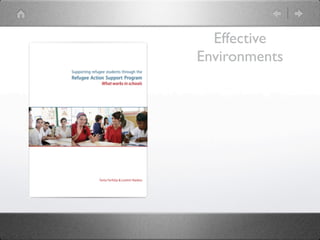
Effective
Environments
Effective
     Environments
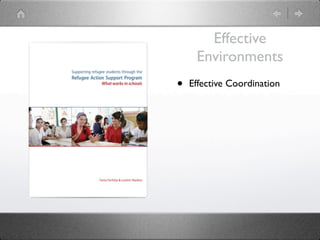
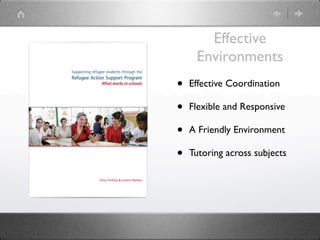
•   Effective Coordination
Effective
     Environments
•   Effective Coordination

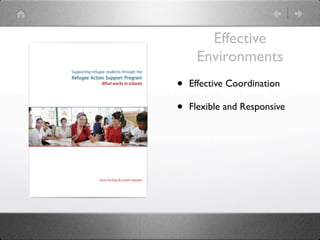
•   Flexible and Responsive
Effective
     Environments
•   Effective Coordination

•   Flexible and Responsive

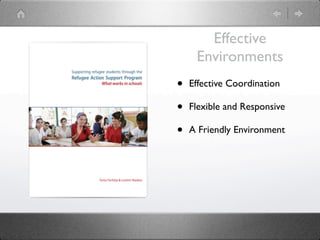
•   A Friendly Environment
Effective
     Environments
•   Effective Coordination

•   Flexible and Responsive

•   A Friendly Environment

•   Tutoring across subjects
Effective
     Environments
•   Effective Coordination

•   Flexible and Responsive

•   A Friendly Environment

•   Tutoring across subjects

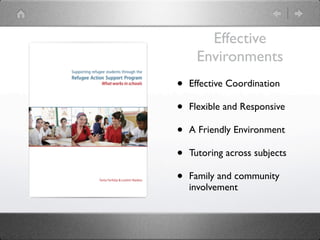
•   Family and community
    involvement
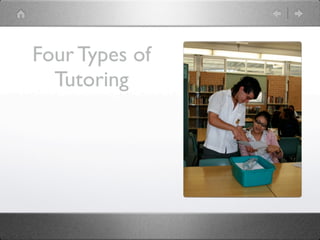
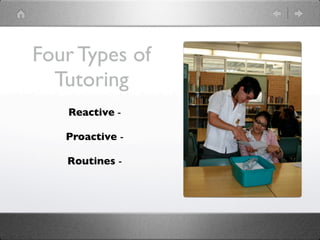
Four Types of
  Tutoring
Four Types of
  Tutoring
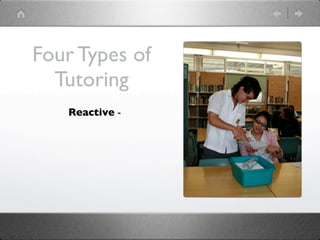
   Reactive -
Four Types of
  Tutoring
   Reactive -
Four Types of
  Tutoring
   Reactive -

   Proactive -
Four Types of
  Tutoring
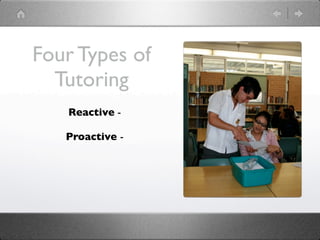
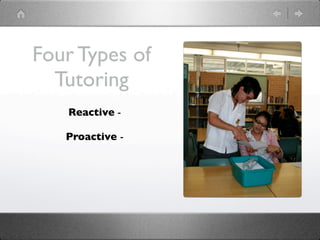
   Reactive -

   Proactive -
Four Types of
  Tutoring
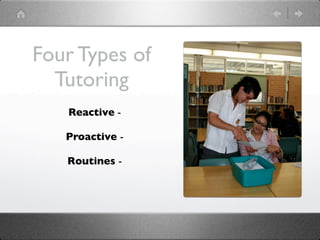
   Reactive -

   Proactive -

   Routines -
Four Types of
  Tutoring
   Reactive -

   Proactive -

   Routines -
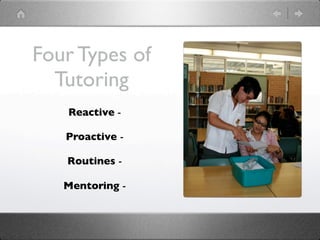
Four Types of
  Tutoring
   Reactive -

   Proactive -

   Routines -

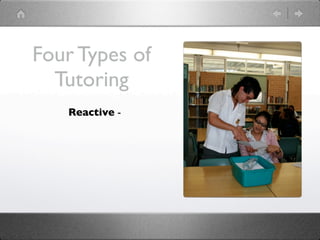
   Mentoring -
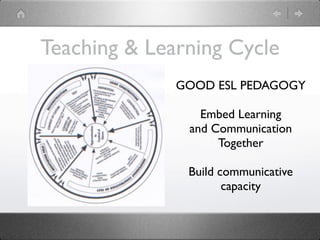
Teaching & Learning Cycle
              GOOD ESL PEDAGOGY

                 Embed Learning
               and Communication
                    Together

               Build communicative
                      capacity
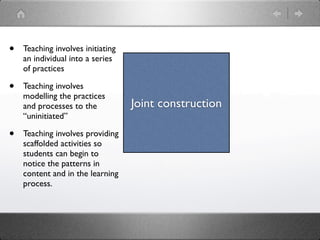
•   Teaching involves initiating
    an individual into a series
    of practices

•   Teaching involves
    modelling the practices
    and processes to the
    “uninitiated”

•   Teaching involves providing
    scaffolded activities so
    students can begin to
    notice the patterns in
    content and in the learning
    process.
•   Teaching involves initiating
    an individual into a series
    of practices

•   Teaching involves
    modelling the practices
    and processes to the           Joint construction
    “uninitiated”

•   Teaching involves providing
    scaffolded activities so
    students can begin to
    notice the patterns in
    content and in the learning
    process.
•   Teaching involves initiating
    an individual into a series
    of practices

•   Teaching involves
    modelling the practices
    and processes to the
    “uninitiated”

•   Teaching involves providing
    scaffolded activities so
    students can begin to
    notice the patterns in
    content and in the learning
    process.
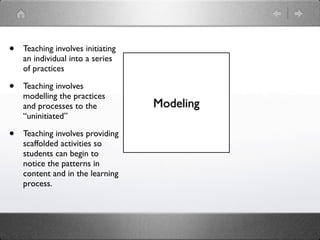
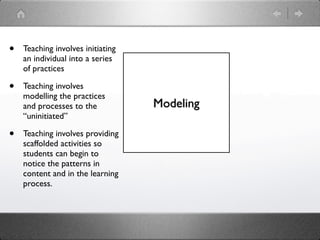
•   Teaching involves initiating
    an individual into a series
    of practices

•   Teaching involves
    modelling the practices
    and processes to the           Modeling
    “uninitiated”

•   Teaching involves providing
    scaffolded activities so
    students can begin to
    notice the patterns in
    content and in the learning
    process.
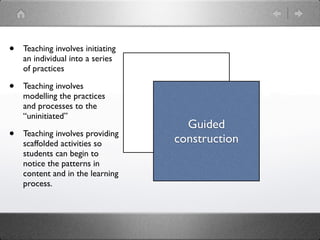
•   Teaching involves initiating
    an individual into a series
    of practices

•   Teaching involves
    modelling the practices
    and processes to the           Modeling
    “uninitiated”
                                        Guided
•   Teaching involves providing
                                      construction
    scaffolded activities so
    students can begin to
    notice the patterns in
    content and in the learning
    process.
•   Teaching involves initiating
    an individual into a series
    of practices

•   Teaching involves
    modelling the practices
    and processes to the           Modeling
    “uninitiated”

•   Teaching involves providing
    scaffolded activities so
    students can begin to
    notice the patterns in
    content and in the learning
    process.
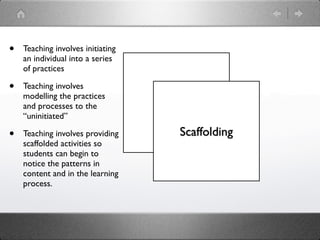
•   Teaching involves initiating
    an individual into a series
    of practices

•   Teaching involves
    modelling the practices
    and processes to the           Modeling
    “uninitiated”

•   Teaching involves providing        Scaffolding
    scaffolded activities so
    students can begin to
    notice the patterns in
    content and in the learning
    process.
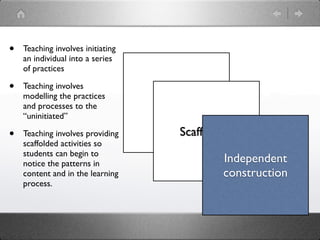
•   Teaching involves initiating
    an individual into a series
    of practices

•   Teaching involves
    modelling the practices
    and processes to the           Modeling
    “uninitiated”

•   Teaching involves providing        Scaffolding
    scaffolded activities so
    students can begin to
    notice the patterns in                      Independent
    content and in the learning                 construction
    process.
The [student] as a novice is continually attempting to make sense of

new situations and to acquire the skills necessary to function in those

situations. The teacher’s role is to help the [student] by arranging tasks

and activities in such a way that they are easily accessible.

Intersubjectivity, shared understanding based on common area of

focus is seen by adherents of literacy engagement as a crucial

prerequisite for successful communication between teacher and

[student] (Verhoeven and Snow, 2001, pp. 5).
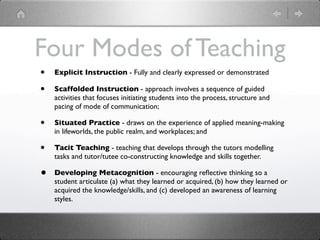
Four Modes of Teaching
•   Explicit Instruction - Fully and clearly expressed or demonstrated

•   Scaffolded Instruction - approach involves a sequence of guided
    activities that focuses initiating students into the process, structure and
    pacing of mode of communication;

•   Situated Practice - draws on the experience of applied meaning-making
    in lifeworlds, the public realm, and workplaces; and

•   Tacit Teaching - teaching that develops through the tutors modelling
    tasks and tutor/tutee co-constructing knowledge and skills together.

•   Developing Metacognition - encouraging reflective thinking so a
    student articulate (a) what they learned or acquired, (b) how they learned or
    acquired the knowledge/skills, and (c) developed an awareness of learning
    styles.
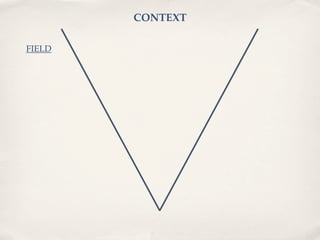
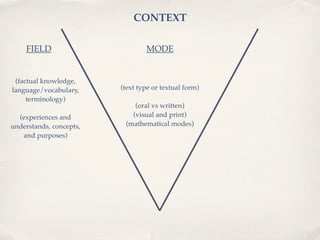
CONTEXT
CONTEXT
CONTEXT
CONTEXT

FIELD
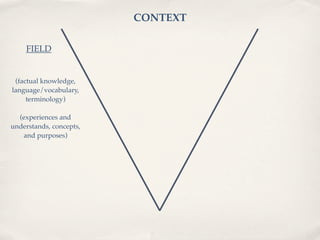
CONTEXT

    FIELD


 (factual knowledge,
language/vocabulary,
     terminology)

  (experiences and
understands, concepts,
   and purposes)
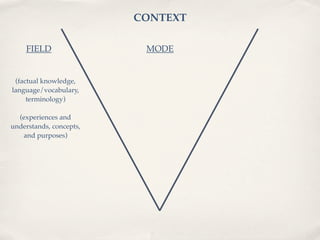
CONTEXT

    FIELD                 MODE


 (factual knowledge,
language/vocabulary,
     terminology)

  (experiences and
understands, concepts,
   and purposes)
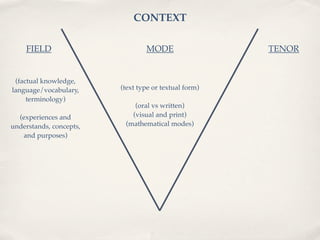
CONTEXT

    FIELD                        MODE


 (factual knowledge,
language/vocabulary,     (text type or textual form)
     terminology)
                             (oral vs written)
  (experiences and          (visual and print)
understands, concepts,    (mathematical modes)
   and purposes)
CONTEXT

    FIELD                        MODE                  TENOR


 (factual knowledge,
language/vocabulary,     (text type or textual form)
     terminology)
                             (oral vs written)
  (experiences and          (visual and print)
understands, concepts,    (mathematical modes)
   and purposes)
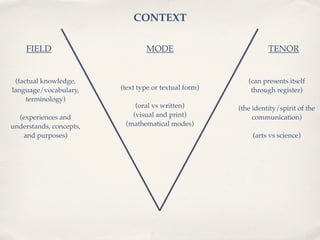
CONTEXT

    FIELD                        MODE                            TENOR


 (factual knowledge,                                      (can presents itself
language/vocabulary,     (text type or textual form)       through register)
     terminology)
                             (oral vs written)         (the identity/spirit of the
  (experiences and          (visual and print)              communication)
understands, concepts,    (mathematical modes)
   and purposes)                                            (arts vs science)
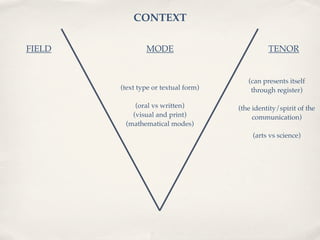
CONTEXT

FIELD           MODE                            TENOR


                                         (can presents itself
        (text type or textual form)       through register)

            (oral vs written)         (the identity/spirit of the
           (visual and print)              communication)
         (mathematical modes)
                                           (arts vs science)
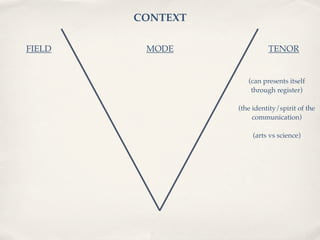
CONTEXT

FIELD    MODE               TENOR


                     (can presents itself
                      through register)

                  (the identity/spirit of the
                       communication)

                       (arts vs science)
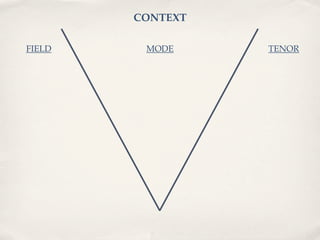
CONTEXT

FIELD    MODE     TENOR
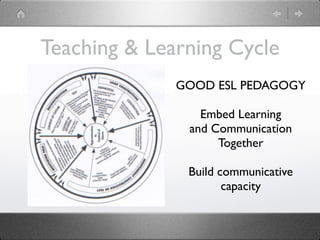
Teaching & Learning Cycle
              GOOD ESL PEDAGOGY

                 Embed Learning
               and Communication
                    Together

               Build communicative
                      capacity
little “d” discourse
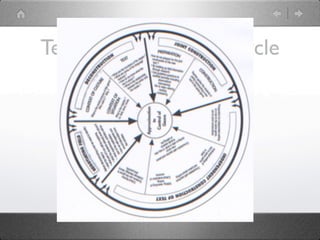
Teaching & Learning Cycle
•   Negotiating the Field;

•   Deconstructing;

    •   Deconstructing the Context + Situation of Use;

    •   Deconstructing the Text

•   Joint Construction

•   Guided Construction

•   Independent Construction;

•   Reflective Practice
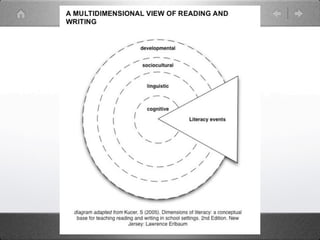
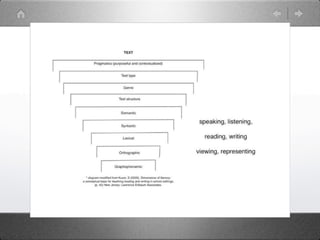
Four Literate Roles
  Psycholinguistic and Cognitive
• Decoder; (techniques)
• Meaning Maker; (tools of interpretation)
  Socio-linguistic and cultural
• Text user and participants;
• Explorer - learning through reading

New ras lecture

  • 1.
    Refugee Action Support Overview to the Orientation of Literacy and Learning
  • 2.
  • 3.
  • 4.
    Type of Improvement observed • Engagement within the school and in the classroom;
  • 5.
    Type of Improvement observed • Engagement within the school and in the classroom; • Development of organisational skills and study habits;
  • 6.
    Type of Improvement observed • Engagement within the school and in the classroom; • Development of organisational skills and study habits; • Development of speaking and listening skills
  • 7.
    Type of Improvement observed • Engagement within the school and in the classroom; • Development of organisational skills and study habits; • Development of speaking and listening skills • Development of writing skills for classroom purposes
  • 8.
    Type of Improvement observed • Engagement within the school and in the classroom; • Development of organisational skills and study habits; • Development of speaking and listening skills • Development of writing skills for classroom purposes • Development of academic reading strategies
  • 25.
  • 26.
    Effective Environments • Effective Coordination
  • 27.
    Effective Environments • Effective Coordination • Flexible and Responsive
  • 28.
    Effective Environments • Effective Coordination • Flexible and Responsive • A Friendly Environment
  • 29.
    Effective Environments • Effective Coordination • Flexible and Responsive • A Friendly Environment • Tutoring across subjects
  • 30.
    Effective Environments • Effective Coordination • Flexible and Responsive • A Friendly Environment • Tutoring across subjects • Family and community involvement
  • 31.
  • 32.
    Four Types of Tutoring Reactive -
  • 33.
    Four Types of Tutoring Reactive -
  • 34.
    Four Types of Tutoring Reactive - Proactive -
  • 35.
    Four Types of Tutoring Reactive - Proactive -
  • 36.
    Four Types of Tutoring Reactive - Proactive - Routines -
  • 37.
    Four Types of Tutoring Reactive - Proactive - Routines -
  • 38.
    Four Types of Tutoring Reactive - Proactive - Routines - Mentoring -
  • 39.
    Teaching & LearningCycle GOOD ESL PEDAGOGY Embed Learning and Communication Together Build communicative capacity
  • 40.
    Teaching involves initiating an individual into a series of practices • Teaching involves modelling the practices and processes to the “uninitiated” • Teaching involves providing scaffolded activities so students can begin to notice the patterns in content and in the learning process.
  • 41.
    Teaching involves initiating an individual into a series of practices • Teaching involves modelling the practices and processes to the Joint construction “uninitiated” • Teaching involves providing scaffolded activities so students can begin to notice the patterns in content and in the learning process.
  • 42.
    Teaching involves initiating an individual into a series of practices • Teaching involves modelling the practices and processes to the “uninitiated” • Teaching involves providing scaffolded activities so students can begin to notice the patterns in content and in the learning process.
  • 43.
    Teaching involves initiating an individual into a series of practices • Teaching involves modelling the practices and processes to the Modeling “uninitiated” • Teaching involves providing scaffolded activities so students can begin to notice the patterns in content and in the learning process.
  • 44.
    Teaching involves initiating an individual into a series of practices • Teaching involves modelling the practices and processes to the Modeling “uninitiated” Guided • Teaching involves providing construction scaffolded activities so students can begin to notice the patterns in content and in the learning process.
  • 45.
    Teaching involves initiating an individual into a series of practices • Teaching involves modelling the practices and processes to the Modeling “uninitiated” • Teaching involves providing scaffolded activities so students can begin to notice the patterns in content and in the learning process.
  • 46.
    Teaching involves initiating an individual into a series of practices • Teaching involves modelling the practices and processes to the Modeling “uninitiated” • Teaching involves providing Scaffolding scaffolded activities so students can begin to notice the patterns in content and in the learning process.
  • 47.
    Teaching involves initiating an individual into a series of practices • Teaching involves modelling the practices and processes to the Modeling “uninitiated” • Teaching involves providing Scaffolding scaffolded activities so students can begin to notice the patterns in Independent content and in the learning construction process.
  • 48.
    The [student] asa novice is continually attempting to make sense of new situations and to acquire the skills necessary to function in those situations. The teacher’s role is to help the [student] by arranging tasks and activities in such a way that they are easily accessible. Intersubjectivity, shared understanding based on common area of focus is seen by adherents of literacy engagement as a crucial prerequisite for successful communication between teacher and [student] (Verhoeven and Snow, 2001, pp. 5).
  • 49.
    Four Modes ofTeaching • Explicit Instruction - Fully and clearly expressed or demonstrated • Scaffolded Instruction - approach involves a sequence of guided activities that focuses initiating students into the process, structure and pacing of mode of communication; • Situated Practice - draws on the experience of applied meaning-making in lifeworlds, the public realm, and workplaces; and • Tacit Teaching - teaching that develops through the tutors modelling tasks and tutor/tutee co-constructing knowledge and skills together. • Developing Metacognition - encouraging reflective thinking so a student articulate (a) what they learned or acquired, (b) how they learned or acquired the knowledge/skills, and (c) developed an awareness of learning styles.
  • 50.
  • 51.
  • 52.
  • 53.
  • 54.
    CONTEXT FIELD (factual knowledge, language/vocabulary, terminology) (experiences and understands, concepts, and purposes)
  • 55.
    CONTEXT FIELD MODE (factual knowledge, language/vocabulary, terminology) (experiences and understands, concepts, and purposes)
  • 56.
    CONTEXT FIELD MODE (factual knowledge, language/vocabulary, (text type or textual form) terminology) (oral vs written) (experiences and (visual and print) understands, concepts, (mathematical modes) and purposes)
  • 57.
    CONTEXT FIELD MODE TENOR (factual knowledge, language/vocabulary, (text type or textual form) terminology) (oral vs written) (experiences and (visual and print) understands, concepts, (mathematical modes) and purposes)
  • 58.
    CONTEXT FIELD MODE TENOR (factual knowledge, (can presents itself language/vocabulary, (text type or textual form) through register) terminology) (oral vs written) (the identity/spirit of the (experiences and (visual and print) communication) understands, concepts, (mathematical modes) and purposes) (arts vs science)
  • 59.
    CONTEXT FIELD MODE TENOR (can presents itself (text type or textual form) through register) (oral vs written) (the identity/spirit of the (visual and print) communication) (mathematical modes) (arts vs science)
  • 60.
    CONTEXT FIELD MODE TENOR (can presents itself through register) (the identity/spirit of the communication) (arts vs science)
  • 61.
    CONTEXT FIELD MODE TENOR
  • 62.
    Teaching & LearningCycle GOOD ESL PEDAGOGY Embed Learning and Communication Together Build communicative capacity
  • 65.
  • 66.
  • 70.
  • 71.
  • 72.
    Negotiating the Field; • Deconstructing; • Deconstructing the Context + Situation of Use; • Deconstructing the Text • Joint Construction • Guided Construction • Independent Construction; • Reflective Practice
  • 73.
    Four Literate Roles Psycholinguistic and Cognitive • Decoder; (techniques) • Meaning Maker; (tools of interpretation) Socio-linguistic and cultural • Text user and participants; • Explorer - learning through reading