New Drug Adoption
Process
New Products
Adoption
Process
We define the adoption process as "the mental
process through which an individual passes
from first learning about an innovation to final
adoption', and adoption as the decision by an
individual to become a regular user of the
product.
• Adoption process is the mental process
through which the doctor learn about a new
drug for the first time and make decision on
whether to prescribe it. There are five
stages in the adoption process
(awareness, interest, evaluation, trial, and
adoption).
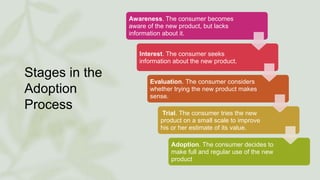
Stages in the
Adoption
Process
Awareness. The consumer becomes
aware of the new product, but lacks
information about it.
Interest. The consumer seeks
information about the new product.
Evaluation. The consumer considers
whether trying the new product makes
sense.
Trial. The consumer tries the new
product on a small scale to improve
his or her estimate of its value.
Adoption. The consumer decides to
make full and regular use of the new
product
Individual
Differences in
Innovativenes
s
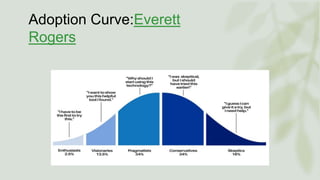
People differ greatly in their readiness to try
new products. In each product area, This has
led to a classification of people into the
adopter categories shown in Figure 1.1.
After a slow start, an increasing number of
people adopt the new product. The number
of adopters reaches a peak and then drops
off as fewer non-adopters remain.
Adoption Curve:Everett
Rogers
The five
adopter groups
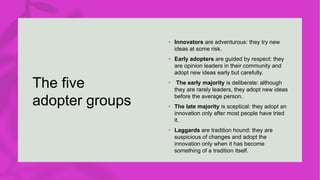
• Innovators are adventurous: they try new
ideas at some risk.
• Early adopters are guided by respect: they
are opinion leaders in their community and
adopt new ideas early but carefully.
• The early majority is deliberate: although
they are rarely leaders, they adopt new ideas
before the average person.
• The late majority is sceptical: they adopt an
innovation only after most people have tried
it.
• Laggards are tradition hound: they are
suspicious of changes and adopt the
innovation only when it has become
something of a tradition itself.
Influence of drug
characteristics on
rate of adoptions:
• Kotler (2018) identified 5 characteristics
influencing the rate of adoption of new
products. these characteristics are relative
advantage, compatibility, complexity,
divisibility, communicability.
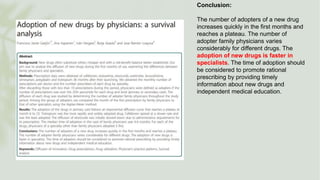
Conclusion:
The number of adopters of a new drug
increases quickly in the first months and
reaches a plateau. The number of
adopter family physicians varies
considerably for different drugs. The
adoption of new drugs is faster in
specialists. The time of adoption should
be considered to promote rational
prescribing by providing timely
information about new drugs and
independent medical education.
Rate of adoption of
the drugs among
physicians in each
specialty
Cumulative number of
adopter family
physicians who
prescribe each drug
over time.
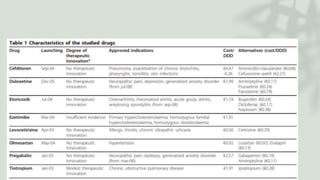
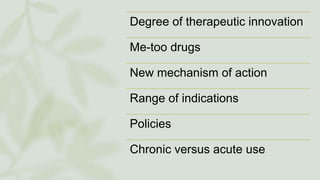
Degree of therapeutic innovation
Me-too drugs
New mechanism of action
Range of indications
Policies
Chronic versus acute use
• Thank You!

New Product Adoption Process.pptx

  • 1.
  • 2.
    New Products Adoption Process We definethe adoption process as "the mental process through which an individual passes from first learning about an innovation to final adoption', and adoption as the decision by an individual to become a regular user of the product.
  • 3.
    • Adoption processis the mental process through which the doctor learn about a new drug for the first time and make decision on whether to prescribe it. There are five stages in the adoption process (awareness, interest, evaluation, trial, and adoption).
  • 4.
    Stages in the Adoption Process Awareness.The consumer becomes aware of the new product, but lacks information about it. Interest. The consumer seeks information about the new product. Evaluation. The consumer considers whether trying the new product makes sense. Trial. The consumer tries the new product on a small scale to improve his or her estimate of its value. Adoption. The consumer decides to make full and regular use of the new product
  • 5.
    Individual Differences in Innovativenes s People differgreatly in their readiness to try new products. In each product area, This has led to a classification of people into the adopter categories shown in Figure 1.1. After a slow start, an increasing number of people adopt the new product. The number of adopters reaches a peak and then drops off as fewer non-adopters remain.
  • 6.
  • 7.
    The five adopter groups •Innovators are adventurous: they try new ideas at some risk. • Early adopters are guided by respect: they are opinion leaders in their community and adopt new ideas early but carefully. • The early majority is deliberate: although they are rarely leaders, they adopt new ideas before the average person. • The late majority is sceptical: they adopt an innovation only after most people have tried it. • Laggards are tradition hound: they are suspicious of changes and adopt the innovation only when it has become something of a tradition itself.
  • 8.
    Influence of drug characteristicson rate of adoptions: • Kotler (2018) identified 5 characteristics influencing the rate of adoption of new products. these characteristics are relative advantage, compatibility, complexity, divisibility, communicability.
  • 9.
    Conclusion: The number ofadopters of a new drug increases quickly in the first months and reaches a plateau. The number of adopter family physicians varies considerably for different drugs. The adoption of new drugs is faster in specialists. The time of adoption should be considered to promote rational prescribing by providing timely information about new drugs and independent medical education.
  • 10.
    Rate of adoptionof the drugs among physicians in each specialty
  • 12.
    Cumulative number of adopterfamily physicians who prescribe each drug over time.
  • 13.
    Degree of therapeuticinnovation Me-too drugs New mechanism of action Range of indications Policies Chronic versus acute use
  • 14.