Infections of Bone & Joint
Dr. T. L. S. Harini
*Osteomyelitis
*Historical background
*Definition
*Pathophysiology and
Classification
*Diagnosis
*Management :
*Antibiotic therapy
*Surgical treatment
*Plastic and reconstructive
surgery
*Current trends
*Definition
*The French surgeon Edouard Chassaignac was the first to
introduce the term osteomyelitis in 1852, when extensive
debridement and early amputation were the mainstays of
treatment
*The generic term ‘osteomyelitis’ originates from the two Greek
words ‘osteon’ and ‘myelos’ – bone and marrow – and is used
synonymously for an inflammation of the cortical and cancellous
bone
*Osteomyelitis is defined as an inflammation of the bone caused
by an infecting organism
*Chronic osteomyelitis is defined as long-standing infection of
the bone characterized by persistence of microorganisms,
presence of sequestrum, low-grade inflammation, and fistulae
*Classification
*Duration
*Mechanism of infection
*Type of host response to the infection
*Based on duration :
*acute
*Subacute: differs form acute in
that it lacks systemic disease
manifestations and begins
gradually
*chronic
*Mechanism of
infection
*Exogenous: caused by open fractures,
surgery (iatrogenic), or contiguous
spread from infected local tissue.
*Hematogenous: results from bacteremia
*Type of host response
to the infection
*pyogenic
*nonpyogenic
*Pathogens:
*Risk Factors
*Systemic:
*Diabetes mellitus
*Local:
*Disturbances in arterial and venous circulation
*Tissue damaged by radiation
*Extensive exposure of the operation site
*Extensive soft-tissue defects
*Extensive hematomas
*Remaining hollow spaces
*Nicotine and drug use
*Disturbances of liver and kidney function
*Severe infections with immunosuppression
*Pathogenesis:
*Microbial invasion the pathogens form a biofilm,
the components of which interact with
osteoblasts and the immune system
*Osteoclastogenesis is induced through several pathways in
osteomyelitis, whereas osteoblasts and therefore bone-
remodelling processes, especially new bone formation, are
inhibited
(1) microbial invasion and biofilm proliferation,
(2) immune response to bacterial biofilm,
(3) impact of bacterial invasion on bone tissue components
*ACUTE HEMATOGENOUS
OSTEOMYELITIS
*most common type of bone infection and usually is seen in
children
*More common in males in all age groups affected
*caused by bacteremia, which is a common occurrence in
childhood
*the infection generally involves the metaphysis of rapidly
growing long bones Because the arteries in the epiphyses
are terminal, the capillaries enter wide sinusoids located
just in front of the growth plates
*age distribution: bimodal <2yrs and 8-12yrs
*The infection first estabilishes in the bone marrow and then
spreads via the haversian and Volkmann’s canals along the
thrombosed capillaries and through the cortex below the
periosteum
* Metaphyseal abscess
*periosteum has been raised from the bone, reduced periosteal
perfusion together with reduced cortical perfusion resulting
from thrombosed capillaries leads to the typical cortical
sequestrum
*periosteal new bone formation and is then referred to as bone
cavity
*In children <2yrs:
some blood vessels
cross the physis and
may allow the spread
of infection into
the epiphysis
Limb shortening or
angular deformity
metaphysis has
relatively fewer
phagocytic cells than
the physis or
diaphysis, allowing
infection to occurmore
easily in this area
some blood vessels cross the physis and may allow the spread of infection into the
epiphysis and eventually into the joint
*older than 2 years,
*physis effectively acts as a barrier to the spread of a
metaphyseal abscess
*diaphysis is at greater risk in these patients.
*If the infection spreads into the diaphysis, the endosteal
blood supply
*With a concurrent sub periosteal abscess, the periosteal
blood supply is damaged and can result in extensive
sequestration and chronic osteomyelitis if not properly
treated.
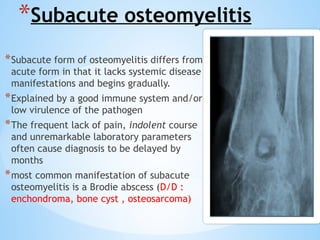
*Subacute osteomyelitis
*Subacute form of osteomyelitis differs from
acute form in that it lacks systemic disease
manifestations and begins gradually.
*Explained by a good immune system and/or
low virulence of the pathogen
*The frequent lack of pain, indolent course
and unremarkable laboratory parameters
often cause diagnosis to be delayed by
months
*most common manifestation of subacute
osteomyelitis is a Brodie abscess (D/D :
enchondroma, bone cyst , osteosarcoma)
*Brodies abscess
*Localized form of subacute osteomyelitis
*Occurs most often in the long bones of the lower
extremities of young adults.
*Before physeal closure, the metaphysis is most often
affected.
*In adults, the metaphyseal-epiphyseal area is involved.
* Intermittent pain of long duration is the presenting
complaint, along with local tenderness over the affected
area
*lytic lesion with a rim of sclerotic bone
*MC organisms: S. aureus and Staphylococcus epidermidis
*The diagnosis often must be established by an open biopsy
and culture.
*MRI is warranted to help narrow the differential diagnosis
and aid surgical planning
*Management: Biopsy and curettage followed by treatment
with appropriate antibiotics. Intravenous antibiotics for 48
hours followed by a 6-week course of oral antibiotics
*Chronic osteomyelitis
*Hallmark : infected dead bone within a compromised soft-
tissue envelope
*Persisting , productive form of bone inflammation is
characterized by chronic purulent fistulous discharge
*Purulent fistulous discharge is the main symptom which
originates from sequestra , which is encapsulated in a scar
tissue and serve as a pathogen reservoir for relapses.
*Osteolyses and the development of infected nonunions are
two important pathophysiologic processes in posttraumatic
or postoperative chronic osteomyelitis.
*Osteolyses are caused by bacteria, either directly by their
endotoxins –LPS and N acetylymuramin dipeptides or by IL-1,
IL-6, and TNF. It is responsible for the lack of bony
consolidation and the development of nonunions. The same
mechanisms also cause septic loosening of prostheses.
*Infected nonunion, a special form of chronic osteomyelitis, is a
combination of two severe, local, mutually potentiating
complications-instability and infection.
*Classification of chronic
osteomyelitis:
*Avascular envelope of scar tissue leaves systemic
antibiotics essentially ineffective
*Eradication of chronic osteomyelitis generally requires
aggressive surgical debridement and dead-space
management combined with effective antibiotic treatment
*Jones et al. classification( in children )
*type A, Brodie abscess;
*type B, sequestrum involucrum
*B1, localized cortical sequestrum;
*B2,sequestrum with structural involucrum;
*B3, sequestrum with sclerotic involucrum; and
*B4, sequestrum without structural involucrum
*type C, sclerotic
*Physeal damage is indicated by the addition of
“P” (proximal) or “D” (distal) to the classification
*SCLEROSING OSTEOMYELITIS
OF GARRÉ
*Chronic form of disease in
which the bone is thickened
and distended but abscesses
and sequestra are absent.
*Children and young adults
*Low grade anaerobic infection
*Expanded bone with
generalized sclerosis
*D/D: Osteoid osteoma and
Paget's disease
*CHRONIC RECURRENT
MULTIFOCAL OSTEOMYELITIS
*autoinflammatory bone disease
*Symptoms wax and wane for months or years
*children, with a peak age of 10 years
*metaphysis of long bones and vertebra plana
*a/w Scoliosis and kyphosis, in 26% and palmar-plantar pustulosis
*Radiographically, the bony lesions are predominantly lytic and
bilaterally symmetric
*Diagnosis is one of exclusion based on :
*two or more bone lesions mimicking osteomyelitis,
*radiographic and bone scan findings consistent with osteomyelitis,
*6 months or more of chronic and relapsing symptoms,
*failure of response to atleast 1 month of appropriate therapy, and
*a lack of other identifiable cause
*Diagnosis
*“gold standard” is to obtain a biopsy specimen for
histologic and microbiologic evaluation of the infected
bone.
*Physical examination should focus on the integrity of the
skin and soft tissue, determine areas of tenderness, assess
bone stability, and evaluate the neurovascular status of the
limb
*Laboratory studies. Erythrocyte sedimentation rate and C-
reactive protein are elevated in most patients, but the
white blood cell count is elevated in only 35%.
*Imaging
* Plain radiographs: Signs of cortical destruction and periosteal
reaction strongly suggest the diagnosis of osteomyelitis
* Sequestra
* Involucrum
* cloaca
* sinuses
* fistulae
* Sinography
* Isotopic bone scanning : more for acute
* Technetium-99m bone scans: increased uptake in areas of increased
blood flow or osteoblastic activity, tend to lack specificity
* Gallium scans increased uptake in areas where leukocytes or bacteria
accumulate
* Indium-111–labeled leukocyte scans more sensitive than technetium
or gallium scans and are especially useful in differentiating chronic
osteomyelitis from neuropathic arthropathy in the diabetic foot.
*CT : Excellent definition of cortical bone and a fair
evaluation of the surrounding soft tissues and is especially
useful in identifying sequestra.
*MRI: provides a fairly accurate determination of the extent
of the pathologic insult by showing the margins of bone
and soft-tissue edema. reveal a well-defined rim of high
signal intensity surrounding the focus of active disease (rim
sign). Sinus tracks and cellulitis appear as areas of
increased signal intensity on T2-weighted imaging
*Ultrasound
*To detect and evaluate associated
soft-tissue changes.
*A subperiosteal fluid collection
may be detectable in acute
osteomyelitis, especially in
children and adolescents
*Indications:
*Visualization of soft-tissue edema
*Visualize Circumscribe Collection
And Abscess
*Visualisation of joint effusion
*Visulaisation of subperiosteal fluid
*CT:
*Visualization of bone fragments,
sequestra, and intraarticular loose
bodies
* Evaluation and follow-up of
‡
complex fractures (bone healing,
fracture consolidation, nonunion,
etc.)
* Preoperative planning, including
‡
determination of the number, size,
and position of bone fragments
* Postoperative follow-up,
‡
including the position of fragments
and internal fixation devices
*MRI:
*Visualisation of bone marrow,
cortical bone, and surrounding soft
tissues
* Visualization of periosteal
‡
reactions
* Visualisation of inflammatory
‡
changes in bones and soft tissues
* Detection of circumscribed
‡
abscesses
*Treatment:
*Multifaceted approach
*Surgery for chronic osteomyelitis consists of sequestrectomy
and resection of scarred and infected bone and soft tissue.
*For soft-tissue and dead-space management, ring external
fixators generally are used after radical debridement
*The goal of surgery is eradication of the infection by
achieving a viable and vascular environment
*Aytac et al. reported a technique, using irrigation,
debridement, temporary hardware maintenance and a
persisting fistula, to control osteomyelitis (acute, subacute,
or chronic) until fracture healing in patients who developed
bacterial colonization after trauma or surgery
*Extensive debridement generally creates a large dead space and
bony instability that requires complex reconstruction of bone
and soft tissue, often requiring multiple procedures.
*Antibiotic polymethyl methacrylate (PMMA) beads typically are
used to fill the dead space created by the initial debridement.
*Bar-On et al. reported that reaming the intramedullary canal
after debridement and lavage and inserting a gentamycin-
impregnated rod and beads eradicated infection with minimal
tissue loss in a case series of four patients
*Vacuum-assisted closure (VAC) therapy also may be efficacious in
treatment because not only does it assist in clearing the bacteria
but it promotes granulation tissue as well. In addition, the use of
VAC may reduce the need for muscle flaps or tissue transfer.
*Management on chronic
osteomyelitis :
*multimodal approach and the cornerstone of the treatment is
surgical management.
*The aim is eradication of infection by thorough debridement,
leaving only healthy and viable tissue and restoring function
*Soft tissue debridement should be in an expansile manner
rather than an extensile approach
*adequacy of debridement with wide excision margins is the
most important clinical predictor of a successful outcome
*Debridement should leave healthy bleeding tissue and should
not be compromised in order to achieve primary closure
*Closure can be achieved, braided or absorbable sutures should
be avoided due to their affinity to harbour microorganisms
*Periosteal stripping should be avoided to preserve vascularity
*Involucrum is viable bone and does not need to be debrided.
*The limits of debridement have classically been determined by
the paprika sign’, which is punctuate cortical or cancellous
bleeding.
*Endosteal infection can be debrided with intramedullary
reaming and has this been reported to be a successful and
reliable technique in several series in conjunction with
intramedullary antibiotic-coated implants.
*Closed suction drains:
*modified Lautenbach method
*negative pressure wound therapy (NPWT) or VAC,
*Lautenbach technique uses a closed irrigation suction
system to wash antibiotics through the medullary cavity
*Lautenbach technique is the ‘gutter procedure and muscle
flap transposition operation’ by Gokalp et al
*OPEN BONE GRAFTING
classical Papineau technique
*STAGE I: DEBRIDEMENT AND STABILIZATION
*Repeat debridement and irrigation with VAC change every
48 to 96 hours until a healthy viable tissue bed is obtained.
*STAGE II: GRAFTING
*STAGE III: WOUND COVERAGE
*Apply skin grafts or allow the wound to heal by
spontaneous epithelialization.
*Two stage Belfast technique
*radical debridement followed by immediate provision of
soft tissue cover. In addition, and when indicated, delayed
autogenous bone grafting was also performed at the
second stage
* POLYMETHYLMETHACRYLATE
ANTIBIOTIC BEAD CHAINS
*Deliver levels of antibiotics locally in concentrations that
exceed the minimal inhibitory concentrations.
*local concentrations of antibiotic achieved are 200 times higher
than levels achieved with systemic antibiotic administration.
*very high local antibiotic concentrations while maintaining low
serum levels and low systemic toxicity.
*most commercially available bone cements have a prepackaged
form available with gentamicin (500 mg/40-g pack). We
generally add 2 to 4 g of vancomycin, with or without 1.2 g of
tobramycin, to each 40-g pack of high velocity cement before
adding the monomer.
*Short-term, long-term, or even permanent implantation of
PMMA antibiotic beads is possible (10 to 80 days)
*Masquelet technique or the induced
membrane technique
*The induced membrane Masquelet technique of the use of
antibiotic laden PMMA with encouraging results.
*This two-stage technique relies upon filling the segmental
defect with a solid block of PMMA, which over 6-8 weeks
becomes surrounded by a highly cellular bio-membrane.
*At reoperation the membrane is incised, the cement is
removed and replaced with bone graft
BIODEGRADABLE ANTIBIOTIC DELIVERY SYSTEMS
*Advantages Over Pmma:
*A second procedure is not required
*Better antibiotic release and compatibility profiles
*Contain osteoconductive and osteoinductive materials
*Made of calcium sulfate or calcium phosphate
*Resorb by about 8 weeks after surgery
*three main categories:
*Proteins :collagen, gelatin, thrombin, and autologous blood clot
*Bone graft materials and substitutes, and
*Synthetic polymers: Polylactide and poly(D,L-lactide-co-glycolic acid)
(PLGA)
*Bioactive glass
*Combines osteoconductive, angiogenic and antimicrobial
properties
*particular emphasis on immunocompromised hosts and
multiresistant strains
*Soft tissue reconstruction
*‘Reconstructive ladder’ starting with primary closure or
healing by secondary intention up to free vascularized flap
coverage
*Negative-pressure wound therapy
*local fasciocutaneous (gastrocnemius, soleus,
microvascular free muscle) flap may be required and
either applied by rotation, advancement, or transposition
techniques.
*larger, deeper defects with scarce vascularity, or pressure
regions such as the plantar aspect of the foot,
myofasciocutaneous flaps could be
*Dead space management
(1) Bone grafting with primary or secondary closure;
(2)use of antibiotic PMMA beads as a temporary filler of the dead
space before reconstruction;
(3)local muscle flaps and skin grafting with or without bone grafting;
(4)microvascular transfer of muscle, myocutaneous, osseous, and
osteocutaneous flaps;
(5)the use of bone transport (ilizarov technique).
*Koval et al.compared three different methods for
management of osteomyelitis and found that flap coverage
had a higher success rate (80%) compared to either primary
closure with suction irrigation or open cancellous bone
grafting
*Free vascularized
bone transfer
*Vascularized structural graft.
*Typically, the fibula is harvested,
although rib, iliac crest, and scapula
have been used as well.
*This is a complex micro-anastomosis
procedure and is not suitable in all
cases.
*Complications : reported stress
fracture rates to be as high as 35% in
tibia and 32% in femurs
*Distraction osteogenesis
*circular frames to transport corticotomized segments of
bone is a well-documented technique- Ilizarov
reconstruction
*ADJUNCTIVE THERAPIES
*Hyperbaric oxygen therapy
*Growth factors, such as bone morphogenic proteins (BMPs)
and even platelet-rich plasma (PRP)
*Pulsed electromagnetic fields [PEMF] and ultrasound
*Antibiotics management:
*6-week course of intravenous antibiotics(total duration of
antibiotic therapy is suggested as 4-8 weeks)
*Fluoroquinolone antibiotics are known to have equivalent
serum concentrations whether given orally or intravenously
*Empirical versus definitive antibiotic therapy
*Antibiotic management of
chronic osteomyelitis
*alone for the curative management of chronic
osteomyelitis are unlikely to be successful.
*This is due to poor antibiotic penetration into necrotic
bone and subsequent failure to sterilize the infected nidus.
*good oral bioavailability, and can be given either orally or
by an intravenous route (fluoroquinolones, linezolid);for
others, parenteral therapy provides higher serum levels
(cephalosporins), while some are only available for use in
parenteral form (carbapenems, broad-spectrum
cephalosporins, vancomycin, and aminoglycosides

New Microsoft PowerPoint Presentation.pptx

  • 1.
    Infections of Bone& Joint Dr. T. L. S. Harini
  • 2.
  • 3.
    *Historical background *Definition *Pathophysiology and Classification *Diagnosis *Management: *Antibiotic therapy *Surgical treatment *Plastic and reconstructive surgery *Current trends
  • 4.
    *Definition *The French surgeonEdouard Chassaignac was the first to introduce the term osteomyelitis in 1852, when extensive debridement and early amputation were the mainstays of treatment *The generic term ‘osteomyelitis’ originates from the two Greek words ‘osteon’ and ‘myelos’ – bone and marrow – and is used synonymously for an inflammation of the cortical and cancellous bone *Osteomyelitis is defined as an inflammation of the bone caused by an infecting organism *Chronic osteomyelitis is defined as long-standing infection of the bone characterized by persistence of microorganisms, presence of sequestrum, low-grade inflammation, and fistulae
  • 5.
  • 6.
    *Based on duration: *acute *Subacute: differs form acute in that it lacks systemic disease manifestations and begins gradually *chronic
  • 7.
    *Mechanism of infection *Exogenous: causedby open fractures, surgery (iatrogenic), or contiguous spread from infected local tissue. *Hematogenous: results from bacteremia
  • 8.
    *Type of hostresponse to the infection *pyogenic *nonpyogenic
  • 9.
  • 10.
    *Risk Factors *Systemic: *Diabetes mellitus *Local: *Disturbancesin arterial and venous circulation *Tissue damaged by radiation *Extensive exposure of the operation site *Extensive soft-tissue defects *Extensive hematomas *Remaining hollow spaces *Nicotine and drug use *Disturbances of liver and kidney function *Severe infections with immunosuppression
  • 11.
    *Pathogenesis: *Microbial invasion thepathogens form a biofilm, the components of which interact with osteoblasts and the immune system *Osteoclastogenesis is induced through several pathways in osteomyelitis, whereas osteoblasts and therefore bone- remodelling processes, especially new bone formation, are inhibited (1) microbial invasion and biofilm proliferation, (2) immune response to bacterial biofilm, (3) impact of bacterial invasion on bone tissue components
  • 12.
    *ACUTE HEMATOGENOUS OSTEOMYELITIS *most commontype of bone infection and usually is seen in children *More common in males in all age groups affected *caused by bacteremia, which is a common occurrence in childhood *the infection generally involves the metaphysis of rapidly growing long bones Because the arteries in the epiphyses are terminal, the capillaries enter wide sinusoids located just in front of the growth plates *age distribution: bimodal <2yrs and 8-12yrs
  • 13.
    *The infection firstestabilishes in the bone marrow and then spreads via the haversian and Volkmann’s canals along the thrombosed capillaries and through the cortex below the periosteum * Metaphyseal abscess *periosteum has been raised from the bone, reduced periosteal perfusion together with reduced cortical perfusion resulting from thrombosed capillaries leads to the typical cortical sequestrum *periosteal new bone formation and is then referred to as bone cavity
  • 15.
    *In children <2yrs: someblood vessels cross the physis and may allow the spread of infection into the epiphysis Limb shortening or angular deformity metaphysis has relatively fewer phagocytic cells than the physis or diaphysis, allowing infection to occurmore easily in this area some blood vessels cross the physis and may allow the spread of infection into the epiphysis and eventually into the joint
  • 16.
    *older than 2years, *physis effectively acts as a barrier to the spread of a metaphyseal abscess *diaphysis is at greater risk in these patients. *If the infection spreads into the diaphysis, the endosteal blood supply *With a concurrent sub periosteal abscess, the periosteal blood supply is damaged and can result in extensive sequestration and chronic osteomyelitis if not properly treated.
  • 17.
    *Subacute osteomyelitis *Subacute formof osteomyelitis differs from acute form in that it lacks systemic disease manifestations and begins gradually. *Explained by a good immune system and/or low virulence of the pathogen *The frequent lack of pain, indolent course and unremarkable laboratory parameters often cause diagnosis to be delayed by months *most common manifestation of subacute osteomyelitis is a Brodie abscess (D/D : enchondroma, bone cyst , osteosarcoma)
  • 21.
    *Brodies abscess *Localized formof subacute osteomyelitis *Occurs most often in the long bones of the lower extremities of young adults. *Before physeal closure, the metaphysis is most often affected. *In adults, the metaphyseal-epiphyseal area is involved. * Intermittent pain of long duration is the presenting complaint, along with local tenderness over the affected area *lytic lesion with a rim of sclerotic bone
  • 22.
    *MC organisms: S.aureus and Staphylococcus epidermidis *The diagnosis often must be established by an open biopsy and culture. *MRI is warranted to help narrow the differential diagnosis and aid surgical planning *Management: Biopsy and curettage followed by treatment with appropriate antibiotics. Intravenous antibiotics for 48 hours followed by a 6-week course of oral antibiotics
  • 23.
    *Chronic osteomyelitis *Hallmark :infected dead bone within a compromised soft- tissue envelope *Persisting , productive form of bone inflammation is characterized by chronic purulent fistulous discharge *Purulent fistulous discharge is the main symptom which originates from sequestra , which is encapsulated in a scar tissue and serve as a pathogen reservoir for relapses. *Osteolyses and the development of infected nonunions are two important pathophysiologic processes in posttraumatic or postoperative chronic osteomyelitis. *Osteolyses are caused by bacteria, either directly by their endotoxins –LPS and N acetylymuramin dipeptides or by IL-1, IL-6, and TNF. It is responsible for the lack of bony consolidation and the development of nonunions. The same mechanisms also cause septic loosening of prostheses.
  • 24.
    *Infected nonunion, aspecial form of chronic osteomyelitis, is a combination of two severe, local, mutually potentiating complications-instability and infection.
  • 25.
  • 26.
    *Avascular envelope ofscar tissue leaves systemic antibiotics essentially ineffective *Eradication of chronic osteomyelitis generally requires aggressive surgical debridement and dead-space management combined with effective antibiotic treatment
  • 27.
    *Jones et al.classification( in children ) *type A, Brodie abscess; *type B, sequestrum involucrum *B1, localized cortical sequestrum; *B2,sequestrum with structural involucrum; *B3, sequestrum with sclerotic involucrum; and *B4, sequestrum without structural involucrum *type C, sclerotic *Physeal damage is indicated by the addition of “P” (proximal) or “D” (distal) to the classification
  • 28.
    *SCLEROSING OSTEOMYELITIS OF GARRÉ *Chronicform of disease in which the bone is thickened and distended but abscesses and sequestra are absent. *Children and young adults *Low grade anaerobic infection *Expanded bone with generalized sclerosis *D/D: Osteoid osteoma and Paget's disease
  • 29.
    *CHRONIC RECURRENT MULTIFOCAL OSTEOMYELITIS *autoinflammatorybone disease *Symptoms wax and wane for months or years *children, with a peak age of 10 years *metaphysis of long bones and vertebra plana *a/w Scoliosis and kyphosis, in 26% and palmar-plantar pustulosis *Radiographically, the bony lesions are predominantly lytic and bilaterally symmetric *Diagnosis is one of exclusion based on : *two or more bone lesions mimicking osteomyelitis, *radiographic and bone scan findings consistent with osteomyelitis, *6 months or more of chronic and relapsing symptoms, *failure of response to atleast 1 month of appropriate therapy, and *a lack of other identifiable cause
  • 30.
    *Diagnosis *“gold standard” isto obtain a biopsy specimen for histologic and microbiologic evaluation of the infected bone. *Physical examination should focus on the integrity of the skin and soft tissue, determine areas of tenderness, assess bone stability, and evaluate the neurovascular status of the limb *Laboratory studies. Erythrocyte sedimentation rate and C- reactive protein are elevated in most patients, but the white blood cell count is elevated in only 35%.
  • 31.
    *Imaging * Plain radiographs:Signs of cortical destruction and periosteal reaction strongly suggest the diagnosis of osteomyelitis * Sequestra * Involucrum * cloaca * sinuses * fistulae * Sinography * Isotopic bone scanning : more for acute * Technetium-99m bone scans: increased uptake in areas of increased blood flow or osteoblastic activity, tend to lack specificity * Gallium scans increased uptake in areas where leukocytes or bacteria accumulate * Indium-111–labeled leukocyte scans more sensitive than technetium or gallium scans and are especially useful in differentiating chronic osteomyelitis from neuropathic arthropathy in the diabetic foot.
  • 33.
    *CT : Excellentdefinition of cortical bone and a fair evaluation of the surrounding soft tissues and is especially useful in identifying sequestra. *MRI: provides a fairly accurate determination of the extent of the pathologic insult by showing the margins of bone and soft-tissue edema. reveal a well-defined rim of high signal intensity surrounding the focus of active disease (rim sign). Sinus tracks and cellulitis appear as areas of increased signal intensity on T2-weighted imaging
  • 35.
    *Ultrasound *To detect andevaluate associated soft-tissue changes. *A subperiosteal fluid collection may be detectable in acute osteomyelitis, especially in children and adolescents *Indications: *Visualization of soft-tissue edema *Visualize Circumscribe Collection And Abscess *Visualisation of joint effusion *Visulaisation of subperiosteal fluid
  • 36.
    *CT: *Visualization of bonefragments, sequestra, and intraarticular loose bodies * Evaluation and follow-up of ‡ complex fractures (bone healing, fracture consolidation, nonunion, etc.) * Preoperative planning, including ‡ determination of the number, size, and position of bone fragments * Postoperative follow-up, ‡ including the position of fragments and internal fixation devices
  • 37.
    *MRI: *Visualisation of bonemarrow, cortical bone, and surrounding soft tissues * Visualization of periosteal ‡ reactions * Visualisation of inflammatory ‡ changes in bones and soft tissues * Detection of circumscribed ‡ abscesses
  • 39.
    *Treatment: *Multifaceted approach *Surgery forchronic osteomyelitis consists of sequestrectomy and resection of scarred and infected bone and soft tissue. *For soft-tissue and dead-space management, ring external fixators generally are used after radical debridement *The goal of surgery is eradication of the infection by achieving a viable and vascular environment *Aytac et al. reported a technique, using irrigation, debridement, temporary hardware maintenance and a persisting fistula, to control osteomyelitis (acute, subacute, or chronic) until fracture healing in patients who developed bacterial colonization after trauma or surgery
  • 40.
    *Extensive debridement generallycreates a large dead space and bony instability that requires complex reconstruction of bone and soft tissue, often requiring multiple procedures. *Antibiotic polymethyl methacrylate (PMMA) beads typically are used to fill the dead space created by the initial debridement. *Bar-On et al. reported that reaming the intramedullary canal after debridement and lavage and inserting a gentamycin- impregnated rod and beads eradicated infection with minimal tissue loss in a case series of four patients *Vacuum-assisted closure (VAC) therapy also may be efficacious in treatment because not only does it assist in clearing the bacteria but it promotes granulation tissue as well. In addition, the use of VAC may reduce the need for muscle flaps or tissue transfer.
  • 41.
    *Management on chronic osteomyelitis: *multimodal approach and the cornerstone of the treatment is surgical management. *The aim is eradication of infection by thorough debridement, leaving only healthy and viable tissue and restoring function *Soft tissue debridement should be in an expansile manner rather than an extensile approach *adequacy of debridement with wide excision margins is the most important clinical predictor of a successful outcome *Debridement should leave healthy bleeding tissue and should not be compromised in order to achieve primary closure *Closure can be achieved, braided or absorbable sutures should be avoided due to their affinity to harbour microorganisms
  • 42.
    *Periosteal stripping shouldbe avoided to preserve vascularity *Involucrum is viable bone and does not need to be debrided. *The limits of debridement have classically been determined by the paprika sign’, which is punctuate cortical or cancellous bleeding. *Endosteal infection can be debrided with intramedullary reaming and has this been reported to be a successful and reliable technique in several series in conjunction with intramedullary antibiotic-coated implants.
  • 44.
    *Closed suction drains: *modifiedLautenbach method *negative pressure wound therapy (NPWT) or VAC, *Lautenbach technique uses a closed irrigation suction system to wash antibiotics through the medullary cavity *Lautenbach technique is the ‘gutter procedure and muscle flap transposition operation’ by Gokalp et al
  • 47.
    *OPEN BONE GRAFTING classicalPapineau technique *STAGE I: DEBRIDEMENT AND STABILIZATION *Repeat debridement and irrigation with VAC change every 48 to 96 hours until a healthy viable tissue bed is obtained. *STAGE II: GRAFTING *STAGE III: WOUND COVERAGE *Apply skin grafts or allow the wound to heal by spontaneous epithelialization.
  • 49.
    *Two stage Belfasttechnique *radical debridement followed by immediate provision of soft tissue cover. In addition, and when indicated, delayed autogenous bone grafting was also performed at the second stage
  • 50.
    * POLYMETHYLMETHACRYLATE ANTIBIOTIC BEADCHAINS *Deliver levels of antibiotics locally in concentrations that exceed the minimal inhibitory concentrations. *local concentrations of antibiotic achieved are 200 times higher than levels achieved with systemic antibiotic administration. *very high local antibiotic concentrations while maintaining low serum levels and low systemic toxicity. *most commercially available bone cements have a prepackaged form available with gentamicin (500 mg/40-g pack). We generally add 2 to 4 g of vancomycin, with or without 1.2 g of tobramycin, to each 40-g pack of high velocity cement before adding the monomer. *Short-term, long-term, or even permanent implantation of PMMA antibiotic beads is possible (10 to 80 days)
  • 51.
    *Masquelet technique orthe induced membrane technique *The induced membrane Masquelet technique of the use of antibiotic laden PMMA with encouraging results. *This two-stage technique relies upon filling the segmental defect with a solid block of PMMA, which over 6-8 weeks becomes surrounded by a highly cellular bio-membrane. *At reoperation the membrane is incised, the cement is removed and replaced with bone graft
  • 52.
    BIODEGRADABLE ANTIBIOTIC DELIVERYSYSTEMS *Advantages Over Pmma: *A second procedure is not required *Better antibiotic release and compatibility profiles *Contain osteoconductive and osteoinductive materials *Made of calcium sulfate or calcium phosphate *Resorb by about 8 weeks after surgery *three main categories: *Proteins :collagen, gelatin, thrombin, and autologous blood clot *Bone graft materials and substitutes, and *Synthetic polymers: Polylactide and poly(D,L-lactide-co-glycolic acid) (PLGA)
  • 53.
    *Bioactive glass *Combines osteoconductive,angiogenic and antimicrobial properties *particular emphasis on immunocompromised hosts and multiresistant strains
  • 54.
    *Soft tissue reconstruction *‘Reconstructiveladder’ starting with primary closure or healing by secondary intention up to free vascularized flap coverage *Negative-pressure wound therapy *local fasciocutaneous (gastrocnemius, soleus, microvascular free muscle) flap may be required and either applied by rotation, advancement, or transposition techniques. *larger, deeper defects with scarce vascularity, or pressure regions such as the plantar aspect of the foot, myofasciocutaneous flaps could be
  • 55.
    *Dead space management (1)Bone grafting with primary or secondary closure; (2)use of antibiotic PMMA beads as a temporary filler of the dead space before reconstruction; (3)local muscle flaps and skin grafting with or without bone grafting; (4)microvascular transfer of muscle, myocutaneous, osseous, and osteocutaneous flaps; (5)the use of bone transport (ilizarov technique).
  • 57.
    *Koval et al.comparedthree different methods for management of osteomyelitis and found that flap coverage had a higher success rate (80%) compared to either primary closure with suction irrigation or open cancellous bone grafting
  • 58.
    *Free vascularized bone transfer *Vascularizedstructural graft. *Typically, the fibula is harvested, although rib, iliac crest, and scapula have been used as well. *This is a complex micro-anastomosis procedure and is not suitable in all cases. *Complications : reported stress fracture rates to be as high as 35% in tibia and 32% in femurs
  • 59.
    *Distraction osteogenesis *circular framesto transport corticotomized segments of bone is a well-documented technique- Ilizarov reconstruction
  • 60.
    *ADJUNCTIVE THERAPIES *Hyperbaric oxygentherapy *Growth factors, such as bone morphogenic proteins (BMPs) and even platelet-rich plasma (PRP) *Pulsed electromagnetic fields [PEMF] and ultrasound
  • 61.
    *Antibiotics management: *6-week courseof intravenous antibiotics(total duration of antibiotic therapy is suggested as 4-8 weeks) *Fluoroquinolone antibiotics are known to have equivalent serum concentrations whether given orally or intravenously *Empirical versus definitive antibiotic therapy
  • 62.
    *Antibiotic management of chronicosteomyelitis *alone for the curative management of chronic osteomyelitis are unlikely to be successful. *This is due to poor antibiotic penetration into necrotic bone and subsequent failure to sterilize the infected nidus. *good oral bioavailability, and can be given either orally or by an intravenous route (fluoroquinolones, linezolid);for others, parenteral therapy provides higher serum levels (cephalosporins), while some are only available for use in parenteral form (carbapenems, broad-spectrum cephalosporins, vancomycin, and aminoglycosides