New Methods For Measuring And Analyzing
Segregation Mark Fossett download
https://ebookbell.com/product/new-methods-for-measuring-and-
analyzing-segregation-mark-fossett-59042308
Explore and download more ebooks at ebookbell.com
Here are some recommended products that we believe you will be
interested in. You can click the link to download.
New Methods For Measuring And Analyzing Segregation Mark Fossett
https://ebookbell.com/product/new-methods-for-measuring-and-analyzing-
segregation-mark-fossett-6750826
New Methods For The Analysis Of Change Decade Of Behavior 1st Edition
Linda M Collins
https://ebookbell.com/product/new-methods-for-the-analysis-of-change-
decade-of-behavior-1st-edition-linda-m-collins-2188604
New Methods For Chaotic Dynamics Nikolai Alexandrovich Magnitskii
https://ebookbell.com/product/new-methods-for-chaotic-dynamics-
nikolai-alexandrovich-magnitskii-979344
Mapping Information Landscapes New Methods For Exploring The
Development And Teaching Of Information Literacy Andrew Whitworth
https://ebookbell.com/product/mapping-information-landscapes-new-
methods-for-exploring-the-development-and-teaching-of-information-
literacy-andrew-whitworth-56933572
Neurosciencebased Cognitive Therapy New Methods For Assessment
Treatment And Selfregulation Tullio Scrimaliauth
https://ebookbell.com/product/neurosciencebased-cognitive-therapy-new-
methods-for-assessment-treatment-and-selfregulation-tullio-
scrimaliauth-4308896
Business Planning For Turbulent Times New Methods For Applying
Scenarios Illustrated Edition Rafael Ramrez
https://ebookbell.com/product/business-planning-for-turbulent-times-
new-methods-for-applying-scenarios-illustrated-edition-rafael-
ramrez-1395006
Annies Crochet New Methods For Crochet Socks Annies Rohn Strong
https://ebookbell.com/product/annies-crochet-new-methods-for-crochet-
socks-annies-rohn-strong-46310664
Neurosciencebased Cognitive Therapy New Methods For Assessment
Treatment And Selfregulation 1st Edition Tullio Scrimali
https://ebookbell.com/product/neurosciencebased-cognitive-therapy-new-
methods-for-assessment-treatment-and-selfregulation-1st-edition-
tullio-scrimali-4575594
Shaping The Next One Hundred Years New Methods For Quantitative
Longterm Policy Analysis 186th Steven C Bankes
https://ebookbell.com/product/shaping-the-next-one-hundred-years-new-
methods-for-quantitative-longterm-policy-analysis-186th-steven-c-
bankes-2215474
The Springer Series on Demographic Methods
and Population Analysis 42
New Methods
for Measuring
and Analyzing
Segregation
Mark Fossett
The Springer Series on Demographic Methods
and Population Analysis
Volume 42
Series Editor
Kenneth C. Land, Duke University
In recent decades, there has been a rapid development of demographic models and
methods and an explosive growth in the range of applications of population analy-
sis. This series seeks to provide a publication outlet both for high-quality textual
and expository books on modern techniques of demographic analysis and for works
that present exemplary applications of such techniques to various aspects of popula-
tion analysis.
Topics appropriate for the series include:
• General demographic methods
• Techniques of standardization
• Life table models and methods
• Multistate and multiregional life tables, analyses and projections
• Demographic aspects of biostatistics and epidemiology
• Stable population theory and its extensions
• Methods of indirect estimation
• Stochastic population models
• Event history analysis, duration analysis, and hazard regression models
• Demographic projection methods and population forecasts
• Techniques of applied demographic analysis, regional and local population
• estimates and projections
• Methods of estimation and projection for business and health care applications
• Methods and estimates for unique populations such as schools and students
Volumes in the series are of interest to researchers, professionals, and students in
demography, sociology, economics, statistics, geography and regional science, pub-
lic health and health care management, epidemiology, biostatistics, actuarial sci-
ence, business, and related fields.
More information about this series at http://www.springer.com/series/6449
Mark Fossett
New Methods for Measuring
and Analyzing Segregation
ISSN 1389-6784	    ISSN 2215-1990 (electronic)
The Springer Series on Demographic Methods and Population Analysis
ISBN 978-3-319-41302-0    ISBN 978-3-319-41304-4 (eBook)
DOI 10.1007/978-3-319-41304-4
Library of Congress Control Number: 2017930612
© The Editor(s) (if applicable) and the Author(s) 2017. This book is an open access publication.
Open Access This book is licensed under the terms of the Creative Commons Attribution-­
NonCommercial 2.5 International License (http://creativecommons.org/licenses/by-nc/2.5/), which
permits any noncommercial use, sharing, adaptation, distribution and reproduction in any medium or
format, as long as you give appropriate credit to the original author(s) and the source, provide a link to
the Creative Commons license and indicate if changes were made.
The images or other third party material in this book are included in the book’s Creative Commons
license, unless indicated otherwise in a credit line to the material. If material is not included in the book’s
Creative Commons license and your intended use is not permitted by statutory regulation or exceeds the
permitted use, you will need to obtain permission directly from the copyright holder.
This work is subject to copyright. All commercial rights are solely and exclusively licensed by the
Publisher, whether the whole or part of the material is concerned, specifically the rights of translation,
reprinting, reuse of illustrations, recitation, broadcasting, reproduction on micro-films or in any other
physical way, and transmission or information storage and retrieval, electronic adaptation, computer
software, or by similar or dissimilar methodology now known or hereafter developed.
The use of general descriptive names, registered names, trademarks, service marks, etc. in this publication
does not imply, even in the absence of a specific statement, that such names are exempt from the relevant
protective laws and regulations and therefore free for general use.
The publisher, the authors and the editors are safe to assume that the advice and information in this book
are believed to be true and accurate at the date of publication. Neither the publisher nor the authors or the
editors give a warranty, express or implied, with respect to the material contained herein or for any errors
or omissions that may have been made.
Printed on acid-free paper
This Springer imprint is published by Springer Nature
The registered company is Springer International Publishing AG
The registered company address is: Gewerbestrasse 11, 6330 Cham, Switzerland
Mark Fossett
Department of Sociology
Texas A&M University
College Station, TX, USA
v
Abstract
In this monograph, I place indices used to measure the uneven distribution dimen-
sion of residential segregation in a new framework; I cast them as simple differ-
ences of group means on individual-level residential outcomes scored from area
racial composition. The “difference-of-group-means” framework places all popular
indices in a common measurement framework in which index scores are additively
determined by individual residential attainments. This yields new and appealing
options regarding substantive interpretations of the scores of segregation indices. It
also brings important methodological benefits by creating the new possibility of
joining the investigation of aggregate segregation and the investigation of
­
individual-level residential attainments together in a single analysis. Specifically,
segregation index scores now can be equated with the effect of group membership
(e.g., race) on individual residential attainments, and thus variation in segregation
over time and across cities can be equated to the ways that the effect of group mem-
bership varies over time and with city characteristics in multilevel models of
­
individual residential attainments. Framing segregation indices in the difference-of-­
group-means framework has several other desirable consequences for segregation
analysis. It creates opportunities to investigate segregation in new ways by permit-
ting researchers to assess the impact of group membership on residential outcomes
in the context of multivariate attainment models that if desired can include controls
for other individual characteristics (e.g., language, education, income). Relatedly, it
suggests a new basis on which to evaluate and compare segregation indices –
whether the individual-level residential outcomes they register and reflect are rele-
vant for theories of residential dynamics and/or are relevant for concerns about
racial differences in socioeconomic attainments and life chances. Finally, the
difference-­
of-group-means framework paves the way for developing refined ver-
sions of indices that are free of potentially problematic upward bias intrinsic to
standard formulations of these indices. Significantly, adopting the new framework
outlined here does not require breaking with previous conceptions of segregation;
results of empirical analyses of segregation using traditional computing formulas
can be exactly replicated within this framework even as several new options for
measurement and analysis become available.
vii
Preface
In this monograph, I review findings and observations I have accumulated while
grappling with issues in segregation measurement over the past decade. My explo-
rations in this area were motivated by three concerns. The first was that, while it is
obvious to all concerned that residential segregation can potentially have important
consequences for group differences in residential outcomes, the literature on segre-
gation measurement does not provide formulations of segregation indices that make
it clear exactly what implications index scores have for group differences in residen-
tial outcomes. In this regard, the measurement and analysis of segregation is on a
different conceptual footing from standard approaches to measuring and analyzing
intergroup disparity and inequality on other socioeconomic and stratification out-
comes such as education, occupation, and income. Researchers investigating dis-
parities in these other areas routinely assess inequality and disparities based on
comparisons of group means on individual-level outcomes. Consequently, the con-
nections between scores of measures of aggregate inequality have clear and direct
implications for group differences in the attainments of individuals. In contrast, the
literature on segregation measurement has not established how segregation index
scores are connected to group differences on residential outcomes for individuals.
This is surprising and unfortunate because the substantive relevance of segregation
indices ultimately rests on the presumption that their scores carry important impli-
cations for group differences on individual residential outcomes and yet these impli-
cations have remained obscure. I address this concern here by introducing new
formulations of popular segregation indices that place them in an overarching
“difference-­
of-group-means” framework that clarifies exactly how segregation
index scores are connected to group differences in individual-level residential
outcomes.
The second concern motivating me was that the literature on segregation mea-
surement and analysis did not provide a straightforward means for directly linking
quantitative findings from studies of micro-level processes of residential attainment
to findings for segregation index scores at the aggregate level (e.g., city-level segre-
gation scores). As a result, the research literature has been divided into two impor-
tant but largely disconnected traditions. One is a tradition of macro-level studies
viii
that use aggregate-level index scores for cities to investigate how segregation varies
across cities and over time; the other is a tradition of micro-level studies that exam-
ine how various individual-level residential attainments are related to social and
economic characteristics of individuals and households such as income, education,
nativity, English language ability, family type, and other related individual-level
variables. The current state of the literature leaves researchers in both traditions in
the frustrating situation of being unable to directly connect segregation index scores
at the aggregate-level to the individual-level outcomes that are examined and mod-
eled in micro-level residential attainment analyses. I address this concern here by
drawing on the difference-of-group-means measurement framework to develop
methods for linking index scores to individual-level residential attainment pro-
cesses. In this new approach, segregation index scores now can be interpreted as the
effect of group membership (e.g., race) on segregation-determining residential out-
comes in an individual-level attainment model. The level of segregation in a city
thus can now be assessed by estimating the effect of group membership on
individual-­
level residential attainment in bivariate attainment model. More impor-
tantly, the model can be extended to a multivariate specification to properly take
account of the role that nonracial characteristics (e.g., income) may play in shaping
the level of segregation in a city. And the model can be further extended to multi-
level specifications to take account of how city-level factors impact segregation net
of the role of nonracial individual characteristics. Significantly, past findings of
aggregate-level analyses can be exactly replicated and subsumed under this approach
while giving researchers many new options for analysis.
The third concern motivating me was that, under the current state of segregation
measurement, many interesting and important research questions cannot be
addressed because segregation index scores exhibit problematic behavior under a
wide range of commonly occurring conditions. In particular, all indices of uneven
distribution are subject to inherent positive bias that can render their scores untrust-
worthy and potentially misleading in a variety of situations – for example, when
segregation is measured at small spatial scales (e.g., at the block level) or when the
groups involved in the segregation comparison are small and/or are imbalanced in
size. This presents severe obstacles to many interesting and important lines of
inquiry in segregation research. For example, it precludes quantitative study of seg-
regation for newly arriving immigrant and migrant groups because, by definition,
the groups initially are small in both absolute size and relative size in comparison to
established population groups. Similarly, it precludes study of segregation among
narrowly defined subgroups with a population (e.g., foreign- and native-born
Latinos, high-income Whites and Blacks, etc.) because one or both subgroups often
are small in absolute and/or relative size.Additionally, it potentially frustrates inves-
tigation of segregation dynamics using agent simulation models because studies in
this tradition routinely examine segregation at small spatial scales.
The impact of these concerns on segregation research is substantial, pervasive,
and hard to overstate. It has led researchers to routinely adopt two “defensive” prac-
tices. One practice is to use various ad hoc guidelines to “screen” cases to avoid
measuring segregation in situations where index scores cannot be trusted. The other
Preface
ix
practice is to differentially weight cases to minimize the undesirable impact of bias
on index scores even after cases have been “screened” to eliminate those where
index scores are most problematic. The first practice prevents researchers from
undertaking many studies that otherwise would be conducted and thus sharply
restricts the scope of segregation studies. In addition, it draws on ad hoc guidelines
that at best are crude and at worst have uncertain effectiveness. The second practice
of differentially weighting cases is predicated on the implicit recognition that the
first practice of screening cases cannot adequately deal with the problem of bias.
Unfortunately, differential weighting of cases is itself inadequate. First and fore-
most, it leaves index scores untrustworthy on a case-by-case basis and so one cannot
discuss and compare cases – otherwise weighting would be unnecessary. Second,
while the strategy permits researchers to avoid “draconian” screening of cases and
thus larger nominal sample sizes, differential weighting in the end amounts to
assessing segregation patterns and trends based on the small subset of cases that get
large weights.
I address this unsatisfying state of affairs by developing and introducing refined
versions of popular segregation indices that provide trustworthy measurements of
segregation over a much broader range of situations than standard measures. I dem-
onstrate that the resulting unbiased measures have attractive properties and provide
researchers the previously unavailable option of dealing with index bias directly at
the point of measurement on a case-by-case basis.
As I worked to address the three concerns just mentioned, I increasingly took
interest in a fourth concern – the question of whether different segregation indices
yielded similar or different results and, if different, under what conditions and why.
Conventional wisdom in the segregation measurement literature has been that the
most widely used measures of uneven distribution tend to give similar results. But I
found discrepancies between indices were common when I measured segregation
over broader samples of cases and group comparisons. At first I thought the large
discrepancies between scores of different indices might be a by-product of the prob-
lem of index bias. After all, using broader samples tends to include cases that are
more susceptible to being adversely affected by the problem of bias, and previous
methodological studies had reported that indices vary in susceptibility to scores
being inflated by index bias. But on investigating the issue further, I found that the
role of bias was only a minor part of the story as discrepancies between scores for
different indices persisted even when using refined versions of the indices that were
free of the influence of bias.
The difference-of-group-means framework provided a useful perspective for
exploring this issue and led me to recognize that the discrepant scores I observed
reflected an aspect of uneven distribution that is not generally widely appreciated,
namely, index sensitivity, or lack thereof, to whether displacement from even distri-
bution is concentrated or dispersed. My goal in exploring this issue was different in
nature from my goals in addressing the first three concerns I noted. In this case, I
was not seeking to make progress toward solving technical problems in measuring
and analyzing segregation. Instead, my goal was to clarify the nature of the differ-
ences between indices to better account for why different indices sometimes yield
Preface
x
­
different results. In the end, I concluded the issue could be framed succinctly in
terms of index sensitivity to whether group displacement from even distribution is
concentrated and dispersed. At any given nontrivial level of group displacement
from even distribution, groups can be concentrated in a way that produces homoge-
neous areas for both groups, or groups can be dispersed in a way that minimizes
homogeneous areas. Indices vary in their sensitivity to this aspect of uneven distri-
bution. For example, the widely used index of dissimilarity (D) takes the same value
regardless of whether displacement is concentrated or dispersed, while the separa-
tion index (S) takes higher values when displacement is concentrated and takes low
values when displacement is widely dispersed.
I am hardly the first to recognize the technical basis for this potential difference
between indices. But I believe my discussion and review of these issues makes use-
ful new contributions to the literature on segregation measurement. First off, the
analyses I report here document that important discrepancies between different
index scores are much more common than previous methodological studies have
suggested. Second, the difference-of-means framework for measuring segregation I
introduce here provides a new basis for understanding exactly how different indices
can yield discrepant index scores. Finally, I offer analytic exercises and empirical
case studies to further clarify the basis of differences between indices and dispel
certain misconceptions regarding of these issues.
My hope is that this monograph will contribute to a better understanding of the
issues examined here and also will provide useful practical strategies for measuring
and analyzing segregation. Looking back on the decade of work reflected here, I can
see with hindsight that the core issues are closely interconnected. Establishing how
segregation index scores related to group differences in residential outcomes was a
necessary step for developing methods for conducting micro-level analysis of
individual-­
level residential attainments that could directly account for overall segre-
gation in a city at the aggregate level. Discovering that the residential attainments in
question were rooted in a simple construct – the pairwise group proportions in the
area of residence – then paved the way for a further discovery, namely, that trouble-
some problem of index bias could be eliminated by making surprisingly simple
refinements in the calculation of pairwise group proportions. Thinking more care-
fully about the individual-level residential outcomes that are registered by different
indices led to a better understanding of the differences between concentrated and
dispersed displacement from even distribution.
The interconnections among the issues are clearer in hindsight. If I had recog-
nized them from the start, I would have avoided muddling around for so long. I offer
my findings and observations on these and related matters here in hopes that others
will find them useful. I apologize in advance for the many limitations of this study
but also suggest that it occasionally offers original insights and new options for
segregation measurement and analysis that I hope can help other researchers move
the study of segregation forward.
Many organizations and many people have provided support and encouragement
that helped make my work possible. Over the past decade, I was fortunate to receive
funding support for projects that helped me develop findings and observations
Preface
xi
included in this monograph. They included National Institutes of Health research
grants R43HD038199 and R44HD038199 “Simulating Residential Segregation
Dynamics: Phases I & II”; a proposal development grant from the MexicanAmerican
and Latino Research Center at TexasA&M University, College Station; and National
Science Foundation research grant SES 1024390 “New Methods for Segregation
Research.” Of course the funding agencies are not responsible for and do not neces-
sarily endorse the findings and conclusions I offer. Finally, I also acknowledge a
faculty development leave from Texas A&M University that was crucial for com-
pleting the first full draft of the monograph. I also thank the College of Liberal Arts
and the Open Access to Knowledge (OAK) program at Texas A&M University
which have provided generous funding to help publish this monograph as an open
access work.
I have always received encouragement and support from my colleagues and good
friends in the Sociology Department at Texas A&M University. In particular, I must
mention Jane Sell, Dudley Poston, and Rogelio Saenz to offer special thanks for
their support over this period of extended effort. I thank Wenquan “Charles” Zhang
for engaging me in many stimulating and productive discussions on the issues
addressed in this study and for collaborating with me as co-investigator on the
aforementioned NSF project and associated empirical analyses that draw on the new
measures and methods introduced in this work. Warner Henson III, currently a doc-
toral student in the Sociology Department at Stanford University, deserves special
acknowledgment for helping me establish the difference-of-means formulation of
the Theil index while an undergraduate major in sociology here at Texas A&M
University. I also must thank Amber Fox Crowell, at the time a doctoral student in
sociology at Texas A&M University and now an assistant professor at California
State University-Fresno, who served as research assistant on research projects in
which the measures and methods introduced here were developed and refined. Her
insights, questions, and suggestions have been extremely helpful. She has a deep
grasp of the potential value the measures and methods can bring to empirical analy-
ses and has applied them with great success in her dissertation project and her proj-
ects as a postdoctoral researcher. I also offer a note of appreciation to the many
students who have attended informal workshops on segregation measurement and
analysis on a regular basis over the past several years including, in rough chrono-
logical order, Warren Waren, Lindsay Howden,Amber Fox Crowell, GabrielAmaro,
Bianca Manago, Jennifer Davis, Jessica Barron, Nicole Jones, Bo Hee Yoon,
Brittany Rico, Melissa Sanchez, Chiying Huang, Xuanren Wang, Katelyn Polk,
Bridget Clark, Danielle Deng, Nathanael Rosenheim, Cassidy Castiglione, and
Xinyuan Zou. Their questions, puzzlements, and suggestions helped me develop
better ways of explaining and thinking about some of the material presented here.
As ever throughout my career, I benefit from the voice of my dissertation supervi-
sor, mentor, and friend, Omer Galle, which always present in the back of my mind
encouraging me and challenging me.
I also must acknowledge the amazing support Ms. Evelien Bakker and Ms.
Bernadette Deelen-Mans with Springer have given during the process of bringing
this monograph to completion. Apparently, it is impossible to exhaust their patience
Preface
xii
and goodwill. They have been encouraging, helpful, and pleasant at every step in the
process. For that I am truly grateful.
I close by thanking my wife, Betsy, and our children Kate, Tyler, and Lane for
their support and patience. They have brought, and continue to bring, great joy to
my life. They have kept me grounded through the ups and downs of the too-long
gestation period for this monograph. I love them more than they know and appreci-
ate that they put up with me and indulge my passion for the study of social inequal-
ity and segregation.
College Station, TX, USA Mark Fossett
December 2015
July 2017
Preface
xiii
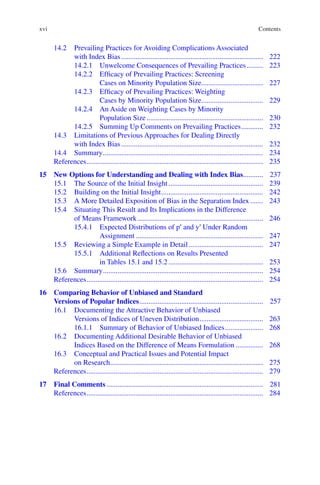
Contents
1	Introduction and Goals............................................................................ 1
References.................................................................................................. 10
2	
Alternative Formulas for Selected Indices............................................. 11
References.................................................................................................. 16
3	
Overview of the “Difference of Means” Framework............................ 19
3.1	
Index Formulas: The Current State of Affairs................................ 19
3.2	
The Difference of Means Formulation – The General
Approach......................................................................................... 22
3.3	
Additional Preliminary Remarks on Implementation..................... 24
References.................................................................................................. 25
4	
Difference of Means Formulations for Selected Indices....................... 27
4.1	
Scoring Residential Outcomes (y) for the Delta
or Dissimilarity Index (D).............................................................. 27
4.2	
Scoring Residential Outcomes (y) for the Gini Index (G).............. 31
4.3	
The Delta or Dissimilarity Index (D) as a Crude Version of G...... 32
4.4	
Scoring Residential Outcomes (y) for the Separation Index (S).... 33
4.5	
A Side Comment on the Separation Index (S) and Uneven
Distribution..................................................................................... 36
4.6	
Scoring Residential Outcomes (y) for the Theil Index (H)............ 39
4.7	
Scoring Residential Outcomes (y) for the Hutchens
Square Root Index (R).................................................................... 40
References.................................................................................................. 43
5	
Index Differences in Registering Area Group Proportions.................. 45
5.1	
Segregation as Group Differences in Individual Residential
Attainments..................................................................................... 46
5.2	
Implications for Sensitivity to Separation and Polarization........... 52
References.................................................................................................. 56
xiv
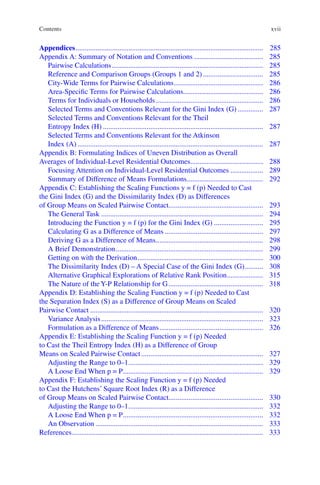
6	Empirical Relationships Among Indices................................................ 57
6.1	
When Do Indices Agree? When Can They Disagree?.................... 61
6.2	
Why Does Relative Group Size Matter?......................................... 71
References.................................................................................................. 75
7	
Distinctions Between Displacement and Separation............................. 77
7.1	
The Increasing Practical Importance of the Distinction
Between Displacement and Separation.......................................... 79
7.2	
Prototypical Segregation and Concentrated
Versus Dispersed Displacement...................................................... 81
7.2.1	Prototypical Segregation................................................... 82
7.3	
Clarifying the Logical Potential for D-S Concordance
and Discordance – Analysis of Exchanges..................................... 86
7.3.1	
Overview of D-S Differences in Responding
to Integration-­
Promoting Exchanges................................ 88
7.3.2	
Examples of D-S Differences in Responding
to Integration-­
Promoting Exchanges................................ 90
7.3.3	
Implications of Analysis of Example Exchanges............. 95
7.4	
Clarifying the Potential for D-S Concordance and
Discordance – Analytic Models...................................................... 97
7.4.1	
Examples of Calculating Values of SMin Given
Values of D and P............................................................. 100
7.4.2	Examining D, SMax, and SMin over Varying
Combinations of D and P.................................................. 105
7.4.3	
Implications of Findings from Analytic
Models for SMax and SMin................................................... 108
7.5	
Is Separation a Distinct Dimension of Segregation?...................... 108
References.................................................................................................. 115
8	
Further Comments on Differences Between Displacement
and Separation......................................................................................... 117
8.1	
Revisiting the Empirical Relationships
of Displacement (D) and Separation (S)......................................... 118
8.2	
Scenarios for How D and S Discrepancies Can Arise.................... 122
8.3	
A Practical Issue When Comparing D and S – Size
of Spatial Units............................................................................... 127
8.3.1	
A Case Study of White-Black Segregation
Cullman County Alabama................................................. 130
8.3.2	
A Case Study of White-Minority Segregation
in Palacios TX................................................................... 132
8.3.3	
Reiterating the Importance of Using
“Right-Sized” Spatial Units.............................................. 133
8.3.4	
More Practical Guidance for Using S............................... 135
8.4	
A Simple Index of Polarization...................................................... 136
References.................................................................................................. 137
Contents
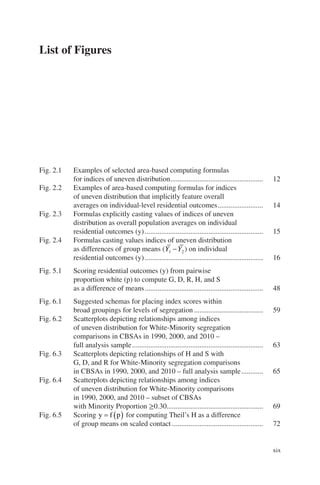
xv
9	
Unifying Micro-level and Macro-level Analyses of Segregation.......... 139
9.1	
New Ways to Work with Detailed Summary File Tabulations........ 141
9.2	Some Preliminaries......................................................................... 142
9.3	Substantive Findings....................................................................... 146
9.4	
Opportunities to Perform Standardization
and Components Analysis............................................................... 148
9.5	
Comparison with Previous Approaches to “Taking
Account” of Non-­
racial Social Characteristics............................... 150
9.6	
Aggregate-Level Controls for Micro-level Determinants
of Residential Outcomes................................................................. 152
9.7	
New Interpretations of Index Scores Based on Bivariate
Regression Analysis........................................................................ 156
9.8	Multivariate Segregation Attainment Analysis (SAA).................... 161
9.9	
Unifying Aggregate Segregation Studies and Studies
of Individual-­
Level Residential Attainment.................................... 170
9.10	
New Possibilities for Investigating Segregation Using
Restricted Data................................................................................ 172
9.11	
An Example Analysis Using Restricted Microdata........................ 174
References.................................................................................................. 178
10	
New Options for Investigating Macro-level Variation
in Segregation........................................................................................... 181
10.1	
New Specifications for Conducting Comparative
and/or Trend Analyses of Segregation............................................ 181
References.................................................................................................. 189
11	
Aspatial and Spatial Applications of Indices of Uneven
Distribution............................................................................................... 191
References.................................................................................................. 193
12	
Relevance of Individual-Level Residential Outcomes
for Describing Segregation...................................................................... 195
12.1	
An Example Analysis of Segregation and Exposure
to Neighborhood Poverty................................................................ 202
13	
Relevance of Individual-Level Residential Outcomes
for Segregation Theory............................................................................ 207
References.................................................................................................. 209
14	
Index Bias and Current Practices.......................................................... 211
14.1	
Overview of the Issue of Index Bias............................................... 214
14.1.1	
Effective Neighborhood Size (ENS): A Further
Complication..................................................................... 218
14.1.2	
The Practical Relevance of Variation in Effective
Neighborhood Size........................................................... 220
14.1.3	
Random Distribution Is a Valid, Useful,
and Conceptually Desirable Reference Point................... 221
Contents
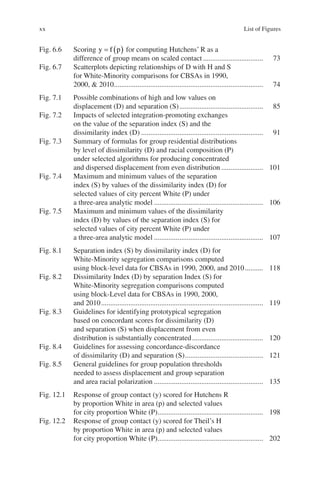
xvi
14.2	
Prevailing Practices for Avoiding Complications Associated
with Index Bias............................................................................... 222
14.2.1	
Unwelcome Consequences of Prevailing Practices.......... 223
14.2.2	
Efficacy of Prevailing Practices: Screening
Cases on Minority Population Size................................... 227
14.2.3	
Efficacy of Prevailing Practices: Weighting
Cases by Minority Population Size................................... 229
14.2.4	
An Aside on Weighting Cases by Minority
Population Size................................................................. 230
14.2.5	
Summing Up Comments on Prevailing Practices............. 232
14.3	
Limitations of Previous Approaches for Dealing Directly
with Index Bias............................................................................... 232
14.4	Summary......................................................................................... 234
References.................................................................................................. 235
15	
New Options for Understanding and Dealing with Index Bias............ 237
15.1	
The Source of the Initial Insight..................................................... 239
15.2	
Building on the Initial Insight......................................................... 242
15.3	
A More Detailed Exposition of Bias in the Separation Index........ 243
15.4	
Situating This Result and Its Implications in the Difference
of Means Framework...................................................................... 246
15.4.1	
Expected Distributions of pʹ and yʹ Under Random
Assignment....................................................................... 247
15.5	
Reviewing a Simple Example in Detail.......................................... 247
15.5.1	
Additional Reflections on Results Presented
in Tables 15.1 and 15.2.....................................................	253
15.6	Summary......................................................................................... 254
References.................................................................................................. 254
16	
Comparing Behavior of Unbiased and Standard
Versions of Popular Indices..................................................................... 257
16.1	
Documenting the Attractive Behavior of Unbiased
Versions of Indices of Uneven Distribution.................................... 263
16.1.1	
Summary of Behavior of Unbiased Indices...................... 268
16.2	
Documenting Additional Desirable Behavior of Unbiased
Indices Based on the Difference of Means Formulation................ 268
16.3	
Conceptual and Practical Issues and Potential Impact
on Research..................................................................................... 275
References.................................................................................................. 279
17	Final Comments....................................................................................... 281
References.................................................................................................. 284
Contents
xvii
Appendices........................................................................................................ 285
Appendix A: Summary of Notation and Conventions....................................... 285
Pairwise Calculations.................................................................................... 285
Reference and Comparison Groups (Groups 1 and 2).................................. 285
City-Wide Terms for Pairwise Calculations.................................................. 286
Area-Specific Terms for Pairwise Calculations............................................ 286
Terms for Individuals or Households............................................................ 286
Selected Terms and Conventions Relevant for the Gini Index (G)............... 287
Selected Terms and Conventions Relevant for the Theil
Entropy Index (H)......................................................................................... 287
Selected Terms and Conventions Relevant for the Atkinson
Index (A)....................................................................................................... 287
Appendix B: Formulating Indices of Uneven Distribution as Overall
Averages of Individual-Level Residential Outcomes......................................... 288
Focusing Attention on Individual-Level Residential Outcomes................... 289
Summary of Difference of Means Formulations........................................... 292
Appendix C: Establishing the Scaling Functions y = f (p) Needed to Cast
the Gini Index (G) and the Dissimilarity Index (D) as Differences
of Group Means on Scaled Pairwise Contact.................................................... 293
The General Task.......................................................................................... 294
Introducing the Function y = f (p) for the Gini Index (G)............................ 295
Calculating G as a Difference of Means....................................................... 297
Deriving G as a Difference of Means............................................................ 298
A Brief Demonstration.................................................................................. 299
Getting on with the Derivation...................................................................... 300
The Dissimilarity Index (D) – A Special Case of the Gini Index (G)........... 308
Alternative Graphical Explorations of Relative Rank Position..................... 315
The Nature of the Y-P Relationship for G..................................................... 318
Appendix D: Establishing the Scaling Function y = f (p) Needed to Cast
the Separation Index (S) as a Difference of Group Means on Scaled
Pairwise Contact................................................................................................ 320
Variance Analysis.......................................................................................... 323
Formulation as a Difference of Means.......................................................... 326
Appendix E: Establishing the Scaling Function y = f (p) Needed
to Cast the Theil Entropy Index (H) as a Difference of Group
Means on Scaled Pairwise Contact.................................................................... 327
Adjusting the Range to 0–1........................................................................... 329
A Loose End When p = P.............................................................................. 329
Appendix F: Establishing the Scaling Function y = f (p) Needed
to Cast the Hutchens’ Square Root Index (R) as a Difference
of Group Means on Scaled Pairwise Contact.................................................... 330
Adjusting the Range to 0–1........................................................................... 332
A Loose End When p = P.............................................................................. 332
An Observation............................................................................................. 333
References.......................................................................................................... 333
Contents
xix
List of Figures
Fig. 2.1 Examples of selected area-based computing formulas
for indices of uneven distribution.................................................... 12
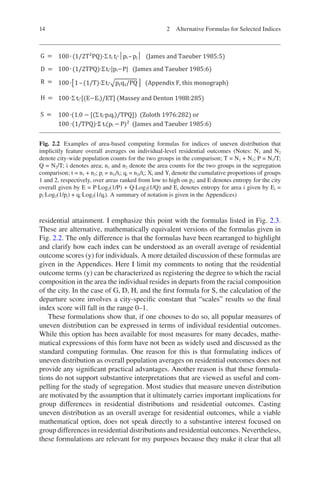
Fig. 2.2 Examples of area-based computing formulas for indices
of uneven distribution that implicitly feature overall
averages on individual-level residential outcomes.......................... 14
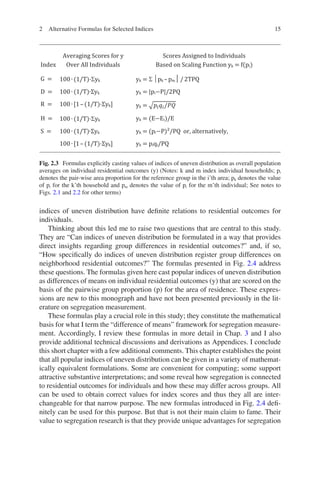
Fig. 2.3 Formulas explicitly casting values of indices of uneven
distribution as overall population averages on individual
residential outcomes (y).................................................................. 15
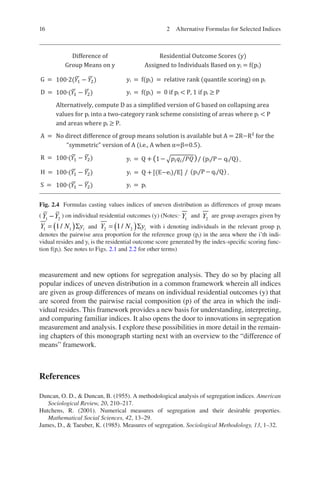
Fig. 2.4 Formulas casting values indices of uneven distribution
as differences of group means (Y Y
1 2
− ) on individual
residential outcomes (y).................................................................. 16
Fig. 5.1 Scoring residential outcomes (y) from pairwise
proportion white (p) to compute G, D, R, H, and S
as a difference of means.................................................................. 48
Fig. 6.1 Suggested schemas for placing index scores within
broad groupings for levels of segregation....................................... 59
Fig. 6.2 Scatterplots depicting relationships among indices
of uneven distribution for White-Minority segregation
comparisons in CBSAs in 1990, 2000, and 2010 –
full analysis sample......................................................................... 63
Fig. 6.3 Scatterplots depicting relationships of H and S with
G, D, and R for White-­
Minority segregation comparisons
in CBSAs in 1990, 2000, and 2010 – full analysis sample............. 65
Fig. 6.4 Scatterplots depicting relationships among indices
of uneven distribution for White-Minority comparisons
in 1990, 2000, and 2010 – subset of CBSAs
with Minority Proportion ≥0.30...................................................... 69
Fig. 6.5 Scoring y f p
= ( ) for computing Theil’s H as a difference
of group means on scaled contact................................................... 72
xx
Fig. 6.6 Scoring y f p
= ( ) for computing Hutchens’ R as a
difference of group means on scaled contact.................................. 73
Fig. 6.7 Scatterplots depicting relationships of D with H and S
for White-Minority comparisons for CBSAs in 1990,
2000,  2010................................................................................... 74
Fig. 7.1 Possible combinations of high and low values on
displacement (D) and separation (S)............................................... 85
Fig. 7.2 Impacts of selected integration-promoting exchanges
on the value of the separation index (S) and the
dissimilarity index (D).................................................................... 91
Fig. 7.3 Summary of formulas for group residential distributions
by level of dissimilarity (D) and racial composition (P)
under selected algorithms for producing concentrated
and dispersed displacement from even distribution........................ 101
Fig. 7.4 Maximum and minimum values of the separation
index (S) by values of the dissimilarity index (D) for
selected values of city percent White (P) under
a three-­
area analytic model............................................................. 106
Fig. 7.5 Maximum and minimum values of the dissimilarity
index (D) by values of the separation index (S) for
selected values of city percent White (P) under
a three-­
area analytic model............................................................. 107
Fig. 8.1 Separation index (S) by dissimilarity index (D) for
White-Minority segregation comparisons computed
using block-level data for CBSAs in 1990, 2000, and 2010........... 118
Fig. 8.2 Dissimilarity Index (D) by separation Index (S) for
White-Minority segregation comparisons computed
using block-Level data for CBSAs in 1990, 2000,
and 2010.......................................................................................... 119
Fig. 8.3 Guidelines for identifying prototypical segregation
based on concordant scores for dissimilarity (D)
and separation (S) when displacement from even
distribution is substantially concentrated........................................ 120
Fig. 8.4 Guidelines for assessing concordance-discordance
of dissimilarity (D) and separation (S)............................................ 121
Fig. 8.5 General guidelines for group population thresholds
needed to assess displacement and group separation
and area racial polarization............................................................. 135
Fig. 12.1 Response of group contact (y) scored for Hutchens R
by proportion White in area (p) and selected values
for city proportion White (P)........................................................... 198
Fig. 12.2 Response of group contact (y) scored for Theil’s H
by proportion White in area (p) and selected values
for city proportion White (P)........................................................... 202
List of Figures
xxi
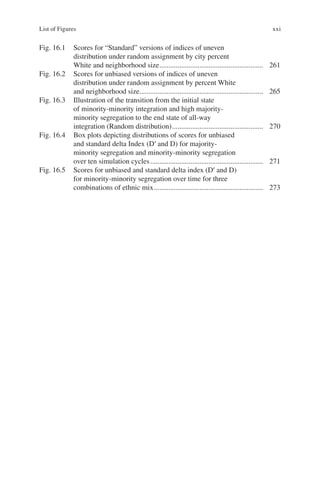
Fig. 16.1 Scores for “Standard” versions of indices of uneven
distribution under random assignment by city percent
White and neighborhood size.......................................................... 261
Fig. 16.2 Scores for unbiased versions of indices of uneven
distribution under random assignment by percent White
and neighborhood size.................................................................... 265
Fig. 16.3 Illustration of the transition from the initial state
of minority-minority integration and high majority-
minority segregation to the end state of all-way
integration (Random distribution)................................................... 270
Fig. 16.4 Box plots depicting distributions of scores for unbiased
and standard delta Index (D′ and D) for majority-
minority segregation and minority-­
minority segregation
over ten simulation cycles............................................................... 271
Fig. 16.5 Scores for unbiased and standard delta index (D′ and D)
for minority-­
minority segregation over time for three
combinations of ethnic mix............................................................. 273
List of Figures
xxiii
List of Tables
Table 5.1 Group counts and overall and pairwise group percentages
for Houston, Texas, 2000.............................................................. 46
Table 5.2 Scores for White-Minority segregation indices obtained
using standard computing formulas, Houston Texas, 2000.......... 46
Table 5.3 Details for obtaining scores for White-Minority segregation
from difference of group means on residential outcomes,
Houston, Texas, 2000................................................................... 47
Table 6.1 Descriptive statistics for indices of uneven distribution
for White-Minority comparisons for CBSAs for 1990,
2000, and 2010............................................................................. 59
Table 6.2 Relationships among indices of uneven distribution
for White-Minority segregation comparisons in CBSAs
in 1990, 2000, and 2010............................................................... 62
Table 6.3 Relationships among indices of uneven distribution
by size of combined group populations for White-
Minority segregation comparisons in CBSAs in 1990,
2000, and 2010............................................................................. 67
Table 6.4 Relationships among indices of uneven distribution
by group proportions for White-Minority segregation
comparisons in CBSAs in 1990, 2000, and 2010......................... 70
Table 9.1 Descriptive statistics for poverty status and distribution
of poverty status by family type for Whites, Black,
Latinos, and Asians in Houston, Texas, 2000............................... 142
Table 9.2 Means on pairwise contact with Whites (y) scored for
the separation index (S) by poverty status and family
type for White-Minority comparisons, Houston,
Texas, 2000................................................................................... 143
xxiv
Table 9.3 Means on scaled pairwise contact with Whites (y)
scored for the dissimilarity index (D)
by poverty status and family type for White-minority
comparisons, Houston, Texas, 2000............................................. 144
Table 9.4 Observed and standardized White-Minority segregation
comparisons, Houston, Texas, 2000............................................. 149
Table 9.5 Bivariate segregation attainment regressions predicting
residential outcomes (y) that additively determine
White-Minority segregation for selected indices,
Houston, Texas, 2000................................................................... 157
Table 9.6 Group-specific attainment regressions for
White-Black segregation.............................................................. 163
Table 9.7 Group-specific attainment regressions for
White-Latino segregation............................................................. 164
Table 9.8 Group-specific attainment regressions for
White-Asian segregation.............................................................. 165
Table 9.9 Coefficients from fractional regressions predicting
residential outcomes (y) determining the separation
index (S) for White-Latino segregation
in Houston, Texas in 2000 and 2010............................................ 175
Table 9.10 Standardization analyses for White-Latino differences
in residential outcomes (y) determining the separation
index (S)....................................................................................... 176
Table 10.1 Regression results illustrating that effects in city-level
analyses of segregation and contact can be obtained
using individual-level, contextual regressions predicting
group differences in contact......................................................... 184
Table 10.2 Analyses illustrating how city-level analyses of segregation
can be conducted using individual-level, contextual
regressions that control non-­
racial characteristics........................ 186
Table 10.3 Analyses illustrating how city-level analyses of
segregation can yield misleading results when
aggregate measures are used to control for group
differences on non-racial characteristics...................................... 187
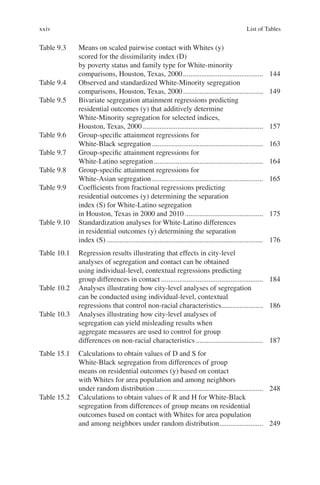
Table 15.1 Calculations to obtain values of D and S for
White-Black segregation from differences of group
means on residential outcomes (y) based on contact
with Whites for area population and among neighbors
under random distribution............................................................ 248
Table 15.2 Calculations to obtain values of R and H for White-Black
segregation from differences of group means on residential
outcomes based on contact with Whites for area population
and among neighbors under random distribution......................... 249
List of Tables
xxv
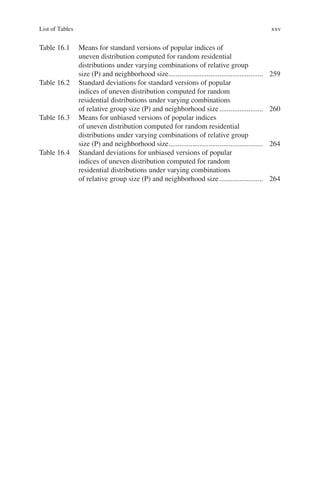
Table 16.1 Means for standard versions of popular indices of
uneven distribution computed for random residential
distributions under varying combinations of relative group
size (P) and neighborhood size..................................................... 259
Table 16.2 Standard deviations for standard versions of popular
indices of uneven distribution computed for random
residential distributions under varying combinations
of relative group size (P) and neighborhood size......................... 260
Table 16.3 Means for unbiased versions of popular indices
of uneven distribution computed for random residential
distributions under varying combinations of relative group
size (P) and neighborhood size..................................................... 264
Table 16.4 Standard deviations for unbiased versions of popular
indices of uneven distribution computed for random
residential distributions under varying combinations
of relative group size (P) and neighborhood size......................... 264
List of Tables
1
© The Author(s) 2017
M. Fossett, New Methods for Measuring and Analyzing Segregation,
The Springer Series on Demographic Methods and Population Analysis 42,
DOI 10.1007/978-3-319-41304-4_1
Chapter 1
Introduction and Goals
The literature on residential segregation is one of the oldest empirical research tra-
ditions in sociology and has long been a core topic in the study of social stratifica-
tion and inequality as well as in the study of the demography of spatial population
distribution. This literature is guided by the fundamental assumption that group
differences in neighborhood residential outcomes are closely associated with social
position and life chances. Accordingly, indices measuring segregation, especially
the dimension of uneven distribution, are viewed as important summary indicators
of overall group standing and scores for segregation indices have been a mainstay
of research documenting levels, patterns, and trends in the residential segregation
of racial and ethnic groups. Given the extensive attention social scientists have
directed to the study of residential segregation, one might assume that the relation-
ship between residential segregation and group differences in neighborhood resi-
dential outcomes is well understood. Surprisingly, this is not the case. The issue has
received little attention in the literature on segregation measurement. Consequently,
researchers are not able to offer precise conclusions about group differences in resi-
dential outcomes based on scores for popular and widely used indices of uneven
distribution.
In this monograph I address this deficiency in the literature by outlining a new
approach to measuring uneven distribution. My goal is not to replace familiar,
widely-used indices with new ones. Instead, I wish to place popular indices in a new
alternative framework that clarifies the implications they carry for group differences
in individual-level residential outcomes. My motivation for doing this rests on two
convictions. One is that understanding how segregation is related to individual resi-
dential outcomes is desirable for its own sake and brings valuable new options for
interpreting segregation index scores and understanding differences between them.
The other is that casting segregation indices in terms of group differences in indi-
vidual residential outcomes brings benefits for segregation measurement and analy-
sis including, as two primary examples, the ability to directly link segregation at the
aggregate or macro level to micro-level processes of residential attainment and the
2
ability to develop versions of the indices that are free of the troublesome problem of
inherent upward bias.
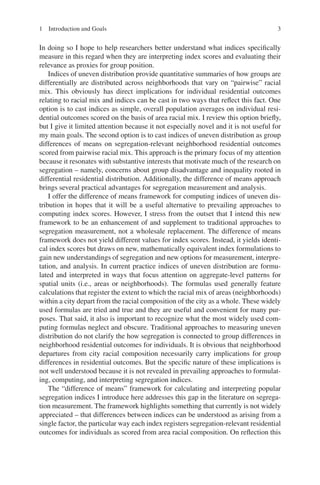
Moving from generalities to specifics, my goal in this monograph is to set forth
the “difference of means” framework, a new framework for segregation measure-
ment wherein popular indices of uneven distribution are cast as simple differences
of group means on residential outcomes that register group contact and exposure
based on area racial composition. In accomplishing this goal I establish that all
widely used segregation indices including the Gini Index (G), the Delta or
Dissimilarity Index (D), the Hutchens Square Root Index (R) – an index with close
similarities to the Atkinson Index (A), the Theil Entropy Index (H), and the
Separation Index (S) – also known as the variance ratio and a variety of other names,
can be expressed as a difference of group means on individual- or household-level
residential outcomes (y) that are scored on the basis of index-specific scaling of
group contact based on area group proportions.
The indices just listed are all well-known and all have been reviewed in detail in
many previous methodological studies (e.g., Duncan and Duncan 1955; Zoloth
1976; James and Taeuber 1985; Stearns and Logan 1986; White 1986; Massey and
Denton 1988; Hutchens 2001, 2004; Reardon and Firebaugh 2002). The contribu-
tion I seek to make is to clarify a characteristic of these indices that currently is not
well understood; namely, the particular way each one relates to and ultimately quan-
titatively registers group differences in neighborhood residential outcomes. The
sociological relevance of segregation index scores rests on the presumption that
they carry important implications for group differences in social position and life
chances that are associated with area of residence. Segregation researchers and con-
sumers of segregation research thus generally assume that variation in segregation
index scores tends to correlate with variation in a broad range of group disparities
associated with neighborhood residential outcomes.
It is definitely plausible to assume that summary index scores may serve as prox-
ies for valuable, but usually unavailable information about residentially-based group
inequality and disparity. But it is important to recognize that, in the final analysis,
the calculations that yield segregation index scores revolve around a simple and
very particular aspect of neighborhood residential outcomes – “pairwise” group
proportions.1
This residential outcome can be understood in multiple ways from the
point of view of individuals and households. For example, it can be understood as
registering levels of contact or exposure based on co-residence with members of the
two groups in the comparison. Alternatively, it can be understood as registering
exposure to deviations or departures from the racial composition of the city as a
whole. One of my goals is to clarify how different indices register group differences
on individual residential outcomes relating to area racial mix and group proportions.
1
The expression “pairwise” ethnic mix or group proportion signifies that the calculations involved
use only the population counts for the two groups in the comparison. It can be contrasted with
“overall” ethnic mix or group proportion based on the full population including groups not in the
segregation comparison. Significantly, the presence and distributions of groups other than the two
in the comparison has no bearing on scores for indices of uneven distribution.
1 Introduction and Goals
3
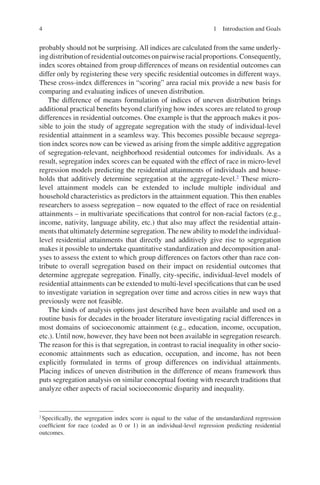
In doing so I hope to help researchers better understand what indices specifically
measure in this regard when they are interpreting index scores and evaluating their
relevance as proxies for group position.
Indices of uneven distribution provide quantitative summaries of how groups are
differentially are distributed across neighborhoods that vary on “pairwise” racial
mix. This obviously has direct implications for individual residential outcomes
relating to racial mix and indices can be cast in two ways that reflect this fact. One
option is to cast indices as simple, overall population averages on individual resi-
dential outcomes scored on the basis of area racial mix. I review this option briefly,
but I give it limited attention because it not especially novel and it is not useful for
my main goals. The second option is to cast indices of uneven distribution as group
differences of means on segregation-relevant neighborhood residential outcomes
scored from pairwise racial mix. This approach is the primary focus of my attention
because it resonates with substantive interests that motivate much of the research on
segregation – namely, concerns about group disadvantage and inequality rooted in
differential residential distribution. Additionally, the difference of means approach
brings several practical advantages for segregation measurement and analysis.
I offer the difference of means framework for computing indices of uneven dis-
tribution in hopes that it will be a useful alternative to prevailing approaches to
computing index scores. However, I stress from the outset that I intend this new
framework to be an enhancement of and supplement to traditional approaches to
segregation measurement, not a wholesale replacement. The difference of means
framework does not yield different values for index scores. Instead, it yields identi-
cal index scores but draws on new, mathematically equivalent index formulations to
gain new understandings of segregation and new options for measurement, interpre-
tation, and analysis. In current practice indices of uneven distribution are formu-
lated and interpreted in ways that focus attention on aggregate-level patterns for
spatial units (i.e., areas or neighborhoods). The formulas used generally feature
calculations that register the extent to which the racial mix of areas (neighborhoods)
within a city depart from the racial composition of the city as a whole. These widely
used formulas are tried and true and they are useful and convenient for many pur-
poses. That said, it also is important to recognize what the most widely used com-
puting formulas neglect and obscure. Traditional approaches to measuring uneven
distribution do not clarify the how segregation is connected to group differences in
neighborhood residential outcomes for individuals. It is obvious that neighborhood
departures from city racial composition necessarily carry implications for group
differences in residential outcomes. But the specific nature of these implications is
not well understood because it is not revealed in prevailing approaches to formulat-
ing, computing, and interpreting segregation indices.
The “difference of means” framework for calculating and interpreting popular
segregation indices I introduce here addresses this gap in the literature on segrega-
tion measurement. The framework highlights something that currently is not widely
appreciated – that differences between indices can be understood as arising from a
single factor, the particular way each index registers segregation-relevant residential
outcomes for individuals as scored from area racial composition. On reflection this
1 Introduction and Goals
4
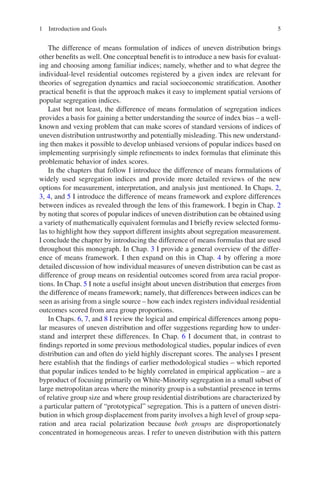
probably should not be surprising. All indices are calculated from the same underly-
ingdistributionofresidentialoutcomesonpairwiseracialproportions.Consequently,
index scores obtained from group differences of means on residential outcomes can
differ only by registering these very specific residential outcomes in different ways.
These cross-index differences in “scoring” area racial mix provide a new basis for
comparing and evaluating indices of uneven distribution.
The difference of means formulation of indices of uneven distribution brings
additional practical benefits beyond clarifying how index scores are related to group
differences in residential outcomes. One example is that the approach makes it pos-
sible to join the study of aggregate segregation with the study of individual-level
residential attainment in a seamless way. This becomes possible because segrega-
tion index scores now can be viewed as arising from the simple additive aggregation
of segregation-relevant, neighborhood residential outcomes for individuals. As a
result, segregation index scores can be equated with the effect of race in micro-level
regression models predicting the residential attainments of individuals and house-
holds that additively determine segregation at the aggregate-level.2
These micro-­
level attainment models can be extended to include multiple individual and
household characteristics as predictors in the attainment equation. This then enables
researchers to assess segregation – now equated to the effect of race on residential
attainments – in multivariate specifications that control for non-racial factors (e.g.,
income, nativity, language ability, etc.) that also may affect the residential attain-
ments that ultimately determine segregation. The new ability to model the individual-­
level residential attainments that directly and additively give rise to segregation
makes it possible to undertake quantitative standardization and decomposition anal-
yses to assess the extent to which group differences on factors other than race con-
tribute to overall segregation based on their impact on residential outcomes that
determine aggregate segregation. Finally, city-specific, individual-level models of
residential attainments can be extended to multi-level specifications that can be used
to investigate variation in segregation over time and across cities in new ways that
previously were not feasible.
The kinds of analysis options just described have been available and used on a
routine basis for decades in the broader literature investigating racial differences in
most domains of socioeconomic attainment (e.g., education, income, occupation,
etc.). Until now, however, they have been not been available in segregation research.
The reason for this is that segregation, in contrast to racial inequality in other socio-
economic attainments such as education, occupation, and income, has not been
explicitly formulated in terms of group differences on individual attainments.
Placing indices of uneven distribution in the difference of means framework thus
puts segregation analysis on similar conceptual footing with research traditions that
analyze other aspects of racial socioeconomic disparity and inequality.
2
Specifically, the segregation index score is equal to the value of the unstandardized regression
coefficient for race (coded as 0 or 1) in an individual-level regression predicting residential
outcomes.
1 Introduction and Goals
5
The difference of means formulation of indices of uneven distribution brings
other benefits as well. One conceptual benefit is to introduce a new basis for evaluat-
ing and choosing among familiar indices; namely, whether and to what degree the
individual-level residential outcomes registered by a given index are relevant for
theories of segregation dynamics and racial socioeconomic stratification. Another
practical benefit is that the approach makes it easy to implement spatial versions of
popular segregation indices.
Last but not least, the difference of means formulation of segregation indices
provides a basis for gaining a better understanding the source of index bias – a well-­
known and vexing problem that can make scores of standard versions of indices of
uneven distribution untrustworthy and potentially misleading. This new understand-
ing then makes it possible to develop unbiased versions of popular indices based on
implementing surprisingly simple refinements to index formulas that eliminate this
problematic behavior of index scores.
In the chapters that follow I introduce the difference of means formulations of
widely used segregation indices and provide more detailed reviews of the new
options for measurement, interpretation, and analysis just mentioned. In Chaps. 2,
3, 4, and 5 I introduce the difference of means framework and explore differences
between indices as revealed through the lens of this framework. I begin in Chap. 2
by noting that scores of popular indices of uneven distribution can be obtained using
a variety of mathematically equivalent formulas and I briefly review selected formu-
las to highlight how they support different insights about segregation measurement.
I conclude the chapter by introducing the difference of means formulas that are used
throughout this monograph. In Chap. 3 I provide a general overview of the differ-
ence of means framework. I then expand on this in Chap. 4 by offering a more
detailed discussion of how individual measures of uneven distribution can be cast as
difference of group means on residential outcomes scored from area racial propor-
tions. In Chap. 5 I note a useful insight about uneven distribution that emerges from
the difference of means framework; namely, that differences between indices can be
seen as arising from a single source – how each index registers individual residential
outcomes scored from area group proportions.
In Chaps. 6, 7, and 8 I review the logical and empirical differences among popu-
lar measures of uneven distribution and offer suggestions regarding how to under-
stand and interpret these differences. In Chap. 6 I document that, in contrast to
findings reported in some previous methodological studies, popular indices of even
distribution can and often do yield highly discrepant scores. The analyses I present
here establish that the findings of earlier methodological studies – which reported
that popular indices tended to be highly correlated in empirical application – are a
byproduct of focusing primarily on White-Minority segregation in a small subset of
large metropolitan areas where the minority group is a substantial presence in terms
of relative group size and where group residential distributions are characterized by
a particular pattern of “prototypical” segregation. This is a pattern of uneven distri-
bution in which group displacement from parity involves a high level of group sepa-
ration and area racial polarization because both groups are disproportionately
concentrated in homogeneous areas. I refer to uneven distribution with this pattern
1 Introduction and Goals
6
of “concentrated displacement” as “prototypical segregation” because this signature
pattern – in which all popular measures of uneven distribution take high scores – is
always present in crafted examples used to illustrate high segregation in didactic
discussions of segregation measurement. Similarly, it also is invariably present in
empirical cases used to illustrate high levels of segregation. So it easy to understand
that many would not be aware that popular indices can take substantially discrepant
scores.
The empirical analyses I present in Chap. 6 document that uneven distribution
does not always take the form of prototypical segregation. To the contrary, the anal-
yses instead reveal that broader samples of cities include a large number of cases
with a sharply contrasting pattern of “dispersed displacement” wherein uneven dis-
tribution involves extensive group displacement from parity but does not involve
group separation and area racial polarization. In these situations, index scores can
be highly discrepant. Specifically, indices that are sensitive to differential displace-
ment – such as the gini index (G) and the dissimilarity index (D) which Duncan and
Duncan (1955) aptly also termed the displacement index – will take high scores
while the Theil index (H) and the separation index (S) – which Stearns and Logan
(1986) note is sensitive to residential separation and area racial polarization – will
take low scores.
In Chap. 7 I review the distinction between concentrated and dispersed displace-
ment in more detail. The chapter makes two important points. One is that the socio-
logical implications of uneven distribution involving “prototypical segregation” and
D-S concordance are fundamentally different from the sociological implications of
uneven distribution with dispersed displacement and substantial D-S divergence.
Simply put, a high level of group separation is obviously substantively compelling
and necessarily entails a high level of displacement. But the reverse is not true.
Thus, high levels of displacement do not always entail high levels of group separa-
tion and this should be noted when it occurs because the literature on segregation
measurement provides no clear basis for viewing differential displacement without
group separation as sociologically important. The second point I make in this chap-
ter is that the largely unrecognized but empirically common outcome of dispersed
displacement is not an artifact of relative group size or deficiencies in indices that
are more sensitive to group separation than displacement. To make this point I intro-
duce and exercise simple analytic models to show that when non-trivial displace-
ment from even distribution is present, it can be concentrated or it can be dispersed.
Concentrated displacement produces “prototypical segregation” wherein the score
of S will approach or even equal the score for D indicating that displacement
involves group separation and area polarization. In the case of dispersed displace-
ment, D will be equally high but S will be low signaling that group separation and
area polarization are minimal, sometimes to the point of being negligible. I review
the principles of transfers and exchanges from segregation measurement theory to
establish that D-S discrepancies of this sort arise because D is flawed and does not
conform to these accepted principles of segregation measurement.
Chapter 8 supplements the analytic results by discussing the sociological dynam-
ics that are likely to influence whether non-trivial displacement takes the form of
1 Introduction and Goals
7
“prototypical segregation” or the substantively less compelling pattern of dispersed
displacement. It also reviews case studies of empirical examples of high-D-high S
combinations that in communities where the minority group is small in relative size.
The discussion here drives home two important points. One is that scores for D and
S can be congruent or discrepant in any setting where displacement from uneven
distribution is non-trivial. The other is that sociological dynamics, not artifacts of
index construction, determine whether in fact D and S are congruent or discrepant
in a given community.
In Chap. 9 I show how the difference of means framework creates new options
for research by joining micro- and macro-level analysis of segregation. At the sim-
plest level, casting segregation as a difference of group means on residential out-
comes leads to the new insight that segregation index scores are exactly
mathematically equivalent to the effect of race in bivariate regression analyses pre-
dicting segregation-determining residential outcomes for individuals. I then argue
that this insight opens the door to the new possibility of using multivariate regres-
sion analyses to quantitatively assess how segregation arises from two sources. The
first source is group differences on distributions of social and economic characteris-
tics that are salient in residential attainment processes. The second source is group
differences in the efficacy of how inputs to residential attainment processes translate
into segregation-determining residential outcomes. In this framework, segregation
can be analyzed in greater detail and sophistication by using standardization and
decomposition analysis in combination with multivariate regression analysis of
attainments, methods that are routinely applied to the study of racial inequality in
education, occupation, income, health, and other important stratification outcomes.
This is a major advance as research on segregation has lagged behind research on
group disparities in other domains where aggregate-level outcomes on group dis-
parities have long been routinely analyzed as outgrowths of micro-level attainment
processes.
In Chap. 10 I show how the regression analysis of individual-level residential
attainments can subsume comparative analysis of cross-city variation in segregation
and create new possibilities for investigating the factors contributing to variation in
segregation across cities and over time. The new approach involves extending city-­
specific analysis of segregation using bivariate and multivariate models of individual-­
level residential attainment to multi-level specifications that reveal how the process
determining segregation varies across cities and over time. I first note that findings
from aggregate-level analyses of cross-city variation in segregation can be exactly
reproduced using multi-level specifications of segregation-attainment models. I
then outline how this specification opens the door for improving the ability of
researchers take accurately assess the role that non-racial characteristics such as
income may play in shaping cross-city variation in segregation.
Previous research has often tried to assess the impact of group differences on
income and other individual-level characteristics by the method of aggregate-level
regression analysis. I note that this approach is prone to yield flawed results because
it runs afoul of the “aggregate fallacy.” The problem is hidden from view and less
obvious when segregation is viewed only as a macro-level outcome. It becomes
1 Introduction and Goals
8
clear and more readily evident when segregation is analyzed within the difference
of means framework where the outcome of segregation at the aggregate-level is
exactly determined by individual-level attainment processes. I demonstrate the
importance of the problem by showing that results of analyses that assess the impact
of group income differences on segregation using aggregate-level regressions are
contradicted by multi-level regression analyses that avoid the aggregate fallacy and
properly take account of the effects of income at the individual-level.
In Chaps. 11, 12, and 13 I review topics that benefit from insights and perspec-
tives gained from drawing on the difference of means framework for analyzing seg-
regation. In Chap. 11 I note that the difference of means framework makes it easy
for researchers to implement spatial versions of popular segregation indices if they
desire to do so. The reason for this is simple; the residential attainments for indi-
viduals that determine segregation scores can be computed using mutually-­exclusive
bounded areas, or using overlapping, spatially-defined areas. The former yields a
traditional aspatial index score. The latter yields a “spatial” index score that is
affected by how neighborhoods that vary in racial composition are distributed in
space.
In Chaps. 12 and 13 I argue that the difference of means framework leads to new
perspectives regarding what aspects of residential segregation researchers will view
as most compelling on substantive grounds. In Chap. 12 I argue that group separa-
tion is a more compelling substantive concern than mere displacement from even
distribution. I frame the issue as follows. It is non-controversial to assert that group
separation area racial polarization is substantively important because it is a logical
prerequisite for group disparity and inequality on neighborhood-based residential
outcomes. In contrast, there is no established basis for arguing that displacement
from even distribution is substantively important when it does not involve group
separation and area racial polarization. The only candidate is the “volume of move-
ment” interpretation of D in which a high value of D does indicate that a large frac-
tion of one group must move to bring about exact even distribution. But it is rendered
irrelevant in situations where movement to exact even distribution has no impact on
group separation and area racial polarization.
In Chap. 13 I consider how being sensitive to different aspects of uneven distri-
bution makes different indices more or less relevant for theories of segregation. I
note that measures rooted in the segregation curve – G and D – are sensitive to rank-­
order differences on the residential outcome of area racial proportion but are rela-
tively insensitive to the quantitative magnitude of the differences involved. In
contrast, the separation index is sensitive to the quantitative magnitude of the differ-
ences because it registers the residential outcome of area racial composition in its
natural metric. Segregation dynamics such as “tipping,” resulting from group dif-
ferentials in entries and exits to areas, and discrimination to exclude groups from
areas are thought to be triggered by area group proportions. In contrast, theories of
segregation dynamics rarely direct attention to rank order position on area racial
composition over and above its association with area racial composition itself.
In Chaps. 14, 15, and 16 I give attention to the problem of index bias. All indices
of uneven distribution have the undesirable property that their scores are subject to
inherent upward bias that can be non-negligible and varies in magnitude across
1 Introduction and Goals
9
individual cases. I draw on the difference of means framework to first identify the
source of index bias and then identify a solution for obtaining unbiased versions of
all popular indices of uneven distribution. I use formal analytic models and empiri-
cal exercises to demonstrate that the unbiased versions of G, D, R, H, and S behave
as desired in analytic exercises and in empirical applications. Significantly, the dif-
ference of means framework is crucial because it provides the vantage point needed
to identify both the source of the problem and its solution both of which turn out to
be surprisingly simple and intuitive. In this new formulation index scores are calcu-
lated as differences of group means on individual residential outcomes scored from
area racial proportion. The source of bias can be traced to how area racial proportion
is assessed from the perspective of individuals. In the “standard” (biased) formula-
tion, the individual in question is included in the area counts used to calculate area
racial proportion. The value of this residential outcome for the individual thus
reflects a combination of two things: the individual’s own contribution to area racial
mix and the racial mix of neighbors – the other individuals in the area. Under ran-
dom assignment the racial mix of neighbors is a random draw and every individual,
regardless of group membership has the same expected distribution of outcomes on
racial mix of neighbors. In contrast, an individual’s own contribution to area racial
mix is fixed and, importantly, differs systematically with group membership. This is
the source of index bias. Once seen from this vantage point, the problem of index
bias can then be eliminated by assessing area racial proportion for individuals based
on neighbors instead of area population.
The solution to index bias I offer in this monograph is attractive for many rea-
sons. To begin, when working within the difference of means framework for calcu-
lating indices of uneven distribution, the solution is simple and intuitive, even
“obvious.” Second, the unbiased measures do not require radical changes in research
practices. Researchers can continue to use the same measures they have used for
decades. But now they can use refined versions of these measures that will yield
scores that are free of bias at the level of individual cases in situations where previ-
ously researchers could not trust index scores and in other situations the scores of
the refined versions will be essentially identical to scores obtained using standard
computing formulas. In sum, the new versions will exactly replicate research find-
ings obtained using standard index versions when measurement is non-problematic
and will yield superior results when standard calculations cannot be trusted.
In Chap. 17 I offer final comments on the contributions of the monograph overall
and reiterate my hope is that the new options for measurement and analysis I intro-
duce here will enable researchers to investigate residential segregation in more
detail and depth than has previously been possible. Significantly, the benefits gained
from using the new options of measurement and analysis are “cost free”; there are
no penalties or sacrifices associated with adopting them. Researchers do not have to
put aside familiar measures and replace them with unfamiliar ones. The difference
of means framework for measuring segregation permits researchers to exactly rep-
licate results of past studies while at the same time giving them new options for
refined measurement, expanded analysis, and attractive substantive interpretations.
Thus, researchers can maintain continuity with previous studies of aggregate
1 Introduction and Goals
10
­
segregation while simultaneously having the option of taking advantage of opportu-
nities to analyze segregation in new ways to gain a deeper, more detailed under-
standing of segregation patterns.
References
Duncan, O. D.,  Duncan, B. (1955). A methodological analysis of segregation indices. American
Sociological Review, 20, 210–217.
Hutchens, R. (2001). Numerical measures of segregation and their desirable properties.
Mathematical Social Sciences, 42, 13–29.
Hutchens, R. (2004). One measure of segregation. International Economic Review, 45, 555–578.
James, D.,  Taeuber, K. (1985). Measures of segregation. Sociological Methodology, 13, 1–32.
Massey, D. S.,  Denton, N. A. (1988). The dimensions of residential segregation. Social Forces,
67, 281–309.
Reardon, S. F.,  Firebaugh, G. (2002). Measures of multi-group segregation. Sociological
Methodology, 31, 33–67.
Stearns, L. B.,  Logan, J. (1986). Measuring segregation: Three dimensions, three measures.
Urban Affairs Quarterly, 22, 124–150.
White, M. J. (1986). Segregation and diversity: Measures of population distribution. Population
Index, 65, 198–221.
Zoloth, B. S. (1976). Alternative measures of school segregation. Land Economics, 52, 278–298.
Open Access This chapter is licensed under the terms of the Creative Commons Attribution-
NonCommercial 2.5 International License (http://creativecommons.org/licenses/by-nc/2.5/),
which permits any noncommercial use, sharing, adaptation, distribution and reproduction in any
medium or format, as long as you give appropriate credit to the original author(s) and the source,
provide a link to the Creative Commons license and indicate if changes were made.
The images or other third party material in this chapter are included in the chapter’s Creative
Commons license, unless indicated otherwise in a credit line to the material. If material is not
included in the chapter’s Creative Commons license and your intended use is not permitted by
statutory regulation or exceeds the permitted use, you will need to obtain permission directly from
the copyright holder.
1 Introduction and Goals
11
© The Author(s) 2017
M. Fossett, New Methods for Measuring and Analyzing Segregation,
The Springer Series on Demographic Methods and Population Analysis 42,
DOI 10.1007/978-3-319-41304-4_2
Chapter 2
Alternative Formulas for Selected Indices
The values of all popular indices of uneven distribution can be obtained using a
variety of mathematically equivalent computing formulas. For a given index some
formulas are more familiar and widely used than others, but no single formula can
be declared sacred or best for all purposes. The many alternatives can be confusing
to those who are new to segregation research. But their availability benefits research-
ers by providing a variety of options from which to choose to best serve the needs
of a particular study. The relevant considerations can include factors such as effi-
ciency of computation, ease of explaining the index to broad audiences, relevance
for establishing appealing substantive interpretations, capacity for enabling practi-
cal tasks such as decomposition analysis or the calculation of spatial versions of
index scores, and utility for pinpointing technical issues in segregation measure-
ment. Researchers may choose a particular formula specifically to serve the needs
of a given study. Or they may use a formula based on familiarity and habit. But in
one crucial sense the choice is unimportant as all valid formulas can be used inter-
changeably without affecting the results of individual index scores, research find-
ings, and substantive conclusions.
To specialists well-versed in the literature on segregation measurement these are
not surprising observations. Nevertheless, I raise the point because many research-
ers and most consumers of segregation research understand the quantitative under-
pinnings of segregation index scores based primarily on a handful of popular
computing formulas. This is not a problem in itself. But problems can arise when
lack of familiarity with mathematically equivalent alternatives makes individuals
resistant to insights and interpretations that can be gained by drawing on alternative
formulations of a particular index. This leads me to suggest that, while some formu-
las for popular indices of uneven distribution are better known and more widely
used, it can be useful to consider other, less well known alternatives. In this chapter
I discuss three classes of formulas. The formulas in the first group, which includes
some well-known formulas that are very widely used in empirical research, focus
attention on outcomes for areas and provide little insight into the relationship
12
between residential segregation and residential outcomes for individuals. The for-
mulas in the second group establish that indices of uneven distribution are con-
nected to the residential outcomes of individuals, but they not provide a basis for
gaining insight into how residential outcomes differ across groups. The formulas in
the third group go one step further and establish that indices of uneven distribution
can be cast in ways that reveal how segregation is specifically connected to group
differences on individual-levels residential outcomes associated with neighborhood
racial composition.
Many, perhaps most, readers will have given little thought to how indices of
uneven distribution are linked to individual residential outcomes. This would not be
surprising as this aspect of indices of uneven distribution has not been emphasized
in the literature on segregation measurement. It also is not obvious from inspecting
the most widely used computing formulas for popular indices. Alternative formulas
that do highlight the property tend not to be well known in addition to being infre-
quently used. In view of this, I use this chapter to briefly introduce formulas that
highlight individual residential outcomes and contrast them with standard comput-
ing formulas. To streamline presentation, I offer minimal commentary here on the
derivations of the new formulas that are introduced in this chapter. For those who
are interested, I provide derivations and more detailed discussion of related techni-
cal issues as Appendices. In Chaps. 3, 4, and 5 in the body of the monograph I
provide general discussions of the new formulas introduced here and then review
their benefits for segregation measurement and analysis throughout the remainder
of the study.
I begin by introducing computing formulas for three indices of uneven distribu-
tion that have very close relations to the segregation curve; namely, the gini index
(G), the dissimilarity or delta index (D), and the Hutchens square root index (R).
The formulas are given in Fig. 2.1. The formulas for G and D are likely to be famil-
iar to many readers as they are widely used in segregation studies. In no small part
this is because these formulas were introduced in Duncan and Duncan (1955), a
landmark methodological study that served as the definitive guide to segregation
measurement for three decades. In addition, they have continued to remain popular
Fig. 2.1 Examples of selected area-based computing formulas for indices of uneven distribution
(Notes: N1 and N2 denote city-wide population counts for the two groups in the comparison; T =
N1 + N2; i denotes area; n1i and n2i denote the area counts for the two groups in the segregation
comparison; and Xi and Yi denote the cumulative proportions of groups 1 and 2, respectively, over
areas ranked from low to high on pi obtained from n1i/(n1i+n2i). A summary of notation used is
given in Appendices)
2 Alternative Formulas for Selected Indices
13
because they are convenient computing formulas that are relatively easy to
­
implement in empirical analyses. The formula for R was introduced more recently
(Hutchens 2001) but I include it with the formulas for D and G because all three
measures have close relations to the segregation curve and, as I document later in
Chap. 6, all three are highly correlated in empirical applications. G and D are better
known to sociologists. But R has technical properties that make it an attractive index
to consider if one is committed to using a measure with close relations to the segre-
gation curve.
The point I make about these three formulas is that they focus attention on out-
comes for areas, not outcomes for individuals. The formulas adopt this orientation
in part because it is efficient for computing index scores from area tabulations – a
fact of non-trivial practical import in the early era of segregation research when
Duncan and Duncan’s study first appeared. In addition, these formulas fit comfort-
ably with approaches to thinking about segregation that have an aggregate-level
focus and frame the assessment of even distribution from the point of view of
whether or not the racial composition of areas or neighborhoods matches the racial
composition of the city as a whole. I note, however, that something important is left
mysterious and obscure in these formulas. It is the residential outcomes that the
individuals residing in these areas experience and how these outcomes may or may
not vary systematically for the two groups in the segregation comparison.
The formulas for G and D given here are probably the two most widely applied
computing formulas for measuring residential segregation. They also are likely to
be the first two computing formulas students of segregation research learn. The fact
that these formulas provide little to no basis for drawing insights about how segre-
gation is connected to residential outcomes for individuals speaks volumes about
the state of the literature on segregation measurement.
Figure 2.2 provides alternative formulas for G, D, and R and adds in similar
formulas for two additional indexes, the Theil entropy index (H) and the separation
index (S) (also known as eta squared [η2
] and the variance ratio). With the exception
of the formula for R, these computing formulas also are likely to be familiar to many
readers because they have been featured in many important methodological studies
(e.g., Duncan and Duncan 1955; Zoloth 1976; James and Taeuber 1985; White
1986; Massey and Denton 1988). They, or close variations on them, are widely used
in segregation studies. In no small part this is because they are convenient comput-
ing formulas that are relatively easy to implement in empirical analyses.
The formulas Fig. 2.2 have a key feature in common. Each formula incorporates
the term “ti” in the core calculations leading to the index value. This term represents
the combined population of the two groups in the comparison residing in the i’th
area in the city. The calculations involving this term are cumulated over all areas
and at some point are divided by “T,” the combined city-wide total populations of
the two groups. Based on this construction, the index score can be understood as an
average value for a quantitative result assessed for all individuals in the segregation
comparison.
The point I want to make about these formulas is that the quantitative result com-
puted for individuals can be viewed as an individual-level residential outcome or
2 Alternative Formulas for Selected Indices
14
residential attainment. I emphasize this point with the formulas listed in Fig. 2.3.
These are alternative, mathematically equivalent versions of the formulas given in
Fig. 2.2. The only difference is that the formulas have been rearranged to highlight
and clarify how each index can be understood as an overall average of residential
outcome scores (y) for individuals. A more detailed discussion of these formulas are
given in the Appendices. Here I limit my comments to noting that the residential
outcome terms (y) can be characterized as registering the degree to which the racial
­
composition in the area the individual resides in departs from the racial composition
of the city. In the case of G, D, H, and the first formula for S, the calculation of the
departure score involves a city-specific constant that “scales” results so the final
index score will fall in the range 0–1.
These formulations show that, if one chooses to do so, all popular measures of
uneven distribution can be expressed in terms of individual residential outcomes.
While this option has been available for most measures for many decades, mathe-
matical expressions of this form have not been as widely used and discussed as the
standard computing formulas. One reason for this is that formulating indices of
uneven distribution as overall population averages on residential outcomes does not
provide any significant practical advantages. Another reason is that these formula-
tions do not support substantive interpretations that are viewed as useful and com-
pelling for the study of segregation. Most studies that measure uneven distribution
are motivated by the assumption that it ultimately carries important implications for
group differences in residential distributions and residential outcomes. Casting
uneven distribution as an overall average for residential outcomes, while a viable
mathematical option, does not speak directly to a substantive interest focused on
group differences in residential distributions and residential outcomes. Nevertheless,
these formulations are relevant for my purposes because they make it clear that all
Fig. 2.2 Examples of area-based computing formulas for indices of uneven distribution that
implicitly feature overall averages on individual-level residential outcomes (Notes: N1 and N2
denote city-wide population counts for the two groups in the comparison; T = N1 + N2; P = N1/T;
Q = N2/T; i denotes area; n1 and n2 denote the area counts for the two groups in the segregation
comparison; t = n1 + n2; pi = n1i/ti; qi = n2i/ti; Xi and Yi denote the cumulative proportions of groups
1 and 2, respectively, over areas ranked from low to high on pi; and E denotes entropy for the city
overall given by E = P∙Log2(1/P) + Q∙Log2(1/Q) and Ei denotes entropy for area i given by Ei =
pi∙Log2(1/pi) + qi∙Log2(1/qi). A summary of notation is given in the Appendices)
2 Alternative Formulas for Selected Indices
15
indices of uneven distribution have definite relations to residential outcomes for
individuals.
Thinking about this led me to raise two questions that are central to this study.
They are “Can indices of uneven distribution be formulated in a way that provides
direct insights regarding group differences in residential outcomes?” and, if so,
“How specifically do indices of uneven distribution register group differences on
neighborhood residential outcomes?” The formulas presented in Fig. 2.4 address
these questions. The formulas given here cast popular indices of uneven distribution
as differences of means on individual residential outcomes (y) that are scored on the
basis of the pairwise group proportion (p) for the area of residence. These expres-
sions are new to this monograph and have not been presented previously in the lit-
erature on segregation measurement.
These formulas play a crucial role in this study; they constitute the mathematical
basis for what I term the “difference of means” framework for segregation measure-
ment. Accordingly, I review these formulas in more detail in Chap. 3 and I also
provide additional technical discussions and derivations as Appendices. I conclude
this short chapter with a few additional comments. This chapter establishes the point
that all popular indices of uneven distribution can be given in a variety of mathemat-
ically equivalent formulations. Some are convenient for computing; some support
attractive substantive interpretations; and some reveal how segregation is connected
to residential outcomes for individuals and how these may differ across groups. All
can be used to obtain correct values for index scores and thus they all are inter-
changeable for that narrow purpose. The new formulas introduced in Fig. 2.4 defi-
nitely can be used for this purpose. But that is not their main claim to fame. Their
value to segregation research is that they provide unique advantages for segregation
Fig. 2.3 Formulas explicitly casting values of indices of uneven distribution as overall population
averages on individual residential outcomes (y) (Notes: k and m index individual households; pi
denotes the pair-wise area proportion for the reference group in the i’th area; pk denotes the value
of pi for the k’th household and pm denotes the value of pi for the m’th individual; See notes to
Figs. 2.1 and 2.2 for other terms)
2 Alternative Formulas for Selected Indices
16
measurement and new options for segregation analysis. They do so by placing all
popular indices of uneven distribution in a common framework wherein all indices
are given as group differences of means on individual residential outcomes (y) that
are scored from the pairwise racial composition (p) of the area in which the indi-
vidual resides. This framework provides a new basis for understanding, interpreting,
and comparing familiar indices. It also opens the door to innovations in segregation
measurement and analysis. I explore these possibilities in more detail in the remain-
ing chapters of this monograph starting next with an overview to the “difference of
means” framework.
References
Duncan, O. D.,  Duncan, B. (1955). A methodological analysis of segregation indices. American
Sociological Review, 20, 210–217.
Hutchens, R. (2001). Numerical measures of segregation and their desirable properties.
Mathematical Social Sciences, 42, 13–29.
James, D.,  Taeuber, K. (1985). Measures of segregation. Sociological Methodology, 13, 1–32.
Fig. 2.4 Formulas casting values indices of uneven distribution as differences of group means
(Y Y
1 2
− ) on individual residential outcomes (y) (Notes:∙Y1
and Y2
are group averages given by
Y N yi
1 1
1
= ( )
/ S and Y N yi
2 2
1
= ( )
/ S with i denoting individuals in the relevant group pi
denotes the pairwise area proportion for the reference group (pi) in the area where the i’th indi-
vidual resides and yi is the residential outcome score generated by the index-specific scoring func-
tion f(pi). See notes to Figs. 2.1 and 2.2 for other terms)
2 Alternative Formulas for Selected Indices
17
Massey, D. S.,  Denton, N. A. (1988). The dimensions of residential segregation. Social Forces,
67, 281–309.
White, M. J. (1986). Segregation and diversity: Measures of population distribution. Population
Index, 65, 198–221.
Zoloth, B. S. (1976). Alternative measures of school segregation. Land Economics, 52, 278–298.
Open Access This chapter is licensed under the terms of the Creative Commons Attribution-
NonCommercial 2.5 International License (http://creativecommons.org/licenses/by-nc/2.5/),
which permits any noncommercial use, sharing, adaptation, distribution and reproduction in any
medium or format, as long as you give appropriate credit to the original author(s) and the source,
provide a link to the Creative Commons license and indicate if changes were made.
The images or other third party material in this chapter are included in the chapter’s Creative
Commons license, unless indicated otherwise in a credit line to the material. If material is not
included in the chapter’s Creative Commons license and your intended use is not permitted by
statutory regulation or exceeds the permitted use, you will need to obtain permission directly from
the copyright holder.
References
19
© The Author(s) 2017
M. Fossett, New Methods for Measuring and Analyzing Segregation,
The Springer Series on Demographic Methods and Population Analysis 42,
DOI 10.1007/978-3-319-41304-4_3
Chapter 3
Overview of the “Difference of Means”
Framework
The previous chapter notes that popular indices of uneven distribution can be
expressed in a variety of mathematically equivalent ways. The discussion there (and
in Appendices) reviews a variety of formulas presented previously in the literature.
It also introduces a set of new formulas that cast indices of uneven distribution as
group differences of means on individual residential outcomes. I argue that the
group difference of means formulation is an important new approach that brings
many advantages and possibilities to segregation measurement and analysis. To
make the case for this view I now provide a more detailed discussion comparing
standard computing formulas with the difference of means formulas.
3.1 
Index Formulas: The Current State of Affairs
As I noted briefly in the previous chapter, popular measures of segregation such as
the widely used dissimilarity or delta index (D) traditionally have been formulated
and interpreted from a perspective that focuses attention on outcomes for areas
rather than outcomes for individuals. For example, the following formula from
Duncan and Duncan (1955: 211) highlights area differences in relative group pres-
ence – specifically, the area’s share (s) of the group’s city-wide population – for the
two groups in the comparison. This formula is widely used to compute D because it
is computationally efficient and easy to implement. In addition, the focus on varia-
tion in area outcomes is seen as an appealing basis for understanding and assessing
the extent to which two groups are distributed unevenly across the residential areas
of a city.
D n N n N
i i
= × ( )-( )
100 1 1 2 2
½ / /
S
20
D s s
i i
= × -
100 1 2
½S
This aggregate-level approach is not unique to the era in which Duncan and Duncan
were writing or to the dissimilarity index. More than four decades later Hutchens
introduced a new measure of uneven distribution termed the square root index (R)
and drew on a similar formulation to clarify how R assesses the extent to which two
groups are distributed unevenly across the residential areas of a city (Hutchens
2001: 23).
R = × - ( )×( )
( )
100 1 0 1 1 2 2
. / /
S n N n N
i i
R = × - ×
( )
100 1 0 1 2
. S s s
i i
In the formula for D, uneven distribution is assessed as 0 only when the “area share
scores” (s) for the two groups in the comparison are exactly equal in all areas of the
city. The same is true for the formula for R.1
Summary measures of uneven distribution formulated in this way have been and
remain valuable tools for aggregate-level description. But the focus on outcomes for
areas rather than individuals and groups imposes a significant limitation that Duncan
and Duncan (1955) noted over 50 years ago. The limitation is that area-oriented
formulations of D and other indices provide little basis for gaining insight into how
underlying micro-level social processes of residential attainment give rise to the
area patterns that determine the level of residential segregation for the city.
Accordingly, Duncan and Duncan stated “In none of the literature on segregation
indices is there a suggestion about how to use them to study the process of segrega-
tion or change in the segregation pattern” (1955: 223; emphasis in original). The
process of course plays out at the level of individuals and households, not for areas.
Indeed, the areas often are defined as statistical units with no intrinsic sociological
qualities relevant for segregation process; they are merely useful constructs for
assessing group differences in residential distribution. So formulas that focus atten-
tion on outcomes for areas are at a level of abstraction removed from “where the
action is” in segregation dynamics.
Duncan and Duncan additionally noted it would be desirable, but was not then
possible, to incorporate controls for the role of individual-level factors (e.g., labor
force status, occupation, income, etc.) beyond race when seeking to understand and
explain the level of segregation in a city. Unfortunately, efforts to achieve this goal
were frustrated then and are currently frustrated now by thinking about segregation
solely from the point of view of the area-oriented computing formulas given above.
The formulas are framed in terms of outcomes for areas, not in terms of individual
1
This may be less obvious for R because it is a relatively recent addition to the literature. When
share scores (s) for groups are equal in an area, the square root of the product of the two share
scores will equal the value of the individual share scores. The resulting terms will sum to 1 when
group share scores are equal in all areas and the index score will be 0.
3 Overview of the “Difference of Means” Framework
21
residential outcomes. So it is no surprise that it is not easy to use them to gain
insights into how index scores arise from an underlying micro-level process where
potentially many factors play a role in shaping the residential outcomes individuals
attain.
When segregation when conceptualized and analyzed from the point of view of
outcomes for areas, it is very difficult to take account of the role of even a single
social or economic characteristic beyond race and it is completely infeasible to take
account of the role of several social and economic characteristics at the same time.
Past efforts to achieve the goal of controlling for the role of non-racial characteris-
tics have been limited to computing index scores using group subsamples that are
matched on one or more relevant social characteristics (e.g., income). This approach
is untenable in practical application because analysis quickly comes to be based on
very small subgroup counts if one measures non-racial characteristics in fine-­
grained ways and/or if one tries to control for more than one or two non-racial
characteristics at the same time. Accordingly, the approach is used infrequently in
the empirical literature. When it is used, implementations are crude and unsatisfying
and the resulting index scores are likely to be problematic on technical grounds. The
implementations are crude because fine-grained distinctions quickly lead to small
subgroup counts. Consequently, “matching” on non-racial characteristics can at
most involve one or two characteristics and an interval variable such as income must
be grouped into very broad categories. Yet even with these compromises, subgroup
counts wind up being much smaller than overall counts and this then leads to techni-
cal problems relating to index bias, a concern I discuss in detail in Chaps. 14, 15,
and 16.
In short, it is a disappointing state of affairs. In the six decades that have passed
since Duncan and Duncan raised these important and fundamental concerns, the
problems they identified have yet to be adequately addressed. Researchers continue
to formulate indices of uneven distribution from area-oriented perspectives that
leave the connections between index scores and individual-level residential attain-
ments, and the related micro-level processes that shape them, unspecified and poorly
understood. As a consequence, research on residential segregation has become
increasingly out of step with the broader literatures investigating racial and ethnic
inequality and disparity in socioeconomic outcomes such as education, occupation,
and income. Studies of racial and ethnic differences in other socioeconomic out-
comes have for many decades routinely drawn on micro-level models of individual
attainment to gain insights into how many different factors may contribute to the
creation of aggregate-level (i.e., national- and community-level) group disparities.
In contrast, the literature on segregation has had to limit its focus to assessing
aggregate-­
level segregation leaving the implications for and connections to group
differences in individual residential outcomes uncertain and unexamined.
To be fair, a vibrant and important literature focusing on individual-level residen-
tial attainment has emerged in recent decades (e.g., Alba and Logan 1993; Logan
and Alba 1993; Logan et al. 1996; Alba et al. 1999; South and Crowder 1997, 1998).
But it has developed as a separate literature that is only loosely connected with
research investigating segregation at the aggregate-level. The reason for this is that
3.1 Index Formulas: The Current State of Affairs
22
the dependent variables in analyses of individual residential attainment do not cor-
respond to terms that figure directly in the calculation of segregation index scores.
Accordingly, studies of individual residential attainments to date do not, and logi-
cally cannot, provide direct insights into the values of D or other aggregate-level
summary indices of uneven distribution. Conversely, studies of aggregate-level seg-
regation cannot directly provide insights into the parameters of individual-level
residential attainment processes.
The current state of affairs is unfortunate and unsatisfactory. Interest in segrega-
tion generally rests on an implicit assumption that segregation has important asso-
ciations with group differences on neighborhood residential outcomes that are
relevant for socioeconomic attainment and inequality in life chances. Individuals
and households strive to attain these residential outcomes either for their own sake
(e.g., as markers of social position) or because they are closely correlated with fac-
tors that impact life chances (e.g., exposure to crime, social problems, schools, ser-
vices, neighborhood amenities, etc.). In view of this, it is clearly desirable to gain a
better understanding of how different segregation indices relate to group differences
on individual-level residential outcomes. Surprisingly, the methodological literature
on segregation measurement is nearly silent on this issue. Segregation measurement
theory gives attention to many properties and qualities of aggregate-level indices
but it has not taken up the question of how different indices relate to individual-level
residential outcomes or carry different implications for group differences on resi-
dential outcomes.
3.2 
The Difference of Means Formulation – The General
Approach
I address this gap in the measurement literature by casting popular measures of
uneven distribution as differences of group means on segregation-relevant individ-
ual residential outcomes. Specifically, I place familiar segregation indices in a com-
mon “difference of means” framework in which the index score “S” is given as
S Y Y
= -
1 2
where:
S is the score of the relevant segregation index (i.e., G, D, R, H, or S),
Y1 is the mean on y for individuals in Group 1 based on either 1 1 1
/ N n y
i i
( )×S when
computed for area data or 1 1 1
/ N y j
( )×S when computed for individual data,
Y2 is the mean on y for individuals in Group 2 based on either 1 2 2
/ N n y
i i
( )×S when
computed for area data or 1 2 2
/ N y j
( )×S when computed for individual data,
n1i and n2i are the counts of Groups 1 and 2, respectively, in the i’th area,
pi is the pairwise area proportion for Group 1 in the i’th area based on
p n n n
i i i i
= +
( )
1 1 2
/ ,
3 Overview of the “Difference of Means” Framework
23
yi is the residential outcome score (y) for the i’th area scored as a function of the
pairwise area group proportion y f p
i i
= ( ),
y1k indicates the residential outcome (y) for the k’th individual in Group 1 (set equal
to the residential outcome score for the area in which the individual resides), and
y2k indicates the residential outcome (y) for the k’th individual in Group 2 (set equal
to the residential outcome score for the area in which the individual resides).
I hold that formulating segregation indices in this way is useful for both concep-
tual and practical reasons. First, it provides a new interpretation for aggregate seg-
regation indices; they now can be understood as registering simple group differences
on residential outcomes (y) scored based on area group proportion (p) which has an
easy, straightforward interpretation as (pairwise) contact with or exposure to Group
1 (i.e., the reference group) based on co-residence. Simple co-residence, of course,
does not necessarily imply harmonious social interaction. But it does indicate com-
mon fate regarding many neighborhood outcomes and many shared residential
experiences. On this basis, it is a potentially important and meaningful social
indicator.
Second, this new approach to computing index values places different indices in
a uniform, common computing framework that highlights differences between mea-
sures on a single, specific point of comparison – the manner in which each index
registers neighborhood residential outcomes (y) based on area group proportion (p).
Since area group proportion can be understood as contact or exposure based on co-­
residence with Group 1, all of the indices can be interpreted as group differences in
average “scaled contact” with Group 1. Differences between indices ultimately
trace to differences in the specific way that residential outcomes (y) are quantita-
tively scored based on area group proportion (p). Consequently, differences between
indices can be seen as arising solely from differences in the index-specific form of
the scaling function y f p
= ( ). This provides a new basis for evaluating segregation
indices; they can be compared on the substantive relevance of how each index reg-
isters residential outcomes (y) based on contact and exposure with Group 1 as
embodied by area group proportion (p).
Third, the segregation-relevant residential outcomes (y) used to compute the seg-
regation index score can directly serve as dependent variables in individual-level
residential attainment analyses. Thus, in the difference of means formulation, the
segregation index score can be equated to the effect of group membership (e.g.,
coded 0 or 1) in an individual-level residential attainment analysis for the city. This
carries minimal practical value for specific task of estimating index scores because
the scores can be readily obtained by simpler methods. But it is important because
it expands options for understanding and analyzing segregation. It unifies the study
of aggregate segregation with the study of residential attainment in a single frame-
work. In doing so it opens the door to a host of new options for segregation analysis
including, for example, the ability to easily take account of the role that factors other
than group membership (e.g., income) may play in determining segregation and the
ability to use multi-level models of residential attainment to study cross-area and
cross-time variation in segregation.
3.2 The Difference of Means Formulation – The General Approach
24
3.3 
Additional Preliminary Remarks on Implementation
The key to implementing the new approach is to identify for each index a scoring
system for neighborhood outcomes (y) that will yield the segregation index score as
a difference of group means (Y Y
1 2
- ). I have identified relevant scoring systems for
five indices that are widely used to measure the unevenness dimension: the gini
index (G), the delta or dissimilarity index (D), the separation index (S) (also known
as the variance ratio index [V]), the Theil entropy index (H), and the Hutchens
square root index (R), a measure that is closely associated with the “symmetric”
implementation of the Atkinson index (A).2,3
For all of these indices, the residential outcome (y) is scored as a function of
“pairwise” group proportion (p) for the area the individual resides in. Indexing areas
by “i”, pi is given as
p n n n
i i i i
= +
( )
1 1 2
/
where pi is the Group 1 proportion in the combined population of Group 1 and
Group 2 in the i’th area. In this formulation the scoring system for each index rests
on a “scaling” function y f p
= ( ) that maps area group proportion scores (p) on to
index-specific residential outcome scores (y). I discuss the index-specific scaling
functions y f p
= ( ) in the chapters that follow and in Appendices.
Before continuing, I comment briefly to note two technical points. One is that the
designation of which group serves as “Group 1” is arbitrary. One group must be so
designated. But the result for the index score will be the same regardless of which
of the two groups is chosen as the reference. White (1986) termed this index prop-
erty as “symmetry.” When one group is understood as a majority group and the other
as a minority group, it has been conventional in previous research to designate the
majority group as Group 1. This is not required, but it is convenient because it facili-
tates interpreting segregation as reflecting the extent to which the minority group
has less contact with the majority group than would occur under even distribution.
This has generally been viewed as useful based on the assumption that areas of
majority group residence are advantaged and thus disparity and disadvantage in
residential outcomes follows when contact with the majority falls below parity. But
it is only a custom, not a logical requirement. If the roles of the two groups are
2
The separation index (S) is known by many names including the revised index of isolation (Bell
1954), the correlation ratio and eta squared (h² ) (Duncan and Duncan 1955), r or rij (Coleman
et al. 1975, 1982), variance ratio (V) (James and Taeuber 1985), and segregation index (S) (Zoloth
1976).
3
I note below that A is an exact nonlinear function of R. To date I have not identified the relevant
scoring system for Atkinson’s Index (A). A is rarely used in empirical studies and has been criti-
cized on conceptual grounds for being asymmetric such that A for White-Black segregation may
differ from A for Black-White segregation (e.g., White 1986). But it has received attention in the
segregation measurement literature. So this remains a task for future research.
3 Overview of the “Difference of Means” Framework
25
reversed, the contact interpretation will be reversed. But all substantive implications
of the patterns of group differences in contact will remain intact and unchanged.
The second technical point I mention is that p is computed using only counts for
the two groups in the segregation comparison. Thus, p is not Group 1’s proportion
among the total population of the area; it is Group 1’s proportion among the com-
bined count of the two groups in the segregation analysis. To emphasize this point,
I sometimes term p as a “pairwise” group proportion. However, as this is the pri-
mary way I use p in this monograph, I often drop the “pairwise” modifier in the
interest of economy of expression. Note that this “pairwise” construction is not at
all controversial in segregation measurement; relevant terms in all of the standard
formulas for measures of uneven distribution reviewed earlier are based on pairwise
implementations of group proportions for areas (i.e., p and q) and for the city as a
whole (i.e., P and Q).
The general outline of the approach is now set. The next task is to review how the
difference of means framework can be implemented with the most popular and
widely used segregation indices.
References
Alba, R. D.,  Logan, J. R. (1993, May). Minority proximity to whites in suburbs: An individual-­
level analysis of segregation. American Journal of Sociology, 98, 1388–1427.
Alba, R. D., Logan, J. R., Stults, B., Marzan, G.,  Zhang, W. (1999, June). Immigrant groups and
suburbs: A reexamination of suburbanization and spatial assimilation. American Sociological
Review, 64, 446–460.
Bell, W. (1954). A probability model for the measurement of ecological segregation. Social Forces,
32, 357–364.
Coleman, J. S., Kelly, S. D.,  Moore, J. A. (1975). Trends in school segregation, 1968–1973.
Washington, DC: The Urban Institute.
Coleman, J. S., Hoffer, T.,  Kilgore, S. (1982). Achievement and segregation in secondary
schools: A further look at public and private school differences. Sociology of Education, 55,
162–182.
Duncan, O. D.,  Duncan, B. (1955). A methodological analysis of segregation indices. American
Sociological Review, 20, 210–217.
Hutchens, R. (2001). Numerical measures of segregation and their desirable properties.
Mathematical Social Sciences, 42, 13–29.
James, D.,  Taeuber, K. (1985). Measures of segregation. Sociological Methodology, 13, 1–32.
Logan, J. R.,  Alba, R. D. (1993, May). Locational returns to human capital: Minority access to
suburban community resources. Demography, 30, 243–268.
Logan, J. R., Alba, R. D., McNulty, T.,  Fisher, B. (1996). Making a place in the metropolis:
Locational attainment in cities and suburbs. Demography, 33, 443–453.
South, S. J.,  Crowder, K. D. (1997, November). Residential mobility between cities and suburbs:
Race, suburbanization, and back-to-the-city moves. Demography, 34, 525–538.
South, S. J,  Crowder, K. D. (1998, February). Leaving the ‘Hood: Residential mobility between
black, white, and integrated neighborhoods. American Sociological Review, 63, 17–26.
References
26
White, M. J. (1986). Segregation and diversity: Measures of population distribution. Population
Index, 65, 198–221.
Zoloth, B. S. (1976). Alternative measures of school segregation. Land Economics, 52, 278–298.
Open Access This chapter is licensed under the terms of the Creative Commons Attribution-
NonCommercial 2.5 International License (http://creativecommons.org/licenses/by-nc/2.5/),
which permits any noncommercial use, sharing, adaptation, distribution and reproduction in any
medium or format, as long as you give appropriate credit to the original author(s) and the source,
provide a link to the Creative Commons license and indicate if changes were made.
The images or other third party material in this chapter are included in the chapter’s Creative
Commons license, unless indicated otherwise in a credit line to the material. If material is not
included in the chapter’s Creative Commons license and your intended use is not permitted by
statutory regulation or exceeds the permitted use, you will need to obtain permission directly from
the copyright holder.
3 Overview of the “Difference of Means” Framework
27
© The Author(s) 2017
M. Fossett, New Methods for Measuring and Analyzing Segregation,
The Springer Series on Demographic Methods and Population Analysis 42,
DOI 10.1007/978-3-319-41304-4_4
Chapter 4
Difference of Means Formulations for Selected
Indices
In this chapter I review the implementation of the difference of means framework
for calculating indices of uneven distribution for five indices: the delta or dissimilar-
ity index (D), the gini index (G), the separation index (S), the Theil entropy index
(H), and the Hutchens square root index (R). For each index I introduce the relevant
scoring systems for residential outcomes (y) that makes it possible to obtain the
index scores as simple differences of group means on individual residential out-
comes (y). To facilitate discussion, I replace the abstract terms “Group 1” and
“Group 2” with the more concrete example of Whites and Blacks which has been
investigated in hundreds of empirical analyses of uneven distribution in U.S. cities,
urban areas, and metropolitan areas. As I move from index to index, I provide com-
ments on the nature of the scaling function that maps scores for contact and expo-
sure based on pairwise area proportion White (p) onto index-specific residential
outcome scores (y). In addition, I sometimes offer commentary on the index. Note,
however, that I do not provide a comprehensive review of the five indices because
this task has been addressed previously in the existing literature and does not need
to be repeated here.
4.1 
Scoring Residential Outcomes (y) for the Delta or
Dissimilarity Index (D)
I begin with the delta or dissimilarity index (D) because it is by far the most widely
used index of uneven distribution. I review two scoring schemes for the function
y f p
= ( ) for the delta index (D). One is based on interpreting D as a crude variant
of the gini index (G). I discuss this below after I have introduced and reviewed the
scoring scheme for G. First, however, I review a scoring scheme for D that is espe-
cially simple, easy to explain, and attractive on substantive grounds. In this scheme
D is obtained as a difference of group means (Y1–Y2) based on assigning residential
28
outcomes (y) for individuals a value of either 0 or 1 based on whether area propor-
tion White (p) for their area of residence equals or exceeds proportion White for the
city (P).1
Thus, the relevant scaling function y f p
= ( ) for D is a monotonic, binary
step function where y = 1 when p P
≥ and 0 otherwise (i.e., when pP), where
p n n n
= +
( )
1 1 2
/ and P N N N
= +
( )
1 1 2
/ per expressions introduced earlier with
counts for Whites being used for Group 1 (the reference group) and counts for
Blacks being used for Group 2 (the comparison group).
I review the underlying formal basis for this scoring of residential outcomes
in Appendices. The material also provides detailed discussions establishing the
formal basis for scoring function y f p
= ( ) for all indices considered in the body
of this paper. The discussions are mostly dry and tedious. But I encourage inter-
ested readers to review the discussions to verify the basis for the scoring func-
tions and to gain additional insights into the underlying nature of different
indices.
The scoring of residential outcomes as either 0 or 1 based on whether area pro-
portion White (p) equals or exceeds the city mean (P) supports a simple, straightfor-
ward substantive interpretation of D in terms of group differences in “exposure” and
“contact”. Specifically, D can be understood as the White-Black difference in the
proportion in each group that experiences “parity” in (pairwise) contact with Whites.
Parity here is equated to attaining at least the level of (pairwise) proportion White
seen for the city overall. Noting this substantive interpretation for D introduces a
theme that will recur throughout this chapter. It is that:
D and all other popular indices of uneven distribution can be interpreted as measures of
simple group differences on residential outcomes of scaled group “exposure” or “contact”
for individuals.
The contact interpretation of D is simple and easy to grasp. In light of this, it is
surprising that it is so infrequently discussed in the broader literature. Instead, it is
much more common for the substantive interpretation of D to be framed in terms of
the extensiveness of group displacement from even distribution based on “volume
of group movement”. In this interpretation D indicates “the minimum proportion of
one group that would have to move to a new area to bring about even distribution.”2
This interpretation of D is useful for some purposes and it is often seen as an inter-
pretation that is easy to convey to broad audiences. For example, it is relevant for
policy analysis assessing consequences of segregation in terms of the “disruption”
in residential patterns (or school attendance patterns) that would result if policies
1
The same result is obtained if y is set to 1 when contact exceeds parity (i.e., pP). This is because
assigning 0 or 1 in cases where p P
= will shift the mean for both groups by the same amount and
thus have not impact on the index score.
2
This interpretation rests on the assumption that only one group relocates (Zelder 1977). Minimum
“volume of movement” requirements can be quite different if members of both groups exchange
residential locations.
4 Difference of Means Formulations for Selected Indices
Random documents with unrelated
content Scribd suggests to you:
HENRI ROCHEFORT
l serait injuste de ne voir en M. Henri Rochefort qu'un
écrivain de beaucoup d'esprit. Ce chroniqueur, qui fut
condamné à mort pour raison d'État, est mieux ou pire
qu'un dilettante. Les gens de lettres n'ont point coutume
d'inscrire leurs bons mots dans l'histoire de France: leur sagesse
ingénieuse s'insinue vers ses fins par des voies plus détournées; elle
agit sur les mœurs d'une façon moins immédiate. Parti du café de
Madrid pour aller siéger au gouvernement de la Défense nationale,
M. Henri Rochefort sortit de l'hôtel de ville pour se rendre au bagne,
d'où il revint en triomphateur. Il fut l'ami de Mme Doche et de Louise
Michel, le collaborateur de Lambert Thiboust et de Delescluze; il
découvrit Léonide Leblanc quand elle ne mangeait que des pommes
de terre frites, et M. Lavy quand il ne songeait pas encore aux
spooms à la Lucullus. Gustave Flourens se fit son prophète; Morny
tenta, en vain, de se le faire présenter; Victor Hugo en raffola.
Sa vie est pittoresque et tourmentée comme sa silhouette.
Pour comprendre cet insurgé badin, ce boulevardier héroïque qui
rallie les masses à son toupet célèbre, comme à un panache blanc, il
faut avoir senti battre le pouls de la foule un jour où, comme on dit,
elle «manifeste». Elle est légère et redoutable, et sa gouaille est
toujours près d'un éclat; même dans sa nonchalance, elle
communique une petite sensation de danger. Partout ailleurs le
peuple se soulève pour des intérêts; seul, le peuple parisien est
capable d'un coup de tête pour une idée, pour un caprice, pour un
rien. Une émeute eût-elle jamais mijoté chez nous, ainsi qu'il arriva
dans la capitale belge en 1848, à une représentation de la Muette de
Portici?
Chef brillant aux nerfs impressionnables, M. Henri Rochefort est
bien le directeur spirituel de Paris. Le feu follet de son esprit, qui
pétille et qui brûle, contribue au rayonnement de la ville-lumière. Et
sa souveraineté n'est point nominale ou bornée aux limites d'une
circonscription. Née au boulevard, elle s'arrondit peu à peu; il y
agrégea successivement Belleville, Charonne, Montmartre, le
Croissant, le faubourg Saint-Germain, le bois de Boulogne...
Unis sous sa tutelle, ces quartiers s'accordent mutuellement un
fidèle appui. Le faubourg prête de la morgue à l'apôtre de Belleville
fouaillant l'égoïsme d'un parvenu; et, parfois, l'ancien habitué du
café des Variétés reparaît sous le citoyen de Charonne et fait surgir,
au détour d'une phrase où quelque gouvernant est traîné sur la
claie, l'image aimable de saint Agnan-Choler, soudain formidable, et
dont les gentilles malices prennent une portée inattendue; tels les
fédérés de 1871 empruntèrent des armes au magasin d'accessoires
de la Gaîté pour combattre les troupes de Versailles...
Les prévenances de vocabulaire par lesquelles M. Henri Rochefort
honore, avec une équité impartiale, les différentes subdivisions de
son fief en demandant à l'une son espièglerie, à l'autre son ardeur, à
celle-ci sa grâce, à celle-là sa violence, font songer à la courtoisie
des anciens monarques qui empruntaient leurs noms aux provinces,
afin d'en orner les princes de sang... Cet usage procure d'ailleurs de
rares commodités aux ennemis du Grand Électeur: s'ils sont
domiciliés rue de Varennes, ils le traitent de libertaire; s'ils
demeurent près de la Sorbonne, ils lui donnent du vaudevilliste; et
s'ils campent sur le mont Aventin, ils le rappellent à l'humilité du
péché originel en lui disant, avec de discrets reproches: «Monsieur le
marquis!»
*
* *
Ainsi, depuis un tiers de siècle, ce prodigieux journaliste réussit
quotidiennement le miracle de satisfaire les duchesses et les cochers
de fiacre, les révoltés et les sceptiques. Sa gaîté meurtrière a des
intelligences dans la sensibilité des frêles patriciennes et sous les
rudes crânes des travailleurs. De part et d'autre on lui ouvre un large
crédit de tolérance.
Lepelletier de Saint-Fargeau disait que, lorsqu'on a cinq cent mille
livres de rente, il faut être à Coblentz ou au sommet de la Montagne.
L'observation du gentilhomme conventionnel reste bonne, même si
le titre nobiliaire ne s'appuie pas sur des titres de rente. En politique
la distance à parcourir est plus courte de l'extrême-droite à
l'extrême-gauche que de l'extrême-droite au centre. Et c'est
pourquoi les belles lectrices de M. Henri Rochefort le trouvent moins
éloigné d'elles, au milieu des prolétaires, qu'il ne serait dans les
rangs des bourgeois. A lire ses proses virulentes, elles éprouvent
l'espèce de satisfaction que pouvaient ressentir les romaines de 1793
aux bordées de l'Internonce à Paris, rédigeant, par égard pour les
circonstances, ses rapports dans la langue du père Duchêne.
De leur côté, les lutteurs d'avant-garde, les nourrissons de la
Sociale, lui tolèrent des insolences qui, d'aventure, laissent percer
une certaine hauteur de «ci-devant». Ils ont un goût et, j'allais dire,
une faiblesse pour ce grand seigneur dont les dédains épousèrent
les rancunes du peuple. Que pouvait importer à un républicain de 68
qu'aux jouissances du Lanternier acharné contre Napoléon III, se
mêlât l'obscur plaisir de venger, par surcroît, une arrière-cousine,
cette princesse de Rohan-Rochefort qui était fiancée au duc
d'Enghien quand le premier consul le fit fusiller? La foule marqua
toujours une prédilection pour les révoltés de bonne maison: peut-
être les gens de peu lui paraissent-ils être des mécontents à trop
bon compte, et qui n'ont point de mérite. Un brave automédon,
dépliant le journal de M. Henri Rochefort avec lenteur, comme un
gourmet qui s'apprête à savourer un fin repas, me dit un jour:
«Voyons ce qu'Henri leur raconte aujourd'hui!» Et dans la familiarité
il y avait sans doute une satisfaction de partisan, mais aussi un
secret orgueil de compagnon flatté.
Enfin les sceptiques seraient ingrats s'ils ne gardaient, à cet
artiste, de la gratitude. Ils se plaisent à voir traîner un gant blanc sur
la table où, au sortir des Premières, M. Rochefort rédige d'une plume
alerte ses vigoureuses diatribes. Les œuvres d'art, produits des fins
loisirs, et les injustices qu'engendre une société mauvaise font vibrer
également sa délicate sensibilité. Il entretient de jeunes peintres et
de vieux communards. Enfin la première fois qu'il risqua la police
correctionnelle, ce fut pour Donatello... Mais, surtout, il a abaissé le
taux de l'injure. En même temps qu'il familiarisait les femmes du
monde avec les gros mots, il initiait le populaire aux demi-mots.
Imagine-t-on les épithètes dont on rehausse nos controverses
tombant à l'improviste en des cervelles mal préparées de
Norvégiens, de Suisses, d'Allemands ou d'Anglais? Ce serait un beau
tapage! Grâce au pamphlétaire, qui reste un chroniqueur, le peuple
le plus spirituel du monde connut le déchet que laissent les adjectifs
de polémiques; il apprit ce que les nasardes ont d'opportun et, pour
ainsi dire, de provisoire. Aujourd'hui, on ne pardonne pas toujours à
l'adversaire qui vous appela imbécile; on se réconcilie volontiers avec
celui qui vous traita de misérable. De cette façon, la violence porte
en soi son remède et guérit les blessures qu'elle fait.
*
* *
L'accord de sympathies si hétérogènes n'en stimula pas moins,
comme un problème irritant, la sagacité des philosophes. Dans le
paradoxe d'une telle situation, ils s'entendirent pour admirer un
prodige d'équilibre ou un chef-d'œuvre d'artifice. Hypothèses
téméraires, car on ne soutient pas quarante ans un personnage
composé; en une si longue période, il arrive toujours une minute où
l'acrobate se casse les reins. Le cas est bien plus curieux, si l'on
considère que M. Henri Rochefort resta le même homme avec une
parfaite aisance et une simplicité presque candide, sans consentir le
moindre sacrifice de soi.
J'ai conservé dans ma mémoire la vision d'un charmant tableau
d'intérieur: M. Henri Rochefort dans son cabinet directorial, au
moment où il vient d'achever son article. Celui-là était intitulé:
l'Homme des Champs, et le héros rustique auquel le maître
journaliste faisait les honneurs du Premier-Paris n'était autre que M.
Constans. Le rédacteur en chef de l'Intransigeant voulut bien, à ma
prière, me faire connaître la page encore fraîche où il paraphrasait
les déclarations faites la veille au bon Chincholle par le ministre de
l'Intérieur, villégiaturant en son château de Sembel; et l'on sait de
reste comment, pour Rochefort, M. Constans emploie ses loisirs.
C'était d'un brio et d'une impertinence inouïs: un petit chef-d'œuvre
de férocité joyeuse. Et tandis qu'il lisait ce morceau, s'esclaffant lui-
même avec une bonhomie sans prétention aux trouvailles de sa
verve, je regardais ce visage, populaire comme une affiche, où il y a
un singulier mélange de passion, de cruauté et de gaminerie. Les
yeux clairs, qu'il levait quelquefois par-dessus ses lunettes, étaient
durs et froids, avec des reflets d'acier; et quand il riait, sa bouche,
qui découvre des dents serrées et d'une blancheur éclatante, avait
un modelé d'une douceur presque puérile.
Cette persistante jeunesse est un phénomène surprenant. Peut-
être M. Henri Rochefort doit-il, dans une certaine mesure, au
gouvernement de M. Thiers la verdeur singulière qui lui conserva,
devant les défaillances des politiciens, une inaltérable faculté
d'étonnement et une spontanéité d'irritation toujours neuve. Si le
petit Bourgeois, en l'expédiant aux antipodes, ne s'inspira
vraisemblablement d'aucune arrière-pensée d'hygiène, il lui assura
du moins, par cette cure violente, des vacances profitables à sa
santé intellectuelle. Notez que la halte se place juste au milieu de sa
carrière. Le repos forcé auquel l'ancien membre du gouvernement
provisoire fut condamné par les Conseils de guerre semble avoir fixé
l'âge où il se tint. Il n'a pas soixante-dix ans, comme le prétendent
les frivoles lexicographes: voilà trente ans qu'il en a quarante. Les
malveillants objecteraient qu'il en a plutôt vingt depuis un demi
siècle. Mais n'a-t-il pas écrit lui-même qu'en présence d'une iniquité
son âme redevient presque enfantine?
Il y a en lui du gamin de Paris et du vieux français. Il est le fils
intellectuel d'un héritier de Voltaire qui aurait épousé une
descendante du duc de Beaufort, roi des Halles. Sa sympathie de
démocrate a je ne sais quel air de fraternité distante. Il ne se montre
pas sur le forum en sabots, à la manière des nobles républicains de
48, pressés d'attester leur loyalisme. Aussi bien ses papiers ont-ils
toujours le même ragoût de trivialité et d'élégance. Ce libertaire
déchaîné est un sujet soumis et un serviteur respectueux de la
grammaire. Il peut faillir à la civilité puérile et honnête; jamais à la
syntaxe. Sa langue est polie et dépouillée, comme celle des écrivains
du XVIIIe siècle. Dans la guerre de classes où déjà l'on voit poindre
les haches et les massues, il garde son arme claire.
N'est-ce point un piquant sujet de méditation que les ancêtres de
M. Henri Rochefort aient été les suzerains du pays où G. Sand vibra
à tous les frissons de la terre et du ciel, se donna à toutes les
utopies? Le rejeton des anciens seigneurs de Nohant est également
imperméable à la chimère et à la nature. Les systèmes dont la
lourde armature embarrasse et alourdit les mouvements de l'esprit;
les constructions arbitraires, toujours embrumées de rêverie
allemande, qui ont besoin de quelques nuages pour fondre les
contours incertains de leurs architectures et en compléter
l'harmonie, inspirent des défiances à sa raison agile. De même, il put
traverser les paysages des tropiques sans être touché de leur
splendeur (je sais bien qu'il avait, à cette époque, d'autres motifs
d'émotion; cependant, les circonstances tragiques de 1871 ne
l'empêchèrent point de songer à Watteau, menacé par les obus de
Guillaume); enfin la vie anglaise, si intense, n'entama point sa
personnalité légère, brillante et fortement trempée. Et il revint de
Londres, comme il était revenu de Nouvelle-Calédonie, ainsi
qu'autrefois on sortait de la Bastille, avec belle humeur.
*
* *
Cette fougue juvénile et cette réserve un peu hautaine demeurent
les traits caractéristiques de sa physionomie. Il aime, comme un joli
divertissement, la faveur publique, et j'imagine qu'il éprouve du
plaisir à entendre, quand il passe, les badauds répéter: «C'est lui!»
Toutefois son inaptitude au respect le garantit contre les mauvaises
tentations de la popularité.
Les politiciens ne savent point porter cette charmante parure. Elle
ne leur inspire pas seulement des troubles malsains, mais encore
des spéculations intéressées. A peine les électeurs témoignèrent-ils à
leur endroit de la complaisance, qu'ils gèrent ce caprice avec une
sagesse bourgeoise. Le premier souci des révolutionnaires arrivés
est d'arrêter les frais de la révolution. En chacun d'eux veille un
satisfait, prêt à dédaigner, pour un plat de lentilles servi dans la
vaisselle de l'État, les plus doux sourires de la gloire. Les postes
officiels leur inspirent des égards. Or on sait qu'actuellement le chef
d'un cabinet n'offre pas un portefeuille au collaborateur capable de
le mieux servir, mais au collègue qui serait susceptible de devenir
gênant. Un ministère est d'abord une somptueuse prison où l'on
enferme, par précaution, un adversaire éventuel...
C'est la seule, qu'en sa vie accidentée, M. Henri Rochefort n'ait
pas connue. Quel otage, cependant, pour un gouvernement! Il
préféra demeurer le ministre in partibus de l'opinion—de cette
opinion que M. Villemain, avec quelque pompe, nommait: la seconde
conscience des hommes d'État.
C'est un beau rôle: il représente une fonction légitime et, pour
ainsi dire, organique, dans un pays de représentation. L'ambitieux
qui compte sur l'appui du peuple afin de parvenir est condamné à
promettre: c'est la loi et l'expiation des succès démocratiques. Les
plus sérieux: Gambetta, Ferry, le prudent Jules Simon lui-même, ne
purent s'y soustraire. Et ils firent, parfois, d'éclatantes pénitences...
L'Intransigeant n'en garde pas moins le droit de leur dire: «Si vos
promesses étaient irréalisables, il ne fallait pas les faire; si elles
étaient bonnes, tenez-les!» Il convient d'attribuer ce sens à la
remarque de Villemain; interprétée différemment, elle ne serait que
de M. Homais.
Là est le secret de la vogue constante qui favorisa M. Henri
Rochefort. La popularité qui rappelle des services positifs est
toujours révocable et précaire; celle du célèbre journaliste évoque
tout ce que les autres n'ont pas fait. C'est pour cela qu'elle est
énorme, irréductible, et, en somme, édifiante. Lamartine siégeait au
plafond; Rochefort est le délégué des vieilles lunes, où vont les
affiches d'antan. Et afin de tenir dignement son emploi de trouble-
fête sacré, dressant en face des beati possidentes le spectre des
vieux programmes, point ne lui fut utile de reculer peu à peu son
poste de combat: pour être de l'opposition, il lui suffit de rester à sa
place. Ses alliés seraient demain au pouvoir qu'il se trouverait, vis-à-
vis d'eux, dans la même situation: celle d'un créancier exigeant à
l'égard de débiteurs insolvables.
Des moralistes lui reprochèrent de ne point observer avec assez
de soin le ton qui conviendrait à un apôtre parlant au nom de la
misère et de la vertu... Mais quoi? Shopenhauer lui-même, qui
croyait également avoir ses raisons de ne pas approuver la conduite
du monde, jouait chaque matin devant sa fenêtre un petit morceau
de clarinette. Et, aux yeux du philosophe, il s'agissait d'une bien
autre aventure; ce n'était pas la constitution nationale, c'était le
Cosmos qui ne marchait point!
On ne peut pas oublier que le député de 1871 joua de la
clarinette, même quand sa peau fut l'enjeu de ses calembours. Et
cette gaminerie a tout de même une gentille allure; on y retrouve
encore l'âme de Gavroche, et celle du marquis de Rochefort-Luçay.
ÉMILE OLLIVIER
es personnages illustres offrent rarement une agréable
surprise et un motif nouveau d'enthousiasme au curieux
qui les observe dans le particulier. Pour ces êtres
d'exception, l'homme privé ajoute peu à l'homme public.
Les uns ont une âme trop inégale à leur génie: ils portent
gauchement, comme une parure étrangère, une renommée dont le
sort, dirait-on, les gratifia par mégarde. L'indigence de leur caractère
les réduit au rôle d'éminents spécialistes. Les autres ne disposent
pas des ressources intellectuelles qui suffiraient à leurs aspirations
morales. Ces désaccords, choquants ou douloureux, n'apparaissent
pas en M. Émile Ollivier. Personne ne remplit avec tant d'aisance
l'idée qu'on se fait du grand homme. Chez lui, l'abondance du cœur
et la générosité du talent s'alimentent évidemment à la même
source.
Les invités de M. Pingard n'ont pas perdu le souvenir de la séance
où, pour la première fois depuis 1870, M. Émile Ollivier parla dans
une cérémonie officielle. Son éloquence, contenue par trente-six ans
de silence, n'eut à s'élancer que vers la louange de la vertu. Et le
spectacle était poignant, de ce tribun enchaîné offrant à la clientèle
élégante de l'endroit, avec des gestes de sommation, les beautés
oratoires dont il se libérait. Mais, dans l'hôtel de la rue Desbordes-
Valmore, sa parole ample et mesurée au cadre d'une assemblée
inspire une admiration à laquelle s'ajoute un peu d'angoisse.
C'est dans la petite maison de Passy, calme et garantie contre les
bruits du siècle, comme la retraite du sage, qu'il me fut permis
d'admirer de près l'ancien ministre de Napoléon III. Il avait réuni
quelques amis à déjeuner: un homme d'État considérable dans la
République et le chantre inspiré de Joyeuse et de Durandal, le
vicomte Henri de Bornier. A cette table il y avait un grand poète: M.
Émile Ollivier. Alors que le bon lyrique de la Fille de Roland suivait sa
Muse vers les cimes, en soufflant un peu, et semblait goûter à terre
une quiétude d'alpiniste au repos, M. Émile Ollivier, magnifique sans
effort, trouvait sur les sommets son atmosphère naturelle.
Il nous entretint, ce jour-là, de Guizot, dont il venait de découvrir
la correspondance adressée à Victor de Broglie. En une lettre
mélancolique, le philosophe confesse ses doléances d'homme
d'action. «Il faut, dit-il, que nous fassions, afin d'arriver jusqu'au
public, comme le chat pour passer sous les portes: se baisser et
s'amincir, c'est la condition sine qua non...» Cette pensée désolante
exaltait M. Émile Ollivier d'une généreuse indignation. Il voulut
chercher le livre dans sa bibliothèque et vérifier la phrase de
«l'austère intrigant».
Cette hauteur familière, cette sorte de candeur virile qui ne
consent point à composer avec la bassesse, montrent excellemment,
sous son aspect essentiel, l'historien de l'Empire libéral. Je le vois
encore qui, dans la pénombre de l'antichambre, encore obsédé par
le souvenir de Guizot, me contait que Lamartine, dont il était alors le
secrétaire, le présenta en 1845 au célèbre doctrinaire, comme un
jeune homme ardent et «très optimiste». M. Guizot l'accueillit avec
bienveillance et laissa tomber de sa triple cravate ces mots
remarquables:
—Vous avez raison, monsieur, d'être optimiste: les pessimistes
sont des spectateurs!
*
* *
Pensée profonde, que la vie de M. Émile Ollivier illustre
pathétiquement. Il ne faut pas médire de l'optimisme, sous le
prétexte que parfois il se donne les airs modestes d'un sentiment qui
se contente à peu de frais. Il est l'heureux mensonge qui
secrètement conseille l'audace aux gens d'action; il reste, en
somme, le principal facteur des conquêtes de l'humanité. Pour avoir
négligé, penché sur les manuscrits des Archives, le coup de soleil qui
illumine les pages de Michelet, M. Taine, incomparable essayiste, ne
fut pas un historien complet. C'est un phénomène notable que les
grands mouvements populaires ont eu lieu l'été. Ces belles
imprudences que sont les révolutions réclament, en effet, de leurs
entrepreneurs une intrépidité d'esprit dont la nature en fête
cautionne et avalise, en quelque sorte, les promesses, avec la
bienveillance d'une complice. C'est en agitant une cocarde de
feuillage prise aux arbres du jardin que Camille Desmoulins, monté
sur une table du Palais-Royal, entraîne les citoyens à la Bastille. Et
nous avons entendu le vénérable M. Gallichet—l'un des héros des
Trois Glorieuses—rapporter de quelle façon, le 27 juillet 1830, ayant
entendu le roulement du tambour, il prit son fusil et, comme il faisait
beau, s'en alla gaillardement renverser une monarchie vieille de dix
siècles.
M. Émile Ollivier possède cette faculté merveilleuse qui,
d'aventure, soulève les montagnes. Et par sa confiance dans l'idée il
paraît plus proche, intellectuellement, de nos théoriciens d'avant-
garde que des hommes dont le hasard le fit le contemporain. Son
père, Démosthène Ollivier, était l'ami de Pierre Leroux; il prêcha
comme une sorte de croisade l'évangile socialiste; enfin il donna à
son fils aîné le prénom d'Aristide. M. Émile Ollivier, lui non plus, ne
désespéra jamais de la justice immanente. Parmi les portraits du
maître, il en est un que je trouve singulièrement révélateur: c'est la
toile où Lévy-Dhurmer a représenté l'homme d'État vieilli. La figure
garde la même expression inspirée et réfléchie qu'on remarque aux
portraits du quadragénaire; les favoris sages encadrent un visage
passionné: cependant une mèche rebelle, un peu chimérique peut-
être, échappant enfin à une longue discipline, se dresse au sommet
du front dégarni. Et ce double aspect d'un visionnaire et d'un juriste
symbolise précisément le caractère du fondateur de l'Empire libéral.
*
* *
On prétend d'ordinaire ne connaître que le premier: c'est juger
imparfaitement M. Émile Ollivier. Le politique qui tenta de réaliser
l'idéal avec prudence reste un peu l'apôtre qu'était son père,—mais
un apôtre surveillé et guidé par un homme d'affaires. Comme tous
les Méridionaux et comme presque tous les poètes, cet orateur à la
parole chantante possède un sens très fin de la réalité.
Les gens du Midi jouissent d'un charmant privilège: même quand
ils sont transplantés, la chaleur emmagasinée en leurs veines par
des générations d'ancêtres et qui pour eux colore les choses ne les
empêche pas de mesurer avec exactitude le mirage. L'illusion est
une force qu'ils emploient avec adresse, comme les ingénieurs
utilisent en énergie motrice les beautés inutiles de la nature. Ils n'en
sont jamais dupes. N'est-il pas curieux qu'en 1863, lorsque les
Comités polonais de Paris se rendent auprès de M. Émile Ollivier afin
de protester contre son attitude, le chef de la délégation soit un
honorable bijoutier, M. Tirard, le futur président du Conseil de 1889?
Ainsi l'utopie se trouva incarnée en un négociant, tandis que le
réalisme avait pour interprète un poète...
Au vrai, le sentimentalisme politique de M. Tirard n'était point
personnel à cet excellent homme; depuis la Restauration, il soutenait
les sympathies militantes des libéraux pour les peuples qu'opprimait
la Sainte-Alliance: l'Italie, la Pologne, l'Allemagne. L'Empereur lui-
même ne fut pas insensible à la suggestion. Et il n'est point
téméraire de prétendre que cet état d'esprit, en empêchant une
entente avec le Tsar, permit la guerre des duchés et, par voie de
conséquence, la campagne de 1870.
Mais en 1870 même, quand le ministre des Affaires étrangères
déclare l'incident prussien clos par la renonciation formelle du prince
Charles de Hohenzollern au trône d'Espagne, quel est le député qui
s'institue le porte-parole de l'opinion publique, déchaînée pour la
guerre, et déclare la dignité nationale mal défendue par le
gouvernement? C'est M. Adolphe Cochery...
*
* *
M. Émile Ollivier a évoqué, à propos de son accession au pouvoir,
l'entrée des musiciens de Roméo qui, conviés au festin nuptial,
arrivent pour chanter les complaintes funèbres. Son existence, où la
tragédie a le premier rôle, est dominée par une fatalité ironique.
Pacifiste, il représente la guerre; la foule, qui a des nerfs et des
caprices de femme, trouva plus commode de se décharger de ses
responsabilités sur une victime expiatoire. Démocrate, il fait figure
de réactionnaire. Après avoir introduit la République dans l'Empire, il
vit les républicains qui le honnissaient en 1869 s'installer
confortablement dans son programme, puis les jacobins restaurer les
méthodes du bas Empire.
Malgré les trahisons de la fortune et des hommes, la foi robuste
de M. Émile Ollivier ne fut pas entamée.
Il ne consentit jamais à admettre que les belles idées pussent être
grosses de faits médiocres,—semblables à la princesse du conte
oriental, dont la bouche délicieuse vomit des bêtes dégoûtantes. A
quatre-vingts ans il est le même qui, jeune homme, jaloux de
concilier l'ordre avec la liberté, affrontait les démagogues des
Bouches-du-Rhône,—les Marseillais, sensibles à la caresse des
phrases harmonieuses et sentant leur vertu civique mal assurée
devant tant d'éloquence, lui criaient: «Taisez-vous!»—le même qui
plus tard entreprit de féconder par des rêves généreux les
combinaisons politiques du duc de Morny...
Cet optimisme impénitent est un spectacle qui émeut: il faut qu'un
cœur soit d'une grande pureté pour qu'à cet âge, et après de telles
épreuves, l'illusion ne s'y fane point. Peut-être, d'ailleurs, M. Émile
Ollivier dut-il à l'injuste disgrâce qui l'écarta de la vie active, autant
qu'à sa grandeur d'âme, de conserver entières ses espérances.
Quand il accepta des mains de l'Empereur le gouvernement, on
appela d'abord le cabinet du 2 janvier le «ministère des honnêtes
gens». Et sans doute le baptême n'impliquait aucune intention
injurieuse à l'adresse de M. Rouher dont la probité fut inattaquable,
pas plus que l'étiquette de «révolution du mépris» donnée au
mouvement de 48 ne marchandait l'estime due au roi Louis-Philippe.
Mais le séduisant paradoxe de l'Empire libéral donnait à la France un
visage qui paraissait convenir davantage à «la plus grande personne
morale du monde». Et elle ressemblait à la jeune Marianne comme
une sœur, cette étrangère, noblement parée d'idéologies, qui fit son
entrée dans les salons officiels en même temps que sainte
Mousseline...
Nous avons vu la divorcée de César, libérée de son idéal, épaissie
dans les soins du ménage; et sa maturité sans grâce, égoïstement
utilitaire, semble digne encore de recueillir des hommages de jeunes
ambitieux. Nous ne concevons plus guère, toutefois, qu'elle puisse
tourner les têtes...
La République, hélas! devrait-elle rester une fiancée? M. Émile
Ollivier conserve l'avantage de la voir toujours à vingt ans. Il croit à
la fraternité, à la liberté, à l'égalité, de la façon qu'on y pouvait
croire quand on ignorait tout ce que contiennent ces mots magiques.
Et ainsi, d'une certaine manière, le premier ministre de 1870
apparaît comme l'un de nos derniers républicains.
MAURICE DONNAY
n éprouve une volupté inquiète et une délicieuse surprise à
entendre, au Théâtre-Français, les comédies de M. Maurice
Donnay. Sur la scène majestueuse où M. Édouard Pailleron
exposait naguère de jolis bouquets artificiels montés avec
soin, voici de longues fleurs aux tiges encore humides et dont les
racines gardent un peu de terre. L'auteur les lia en gerbe, à la façon
des bouquetières du boulevard, d'une main nonchalante et experte;
elles répandent une subtile ivresse. Et cet art, sans ordre apparent
mais harmonieux, ne se contente point d'une admiration paisible: il
requiert encore le consentement de tout l'être.
C'est pour cette raison que la divine Bartet, appréciant l'œuvre si
humaine qui s'appelle l'Autre Danger, put dire:
—Cette pièce, on l'aime comme une personne!
*
* *
Il faut chercher là le secret du charme propre à M. Maurice
Donnay: parmi les poètes de l'amour, il est le plus voisin de la
nature. La jeune et exquise duchesse de Choiseul écrivait à Mme du
Deffant: «M. Walpole me parle toujours comme à une femme!» Tous
les amoureux qu'on rencontre dans les pièces de M. Maurice Donnay
révèlent cette secrète et hardie offensive; aucune amoureuse ne s'en
étonne. Entre ces adversaires mal armés, une force d'animalité
rayonnante et toujours en éveil négocie sans cesse, presque à l'insu
des cœurs. Tandis que les lèvres prononcent des paroles
impertinentes et frivoles, leurs corps, indifférents à ces jolis
concerts, concluent de sérieuses ententes. Dans le merveilleux
musée qu'est le répertoire de la Comédie-Française, on admire
d'incomparables portraits de femmes, frémissantes et douloureuses.
Mais ce sont des héroïnes. L'anathème chrétien qui flétrit les
faiblesses de la chair pèse sur elles. Pour Andromaque, pour
Bérénice et même pour Phèdre, l'âme reste la souveraine,—pauvre
souveraine qui ne gouverne pas toujours, mais du moins règne.
Sous sa tutelle précaire, les sens mènent un état de parents
honteux, qu'on n'avoue point. Et ces esclaves exigeants, mal
résignés au silence, peuvent gronder et cabaler en sourdine: si l'on
pense toujours à eux, on n'en parle jamais.
M. Maurice Donnay restitua aux sens une situation honorable dans
l'amour; il reconnut leurs droits avec honnêteté. Quel autre écrivain
que l'auteur du Torrent aurait eu l'audace—et le droit—d'évoquer les
«désillusions du corps»? Chez lui, l'âme semble être près de la peau,
au point de se confondre avec elle. C'est pourquoi les femmes qu'il a
créées sont peut-être plus femmes que les autres: Racine nous offrit
l'âme de Bérénice, Maurice Donnay nous a livré son parfum.
*
* *
Ainsi ce peintre si actuel et si aigu de la société contemporaine est
le dernier des païens. Grâce à sa magie, le Désir retrouve sa place
légitime parmi les lois augustes qui régissent le monde. Le peintre
Degas prétend que Jupiter se promène encore dans les rues, mais
que nous ne le reconnaissons point. M. Maurice Donnay, s'il croisait
Vénus, ne s'y tromperait pas. Aux Variétés, quand le ténor José
Dupuis décernait à cette déesse la pomme gagnée sur le mont Ida,
elle était une étrangère: à l'ancien Chat-Noir, durant un hiver, elle fut
vraiment chez elle. Et l'on eût sans surprise aperçu sa statuette, telle
une madone familière, au-dessus de la lanterne magique où les
hommes passaient avec des gestes brusques de pantins, comme des
ombres néo-platoniciennes, tandis qu'adossé au guignol le poète, en
des hymnes caressants, chantait Éros et les impudiques orchidées.
C'est que Meilhac et Halévy furent, à la façon de M. Combes, bien
qu'avec une autre grâce tout de même, des spiritualistes sans le
savoir. Dès 1867, le jeune abbé Constantin suit d'un regard paternel
les écarts de la belle Hélène, qui accumule de somptueux éléments
de pénitence. La gouaillerie légère et sournoisement hostile de ces
spirituels voltairiens présente Aphrodite comme une divine
cocodette. Ils sont des profanes, et c'est pourquoi ils ne purent
prétendre à s'élever jusqu'au sacrilège. La dévotion de M. Maurice
Donnay l'autorisait à se montrer schismatique, et il le fut avec une
grâce adorable.
Aussi ne dit-il point la belle Hélène, mais la bonne Hélène. Jamais
Vénus ne reçut d'un fidèle un culte plus ingénieux et plus délicat.
C'est toujours la Vénus Victrix; et autour d'elle se pressent déjà ces
gentilles petites proies, faciles et résignées au sacrifice, qui
s'appellent Valentine Lambert, Claudine Rosay et Claire Jadain.
Néanmoins ce n'est plus la déesse gloutonne qui accueillait sans
discernement les hommages des hommes et par sa cordialité sans
phrases enjôlait le berger Pâris.
Et la troisième, la troisième,
La troisième ne dit rien.
Elle eut le prix tout de même:
Calchas... vous m'entendez bien!
M. Maurice Donnay lui apprit à causer et à choisir. Afin de la
rendre plus séduisante encore, il la para de scrupules et l'arma de
dédains. Le Plaisir reste la loi suprême de ses abandons; mais il est
devenu plus circonspect et, si j'ose dire, plus dégoûté. «Lorsqu'une
femme aime, il y a autour d'elle une atmosphère qui la protège
contre toutes les tentatives, et en elle une force qui la protège
contre toutes les séductions.» N'est-ce point là une formule actuelle
de la Pudeur qu'agréerait la fille de Zeus et de Dioné? Le champagne
«extra-dry» par lequel le disciple respectueux remplace, dans ses
offrandes, le sang des génisses, anime d'une aimable ivresse
l'auguste impassibilité de la déesse, sereine comme le calme des
mers. Et d'une divinité terrible il fit une femme charmante.
*
* *
Il serait injuste de méconnaître la signification et la portée de
cette école qu'on pourrait appeler l'école de Montmartre. Ses plus
audacieux fantaisistes ne furent pas des sceptiques. A côté de Mac-
Nab, l'élégiaque rigolo qui transposa la Chute des feuilles en Ballade
des Poèles Choubersky et devint poitrinaire, à la façon d'un garde
national de 1840, en lisant l'Imitation dans une chambre sans feu,
M. Maurice Donnay fut un fataliste souriant, mais résolu. Et ce n'est
point par surprise ou par complaisance pour une verve turbulente et
gamine que dans le Voyage aux Enfers, où il guida Verlaine en des
cycles inconnus de Dante, le poète d'Ailleurs raille avec un brio
étincelant «Adolphe ou le jeune homme triste»:
Il était pâle et maigrelet,
Ayant sucé le maigre lait
D'une nourrice pessimiste.
Et ce fut un jeune homme triste!
Un instinct sûr lui révélait un ennemi dans le doctrinaire
dédaigneux qui compliqua des tourments de l'idée les tourments de
la chair. Cette maladie infiniment distinguée qu'on pourrait appeler
l'adolphisme lui parut cacher une des plus graves atteintes de l'esprit
à la majesté de l'amour naturel. D'où vient que le petit roman de
cent cinquante pages écrit voici près d'un siècle exprime encore avec
une acuité singulière les inquiétudes de la sensibilité contemporaine?
C'est que Benjamin Constant y nota une des révolutions les plus
profondes du sentiment: l'intervention abusive de l'intelligence dans
les affaires du cœur et son indiscrète tyrannie. Peut-être, au fond, la
crise de l'adolphisme réside-t-elle uniquement dans la différence
d'âge du cerveau et du cœur. Accorder un crédit d'influence anormal
au spectateur qui, dans chacun de nous, surveille l'acteur, c'est
réserver à celui-ci une situation misérable.
En l'amant d'Ellénore, le témoin ingénieux à corrompre sa joie est
un juge morose; en l'amant de Claudine Rosay, ou d'Hélène, ou de
Claire, c'est un ami complaisant. L'émotion lui donne de l'esprit; mais
l'esprit, serviteur docile, avec des espiègleries et des impertinences
de jeune page, fait la police des préjugés et des rosseries. Aucune
arrière-pensée ne trouble la volupté tranquille et l'espèce d'ingénuité
passionnelle de ces séducteurs, qui regardent la Vie sans bouder. Ils
ignorent délicieusement la faute.
*
* *
M. Maurice Donnay présente une des physionomies les plus
complexes de la littérature moderne. Si on lui cherche vainement un
ancêtre, on lui découvrirait du moins des parents. Son âme, sensible
à la beauté et qui ne se refuse point, subit le charme de différents
idéals. Plutôt que de renier aucun dieu, elle les adorerait tous, à la
condition qu'ils ne fussent point sévères. Tour à tour païen et
mystique, néo-grec et néo-chrétien, cet Athénien à la ceinture lâche
apprit, dans ses vagabondages d'un ciel à l'autre, à fortifier la
tolérance antique par la miséricorde chrétienne. C'est aux accords de
l'Adeste fideles, réglé par le gentilhomme-cabaretier, qu'il dédiait à la
reine de l'Olympe les «pauvres petites femmes toutes couvertes de
péchés» dont parle saint Jérôme avec une tendresse farouche.
Les libertaires le reconnaîtraient pour un des leurs: il donne
toujours raison à la Nature et guide l'humanité vers l'anarchie par
des chemins en fleurs, écartant avec bienveillance les obstacles
artificiels des conventions comme, d'une main gantée, les
promeneurs abaissent les buissons qui dissimulent un agréable
paysage. Et ainsi son œuvre fait songer à un évangile selon
Kropotkine, relié en bleu tendre. Cependant un moraliste de l'école
le traiterait de même avec considération, pour son souci d'établir le
bilan des douloureuses... Ah! certes, une pareille éthique est une
caissière incertaine ou du moins distraite, et il lui arrive de présenter
à de maigres dîneurs de formidables additions. Un expert méticuleux
découvrirait des erreurs de calcul et des virements suspects dans les
inventaires où elle totalise la somme des bonnes et des méchantes
actions, jetant à l'idée de justice, comme une aumône, un banquier
véreux et qui néglige sa femme. Toutefois la velléité est déjà
méritoire, pour un épicurien, de tâcher à introduire de l'ordre dans
les passions humaines... Et M. Maurice Donnay ne serait pas
indifférent non plus à M. Jaurès, par ce sentimentalisme pitoyable
qui proclame les droits de chacun au plaisir, et rêve, si j'ose dire, la
socialisation du bonheur. M. Paul Bourget, de son côté, l'accueillerait
avec sympathie, car, s'il aime la joie, il ne méconnaît pas l'élégance
du sacrifice et il chérit la tradition pour la douceur et le capital de
poésie qu'elle renferme. Bérénice immole sa passion à l'Empire;
Bérénicette offre la sienne à la respectabilité. N'est-ce pas une des
plus jolies conquêtes de la bourgeoisie?
Enfin il est évangélique, non seulement par cette «démangeaison
de donner des absolutions à tout venant» que reprochait le P. Rapin
au fils du duc de Longueville récemment entré au noviciat des
Jésuites, mais surtout par son impérieuse bonté. La bonté, qui est la
moins arrogante des vertus, paraît également la plus sensuelle, faite
de petits dons de soi, presque physiques et sans cesse renouvelés.
Elle reste la loi suprême de son génie aimable. Je me rappelle que,
dans l'orgueil de la trentaine—cet âge est sans pitié!—le futur auteur
de l'Autre Danger m'avouait, en souriant, suivre parfois dans la rue
les femmes entre deux âges, afin de leur insinuer la pensée qu'elles
pouvaient encore plaire... Et par cette charité discrète M. Maurice
Donnay nous incline encore, en quelque manière, au souvenir de
saint Vincent de Paul.
Welcome to our website – the perfect destination for book lovers and
knowledge seekers. We believe that every book holds a new world,
offering opportunities for learning, discovery, and personal growth.
That’s why we are dedicated to bringing you a diverse collection of
books, ranging from classic literature and specialized publications to
self-development guides and children's books.
More than just a book-buying platform, we strive to be a bridge
connecting you with timeless cultural and intellectual values. With an
elegant, user-friendly interface and a smart search system, you can
quickly find the books that best suit your interests. Additionally,
our special promotions and home delivery services help you save time
and fully enjoy the joy of reading.
Join us on a journey of knowledge exploration, passion nurturing, and
personal growth every day!
ebookbell.com

New Methods For Measuring And Analyzing Segregation Mark Fossett

  • 1.
    New Methods ForMeasuring And Analyzing Segregation Mark Fossett download https://ebookbell.com/product/new-methods-for-measuring-and- analyzing-segregation-mark-fossett-59042308 Explore and download more ebooks at ebookbell.com
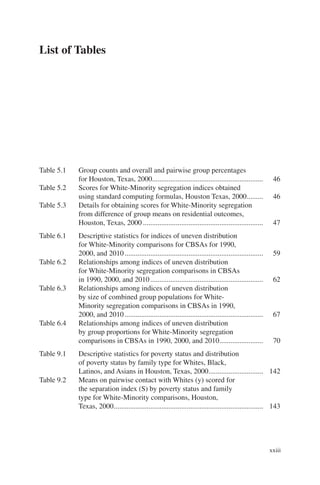
  • 2.
    Here are somerecommended products that we believe you will be interested in. You can click the link to download. New Methods For Measuring And Analyzing Segregation Mark Fossett https://ebookbell.com/product/new-methods-for-measuring-and-analyzing- segregation-mark-fossett-6750826 New Methods For The Analysis Of Change Decade Of Behavior 1st Edition Linda M Collins https://ebookbell.com/product/new-methods-for-the-analysis-of-change- decade-of-behavior-1st-edition-linda-m-collins-2188604 New Methods For Chaotic Dynamics Nikolai Alexandrovich Magnitskii https://ebookbell.com/product/new-methods-for-chaotic-dynamics- nikolai-alexandrovich-magnitskii-979344 Mapping Information Landscapes New Methods For Exploring The Development And Teaching Of Information Literacy Andrew Whitworth https://ebookbell.com/product/mapping-information-landscapes-new- methods-for-exploring-the-development-and-teaching-of-information- literacy-andrew-whitworth-56933572
  • 3.
    Neurosciencebased Cognitive TherapyNew Methods For Assessment Treatment And Selfregulation Tullio Scrimaliauth https://ebookbell.com/product/neurosciencebased-cognitive-therapy-new- methods-for-assessment-treatment-and-selfregulation-tullio- scrimaliauth-4308896 Business Planning For Turbulent Times New Methods For Applying Scenarios Illustrated Edition Rafael Ramrez https://ebookbell.com/product/business-planning-for-turbulent-times- new-methods-for-applying-scenarios-illustrated-edition-rafael- ramrez-1395006 Annies Crochet New Methods For Crochet Socks Annies Rohn Strong https://ebookbell.com/product/annies-crochet-new-methods-for-crochet- socks-annies-rohn-strong-46310664 Neurosciencebased Cognitive Therapy New Methods For Assessment Treatment And Selfregulation 1st Edition Tullio Scrimali https://ebookbell.com/product/neurosciencebased-cognitive-therapy-new- methods-for-assessment-treatment-and-selfregulation-1st-edition- tullio-scrimali-4575594 Shaping The Next One Hundred Years New Methods For Quantitative Longterm Policy Analysis 186th Steven C Bankes https://ebookbell.com/product/shaping-the-next-one-hundred-years-new- methods-for-quantitative-longterm-policy-analysis-186th-steven-c- bankes-2215474
  • 5.
    The Springer Serieson Demographic Methods and Population Analysis 42 New Methods for Measuring and Analyzing Segregation Mark Fossett
  • 6.
    The Springer Serieson Demographic Methods and Population Analysis Volume 42 Series Editor Kenneth C. Land, Duke University
  • 7.
    In recent decades,there has been a rapid development of demographic models and methods and an explosive growth in the range of applications of population analy- sis. This series seeks to provide a publication outlet both for high-quality textual and expository books on modern techniques of demographic analysis and for works that present exemplary applications of such techniques to various aspects of popula- tion analysis. Topics appropriate for the series include: • General demographic methods • Techniques of standardization • Life table models and methods • Multistate and multiregional life tables, analyses and projections • Demographic aspects of biostatistics and epidemiology • Stable population theory and its extensions • Methods of indirect estimation • Stochastic population models • Event history analysis, duration analysis, and hazard regression models • Demographic projection methods and population forecasts • Techniques of applied demographic analysis, regional and local population • estimates and projections • Methods of estimation and projection for business and health care applications • Methods and estimates for unique populations such as schools and students Volumes in the series are of interest to researchers, professionals, and students in demography, sociology, economics, statistics, geography and regional science, pub- lic health and health care management, epidemiology, biostatistics, actuarial sci- ence, business, and related fields. More information about this series at http://www.springer.com/series/6449
  • 8.
    Mark Fossett New Methodsfor Measuring and Analyzing Segregation
  • 9.
    ISSN 1389-6784     ISSN 2215-1990(electronic) The Springer Series on Demographic Methods and Population Analysis ISBN 978-3-319-41302-0    ISBN 978-3-319-41304-4 (eBook) DOI 10.1007/978-3-319-41304-4 Library of Congress Control Number: 2017930612 © The Editor(s) (if applicable) and the Author(s) 2017. This book is an open access publication. Open Access This book is licensed under the terms of the Creative Commons Attribution-­ NonCommercial 2.5 International License (http://creativecommons.org/licenses/by-nc/2.5/), which permits any noncommercial use, sharing, adaptation, distribution and reproduction in any medium or format, as long as you give appropriate credit to the original author(s) and the source, provide a link to the Creative Commons license and indicate if changes were made. The images or other third party material in this book are included in the book’s Creative Commons license, unless indicated otherwise in a credit line to the material. If material is not included in the book’s Creative Commons license and your intended use is not permitted by statutory regulation or exceeds the permitted use, you will need to obtain permission directly from the copyright holder. This work is subject to copyright. All commercial rights are solely and exclusively licensed by the Publisher, whether the whole or part of the material is concerned, specifically the rights of translation, reprinting, reuse of illustrations, recitation, broadcasting, reproduction on micro-films or in any other physical way, and transmission or information storage and retrieval, electronic adaptation, computer software, or by similar or dissimilar methodology now known or hereafter developed. The use of general descriptive names, registered names, trademarks, service marks, etc. in this publication does not imply, even in the absence of a specific statement, that such names are exempt from the relevant protective laws and regulations and therefore free for general use. The publisher, the authors and the editors are safe to assume that the advice and information in this book are believed to be true and accurate at the date of publication. Neither the publisher nor the authors or the editors give a warranty, express or implied, with respect to the material contained herein or for any errors or omissions that may have been made. Printed on acid-free paper This Springer imprint is published by Springer Nature The registered company is Springer International Publishing AG The registered company address is: Gewerbestrasse 11, 6330 Cham, Switzerland Mark Fossett Department of Sociology Texas A&M University College Station, TX, USA
  • 10.
    v Abstract In this monograph,I place indices used to measure the uneven distribution dimen- sion of residential segregation in a new framework; I cast them as simple differ- ences of group means on individual-level residential outcomes scored from area racial composition. The “difference-of-group-means” framework places all popular indices in a common measurement framework in which index scores are additively determined by individual residential attainments. This yields new and appealing options regarding substantive interpretations of the scores of segregation indices. It also brings important methodological benefits by creating the new possibility of joining the investigation of aggregate segregation and the investigation of ­ individual-level residential attainments together in a single analysis. Specifically, segregation index scores now can be equated with the effect of group membership (e.g., race) on individual residential attainments, and thus variation in segregation over time and across cities can be equated to the ways that the effect of group mem- bership varies over time and with city characteristics in multilevel models of ­ individual residential attainments. Framing segregation indices in the difference-of-­ group-means framework has several other desirable consequences for segregation analysis. It creates opportunities to investigate segregation in new ways by permit- ting researchers to assess the impact of group membership on residential outcomes in the context of multivariate attainment models that if desired can include controls for other individual characteristics (e.g., language, education, income). Relatedly, it suggests a new basis on which to evaluate and compare segregation indices – whether the individual-level residential outcomes they register and reflect are rele- vant for theories of residential dynamics and/or are relevant for concerns about racial differences in socioeconomic attainments and life chances. Finally, the difference-­ of-group-means framework paves the way for developing refined ver- sions of indices that are free of potentially problematic upward bias intrinsic to standard formulations of these indices. Significantly, adopting the new framework outlined here does not require breaking with previous conceptions of segregation; results of empirical analyses of segregation using traditional computing formulas can be exactly replicated within this framework even as several new options for measurement and analysis become available.
  • 11.
    vii Preface In this monograph,I review findings and observations I have accumulated while grappling with issues in segregation measurement over the past decade. My explo- rations in this area were motivated by three concerns. The first was that, while it is obvious to all concerned that residential segregation can potentially have important consequences for group differences in residential outcomes, the literature on segre- gation measurement does not provide formulations of segregation indices that make it clear exactly what implications index scores have for group differences in residen- tial outcomes. In this regard, the measurement and analysis of segregation is on a different conceptual footing from standard approaches to measuring and analyzing intergroup disparity and inequality on other socioeconomic and stratification out- comes such as education, occupation, and income. Researchers investigating dis- parities in these other areas routinely assess inequality and disparities based on comparisons of group means on individual-level outcomes. Consequently, the con- nections between scores of measures of aggregate inequality have clear and direct implications for group differences in the attainments of individuals. In contrast, the literature on segregation measurement has not established how segregation index scores are connected to group differences on residential outcomes for individuals. This is surprising and unfortunate because the substantive relevance of segregation indices ultimately rests on the presumption that their scores carry important impli- cations for group differences on individual residential outcomes and yet these impli- cations have remained obscure. I address this concern here by introducing new formulations of popular segregation indices that place them in an overarching “difference-­ of-group-means” framework that clarifies exactly how segregation index scores are connected to group differences in individual-level residential outcomes. The second concern motivating me was that the literature on segregation mea- surement and analysis did not provide a straightforward means for directly linking quantitative findings from studies of micro-level processes of residential attainment to findings for segregation index scores at the aggregate level (e.g., city-level segre- gation scores). As a result, the research literature has been divided into two impor- tant but largely disconnected traditions. One is a tradition of macro-level studies
  • 12.
    viii that use aggregate-levelindex scores for cities to investigate how segregation varies across cities and over time; the other is a tradition of micro-level studies that exam- ine how various individual-level residential attainments are related to social and economic characteristics of individuals and households such as income, education, nativity, English language ability, family type, and other related individual-level variables. The current state of the literature leaves researchers in both traditions in the frustrating situation of being unable to directly connect segregation index scores at the aggregate-level to the individual-level outcomes that are examined and mod- eled in micro-level residential attainment analyses. I address this concern here by drawing on the difference-of-group-means measurement framework to develop methods for linking index scores to individual-level residential attainment pro- cesses. In this new approach, segregation index scores now can be interpreted as the effect of group membership (e.g., race) on segregation-determining residential out- comes in an individual-level attainment model. The level of segregation in a city thus can now be assessed by estimating the effect of group membership on individual-­ level residential attainment in bivariate attainment model. More impor- tantly, the model can be extended to a multivariate specification to properly take account of the role that nonracial characteristics (e.g., income) may play in shaping the level of segregation in a city. And the model can be further extended to multi- level specifications to take account of how city-level factors impact segregation net of the role of nonracial individual characteristics. Significantly, past findings of aggregate-level analyses can be exactly replicated and subsumed under this approach while giving researchers many new options for analysis. The third concern motivating me was that, under the current state of segregation measurement, many interesting and important research questions cannot be addressed because segregation index scores exhibit problematic behavior under a wide range of commonly occurring conditions. In particular, all indices of uneven distribution are subject to inherent positive bias that can render their scores untrust- worthy and potentially misleading in a variety of situations – for example, when segregation is measured at small spatial scales (e.g., at the block level) or when the groups involved in the segregation comparison are small and/or are imbalanced in size. This presents severe obstacles to many interesting and important lines of inquiry in segregation research. For example, it precludes quantitative study of seg- regation for newly arriving immigrant and migrant groups because, by definition, the groups initially are small in both absolute size and relative size in comparison to established population groups. Similarly, it precludes study of segregation among narrowly defined subgroups with a population (e.g., foreign- and native-born Latinos, high-income Whites and Blacks, etc.) because one or both subgroups often are small in absolute and/or relative size.Additionally, it potentially frustrates inves- tigation of segregation dynamics using agent simulation models because studies in this tradition routinely examine segregation at small spatial scales. The impact of these concerns on segregation research is substantial, pervasive, and hard to overstate. It has led researchers to routinely adopt two “defensive” prac- tices. One practice is to use various ad hoc guidelines to “screen” cases to avoid measuring segregation in situations where index scores cannot be trusted. The other Preface
  • 13.
    ix practice is todifferentially weight cases to minimize the undesirable impact of bias on index scores even after cases have been “screened” to eliminate those where index scores are most problematic. The first practice prevents researchers from undertaking many studies that otherwise would be conducted and thus sharply restricts the scope of segregation studies. In addition, it draws on ad hoc guidelines that at best are crude and at worst have uncertain effectiveness. The second practice of differentially weighting cases is predicated on the implicit recognition that the first practice of screening cases cannot adequately deal with the problem of bias. Unfortunately, differential weighting of cases is itself inadequate. First and fore- most, it leaves index scores untrustworthy on a case-by-case basis and so one cannot discuss and compare cases – otherwise weighting would be unnecessary. Second, while the strategy permits researchers to avoid “draconian” screening of cases and thus larger nominal sample sizes, differential weighting in the end amounts to assessing segregation patterns and trends based on the small subset of cases that get large weights. I address this unsatisfying state of affairs by developing and introducing refined versions of popular segregation indices that provide trustworthy measurements of segregation over a much broader range of situations than standard measures. I dem- onstrate that the resulting unbiased measures have attractive properties and provide researchers the previously unavailable option of dealing with index bias directly at the point of measurement on a case-by-case basis. As I worked to address the three concerns just mentioned, I increasingly took interest in a fourth concern – the question of whether different segregation indices yielded similar or different results and, if different, under what conditions and why. Conventional wisdom in the segregation measurement literature has been that the most widely used measures of uneven distribution tend to give similar results. But I found discrepancies between indices were common when I measured segregation over broader samples of cases and group comparisons. At first I thought the large discrepancies between scores of different indices might be a by-product of the prob- lem of index bias. After all, using broader samples tends to include cases that are more susceptible to being adversely affected by the problem of bias, and previous methodological studies had reported that indices vary in susceptibility to scores being inflated by index bias. But on investigating the issue further, I found that the role of bias was only a minor part of the story as discrepancies between scores for different indices persisted even when using refined versions of the indices that were free of the influence of bias. The difference-of-group-means framework provided a useful perspective for exploring this issue and led me to recognize that the discrepant scores I observed reflected an aspect of uneven distribution that is not generally widely appreciated, namely, index sensitivity, or lack thereof, to whether displacement from even distri- bution is concentrated or dispersed. My goal in exploring this issue was different in nature from my goals in addressing the first three concerns I noted. In this case, I was not seeking to make progress toward solving technical problems in measuring and analyzing segregation. Instead, my goal was to clarify the nature of the differ- ences between indices to better account for why different indices sometimes yield Preface
  • 14.
    x ­ different results. Inthe end, I concluded the issue could be framed succinctly in terms of index sensitivity to whether group displacement from even distribution is concentrated and dispersed. At any given nontrivial level of group displacement from even distribution, groups can be concentrated in a way that produces homoge- neous areas for both groups, or groups can be dispersed in a way that minimizes homogeneous areas. Indices vary in their sensitivity to this aspect of uneven distri- bution. For example, the widely used index of dissimilarity (D) takes the same value regardless of whether displacement is concentrated or dispersed, while the separa- tion index (S) takes higher values when displacement is concentrated and takes low values when displacement is widely dispersed. I am hardly the first to recognize the technical basis for this potential difference between indices. But I believe my discussion and review of these issues makes use- ful new contributions to the literature on segregation measurement. First off, the analyses I report here document that important discrepancies between different index scores are much more common than previous methodological studies have suggested. Second, the difference-of-means framework for measuring segregation I introduce here provides a new basis for understanding exactly how different indices can yield discrepant index scores. Finally, I offer analytic exercises and empirical case studies to further clarify the basis of differences between indices and dispel certain misconceptions regarding of these issues. My hope is that this monograph will contribute to a better understanding of the issues examined here and also will provide useful practical strategies for measuring and analyzing segregation. Looking back on the decade of work reflected here, I can see with hindsight that the core issues are closely interconnected. Establishing how segregation index scores related to group differences in residential outcomes was a necessary step for developing methods for conducting micro-level analysis of individual-­ level residential attainments that could directly account for overall segre- gation in a city at the aggregate level. Discovering that the residential attainments in question were rooted in a simple construct – the pairwise group proportions in the area of residence – then paved the way for a further discovery, namely, that trouble- some problem of index bias could be eliminated by making surprisingly simple refinements in the calculation of pairwise group proportions. Thinking more care- fully about the individual-level residential outcomes that are registered by different indices led to a better understanding of the differences between concentrated and dispersed displacement from even distribution. The interconnections among the issues are clearer in hindsight. If I had recog- nized them from the start, I would have avoided muddling around for so long. I offer my findings and observations on these and related matters here in hopes that others will find them useful. I apologize in advance for the many limitations of this study but also suggest that it occasionally offers original insights and new options for segregation measurement and analysis that I hope can help other researchers move the study of segregation forward. Many organizations and many people have provided support and encouragement that helped make my work possible. Over the past decade, I was fortunate to receive funding support for projects that helped me develop findings and observations Preface
  • 15.
    xi included in thismonograph. They included National Institutes of Health research grants R43HD038199 and R44HD038199 “Simulating Residential Segregation Dynamics: Phases I & II”; a proposal development grant from the MexicanAmerican and Latino Research Center at TexasA&M University, College Station; and National Science Foundation research grant SES 1024390 “New Methods for Segregation Research.” Of course the funding agencies are not responsible for and do not neces- sarily endorse the findings and conclusions I offer. Finally, I also acknowledge a faculty development leave from Texas A&M University that was crucial for com- pleting the first full draft of the monograph. I also thank the College of Liberal Arts and the Open Access to Knowledge (OAK) program at Texas A&M University which have provided generous funding to help publish this monograph as an open access work. I have always received encouragement and support from my colleagues and good friends in the Sociology Department at Texas A&M University. In particular, I must mention Jane Sell, Dudley Poston, and Rogelio Saenz to offer special thanks for their support over this period of extended effort. I thank Wenquan “Charles” Zhang for engaging me in many stimulating and productive discussions on the issues addressed in this study and for collaborating with me as co-investigator on the aforementioned NSF project and associated empirical analyses that draw on the new measures and methods introduced in this work. Warner Henson III, currently a doc- toral student in the Sociology Department at Stanford University, deserves special acknowledgment for helping me establish the difference-of-means formulation of the Theil index while an undergraduate major in sociology here at Texas A&M University. I also must thank Amber Fox Crowell, at the time a doctoral student in sociology at Texas A&M University and now an assistant professor at California State University-Fresno, who served as research assistant on research projects in which the measures and methods introduced here were developed and refined. Her insights, questions, and suggestions have been extremely helpful. She has a deep grasp of the potential value the measures and methods can bring to empirical analy- ses and has applied them with great success in her dissertation project and her proj- ects as a postdoctoral researcher. I also offer a note of appreciation to the many students who have attended informal workshops on segregation measurement and analysis on a regular basis over the past several years including, in rough chrono- logical order, Warren Waren, Lindsay Howden,Amber Fox Crowell, GabrielAmaro, Bianca Manago, Jennifer Davis, Jessica Barron, Nicole Jones, Bo Hee Yoon, Brittany Rico, Melissa Sanchez, Chiying Huang, Xuanren Wang, Katelyn Polk, Bridget Clark, Danielle Deng, Nathanael Rosenheim, Cassidy Castiglione, and Xinyuan Zou. Their questions, puzzlements, and suggestions helped me develop better ways of explaining and thinking about some of the material presented here. As ever throughout my career, I benefit from the voice of my dissertation supervi- sor, mentor, and friend, Omer Galle, which always present in the back of my mind encouraging me and challenging me. I also must acknowledge the amazing support Ms. Evelien Bakker and Ms. Bernadette Deelen-Mans with Springer have given during the process of bringing this monograph to completion. Apparently, it is impossible to exhaust their patience Preface
  • 16.
    xii and goodwill. Theyhave been encouraging, helpful, and pleasant at every step in the process. For that I am truly grateful. I close by thanking my wife, Betsy, and our children Kate, Tyler, and Lane for their support and patience. They have brought, and continue to bring, great joy to my life. They have kept me grounded through the ups and downs of the too-long gestation period for this monograph. I love them more than they know and appreci- ate that they put up with me and indulge my passion for the study of social inequal- ity and segregation. College Station, TX, USA Mark Fossett December 2015 July 2017 Preface
  • 17.
    xiii Contents 1 Introduction and Goals............................................................................1 References.................................................................................................. 10 2 Alternative Formulas for Selected Indices............................................. 11 References.................................................................................................. 16 3 Overview of the “Difference of Means” Framework............................ 19 3.1 Index Formulas: The Current State of Affairs................................ 19 3.2 The Difference of Means Formulation – The General Approach......................................................................................... 22 3.3 Additional Preliminary Remarks on Implementation..................... 24 References.................................................................................................. 25 4 Difference of Means Formulations for Selected Indices....................... 27 4.1 Scoring Residential Outcomes (y) for the Delta or Dissimilarity Index (D).............................................................. 27 4.2 Scoring Residential Outcomes (y) for the Gini Index (G).............. 31 4.3 The Delta or Dissimilarity Index (D) as a Crude Version of G...... 32 4.4 Scoring Residential Outcomes (y) for the Separation Index (S).... 33 4.5 A Side Comment on the Separation Index (S) and Uneven Distribution..................................................................................... 36 4.6 Scoring Residential Outcomes (y) for the Theil Index (H)............ 39 4.7 Scoring Residential Outcomes (y) for the Hutchens Square Root Index (R).................................................................... 40 References.................................................................................................. 43 5 Index Differences in Registering Area Group Proportions.................. 45 5.1 Segregation as Group Differences in Individual Residential Attainments..................................................................................... 46 5.2 Implications for Sensitivity to Separation and Polarization........... 52 References.................................................................................................. 56
  • 18.
    xiv 6 Empirical Relationships AmongIndices................................................ 57 6.1 When Do Indices Agree? When Can They Disagree?.................... 61 6.2 Why Does Relative Group Size Matter?......................................... 71 References.................................................................................................. 75 7 Distinctions Between Displacement and Separation............................. 77 7.1 The Increasing Practical Importance of the Distinction Between Displacement and Separation.......................................... 79 7.2 Prototypical Segregation and Concentrated Versus Dispersed Displacement...................................................... 81 7.2.1 Prototypical Segregation................................................... 82 7.3 Clarifying the Logical Potential for D-S Concordance and Discordance – Analysis of Exchanges..................................... 86 7.3.1 Overview of D-S Differences in Responding to Integration-­ Promoting Exchanges................................ 88 7.3.2 Examples of D-S Differences in Responding to Integration-­ Promoting Exchanges................................ 90 7.3.3 Implications of Analysis of Example Exchanges............. 95 7.4 Clarifying the Potential for D-S Concordance and Discordance – Analytic Models...................................................... 97 7.4.1 Examples of Calculating Values of SMin Given Values of D and P............................................................. 100 7.4.2 Examining D, SMax, and SMin over Varying Combinations of D and P.................................................. 105 7.4.3 Implications of Findings from Analytic Models for SMax and SMin................................................... 108 7.5 Is Separation a Distinct Dimension of Segregation?...................... 108 References.................................................................................................. 115 8 Further Comments on Differences Between Displacement and Separation......................................................................................... 117 8.1 Revisiting the Empirical Relationships of Displacement (D) and Separation (S)......................................... 118 8.2 Scenarios for How D and S Discrepancies Can Arise.................... 122 8.3 A Practical Issue When Comparing D and S – Size of Spatial Units............................................................................... 127 8.3.1 A Case Study of White-Black Segregation Cullman County Alabama................................................. 130 8.3.2 A Case Study of White-Minority Segregation in Palacios TX................................................................... 132 8.3.3 Reiterating the Importance of Using “Right-Sized” Spatial Units.............................................. 133 8.3.4 More Practical Guidance for Using S............................... 135 8.4 A Simple Index of Polarization...................................................... 136 References.................................................................................................. 137 Contents
  • 19.
    xv 9 Unifying Micro-level andMacro-level Analyses of Segregation.......... 139 9.1 New Ways to Work with Detailed Summary File Tabulations........ 141 9.2 Some Preliminaries......................................................................... 142 9.3 Substantive Findings....................................................................... 146 9.4 Opportunities to Perform Standardization and Components Analysis............................................................... 148 9.5 Comparison with Previous Approaches to “Taking Account” of Non-­ racial Social Characteristics............................... 150 9.6 Aggregate-Level Controls for Micro-level Determinants of Residential Outcomes................................................................. 152 9.7 New Interpretations of Index Scores Based on Bivariate Regression Analysis........................................................................ 156 9.8 Multivariate Segregation Attainment Analysis (SAA).................... 161 9.9 Unifying Aggregate Segregation Studies and Studies of Individual-­ Level Residential Attainment.................................... 170 9.10 New Possibilities for Investigating Segregation Using Restricted Data................................................................................ 172 9.11 An Example Analysis Using Restricted Microdata........................ 174 References.................................................................................................. 178 10 New Options for Investigating Macro-level Variation in Segregation........................................................................................... 181 10.1 New Specifications for Conducting Comparative and/or Trend Analyses of Segregation............................................ 181 References.................................................................................................. 189 11 Aspatial and Spatial Applications of Indices of Uneven Distribution............................................................................................... 191 References.................................................................................................. 193 12 Relevance of Individual-Level Residential Outcomes for Describing Segregation...................................................................... 195 12.1 An Example Analysis of Segregation and Exposure to Neighborhood Poverty................................................................ 202 13 Relevance of Individual-Level Residential Outcomes for Segregation Theory............................................................................ 207 References.................................................................................................. 209 14 Index Bias and Current Practices.......................................................... 211 14.1 Overview of the Issue of Index Bias............................................... 214 14.1.1 Effective Neighborhood Size (ENS): A Further Complication..................................................................... 218 14.1.2 The Practical Relevance of Variation in Effective Neighborhood Size........................................................... 220 14.1.3 Random Distribution Is a Valid, Useful, and Conceptually Desirable Reference Point................... 221 Contents
  • 20.
    xvi 14.2 Prevailing Practices forAvoiding Complications Associated with Index Bias............................................................................... 222 14.2.1 Unwelcome Consequences of Prevailing Practices.......... 223 14.2.2 Efficacy of Prevailing Practices: Screening Cases on Minority Population Size................................... 227 14.2.3 Efficacy of Prevailing Practices: Weighting Cases by Minority Population Size................................... 229 14.2.4 An Aside on Weighting Cases by Minority Population Size................................................................. 230 14.2.5 Summing Up Comments on Prevailing Practices............. 232 14.3 Limitations of Previous Approaches for Dealing Directly with Index Bias............................................................................... 232 14.4 Summary......................................................................................... 234 References.................................................................................................. 235 15 New Options for Understanding and Dealing with Index Bias............ 237 15.1 The Source of the Initial Insight..................................................... 239 15.2 Building on the Initial Insight......................................................... 242 15.3 A More Detailed Exposition of Bias in the Separation Index........ 243 15.4 Situating This Result and Its Implications in the Difference of Means Framework...................................................................... 246 15.4.1 Expected Distributions of pʹ and yʹ Under Random Assignment....................................................................... 247 15.5 Reviewing a Simple Example in Detail.......................................... 247 15.5.1 Additional Reflections on Results Presented in Tables 15.1 and 15.2..................................................... 253 15.6 Summary......................................................................................... 254 References.................................................................................................. 254 16 Comparing Behavior of Unbiased and Standard Versions of Popular Indices..................................................................... 257 16.1 Documenting the Attractive Behavior of Unbiased Versions of Indices of Uneven Distribution.................................... 263 16.1.1 Summary of Behavior of Unbiased Indices...................... 268 16.2 Documenting Additional Desirable Behavior of Unbiased Indices Based on the Difference of Means Formulation................ 268 16.3 Conceptual and Practical Issues and Potential Impact on Research..................................................................................... 275 References.................................................................................................. 279 17 Final Comments....................................................................................... 281 References.................................................................................................. 284 Contents
  • 21.
    xvii Appendices........................................................................................................ 285 Appendix A:Summary of Notation and Conventions....................................... 285 Pairwise Calculations.................................................................................... 285 Reference and Comparison Groups (Groups 1 and 2).................................. 285 City-Wide Terms for Pairwise Calculations.................................................. 286 Area-Specific Terms for Pairwise Calculations............................................ 286 Terms for Individuals or Households............................................................ 286 Selected Terms and Conventions Relevant for the Gini Index (G)............... 287 Selected Terms and Conventions Relevant for the Theil Entropy Index (H)......................................................................................... 287 Selected Terms and Conventions Relevant for the Atkinson Index (A)....................................................................................................... 287 Appendix B: Formulating Indices of Uneven Distribution as Overall Averages of Individual-Level Residential Outcomes......................................... 288 Focusing Attention on Individual-Level Residential Outcomes................... 289 Summary of Difference of Means Formulations........................................... 292 Appendix C: Establishing the Scaling Functions y = f (p) Needed to Cast the Gini Index (G) and the Dissimilarity Index (D) as Differences of Group Means on Scaled Pairwise Contact.................................................... 293 The General Task.......................................................................................... 294 Introducing the Function y = f (p) for the Gini Index (G)............................ 295 Calculating G as a Difference of Means....................................................... 297 Deriving G as a Difference of Means............................................................ 298 A Brief Demonstration.................................................................................. 299 Getting on with the Derivation...................................................................... 300 The Dissimilarity Index (D) – A Special Case of the Gini Index (G)........... 308 Alternative Graphical Explorations of Relative Rank Position..................... 315 The Nature of the Y-P Relationship for G..................................................... 318 Appendix D: Establishing the Scaling Function y = f (p) Needed to Cast the Separation Index (S) as a Difference of Group Means on Scaled Pairwise Contact................................................................................................ 320 Variance Analysis.......................................................................................... 323 Formulation as a Difference of Means.......................................................... 326 Appendix E: Establishing the Scaling Function y = f (p) Needed to Cast the Theil Entropy Index (H) as a Difference of Group Means on Scaled Pairwise Contact.................................................................... 327 Adjusting the Range to 0–1........................................................................... 329 A Loose End When p = P.............................................................................. 329 Appendix F: Establishing the Scaling Function y = f (p) Needed to Cast the Hutchens’ Square Root Index (R) as a Difference of Group Means on Scaled Pairwise Contact.................................................... 330 Adjusting the Range to 0–1........................................................................... 332 A Loose End When p = P.............................................................................. 332 An Observation............................................................................................. 333 References.......................................................................................................... 333 Contents
  • 22.
    xix List of Figures Fig.2.1 Examples of selected area-based computing formulas for indices of uneven distribution.................................................... 12 Fig. 2.2 Examples of area-based computing formulas for indices of uneven distribution that implicitly feature overall averages on individual-level residential outcomes.......................... 14 Fig. 2.3 Formulas explicitly casting values of indices of uneven distribution as overall population averages on individual residential outcomes (y).................................................................. 15 Fig. 2.4 Formulas casting values indices of uneven distribution as differences of group means (Y Y 1 2 − ) on individual residential outcomes (y).................................................................. 16 Fig. 5.1 Scoring residential outcomes (y) from pairwise proportion white (p) to compute G, D, R, H, and S as a difference of means.................................................................. 48 Fig. 6.1 Suggested schemas for placing index scores within broad groupings for levels of segregation....................................... 59 Fig. 6.2 Scatterplots depicting relationships among indices of uneven distribution for White-Minority segregation comparisons in CBSAs in 1990, 2000, and 2010 – full analysis sample......................................................................... 63 Fig. 6.3 Scatterplots depicting relationships of H and S with G, D, and R for White-­ Minority segregation comparisons in CBSAs in 1990, 2000, and 2010 – full analysis sample............. 65 Fig. 6.4 Scatterplots depicting relationships among indices of uneven distribution for White-Minority comparisons in 1990, 2000, and 2010 – subset of CBSAs with Minority Proportion ≥0.30...................................................... 69 Fig. 6.5 Scoring y f p = ( ) for computing Theil’s H as a difference of group means on scaled contact................................................... 72
  • 23.
    xx Fig. 6.6 Scoringy f p = ( ) for computing Hutchens’ R as a difference of group means on scaled contact.................................. 73 Fig. 6.7 Scatterplots depicting relationships of D with H and S for White-Minority comparisons for CBSAs in 1990, 2000, 2010................................................................................... 74 Fig. 7.1 Possible combinations of high and low values on displacement (D) and separation (S)............................................... 85 Fig. 7.2 Impacts of selected integration-promoting exchanges on the value of the separation index (S) and the dissimilarity index (D).................................................................... 91 Fig. 7.3 Summary of formulas for group residential distributions by level of dissimilarity (D) and racial composition (P) under selected algorithms for producing concentrated and dispersed displacement from even distribution........................ 101 Fig. 7.4 Maximum and minimum values of the separation index (S) by values of the dissimilarity index (D) for selected values of city percent White (P) under a three-­ area analytic model............................................................. 106 Fig. 7.5 Maximum and minimum values of the dissimilarity index (D) by values of the separation index (S) for selected values of city percent White (P) under a three-­ area analytic model............................................................. 107 Fig. 8.1 Separation index (S) by dissimilarity index (D) for White-Minority segregation comparisons computed using block-level data for CBSAs in 1990, 2000, and 2010........... 118 Fig. 8.2 Dissimilarity Index (D) by separation Index (S) for White-Minority segregation comparisons computed using block-Level data for CBSAs in 1990, 2000, and 2010.......................................................................................... 119 Fig. 8.3 Guidelines for identifying prototypical segregation based on concordant scores for dissimilarity (D) and separation (S) when displacement from even distribution is substantially concentrated........................................ 120 Fig. 8.4 Guidelines for assessing concordance-discordance of dissimilarity (D) and separation (S)............................................ 121 Fig. 8.5 General guidelines for group population thresholds needed to assess displacement and group separation and area racial polarization............................................................. 135 Fig. 12.1 Response of group contact (y) scored for Hutchens R by proportion White in area (p) and selected values for city proportion White (P)........................................................... 198 Fig. 12.2 Response of group contact (y) scored for Theil’s H by proportion White in area (p) and selected values for city proportion White (P)........................................................... 202 List of Figures
  • 24.
    xxi Fig. 16.1 Scoresfor “Standard” versions of indices of uneven distribution under random assignment by city percent White and neighborhood size.......................................................... 261 Fig. 16.2 Scores for unbiased versions of indices of uneven distribution under random assignment by percent White and neighborhood size.................................................................... 265 Fig. 16.3 Illustration of the transition from the initial state of minority-minority integration and high majority- minority segregation to the end state of all-way integration (Random distribution)................................................... 270 Fig. 16.4 Box plots depicting distributions of scores for unbiased and standard delta Index (D′ and D) for majority- minority segregation and minority-­ minority segregation over ten simulation cycles............................................................... 271 Fig. 16.5 Scores for unbiased and standard delta index (D′ and D) for minority-­ minority segregation over time for three combinations of ethnic mix............................................................. 273 List of Figures
  • 25.
    xxiii List of Tables Table5.1 Group counts and overall and pairwise group percentages for Houston, Texas, 2000.............................................................. 46 Table 5.2 Scores for White-Minority segregation indices obtained using standard computing formulas, Houston Texas, 2000.......... 46 Table 5.3 Details for obtaining scores for White-Minority segregation from difference of group means on residential outcomes, Houston, Texas, 2000................................................................... 47 Table 6.1 Descriptive statistics for indices of uneven distribution for White-Minority comparisons for CBSAs for 1990, 2000, and 2010............................................................................. 59 Table 6.2 Relationships among indices of uneven distribution for White-Minority segregation comparisons in CBSAs in 1990, 2000, and 2010............................................................... 62 Table 6.3 Relationships among indices of uneven distribution by size of combined group populations for White- Minority segregation comparisons in CBSAs in 1990, 2000, and 2010............................................................................. 67 Table 6.4 Relationships among indices of uneven distribution by group proportions for White-Minority segregation comparisons in CBSAs in 1990, 2000, and 2010......................... 70 Table 9.1 Descriptive statistics for poverty status and distribution of poverty status by family type for Whites, Black, Latinos, and Asians in Houston, Texas, 2000............................... 142 Table 9.2 Means on pairwise contact with Whites (y) scored for the separation index (S) by poverty status and family type for White-Minority comparisons, Houston, Texas, 2000................................................................................... 143
  • 26.
    xxiv Table 9.3 Meanson scaled pairwise contact with Whites (y) scored for the dissimilarity index (D) by poverty status and family type for White-minority comparisons, Houston, Texas, 2000............................................. 144 Table 9.4 Observed and standardized White-Minority segregation comparisons, Houston, Texas, 2000............................................. 149 Table 9.5 Bivariate segregation attainment regressions predicting residential outcomes (y) that additively determine White-Minority segregation for selected indices, Houston, Texas, 2000................................................................... 157 Table 9.6 Group-specific attainment regressions for White-Black segregation.............................................................. 163 Table 9.7 Group-specific attainment regressions for White-Latino segregation............................................................. 164 Table 9.8 Group-specific attainment regressions for White-Asian segregation.............................................................. 165 Table 9.9 Coefficients from fractional regressions predicting residential outcomes (y) determining the separation index (S) for White-Latino segregation in Houston, Texas in 2000 and 2010............................................ 175 Table 9.10 Standardization analyses for White-Latino differences in residential outcomes (y) determining the separation index (S)....................................................................................... 176 Table 10.1 Regression results illustrating that effects in city-level analyses of segregation and contact can be obtained using individual-level, contextual regressions predicting group differences in contact......................................................... 184 Table 10.2 Analyses illustrating how city-level analyses of segregation can be conducted using individual-level, contextual regressions that control non-­ racial characteristics........................ 186 Table 10.3 Analyses illustrating how city-level analyses of segregation can yield misleading results when aggregate measures are used to control for group differences on non-racial characteristics...................................... 187 Table 15.1 Calculations to obtain values of D and S for White-Black segregation from differences of group means on residential outcomes (y) based on contact with Whites for area population and among neighbors under random distribution............................................................ 248 Table 15.2 Calculations to obtain values of R and H for White-Black segregation from differences of group means on residential outcomes based on contact with Whites for area population and among neighbors under random distribution......................... 249 List of Tables
  • 27.
    xxv Table 16.1 Meansfor standard versions of popular indices of uneven distribution computed for random residential distributions under varying combinations of relative group size (P) and neighborhood size..................................................... 259 Table 16.2 Standard deviations for standard versions of popular indices of uneven distribution computed for random residential distributions under varying combinations of relative group size (P) and neighborhood size......................... 260 Table 16.3 Means for unbiased versions of popular indices of uneven distribution computed for random residential distributions under varying combinations of relative group size (P) and neighborhood size..................................................... 264 Table 16.4 Standard deviations for unbiased versions of popular indices of uneven distribution computed for random residential distributions under varying combinations of relative group size (P) and neighborhood size......................... 264 List of Tables
  • 28.
    1 © The Author(s)2017 M. Fossett, New Methods for Measuring and Analyzing Segregation, The Springer Series on Demographic Methods and Population Analysis 42, DOI 10.1007/978-3-319-41304-4_1 Chapter 1 Introduction and Goals The literature on residential segregation is one of the oldest empirical research tra- ditions in sociology and has long been a core topic in the study of social stratifica- tion and inequality as well as in the study of the demography of spatial population distribution. This literature is guided by the fundamental assumption that group differences in neighborhood residential outcomes are closely associated with social position and life chances. Accordingly, indices measuring segregation, especially the dimension of uneven distribution, are viewed as important summary indicators of overall group standing and scores for segregation indices have been a mainstay of research documenting levels, patterns, and trends in the residential segregation of racial and ethnic groups. Given the extensive attention social scientists have directed to the study of residential segregation, one might assume that the relation- ship between residential segregation and group differences in neighborhood resi- dential outcomes is well understood. Surprisingly, this is not the case. The issue has received little attention in the literature on segregation measurement. Consequently, researchers are not able to offer precise conclusions about group differences in resi- dential outcomes based on scores for popular and widely used indices of uneven distribution. In this monograph I address this deficiency in the literature by outlining a new approach to measuring uneven distribution. My goal is not to replace familiar, widely-used indices with new ones. Instead, I wish to place popular indices in a new alternative framework that clarifies the implications they carry for group differences in individual-level residential outcomes. My motivation for doing this rests on two convictions. One is that understanding how segregation is related to individual resi- dential outcomes is desirable for its own sake and brings valuable new options for interpreting segregation index scores and understanding differences between them. The other is that casting segregation indices in terms of group differences in indi- vidual residential outcomes brings benefits for segregation measurement and analy- sis including, as two primary examples, the ability to directly link segregation at the aggregate or macro level to micro-level processes of residential attainment and the
  • 29.
    2 ability to developversions of the indices that are free of the troublesome problem of inherent upward bias. Moving from generalities to specifics, my goal in this monograph is to set forth the “difference of means” framework, a new framework for segregation measure- ment wherein popular indices of uneven distribution are cast as simple differences of group means on residential outcomes that register group contact and exposure based on area racial composition. In accomplishing this goal I establish that all widely used segregation indices including the Gini Index (G), the Delta or Dissimilarity Index (D), the Hutchens Square Root Index (R) – an index with close similarities to the Atkinson Index (A), the Theil Entropy Index (H), and the Separation Index (S) – also known as the variance ratio and a variety of other names, can be expressed as a difference of group means on individual- or household-level residential outcomes (y) that are scored on the basis of index-specific scaling of group contact based on area group proportions. The indices just listed are all well-known and all have been reviewed in detail in many previous methodological studies (e.g., Duncan and Duncan 1955; Zoloth 1976; James and Taeuber 1985; Stearns and Logan 1986; White 1986; Massey and Denton 1988; Hutchens 2001, 2004; Reardon and Firebaugh 2002). The contribu- tion I seek to make is to clarify a characteristic of these indices that currently is not well understood; namely, the particular way each one relates to and ultimately quan- titatively registers group differences in neighborhood residential outcomes. The sociological relevance of segregation index scores rests on the presumption that they carry important implications for group differences in social position and life chances that are associated with area of residence. Segregation researchers and con- sumers of segregation research thus generally assume that variation in segregation index scores tends to correlate with variation in a broad range of group disparities associated with neighborhood residential outcomes. It is definitely plausible to assume that summary index scores may serve as prox- ies for valuable, but usually unavailable information about residentially-based group inequality and disparity. But it is important to recognize that, in the final analysis, the calculations that yield segregation index scores revolve around a simple and very particular aspect of neighborhood residential outcomes – “pairwise” group proportions.1 This residential outcome can be understood in multiple ways from the point of view of individuals and households. For example, it can be understood as registering levels of contact or exposure based on co-residence with members of the two groups in the comparison. Alternatively, it can be understood as registering exposure to deviations or departures from the racial composition of the city as a whole. One of my goals is to clarify how different indices register group differences on individual residential outcomes relating to area racial mix and group proportions. 1 The expression “pairwise” ethnic mix or group proportion signifies that the calculations involved use only the population counts for the two groups in the comparison. It can be contrasted with “overall” ethnic mix or group proportion based on the full population including groups not in the segregation comparison. Significantly, the presence and distributions of groups other than the two in the comparison has no bearing on scores for indices of uneven distribution. 1 Introduction and Goals
  • 30.
    3 In doing soI hope to help researchers better understand what indices specifically measure in this regard when they are interpreting index scores and evaluating their relevance as proxies for group position. Indices of uneven distribution provide quantitative summaries of how groups are differentially are distributed across neighborhoods that vary on “pairwise” racial mix. This obviously has direct implications for individual residential outcomes relating to racial mix and indices can be cast in two ways that reflect this fact. One option is to cast indices as simple, overall population averages on individual resi- dential outcomes scored on the basis of area racial mix. I review this option briefly, but I give it limited attention because it not especially novel and it is not useful for my main goals. The second option is to cast indices of uneven distribution as group differences of means on segregation-relevant neighborhood residential outcomes scored from pairwise racial mix. This approach is the primary focus of my attention because it resonates with substantive interests that motivate much of the research on segregation – namely, concerns about group disadvantage and inequality rooted in differential residential distribution. Additionally, the difference of means approach brings several practical advantages for segregation measurement and analysis. I offer the difference of means framework for computing indices of uneven dis- tribution in hopes that it will be a useful alternative to prevailing approaches to computing index scores. However, I stress from the outset that I intend this new framework to be an enhancement of and supplement to traditional approaches to segregation measurement, not a wholesale replacement. The difference of means framework does not yield different values for index scores. Instead, it yields identi- cal index scores but draws on new, mathematically equivalent index formulations to gain new understandings of segregation and new options for measurement, interpre- tation, and analysis. In current practice indices of uneven distribution are formu- lated and interpreted in ways that focus attention on aggregate-level patterns for spatial units (i.e., areas or neighborhoods). The formulas used generally feature calculations that register the extent to which the racial mix of areas (neighborhoods) within a city depart from the racial composition of the city as a whole. These widely used formulas are tried and true and they are useful and convenient for many pur- poses. That said, it also is important to recognize what the most widely used com- puting formulas neglect and obscure. Traditional approaches to measuring uneven distribution do not clarify the how segregation is connected to group differences in neighborhood residential outcomes for individuals. It is obvious that neighborhood departures from city racial composition necessarily carry implications for group differences in residential outcomes. But the specific nature of these implications is not well understood because it is not revealed in prevailing approaches to formulat- ing, computing, and interpreting segregation indices. The “difference of means” framework for calculating and interpreting popular segregation indices I introduce here addresses this gap in the literature on segrega- tion measurement. The framework highlights something that currently is not widely appreciated – that differences between indices can be understood as arising from a single factor, the particular way each index registers segregation-relevant residential outcomes for individuals as scored from area racial composition. On reflection this 1 Introduction and Goals
  • 31.
    4 probably should notbe surprising. All indices are calculated from the same underly- ingdistributionofresidentialoutcomesonpairwiseracialproportions.Consequently, index scores obtained from group differences of means on residential outcomes can differ only by registering these very specific residential outcomes in different ways. These cross-index differences in “scoring” area racial mix provide a new basis for comparing and evaluating indices of uneven distribution. The difference of means formulation of indices of uneven distribution brings additional practical benefits beyond clarifying how index scores are related to group differences in residential outcomes. One example is that the approach makes it pos- sible to join the study of aggregate segregation with the study of individual-level residential attainment in a seamless way. This becomes possible because segrega- tion index scores now can be viewed as arising from the simple additive aggregation of segregation-relevant, neighborhood residential outcomes for individuals. As a result, segregation index scores can be equated with the effect of race in micro-level regression models predicting the residential attainments of individuals and house- holds that additively determine segregation at the aggregate-level.2 These micro-­ level attainment models can be extended to include multiple individual and household characteristics as predictors in the attainment equation. This then enables researchers to assess segregation – now equated to the effect of race on residential attainments – in multivariate specifications that control for non-racial factors (e.g., income, nativity, language ability, etc.) that also may affect the residential attain- ments that ultimately determine segregation. The new ability to model the individual-­ level residential attainments that directly and additively give rise to segregation makes it possible to undertake quantitative standardization and decomposition anal- yses to assess the extent to which group differences on factors other than race con- tribute to overall segregation based on their impact on residential outcomes that determine aggregate segregation. Finally, city-specific, individual-level models of residential attainments can be extended to multi-level specifications that can be used to investigate variation in segregation over time and across cities in new ways that previously were not feasible. The kinds of analysis options just described have been available and used on a routine basis for decades in the broader literature investigating racial differences in most domains of socioeconomic attainment (e.g., education, income, occupation, etc.). Until now, however, they have been not been available in segregation research. The reason for this is that segregation, in contrast to racial inequality in other socio- economic attainments such as education, occupation, and income, has not been explicitly formulated in terms of group differences on individual attainments. Placing indices of uneven distribution in the difference of means framework thus puts segregation analysis on similar conceptual footing with research traditions that analyze other aspects of racial socioeconomic disparity and inequality. 2 Specifically, the segregation index score is equal to the value of the unstandardized regression coefficient for race (coded as 0 or 1) in an individual-level regression predicting residential outcomes. 1 Introduction and Goals
  • 32.
    5 The difference ofmeans formulation of indices of uneven distribution brings other benefits as well. One conceptual benefit is to introduce a new basis for evaluat- ing and choosing among familiar indices; namely, whether and to what degree the individual-level residential outcomes registered by a given index are relevant for theories of segregation dynamics and racial socioeconomic stratification. Another practical benefit is that the approach makes it easy to implement spatial versions of popular segregation indices. Last but not least, the difference of means formulation of segregation indices provides a basis for gaining a better understanding the source of index bias – a well-­ known and vexing problem that can make scores of standard versions of indices of uneven distribution untrustworthy and potentially misleading. This new understand- ing then makes it possible to develop unbiased versions of popular indices based on implementing surprisingly simple refinements to index formulas that eliminate this problematic behavior of index scores. In the chapters that follow I introduce the difference of means formulations of widely used segregation indices and provide more detailed reviews of the new options for measurement, interpretation, and analysis just mentioned. In Chaps. 2, 3, 4, and 5 I introduce the difference of means framework and explore differences between indices as revealed through the lens of this framework. I begin in Chap. 2 by noting that scores of popular indices of uneven distribution can be obtained using a variety of mathematically equivalent formulas and I briefly review selected formu- las to highlight how they support different insights about segregation measurement. I conclude the chapter by introducing the difference of means formulas that are used throughout this monograph. In Chap. 3 I provide a general overview of the differ- ence of means framework. I then expand on this in Chap. 4 by offering a more detailed discussion of how individual measures of uneven distribution can be cast as difference of group means on residential outcomes scored from area racial propor- tions. In Chap. 5 I note a useful insight about uneven distribution that emerges from the difference of means framework; namely, that differences between indices can be seen as arising from a single source – how each index registers individual residential outcomes scored from area group proportions. In Chaps. 6, 7, and 8 I review the logical and empirical differences among popu- lar measures of uneven distribution and offer suggestions regarding how to under- stand and interpret these differences. In Chap. 6 I document that, in contrast to findings reported in some previous methodological studies, popular indices of even distribution can and often do yield highly discrepant scores. The analyses I present here establish that the findings of earlier methodological studies – which reported that popular indices tended to be highly correlated in empirical application – are a byproduct of focusing primarily on White-Minority segregation in a small subset of large metropolitan areas where the minority group is a substantial presence in terms of relative group size and where group residential distributions are characterized by a particular pattern of “prototypical” segregation. This is a pattern of uneven distri- bution in which group displacement from parity involves a high level of group sepa- ration and area racial polarization because both groups are disproportionately concentrated in homogeneous areas. I refer to uneven distribution with this pattern 1 Introduction and Goals
  • 33.
    6 of “concentrated displacement”as “prototypical segregation” because this signature pattern – in which all popular measures of uneven distribution take high scores – is always present in crafted examples used to illustrate high segregation in didactic discussions of segregation measurement. Similarly, it also is invariably present in empirical cases used to illustrate high levels of segregation. So it easy to understand that many would not be aware that popular indices can take substantially discrepant scores. The empirical analyses I present in Chap. 6 document that uneven distribution does not always take the form of prototypical segregation. To the contrary, the anal- yses instead reveal that broader samples of cities include a large number of cases with a sharply contrasting pattern of “dispersed displacement” wherein uneven dis- tribution involves extensive group displacement from parity but does not involve group separation and area racial polarization. In these situations, index scores can be highly discrepant. Specifically, indices that are sensitive to differential displace- ment – such as the gini index (G) and the dissimilarity index (D) which Duncan and Duncan (1955) aptly also termed the displacement index – will take high scores while the Theil index (H) and the separation index (S) – which Stearns and Logan (1986) note is sensitive to residential separation and area racial polarization – will take low scores. In Chap. 7 I review the distinction between concentrated and dispersed displace- ment in more detail. The chapter makes two important points. One is that the socio- logical implications of uneven distribution involving “prototypical segregation” and D-S concordance are fundamentally different from the sociological implications of uneven distribution with dispersed displacement and substantial D-S divergence. Simply put, a high level of group separation is obviously substantively compelling and necessarily entails a high level of displacement. But the reverse is not true. Thus, high levels of displacement do not always entail high levels of group separa- tion and this should be noted when it occurs because the literature on segregation measurement provides no clear basis for viewing differential displacement without group separation as sociologically important. The second point I make in this chap- ter is that the largely unrecognized but empirically common outcome of dispersed displacement is not an artifact of relative group size or deficiencies in indices that are more sensitive to group separation than displacement. To make this point I intro- duce and exercise simple analytic models to show that when non-trivial displace- ment from even distribution is present, it can be concentrated or it can be dispersed. Concentrated displacement produces “prototypical segregation” wherein the score of S will approach or even equal the score for D indicating that displacement involves group separation and area polarization. In the case of dispersed displace- ment, D will be equally high but S will be low signaling that group separation and area polarization are minimal, sometimes to the point of being negligible. I review the principles of transfers and exchanges from segregation measurement theory to establish that D-S discrepancies of this sort arise because D is flawed and does not conform to these accepted principles of segregation measurement. Chapter 8 supplements the analytic results by discussing the sociological dynam- ics that are likely to influence whether non-trivial displacement takes the form of 1 Introduction and Goals
  • 34.
    7 “prototypical segregation” orthe substantively less compelling pattern of dispersed displacement. It also reviews case studies of empirical examples of high-D-high S combinations that in communities where the minority group is small in relative size. The discussion here drives home two important points. One is that scores for D and S can be congruent or discrepant in any setting where displacement from uneven distribution is non-trivial. The other is that sociological dynamics, not artifacts of index construction, determine whether in fact D and S are congruent or discrepant in a given community. In Chap. 9 I show how the difference of means framework creates new options for research by joining micro- and macro-level analysis of segregation. At the sim- plest level, casting segregation as a difference of group means on residential out- comes leads to the new insight that segregation index scores are exactly mathematically equivalent to the effect of race in bivariate regression analyses pre- dicting segregation-determining residential outcomes for individuals. I then argue that this insight opens the door to the new possibility of using multivariate regres- sion analyses to quantitatively assess how segregation arises from two sources. The first source is group differences on distributions of social and economic characteris- tics that are salient in residential attainment processes. The second source is group differences in the efficacy of how inputs to residential attainment processes translate into segregation-determining residential outcomes. In this framework, segregation can be analyzed in greater detail and sophistication by using standardization and decomposition analysis in combination with multivariate regression analysis of attainments, methods that are routinely applied to the study of racial inequality in education, occupation, income, health, and other important stratification outcomes. This is a major advance as research on segregation has lagged behind research on group disparities in other domains where aggregate-level outcomes on group dis- parities have long been routinely analyzed as outgrowths of micro-level attainment processes. In Chap. 10 I show how the regression analysis of individual-level residential attainments can subsume comparative analysis of cross-city variation in segregation and create new possibilities for investigating the factors contributing to variation in segregation across cities and over time. The new approach involves extending city-­ specific analysis of segregation using bivariate and multivariate models of individual-­ level residential attainment to multi-level specifications that reveal how the process determining segregation varies across cities and over time. I first note that findings from aggregate-level analyses of cross-city variation in segregation can be exactly reproduced using multi-level specifications of segregation-attainment models. I then outline how this specification opens the door for improving the ability of researchers take accurately assess the role that non-racial characteristics such as income may play in shaping cross-city variation in segregation. Previous research has often tried to assess the impact of group differences on income and other individual-level characteristics by the method of aggregate-level regression analysis. I note that this approach is prone to yield flawed results because it runs afoul of the “aggregate fallacy.” The problem is hidden from view and less obvious when segregation is viewed only as a macro-level outcome. It becomes 1 Introduction and Goals
  • 35.
    8 clear and morereadily evident when segregation is analyzed within the difference of means framework where the outcome of segregation at the aggregate-level is exactly determined by individual-level attainment processes. I demonstrate the importance of the problem by showing that results of analyses that assess the impact of group income differences on segregation using aggregate-level regressions are contradicted by multi-level regression analyses that avoid the aggregate fallacy and properly take account of the effects of income at the individual-level. In Chaps. 11, 12, and 13 I review topics that benefit from insights and perspec- tives gained from drawing on the difference of means framework for analyzing seg- regation. In Chap. 11 I note that the difference of means framework makes it easy for researchers to implement spatial versions of popular segregation indices if they desire to do so. The reason for this is simple; the residential attainments for indi- viduals that determine segregation scores can be computed using mutually-­exclusive bounded areas, or using overlapping, spatially-defined areas. The former yields a traditional aspatial index score. The latter yields a “spatial” index score that is affected by how neighborhoods that vary in racial composition are distributed in space. In Chaps. 12 and 13 I argue that the difference of means framework leads to new perspectives regarding what aspects of residential segregation researchers will view as most compelling on substantive grounds. In Chap. 12 I argue that group separa- tion is a more compelling substantive concern than mere displacement from even distribution. I frame the issue as follows. It is non-controversial to assert that group separation area racial polarization is substantively important because it is a logical prerequisite for group disparity and inequality on neighborhood-based residential outcomes. In contrast, there is no established basis for arguing that displacement from even distribution is substantively important when it does not involve group separation and area racial polarization. The only candidate is the “volume of move- ment” interpretation of D in which a high value of D does indicate that a large frac- tion of one group must move to bring about exact even distribution. But it is rendered irrelevant in situations where movement to exact even distribution has no impact on group separation and area racial polarization. In Chap. 13 I consider how being sensitive to different aspects of uneven distri- bution makes different indices more or less relevant for theories of segregation. I note that measures rooted in the segregation curve – G and D – are sensitive to rank-­ order differences on the residential outcome of area racial proportion but are rela- tively insensitive to the quantitative magnitude of the differences involved. In contrast, the separation index is sensitive to the quantitative magnitude of the differ- ences because it registers the residential outcome of area racial composition in its natural metric. Segregation dynamics such as “tipping,” resulting from group dif- ferentials in entries and exits to areas, and discrimination to exclude groups from areas are thought to be triggered by area group proportions. In contrast, theories of segregation dynamics rarely direct attention to rank order position on area racial composition over and above its association with area racial composition itself. In Chaps. 14, 15, and 16 I give attention to the problem of index bias. All indices of uneven distribution have the undesirable property that their scores are subject to inherent upward bias that can be non-negligible and varies in magnitude across 1 Introduction and Goals
  • 36.
    9 individual cases. Idraw on the difference of means framework to first identify the source of index bias and then identify a solution for obtaining unbiased versions of all popular indices of uneven distribution. I use formal analytic models and empiri- cal exercises to demonstrate that the unbiased versions of G, D, R, H, and S behave as desired in analytic exercises and in empirical applications. Significantly, the dif- ference of means framework is crucial because it provides the vantage point needed to identify both the source of the problem and its solution both of which turn out to be surprisingly simple and intuitive. In this new formulation index scores are calcu- lated as differences of group means on individual residential outcomes scored from area racial proportion. The source of bias can be traced to how area racial proportion is assessed from the perspective of individuals. In the “standard” (biased) formula- tion, the individual in question is included in the area counts used to calculate area racial proportion. The value of this residential outcome for the individual thus reflects a combination of two things: the individual’s own contribution to area racial mix and the racial mix of neighbors – the other individuals in the area. Under ran- dom assignment the racial mix of neighbors is a random draw and every individual, regardless of group membership has the same expected distribution of outcomes on racial mix of neighbors. In contrast, an individual’s own contribution to area racial mix is fixed and, importantly, differs systematically with group membership. This is the source of index bias. Once seen from this vantage point, the problem of index bias can then be eliminated by assessing area racial proportion for individuals based on neighbors instead of area population. The solution to index bias I offer in this monograph is attractive for many rea- sons. To begin, when working within the difference of means framework for calcu- lating indices of uneven distribution, the solution is simple and intuitive, even “obvious.” Second, the unbiased measures do not require radical changes in research practices. Researchers can continue to use the same measures they have used for decades. But now they can use refined versions of these measures that will yield scores that are free of bias at the level of individual cases in situations where previ- ously researchers could not trust index scores and in other situations the scores of the refined versions will be essentially identical to scores obtained using standard computing formulas. In sum, the new versions will exactly replicate research find- ings obtained using standard index versions when measurement is non-problematic and will yield superior results when standard calculations cannot be trusted. In Chap. 17 I offer final comments on the contributions of the monograph overall and reiterate my hope is that the new options for measurement and analysis I intro- duce here will enable researchers to investigate residential segregation in more detail and depth than has previously been possible. Significantly, the benefits gained from using the new options of measurement and analysis are “cost free”; there are no penalties or sacrifices associated with adopting them. Researchers do not have to put aside familiar measures and replace them with unfamiliar ones. The difference of means framework for measuring segregation permits researchers to exactly rep- licate results of past studies while at the same time giving them new options for refined measurement, expanded analysis, and attractive substantive interpretations. Thus, researchers can maintain continuity with previous studies of aggregate 1 Introduction and Goals
  • 37.
    10 ­ segregation while simultaneouslyhaving the option of taking advantage of opportu- nities to analyze segregation in new ways to gain a deeper, more detailed under- standing of segregation patterns. References Duncan, O. D., Duncan, B. (1955). A methodological analysis of segregation indices. American Sociological Review, 20, 210–217. Hutchens, R. (2001). Numerical measures of segregation and their desirable properties. Mathematical Social Sciences, 42, 13–29. Hutchens, R. (2004). One measure of segregation. International Economic Review, 45, 555–578. James, D., Taeuber, K. (1985). Measures of segregation. Sociological Methodology, 13, 1–32. Massey, D. S., Denton, N. A. (1988). The dimensions of residential segregation. Social Forces, 67, 281–309. Reardon, S. F., Firebaugh, G. (2002). Measures of multi-group segregation. Sociological Methodology, 31, 33–67. Stearns, L. B., Logan, J. (1986). Measuring segregation: Three dimensions, three measures. Urban Affairs Quarterly, 22, 124–150. White, M. J. (1986). Segregation and diversity: Measures of population distribution. Population Index, 65, 198–221. Zoloth, B. S. (1976). Alternative measures of school segregation. Land Economics, 52, 278–298. Open Access This chapter is licensed under the terms of the Creative Commons Attribution- NonCommercial 2.5 International License (http://creativecommons.org/licenses/by-nc/2.5/), which permits any noncommercial use, sharing, adaptation, distribution and reproduction in any medium or format, as long as you give appropriate credit to the original author(s) and the source, provide a link to the Creative Commons license and indicate if changes were made. The images or other third party material in this chapter are included in the chapter’s Creative Commons license, unless indicated otherwise in a credit line to the material. If material is not included in the chapter’s Creative Commons license and your intended use is not permitted by statutory regulation or exceeds the permitted use, you will need to obtain permission directly from the copyright holder. 1 Introduction and Goals
  • 38.
    11 © The Author(s)2017 M. Fossett, New Methods for Measuring and Analyzing Segregation, The Springer Series on Demographic Methods and Population Analysis 42, DOI 10.1007/978-3-319-41304-4_2 Chapter 2 Alternative Formulas for Selected Indices The values of all popular indices of uneven distribution can be obtained using a variety of mathematically equivalent computing formulas. For a given index some formulas are more familiar and widely used than others, but no single formula can be declared sacred or best for all purposes. The many alternatives can be confusing to those who are new to segregation research. But their availability benefits research- ers by providing a variety of options from which to choose to best serve the needs of a particular study. The relevant considerations can include factors such as effi- ciency of computation, ease of explaining the index to broad audiences, relevance for establishing appealing substantive interpretations, capacity for enabling practi- cal tasks such as decomposition analysis or the calculation of spatial versions of index scores, and utility for pinpointing technical issues in segregation measure- ment. Researchers may choose a particular formula specifically to serve the needs of a given study. Or they may use a formula based on familiarity and habit. But in one crucial sense the choice is unimportant as all valid formulas can be used inter- changeably without affecting the results of individual index scores, research find- ings, and substantive conclusions. To specialists well-versed in the literature on segregation measurement these are not surprising observations. Nevertheless, I raise the point because many research- ers and most consumers of segregation research understand the quantitative under- pinnings of segregation index scores based primarily on a handful of popular computing formulas. This is not a problem in itself. But problems can arise when lack of familiarity with mathematically equivalent alternatives makes individuals resistant to insights and interpretations that can be gained by drawing on alternative formulations of a particular index. This leads me to suggest that, while some formu- las for popular indices of uneven distribution are better known and more widely used, it can be useful to consider other, less well known alternatives. In this chapter I discuss three classes of formulas. The formulas in the first group, which includes some well-known formulas that are very widely used in empirical research, focus attention on outcomes for areas and provide little insight into the relationship
  • 39.
    12 between residential segregationand residential outcomes for individuals. The for- mulas in the second group establish that indices of uneven distribution are con- nected to the residential outcomes of individuals, but they not provide a basis for gaining insight into how residential outcomes differ across groups. The formulas in the third group go one step further and establish that indices of uneven distribution can be cast in ways that reveal how segregation is specifically connected to group differences on individual-levels residential outcomes associated with neighborhood racial composition. Many, perhaps most, readers will have given little thought to how indices of uneven distribution are linked to individual residential outcomes. This would not be surprising as this aspect of indices of uneven distribution has not been emphasized in the literature on segregation measurement. It also is not obvious from inspecting the most widely used computing formulas for popular indices. Alternative formulas that do highlight the property tend not to be well known in addition to being infre- quently used. In view of this, I use this chapter to briefly introduce formulas that highlight individual residential outcomes and contrast them with standard comput- ing formulas. To streamline presentation, I offer minimal commentary here on the derivations of the new formulas that are introduced in this chapter. For those who are interested, I provide derivations and more detailed discussion of related techni- cal issues as Appendices. In Chaps. 3, 4, and 5 in the body of the monograph I provide general discussions of the new formulas introduced here and then review their benefits for segregation measurement and analysis throughout the remainder of the study. I begin by introducing computing formulas for three indices of uneven distribu- tion that have very close relations to the segregation curve; namely, the gini index (G), the dissimilarity or delta index (D), and the Hutchens square root index (R). The formulas are given in Fig. 2.1. The formulas for G and D are likely to be famil- iar to many readers as they are widely used in segregation studies. In no small part this is because these formulas were introduced in Duncan and Duncan (1955), a landmark methodological study that served as the definitive guide to segregation measurement for three decades. In addition, they have continued to remain popular Fig. 2.1 Examples of selected area-based computing formulas for indices of uneven distribution (Notes: N1 and N2 denote city-wide population counts for the two groups in the comparison; T = N1 + N2; i denotes area; n1i and n2i denote the area counts for the two groups in the segregation comparison; and Xi and Yi denote the cumulative proportions of groups 1 and 2, respectively, over areas ranked from low to high on pi obtained from n1i/(n1i+n2i). A summary of notation used is given in Appendices) 2 Alternative Formulas for Selected Indices
  • 40.
    13 because they areconvenient computing formulas that are relatively easy to ­ implement in empirical analyses. The formula for R was introduced more recently (Hutchens 2001) but I include it with the formulas for D and G because all three measures have close relations to the segregation curve and, as I document later in Chap. 6, all three are highly correlated in empirical applications. G and D are better known to sociologists. But R has technical properties that make it an attractive index to consider if one is committed to using a measure with close relations to the segre- gation curve. The point I make about these three formulas is that they focus attention on out- comes for areas, not outcomes for individuals. The formulas adopt this orientation in part because it is efficient for computing index scores from area tabulations – a fact of non-trivial practical import in the early era of segregation research when Duncan and Duncan’s study first appeared. In addition, these formulas fit comfort- ably with approaches to thinking about segregation that have an aggregate-level focus and frame the assessment of even distribution from the point of view of whether or not the racial composition of areas or neighborhoods matches the racial composition of the city as a whole. I note, however, that something important is left mysterious and obscure in these formulas. It is the residential outcomes that the individuals residing in these areas experience and how these outcomes may or may not vary systematically for the two groups in the segregation comparison. The formulas for G and D given here are probably the two most widely applied computing formulas for measuring residential segregation. They also are likely to be the first two computing formulas students of segregation research learn. The fact that these formulas provide little to no basis for drawing insights about how segre- gation is connected to residential outcomes for individuals speaks volumes about the state of the literature on segregation measurement. Figure 2.2 provides alternative formulas for G, D, and R and adds in similar formulas for two additional indexes, the Theil entropy index (H) and the separation index (S) (also known as eta squared [η2 ] and the variance ratio). With the exception of the formula for R, these computing formulas also are likely to be familiar to many readers because they have been featured in many important methodological studies (e.g., Duncan and Duncan 1955; Zoloth 1976; James and Taeuber 1985; White 1986; Massey and Denton 1988). They, or close variations on them, are widely used in segregation studies. In no small part this is because they are convenient comput- ing formulas that are relatively easy to implement in empirical analyses. The formulas Fig. 2.2 have a key feature in common. Each formula incorporates the term “ti” in the core calculations leading to the index value. This term represents the combined population of the two groups in the comparison residing in the i’th area in the city. The calculations involving this term are cumulated over all areas and at some point are divided by “T,” the combined city-wide total populations of the two groups. Based on this construction, the index score can be understood as an average value for a quantitative result assessed for all individuals in the segregation comparison. The point I want to make about these formulas is that the quantitative result com- puted for individuals can be viewed as an individual-level residential outcome or 2 Alternative Formulas for Selected Indices
  • 41.
    14 residential attainment. Iemphasize this point with the formulas listed in Fig. 2.3. These are alternative, mathematically equivalent versions of the formulas given in Fig. 2.2. The only difference is that the formulas have been rearranged to highlight and clarify how each index can be understood as an overall average of residential outcome scores (y) for individuals. A more detailed discussion of these formulas are given in the Appendices. Here I limit my comments to noting that the residential outcome terms (y) can be characterized as registering the degree to which the racial ­ composition in the area the individual resides in departs from the racial composition of the city. In the case of G, D, H, and the first formula for S, the calculation of the departure score involves a city-specific constant that “scales” results so the final index score will fall in the range 0–1. These formulations show that, if one chooses to do so, all popular measures of uneven distribution can be expressed in terms of individual residential outcomes. While this option has been available for most measures for many decades, mathe- matical expressions of this form have not been as widely used and discussed as the standard computing formulas. One reason for this is that formulating indices of uneven distribution as overall population averages on residential outcomes does not provide any significant practical advantages. Another reason is that these formula- tions do not support substantive interpretations that are viewed as useful and com- pelling for the study of segregation. Most studies that measure uneven distribution are motivated by the assumption that it ultimately carries important implications for group differences in residential distributions and residential outcomes. Casting uneven distribution as an overall average for residential outcomes, while a viable mathematical option, does not speak directly to a substantive interest focused on group differences in residential distributions and residential outcomes. Nevertheless, these formulations are relevant for my purposes because they make it clear that all Fig. 2.2 Examples of area-based computing formulas for indices of uneven distribution that implicitly feature overall averages on individual-level residential outcomes (Notes: N1 and N2 denote city-wide population counts for the two groups in the comparison; T = N1 + N2; P = N1/T; Q = N2/T; i denotes area; n1 and n2 denote the area counts for the two groups in the segregation comparison; t = n1 + n2; pi = n1i/ti; qi = n2i/ti; Xi and Yi denote the cumulative proportions of groups 1 and 2, respectively, over areas ranked from low to high on pi; and E denotes entropy for the city overall given by E = P∙Log2(1/P) + Q∙Log2(1/Q) and Ei denotes entropy for area i given by Ei = pi∙Log2(1/pi) + qi∙Log2(1/qi). A summary of notation is given in the Appendices) 2 Alternative Formulas for Selected Indices
  • 42.
    15 indices of unevendistribution have definite relations to residential outcomes for individuals. Thinking about this led me to raise two questions that are central to this study. They are “Can indices of uneven distribution be formulated in a way that provides direct insights regarding group differences in residential outcomes?” and, if so, “How specifically do indices of uneven distribution register group differences on neighborhood residential outcomes?” The formulas presented in Fig. 2.4 address these questions. The formulas given here cast popular indices of uneven distribution as differences of means on individual residential outcomes (y) that are scored on the basis of the pairwise group proportion (p) for the area of residence. These expres- sions are new to this monograph and have not been presented previously in the lit- erature on segregation measurement. These formulas play a crucial role in this study; they constitute the mathematical basis for what I term the “difference of means” framework for segregation measure- ment. Accordingly, I review these formulas in more detail in Chap. 3 and I also provide additional technical discussions and derivations as Appendices. I conclude this short chapter with a few additional comments. This chapter establishes the point that all popular indices of uneven distribution can be given in a variety of mathemat- ically equivalent formulations. Some are convenient for computing; some support attractive substantive interpretations; and some reveal how segregation is connected to residential outcomes for individuals and how these may differ across groups. All can be used to obtain correct values for index scores and thus they all are inter- changeable for that narrow purpose. The new formulas introduced in Fig. 2.4 defi- nitely can be used for this purpose. But that is not their main claim to fame. Their value to segregation research is that they provide unique advantages for segregation Fig. 2.3 Formulas explicitly casting values of indices of uneven distribution as overall population averages on individual residential outcomes (y) (Notes: k and m index individual households; pi denotes the pair-wise area proportion for the reference group in the i’th area; pk denotes the value of pi for the k’th household and pm denotes the value of pi for the m’th individual; See notes to Figs. 2.1 and 2.2 for other terms) 2 Alternative Formulas for Selected Indices
  • 43.
    16 measurement and newoptions for segregation analysis. They do so by placing all popular indices of uneven distribution in a common framework wherein all indices are given as group differences of means on individual residential outcomes (y) that are scored from the pairwise racial composition (p) of the area in which the indi- vidual resides. This framework provides a new basis for understanding, interpreting, and comparing familiar indices. It also opens the door to innovations in segregation measurement and analysis. I explore these possibilities in more detail in the remain- ing chapters of this monograph starting next with an overview to the “difference of means” framework. References Duncan, O. D., Duncan, B. (1955). A methodological analysis of segregation indices. American Sociological Review, 20, 210–217. Hutchens, R. (2001). Numerical measures of segregation and their desirable properties. Mathematical Social Sciences, 42, 13–29. James, D., Taeuber, K. (1985). Measures of segregation. Sociological Methodology, 13, 1–32. Fig. 2.4 Formulas casting values indices of uneven distribution as differences of group means (Y Y 1 2 − ) on individual residential outcomes (y) (Notes:∙Y1 and Y2 are group averages given by Y N yi 1 1 1 = ( ) / S and Y N yi 2 2 1 = ( ) / S with i denoting individuals in the relevant group pi denotes the pairwise area proportion for the reference group (pi) in the area where the i’th indi- vidual resides and yi is the residential outcome score generated by the index-specific scoring func- tion f(pi). See notes to Figs. 2.1 and 2.2 for other terms) 2 Alternative Formulas for Selected Indices
  • 44.
    17 Massey, D. S., Denton, N. A. (1988). The dimensions of residential segregation. Social Forces, 67, 281–309. White, M. J. (1986). Segregation and diversity: Measures of population distribution. Population Index, 65, 198–221. Zoloth, B. S. (1976). Alternative measures of school segregation. Land Economics, 52, 278–298. Open Access This chapter is licensed under the terms of the Creative Commons Attribution- NonCommercial 2.5 International License (http://creativecommons.org/licenses/by-nc/2.5/), which permits any noncommercial use, sharing, adaptation, distribution and reproduction in any medium or format, as long as you give appropriate credit to the original author(s) and the source, provide a link to the Creative Commons license and indicate if changes were made. The images or other third party material in this chapter are included in the chapter’s Creative Commons license, unless indicated otherwise in a credit line to the material. If material is not included in the chapter’s Creative Commons license and your intended use is not permitted by statutory regulation or exceeds the permitted use, you will need to obtain permission directly from the copyright holder. References
  • 45.
    19 © The Author(s)2017 M. Fossett, New Methods for Measuring and Analyzing Segregation, The Springer Series on Demographic Methods and Population Analysis 42, DOI 10.1007/978-3-319-41304-4_3 Chapter 3 Overview of the “Difference of Means” Framework The previous chapter notes that popular indices of uneven distribution can be expressed in a variety of mathematically equivalent ways. The discussion there (and in Appendices) reviews a variety of formulas presented previously in the literature. It also introduces a set of new formulas that cast indices of uneven distribution as group differences of means on individual residential outcomes. I argue that the group difference of means formulation is an important new approach that brings many advantages and possibilities to segregation measurement and analysis. To make the case for this view I now provide a more detailed discussion comparing standard computing formulas with the difference of means formulas. 3.1 Index Formulas: The Current State of Affairs As I noted briefly in the previous chapter, popular measures of segregation such as the widely used dissimilarity or delta index (D) traditionally have been formulated and interpreted from a perspective that focuses attention on outcomes for areas rather than outcomes for individuals. For example, the following formula from Duncan and Duncan (1955: 211) highlights area differences in relative group pres- ence – specifically, the area’s share (s) of the group’s city-wide population – for the two groups in the comparison. This formula is widely used to compute D because it is computationally efficient and easy to implement. In addition, the focus on varia- tion in area outcomes is seen as an appealing basis for understanding and assessing the extent to which two groups are distributed unevenly across the residential areas of a city. D n N n N i i = × ( )-( ) 100 1 1 2 2 ½ / / S
  • 46.
    20 D s s ii = × - 100 1 2 ½S This aggregate-level approach is not unique to the era in which Duncan and Duncan were writing or to the dissimilarity index. More than four decades later Hutchens introduced a new measure of uneven distribution termed the square root index (R) and drew on a similar formulation to clarify how R assesses the extent to which two groups are distributed unevenly across the residential areas of a city (Hutchens 2001: 23). R = × - ( )×( ) ( ) 100 1 0 1 1 2 2 . / / S n N n N i i R = × - × ( ) 100 1 0 1 2 . S s s i i In the formula for D, uneven distribution is assessed as 0 only when the “area share scores” (s) for the two groups in the comparison are exactly equal in all areas of the city. The same is true for the formula for R.1 Summary measures of uneven distribution formulated in this way have been and remain valuable tools for aggregate-level description. But the focus on outcomes for areas rather than individuals and groups imposes a significant limitation that Duncan and Duncan (1955) noted over 50 years ago. The limitation is that area-oriented formulations of D and other indices provide little basis for gaining insight into how underlying micro-level social processes of residential attainment give rise to the area patterns that determine the level of residential segregation for the city. Accordingly, Duncan and Duncan stated “In none of the literature on segregation indices is there a suggestion about how to use them to study the process of segrega- tion or change in the segregation pattern” (1955: 223; emphasis in original). The process of course plays out at the level of individuals and households, not for areas. Indeed, the areas often are defined as statistical units with no intrinsic sociological qualities relevant for segregation process; they are merely useful constructs for assessing group differences in residential distribution. So formulas that focus atten- tion on outcomes for areas are at a level of abstraction removed from “where the action is” in segregation dynamics. Duncan and Duncan additionally noted it would be desirable, but was not then possible, to incorporate controls for the role of individual-level factors (e.g., labor force status, occupation, income, etc.) beyond race when seeking to understand and explain the level of segregation in a city. Unfortunately, efforts to achieve this goal were frustrated then and are currently frustrated now by thinking about segregation solely from the point of view of the area-oriented computing formulas given above. The formulas are framed in terms of outcomes for areas, not in terms of individual 1 This may be less obvious for R because it is a relatively recent addition to the literature. When share scores (s) for groups are equal in an area, the square root of the product of the two share scores will equal the value of the individual share scores. The resulting terms will sum to 1 when group share scores are equal in all areas and the index score will be 0. 3 Overview of the “Difference of Means” Framework
  • 47.
    21 residential outcomes. Soit is no surprise that it is not easy to use them to gain insights into how index scores arise from an underlying micro-level process where potentially many factors play a role in shaping the residential outcomes individuals attain. When segregation when conceptualized and analyzed from the point of view of outcomes for areas, it is very difficult to take account of the role of even a single social or economic characteristic beyond race and it is completely infeasible to take account of the role of several social and economic characteristics at the same time. Past efforts to achieve the goal of controlling for the role of non-racial characteris- tics have been limited to computing index scores using group subsamples that are matched on one or more relevant social characteristics (e.g., income). This approach is untenable in practical application because analysis quickly comes to be based on very small subgroup counts if one measures non-racial characteristics in fine-­ grained ways and/or if one tries to control for more than one or two non-racial characteristics at the same time. Accordingly, the approach is used infrequently in the empirical literature. When it is used, implementations are crude and unsatisfying and the resulting index scores are likely to be problematic on technical grounds. The implementations are crude because fine-grained distinctions quickly lead to small subgroup counts. Consequently, “matching” on non-racial characteristics can at most involve one or two characteristics and an interval variable such as income must be grouped into very broad categories. Yet even with these compromises, subgroup counts wind up being much smaller than overall counts and this then leads to techni- cal problems relating to index bias, a concern I discuss in detail in Chaps. 14, 15, and 16. In short, it is a disappointing state of affairs. In the six decades that have passed since Duncan and Duncan raised these important and fundamental concerns, the problems they identified have yet to be adequately addressed. Researchers continue to formulate indices of uneven distribution from area-oriented perspectives that leave the connections between index scores and individual-level residential attain- ments, and the related micro-level processes that shape them, unspecified and poorly understood. As a consequence, research on residential segregation has become increasingly out of step with the broader literatures investigating racial and ethnic inequality and disparity in socioeconomic outcomes such as education, occupation, and income. Studies of racial and ethnic differences in other socioeconomic out- comes have for many decades routinely drawn on micro-level models of individual attainment to gain insights into how many different factors may contribute to the creation of aggregate-level (i.e., national- and community-level) group disparities. In contrast, the literature on segregation has had to limit its focus to assessing aggregate-­ level segregation leaving the implications for and connections to group differences in individual residential outcomes uncertain and unexamined. To be fair, a vibrant and important literature focusing on individual-level residen- tial attainment has emerged in recent decades (e.g., Alba and Logan 1993; Logan and Alba 1993; Logan et al. 1996; Alba et al. 1999; South and Crowder 1997, 1998). But it has developed as a separate literature that is only loosely connected with research investigating segregation at the aggregate-level. The reason for this is that 3.1 Index Formulas: The Current State of Affairs
  • 48.
    22 the dependent variablesin analyses of individual residential attainment do not cor- respond to terms that figure directly in the calculation of segregation index scores. Accordingly, studies of individual residential attainments to date do not, and logi- cally cannot, provide direct insights into the values of D or other aggregate-level summary indices of uneven distribution. Conversely, studies of aggregate-level seg- regation cannot directly provide insights into the parameters of individual-level residential attainment processes. The current state of affairs is unfortunate and unsatisfactory. Interest in segrega- tion generally rests on an implicit assumption that segregation has important asso- ciations with group differences on neighborhood residential outcomes that are relevant for socioeconomic attainment and inequality in life chances. Individuals and households strive to attain these residential outcomes either for their own sake (e.g., as markers of social position) or because they are closely correlated with fac- tors that impact life chances (e.g., exposure to crime, social problems, schools, ser- vices, neighborhood amenities, etc.). In view of this, it is clearly desirable to gain a better understanding of how different segregation indices relate to group differences on individual-level residential outcomes. Surprisingly, the methodological literature on segregation measurement is nearly silent on this issue. Segregation measurement theory gives attention to many properties and qualities of aggregate-level indices but it has not taken up the question of how different indices relate to individual-level residential outcomes or carry different implications for group differences on resi- dential outcomes. 3.2 The Difference of Means Formulation – The General Approach I address this gap in the measurement literature by casting popular measures of uneven distribution as differences of group means on segregation-relevant individ- ual residential outcomes. Specifically, I place familiar segregation indices in a com- mon “difference of means” framework in which the index score “S” is given as S Y Y = - 1 2 where: S is the score of the relevant segregation index (i.e., G, D, R, H, or S), Y1 is the mean on y for individuals in Group 1 based on either 1 1 1 / N n y i i ( )×S when computed for area data or 1 1 1 / N y j ( )×S when computed for individual data, Y2 is the mean on y for individuals in Group 2 based on either 1 2 2 / N n y i i ( )×S when computed for area data or 1 2 2 / N y j ( )×S when computed for individual data, n1i and n2i are the counts of Groups 1 and 2, respectively, in the i’th area, pi is the pairwise area proportion for Group 1 in the i’th area based on p n n n i i i i = + ( ) 1 1 2 / , 3 Overview of the “Difference of Means” Framework
  • 49.
    23 yi is theresidential outcome score (y) for the i’th area scored as a function of the pairwise area group proportion y f p i i = ( ), y1k indicates the residential outcome (y) for the k’th individual in Group 1 (set equal to the residential outcome score for the area in which the individual resides), and y2k indicates the residential outcome (y) for the k’th individual in Group 2 (set equal to the residential outcome score for the area in which the individual resides). I hold that formulating segregation indices in this way is useful for both concep- tual and practical reasons. First, it provides a new interpretation for aggregate seg- regation indices; they now can be understood as registering simple group differences on residential outcomes (y) scored based on area group proportion (p) which has an easy, straightforward interpretation as (pairwise) contact with or exposure to Group 1 (i.e., the reference group) based on co-residence. Simple co-residence, of course, does not necessarily imply harmonious social interaction. But it does indicate com- mon fate regarding many neighborhood outcomes and many shared residential experiences. On this basis, it is a potentially important and meaningful social indicator. Second, this new approach to computing index values places different indices in a uniform, common computing framework that highlights differences between mea- sures on a single, specific point of comparison – the manner in which each index registers neighborhood residential outcomes (y) based on area group proportion (p). Since area group proportion can be understood as contact or exposure based on co-­ residence with Group 1, all of the indices can be interpreted as group differences in average “scaled contact” with Group 1. Differences between indices ultimately trace to differences in the specific way that residential outcomes (y) are quantita- tively scored based on area group proportion (p). Consequently, differences between indices can be seen as arising solely from differences in the index-specific form of the scaling function y f p = ( ). This provides a new basis for evaluating segregation indices; they can be compared on the substantive relevance of how each index reg- isters residential outcomes (y) based on contact and exposure with Group 1 as embodied by area group proportion (p). Third, the segregation-relevant residential outcomes (y) used to compute the seg- regation index score can directly serve as dependent variables in individual-level residential attainment analyses. Thus, in the difference of means formulation, the segregation index score can be equated to the effect of group membership (e.g., coded 0 or 1) in an individual-level residential attainment analysis for the city. This carries minimal practical value for specific task of estimating index scores because the scores can be readily obtained by simpler methods. But it is important because it expands options for understanding and analyzing segregation. It unifies the study of aggregate segregation with the study of residential attainment in a single frame- work. In doing so it opens the door to a host of new options for segregation analysis including, for example, the ability to easily take account of the role that factors other than group membership (e.g., income) may play in determining segregation and the ability to use multi-level models of residential attainment to study cross-area and cross-time variation in segregation. 3.2 The Difference of Means Formulation – The General Approach
  • 50.
    24 3.3 Additional PreliminaryRemarks on Implementation The key to implementing the new approach is to identify for each index a scoring system for neighborhood outcomes (y) that will yield the segregation index score as a difference of group means (Y Y 1 2 - ). I have identified relevant scoring systems for five indices that are widely used to measure the unevenness dimension: the gini index (G), the delta or dissimilarity index (D), the separation index (S) (also known as the variance ratio index [V]), the Theil entropy index (H), and the Hutchens square root index (R), a measure that is closely associated with the “symmetric” implementation of the Atkinson index (A).2,3 For all of these indices, the residential outcome (y) is scored as a function of “pairwise” group proportion (p) for the area the individual resides in. Indexing areas by “i”, pi is given as p n n n i i i i = + ( ) 1 1 2 / where pi is the Group 1 proportion in the combined population of Group 1 and Group 2 in the i’th area. In this formulation the scoring system for each index rests on a “scaling” function y f p = ( ) that maps area group proportion scores (p) on to index-specific residential outcome scores (y). I discuss the index-specific scaling functions y f p = ( ) in the chapters that follow and in Appendices. Before continuing, I comment briefly to note two technical points. One is that the designation of which group serves as “Group 1” is arbitrary. One group must be so designated. But the result for the index score will be the same regardless of which of the two groups is chosen as the reference. White (1986) termed this index prop- erty as “symmetry.” When one group is understood as a majority group and the other as a minority group, it has been conventional in previous research to designate the majority group as Group 1. This is not required, but it is convenient because it facili- tates interpreting segregation as reflecting the extent to which the minority group has less contact with the majority group than would occur under even distribution. This has generally been viewed as useful based on the assumption that areas of majority group residence are advantaged and thus disparity and disadvantage in residential outcomes follows when contact with the majority falls below parity. But it is only a custom, not a logical requirement. If the roles of the two groups are 2 The separation index (S) is known by many names including the revised index of isolation (Bell 1954), the correlation ratio and eta squared (h² ) (Duncan and Duncan 1955), r or rij (Coleman et al. 1975, 1982), variance ratio (V) (James and Taeuber 1985), and segregation index (S) (Zoloth 1976). 3 I note below that A is an exact nonlinear function of R. To date I have not identified the relevant scoring system for Atkinson’s Index (A). A is rarely used in empirical studies and has been criti- cized on conceptual grounds for being asymmetric such that A for White-Black segregation may differ from A for Black-White segregation (e.g., White 1986). But it has received attention in the segregation measurement literature. So this remains a task for future research. 3 Overview of the “Difference of Means” Framework
  • 51.
    25 reversed, the contactinterpretation will be reversed. But all substantive implications of the patterns of group differences in contact will remain intact and unchanged. The second technical point I mention is that p is computed using only counts for the two groups in the segregation comparison. Thus, p is not Group 1’s proportion among the total population of the area; it is Group 1’s proportion among the com- bined count of the two groups in the segregation analysis. To emphasize this point, I sometimes term p as a “pairwise” group proportion. However, as this is the pri- mary way I use p in this monograph, I often drop the “pairwise” modifier in the interest of economy of expression. Note that this “pairwise” construction is not at all controversial in segregation measurement; relevant terms in all of the standard formulas for measures of uneven distribution reviewed earlier are based on pairwise implementations of group proportions for areas (i.e., p and q) and for the city as a whole (i.e., P and Q). The general outline of the approach is now set. The next task is to review how the difference of means framework can be implemented with the most popular and widely used segregation indices. References Alba, R. D., Logan, J. R. (1993, May). Minority proximity to whites in suburbs: An individual-­ level analysis of segregation. American Journal of Sociology, 98, 1388–1427. Alba, R. D., Logan, J. R., Stults, B., Marzan, G., Zhang, W. (1999, June). Immigrant groups and suburbs: A reexamination of suburbanization and spatial assimilation. American Sociological Review, 64, 446–460. Bell, W. (1954). A probability model for the measurement of ecological segregation. Social Forces, 32, 357–364. Coleman, J. S., Kelly, S. D., Moore, J. A. (1975). Trends in school segregation, 1968–1973. Washington, DC: The Urban Institute. Coleman, J. S., Hoffer, T., Kilgore, S. (1982). Achievement and segregation in secondary schools: A further look at public and private school differences. Sociology of Education, 55, 162–182. Duncan, O. D., Duncan, B. (1955). A methodological analysis of segregation indices. American Sociological Review, 20, 210–217. Hutchens, R. (2001). Numerical measures of segregation and their desirable properties. Mathematical Social Sciences, 42, 13–29. James, D., Taeuber, K. (1985). Measures of segregation. Sociological Methodology, 13, 1–32. Logan, J. R., Alba, R. D. (1993, May). Locational returns to human capital: Minority access to suburban community resources. Demography, 30, 243–268. Logan, J. R., Alba, R. D., McNulty, T., Fisher, B. (1996). Making a place in the metropolis: Locational attainment in cities and suburbs. Demography, 33, 443–453. South, S. J., Crowder, K. D. (1997, November). Residential mobility between cities and suburbs: Race, suburbanization, and back-to-the-city moves. Demography, 34, 525–538. South, S. J, Crowder, K. D. (1998, February). Leaving the ‘Hood: Residential mobility between black, white, and integrated neighborhoods. American Sociological Review, 63, 17–26. References
  • 52.
    26 White, M. J.(1986). Segregation and diversity: Measures of population distribution. Population Index, 65, 198–221. Zoloth, B. S. (1976). Alternative measures of school segregation. Land Economics, 52, 278–298. Open Access This chapter is licensed under the terms of the Creative Commons Attribution- NonCommercial 2.5 International License (http://creativecommons.org/licenses/by-nc/2.5/), which permits any noncommercial use, sharing, adaptation, distribution and reproduction in any medium or format, as long as you give appropriate credit to the original author(s) and the source, provide a link to the Creative Commons license and indicate if changes were made. The images or other third party material in this chapter are included in the chapter’s Creative Commons license, unless indicated otherwise in a credit line to the material. If material is not included in the chapter’s Creative Commons license and your intended use is not permitted by statutory regulation or exceeds the permitted use, you will need to obtain permission directly from the copyright holder. 3 Overview of the “Difference of Means” Framework
  • 53.
    27 © The Author(s)2017 M. Fossett, New Methods for Measuring and Analyzing Segregation, The Springer Series on Demographic Methods and Population Analysis 42, DOI 10.1007/978-3-319-41304-4_4 Chapter 4 Difference of Means Formulations for Selected Indices In this chapter I review the implementation of the difference of means framework for calculating indices of uneven distribution for five indices: the delta or dissimilar- ity index (D), the gini index (G), the separation index (S), the Theil entropy index (H), and the Hutchens square root index (R). For each index I introduce the relevant scoring systems for residential outcomes (y) that makes it possible to obtain the index scores as simple differences of group means on individual residential out- comes (y). To facilitate discussion, I replace the abstract terms “Group 1” and “Group 2” with the more concrete example of Whites and Blacks which has been investigated in hundreds of empirical analyses of uneven distribution in U.S. cities, urban areas, and metropolitan areas. As I move from index to index, I provide com- ments on the nature of the scaling function that maps scores for contact and expo- sure based on pairwise area proportion White (p) onto index-specific residential outcome scores (y). In addition, I sometimes offer commentary on the index. Note, however, that I do not provide a comprehensive review of the five indices because this task has been addressed previously in the existing literature and does not need to be repeated here. 4.1 Scoring Residential Outcomes (y) for the Delta or Dissimilarity Index (D) I begin with the delta or dissimilarity index (D) because it is by far the most widely used index of uneven distribution. I review two scoring schemes for the function y f p = ( ) for the delta index (D). One is based on interpreting D as a crude variant of the gini index (G). I discuss this below after I have introduced and reviewed the scoring scheme for G. First, however, I review a scoring scheme for D that is espe- cially simple, easy to explain, and attractive on substantive grounds. In this scheme D is obtained as a difference of group means (Y1–Y2) based on assigning residential
  • 54.
    28 outcomes (y) forindividuals a value of either 0 or 1 based on whether area propor- tion White (p) for their area of residence equals or exceeds proportion White for the city (P).1 Thus, the relevant scaling function y f p = ( ) for D is a monotonic, binary step function where y = 1 when p P ≥ and 0 otherwise (i.e., when pP), where p n n n = + ( ) 1 1 2 / and P N N N = + ( ) 1 1 2 / per expressions introduced earlier with counts for Whites being used for Group 1 (the reference group) and counts for Blacks being used for Group 2 (the comparison group). I review the underlying formal basis for this scoring of residential outcomes in Appendices. The material also provides detailed discussions establishing the formal basis for scoring function y f p = ( ) for all indices considered in the body of this paper. The discussions are mostly dry and tedious. But I encourage inter- ested readers to review the discussions to verify the basis for the scoring func- tions and to gain additional insights into the underlying nature of different indices. The scoring of residential outcomes as either 0 or 1 based on whether area pro- portion White (p) equals or exceeds the city mean (P) supports a simple, straightfor- ward substantive interpretation of D in terms of group differences in “exposure” and “contact”. Specifically, D can be understood as the White-Black difference in the proportion in each group that experiences “parity” in (pairwise) contact with Whites. Parity here is equated to attaining at least the level of (pairwise) proportion White seen for the city overall. Noting this substantive interpretation for D introduces a theme that will recur throughout this chapter. It is that: D and all other popular indices of uneven distribution can be interpreted as measures of simple group differences on residential outcomes of scaled group “exposure” or “contact” for individuals. The contact interpretation of D is simple and easy to grasp. In light of this, it is surprising that it is so infrequently discussed in the broader literature. Instead, it is much more common for the substantive interpretation of D to be framed in terms of the extensiveness of group displacement from even distribution based on “volume of group movement”. In this interpretation D indicates “the minimum proportion of one group that would have to move to a new area to bring about even distribution.”2 This interpretation of D is useful for some purposes and it is often seen as an inter- pretation that is easy to convey to broad audiences. For example, it is relevant for policy analysis assessing consequences of segregation in terms of the “disruption” in residential patterns (or school attendance patterns) that would result if policies 1 The same result is obtained if y is set to 1 when contact exceeds parity (i.e., pP). This is because assigning 0 or 1 in cases where p P = will shift the mean for both groups by the same amount and thus have not impact on the index score. 2 This interpretation rests on the assumption that only one group relocates (Zelder 1977). Minimum “volume of movement” requirements can be quite different if members of both groups exchange residential locations. 4 Difference of Means Formulations for Selected Indices
  • 55.
    Random documents withunrelated content Scribd suggests to you:
  • 58.
    HENRI ROCHEFORT l seraitinjuste de ne voir en M. Henri Rochefort qu'un écrivain de beaucoup d'esprit. Ce chroniqueur, qui fut condamné à mort pour raison d'État, est mieux ou pire qu'un dilettante. Les gens de lettres n'ont point coutume d'inscrire leurs bons mots dans l'histoire de France: leur sagesse ingénieuse s'insinue vers ses fins par des voies plus détournées; elle agit sur les mœurs d'une façon moins immédiate. Parti du café de Madrid pour aller siéger au gouvernement de la Défense nationale, M. Henri Rochefort sortit de l'hôtel de ville pour se rendre au bagne, d'où il revint en triomphateur. Il fut l'ami de Mme Doche et de Louise Michel, le collaborateur de Lambert Thiboust et de Delescluze; il découvrit Léonide Leblanc quand elle ne mangeait que des pommes de terre frites, et M. Lavy quand il ne songeait pas encore aux spooms à la Lucullus. Gustave Flourens se fit son prophète; Morny tenta, en vain, de se le faire présenter; Victor Hugo en raffola.
  • 59.
    Sa vie estpittoresque et tourmentée comme sa silhouette. Pour comprendre cet insurgé badin, ce boulevardier héroïque qui rallie les masses à son toupet célèbre, comme à un panache blanc, il faut avoir senti battre le pouls de la foule un jour où, comme on dit, elle «manifeste». Elle est légère et redoutable, et sa gouaille est toujours près d'un éclat; même dans sa nonchalance, elle communique une petite sensation de danger. Partout ailleurs le peuple se soulève pour des intérêts; seul, le peuple parisien est capable d'un coup de tête pour une idée, pour un caprice, pour un rien. Une émeute eût-elle jamais mijoté chez nous, ainsi qu'il arriva dans la capitale belge en 1848, à une représentation de la Muette de Portici? Chef brillant aux nerfs impressionnables, M. Henri Rochefort est bien le directeur spirituel de Paris. Le feu follet de son esprit, qui pétille et qui brûle, contribue au rayonnement de la ville-lumière. Et sa souveraineté n'est point nominale ou bornée aux limites d'une circonscription. Née au boulevard, elle s'arrondit peu à peu; il y agrégea successivement Belleville, Charonne, Montmartre, le Croissant, le faubourg Saint-Germain, le bois de Boulogne... Unis sous sa tutelle, ces quartiers s'accordent mutuellement un fidèle appui. Le faubourg prête de la morgue à l'apôtre de Belleville fouaillant l'égoïsme d'un parvenu; et, parfois, l'ancien habitué du café des Variétés reparaît sous le citoyen de Charonne et fait surgir, au détour d'une phrase où quelque gouvernant est traîné sur la claie, l'image aimable de saint Agnan-Choler, soudain formidable, et dont les gentilles malices prennent une portée inattendue; tels les fédérés de 1871 empruntèrent des armes au magasin d'accessoires de la Gaîté pour combattre les troupes de Versailles... Les prévenances de vocabulaire par lesquelles M. Henri Rochefort honore, avec une équité impartiale, les différentes subdivisions de son fief en demandant à l'une son espièglerie, à l'autre son ardeur, à celle-ci sa grâce, à celle-là sa violence, font songer à la courtoisie des anciens monarques qui empruntaient leurs noms aux provinces,
  • 60.
    afin d'en ornerles princes de sang... Cet usage procure d'ailleurs de rares commodités aux ennemis du Grand Électeur: s'ils sont domiciliés rue de Varennes, ils le traitent de libertaire; s'ils demeurent près de la Sorbonne, ils lui donnent du vaudevilliste; et s'ils campent sur le mont Aventin, ils le rappellent à l'humilité du péché originel en lui disant, avec de discrets reproches: «Monsieur le marquis!» * * * Ainsi, depuis un tiers de siècle, ce prodigieux journaliste réussit quotidiennement le miracle de satisfaire les duchesses et les cochers de fiacre, les révoltés et les sceptiques. Sa gaîté meurtrière a des intelligences dans la sensibilité des frêles patriciennes et sous les rudes crânes des travailleurs. De part et d'autre on lui ouvre un large crédit de tolérance. Lepelletier de Saint-Fargeau disait que, lorsqu'on a cinq cent mille livres de rente, il faut être à Coblentz ou au sommet de la Montagne. L'observation du gentilhomme conventionnel reste bonne, même si le titre nobiliaire ne s'appuie pas sur des titres de rente. En politique la distance à parcourir est plus courte de l'extrême-droite à l'extrême-gauche que de l'extrême-droite au centre. Et c'est pourquoi les belles lectrices de M. Henri Rochefort le trouvent moins éloigné d'elles, au milieu des prolétaires, qu'il ne serait dans les rangs des bourgeois. A lire ses proses virulentes, elles éprouvent l'espèce de satisfaction que pouvaient ressentir les romaines de 1793 aux bordées de l'Internonce à Paris, rédigeant, par égard pour les circonstances, ses rapports dans la langue du père Duchêne. De leur côté, les lutteurs d'avant-garde, les nourrissons de la Sociale, lui tolèrent des insolences qui, d'aventure, laissent percer une certaine hauteur de «ci-devant». Ils ont un goût et, j'allais dire, une faiblesse pour ce grand seigneur dont les dédains épousèrent les rancunes du peuple. Que pouvait importer à un républicain de 68 qu'aux jouissances du Lanternier acharné contre Napoléon III, se
  • 61.
    mêlât l'obscur plaisirde venger, par surcroît, une arrière-cousine, cette princesse de Rohan-Rochefort qui était fiancée au duc d'Enghien quand le premier consul le fit fusiller? La foule marqua toujours une prédilection pour les révoltés de bonne maison: peut- être les gens de peu lui paraissent-ils être des mécontents à trop bon compte, et qui n'ont point de mérite. Un brave automédon, dépliant le journal de M. Henri Rochefort avec lenteur, comme un gourmet qui s'apprête à savourer un fin repas, me dit un jour: «Voyons ce qu'Henri leur raconte aujourd'hui!» Et dans la familiarité il y avait sans doute une satisfaction de partisan, mais aussi un secret orgueil de compagnon flatté. Enfin les sceptiques seraient ingrats s'ils ne gardaient, à cet artiste, de la gratitude. Ils se plaisent à voir traîner un gant blanc sur la table où, au sortir des Premières, M. Rochefort rédige d'une plume alerte ses vigoureuses diatribes. Les œuvres d'art, produits des fins loisirs, et les injustices qu'engendre une société mauvaise font vibrer également sa délicate sensibilité. Il entretient de jeunes peintres et de vieux communards. Enfin la première fois qu'il risqua la police correctionnelle, ce fut pour Donatello... Mais, surtout, il a abaissé le taux de l'injure. En même temps qu'il familiarisait les femmes du monde avec les gros mots, il initiait le populaire aux demi-mots. Imagine-t-on les épithètes dont on rehausse nos controverses tombant à l'improviste en des cervelles mal préparées de Norvégiens, de Suisses, d'Allemands ou d'Anglais? Ce serait un beau tapage! Grâce au pamphlétaire, qui reste un chroniqueur, le peuple le plus spirituel du monde connut le déchet que laissent les adjectifs de polémiques; il apprit ce que les nasardes ont d'opportun et, pour ainsi dire, de provisoire. Aujourd'hui, on ne pardonne pas toujours à l'adversaire qui vous appela imbécile; on se réconcilie volontiers avec celui qui vous traita de misérable. De cette façon, la violence porte en soi son remède et guérit les blessures qu'elle fait. * * *
  • 62.
    L'accord de sympathiessi hétérogènes n'en stimula pas moins, comme un problème irritant, la sagacité des philosophes. Dans le paradoxe d'une telle situation, ils s'entendirent pour admirer un prodige d'équilibre ou un chef-d'œuvre d'artifice. Hypothèses téméraires, car on ne soutient pas quarante ans un personnage composé; en une si longue période, il arrive toujours une minute où l'acrobate se casse les reins. Le cas est bien plus curieux, si l'on considère que M. Henri Rochefort resta le même homme avec une parfaite aisance et une simplicité presque candide, sans consentir le moindre sacrifice de soi. J'ai conservé dans ma mémoire la vision d'un charmant tableau d'intérieur: M. Henri Rochefort dans son cabinet directorial, au moment où il vient d'achever son article. Celui-là était intitulé: l'Homme des Champs, et le héros rustique auquel le maître journaliste faisait les honneurs du Premier-Paris n'était autre que M. Constans. Le rédacteur en chef de l'Intransigeant voulut bien, à ma prière, me faire connaître la page encore fraîche où il paraphrasait les déclarations faites la veille au bon Chincholle par le ministre de l'Intérieur, villégiaturant en son château de Sembel; et l'on sait de reste comment, pour Rochefort, M. Constans emploie ses loisirs. C'était d'un brio et d'une impertinence inouïs: un petit chef-d'œuvre de férocité joyeuse. Et tandis qu'il lisait ce morceau, s'esclaffant lui- même avec une bonhomie sans prétention aux trouvailles de sa verve, je regardais ce visage, populaire comme une affiche, où il y a un singulier mélange de passion, de cruauté et de gaminerie. Les yeux clairs, qu'il levait quelquefois par-dessus ses lunettes, étaient durs et froids, avec des reflets d'acier; et quand il riait, sa bouche, qui découvre des dents serrées et d'une blancheur éclatante, avait un modelé d'une douceur presque puérile. Cette persistante jeunesse est un phénomène surprenant. Peut- être M. Henri Rochefort doit-il, dans une certaine mesure, au gouvernement de M. Thiers la verdeur singulière qui lui conserva, devant les défaillances des politiciens, une inaltérable faculté d'étonnement et une spontanéité d'irritation toujours neuve. Si le
  • 63.
    petit Bourgeois, enl'expédiant aux antipodes, ne s'inspira vraisemblablement d'aucune arrière-pensée d'hygiène, il lui assura du moins, par cette cure violente, des vacances profitables à sa santé intellectuelle. Notez que la halte se place juste au milieu de sa carrière. Le repos forcé auquel l'ancien membre du gouvernement provisoire fut condamné par les Conseils de guerre semble avoir fixé l'âge où il se tint. Il n'a pas soixante-dix ans, comme le prétendent les frivoles lexicographes: voilà trente ans qu'il en a quarante. Les malveillants objecteraient qu'il en a plutôt vingt depuis un demi siècle. Mais n'a-t-il pas écrit lui-même qu'en présence d'une iniquité son âme redevient presque enfantine? Il y a en lui du gamin de Paris et du vieux français. Il est le fils intellectuel d'un héritier de Voltaire qui aurait épousé une descendante du duc de Beaufort, roi des Halles. Sa sympathie de démocrate a je ne sais quel air de fraternité distante. Il ne se montre pas sur le forum en sabots, à la manière des nobles républicains de 48, pressés d'attester leur loyalisme. Aussi bien ses papiers ont-ils toujours le même ragoût de trivialité et d'élégance. Ce libertaire déchaîné est un sujet soumis et un serviteur respectueux de la grammaire. Il peut faillir à la civilité puérile et honnête; jamais à la syntaxe. Sa langue est polie et dépouillée, comme celle des écrivains du XVIIIe siècle. Dans la guerre de classes où déjà l'on voit poindre les haches et les massues, il garde son arme claire. N'est-ce point un piquant sujet de méditation que les ancêtres de M. Henri Rochefort aient été les suzerains du pays où G. Sand vibra à tous les frissons de la terre et du ciel, se donna à toutes les utopies? Le rejeton des anciens seigneurs de Nohant est également imperméable à la chimère et à la nature. Les systèmes dont la lourde armature embarrasse et alourdit les mouvements de l'esprit; les constructions arbitraires, toujours embrumées de rêverie allemande, qui ont besoin de quelques nuages pour fondre les contours incertains de leurs architectures et en compléter l'harmonie, inspirent des défiances à sa raison agile. De même, il put traverser les paysages des tropiques sans être touché de leur
  • 64.
    splendeur (je saisbien qu'il avait, à cette époque, d'autres motifs d'émotion; cependant, les circonstances tragiques de 1871 ne l'empêchèrent point de songer à Watteau, menacé par les obus de Guillaume); enfin la vie anglaise, si intense, n'entama point sa personnalité légère, brillante et fortement trempée. Et il revint de Londres, comme il était revenu de Nouvelle-Calédonie, ainsi qu'autrefois on sortait de la Bastille, avec belle humeur. * * * Cette fougue juvénile et cette réserve un peu hautaine demeurent les traits caractéristiques de sa physionomie. Il aime, comme un joli divertissement, la faveur publique, et j'imagine qu'il éprouve du plaisir à entendre, quand il passe, les badauds répéter: «C'est lui!» Toutefois son inaptitude au respect le garantit contre les mauvaises tentations de la popularité. Les politiciens ne savent point porter cette charmante parure. Elle ne leur inspire pas seulement des troubles malsains, mais encore des spéculations intéressées. A peine les électeurs témoignèrent-ils à leur endroit de la complaisance, qu'ils gèrent ce caprice avec une sagesse bourgeoise. Le premier souci des révolutionnaires arrivés est d'arrêter les frais de la révolution. En chacun d'eux veille un satisfait, prêt à dédaigner, pour un plat de lentilles servi dans la vaisselle de l'État, les plus doux sourires de la gloire. Les postes officiels leur inspirent des égards. Or on sait qu'actuellement le chef d'un cabinet n'offre pas un portefeuille au collaborateur capable de le mieux servir, mais au collègue qui serait susceptible de devenir gênant. Un ministère est d'abord une somptueuse prison où l'on enferme, par précaution, un adversaire éventuel... C'est la seule, qu'en sa vie accidentée, M. Henri Rochefort n'ait pas connue. Quel otage, cependant, pour un gouvernement! Il préféra demeurer le ministre in partibus de l'opinion—de cette opinion que M. Villemain, avec quelque pompe, nommait: la seconde conscience des hommes d'État.
  • 65.
    C'est un beaurôle: il représente une fonction légitime et, pour ainsi dire, organique, dans un pays de représentation. L'ambitieux qui compte sur l'appui du peuple afin de parvenir est condamné à promettre: c'est la loi et l'expiation des succès démocratiques. Les plus sérieux: Gambetta, Ferry, le prudent Jules Simon lui-même, ne purent s'y soustraire. Et ils firent, parfois, d'éclatantes pénitences... L'Intransigeant n'en garde pas moins le droit de leur dire: «Si vos promesses étaient irréalisables, il ne fallait pas les faire; si elles étaient bonnes, tenez-les!» Il convient d'attribuer ce sens à la remarque de Villemain; interprétée différemment, elle ne serait que de M. Homais. Là est le secret de la vogue constante qui favorisa M. Henri Rochefort. La popularité qui rappelle des services positifs est toujours révocable et précaire; celle du célèbre journaliste évoque tout ce que les autres n'ont pas fait. C'est pour cela qu'elle est énorme, irréductible, et, en somme, édifiante. Lamartine siégeait au plafond; Rochefort est le délégué des vieilles lunes, où vont les affiches d'antan. Et afin de tenir dignement son emploi de trouble- fête sacré, dressant en face des beati possidentes le spectre des vieux programmes, point ne lui fut utile de reculer peu à peu son poste de combat: pour être de l'opposition, il lui suffit de rester à sa place. Ses alliés seraient demain au pouvoir qu'il se trouverait, vis-à- vis d'eux, dans la même situation: celle d'un créancier exigeant à l'égard de débiteurs insolvables. Des moralistes lui reprochèrent de ne point observer avec assez de soin le ton qui conviendrait à un apôtre parlant au nom de la misère et de la vertu... Mais quoi? Shopenhauer lui-même, qui croyait également avoir ses raisons de ne pas approuver la conduite du monde, jouait chaque matin devant sa fenêtre un petit morceau de clarinette. Et, aux yeux du philosophe, il s'agissait d'une bien autre aventure; ce n'était pas la constitution nationale, c'était le Cosmos qui ne marchait point! On ne peut pas oublier que le député de 1871 joua de la clarinette, même quand sa peau fut l'enjeu de ses calembours. Et
  • 66.
    cette gaminerie atout de même une gentille allure; on y retrouve encore l'âme de Gavroche, et celle du marquis de Rochefort-Luçay.
  • 67.
    ÉMILE OLLIVIER es personnagesillustres offrent rarement une agréable surprise et un motif nouveau d'enthousiasme au curieux qui les observe dans le particulier. Pour ces êtres d'exception, l'homme privé ajoute peu à l'homme public. Les uns ont une âme trop inégale à leur génie: ils portent gauchement, comme une parure étrangère, une renommée dont le sort, dirait-on, les gratifia par mégarde. L'indigence de leur caractère les réduit au rôle d'éminents spécialistes. Les autres ne disposent pas des ressources intellectuelles qui suffiraient à leurs aspirations morales. Ces désaccords, choquants ou douloureux, n'apparaissent pas en M. Émile Ollivier. Personne ne remplit avec tant d'aisance l'idée qu'on se fait du grand homme. Chez lui, l'abondance du cœur et la générosité du talent s'alimentent évidemment à la même source.
  • 68.
    Les invités deM. Pingard n'ont pas perdu le souvenir de la séance où, pour la première fois depuis 1870, M. Émile Ollivier parla dans une cérémonie officielle. Son éloquence, contenue par trente-six ans de silence, n'eut à s'élancer que vers la louange de la vertu. Et le spectacle était poignant, de ce tribun enchaîné offrant à la clientèle élégante de l'endroit, avec des gestes de sommation, les beautés oratoires dont il se libérait. Mais, dans l'hôtel de la rue Desbordes- Valmore, sa parole ample et mesurée au cadre d'une assemblée inspire une admiration à laquelle s'ajoute un peu d'angoisse. C'est dans la petite maison de Passy, calme et garantie contre les bruits du siècle, comme la retraite du sage, qu'il me fut permis d'admirer de près l'ancien ministre de Napoléon III. Il avait réuni quelques amis à déjeuner: un homme d'État considérable dans la République et le chantre inspiré de Joyeuse et de Durandal, le vicomte Henri de Bornier. A cette table il y avait un grand poète: M. Émile Ollivier. Alors que le bon lyrique de la Fille de Roland suivait sa Muse vers les cimes, en soufflant un peu, et semblait goûter à terre une quiétude d'alpiniste au repos, M. Émile Ollivier, magnifique sans effort, trouvait sur les sommets son atmosphère naturelle. Il nous entretint, ce jour-là, de Guizot, dont il venait de découvrir la correspondance adressée à Victor de Broglie. En une lettre mélancolique, le philosophe confesse ses doléances d'homme d'action. «Il faut, dit-il, que nous fassions, afin d'arriver jusqu'au public, comme le chat pour passer sous les portes: se baisser et s'amincir, c'est la condition sine qua non...» Cette pensée désolante exaltait M. Émile Ollivier d'une généreuse indignation. Il voulut chercher le livre dans sa bibliothèque et vérifier la phrase de «l'austère intrigant». Cette hauteur familière, cette sorte de candeur virile qui ne consent point à composer avec la bassesse, montrent excellemment, sous son aspect essentiel, l'historien de l'Empire libéral. Je le vois encore qui, dans la pénombre de l'antichambre, encore obsédé par le souvenir de Guizot, me contait que Lamartine, dont il était alors le secrétaire, le présenta en 1845 au célèbre doctrinaire, comme un
  • 69.
    jeune homme ardentet «très optimiste». M. Guizot l'accueillit avec bienveillance et laissa tomber de sa triple cravate ces mots remarquables: —Vous avez raison, monsieur, d'être optimiste: les pessimistes sont des spectateurs! * * * Pensée profonde, que la vie de M. Émile Ollivier illustre pathétiquement. Il ne faut pas médire de l'optimisme, sous le prétexte que parfois il se donne les airs modestes d'un sentiment qui se contente à peu de frais. Il est l'heureux mensonge qui secrètement conseille l'audace aux gens d'action; il reste, en somme, le principal facteur des conquêtes de l'humanité. Pour avoir négligé, penché sur les manuscrits des Archives, le coup de soleil qui illumine les pages de Michelet, M. Taine, incomparable essayiste, ne fut pas un historien complet. C'est un phénomène notable que les grands mouvements populaires ont eu lieu l'été. Ces belles imprudences que sont les révolutions réclament, en effet, de leurs entrepreneurs une intrépidité d'esprit dont la nature en fête cautionne et avalise, en quelque sorte, les promesses, avec la bienveillance d'une complice. C'est en agitant une cocarde de feuillage prise aux arbres du jardin que Camille Desmoulins, monté sur une table du Palais-Royal, entraîne les citoyens à la Bastille. Et nous avons entendu le vénérable M. Gallichet—l'un des héros des Trois Glorieuses—rapporter de quelle façon, le 27 juillet 1830, ayant entendu le roulement du tambour, il prit son fusil et, comme il faisait beau, s'en alla gaillardement renverser une monarchie vieille de dix siècles. M. Émile Ollivier possède cette faculté merveilleuse qui, d'aventure, soulève les montagnes. Et par sa confiance dans l'idée il paraît plus proche, intellectuellement, de nos théoriciens d'avant- garde que des hommes dont le hasard le fit le contemporain. Son père, Démosthène Ollivier, était l'ami de Pierre Leroux; il prêcha
  • 70.
    comme une sortede croisade l'évangile socialiste; enfin il donna à son fils aîné le prénom d'Aristide. M. Émile Ollivier, lui non plus, ne désespéra jamais de la justice immanente. Parmi les portraits du maître, il en est un que je trouve singulièrement révélateur: c'est la toile où Lévy-Dhurmer a représenté l'homme d'État vieilli. La figure garde la même expression inspirée et réfléchie qu'on remarque aux portraits du quadragénaire; les favoris sages encadrent un visage passionné: cependant une mèche rebelle, un peu chimérique peut- être, échappant enfin à une longue discipline, se dresse au sommet du front dégarni. Et ce double aspect d'un visionnaire et d'un juriste symbolise précisément le caractère du fondateur de l'Empire libéral. * * * On prétend d'ordinaire ne connaître que le premier: c'est juger imparfaitement M. Émile Ollivier. Le politique qui tenta de réaliser l'idéal avec prudence reste un peu l'apôtre qu'était son père,—mais un apôtre surveillé et guidé par un homme d'affaires. Comme tous les Méridionaux et comme presque tous les poètes, cet orateur à la parole chantante possède un sens très fin de la réalité. Les gens du Midi jouissent d'un charmant privilège: même quand ils sont transplantés, la chaleur emmagasinée en leurs veines par des générations d'ancêtres et qui pour eux colore les choses ne les empêche pas de mesurer avec exactitude le mirage. L'illusion est une force qu'ils emploient avec adresse, comme les ingénieurs utilisent en énergie motrice les beautés inutiles de la nature. Ils n'en sont jamais dupes. N'est-il pas curieux qu'en 1863, lorsque les Comités polonais de Paris se rendent auprès de M. Émile Ollivier afin de protester contre son attitude, le chef de la délégation soit un honorable bijoutier, M. Tirard, le futur président du Conseil de 1889? Ainsi l'utopie se trouva incarnée en un négociant, tandis que le réalisme avait pour interprète un poète... Au vrai, le sentimentalisme politique de M. Tirard n'était point personnel à cet excellent homme; depuis la Restauration, il soutenait
  • 71.
    les sympathies militantesdes libéraux pour les peuples qu'opprimait la Sainte-Alliance: l'Italie, la Pologne, l'Allemagne. L'Empereur lui- même ne fut pas insensible à la suggestion. Et il n'est point téméraire de prétendre que cet état d'esprit, en empêchant une entente avec le Tsar, permit la guerre des duchés et, par voie de conséquence, la campagne de 1870. Mais en 1870 même, quand le ministre des Affaires étrangères déclare l'incident prussien clos par la renonciation formelle du prince Charles de Hohenzollern au trône d'Espagne, quel est le député qui s'institue le porte-parole de l'opinion publique, déchaînée pour la guerre, et déclare la dignité nationale mal défendue par le gouvernement? C'est M. Adolphe Cochery... * * * M. Émile Ollivier a évoqué, à propos de son accession au pouvoir, l'entrée des musiciens de Roméo qui, conviés au festin nuptial, arrivent pour chanter les complaintes funèbres. Son existence, où la tragédie a le premier rôle, est dominée par une fatalité ironique. Pacifiste, il représente la guerre; la foule, qui a des nerfs et des caprices de femme, trouva plus commode de se décharger de ses responsabilités sur une victime expiatoire. Démocrate, il fait figure de réactionnaire. Après avoir introduit la République dans l'Empire, il vit les républicains qui le honnissaient en 1869 s'installer confortablement dans son programme, puis les jacobins restaurer les méthodes du bas Empire. Malgré les trahisons de la fortune et des hommes, la foi robuste de M. Émile Ollivier ne fut pas entamée. Il ne consentit jamais à admettre que les belles idées pussent être grosses de faits médiocres,—semblables à la princesse du conte oriental, dont la bouche délicieuse vomit des bêtes dégoûtantes. A quatre-vingts ans il est le même qui, jeune homme, jaloux de concilier l'ordre avec la liberté, affrontait les démagogues des
  • 72.
    Bouches-du-Rhône,—les Marseillais, sensiblesà la caresse des phrases harmonieuses et sentant leur vertu civique mal assurée devant tant d'éloquence, lui criaient: «Taisez-vous!»—le même qui plus tard entreprit de féconder par des rêves généreux les combinaisons politiques du duc de Morny... Cet optimisme impénitent est un spectacle qui émeut: il faut qu'un cœur soit d'une grande pureté pour qu'à cet âge, et après de telles épreuves, l'illusion ne s'y fane point. Peut-être, d'ailleurs, M. Émile Ollivier dut-il à l'injuste disgrâce qui l'écarta de la vie active, autant qu'à sa grandeur d'âme, de conserver entières ses espérances. Quand il accepta des mains de l'Empereur le gouvernement, on appela d'abord le cabinet du 2 janvier le «ministère des honnêtes gens». Et sans doute le baptême n'impliquait aucune intention injurieuse à l'adresse de M. Rouher dont la probité fut inattaquable, pas plus que l'étiquette de «révolution du mépris» donnée au mouvement de 48 ne marchandait l'estime due au roi Louis-Philippe. Mais le séduisant paradoxe de l'Empire libéral donnait à la France un visage qui paraissait convenir davantage à «la plus grande personne morale du monde». Et elle ressemblait à la jeune Marianne comme une sœur, cette étrangère, noblement parée d'idéologies, qui fit son entrée dans les salons officiels en même temps que sainte Mousseline... Nous avons vu la divorcée de César, libérée de son idéal, épaissie dans les soins du ménage; et sa maturité sans grâce, égoïstement utilitaire, semble digne encore de recueillir des hommages de jeunes ambitieux. Nous ne concevons plus guère, toutefois, qu'elle puisse tourner les têtes... La République, hélas! devrait-elle rester une fiancée? M. Émile Ollivier conserve l'avantage de la voir toujours à vingt ans. Il croit à la fraternité, à la liberté, à l'égalité, de la façon qu'on y pouvait croire quand on ignorait tout ce que contiennent ces mots magiques.
  • 73.
    Et ainsi, d'unecertaine manière, le premier ministre de 1870 apparaît comme l'un de nos derniers républicains.
  • 74.
    MAURICE DONNAY n éprouveune volupté inquiète et une délicieuse surprise à entendre, au Théâtre-Français, les comédies de M. Maurice Donnay. Sur la scène majestueuse où M. Édouard Pailleron exposait naguère de jolis bouquets artificiels montés avec soin, voici de longues fleurs aux tiges encore humides et dont les racines gardent un peu de terre. L'auteur les lia en gerbe, à la façon des bouquetières du boulevard, d'une main nonchalante et experte; elles répandent une subtile ivresse. Et cet art, sans ordre apparent mais harmonieux, ne se contente point d'une admiration paisible: il requiert encore le consentement de tout l'être. C'est pour cette raison que la divine Bartet, appréciant l'œuvre si humaine qui s'appelle l'Autre Danger, put dire: —Cette pièce, on l'aime comme une personne!
  • 75.
    * * * Il fautchercher là le secret du charme propre à M. Maurice Donnay: parmi les poètes de l'amour, il est le plus voisin de la nature. La jeune et exquise duchesse de Choiseul écrivait à Mme du Deffant: «M. Walpole me parle toujours comme à une femme!» Tous les amoureux qu'on rencontre dans les pièces de M. Maurice Donnay révèlent cette secrète et hardie offensive; aucune amoureuse ne s'en étonne. Entre ces adversaires mal armés, une force d'animalité rayonnante et toujours en éveil négocie sans cesse, presque à l'insu des cœurs. Tandis que les lèvres prononcent des paroles impertinentes et frivoles, leurs corps, indifférents à ces jolis concerts, concluent de sérieuses ententes. Dans le merveilleux musée qu'est le répertoire de la Comédie-Française, on admire d'incomparables portraits de femmes, frémissantes et douloureuses. Mais ce sont des héroïnes. L'anathème chrétien qui flétrit les faiblesses de la chair pèse sur elles. Pour Andromaque, pour Bérénice et même pour Phèdre, l'âme reste la souveraine,—pauvre souveraine qui ne gouverne pas toujours, mais du moins règne. Sous sa tutelle précaire, les sens mènent un état de parents honteux, qu'on n'avoue point. Et ces esclaves exigeants, mal résignés au silence, peuvent gronder et cabaler en sourdine: si l'on pense toujours à eux, on n'en parle jamais. M. Maurice Donnay restitua aux sens une situation honorable dans l'amour; il reconnut leurs droits avec honnêteté. Quel autre écrivain que l'auteur du Torrent aurait eu l'audace—et le droit—d'évoquer les «désillusions du corps»? Chez lui, l'âme semble être près de la peau, au point de se confondre avec elle. C'est pourquoi les femmes qu'il a créées sont peut-être plus femmes que les autres: Racine nous offrit l'âme de Bérénice, Maurice Donnay nous a livré son parfum. * * *
  • 76.
    Ainsi ce peintresi actuel et si aigu de la société contemporaine est le dernier des païens. Grâce à sa magie, le Désir retrouve sa place légitime parmi les lois augustes qui régissent le monde. Le peintre Degas prétend que Jupiter se promène encore dans les rues, mais que nous ne le reconnaissons point. M. Maurice Donnay, s'il croisait Vénus, ne s'y tromperait pas. Aux Variétés, quand le ténor José Dupuis décernait à cette déesse la pomme gagnée sur le mont Ida, elle était une étrangère: à l'ancien Chat-Noir, durant un hiver, elle fut vraiment chez elle. Et l'on eût sans surprise aperçu sa statuette, telle une madone familière, au-dessus de la lanterne magique où les hommes passaient avec des gestes brusques de pantins, comme des ombres néo-platoniciennes, tandis qu'adossé au guignol le poète, en des hymnes caressants, chantait Éros et les impudiques orchidées. C'est que Meilhac et Halévy furent, à la façon de M. Combes, bien qu'avec une autre grâce tout de même, des spiritualistes sans le savoir. Dès 1867, le jeune abbé Constantin suit d'un regard paternel les écarts de la belle Hélène, qui accumule de somptueux éléments de pénitence. La gouaillerie légère et sournoisement hostile de ces spirituels voltairiens présente Aphrodite comme une divine cocodette. Ils sont des profanes, et c'est pourquoi ils ne purent prétendre à s'élever jusqu'au sacrilège. La dévotion de M. Maurice Donnay l'autorisait à se montrer schismatique, et il le fut avec une grâce adorable. Aussi ne dit-il point la belle Hélène, mais la bonne Hélène. Jamais Vénus ne reçut d'un fidèle un culte plus ingénieux et plus délicat. C'est toujours la Vénus Victrix; et autour d'elle se pressent déjà ces gentilles petites proies, faciles et résignées au sacrifice, qui s'appellent Valentine Lambert, Claudine Rosay et Claire Jadain. Néanmoins ce n'est plus la déesse gloutonne qui accueillait sans discernement les hommages des hommes et par sa cordialité sans phrases enjôlait le berger Pâris.
  • 77.
    Et la troisième,la troisième, La troisième ne dit rien. Elle eut le prix tout de même: Calchas... vous m'entendez bien! M. Maurice Donnay lui apprit à causer et à choisir. Afin de la rendre plus séduisante encore, il la para de scrupules et l'arma de dédains. Le Plaisir reste la loi suprême de ses abandons; mais il est devenu plus circonspect et, si j'ose dire, plus dégoûté. «Lorsqu'une femme aime, il y a autour d'elle une atmosphère qui la protège contre toutes les tentatives, et en elle une force qui la protège contre toutes les séductions.» N'est-ce point là une formule actuelle de la Pudeur qu'agréerait la fille de Zeus et de Dioné? Le champagne «extra-dry» par lequel le disciple respectueux remplace, dans ses offrandes, le sang des génisses, anime d'une aimable ivresse l'auguste impassibilité de la déesse, sereine comme le calme des mers. Et d'une divinité terrible il fit une femme charmante. * * * Il serait injuste de méconnaître la signification et la portée de cette école qu'on pourrait appeler l'école de Montmartre. Ses plus audacieux fantaisistes ne furent pas des sceptiques. A côté de Mac- Nab, l'élégiaque rigolo qui transposa la Chute des feuilles en Ballade des Poèles Choubersky et devint poitrinaire, à la façon d'un garde national de 1840, en lisant l'Imitation dans une chambre sans feu, M. Maurice Donnay fut un fataliste souriant, mais résolu. Et ce n'est point par surprise ou par complaisance pour une verve turbulente et gamine que dans le Voyage aux Enfers, où il guida Verlaine en des cycles inconnus de Dante, le poète d'Ailleurs raille avec un brio étincelant «Adolphe ou le jeune homme triste»: Il était pâle et maigrelet, Ayant sucé le maigre lait D'une nourrice pessimiste. Et ce fut un jeune homme triste!
  • 78.
    Un instinct sûrlui révélait un ennemi dans le doctrinaire dédaigneux qui compliqua des tourments de l'idée les tourments de la chair. Cette maladie infiniment distinguée qu'on pourrait appeler l'adolphisme lui parut cacher une des plus graves atteintes de l'esprit à la majesté de l'amour naturel. D'où vient que le petit roman de cent cinquante pages écrit voici près d'un siècle exprime encore avec une acuité singulière les inquiétudes de la sensibilité contemporaine? C'est que Benjamin Constant y nota une des révolutions les plus profondes du sentiment: l'intervention abusive de l'intelligence dans les affaires du cœur et son indiscrète tyrannie. Peut-être, au fond, la crise de l'adolphisme réside-t-elle uniquement dans la différence d'âge du cerveau et du cœur. Accorder un crédit d'influence anormal au spectateur qui, dans chacun de nous, surveille l'acteur, c'est réserver à celui-ci une situation misérable. En l'amant d'Ellénore, le témoin ingénieux à corrompre sa joie est un juge morose; en l'amant de Claudine Rosay, ou d'Hélène, ou de Claire, c'est un ami complaisant. L'émotion lui donne de l'esprit; mais l'esprit, serviteur docile, avec des espiègleries et des impertinences de jeune page, fait la police des préjugés et des rosseries. Aucune arrière-pensée ne trouble la volupté tranquille et l'espèce d'ingénuité passionnelle de ces séducteurs, qui regardent la Vie sans bouder. Ils ignorent délicieusement la faute. * * * M. Maurice Donnay présente une des physionomies les plus complexes de la littérature moderne. Si on lui cherche vainement un ancêtre, on lui découvrirait du moins des parents. Son âme, sensible à la beauté et qui ne se refuse point, subit le charme de différents idéals. Plutôt que de renier aucun dieu, elle les adorerait tous, à la condition qu'ils ne fussent point sévères. Tour à tour païen et mystique, néo-grec et néo-chrétien, cet Athénien à la ceinture lâche apprit, dans ses vagabondages d'un ciel à l'autre, à fortifier la tolérance antique par la miséricorde chrétienne. C'est aux accords de l'Adeste fideles, réglé par le gentilhomme-cabaretier, qu'il dédiait à la
  • 79.
    reine de l'Olympeles «pauvres petites femmes toutes couvertes de péchés» dont parle saint Jérôme avec une tendresse farouche. Les libertaires le reconnaîtraient pour un des leurs: il donne toujours raison à la Nature et guide l'humanité vers l'anarchie par des chemins en fleurs, écartant avec bienveillance les obstacles artificiels des conventions comme, d'une main gantée, les promeneurs abaissent les buissons qui dissimulent un agréable paysage. Et ainsi son œuvre fait songer à un évangile selon Kropotkine, relié en bleu tendre. Cependant un moraliste de l'école le traiterait de même avec considération, pour son souci d'établir le bilan des douloureuses... Ah! certes, une pareille éthique est une caissière incertaine ou du moins distraite, et il lui arrive de présenter à de maigres dîneurs de formidables additions. Un expert méticuleux découvrirait des erreurs de calcul et des virements suspects dans les inventaires où elle totalise la somme des bonnes et des méchantes actions, jetant à l'idée de justice, comme une aumône, un banquier véreux et qui néglige sa femme. Toutefois la velléité est déjà méritoire, pour un épicurien, de tâcher à introduire de l'ordre dans les passions humaines... Et M. Maurice Donnay ne serait pas indifférent non plus à M. Jaurès, par ce sentimentalisme pitoyable qui proclame les droits de chacun au plaisir, et rêve, si j'ose dire, la socialisation du bonheur. M. Paul Bourget, de son côté, l'accueillerait avec sympathie, car, s'il aime la joie, il ne méconnaît pas l'élégance du sacrifice et il chérit la tradition pour la douceur et le capital de poésie qu'elle renferme. Bérénice immole sa passion à l'Empire; Bérénicette offre la sienne à la respectabilité. N'est-ce pas une des plus jolies conquêtes de la bourgeoisie? Enfin il est évangélique, non seulement par cette «démangeaison de donner des absolutions à tout venant» que reprochait le P. Rapin au fils du duc de Longueville récemment entré au noviciat des Jésuites, mais surtout par son impérieuse bonté. La bonté, qui est la moins arrogante des vertus, paraît également la plus sensuelle, faite de petits dons de soi, presque physiques et sans cesse renouvelés. Elle reste la loi suprême de son génie aimable. Je me rappelle que,
  • 80.
    dans l'orgueil dela trentaine—cet âge est sans pitié!—le futur auteur de l'Autre Danger m'avouait, en souriant, suivre parfois dans la rue les femmes entre deux âges, afin de leur insinuer la pensée qu'elles pouvaient encore plaire... Et par cette charité discrète M. Maurice Donnay nous incline encore, en quelque manière, au souvenir de saint Vincent de Paul.
  • 81.
    Welcome to ourwebsite – the perfect destination for book lovers and knowledge seekers. We believe that every book holds a new world, offering opportunities for learning, discovery, and personal growth. That’s why we are dedicated to bringing you a diverse collection of books, ranging from classic literature and specialized publications to self-development guides and children's books. More than just a book-buying platform, we strive to be a bridge connecting you with timeless cultural and intellectual values. With an elegant, user-friendly interface and a smart search system, you can quickly find the books that best suit your interests. Additionally, our special promotions and home delivery services help you save time and fully enjoy the joy of reading. Join us on a journey of knowledge exploration, passion nurturing, and personal growth every day! ebookbell.com