
New Life inside 
Monolithic Application 
This presentation will be useful to those 
who would like to get acquainted with lifetime 
history 
of successful monolithic Java application 
By Taras Matyashovsky 
Taras Matyashovsky, Software Engineer/Team & Tech Lead, CSM, @tmatyashovsky
Introduction
About me 
• Software engineer/TL 
• Worked for outsource companies, 
product companies and tried myself in 
startups/freelancing 
• 8+ years production Java experience 
• Fan of Agile methodologies, CSM 
• Founder of Morning@Lohika 
tech talks in Lviv 
Introduction
This Presentation 
• shows architectural and technical 
evolution of one Java web startup that 
is beyond daily coding routine 
• contains a lot of 
• simplifications 
• Captain Obvious 
• internet memes 
Introduction
Notice 
• business domain is not important 
• this presentation is not intended for 
monolithic vs. micro services 
architectures comparison 
Introduction
Agenda 
• You’ve decided to build a startup 
• You’ve built a startup 
• Early issues 
• Solutions 
• Still not enough 
• New solution 
• Proof of concept 
• New life inside monolith 
• Next goals 
• Groupon way 
• Conclusions 
• Instead of epilogue 
Introduction
You’ve Decided to 
Build a Startup
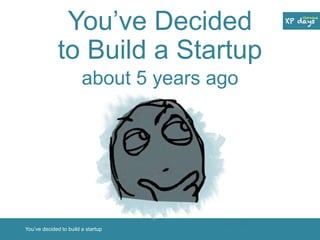
You’ve Decided 
to Build a Startup 
about 5 years ago 
You’ve decided to build a startup
Product Overview 
• business model – B2B 
•main product flow: 
• import data from customer 
• process data, e.g. validate, filter, pre-calculate 
• show different analytics to end users 
You’ve built a startup
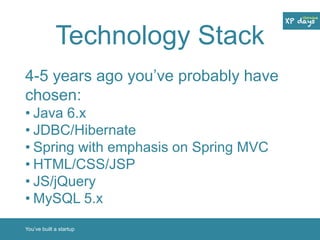
Technology Stack 
4-5 years ago you’ve probably have 
chosen: 
• Java 6.x 
• JDBC/Hibernate 
• Spring with emphasis on Spring MVC 
• HTML/CSS/JSP 
• JS/jQuery 
• MySQL 5.x 
You’ve built a startup
Tools 
4-5 years ago you’ve probably have 
chosen: 
• Maven 2.x 
• Jetty 6.x 
• Jenkins 
• Subversion 
• JIRA 
• Confluence 
You’ve built a startup
You’ve Built a Startup 
You’ve built a startup
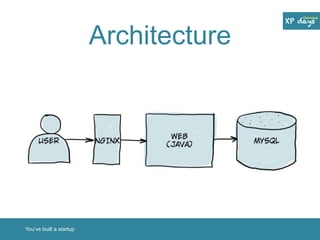
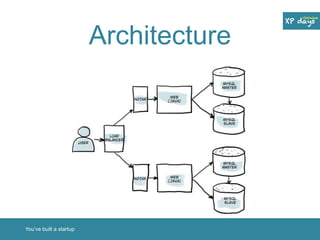
Architecture 
Not thinking about: 
•scalability 
•performance 
• customization 
• l10n, i18n 
You’ve built a startup
SaaS Maturity 
Model (Level 2) 
You’ve built a startup
Architecture 
You’ve built a startup
Architecture 
You’ve built a startup
Architecture 
You’ve built a startup
You’ve Built a Startup 
Single tenant 
monolithic stateful 
application 
with no thought on cost of 
future scalability, customization, 
l10n/i18n and performance 
You’ve built a startup
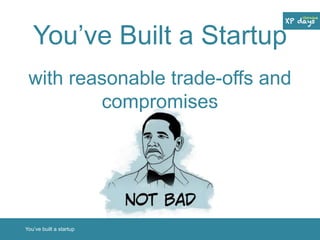
You’ve Built a Startup 
with reasonable trade-offs and 
compromises 
You’ve built a startup
You’ve Built a Startup 
And it became a successful product 
You’ve built a startup
Early Issues
Internal Quality 
•time to market vs. internal 
quality 
•business logic becomes more 
and more complicated 
Early Issues
A Lot of Customers 
•each customer wants specific 
features 
•seamless integration 
•l10n, i18n 
Early Issues
Early Issues 
Early Issues
Issues => Challenges 
Early Issues
Solutions
Internal Quality 
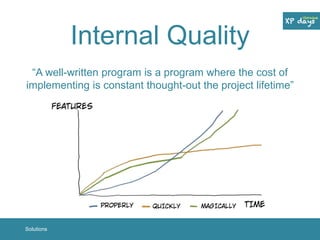
“A well-written program is a program where the cost of 
implementing is constant thought-out the project lifetime” 
Solutions
Internal Quality 
•formal code review process 
via Atlassian Crucible 
•integration with 
CheckStyle/PMD with strict 
set of rules 
Solutions
Internal Quality 
•unit/integration tests 
•functional tests bases on 
htmlunit/jwebunit written and 
maintained by developers 
Solutions
Internal Quality 
•automation tests framework 
based on 
Ruby/Selenium/Cucumber 
written and maintained by QA 
engineers 
•performance tests using 
NewRelic 
Solutions
A Lot of Customers 
Still continue 
with maturity level 2 
and tackle customization, i18n, 
l10n problems separately 
Solutions
Maturity Level 2 
Solutions
Internal Customization 
•is implemented via hierarchy 
of application.properties files 
Solutions
Ruby Scripts 
• start application per default “demo” 
customer 
• start application in debug mode 
• start application per specific customer 
using local/remote db 
• load fixtures data to main/test local 
database 
• start application in web tests mode 
• run specific web test 
Solutions
Specific Features 
•created additional Spring 
contexts per customer 
•introduced unique Spring 
beans per customer and 
injected them via aliases 
Solutions
External 
Customization 
• each customer had specific static 
assets, e.g. styles, images, js, etc. 
• Sass framework was used to 
reasonably generate CSS files per 
customer 
Solutions
Storage 
•one database schema per all 
customers 
•patches per customer during 
deployment 
Solutions
Code Organization 
•maintained one repository for 
default “demo” customer 
•created separated 
repositories per each 
customer 
Solutions
Customer Repo 
Contains: 
• java files 
• Spring contexts 
• database patches 
• static assets, e.g. styles, images, tags, 
etc. 
Web app for each customer 
is unpackaged and customized 
at deploy time 
Solutions
So 
•code and product complexity 
is controlled in certain bounds 
•internal product quality is high 
Solutions
So 
•build, testing, deployment, 
customization, localization 
processes are automated 
Solutions
Summary 
Successful product that 
overgrew startup stage and 
is delivered to more than 
90 customers all over the 
globe 
Solutions
Still not Enough
Business Issues 
•customization is limited 
• as business domain is unique 
product is hard to be sold to more 
than 1 customer in region/country 
Still not Enough
DevOps Issues 
•high maintenance cost 
•not effective utilization of 
resources 
Still not Enough
Engineering Issues 
•it is impossible to develop/test 
new features without the 
entire stack running 
•high cost for even tiny change 
Still not Enough
Unfortunately 
Current application is 
expensive 
to maintain, customize and 
configure 
Still not Enough
New Solution
New Solution 
Redesign existing web solution 
as a multi-tenant widget-based 
application 
with easier customization and 
configuration support 
New Solution
•lower maintenance cost 
•easier customization via 
configuration and static 
assets that can be re-deployed 
without releasing 
software 
Goals 
New Solution
Goals 
•modular architecture with 
well-defined contracts 
•split of front-end and back-end 
with possibility to easily 
provide public API 
New Solution
Vision
Vision 
Z 1.2.4 
Widget YX 21.0.01 WWiiddggeett YZ 12..20..30 
New Solution 
Widget Container X 1.0.0 
1 
Container 2 Container 3
Skeleton 
•will describe header, footer, 
as well as main page loader 
•unique per application 
New Solution
Page Layout 
•will be defined via templates 
that describe containers in 
which appropriate widgets will 
be loaded 
New Solution
Widget 
•separated web application 
representing some major 
feature of application 
New Solution
Widget 
• is a consolidation of html, css, js plus all 
necessary images and localized 
message properties 
• is going to be stored on static assets 
server 
• should be built according to unified 
web application framework 
New Solution
Targeting API 
•will provide data essential to 
build page layout based on a 
template with widgets to be 
loaded in particular containers 
New Solution
Sequence Diagram 
HTML Skeleton 
Common (branded) CSS 
Common Code: 
• targeting call 
• page layout 
New Solution 
Static 
Content Server 
CDN 
Layout / 
Targeting 
API 
Widget 
Specific 
API(s) 
Widget HTML 
Widget CSS 
Widget Code 
1 
3 
2 
4
Looks Great 
New Solution
Nuance 
New Solution
Nuance 
That should be done in parallel 
with the existing application 
development 
New Solution
Nuance 
One proof-of-concept widget 
with corresponding APIs 
should be implemented 
to prove future architecture 
New Solution
Proof of Concept
Widgets 
Technology Stack 
• Angular 
• Node.js 
• Bower 
• Grunt 
• Karma (ex. Testacular), Mocha, 
Jasmine, PhantomJS 
• Additional custom libraries for mocking 
and localization were also built 
Proof of Concept
API 
Technology Stack 
Created essential APIs inside 
existing web application using: 
• Spring Restful services 
• Spring rest template/JSON assert for 
testing 
Proof of Concept
Targeting API 
• provides targeting page layout for 
particular customer and logged-in 
user 
• provides information if user is 
currently logged in 
• provides authentication endpoint 
URL 
• provides static assets endpoint URL 
Proof of Concept
Authentication API 
•is used by page loader to 
force user authentication 
Proof of Concept
Static Assets API 
• handles all GET requests and 
serves up static assets either from 
file system or from Amazon S3 
• combines expiration and validation 
caching strategies, supports 
gzipping 
Proof of Concept
Current Sequence 
Diagram 
Monolithic Web App 
Page Loader 
Common (branded) CSS 
Common Code: 
• dependencies 
• client for targeting API 
• client for authentication API 
Proof of Concept 
Static 
Content 
Server 
CD 
N 
Static Assets 
API 
Layout / 
Targeting 
API 
Widget 
Specific 
API(s) 
Widget HTML 
Widget CSS 
Client for Widget API 
Authentication API 
Redesigned Page 1 
2 
3 
4 
5 
6
New Life inside 
Monolith
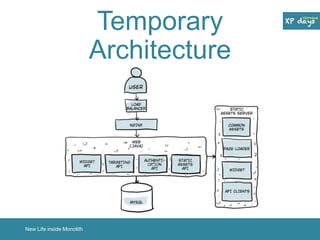
Temporary 
Architecture 
New Life inside Monolith
New Approach 
•one widget in production 
using described APIs that live 
inside existing monolith 
•web framework for front-end 
developers to build more 
widgets 
New Life inside Monolith
So 
Selected 
architecture, technology stack 
and tools were proven 
New Life inside Monolith
Next Goals
Next Goals 
•improve web framework, e.g. 
repository management, end 
to end tests, etc. 
•rebuild other pages using 
widgets approach when 
needed 
Next Goals
Next Goals 
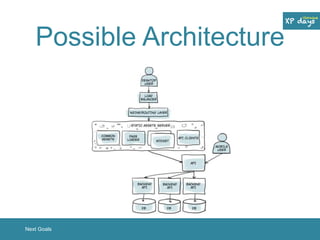
•dismantle the monolith using 
SOA-like services 
•create mobile clients 
connected to redesigned 
unified API 
Next Goals
Possible Architecture 
Next Goals
Groupon Way
•migrated frontend from Ruby 
to Node.js infrastructure 
•the old monolithic frontend 
was split up into ~20 separate 
web apps 
Groupon Way 
“Dismantling the 
Monoliths”
•ability to deploy changes to 
applications independently 
•ability to make site-wide 
feature and design changes 
much more quickly 
Groupon Way 
“Dismantling the 
Monoliths”
Groupon Architecture 
Groupon Way
Conclusions
Conclusions 
•monolithic applications can be 
successful 
Conclusions
Conclusions 
•you should have a good 
reasons for dismantling as 
well as for choosing micro 
services architecture 
Conclusions
Conclusions 
•gradual dismantling the 
monolithic application is 
doable 
Conclusions
Conclusions 
Conclusions
Instead of Epilogue
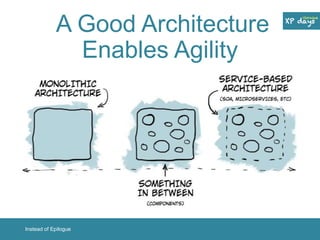
A Good Architecture 
Enables Agility 
By Simon Brown, @simonbrown, http://www.simonbrown.je/
Just Think 
If you can’t build a structured 
monolith what makes you think 
micro services is the answer? 
Don’t blindly copy what everybody 
else seems to be doing 
By Simon Brown, @simonbrown, http://www.simonbrown.je/
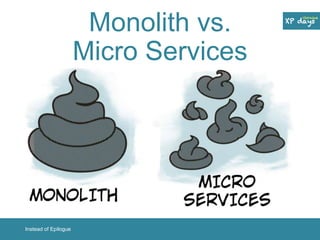
Monolith vs. 
Micro Services 
By Aviran Mordo, https://twitter.com/aviranm/status/531925339518148609/photo/1
Monolith vs. 
Micro Services 
Instead of Epilogue
Thanks! 
Questions? 
New Life inside Monolithic Application by Taras 
Matyashovsky 
Design by
References 
• http://martinfowler.com/articles/microservices.html 
• http://www.infoq.com/news/2014/08/microservices-monoliths 
• http://www.infoq.com/news/2014/08/microservices_ballmud 
• http://www.infoq.com/presentations/development-deployment-collaboration-etsy 
• https://twitter.com/aviranm/status/531925339518148609/photo/1 
• https://thecloudworld.wordpress.com/tag/maturity-model/ 
• http://highscalability.com/blog/2014/7/28/the-great-microservices-vs-monolithic- 
apps-twitter-melee.html 
• http://www.codingthearchitecture.com/presentations/devday2014-software-software- 
architecture-vs-code 
• http://www.simonbrown.je/ 
• https://engineering.groupon.com/2013/misc/i-tier-dismantling-the-monoliths/ 
References

New life inside monolithic application

  • 1.
    New Life inside Monolithic Application This presentation will be useful to those who would like to get acquainted with lifetime history of successful monolithic Java application By Taras Matyashovsky Taras Matyashovsky, Software Engineer/Team & Tech Lead, CSM, @tmatyashovsky
  • 2.
  • 3.
    About me •Software engineer/TL • Worked for outsource companies, product companies and tried myself in startups/freelancing • 8+ years production Java experience • Fan of Agile methodologies, CSM • Founder of Morning@Lohika tech talks in Lviv Introduction
  • 4.
    This Presentation •shows architectural and technical evolution of one Java web startup that is beyond daily coding routine • contains a lot of • simplifications • Captain Obvious • internet memes Introduction
  • 5.
    Notice • businessdomain is not important • this presentation is not intended for monolithic vs. micro services architectures comparison Introduction
  • 6.
    Agenda • You’vedecided to build a startup • You’ve built a startup • Early issues • Solutions • Still not enough • New solution • Proof of concept • New life inside monolith • Next goals • Groupon way • Conclusions • Instead of epilogue Introduction
  • 7.
    You’ve Decided to Build a Startup
  • 8.
    You’ve Decided toBuild a Startup about 5 years ago You’ve decided to build a startup
  • 9.
    Product Overview •business model – B2B •main product flow: • import data from customer • process data, e.g. validate, filter, pre-calculate • show different analytics to end users You’ve built a startup
  • 10.
    Technology Stack 4-5years ago you’ve probably have chosen: • Java 6.x • JDBC/Hibernate • Spring with emphasis on Spring MVC • HTML/CSS/JSP • JS/jQuery • MySQL 5.x You’ve built a startup
  • 11.
    Tools 4-5 yearsago you’ve probably have chosen: • Maven 2.x • Jetty 6.x • Jenkins • Subversion • JIRA • Confluence You’ve built a startup
  • 12.
    You’ve Built aStartup You’ve built a startup
  • 13.
    Architecture Not thinkingabout: •scalability •performance • customization • l10n, i18n You’ve built a startup
  • 14.
    SaaS Maturity Model(Level 2) You’ve built a startup
  • 15.
  • 16.
  • 17.
  • 18.
    You’ve Built aStartup Single tenant monolithic stateful application with no thought on cost of future scalability, customization, l10n/i18n and performance You’ve built a startup
  • 19.
    You’ve Built aStartup with reasonable trade-offs and compromises You’ve built a startup
  • 20.
    You’ve Built aStartup And it became a successful product You’ve built a startup
  • 21.
  • 22.
    Internal Quality •timeto market vs. internal quality •business logic becomes more and more complicated Early Issues
  • 23.
    A Lot ofCustomers •each customer wants specific features •seamless integration •l10n, i18n Early Issues
  • 24.
  • 25.
    Issues => Challenges Early Issues
  • 26.
  • 27.
    Internal Quality “Awell-written program is a program where the cost of implementing is constant thought-out the project lifetime” Solutions
  • 28.
    Internal Quality •formalcode review process via Atlassian Crucible •integration with CheckStyle/PMD with strict set of rules Solutions
  • 29.
    Internal Quality •unit/integrationtests •functional tests bases on htmlunit/jwebunit written and maintained by developers Solutions
  • 30.
    Internal Quality •automationtests framework based on Ruby/Selenium/Cucumber written and maintained by QA engineers •performance tests using NewRelic Solutions
  • 31.
    A Lot ofCustomers Still continue with maturity level 2 and tackle customization, i18n, l10n problems separately Solutions
  • 32.
    Maturity Level 2 Solutions
  • 33.
    Internal Customization •isimplemented via hierarchy of application.properties files Solutions
  • 34.
    Ruby Scripts •start application per default “demo” customer • start application in debug mode • start application per specific customer using local/remote db • load fixtures data to main/test local database • start application in web tests mode • run specific web test Solutions
  • 35.
    Specific Features •createdadditional Spring contexts per customer •introduced unique Spring beans per customer and injected them via aliases Solutions
  • 36.
    External Customization •each customer had specific static assets, e.g. styles, images, js, etc. • Sass framework was used to reasonably generate CSS files per customer Solutions
  • 37.
    Storage •one databaseschema per all customers •patches per customer during deployment Solutions
  • 38.
    Code Organization •maintainedone repository for default “demo” customer •created separated repositories per each customer Solutions
  • 39.
    Customer Repo Contains: • java files • Spring contexts • database patches • static assets, e.g. styles, images, tags, etc. Web app for each customer is unpackaged and customized at deploy time Solutions
  • 40.
    So •code andproduct complexity is controlled in certain bounds •internal product quality is high Solutions
  • 41.
    So •build, testing,deployment, customization, localization processes are automated Solutions
  • 42.
    Summary Successful productthat overgrew startup stage and is delivered to more than 90 customers all over the globe Solutions
  • 43.
  • 44.
    Business Issues •customizationis limited • as business domain is unique product is hard to be sold to more than 1 customer in region/country Still not Enough
  • 45.
    DevOps Issues •highmaintenance cost •not effective utilization of resources Still not Enough
  • 46.
    Engineering Issues •itis impossible to develop/test new features without the entire stack running •high cost for even tiny change Still not Enough
  • 47.
    Unfortunately Current applicationis expensive to maintain, customize and configure Still not Enough
  • 48.
  • 49.
    New Solution Redesignexisting web solution as a multi-tenant widget-based application with easier customization and configuration support New Solution
  • 50.
    •lower maintenance cost •easier customization via configuration and static assets that can be re-deployed without releasing software Goals New Solution
  • 51.
    Goals •modular architecturewith well-defined contracts •split of front-end and back-end with possibility to easily provide public API New Solution
  • 52.
  • 53.
    Vision Z 1.2.4 Widget YX 21.0.01 WWiiddggeett YZ 12..20..30 New Solution Widget Container X 1.0.0 1 Container 2 Container 3
  • 54.
    Skeleton •will describeheader, footer, as well as main page loader •unique per application New Solution
  • 55.
    Page Layout •willbe defined via templates that describe containers in which appropriate widgets will be loaded New Solution
  • 56.
    Widget •separated webapplication representing some major feature of application New Solution
  • 57.
    Widget • isa consolidation of html, css, js plus all necessary images and localized message properties • is going to be stored on static assets server • should be built according to unified web application framework New Solution
  • 58.
    Targeting API •willprovide data essential to build page layout based on a template with widgets to be loaded in particular containers New Solution
  • 59.
    Sequence Diagram HTMLSkeleton Common (branded) CSS Common Code: • targeting call • page layout New Solution Static Content Server CDN Layout / Targeting API Widget Specific API(s) Widget HTML Widget CSS Widget Code 1 3 2 4
  • 60.
  • 61.
  • 62.
    Nuance That shouldbe done in parallel with the existing application development New Solution
  • 63.
    Nuance One proof-of-conceptwidget with corresponding APIs should be implemented to prove future architecture New Solution
  • 64.
  • 65.
    Widgets Technology Stack • Angular • Node.js • Bower • Grunt • Karma (ex. Testacular), Mocha, Jasmine, PhantomJS • Additional custom libraries for mocking and localization were also built Proof of Concept
  • 66.
    API Technology Stack Created essential APIs inside existing web application using: • Spring Restful services • Spring rest template/JSON assert for testing Proof of Concept
  • 67.
    Targeting API •provides targeting page layout for particular customer and logged-in user • provides information if user is currently logged in • provides authentication endpoint URL • provides static assets endpoint URL Proof of Concept
  • 68.
    Authentication API •isused by page loader to force user authentication Proof of Concept
  • 69.
    Static Assets API • handles all GET requests and serves up static assets either from file system or from Amazon S3 • combines expiration and validation caching strategies, supports gzipping Proof of Concept
  • 70.
    Current Sequence Diagram Monolithic Web App Page Loader Common (branded) CSS Common Code: • dependencies • client for targeting API • client for authentication API Proof of Concept Static Content Server CD N Static Assets API Layout / Targeting API Widget Specific API(s) Widget HTML Widget CSS Client for Widget API Authentication API Redesigned Page 1 2 3 4 5 6
  • 71.
    New Life inside Monolith
  • 72.
    Temporary Architecture NewLife inside Monolith
  • 73.
    New Approach •onewidget in production using described APIs that live inside existing monolith •web framework for front-end developers to build more widgets New Life inside Monolith
  • 74.
    So Selected architecture,technology stack and tools were proven New Life inside Monolith
  • 75.
  • 76.
    Next Goals •improveweb framework, e.g. repository management, end to end tests, etc. •rebuild other pages using widgets approach when needed Next Goals
  • 77.
    Next Goals •dismantlethe monolith using SOA-like services •create mobile clients connected to redesigned unified API Next Goals
  • 78.
  • 79.
  • 80.
    •migrated frontend fromRuby to Node.js infrastructure •the old monolithic frontend was split up into ~20 separate web apps Groupon Way “Dismantling the Monoliths”
  • 81.
    •ability to deploychanges to applications independently •ability to make site-wide feature and design changes much more quickly Groupon Way “Dismantling the Monoliths”
  • 82.
  • 83.
  • 84.
    Conclusions •monolithic applicationscan be successful Conclusions
  • 85.
    Conclusions •you shouldhave a good reasons for dismantling as well as for choosing micro services architecture Conclusions
  • 86.
    Conclusions •gradual dismantlingthe monolithic application is doable Conclusions
  • 87.
  • 88.
  • 89.
    A Good Architecture Enables Agility By Simon Brown, @simonbrown, http://www.simonbrown.je/
  • 90.
    Just Think Ifyou can’t build a structured monolith what makes you think micro services is the answer? Don’t blindly copy what everybody else seems to be doing By Simon Brown, @simonbrown, http://www.simonbrown.je/
  • 91.
    Monolith vs. MicroServices By Aviran Mordo, https://twitter.com/aviranm/status/531925339518148609/photo/1
  • 92.
    Monolith vs. MicroServices Instead of Epilogue
  • 93.
    Thanks! Questions? NewLife inside Monolithic Application by Taras Matyashovsky Design by
  • 94.
    References • http://martinfowler.com/articles/microservices.html • http://www.infoq.com/news/2014/08/microservices-monoliths • http://www.infoq.com/news/2014/08/microservices_ballmud • http://www.infoq.com/presentations/development-deployment-collaboration-etsy • https://twitter.com/aviranm/status/531925339518148609/photo/1 • https://thecloudworld.wordpress.com/tag/maturity-model/ • http://highscalability.com/blog/2014/7/28/the-great-microservices-vs-monolithic- apps-twitter-melee.html • http://www.codingthearchitecture.com/presentations/devday2014-software-software- architecture-vs-code • http://www.simonbrown.je/ • https://engineering.groupon.com/2013/misc/i-tier-dismantling-the-monoliths/ References

Editor's Notes

  • #34 introduced notion of host, tier (local, dev, qa, stage, prod), client (i.e. customer) created hierarchy of application.properties files and corresponding values that were capable to change behavior of the application for specific host/tier/client provided correct general (default) values as well as client specific per each host/tier that will be overridden during deployment
  • #35 Pure Maven was not enough now to easily support such differentiation of application startup.
  • #36 Some customers required existing functionality to behave differently as well as some specific new functionality.
  • #37 Sass framework was used in order to reasonably generate CSS files per client using variables, nesting, imports, inheritance, etc.
  • #38 one database schema per all customers, but some customers needed additional tables, columns, etc. created an internal tool capable of automated execution of some patches to the existing schema per customer during deployment
  • #51 lower maintenance cost easier support for "standard" customizations via configuration that can be re-deployed without releasing software easier support for "extended" customization by enforcing a modular architecture with well-defined contracts separated front-end from back-end API move from single-tenancy to multi-tenancy
  • #52 lower maintenance cost easier support for "standard" customizations via configuration that can be re-deployed without releasing software easier support for "extended" customization by enforcing a modular architecture with well-defined contracts separated front-end from back-end API move from single-tenancy to multi-tenancy
  • #57 Web application framework should be built that would include common features needed by each widget to make it easy for front-end developers to build out these individual web apps with maximum isolation from current stack and back-end engineers
  • #58 Web application framework should be built that would include common features needed by each widget to make it easy for front-end developers to build out these individual web apps with maximum isolation from current stack and back-end engineers
  • #59 will be single point of knowledge whether use default message properties or client specific, file structure on static assets server, locale to be used by end-user, etc.
  • #67 Benefits: reused existing SSO solution
  • #68 provides targeting site layout for particular customer and logged-in user in multi-tenant environment as well as targeting site layout for current customer in single-tenant environment provides information if currently user is currently logged in provides URL that should be used to authentication provides URL for static assets endpoint
  • #71 1. visit redesigned widget-based page that has URL under static assets endpoint, e.g. static_assets/redesigned_page. Static assets API will provide page loader if resource is not found. 2. fetch page loader including common skeleton, css customized per customer, common dependencies, clients for main APIs 3. call the targeting API to figure out what tabs to show and what widget to use 4. if widget requires user to be logged in then perform authentication via authentication API 5. fetch widget assets, e.g. markup, css, message properties, client for specific API 6. widget will make further calls to widget specific APIs in order to get data
  • #74 one widget in production using described APIs that live inside existing monolith web framework that includes common features needed by each widget to make it easy for front-end developers to build out these widgets with isolation from current stack and back-end engineers