This project has received funding from the European research infrastructures
(including e-Infrastructures) under the European Union's Horizon 2020 research
and innovation programme under grant agreement No 101017501
Research Lifecycle Management technologies for
Earth Science Communities and Copernicus users in EOSC
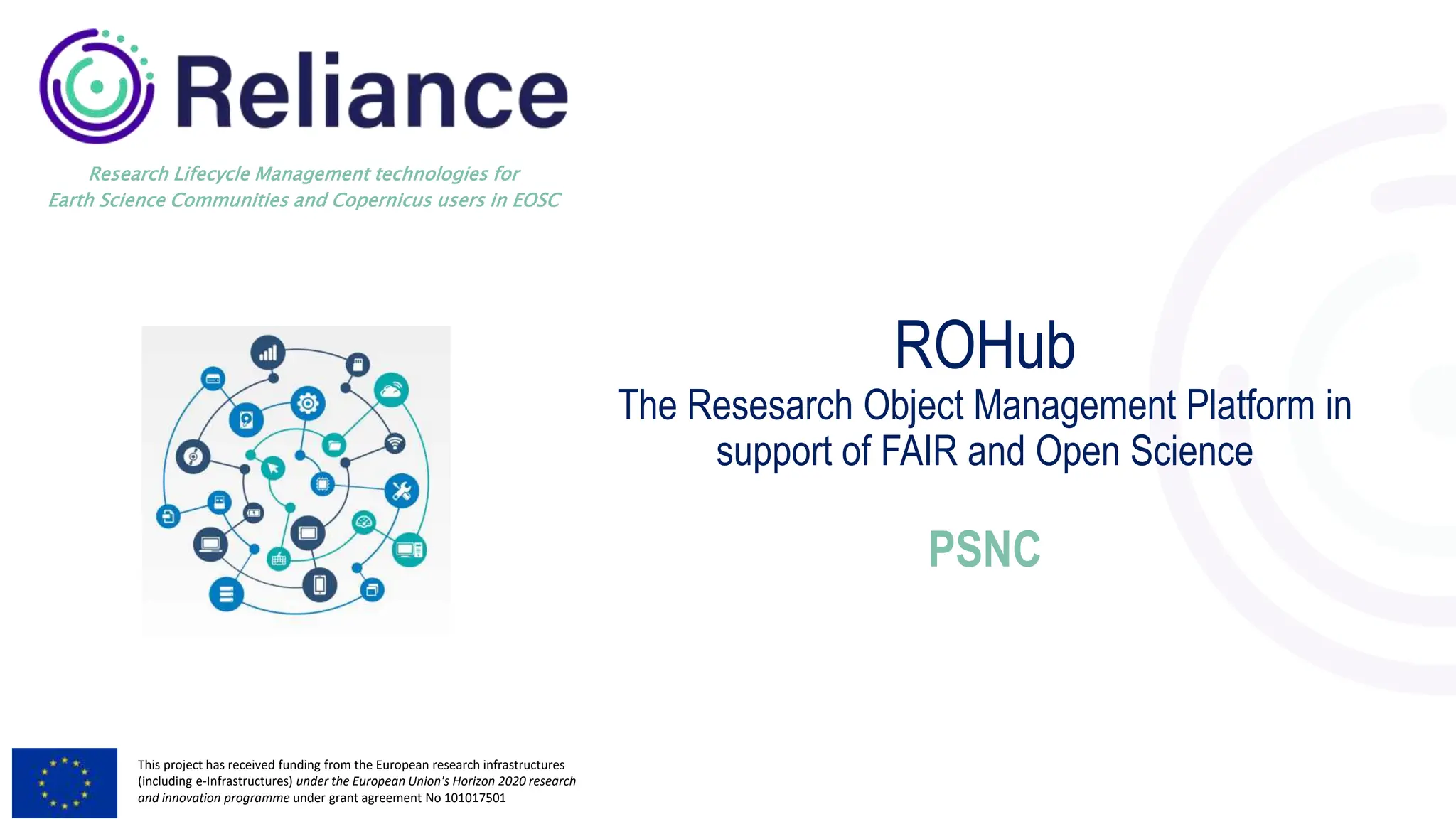
ROHub
The Resesarch Object Management Platform in
support of FAIR and Open Science
PSNC
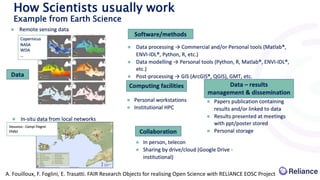
How Scientists usually work
Example from Earth Science
A. Fouilloux, F. Foglini, E. Trasatti. FAIR Research Objects for realising Open Science with RELIANCE EOSC Project
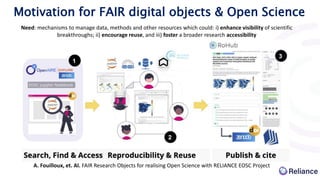
Motivation for FAIR digital objects & Open Science
A. Fouilloux, et. Al. FAIR Research Objects for realising Open Science with RELIANCE EOSC Project
Need: mechanisms to manage data, methods and other resources which could: i) enhance visibility of scientific
breakthroughs; ii) encourage reuse, and iii) foster a broader research accessibility
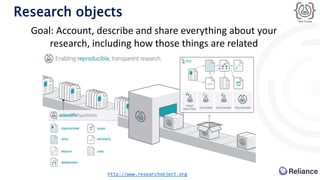
Goal: Account, describe and share everything about your
research, including how those things are related
Research objects
http://www.researchobject.org
Research outcomes and related resources
Each object has its own metadata and repositories
All are first class citizens and are required to make research FAIR
[source RO-Crate: A framework for packaging research products into
FAIR Research Objects]
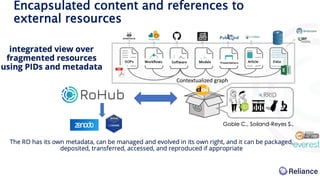
Encapsulated content and references to
external resources
Contextualized graph
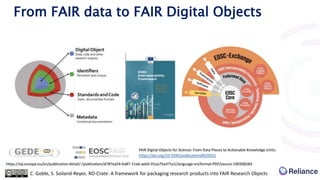
From FAIR data to FAIR Digital Objects
C. Goble, S. Soiland-Reyes. RO-Crate: A framework for packaging research products into FAIR Research Objects
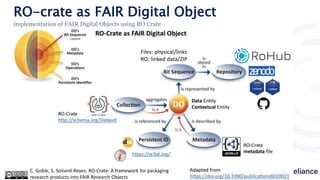
RO-crate as FAIR Digital Object
C. Goble, S. Soiland-Reyes. RO-Crate: A framework for packaging
research products into FAIR Research Objects
Files: physical/links
RO: linked data/ZIP
implementation of FAIR Digital Objects using RO Crate
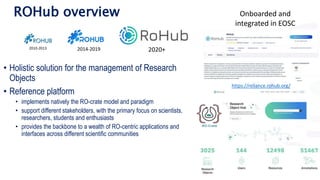
• Holistic solution for the management of Research
Objects
• Reference platform
• implements natively the RO-crate model and paradigm
• support different stakeholders, with the primary focus on scientists,
researchers, students and enthusiasts
• provides the backbone to a wealth of RO-centric applications and
interfaces across different scientific communities
ROHub overview
2020+
2010-2013 2014-2019
https://reliance.rohub.org/
Onboarded and
integrated in EOSC
ROHUB enables:
• to create and manage high-quality ROs that can be interpreted and reproduced in the future
• to reference, share and preserve scientific studies, campaigns, and observations related resources, including internal
ones, links to external ones as well as other ROs (nested ROs)
• to collaborate with colleagues and to discover new knowledge via advanced exploratory search interfaces that exploit RO
metadata (both explicitly provided and automatically extracted from its content), as well as via an standard search API
via an standard search API OpenSearch with Geo extensions
• to manage the RO evolution including the ability to generate snapshots and releases and to allow others to fork the RO
to reuse it and extend it.
• to publish the associated work and assign it a DOI to allow its citation in scholarly communications
• to monitor and follow a particular RO, getting notifications about its progress or quality changes
• researchers to build reputation by enabling users to rate and favorite ROs created by others
• to find related works or researchers in a a domain, e.g., for possible collaborations or reviews
High-level features
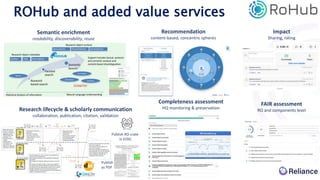
ROHub and added value services
Semantic enrichment
readability, discoverability, reuse
Recommendation
content-based, concentric spheres
Research lifecycle & scholarly communication
collaboration, publication, citation, validation
Completeness assessment
HQ monitoring & preservation
Impact
Sharing, rating
Publish RO-crate
in EOSC
Publish
as PDF
FAIR assessment
RO and components level
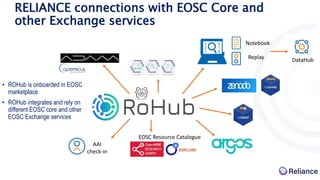
RELIANCE connections with EOSC Core and
other Exchange services
• ROHub is onboarded in EOSC
marketplace
• ROHub integrates and rely on
different EOSC core and other
EOSC Exchange services
Replay
AAI
check-in
EOSC Resource Catalogue
DataHub
Notebook
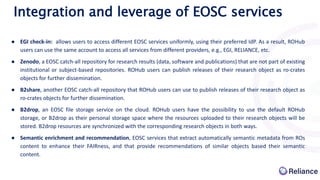
● EGI check-in: allows users to access different EOSC services uniformly, using their preferred IdP. As a result, ROHub
users can use the same account to access all services from different providers, e.g., EGI, RELIANCE, etc.
● Zenodo, a EOSC catch-all repository for research results (data, software and publications) that are not part of existing
institutional or subject-based repositories. ROHub users can publish releases of their research object as ro-crates
objects for further dissemination.
● B2share, another EOSC catch-all repository that ROHub users can use to publish releases of their research object as
ro-crates objects for further dissemination.
● B2drop, an EOSC file storage service on the cloud. ROHub users have the possibility to use the default ROHub
storage, or B2drop as their personal storage space where the resources uploaded to their research objects will be
stored. B2drop resources are synchronized with the corresponding research objects in both ways.
● Semantic enrichment and recommendation, EOSC services that extract automatically semantic metadata from ROs
content to enhance their FAIRness, and that provide recommendations of similar objects based their semantic
content.
Integration and leverage of EOSC services
● EGI Notebooks, a browser-based tool, based on JupyterHub, for interactive analysis of data using EGI storage and compute
services. ROHub users can open and load the Jupyter notebooks in the ROs automatically in EGI Notebooks directly from
ROHub and execute their methods/processing in an interactive computing environment (eproducible science).
● EGI Replay, a place, based on Jupyter Binder, to reproduce notebooks and their run-time environment. Complementing the
previous functionality, ROHub users can open and load automatically Jupyter notebooks and reproduce their associated
computing environment with Replay, including any related input datasets, directly from the ROs in ROHub. (highest
reproducible science)
● OpenAire Graph, an open resource that aggregates a collection of research data properties (metadata, links). This graph is the
source for searching and discovering resources in EOSC explore. ROHub resources, particularly ROs, Jupyter notebooks and
data cubes, are harvested in the graph, and thus they are findable directly from the EOSC marketplace.
● Argos, an online machine-actionable tool to facilitate creation of Data Management Plans (DMPs). ROHub enables the
creation of ROs from DMPs in Argos, leveraging and representing all the DMP information in machine-readable format,
enabling researchers to shift their DMP into machine actionable DMPs, connected with the datasets themselves.
● ADAM, EOSC service enabling efficient and scalable structured data access and discovery of Earth Observation Data via data
cubes. ROHub enables the aggregation of data cubes from ADAM by reference, leveraging all the available metadata available
in ADAM to describe them in the RO. ROHub users can open and load data cubes in ADAM directly from ROHub for their
usage and exploration.
Integration and leverage of EOSC services
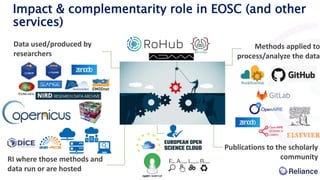
Impact & complementarity role in EOSC (and other
services)
Data used/produced by
researchers
Methods applied to
process/analyze the data
RI where those methods and
data run or are hosted
Publications to the scholarly
community
• Anne, a scientist from Oslo and her team
want to perform a climate change research
under the atmospheric perspective.
• Anne goes to EOSC resource catalogue where
she searches for existing results and finds an
executable RO from another researcher
• She opens the RO and finds a Jupyter
notebook that was used to analyze the data.
• Anne clicks on the notebook and it is opened in EGI
notebooks. She uses Data Cubes to exploit EO data
provided by the Copernicus program, and saves
results in EGI DataHub
• Anne creates her own RO (forking the reused RO)
and starts to work on it, i.e., aggregates the new
notebook, the data cube, and other resources.The
new RO will then also appear in EOSC catalogue
• Anne invites colleagues to contribute; the shared RO
will keep track of the provenance of contributions.
They can be notified when the RO is modified.
• Before publishing, they make a self-
assessment of the FAIR-ness of their
research, and check the quality of the RO
• Once RO is ready, Anne makes a release with a DOI
and publish it in Zenodo/B2Share, making it also
available in EOSC catalogue so others can find/reuse
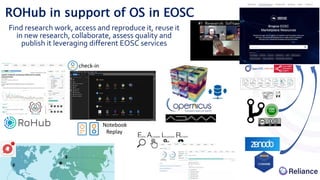
Find research work, access and reproduce it, reuse it
in new research, collaborate, assess quality and
publish it leveraging different EOSC services
check-in
ROHub in support of OS in EOSC
Replay
Notebook
© Poznan Supercomputing and Networking Center
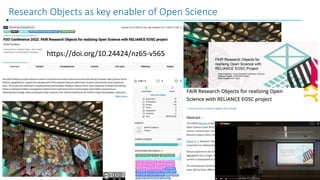
Research Objects as key enabler of Open Science
https://doi.org/10.24424/nz65-v565
This project has received funding from the European research infrastructures
(including e-Infrastructures) under the European Union's Horizon 2020 research
and innovation programme under grant agreement No 101017501
Research Lifecycle Management technologies for
Earth Science Communities and Copernicus users in EOSC
Thanks!
Raul Palma
rpalma@man.poznan.pl
• ROHub in EOSC marketplace: https://marketplace.eosc-portal.eu/services/psnc.rohub
• ROHub portal https://reliance.rohub.org/
• ROHub tutorial: https://reliance-eosc.github.io/ROHUB-API_documentation/html/tutorials.html
• ROHub portal documentation: https://reliance-eosc.github.io/rohub-portal-documentation/
• ROHub API library documentation : https://reliance-eosc.github.io/ROHUB-
API_documentation/html/index.html
• ROHub API library example Jupyter Notebooks: https://github.com/RELIANCE-EOSC/sample-
notebooks
• ROHub helpdesk: https://support.pcss.pl/servicedesk/customer/portal/27 or support
email:support@rohub.org
Onboarding and support resources

RO-crate-FDO-ROHub

  • 1.
    This project hasreceived funding from the European research infrastructures (including e-Infrastructures) under the European Union's Horizon 2020 research and innovation programme under grant agreement No 101017501 Research Lifecycle Management technologies for Earth Science Communities and Copernicus users in EOSC ROHub The Resesarch Object Management Platform in support of FAIR and Open Science PSNC
  • 2.
    How Scientists usuallywork Example from Earth Science A. Fouilloux, F. Foglini, E. Trasatti. FAIR Research Objects for realising Open Science with RELIANCE EOSC Project
  • 3.
    Motivation for FAIRdigital objects & Open Science A. Fouilloux, et. Al. FAIR Research Objects for realising Open Science with RELIANCE EOSC Project Need: mechanisms to manage data, methods and other resources which could: i) enhance visibility of scientific breakthroughs; ii) encourage reuse, and iii) foster a broader research accessibility
  • 4.
    Goal: Account, describeand share everything about your research, including how those things are related Research objects http://www.researchobject.org
  • 5.
    Research outcomes andrelated resources Each object has its own metadata and repositories All are first class citizens and are required to make research FAIR [source RO-Crate: A framework for packaging research products into FAIR Research Objects]
  • 6.
    Encapsulated content andreferences to external resources Contextualized graph
  • 7.
    From FAIR datato FAIR Digital Objects C. Goble, S. Soiland-Reyes. RO-Crate: A framework for packaging research products into FAIR Research Objects
  • 8.
    RO-crate as FAIRDigital Object C. Goble, S. Soiland-Reyes. RO-Crate: A framework for packaging research products into FAIR Research Objects Files: physical/links RO: linked data/ZIP implementation of FAIR Digital Objects using RO Crate
  • 9.
    • Holistic solutionfor the management of Research Objects • Reference platform • implements natively the RO-crate model and paradigm • support different stakeholders, with the primary focus on scientists, researchers, students and enthusiasts • provides the backbone to a wealth of RO-centric applications and interfaces across different scientific communities ROHub overview 2020+ 2010-2013 2014-2019 https://reliance.rohub.org/ Onboarded and integrated in EOSC
  • 10.
    ROHUB enables: • tocreate and manage high-quality ROs that can be interpreted and reproduced in the future • to reference, share and preserve scientific studies, campaigns, and observations related resources, including internal ones, links to external ones as well as other ROs (nested ROs) • to collaborate with colleagues and to discover new knowledge via advanced exploratory search interfaces that exploit RO metadata (both explicitly provided and automatically extracted from its content), as well as via an standard search API via an standard search API OpenSearch with Geo extensions • to manage the RO evolution including the ability to generate snapshots and releases and to allow others to fork the RO to reuse it and extend it. • to publish the associated work and assign it a DOI to allow its citation in scholarly communications • to monitor and follow a particular RO, getting notifications about its progress or quality changes • researchers to build reputation by enabling users to rate and favorite ROs created by others • to find related works or researchers in a a domain, e.g., for possible collaborations or reviews High-level features
  • 11.
    ROHub and addedvalue services Semantic enrichment readability, discoverability, reuse Recommendation content-based, concentric spheres Research lifecycle & scholarly communication collaboration, publication, citation, validation Completeness assessment HQ monitoring & preservation Impact Sharing, rating Publish RO-crate in EOSC Publish as PDF FAIR assessment RO and components level
  • 12.
    RELIANCE connections withEOSC Core and other Exchange services • ROHub is onboarded in EOSC marketplace • ROHub integrates and rely on different EOSC core and other EOSC Exchange services Replay AAI check-in EOSC Resource Catalogue DataHub Notebook
  • 13.
    ● EGI check-in:allows users to access different EOSC services uniformly, using their preferred IdP. As a result, ROHub users can use the same account to access all services from different providers, e.g., EGI, RELIANCE, etc. ● Zenodo, a EOSC catch-all repository for research results (data, software and publications) that are not part of existing institutional or subject-based repositories. ROHub users can publish releases of their research object as ro-crates objects for further dissemination. ● B2share, another EOSC catch-all repository that ROHub users can use to publish releases of their research object as ro-crates objects for further dissemination. ● B2drop, an EOSC file storage service on the cloud. ROHub users have the possibility to use the default ROHub storage, or B2drop as their personal storage space where the resources uploaded to their research objects will be stored. B2drop resources are synchronized with the corresponding research objects in both ways. ● Semantic enrichment and recommendation, EOSC services that extract automatically semantic metadata from ROs content to enhance their FAIRness, and that provide recommendations of similar objects based their semantic content. Integration and leverage of EOSC services
  • 14.
    ● EGI Notebooks,a browser-based tool, based on JupyterHub, for interactive analysis of data using EGI storage and compute services. ROHub users can open and load the Jupyter notebooks in the ROs automatically in EGI Notebooks directly from ROHub and execute their methods/processing in an interactive computing environment (eproducible science). ● EGI Replay, a place, based on Jupyter Binder, to reproduce notebooks and their run-time environment. Complementing the previous functionality, ROHub users can open and load automatically Jupyter notebooks and reproduce their associated computing environment with Replay, including any related input datasets, directly from the ROs in ROHub. (highest reproducible science) ● OpenAire Graph, an open resource that aggregates a collection of research data properties (metadata, links). This graph is the source for searching and discovering resources in EOSC explore. ROHub resources, particularly ROs, Jupyter notebooks and data cubes, are harvested in the graph, and thus they are findable directly from the EOSC marketplace. ● Argos, an online machine-actionable tool to facilitate creation of Data Management Plans (DMPs). ROHub enables the creation of ROs from DMPs in Argos, leveraging and representing all the DMP information in machine-readable format, enabling researchers to shift their DMP into machine actionable DMPs, connected with the datasets themselves. ● ADAM, EOSC service enabling efficient and scalable structured data access and discovery of Earth Observation Data via data cubes. ROHub enables the aggregation of data cubes from ADAM by reference, leveraging all the available metadata available in ADAM to describe them in the RO. ROHub users can open and load data cubes in ADAM directly from ROHub for their usage and exploration. Integration and leverage of EOSC services
  • 15.
    Impact & complementarityrole in EOSC (and other services) Data used/produced by researchers Methods applied to process/analyze the data RI where those methods and data run or are hosted Publications to the scholarly community
  • 16.
    • Anne, ascientist from Oslo and her team want to perform a climate change research under the atmospheric perspective. • Anne goes to EOSC resource catalogue where she searches for existing results and finds an executable RO from another researcher • She opens the RO and finds a Jupyter notebook that was used to analyze the data. • Anne clicks on the notebook and it is opened in EGI notebooks. She uses Data Cubes to exploit EO data provided by the Copernicus program, and saves results in EGI DataHub • Anne creates her own RO (forking the reused RO) and starts to work on it, i.e., aggregates the new notebook, the data cube, and other resources.The new RO will then also appear in EOSC catalogue • Anne invites colleagues to contribute; the shared RO will keep track of the provenance of contributions. They can be notified when the RO is modified. • Before publishing, they make a self- assessment of the FAIR-ness of their research, and check the quality of the RO • Once RO is ready, Anne makes a release with a DOI and publish it in Zenodo/B2Share, making it also available in EOSC catalogue so others can find/reuse Find research work, access and reproduce it, reuse it in new research, collaborate, assess quality and publish it leveraging different EOSC services check-in ROHub in support of OS in EOSC Replay Notebook
  • 17.
    © Poznan Supercomputingand Networking Center Research Objects as key enabler of Open Science https://doi.org/10.24424/nz65-v565
  • 18.
    This project hasreceived funding from the European research infrastructures (including e-Infrastructures) under the European Union's Horizon 2020 research and innovation programme under grant agreement No 101017501 Research Lifecycle Management technologies for Earth Science Communities and Copernicus users in EOSC Thanks! Raul Palma rpalma@man.poznan.pl
  • 19.
    • ROHub inEOSC marketplace: https://marketplace.eosc-portal.eu/services/psnc.rohub • ROHub portal https://reliance.rohub.org/ • ROHub tutorial: https://reliance-eosc.github.io/ROHUB-API_documentation/html/tutorials.html • ROHub portal documentation: https://reliance-eosc.github.io/rohub-portal-documentation/ • ROHub API library documentation : https://reliance-eosc.github.io/ROHUB- API_documentation/html/index.html • ROHub API library example Jupyter Notebooks: https://github.com/RELIANCE-EOSC/sample- notebooks • ROHub helpdesk: https://support.pcss.pl/servicedesk/customer/portal/27 or support email:support@rohub.org Onboarding and support resources

Editor's Notes

  • #5 incl. information of the underlying context & relations between resources,
  • #6 incl. information of the underlying context & relations between resources,
  • #7 incl. information of the underlying context & relations between resources,
  • #8 RO-crate provides a straightforward and lightweight implementation of FDOs, which are part of the long-term vision of EOSC. FDO are defined as sequence of bits that represents an informational unit and is presented according to the FAIR principle FDO is a unit of data that is able to interact with automated data processing systems. FDOs are accessed through their PID. They may receive requests for operations, which they may inherit from their type, as known from object-oriented programming. Through operations, their metadata can be accessed, which in turn describes the enclosed data content (a bit sequence). A trusted and open virtual environment for the scientific community with seamless access to services (with highest TRLs) addressing the whole research lifecycle: EOSC aim to provide 1.7m EU researchers an environment with free, open services for data storage, management, analysis and re-use across disciplines A web of FAIR data and services Federation of eInfra and Research Infrastructures (RIs) EOSC core, the set of enabling services needed to operate the EOSC EOSC exchange registering resources and services from research infrastructures, other EOSC projects and science clusters to the EOSC and integrating them with the EOSC core functionalities the EOSC interoperability framework will provide guidelines for providers that want to integrate services or data into EOSC It recommends beginning with a first iteration to establish a Minimum Viable EOSC (MVE) addressing the needs of publicly funded researchers exploiting openly available data.
  • #9 FDOs are accessed through their PID. They may receive requests for operations, which they may inherit from their type. Through operations, their metadata can be accessed, which in turn describes the enclosed data content (a bit sequence).  The content of a DO is encoded as a structured bit-sequence and stored in repositories. It is assigned a globally unique, persistent and resolvable identifier (PID), as well as rich metadata (descriptive, scientific, system, provenance, rights, etc.). Metadata descriptions themselves are DOs. Moreover, DOs can be aggregated to collections which are also DOs with a content consisting of the references to its components.
  • #10 e.g., scientific investigations, campaigns and operational processes including latest RO-crate specification
  • #16 So, in the overall EOSC picture, RELIANCE will play a complementary role to what is already available. In particular, the RELIANCE services would act as a bridge between various EOSC services, working at a higher level and connecting the resources used/produced during the research lifecycle, including Data used by researchers, e.g., DC for Copernicus data and other datasets available from EOSC (e.g., EGI DataHub), Methods used to process such data (e.g., via EGI Jupyter notebooks) Research Infrastructures (RI) used for research (to monitor their impact) Results published via scholarly communication services (e.g., Zenodo/OpenAire). This would facilitate the interoperability and consolidation of eInfrastructures and their cooperation with Earth Science communities Moreover, RELIANCE results will be key enablers to support the implementation of FAIR principles and the systemic change of science practices to Open Science within EOSC, with an enhanced support for sharing different research artefacts and the systematic capture of the research lifecycle For instance, Research Object snapshots/releases may be produced at different points in time during the lifecycle, and these may be also published to EOSC repositories or scholarly communication platforms in line with FAIR and open science principles. And The final RO release & publication will, thus, close the gap between the data services used in a research and the scholarly communication services used to publish the research results, connecting all resources used/produced in the middle with rich metadata.  RELIANCE results are key enablers to support the implementation of FAIR principles and the systemic change of science practices to Open Science within EOSC, with an enhanced support for sharing research artefacts and the systematic capture of the research lifecycle. RELIANCE can act as a bridge between various EOSC services, facilitating the interoperability and consolidation of eInfrastructures and their cooperation with Earth Science communities by supporting multidisciplinary research.
  • #21 e.g., scientific investigations, campaigns and operational processes including latest RO-crate specification
  • #22 exposing RO functionalities that can be used by other applications or by data scientists via (jupyter) notebooks Comprises backend service exposing a set of APIs IAM component integrated with EOSC AAI reference web client application Python library EOSC integration (AAI, publishing, storage) External RO added value services Semantic enrichment & recommendation Checklist evaluation Quality monitoring PDF generation Data cubes