 
Igor Jurčić, Sven Gotovac
Split, 24.9.2016.
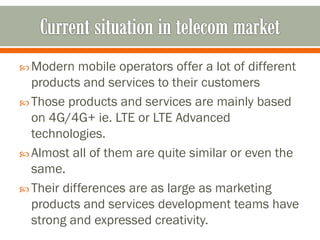
 Modern mobile operators offer a lot of different
products and services to their customers
 Those products and services are mainly based
on 4G/4G+ ie. LTE or LTE Advanced
technologies.
 Almost all of them are quite similar or even the
same.
 Their differences are as large as marketing
products and services development teams have
strong and expressed creativity.
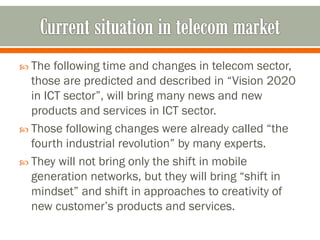
 The following time and changes in telecom sector,
those are predicted and described in “Vision 2020
in ICT sector”, will bring many news and new
products and services in ICT sector.
 Those following changes were already called “the
fourth industrial revolution” by many experts.
 They will not bring only the shift in mobile
generation networks, but they will bring “shift in
mindset” and shift in approaches to creativity of
new customer’s products and services.
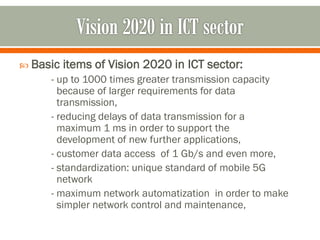
 Basic items of Vision 2020 in ICT sector:
- up to 1000 times greater transmission capacity
because of larger requirements for data
transmission,
- reducing delays of data transmission for a
maximum 1 ms in order to support the
development of new further applications,
- customer data access of 1 Gb/s and even more,
- standardization: unique standard of mobile 5G
network
- maximum network automatization in order to make
simpler network control and maintenance,
 Basic items of Vision 2020 in ICT sector (2):
- adjustment of network experience to enable the
introduction of business models of the future,
- dynamic access to information by the relay with
artificial intelligence (AI - artificial intelligence),
- unique IP networks (based on IPv6 addressing) with a
combination of "seamless" access via mobile
networks, and wireless networks such as LAN / WAN /
MAN and wwww (introduces a brand new
concept "wireless world wide web")
- adjustment of telecom operators for "solutions in the
cloud" in order to develop "network on demand",
- reducing of the total energy consumption, because of
rapid growth of data traffic.
 Fifth generation (5G) mobile network will be basis for the
implementation of Vision 2020.
 5G mobile network is not just a shift in generations of mobile
networks but it is a shift in a completely new approach to
developing products and services, or better say „a shift in
mindset”.
 Fifth-generation of mobile network has not yet been standardized
and the process of standardization is in progress.
 The approach to customers will be based on combination of
clasical mobile base stations, wi-fi connections and even some
new technologies (such as Li-Fi technology).
 Handover between classic mobile base stations and wi-fi access
(or LiFi access) must be „seamless”.
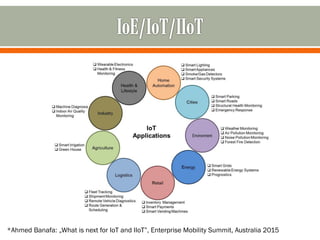
 The Internet of Things (IoT) is the network of physical objects
accessed through the Internet. These objects contain embedded
technology to interact with internal states or the external
environment.
 The Industrial Internet of Things (IIoT) is a network of physical
objects, systems, platforms and applications that contain
embedded technology to communicate and share intelligence
with each other, the external environment and with people.
 The Internet of Everything (IoE) brings together people, process,
data and things to make networked connections more relevant
and valuable than ever before – turning information into actions
that create new capabilities, richer experiences and
unprecedented economic opportunity for business, individuals or
countries.
*Ahmed Banafa: „What is next for IoT and IIoT”, Enterprise Mobility Summit, Australia 2015
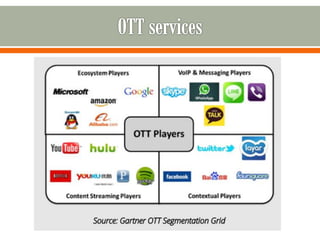
 OTT applications are popularly called „murderers of modern
mobile telecom operators”.
 Some of most popular OTT applications for making calls and
for sending messages: Viber, Skype, What’s up,…
 According to Vision 2020, we will have an even faster
mobile Internet access which opens up many possibilities
for the application and development of existing or creation
of new applications.
 OTT applications take over domestic and international
traffic from mobile and fixed telecom operators – they DO
NOT take over customers.
 OTT applications also need strong mobile operators with
high quality of mobile network.
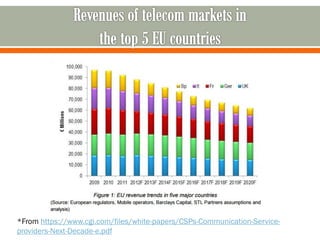
*From https://www.cgi.com/files/white-papers/CSPs-Communication-Service-
providers-Next-Decade-e.pdf
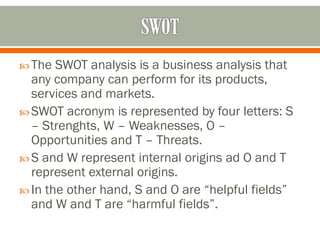
 The SWOT analysis is a business analysis that
any company can perform for its products,
services and markets.
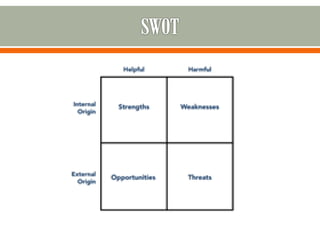
 SWOT acronym is represented by four letters: S
– Strenghts, W – Weaknesses, O –
Opportunities and T – Threats.
 S and W represent internal origins ad O and T
represent external origins.
 In the other hand, S and O are “helpful fields”
and W and T are “harmful fields”.
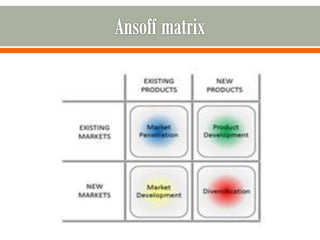
 The main sequences of this strategy are:
o Market penetration – focus on selling existing
products and services on existing market,
o Market development – focus on developing new
markets or market segments for existing products
and services,
o Product development – focus on developing new
products or services for existing markets,
o Diversification – focus on the development of new
products and services to sell into new market.
 PESTLE analysis should give answer on following main
issues:
o Political: stability of government, potential changes to legislation,
global influences,…
o Economic: economic growth, employment rates, inflation rates,
monetary policy, consumer confidence,…
o Social: income distribution, demographic influences, lifestyle
factors,…
o Technological: international influences, changes in ICT technology,
take up rates,…
o Legal: taxation policies, employment laws, industry regulations,
health and safety,…
o Environmental: regulation and restrictions, attitudes of customers,…
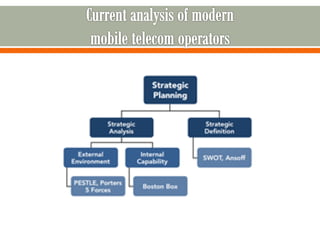
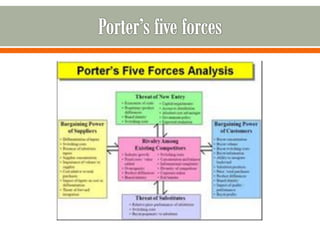
 The Porter's Five Forces model is used to analyze
competitive environment of the company on the market and
it is described as following:
o Competitive rivalry - the competition aggressiveness in the industry.
o Threat of substitution - the amount of other alternative products
which can be used to replace company offering.
o Threat of new entry - the entry barriers to start the business in the
industry.
o Buyer power - how the customers are influential and organized to
decrease the product prices.
o Supplier power - how the vendors are unique and powerful to keep
high prices for your input materials.
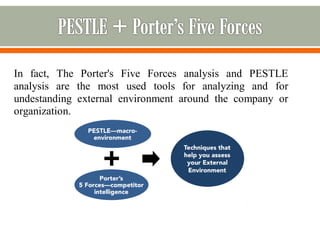
In fact, The Porter's Five Forces analysis and PESTLE
analysis are the most used tools for analyzing and for
undestanding external environment around the company or
organization.
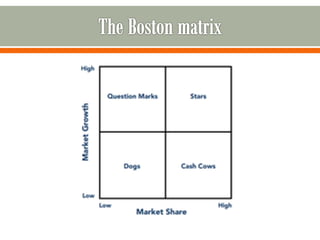
 The Boston Matrix is used for analyzing how companies can
allocate resources to each their products and services and how
these products and/or services are positioned on the market.
 The Boston Matrix consists of two axes:
o Market growth
o Market share.
 The resulting four quadrants can classify and define company’s
business units, products or services.
 This analysis can provide an initial way for screening company’s
opportunities.
 The matrix provides mechanism to find out how to allocate
resources and investment funding in order to maximize
company’s profit and growth.
 All of them are significantly subjective and this is
their main disadvantage.
 None of them are specially developed for telecom
sector and telecom operators and they all are quite
general.
 None of them analyze all important sectors/filelds
in telecom operator but only some of them.
 They are very dependent on the persons who
prepare the analysis.
 There were no defined items those should be
analyzed
 The main ideas of new analysis are objectivity and defining all
items in each key field.
 All items in each field will be weight evaluated.
 In eight fields will be analyzed internal and external
environment of mobile telecom operator.
 It will be mathematically modeled comparison with
competitors.
 It and will be given feedback to operators what they should
change in their business.
 It will be visible feedback to equipment vendors and to
international standardization organizations regarding
directions for standardizations of new technologies, services
and new generation of mobile systems.
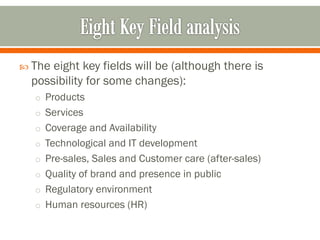
 The eight key fields will be (although there is
possibility for some changes):
o Products
o Services
o Coverage and Availability
o Technological and IT development
o Pre-sales, Sales and Customer care (after-sales)
o Quality of brand and presence in public
o Regulatory environment
o Human resources (HR)
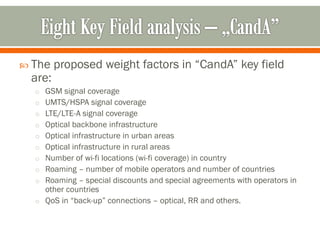
 The proposed weight factors in “CandA” key field
are:
o GSM signal coverage
o UMTS/HSPA signal coverage
o LTE/LTE-A signal coverage
o Optical backbone infrastructure
o Optical infrastructure in urban areas
o Optical infrastructure in rural areas
o Number of wi-fi locations (wi-fi coverage) in country
o Roaming – number of mobile operators and number of countries
o Roaming – special discounts and special agreements with operators in
other countries
o QoS in “back-up” connections – optical, RR and others.
This is only general idea of weight factors for
“CandA” key field. During following time and
research these items could be changed and
adjusted.
The general idea is that maximum amount
for each key field is 1 and that this number
is sum of all factors in key field.
The weight amount of each factor in key field
is not the same for different countries.
 For example factor “LTE/LTE-A” coverage in
Germany could be 0,15 or even 0,20 but in Bosnia
and Herzegovina is 0 (there are no commercial LTE
networks).
 The other approach could be by defining Internet
access rate (up to 2 Mb/s, up to 10 Mb/s, up to
100 Mb/s,…) but not by defining technology (HSPA,
LTE,…).
 The further analysis and research will show which
approach is better for use in this analysis.
 New approach or new way of analysis, named “EKF
Analysis” will enable several following important facts:
o objectivity,
o analysis of internal and external factors (in one analysis),
o mathematical results for each key field,
o possibility for detecting advantages or disadvantages in a
mobile operator in specific parts - it will be possible to make
analysis in only one, two or more key fields – it is not
necessary to make a complete analysis.
o Of course for getting a complete figure of a mobile telecom
operator it will be necessary to make complete analysis – and
thus have all important details of internal and external
factors.
… for your attention!

New appraoch in mobile telecom operators analysis rg - presentation

  • 1.
      Igor Jurčić,Sven Gotovac Split, 24.9.2016.
  • 2.
     Modern mobileoperators offer a lot of different products and services to their customers  Those products and services are mainly based on 4G/4G+ ie. LTE or LTE Advanced technologies.  Almost all of them are quite similar or even the same.  Their differences are as large as marketing products and services development teams have strong and expressed creativity.
  • 3.
     The followingtime and changes in telecom sector, those are predicted and described in “Vision 2020 in ICT sector”, will bring many news and new products and services in ICT sector.  Those following changes were already called “the fourth industrial revolution” by many experts.  They will not bring only the shift in mobile generation networks, but they will bring “shift in mindset” and shift in approaches to creativity of new customer’s products and services.
  • 4.
     Basic itemsof Vision 2020 in ICT sector: - up to 1000 times greater transmission capacity because of larger requirements for data transmission, - reducing delays of data transmission for a maximum 1 ms in order to support the development of new further applications, - customer data access of 1 Gb/s and even more, - standardization: unique standard of mobile 5G network - maximum network automatization in order to make simpler network control and maintenance,
  • 5.
     Basic itemsof Vision 2020 in ICT sector (2): - adjustment of network experience to enable the introduction of business models of the future, - dynamic access to information by the relay with artificial intelligence (AI - artificial intelligence), - unique IP networks (based on IPv6 addressing) with a combination of "seamless" access via mobile networks, and wireless networks such as LAN / WAN / MAN and wwww (introduces a brand new concept "wireless world wide web") - adjustment of telecom operators for "solutions in the cloud" in order to develop "network on demand", - reducing of the total energy consumption, because of rapid growth of data traffic.
  • 6.
     Fifth generation(5G) mobile network will be basis for the implementation of Vision 2020.  5G mobile network is not just a shift in generations of mobile networks but it is a shift in a completely new approach to developing products and services, or better say „a shift in mindset”.  Fifth-generation of mobile network has not yet been standardized and the process of standardization is in progress.  The approach to customers will be based on combination of clasical mobile base stations, wi-fi connections and even some new technologies (such as Li-Fi technology).  Handover between classic mobile base stations and wi-fi access (or LiFi access) must be „seamless”.
  • 7.
     The Internetof Things (IoT) is the network of physical objects accessed through the Internet. These objects contain embedded technology to interact with internal states or the external environment.  The Industrial Internet of Things (IIoT) is a network of physical objects, systems, platforms and applications that contain embedded technology to communicate and share intelligence with each other, the external environment and with people.  The Internet of Everything (IoE) brings together people, process, data and things to make networked connections more relevant and valuable than ever before – turning information into actions that create new capabilities, richer experiences and unprecedented economic opportunity for business, individuals or countries.
  • 8.
    *Ahmed Banafa: „Whatis next for IoT and IIoT”, Enterprise Mobility Summit, Australia 2015
  • 9.
     OTT applicationsare popularly called „murderers of modern mobile telecom operators”.  Some of most popular OTT applications for making calls and for sending messages: Viber, Skype, What’s up,…  According to Vision 2020, we will have an even faster mobile Internet access which opens up many possibilities for the application and development of existing or creation of new applications.  OTT applications take over domestic and international traffic from mobile and fixed telecom operators – they DO NOT take over customers.  OTT applications also need strong mobile operators with high quality of mobile network.
  • 11.
  • 13.
     The SWOTanalysis is a business analysis that any company can perform for its products, services and markets.  SWOT acronym is represented by four letters: S – Strenghts, W – Weaknesses, O – Opportunities and T – Threats.  S and W represent internal origins ad O and T represent external origins.  In the other hand, S and O are “helpful fields” and W and T are “harmful fields”.
  • 15.
     The mainsequences of this strategy are: o Market penetration – focus on selling existing products and services on existing market, o Market development – focus on developing new markets or market segments for existing products and services, o Product development – focus on developing new products or services for existing markets, o Diversification – focus on the development of new products and services to sell into new market.
  • 17.
     PESTLE analysisshould give answer on following main issues: o Political: stability of government, potential changes to legislation, global influences,… o Economic: economic growth, employment rates, inflation rates, monetary policy, consumer confidence,… o Social: income distribution, demographic influences, lifestyle factors,… o Technological: international influences, changes in ICT technology, take up rates,… o Legal: taxation policies, employment laws, industry regulations, health and safety,… o Environmental: regulation and restrictions, attitudes of customers,…
  • 18.
     The Porter'sFive Forces model is used to analyze competitive environment of the company on the market and it is described as following: o Competitive rivalry - the competition aggressiveness in the industry. o Threat of substitution - the amount of other alternative products which can be used to replace company offering. o Threat of new entry - the entry barriers to start the business in the industry. o Buyer power - how the customers are influential and organized to decrease the product prices. o Supplier power - how the vendors are unique and powerful to keep high prices for your input materials.
  • 20.
    In fact, ThePorter's Five Forces analysis and PESTLE analysis are the most used tools for analyzing and for undestanding external environment around the company or organization.
  • 21.
     The BostonMatrix is used for analyzing how companies can allocate resources to each their products and services and how these products and/or services are positioned on the market.  The Boston Matrix consists of two axes: o Market growth o Market share.  The resulting four quadrants can classify and define company’s business units, products or services.  This analysis can provide an initial way for screening company’s opportunities.  The matrix provides mechanism to find out how to allocate resources and investment funding in order to maximize company’s profit and growth.
  • 23.
     All ofthem are significantly subjective and this is their main disadvantage.  None of them are specially developed for telecom sector and telecom operators and they all are quite general.  None of them analyze all important sectors/filelds in telecom operator but only some of them.  They are very dependent on the persons who prepare the analysis.  There were no defined items those should be analyzed
  • 24.
     The mainideas of new analysis are objectivity and defining all items in each key field.  All items in each field will be weight evaluated.  In eight fields will be analyzed internal and external environment of mobile telecom operator.  It will be mathematically modeled comparison with competitors.  It and will be given feedback to operators what they should change in their business.  It will be visible feedback to equipment vendors and to international standardization organizations regarding directions for standardizations of new technologies, services and new generation of mobile systems.
  • 25.
     The eightkey fields will be (although there is possibility for some changes): o Products o Services o Coverage and Availability o Technological and IT development o Pre-sales, Sales and Customer care (after-sales) o Quality of brand and presence in public o Regulatory environment o Human resources (HR)
  • 26.
     The proposedweight factors in “CandA” key field are: o GSM signal coverage o UMTS/HSPA signal coverage o LTE/LTE-A signal coverage o Optical backbone infrastructure o Optical infrastructure in urban areas o Optical infrastructure in rural areas o Number of wi-fi locations (wi-fi coverage) in country o Roaming – number of mobile operators and number of countries o Roaming – special discounts and special agreements with operators in other countries o QoS in “back-up” connections – optical, RR and others.
  • 27.
    This is onlygeneral idea of weight factors for “CandA” key field. During following time and research these items could be changed and adjusted. The general idea is that maximum amount for each key field is 1 and that this number is sum of all factors in key field. The weight amount of each factor in key field is not the same for different countries.
  • 28.
     For examplefactor “LTE/LTE-A” coverage in Germany could be 0,15 or even 0,20 but in Bosnia and Herzegovina is 0 (there are no commercial LTE networks).  The other approach could be by defining Internet access rate (up to 2 Mb/s, up to 10 Mb/s, up to 100 Mb/s,…) but not by defining technology (HSPA, LTE,…).  The further analysis and research will show which approach is better for use in this analysis.
  • 29.
     New approachor new way of analysis, named “EKF Analysis” will enable several following important facts: o objectivity, o analysis of internal and external factors (in one analysis), o mathematical results for each key field, o possibility for detecting advantages or disadvantages in a mobile operator in specific parts - it will be possible to make analysis in only one, two or more key fields – it is not necessary to make a complete analysis. o Of course for getting a complete figure of a mobile telecom operator it will be necessary to make complete analysis – and thus have all important details of internal and external factors.
  • 30.
    … for yourattention!