Swallowing and chocking difficulties with Parkinson’s and Neurologic conditions:
improvement and self rescue.
Vera Shury
From the ‘Perky Parkies group Saddlebrooke,, Oro Valley Parks, Recreation, Library and Cultural Rescources, Oro
Valley and Liberty Science LLC, Oro Valley, Arizona.
Key words: chocking, swallow problems, feeding
tube, throat tightness, motor recovery, movement
disorder, rehabilitation, neurorecovery, Parkinson’s
INTRODUCTION:
Chocking is a major cause of impairment
and problem in thousands of people world
wide that have neurologic conditions like
Parkinson’s Disease, MS, stroke etc. The
atrophy of the muscles in the mouth and
throat start happening years before
diagnosis; with chocking symptoms
impeding pill taking. It sneaks up without
the person realizing the slow progression.
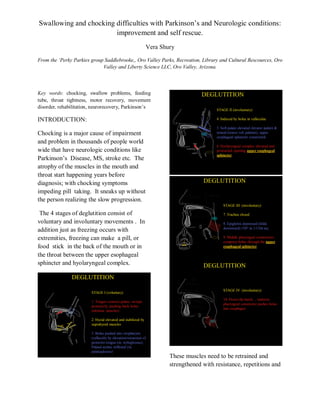
The 4 stages of deglutition consist of
voluntary and involuntary movements . In
addition just as freezing occurs with
extremities, freezing can make a pill, or
food stick in the back of the mouth or in
the throat between the upper esophageal
sphincter and hyolaryngeal complex.
DEGLUTITION
STAGE I (voluntary)
1. Tongue contacts palate, sweeps
posteriorly, pushing back bolus
(intrinsic muscles)
2. Hyoid elevated and stabilized by
suprahyoid muscles
3. Bolus pushed into oropharynx
(velleculi) by elevation/retraction of
posterior tongue (m. styloglossus);
Palatal arches stiffened (m.
palatoglossus)
GH
MH
SH
D
DEGLUTITION
STAGE II (involuntary)
4. Induced by bolus in valleculae
5. Soft palate elevated (levator palati) &
tensed (tensor veli palatini); upper
esophageal sphincter constricted
6. Hyolaryngeal complex elevated and
protracted, opening upper esophogeal
sphincter.
DEGLUTITION
STAGE III (involuntary)
7. Trachea closed
8. Epiglottis depressed (folds
downward) 150° in 1/15th sec.
9. Middle pharyngeal constrictors
compress bolus through the upper
esophageal sphincter.
DEGLUTITION
STAGE IV (involuntary)
10. Down the hatch… (inferior
pharyngeal constrictor pushes bolus
into esophagus
These muscles need to be retrained and
strengthened with resistance, repetitions and
Swallowing and chocking difficulties with Parkinson’s and Neurologic conditions:
improvement and self rescue.
Vera Shury
From the ‘Perky Parkies group Saddlebrooke,, Oro Valley Parks, Recreation, Library and Cultural Rescources, Oro
Valley and Liberty Science LLC, Oro Valley, Arizona.
sets on a regular basis as other muscles are
maintained.
Preparation: It is important to
chew food into a bolus, with the natural
saliva. It starts the digestive process and
helps the bolus slide down in to the stomach.
The amazing thing is that the involuntary
movements can be turned in to voluntary
movements. It is how sword swallowers
perform their feats. Sternum UP! Good
posture is the foundation for all
improvement. Rehabilitating the swallowing
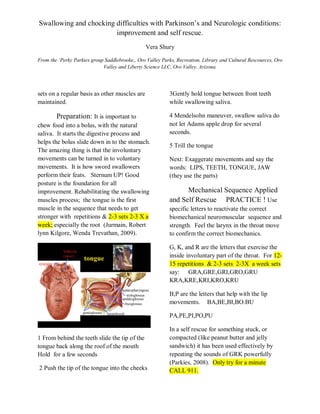
muscles process; the tongue is the first
muscle in the sequence that needs to get
stronger with repetitions & 2-3 sets 2-3 X a
week; especially the root (Jurmain, Robert
lynn Kilgore, Wenda Trevathan, 2009).
tongue
genioglossus geniohyoid
body
root
epiglottis
Vallecula
(space)
hyoglossus
palatoglossus
palatopharyngeus
styloglossus
1 From behind the teeth slide the tip of the
tongue back along the roof of the mouth
Hold for a few seconds
2 Push the tip of the tongue into the cheeks
3Gently hold tongue between front teeth
while swallowing saliva.
4 Mendelsohn maneuver, swallow saliva do
not let Adams apple drop for several
seconds.
5 Trill the tongue
Next: Exaggerate movements and say the
words: LIPS, TEETH, TONGUE, JAW
(they use the parts)
Mechanical Sequence Applied
and Self Rescue PRACTICE ! Use
specific letters to reactivate the correct
biomechanical neuromuscular sequence and
strength. Feel the larynx in the throat move
to confirm the correct biomechanics.
G, K, and R are the letters that exercise the
inside involuntary part of the throat. For 12-
15 repetitions & 2-3 sets 2-3X a week sets
say: GRA,GRE,GRI,GRO,GRU
KRA,KRE,KRI,KRO,KRU
B,P are the letters that help with the lip
movements. BA,BE,BI,BO.BU
PA,PE,PI,PO,PU
In a self rescue for something stuck, or
compacted (like peanut butter and jelly
sandwich) it has been used effectively by
repeating the sounds of GRK powerfully
(Parkies, 2008). Only try for a minute
CALL 911.
Swallowing and chocking difficulties with Parkinson’s and Neurologic conditions:
improvement and self rescue.
Vera Shury
From the ‘Perky Parkies group Saddlebrooke,, Oro Valley Parks, Recreation, Library and Cultural Rescources, Oro
Valley and Liberty Science LLC, Oro Valley, Arizona.
Cookie swallow: To help ease
the swallow coat the throat with a swallow
of nectar or use apple sauce. Tuck the chin,
get the bolus of food or pill toward the tip of
the tongue, then use the tongue to push it to
the back of the mouth to swallow it add a
double swallow (Ruddy & Sapienza, 2003).
Voice level meter: A voice level
meter provides measurable evidence to the
improvement in voice that may occur
(Farley, 2003).Improvement in voice
amplitude is also a contributing factor in
maintaining breath capacity.
Obstructions to smooth
sequencing: Tremor , atrophied
muscles, freezing or poverty of muscle
movement can interrupt the sequences. Poor
breath capacity and inhalation timing can
also add to difficulties in swallowing. With
rigidity stenosis is an additional risk factor
(Spittle & McCluskey, 2000).
Discussion: Resistance training
are accepted, evidence based techniques in
rehabilitation (Farley, Exercise Tips, 2008)
(Phend, 2012). The specificity of
kinesiology for safely and effectively
rehabilitating the throat for swallowing and
choke prevention has been applied on an
extremely limited basis. More frequently
it’s used for voice, volume and speech
amplitude. (Fox, Shill, & McKay, 2008).
Not swallowing; especially not self rescue.
Further research: The number
of participants is small, about 30 over the
last 3years since this modality was designed
during a biological anthropology class at the
University of Arizona led by Dr. David
Raichlen.
Farley, B. (2008). Exercise Tips. Tucson, AZ: TMC
Sr Resource Center.
Farley, B. (2003). PD 101. Tucson: AZAPDA.
Fox, C. F., Shill, H., & McKay, B. (2008). LSVT
BIG,LOUD, Emerging, Cell based treat., . Tucson,
AZ: AZAPDA.
Jurmain, Robert lynn Kilgore, Wenda Trevathan.
(2009). Essentials of Physical Anthropology.
Belmont,CA: Wadsworth.
Parkies, P. (2008, Oct 2). SB. (VS, Interviewer)
Phend, C. (2012). Pumping Iron Best Exercise in
Parkinson's. New Orelans, LA: Medpage.
Ruddy, B. H., & Sapienza, C. (2003). Swallowing
Function. In B. H. Ruddy, & C. Sa[ienza,
Speaking Effectively (p. 19). Staten Island, NY:
American Parkinson's Disease Association.
Spittle, N., & McCluskey. (2000). tracheal
Stenosis after intubation. Washington D.C.: Pub
Med Central.

Neuroswallowvoice

  • 1.
    Swallowing and chockingdifficulties with Parkinson’s and Neurologic conditions: improvement and self rescue. Vera Shury From the ‘Perky Parkies group Saddlebrooke,, Oro Valley Parks, Recreation, Library and Cultural Rescources, Oro Valley and Liberty Science LLC, Oro Valley, Arizona. Key words: chocking, swallow problems, feeding tube, throat tightness, motor recovery, movement disorder, rehabilitation, neurorecovery, Parkinson’s INTRODUCTION: Chocking is a major cause of impairment and problem in thousands of people world wide that have neurologic conditions like Parkinson’s Disease, MS, stroke etc. The atrophy of the muscles in the mouth and throat start happening years before diagnosis; with chocking symptoms impeding pill taking. It sneaks up without the person realizing the slow progression. The 4 stages of deglutition consist of voluntary and involuntary movements . In addition just as freezing occurs with extremities, freezing can make a pill, or food stick in the back of the mouth or in the throat between the upper esophageal sphincter and hyolaryngeal complex. DEGLUTITION STAGE I (voluntary) 1. Tongue contacts palate, sweeps posteriorly, pushing back bolus (intrinsic muscles) 2. Hyoid elevated and stabilized by suprahyoid muscles 3. Bolus pushed into oropharynx (velleculi) by elevation/retraction of posterior tongue (m. styloglossus); Palatal arches stiffened (m. palatoglossus) GH MH SH D DEGLUTITION STAGE II (involuntary) 4. Induced by bolus in valleculae 5. Soft palate elevated (levator palati) & tensed (tensor veli palatini); upper esophageal sphincter constricted 6. Hyolaryngeal complex elevated and protracted, opening upper esophogeal sphincter. DEGLUTITION STAGE III (involuntary) 7. Trachea closed 8. Epiglottis depressed (folds downward) 150° in 1/15th sec. 9. Middle pharyngeal constrictors compress bolus through the upper esophageal sphincter. DEGLUTITION STAGE IV (involuntary) 10. Down the hatch… (inferior pharyngeal constrictor pushes bolus into esophagus These muscles need to be retrained and strengthened with resistance, repetitions and
  • 2.
    Swallowing and chockingdifficulties with Parkinson’s and Neurologic conditions: improvement and self rescue. Vera Shury From the ‘Perky Parkies group Saddlebrooke,, Oro Valley Parks, Recreation, Library and Cultural Rescources, Oro Valley and Liberty Science LLC, Oro Valley, Arizona. sets on a regular basis as other muscles are maintained. Preparation: It is important to chew food into a bolus, with the natural saliva. It starts the digestive process and helps the bolus slide down in to the stomach. The amazing thing is that the involuntary movements can be turned in to voluntary movements. It is how sword swallowers perform their feats. Sternum UP! Good posture is the foundation for all improvement. Rehabilitating the swallowing muscles process; the tongue is the first muscle in the sequence that needs to get stronger with repetitions & 2-3 sets 2-3 X a week; especially the root (Jurmain, Robert lynn Kilgore, Wenda Trevathan, 2009). tongue genioglossus geniohyoid body root epiglottis Vallecula (space) hyoglossus palatoglossus palatopharyngeus styloglossus 1 From behind the teeth slide the tip of the tongue back along the roof of the mouth Hold for a few seconds 2 Push the tip of the tongue into the cheeks 3Gently hold tongue between front teeth while swallowing saliva. 4 Mendelsohn maneuver, swallow saliva do not let Adams apple drop for several seconds. 5 Trill the tongue Next: Exaggerate movements and say the words: LIPS, TEETH, TONGUE, JAW (they use the parts) Mechanical Sequence Applied and Self Rescue PRACTICE ! Use specific letters to reactivate the correct biomechanical neuromuscular sequence and strength. Feel the larynx in the throat move to confirm the correct biomechanics. G, K, and R are the letters that exercise the inside involuntary part of the throat. For 12- 15 repetitions & 2-3 sets 2-3X a week sets say: GRA,GRE,GRI,GRO,GRU KRA,KRE,KRI,KRO,KRU B,P are the letters that help with the lip movements. BA,BE,BI,BO.BU PA,PE,PI,PO,PU In a self rescue for something stuck, or compacted (like peanut butter and jelly sandwich) it has been used effectively by repeating the sounds of GRK powerfully (Parkies, 2008). Only try for a minute CALL 911.
  • 3.
    Swallowing and chockingdifficulties with Parkinson’s and Neurologic conditions: improvement and self rescue. Vera Shury From the ‘Perky Parkies group Saddlebrooke,, Oro Valley Parks, Recreation, Library and Cultural Rescources, Oro Valley and Liberty Science LLC, Oro Valley, Arizona. Cookie swallow: To help ease the swallow coat the throat with a swallow of nectar or use apple sauce. Tuck the chin, get the bolus of food or pill toward the tip of the tongue, then use the tongue to push it to the back of the mouth to swallow it add a double swallow (Ruddy & Sapienza, 2003). Voice level meter: A voice level meter provides measurable evidence to the improvement in voice that may occur (Farley, 2003).Improvement in voice amplitude is also a contributing factor in maintaining breath capacity. Obstructions to smooth sequencing: Tremor , atrophied muscles, freezing or poverty of muscle movement can interrupt the sequences. Poor breath capacity and inhalation timing can also add to difficulties in swallowing. With rigidity stenosis is an additional risk factor (Spittle & McCluskey, 2000). Discussion: Resistance training are accepted, evidence based techniques in rehabilitation (Farley, Exercise Tips, 2008) (Phend, 2012). The specificity of kinesiology for safely and effectively rehabilitating the throat for swallowing and choke prevention has been applied on an extremely limited basis. More frequently it’s used for voice, volume and speech amplitude. (Fox, Shill, & McKay, 2008). Not swallowing; especially not self rescue. Further research: The number of participants is small, about 30 over the last 3years since this modality was designed during a biological anthropology class at the University of Arizona led by Dr. David Raichlen. Farley, B. (2008). Exercise Tips. Tucson, AZ: TMC Sr Resource Center. Farley, B. (2003). PD 101. Tucson: AZAPDA. Fox, C. F., Shill, H., & McKay, B. (2008). LSVT BIG,LOUD, Emerging, Cell based treat., . Tucson, AZ: AZAPDA. Jurmain, Robert lynn Kilgore, Wenda Trevathan. (2009). Essentials of Physical Anthropology. Belmont,CA: Wadsworth. Parkies, P. (2008, Oct 2). SB. (VS, Interviewer) Phend, C. (2012). Pumping Iron Best Exercise in Parkinson's. New Orelans, LA: Medpage. Ruddy, B. H., & Sapienza, C. (2003). Swallowing Function. In B. H. Ruddy, & C. Sa[ienza, Speaking Effectively (p. 19). Staten Island, NY: American Parkinson's Disease Association. Spittle, N., & McCluskey. (2000). tracheal Stenosis after intubation. Washington D.C.: Pub Med Central.