Vera Shury B.A., C.F.T.,S.D.,A.C.H.M.
©copyright 2013
Core Belief and Change
 Fulfill a positive
prophecy
 Often our belief is based
on misperception or
outdated information
 Fitness & Health
knowledge including
Rehabilitation has
advanced with amazing
results
 Just keep an open mind
Brain synapsis
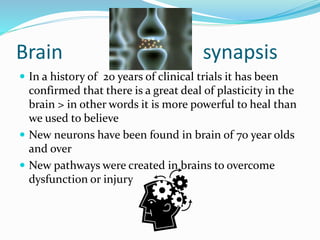
 In a history of 20 years of clinical trials it has been
confirmed that there is a great deal of plasticity in the
brain > in other words it is more powerful to heal than
we used to believe
 New neurons have been found in brain of 70 year olds
and over
 New pathways were created in brains to overcome
dysfunction or injury
Motor Movement Imagery
 Imagining the movement as part of preparation done
by elite athletes such as Olympians do to train
 Imagine rehearsing movement in a strong healthy
neuro-muscularly correct bio-mechanical movement
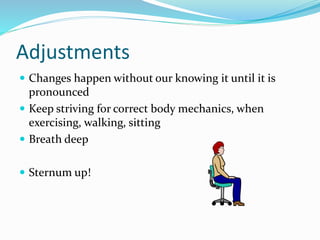
Adjustments
 Changes happen without our knowing it until it is
pronounced
 Keep striving for correct body mechanics, when
exercising, walking, sitting
 Breath deep
 Sternum up!
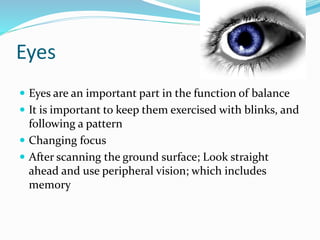
Eyes
 Eyes are an important part in the function of balance
 It is important to keep them exercised with blinks, and
following a pattern
 Changing focus
 After scanning the ground surface; Look straight
ahead and use peripheral vision; which includes
memory
Disclosure
 Opening the door to
authentic
communication not the
superficial “I am ok”
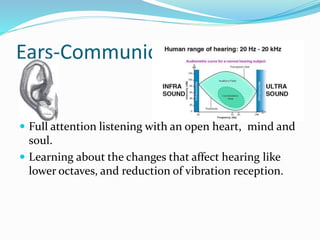
Ears-Communication
 Full attention listening with an open heart, mind and
soul.
 Learning about the changes that affect hearing like
lower octaves, and reduction of vibration reception.
Public Perceptions
 Of various human conditions due to ignorance
 ie: treating some one with hearing loss as ignorant
 Ie: treating a chronic condition as contagious when it
is not
 Ie: treating someone as a slow brainer when it is only
body mechanics that are slow
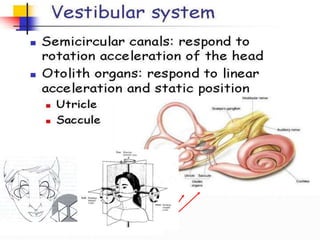
Hair cells very similar to those in the cochlea
Your True Self
How deep is you passion?
How Much do you hide?
What do you show and express?
Do you feel understood?
cared about?
wanted?
Do you express in words and affect your feelings?
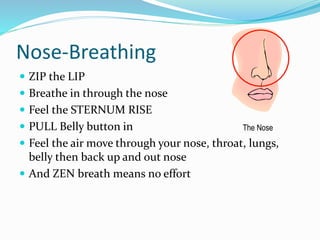
Nose-Breathing
 ZIP the LIP
 Breathe in through the nose
 Feel the STERNUM RISE
 PULL Belly button in
 Feel the air move through your nose, throat, lungs,
belly then back up and out nose
 And ZEN breath means no effort
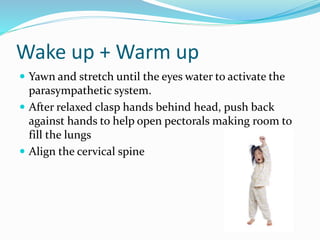
Wake up + Warm up
 Yawn and stretch until the eyes water to activate the
parasympathetic system.
 After relaxed clasp hands behind head, push back
against hands to help open pectorals making room to
fill the lungs
 Align the cervical spine
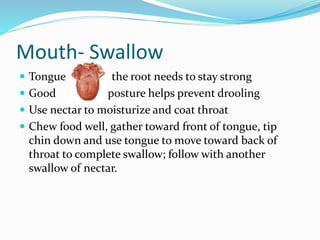
Mouth- Swallow
 Tongue the root needs to stay strong
 Good posture helps prevent drooling
 Use nectar to moisturize and coat throat
 Chew food well, gather toward front of tongue, tip
chin down and use tongue to move toward back of
throat to complete swallow; follow with another
swallow of nectar.
Mouth - Speech
 Breathe, start speaking on the exhale
 Neuro warm up combined thought and movement
 Tongue loosening, cheeks, lips, neck
 Inhale speak on the exhale: AEIOU, say: Lips, Teeth,
Tongue, Jaw
 Krak, Krek, Krik, Krok, Kruk- exercises the larynx
 Martial arts teaches relax, slow to get fast
Face - Expression
 Smile even with a booboo
 Lack of expression often gets interpreted as apathy or
anger
 Keep an internal happy thought to cheer you up
 Neurological decline can be unnoticeable- exercise

(even the face and mouth) can
Bright Eyes
 Follow a pattern with eyes (watch focus)
 Tap next to outside of eye socket doz X
 Under pupil on socket
 Inside eyebrows
 Hold index fingers on tear ducts lightly
 Then blink 25X
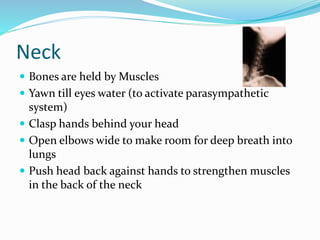
Neck
 Bones are held by Muscles
 Yawn till eyes water (to activate parasympathetic
system)
 Clasp hands behind your head
 Open elbows wide to make room for deep breath into
lungs
 Push head back against hands to strengthen muscles
in the back of the neck
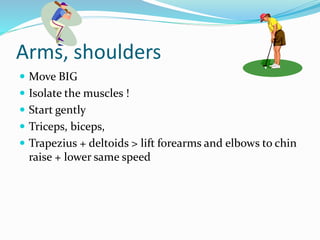
Arms, shoulders
 Move BIG
 Isolate the muscles !
 Start gently
 Triceps, biceps,
 Trapezius + deltoids > lift forearms and elbows to chin
raise + lower same speed
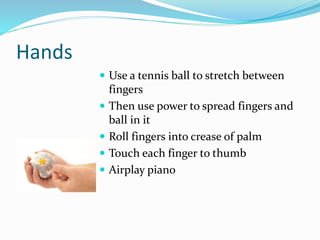
Hands
 Use a tennis ball to stretch between
fingers
 Then use power to spread fingers and
ball in it
 Roll fingers into crease of palm
 Touch each finger to thumb
 Airplay piano
Male Energy Supplements
 Contact medical or pharmacological advisor for
interactions with medication
 Andropause = reduction of Testosterone
 Possible Symptoms = lower libido + energy levels, sleep
disruption, depression, irritability
 Supported by studies
http://www.energytimes.com/pages/departments/1102/sup
psavvy1102.html
 Peroxynitrite for cardio/neuromuscular disorders
 Tribulus terrestric, fenugreek (spice), Panax ginseng,
Rhodiola rosea, mineral zinc, calcium fructate,
polyphenols in grapes/apples
Women’s energy Supplements
 Before using consult medical or pharmacological
advisor
 Menopause = reduction of Estrogen
 Possible symptoms = reduction in libido + energy
levels, sleep disruption, anxiety
 Black Cohosh, Dong quai (Angelica sinensis)Ginseng
(panax ginseng), Kava (Piper methysticum), red clover
(trifolium pratense), soy , DHEA
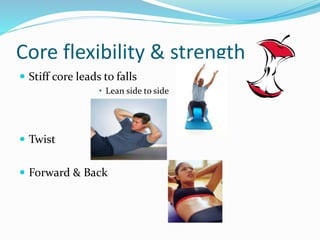
Core flexibility & strength
 Stiff core leads to falls
• Lean side to side
 Twist
 Forward & Back
Heart matter
 DO
 Aerobic exercise
 Remove white, flour, sugar, salt
 Reduce fried foods
 Add
 omega3 oil or Salmon
 Whole grains
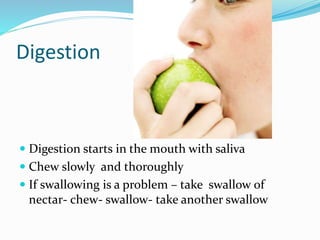
Digestion
 Digestion starts in the mouth with saliva
 Chew slowly and thoroughly
 If swallowing is a problem – take swallow of
nectar- chew- swallow- take another swallow
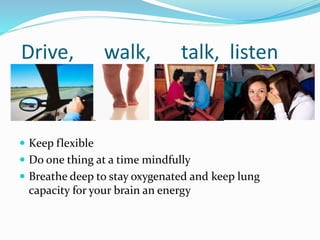
Drive, walk, talk, listen
 Keep flexible
 Do one thing at a time mindfully
 Breathe deep to stay oxygenated and keep lung
capacity for your brain an energy
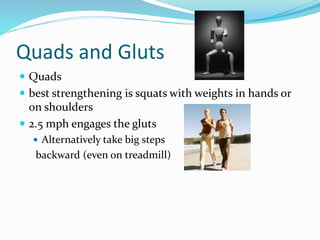
Quads and Gluts
 Quads
 best strengthening is squats with weights in hands or
on shoulders
 2.5 mph engages the gluts
 Alternatively take big steps
backward (even on treadmill)
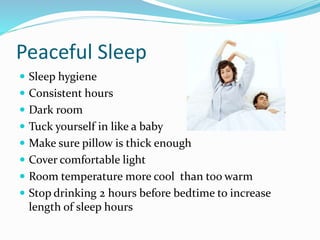
Peaceful Sleep
 Sleep hygiene
 Consistent hours
 Dark room
 Tuck yourself in like a baby
 Make sure pillow is thick enough
 Cover comfortable light
 Room temperature more cool than too warm
 Stop drinking 2 hours before bedtime to increase
length of sleep hours
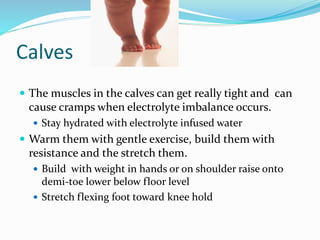
Calves
 The muscles in the calves can get really tight and can
cause cramps when electrolyte imbalance occurs.
 Stay hydrated with electrolyte infused water
 Warm them with gentle exercise, build them with
resistance and the stretch them.
 Build with weight in hands or on shoulder raise onto
demi-toe lower below floor level
 Stretch flexing foot toward knee hold
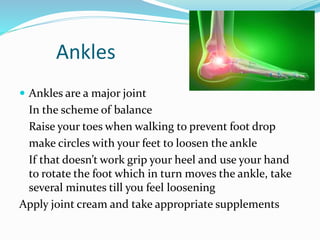
Ankles
 Ankles are a major joint
In the scheme of balance
Raise your toes when walking to prevent foot drop
make circles with your feet to loosen the ankle
If that doesn’t work grip your heel and use your hand
to rotate the foot which in turn moves the ankle, take
several minutes till you feel loosening
Apply joint cream and take appropriate supplements
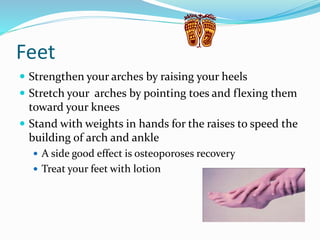
Feet
 Strengthen your arches by raising your heels
 Stretch your arches by pointing toes and flexing them
toward your knees
 Stand with weights in hands for the raises to speed the
building of arch and ankle
 A side good effect is osteoporoses recovery
 Treat your feet with lotion
Basic Exercise
 Main Areas to stay mobile (ambulatory) =get up and
go
 1 squats, side lunges
 2 longer stride to exercise gluts (2.5+ mph)
 3 triceps dips or raises for rising from chair and turning
in bed
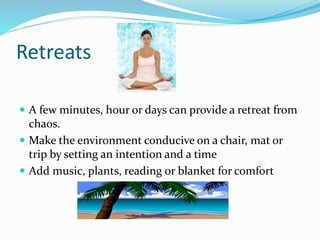
Retreats
 A few minutes, hour or days can provide a retreat from
chaos.
 Make the environment conducive on a chair, mat or
trip by setting an intention and a time
 Add music, plants, reading or blanket for comfort
Complimentary Activities
 Set the scene for a calm environment
 Simplify the environment
 Deep Breath in = peace > exhale toxins
 Ignite a new paradigm of health
Skin I
 This week concentrate on your skin,
 eat well,
 Rest
 Cleanse and moisturize especially in dry climate
outside or in
 Use suntan lotion
Skin II Herbs, Supplements, Lotions
 Silicon, Astataxanthin, Vitamin C & E are preferred
supplemental support.
 Cetaphil, Cerave' and Oil of Olay have been
recommended by my Doctors.
 Of Course Omega 3
 All available at drug, grocery and discount Stores.
Supportive Nutrition
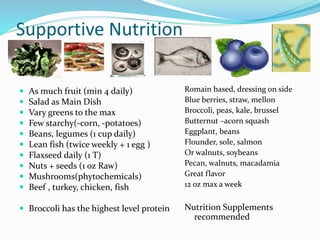
 As much fruit (min 4 daily)
 Salad as Main Dish
 Vary greens to the max
 Few starchy(-corn, -potatoes)
 Beans, legumes (1 cup daily)
 Lean fish (twice weekly + 1 egg )
 Flaxseed daily (1 T)
 Nuts + seeds (1 oz Raw)
 Mushrooms(phytochemicals)
 Beef , turkey, chicken, fish
 Broccoli has the highest level protein
Romain based, dressing on side
Blue berries, straw, mellon
Broccoli, peas, kale, brussel
Butternut –acorn squash
Eggplant, beans
Flounder, sole, salmon
Or walnuts, soybeans
Pecan, walnuts, macadamia
Great flavor
12 oz max a week
Nutrition Supplements
recommended
Supportive Brain Supplements
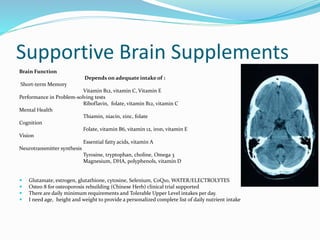
Brain Function
Depends on adequate intake of :
Short-term Memory
Vitamin B12, vitamin C, Vitamin E
Performance in Problem-solving tests
Riboflavin, folate, vitamin B12, vitamin C
Mental Health
Thiamin, niacin, zinc, folate
Cognition
Folate, vitamin B6, vitamin 12, iron, vitamin E
Vision
Essential fatty acids, vitamin A
Neurotransmitter synthesis
Tyrosine, tryptophan, choline, Omega 3
Magnesium, DHA, polyphenols, vitamin D
 Glutamate, estrogen, glutathione, cytosine, Selenium, CoQ10, WATER/ELECTROLYTES
 Osteo 8 for osteoporosis rebuilding (Chinese Herb) clinical trial supported
 There are daily minimum requirements and Tolerable Upper Level intakes per day.
 I need age, height and weight to provide a personalized complete list of daily nutrient intake
Nutritional Stress Support
 Nutritional Stress Relief (Natural and Homeopathic )
 To help calm the nervous system: taurine, glycine, and
GABA (Zeff, 2007);
 “Rescue Remedy” flower essence tincture: (Casler,
2010) available in health food stores like Warehouse
Vitamins.
 Herbs: Valerian, passionflower, or hops and
chamomile (Zeff, 2007)
 A New science measures Organic Acids in Urine,
Specimen can be sent in by mail at
www.Metametrix.com/organix (Casler, 2010)
Some guidelines for supplements
and Seasonings
 Flaxseed 1T
 Flax Oil 1t
 Walnuts 4T
 Soybeans 1 ½ c
 Tofu 1 ½ c
 Tea >Chinese = Jasmine Japanese =Sencha
 Healthy seasoning
 Sweet >powder equal ginger, cinnamon, xylitol
 Flavor >powder turmeric, garlic, ur choice dried leaves
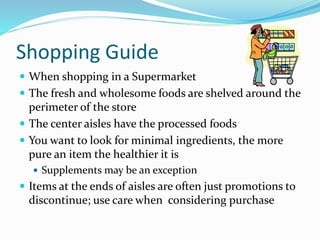
Shopping Guide
 When shopping in a Supermarket
 The fresh and wholesome foods are shelved around the
perimeter of the store
 The center aisles have the processed foods
 You want to look for minimal ingredients, the more
pure an item the healthier it is
 Supplements may be an exception
 Items at the ends of aisles are often just promotions to
discontinue; use care when considering purchase
Sharing
 A new Spirit enters the equation when honest sincere
and gentle sharing of information and feelings occurs
 A better quality of life for all concerned can happen
when that goal is held aloft
 Making choices is avoiding sacrifice, or keeping
sacrifice at a minimum
Relationships
 In relationships changes occur without knowing
 Communication is a bridge to harmony
 Build a system to resolve conflicts
 Pause
 Take personal responsibility for a part
 Apologies for that part
 with questions, search for solutions
Healing Fear
 Building strength is the anti-dote for fear
after physical or emotional incidents
 A slow, cautious progression coupled with
repetition of technical and strategic
moves is part of the way to overcome fear
conscious or subconscious.
 Building on successes however
insignificant they may seem
Meditations
Creating an inner calm by
just concentrating on
breathing first
Stay in the present moment
of OK right now
Do a good thing for yourself
1st & be compassionate with
yourself
Then a good thing for
someone else
Letting Others Help
 People need people
 Embarrassment or pride
are harmful to ourselves
 Do allow others to have
the pleasure doing for us
what we cannot do for
ourselves
Day to Night
 Transition gradually
 Learn how you go from action to leisure
 Schedule time with friends
 Drink healthy beverages and amounts
 Eat healthy snacks and amounts
Solving Sleep Problems
 Use Cognitive behavioral therapy for relationship
issues
 Use progressive relaxation techniques
 Music or white noise
 Stop ruminating
 Try acupuncture
 Avoid alcohol and cigarettes
 Some awakinings will happen, relax
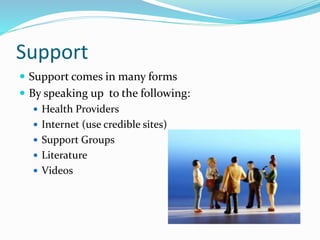
Support
 Support comes in many forms
 By speaking up to the following:
 Health Providers
 Internet (use credible sites)
 Support Groups
 Literature
 Videos
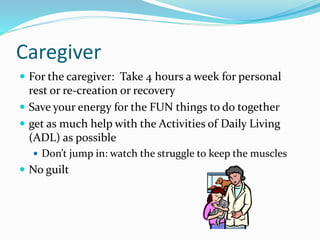
Caregiver
 For the caregiver: Take 4 hours a week for personal
rest or re-creation or recovery
 Save your energy for the FUN things to do together
 get as much help with the Activities of Daily Living
(ADL) as possible
 Don’t jump in: watch the struggle to keep the muscles
 No guilt
Gratitude
 Keep an attitude of gratitude
 Concentrate on the good things in the moment or life
 Do not fulfill a negative prophecy
 Keep a sense of Humor
 Appreciate Caregivers
Calming Food
 Silent inflammation is a major interference with healthy
weight and life
 Dr Weil’s anti-inflammatory Pyramid is easy
http://www.drweil.com/drw/ecs/pyramid/press-
foodpyramid.html
Parkinson’s specific Nutritional plan
http://www.nutritionucanlivewith.com/
Stroke appropriate nutrition
http://www.strokeassociation.org/STROKEORG/LifeAfterStr
oke/HealthyLivingAfterStroke/Nutrition/Nutrition_UCM_
308569_SubHomePage.jsp
Ms
http://www.ehow.com/way_5147446_healthy-eating-plan-
multiple-sclerosis.html
References
 Anthropology 324 The Human Machine Professor David Raichlen University of Arizona
 Argue, John. Parkinson's Disease & The Art of Moving. Oakland: New Harbinger Publications, Inc., 2000. 95-99, 126-
131.
 Farley Ph. D BG, Koshland GF, Prior MM (2004) Learning Big™ decrease bradykinesia in the upper and lower limbs in
people with Parkinson’s disease. Program No. 874.11. 2004 Abstract Viewer and Itinerary Planner. Washington, DC:
Society for Neuroscience, Online.
 Hatfield, Frederick C. Fitness: The Complete Guide. Rev. 7th ed. Santa Barbara: International Sports and Sciences, 2001.
2.7-2.14,15.1-15.16.
 Bose MD, Sue. Sleep and Parkinson’s Disease Lecture to APDA. 2004.
 Montesorri, Maria. The Absorbent Mind. Oxford: ABC-CLIO Ltd., 1988. 130-135.
 Yessis Ph. D., Michael. Kinesiology of Exercise. Columbus: McGraw-Hill, 1992. xi, 3,17,22,49,123,146.
 Pearl, Bill. Keys to the Inner Universe. Pasadena: Physical Fitness Architects, 1982. 28-30.
 Prudden, Bonnie. Myotherapy: Bonnie Prudden's Complete Guide to Pain-Free Living. New York: Dial Press, 1984. 75,
82.
 Fuhrman, M.D. Joel. Eat to Live, Hachettebookgroupusa.com
 Parolisi, NCCAOM Diplomat O.M. parolisi1@wbhsi.net
 Ackerly, MD Mary, mypassion4health.com marymd@mypassion4health.com
 Vera Shury is program director of PARKINSON’STRENGTH™, a program offered by Liberty Science LLC and based upon
the philosophy developed by John Argue in conjunction with Stanford Comprehensive Movement Disorder Center and the
Department of Neurology at Kaiser Permanente. Vera can be contacted at vshury@libertyscience.com
 Zeff, T. (2007). Highly Sensitive Person's Companion. Oakland, CA : New Harbinger Publication, Inc.

Liberty science llc52 weeks of Improvement

  • 1.
    Vera Shury B.A.,C.F.T.,S.D.,A.C.H.M. ©copyright 2013
  • 2.
    Core Belief andChange  Fulfill a positive prophecy  Often our belief is based on misperception or outdated information  Fitness & Health knowledge including Rehabilitation has advanced with amazing results  Just keep an open mind
  • 3.
    Brain synapsis  Ina history of 20 years of clinical trials it has been confirmed that there is a great deal of plasticity in the brain > in other words it is more powerful to heal than we used to believe  New neurons have been found in brain of 70 year olds and over  New pathways were created in brains to overcome dysfunction or injury
  • 4.
    Motor Movement Imagery Imagining the movement as part of preparation done by elite athletes such as Olympians do to train  Imagine rehearsing movement in a strong healthy neuro-muscularly correct bio-mechanical movement
  • 5.
    Adjustments  Changes happenwithout our knowing it until it is pronounced  Keep striving for correct body mechanics, when exercising, walking, sitting  Breath deep  Sternum up!
  • 6.
    Eyes  Eyes arean important part in the function of balance  It is important to keep them exercised with blinks, and following a pattern  Changing focus  After scanning the ground surface; Look straight ahead and use peripheral vision; which includes memory
  • 7.
    Disclosure  Opening thedoor to authentic communication not the superficial “I am ok”
  • 8.
    Ears-Communication  Full attentionlistening with an open heart, mind and soul.  Learning about the changes that affect hearing like lower octaves, and reduction of vibration reception.
  • 9.
    Public Perceptions  Ofvarious human conditions due to ignorance  ie: treating some one with hearing loss as ignorant  Ie: treating a chronic condition as contagious when it is not  Ie: treating someone as a slow brainer when it is only body mechanics that are slow
  • 10.
    Hair cells verysimilar to those in the cochlea
  • 11.
    Your True Self Howdeep is you passion? How Much do you hide? What do you show and express? Do you feel understood? cared about? wanted? Do you express in words and affect your feelings?
  • 12.
    Nose-Breathing  ZIP theLIP  Breathe in through the nose  Feel the STERNUM RISE  PULL Belly button in  Feel the air move through your nose, throat, lungs, belly then back up and out nose  And ZEN breath means no effort
  • 13.
    Wake up +Warm up  Yawn and stretch until the eyes water to activate the parasympathetic system.  After relaxed clasp hands behind head, push back against hands to help open pectorals making room to fill the lungs  Align the cervical spine
  • 14.
    Mouth- Swallow  Tonguethe root needs to stay strong  Good posture helps prevent drooling  Use nectar to moisturize and coat throat  Chew food well, gather toward front of tongue, tip chin down and use tongue to move toward back of throat to complete swallow; follow with another swallow of nectar.
  • 15.
    Mouth - Speech Breathe, start speaking on the exhale  Neuro warm up combined thought and movement  Tongue loosening, cheeks, lips, neck  Inhale speak on the exhale: AEIOU, say: Lips, Teeth, Tongue, Jaw  Krak, Krek, Krik, Krok, Kruk- exercises the larynx  Martial arts teaches relax, slow to get fast
  • 16.
    Face - Expression Smile even with a booboo  Lack of expression often gets interpreted as apathy or anger  Keep an internal happy thought to cheer you up  Neurological decline can be unnoticeable- exercise (even the face and mouth) can
  • 17.
    Bright Eyes  Followa pattern with eyes (watch focus)  Tap next to outside of eye socket doz X  Under pupil on socket  Inside eyebrows  Hold index fingers on tear ducts lightly  Then blink 25X
  • 18.
    Neck  Bones areheld by Muscles  Yawn till eyes water (to activate parasympathetic system)  Clasp hands behind your head  Open elbows wide to make room for deep breath into lungs  Push head back against hands to strengthen muscles in the back of the neck
  • 19.
    Arms, shoulders  MoveBIG  Isolate the muscles !  Start gently  Triceps, biceps,  Trapezius + deltoids > lift forearms and elbows to chin raise + lower same speed
  • 20.
    Hands  Use atennis ball to stretch between fingers  Then use power to spread fingers and ball in it  Roll fingers into crease of palm  Touch each finger to thumb  Airplay piano
  • 21.
    Male Energy Supplements Contact medical or pharmacological advisor for interactions with medication  Andropause = reduction of Testosterone  Possible Symptoms = lower libido + energy levels, sleep disruption, depression, irritability  Supported by studies http://www.energytimes.com/pages/departments/1102/sup psavvy1102.html  Peroxynitrite for cardio/neuromuscular disorders  Tribulus terrestric, fenugreek (spice), Panax ginseng, Rhodiola rosea, mineral zinc, calcium fructate, polyphenols in grapes/apples
  • 22.
    Women’s energy Supplements Before using consult medical or pharmacological advisor  Menopause = reduction of Estrogen  Possible symptoms = reduction in libido + energy levels, sleep disruption, anxiety  Black Cohosh, Dong quai (Angelica sinensis)Ginseng (panax ginseng), Kava (Piper methysticum), red clover (trifolium pratense), soy , DHEA
  • 23.
    Core flexibility &strength  Stiff core leads to falls • Lean side to side  Twist  Forward & Back
  • 24.
    Heart matter  DO Aerobic exercise  Remove white, flour, sugar, salt  Reduce fried foods  Add  omega3 oil or Salmon  Whole grains
  • 25.
    Digestion  Digestion startsin the mouth with saliva  Chew slowly and thoroughly  If swallowing is a problem – take swallow of nectar- chew- swallow- take another swallow
  • 26.
    Drive, walk, talk,listen  Keep flexible  Do one thing at a time mindfully  Breathe deep to stay oxygenated and keep lung capacity for your brain an energy
  • 27.
    Quads and Gluts Quads  best strengthening is squats with weights in hands or on shoulders  2.5 mph engages the gluts  Alternatively take big steps backward (even on treadmill)
  • 28.
    Peaceful Sleep  Sleephygiene  Consistent hours  Dark room  Tuck yourself in like a baby  Make sure pillow is thick enough  Cover comfortable light  Room temperature more cool than too warm  Stop drinking 2 hours before bedtime to increase length of sleep hours
  • 29.
    Calves  The musclesin the calves can get really tight and can cause cramps when electrolyte imbalance occurs.  Stay hydrated with electrolyte infused water  Warm them with gentle exercise, build them with resistance and the stretch them.  Build with weight in hands or on shoulder raise onto demi-toe lower below floor level  Stretch flexing foot toward knee hold
  • 30.
    Ankles  Ankles area major joint In the scheme of balance Raise your toes when walking to prevent foot drop make circles with your feet to loosen the ankle If that doesn’t work grip your heel and use your hand to rotate the foot which in turn moves the ankle, take several minutes till you feel loosening Apply joint cream and take appropriate supplements
  • 31.
    Feet  Strengthen yourarches by raising your heels  Stretch your arches by pointing toes and flexing them toward your knees  Stand with weights in hands for the raises to speed the building of arch and ankle  A side good effect is osteoporoses recovery  Treat your feet with lotion
  • 32.
    Basic Exercise  MainAreas to stay mobile (ambulatory) =get up and go  1 squats, side lunges  2 longer stride to exercise gluts (2.5+ mph)  3 triceps dips or raises for rising from chair and turning in bed
  • 33.
    Retreats  A fewminutes, hour or days can provide a retreat from chaos.  Make the environment conducive on a chair, mat or trip by setting an intention and a time  Add music, plants, reading or blanket for comfort
  • 34.
    Complimentary Activities  Setthe scene for a calm environment  Simplify the environment  Deep Breath in = peace > exhale toxins  Ignite a new paradigm of health
  • 35.
    Skin I  Thisweek concentrate on your skin,  eat well,  Rest  Cleanse and moisturize especially in dry climate outside or in  Use suntan lotion
  • 36.
    Skin II Herbs,Supplements, Lotions  Silicon, Astataxanthin, Vitamin C & E are preferred supplemental support.  Cetaphil, Cerave' and Oil of Olay have been recommended by my Doctors.  Of Course Omega 3  All available at drug, grocery and discount Stores.
  • 37.
    Supportive Nutrition  Asmuch fruit (min 4 daily)  Salad as Main Dish  Vary greens to the max  Few starchy(-corn, -potatoes)  Beans, legumes (1 cup daily)  Lean fish (twice weekly + 1 egg )  Flaxseed daily (1 T)  Nuts + seeds (1 oz Raw)  Mushrooms(phytochemicals)  Beef , turkey, chicken, fish  Broccoli has the highest level protein Romain based, dressing on side Blue berries, straw, mellon Broccoli, peas, kale, brussel Butternut –acorn squash Eggplant, beans Flounder, sole, salmon Or walnuts, soybeans Pecan, walnuts, macadamia Great flavor 12 oz max a week Nutrition Supplements recommended
  • 38.
    Supportive Brain Supplements BrainFunction Depends on adequate intake of : Short-term Memory Vitamin B12, vitamin C, Vitamin E Performance in Problem-solving tests Riboflavin, folate, vitamin B12, vitamin C Mental Health Thiamin, niacin, zinc, folate Cognition Folate, vitamin B6, vitamin 12, iron, vitamin E Vision Essential fatty acids, vitamin A Neurotransmitter synthesis Tyrosine, tryptophan, choline, Omega 3 Magnesium, DHA, polyphenols, vitamin D  Glutamate, estrogen, glutathione, cytosine, Selenium, CoQ10, WATER/ELECTROLYTES  Osteo 8 for osteoporosis rebuilding (Chinese Herb) clinical trial supported  There are daily minimum requirements and Tolerable Upper Level intakes per day.  I need age, height and weight to provide a personalized complete list of daily nutrient intake
  • 39.
    Nutritional Stress Support Nutritional Stress Relief (Natural and Homeopathic )  To help calm the nervous system: taurine, glycine, and GABA (Zeff, 2007);  “Rescue Remedy” flower essence tincture: (Casler, 2010) available in health food stores like Warehouse Vitamins.  Herbs: Valerian, passionflower, or hops and chamomile (Zeff, 2007)  A New science measures Organic Acids in Urine, Specimen can be sent in by mail at www.Metametrix.com/organix (Casler, 2010)
  • 40.
    Some guidelines forsupplements and Seasonings  Flaxseed 1T  Flax Oil 1t  Walnuts 4T  Soybeans 1 ½ c  Tofu 1 ½ c  Tea >Chinese = Jasmine Japanese =Sencha  Healthy seasoning  Sweet >powder equal ginger, cinnamon, xylitol  Flavor >powder turmeric, garlic, ur choice dried leaves
  • 41.
    Shopping Guide  Whenshopping in a Supermarket  The fresh and wholesome foods are shelved around the perimeter of the store  The center aisles have the processed foods  You want to look for minimal ingredients, the more pure an item the healthier it is  Supplements may be an exception  Items at the ends of aisles are often just promotions to discontinue; use care when considering purchase
  • 42.
    Sharing  A newSpirit enters the equation when honest sincere and gentle sharing of information and feelings occurs  A better quality of life for all concerned can happen when that goal is held aloft  Making choices is avoiding sacrifice, or keeping sacrifice at a minimum
  • 43.
    Relationships  In relationshipschanges occur without knowing  Communication is a bridge to harmony  Build a system to resolve conflicts  Pause  Take personal responsibility for a part  Apologies for that part  with questions, search for solutions
  • 44.
    Healing Fear  Buildingstrength is the anti-dote for fear after physical or emotional incidents  A slow, cautious progression coupled with repetition of technical and strategic moves is part of the way to overcome fear conscious or subconscious.  Building on successes however insignificant they may seem
  • 45.
    Meditations Creating an innercalm by just concentrating on breathing first Stay in the present moment of OK right now Do a good thing for yourself 1st & be compassionate with yourself Then a good thing for someone else
  • 46.
    Letting Others Help People need people  Embarrassment or pride are harmful to ourselves  Do allow others to have the pleasure doing for us what we cannot do for ourselves
  • 47.
    Day to Night Transition gradually  Learn how you go from action to leisure  Schedule time with friends  Drink healthy beverages and amounts  Eat healthy snacks and amounts
  • 48.
    Solving Sleep Problems Use Cognitive behavioral therapy for relationship issues  Use progressive relaxation techniques  Music or white noise  Stop ruminating  Try acupuncture  Avoid alcohol and cigarettes  Some awakinings will happen, relax
  • 49.
    Support  Support comesin many forms  By speaking up to the following:  Health Providers  Internet (use credible sites)  Support Groups  Literature  Videos
  • 50.
    Caregiver  For thecaregiver: Take 4 hours a week for personal rest or re-creation or recovery  Save your energy for the FUN things to do together  get as much help with the Activities of Daily Living (ADL) as possible  Don’t jump in: watch the struggle to keep the muscles  No guilt
  • 51.
    Gratitude  Keep anattitude of gratitude  Concentrate on the good things in the moment or life  Do not fulfill a negative prophecy  Keep a sense of Humor  Appreciate Caregivers
  • 52.
    Calming Food  Silentinflammation is a major interference with healthy weight and life  Dr Weil’s anti-inflammatory Pyramid is easy http://www.drweil.com/drw/ecs/pyramid/press- foodpyramid.html Parkinson’s specific Nutritional plan http://www.nutritionucanlivewith.com/ Stroke appropriate nutrition http://www.strokeassociation.org/STROKEORG/LifeAfterStr oke/HealthyLivingAfterStroke/Nutrition/Nutrition_UCM_ 308569_SubHomePage.jsp Ms http://www.ehow.com/way_5147446_healthy-eating-plan- multiple-sclerosis.html
  • 53.
    References  Anthropology 324The Human Machine Professor David Raichlen University of Arizona  Argue, John. Parkinson's Disease & The Art of Moving. Oakland: New Harbinger Publications, Inc., 2000. 95-99, 126- 131.  Farley Ph. D BG, Koshland GF, Prior MM (2004) Learning Big™ decrease bradykinesia in the upper and lower limbs in people with Parkinson’s disease. Program No. 874.11. 2004 Abstract Viewer and Itinerary Planner. Washington, DC: Society for Neuroscience, Online.  Hatfield, Frederick C. Fitness: The Complete Guide. Rev. 7th ed. Santa Barbara: International Sports and Sciences, 2001. 2.7-2.14,15.1-15.16.  Bose MD, Sue. Sleep and Parkinson’s Disease Lecture to APDA. 2004.  Montesorri, Maria. The Absorbent Mind. Oxford: ABC-CLIO Ltd., 1988. 130-135.  Yessis Ph. D., Michael. Kinesiology of Exercise. Columbus: McGraw-Hill, 1992. xi, 3,17,22,49,123,146.  Pearl, Bill. Keys to the Inner Universe. Pasadena: Physical Fitness Architects, 1982. 28-30.  Prudden, Bonnie. Myotherapy: Bonnie Prudden's Complete Guide to Pain-Free Living. New York: Dial Press, 1984. 75, 82.  Fuhrman, M.D. Joel. Eat to Live, Hachettebookgroupusa.com  Parolisi, NCCAOM Diplomat O.M. parolisi1@wbhsi.net  Ackerly, MD Mary, mypassion4health.com marymd@mypassion4health.com  Vera Shury is program director of PARKINSON’STRENGTH™, a program offered by Liberty Science LLC and based upon the philosophy developed by John Argue in conjunction with Stanford Comprehensive Movement Disorder Center and the Department of Neurology at Kaiser Permanente. Vera can be contacted at vshury@libertyscience.com  Zeff, T. (2007). Highly Sensitive Person's Companion. Oakland, CA : New Harbinger Publication, Inc.