NEURORADIOLOGY
DIL part 2
An approach to head CT interpretation
K. Agyem MD, G. Hall MD, D. Palathinkal MD, Alexandre
Menard
March/April 2015
OVERVIEW
• Introduction to Neuroimaging - DIL part 1
• Basic Brain Anatomy - DIL part 1
• Standardized Approach to Image Interpretation - DIL part 2
• Common Pathology
• Bleeds (Hemorrhages) - DIL part 3
• Strokes (Infarcts) DIL part 4
• Masses (Tumors) part 5
APPROACH TO CT
• The most important thing is to use the same
approach every time! We will go through an
example approach.
• Use different window settings (ie brain vs bone
windows).
• Use different planes (axials, coronals and
sagittals).
EXAMPLE APPROACH
• Extra-axial space
• Intra-axial space
• Bones
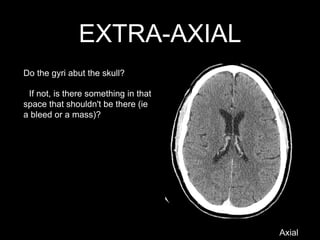
EXTRA-AXIAL
Axial
Do the gyri abut the skull?
If not, is there something in that
space that shouldn't be there (ie
a bleed or a mass)?
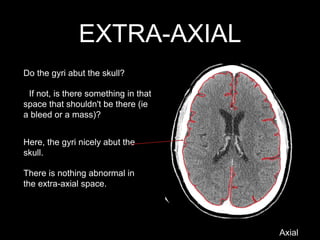
EXTRA-AXIAL
Do the gyri abut the skull?
If not, is there something in that
space that shouldn't be there (ie
a bleed or a mass)?
Here, the gyri nicely abut the
skull.
There is nothing abnormal in
the extra-axial space.
Axial
EXTRA-AXIAL
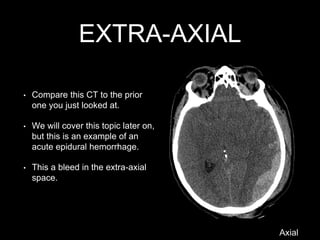
• Compare this CT to the prior
one you just looked at.
• We will cover this topic later on,
but this is an example of an
acute epidural hemorrhage.
• This a bleed in the extra-axial
space.
Axial
EXTRA-AXIAL
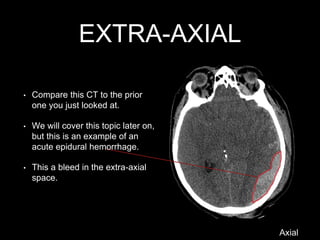
• Compare this CT to the prior
one you just looked at.
• We will cover this topic later on,
but this is an example of an
acute epidural hemorrhage.
• This a bleed in the extra-axial
space.
Axial
EXTRA-AXIAL
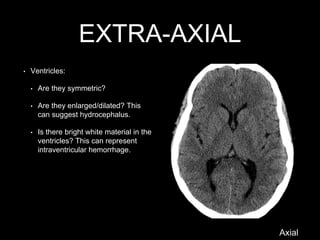
• Ventricles:
• Are they symmetric?
• Are they enlarged/dilated? This
can suggest hydrocephalus.
• Is there bright white material in the
ventricles? This can represent
intraventricular hemorrhage.
Axial
EXTRA-AXIAL
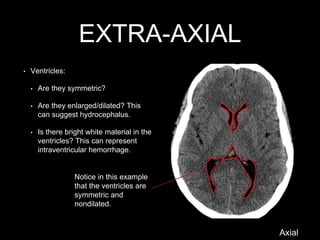
Notice in this example
that the ventricles are
symmetric and
nondilated.
Axial
• Ventricles:
• Are they symmetric?
• Are they enlarged/dilated? This
can suggest hydrocephalus.
• Is there bright white material in the
ventricles? This can represent
intraventricular hemorrhage.
EXTRA-AXIAL
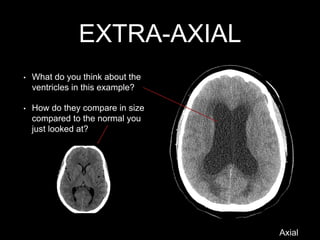
• What do you think about the
ventricles in this example?
• How do they compare in size
compared to the normal you
just looked at?
Axial
EXTRA-AXIAL
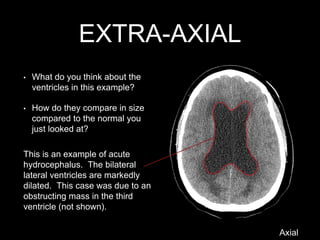
This is an example of acute
hydrocephalus. The bilateral
lateral ventricles are markedly
dilated. This case was due to an
obstructing mass in the third
ventricle (not shown).
• What do you think about the
ventricles in this example?
• How do they compare in size
compared to the normal you
just looked at?
Axial
EXTRA-AXIAL
Axial
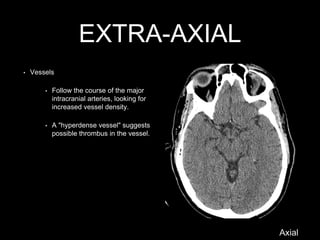
• Vessels
• Follow the course of the major
intracranial arteries, looking for
increased vessel density.
• A "hyperdense vessel" suggests
possible thrombus in the vessel.
EXTRA-AXIAL
• Vessels
• Follow the course of the major
intracranial arteries, looking for
increased vessel density.
• A "hyperdense vessel" suggests
possible thrombus in the vessel.
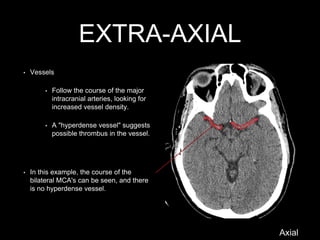
• In this example, the course of the
bilateral MCA's can be seen, and there
is no hyperdense vessel.
Axial
EXTRA-AXIAL
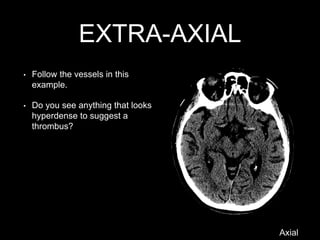
• Follow the vessels in this
example.
• Do you see anything that looks
hyperdense to suggest a
thrombus?
Axial
EXTRA-AXIAL
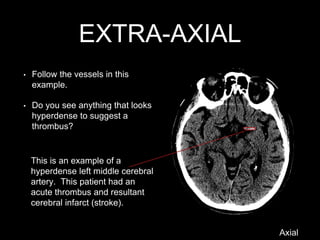
• Follow the vessels in this
example.
• Do you see anything that looks
hyperdense to suggest a
thrombus?
This is an example of a
hyperdense left middle cerebral
artery. This patient had an
acute thrombus and resultant
cerebral infarct (stroke).
Axial
INTRA-AXIAL
• Are the midline structures present and normal appearing?
• Are there any masses?
• Is there mass effect?
• Is there "effacement" of cortical sulci?
• Is there any brain herniation? We will cover this in a
minute.
• Are the basal ganglia present and symmetric?
INTRA-AXIAL
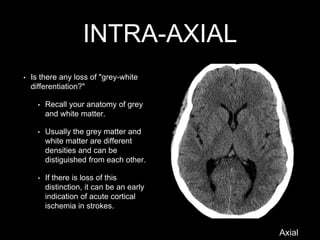
• Is there any loss of "grey-white
differentiation?"
• Recall your anatomy of grey
and white matter.
• Usually the grey matter and
white matter are different
densities and can be
distiguished from each other.
• If there is loss of this
distinction, it can be an early
indication of acute cortical
ischemia in strokes.
Axial
INTRA-AXIAL
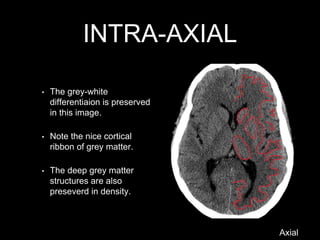
• The grey-white
differentiaion is preserved
in this image.
• Note the nice cortical
ribbon of grey matter.
• The deep grey matter
structures are also
preseverd in density.
Axial
INTRA-AXIAL
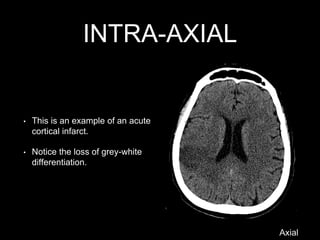
• This is an example of an acute
cortical infarct.
• Notice the loss of grey-white
differentiation.
Axial
INTRA-AXIAL
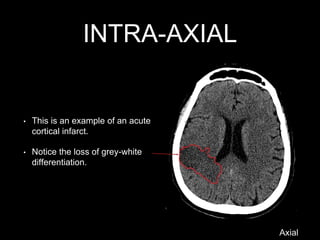
• This is an example of an acute
cortical infarct.
• Notice the loss of grey-white
differentiation.
Axial
HERNIATION
• The volume of the intracranial space is fixed. It
contains brain tissue, CSF and blood vessels.
• In pathologic states, if there is an intracranial space
occupying lesion (eg. bleed, tumor, edema), mass
effect can result. This can displace brain tissue
under/over/through fixed structures. This process
is called herniation.
• The following slide demonstrates some of the
common herniation syndromes.
HERNIATION
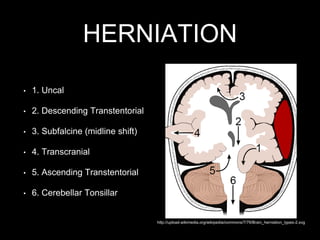
• 1. Uncal
• 2. Descending Transtentorial
• 3. Subfalcine (midline shift)
• 4. Transcranial
• 5. Ascending Transtentorial
• 6. Cerebellar Tonsillar
http://upload.wikimedia.org/wikipedia/commons/7/79/Brain_herniation_types-2.svg
HERNIATION
Axial
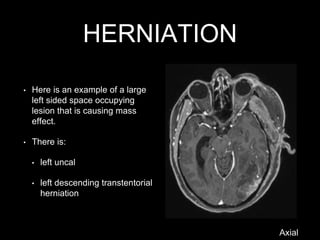
• Here is an example of a large
left sided space occupying
lesion that is causing mass
effect.
• There is:
• left uncal
• left descending transtentorial
herniation
HERNIATION
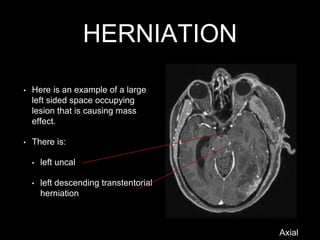
• Here is an example of a large
left sided space occupying
lesion that is causing mass
effect.
• There is:
• left uncal
• left descending transtentorial
herniation
Axial
HERNIATION
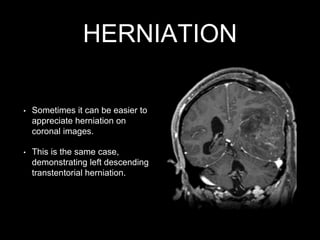
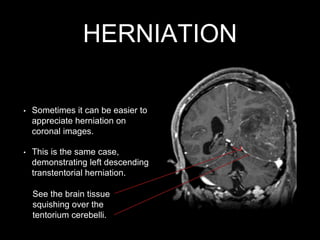
• Sometimes it can be easier to
appreciate herniation on
coronal images.
• This is the same case,
demonstrating left descending
transtentorial herniation.
HERNIATION
• Sometimes it can be easier to
appreciate herniation on
coronal images.
• This is the same case,
demonstrating left descending
transtentorial herniation.
See the brain tissue
squishing over the
tentorium cerebelli.
BONES
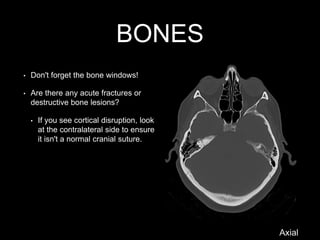
• Don't forget the bone windows!
• Are there any acute fractures or
destructive bone lesions?
• If you see cortical disruption, look
at the contralateral side to ensure
it isn't a normal cranial suture.
Axial
BONES
• Don't forget the bone windows!
• Are there any acute fractures or
destructive bone lesions?
• If you see cortical disruption, look
at the contralateral side to ensure
it isn't a normal cranial suture.
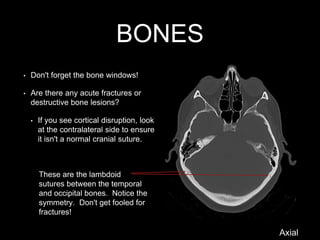
These are the lambdoid
sutures between the temporal
and occipital bones. Notice the
symmetry. Don't get fooled for
fractures!
Axial
BONES
• Don't forget the bone windows!
• Are there any acute fractures or
destructive bone lesions?
• If you see cortical disruption, look
at the contralateral side to ensure
it isn't a normal cranial suture.
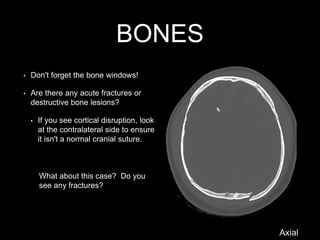
What about this case? Do you
see any fractures?
Axial
BONES
• Don't forget the bone windows!
• Are there any acute fractures or
destructive bone lesions?
• If you see cortical disruption, look
at the contralateral side to ensure
it isn't a normal cranial suture.
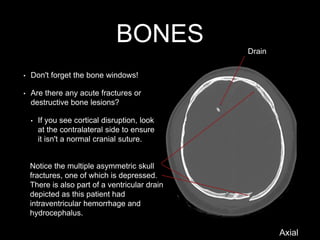
Notice the multiple asymmetric skull
fractures, one of which is depressed.
There is also part of a ventricular drain
depicted as this patient had
intraventricular hemorrhage and
hydrocephalus.
Drain
Axial
• Introduction to Neuroimaging - DIL part 1
• Basic Brain Anatomy - DIL part 1
• Standardized Approach to Image Interpretation - DIL part 2
• Common Pathology
• Bleeds (Hemorrhages) - DIL part 3
• Strokes (Infarcts) DIL part 4
• Masses (Tumors) part 5
End of module 2
neuro_module_part_2.pdf interpretation d'un ct scan

  • 1.
    NEURORADIOLOGY DIL part 2 Anapproach to head CT interpretation K. Agyem MD, G. Hall MD, D. Palathinkal MD, Alexandre Menard March/April 2015
  • 2.
    OVERVIEW • Introduction toNeuroimaging - DIL part 1 • Basic Brain Anatomy - DIL part 1 • Standardized Approach to Image Interpretation - DIL part 2 • Common Pathology • Bleeds (Hemorrhages) - DIL part 3 • Strokes (Infarcts) DIL part 4 • Masses (Tumors) part 5
  • 3.
    APPROACH TO CT •The most important thing is to use the same approach every time! We will go through an example approach. • Use different window settings (ie brain vs bone windows). • Use different planes (axials, coronals and sagittals).
  • 4.
    EXAMPLE APPROACH • Extra-axialspace • Intra-axial space • Bones
  • 5.
    EXTRA-AXIAL Axial Do the gyriabut the skull? If not, is there something in that space that shouldn't be there (ie a bleed or a mass)?
  • 6.
    EXTRA-AXIAL Do the gyriabut the skull? If not, is there something in that space that shouldn't be there (ie a bleed or a mass)? Here, the gyri nicely abut the skull. There is nothing abnormal in the extra-axial space. Axial
  • 7.
    EXTRA-AXIAL • Compare thisCT to the prior one you just looked at. • We will cover this topic later on, but this is an example of an acute epidural hemorrhage. • This a bleed in the extra-axial space. Axial
  • 8.
    EXTRA-AXIAL • Compare thisCT to the prior one you just looked at. • We will cover this topic later on, but this is an example of an acute epidural hemorrhage. • This a bleed in the extra-axial space. Axial
  • 9.
    EXTRA-AXIAL • Ventricles: • Arethey symmetric? • Are they enlarged/dilated? This can suggest hydrocephalus. • Is there bright white material in the ventricles? This can represent intraventricular hemorrhage. Axial
  • 10.
    EXTRA-AXIAL Notice in thisexample that the ventricles are symmetric and nondilated. Axial • Ventricles: • Are they symmetric? • Are they enlarged/dilated? This can suggest hydrocephalus. • Is there bright white material in the ventricles? This can represent intraventricular hemorrhage.
  • 11.
    EXTRA-AXIAL • What doyou think about the ventricles in this example? • How do they compare in size compared to the normal you just looked at? Axial
  • 12.
    EXTRA-AXIAL This is anexample of acute hydrocephalus. The bilateral lateral ventricles are markedly dilated. This case was due to an obstructing mass in the third ventricle (not shown). • What do you think about the ventricles in this example? • How do they compare in size compared to the normal you just looked at? Axial
  • 13.
    EXTRA-AXIAL Axial • Vessels • Followthe course of the major intracranial arteries, looking for increased vessel density. • A "hyperdense vessel" suggests possible thrombus in the vessel.
  • 14.
    EXTRA-AXIAL • Vessels • Followthe course of the major intracranial arteries, looking for increased vessel density. • A "hyperdense vessel" suggests possible thrombus in the vessel. • In this example, the course of the bilateral MCA's can be seen, and there is no hyperdense vessel. Axial
  • 15.
    EXTRA-AXIAL • Follow thevessels in this example. • Do you see anything that looks hyperdense to suggest a thrombus? Axial
  • 16.
    EXTRA-AXIAL • Follow thevessels in this example. • Do you see anything that looks hyperdense to suggest a thrombus? This is an example of a hyperdense left middle cerebral artery. This patient had an acute thrombus and resultant cerebral infarct (stroke). Axial
  • 17.
    INTRA-AXIAL • Are themidline structures present and normal appearing? • Are there any masses? • Is there mass effect? • Is there "effacement" of cortical sulci? • Is there any brain herniation? We will cover this in a minute. • Are the basal ganglia present and symmetric?
  • 18.
    INTRA-AXIAL • Is thereany loss of "grey-white differentiation?" • Recall your anatomy of grey and white matter. • Usually the grey matter and white matter are different densities and can be distiguished from each other. • If there is loss of this distinction, it can be an early indication of acute cortical ischemia in strokes. Axial
  • 19.
    INTRA-AXIAL • The grey-white differentiaionis preserved in this image. • Note the nice cortical ribbon of grey matter. • The deep grey matter structures are also preseverd in density. Axial
  • 20.
    INTRA-AXIAL • This isan example of an acute cortical infarct. • Notice the loss of grey-white differentiation. Axial
  • 21.
    INTRA-AXIAL • This isan example of an acute cortical infarct. • Notice the loss of grey-white differentiation. Axial
  • 22.
    HERNIATION • The volumeof the intracranial space is fixed. It contains brain tissue, CSF and blood vessels. • In pathologic states, if there is an intracranial space occupying lesion (eg. bleed, tumor, edema), mass effect can result. This can displace brain tissue under/over/through fixed structures. This process is called herniation. • The following slide demonstrates some of the common herniation syndromes.
  • 23.
    HERNIATION • 1. Uncal •2. Descending Transtentorial • 3. Subfalcine (midline shift) • 4. Transcranial • 5. Ascending Transtentorial • 6. Cerebellar Tonsillar http://upload.wikimedia.org/wikipedia/commons/7/79/Brain_herniation_types-2.svg
  • 24.
    HERNIATION Axial • Here isan example of a large left sided space occupying lesion that is causing mass effect. • There is: • left uncal • left descending transtentorial herniation
  • 25.
    HERNIATION • Here isan example of a large left sided space occupying lesion that is causing mass effect. • There is: • left uncal • left descending transtentorial herniation Axial
  • 26.
    HERNIATION • Sometimes itcan be easier to appreciate herniation on coronal images. • This is the same case, demonstrating left descending transtentorial herniation.
  • 27.
    HERNIATION • Sometimes itcan be easier to appreciate herniation on coronal images. • This is the same case, demonstrating left descending transtentorial herniation. See the brain tissue squishing over the tentorium cerebelli.
  • 28.
    BONES • Don't forgetthe bone windows! • Are there any acute fractures or destructive bone lesions? • If you see cortical disruption, look at the contralateral side to ensure it isn't a normal cranial suture. Axial
  • 29.
    BONES • Don't forgetthe bone windows! • Are there any acute fractures or destructive bone lesions? • If you see cortical disruption, look at the contralateral side to ensure it isn't a normal cranial suture. These are the lambdoid sutures between the temporal and occipital bones. Notice the symmetry. Don't get fooled for fractures! Axial
  • 30.
    BONES • Don't forgetthe bone windows! • Are there any acute fractures or destructive bone lesions? • If you see cortical disruption, look at the contralateral side to ensure it isn't a normal cranial suture. What about this case? Do you see any fractures? Axial
  • 31.
    BONES • Don't forgetthe bone windows! • Are there any acute fractures or destructive bone lesions? • If you see cortical disruption, look at the contralateral side to ensure it isn't a normal cranial suture. Notice the multiple asymmetric skull fractures, one of which is depressed. There is also part of a ventricular drain depicted as this patient had intraventricular hemorrhage and hydrocephalus. Drain Axial
  • 32.
    • Introduction toNeuroimaging - DIL part 1 • Basic Brain Anatomy - DIL part 1 • Standardized Approach to Image Interpretation - DIL part 2 • Common Pathology • Bleeds (Hemorrhages) - DIL part 3 • Strokes (Infarcts) DIL part 4 • Masses (Tumors) part 5 End of module 2