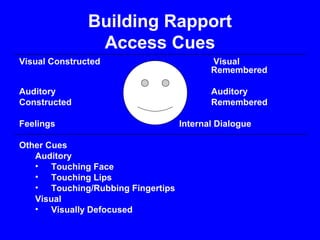
Building Rapport
Access Cues
Visual Constructed Visual
Remembered
Auditory Auditory
Constructed Remembered
Feelings Internal Dialogue
Other Cues
Auditory
• Touching Face
• Touching Lips
• Touching/Rubbing Fingertips
Visual
• Visually Defocused
Building Rapport
Questions and Access Cues
• Visual
– How does that look to you?
– Do you see what I mean?
• Auditory
– Does that sound good to you?
• Internal Dialogue
– What do you say to yourself about that?
• Feelings
– How would you feel about that?
Neuro Linguistic
Programming
Linguistic
Language and nonverbal
communication systems
through which neural
representations are coded,
ordered, and given meaning.
Programming
The ability to organize our
communication and
neurological systems to
achieve specific desired
goals and results.
Neuro
Nervous system through
which experience is
received and processed
through the five senses.
http://www.purenlp.com/nlpis1.htm
“…the study
of the
structure of
subjective
experience.”
www.richardbandler.tv
Roots of NLP
“The Structure of Magic” volume
1, Richard Bandler & John
Virginia Satir
Fritz Perls
Frank Farrelly
Milton Erickson
Others
Transformational
Grammar
Roots of NLP

Family Therapy
Congruence
Groups
Change
Gestalt Therapy
Context
Provocative Therapy
Attitude
Humour
Challenge
Explore limits
Honesty
Hypnosis
Ambiguity
Conversational Change
George Miller
Gregory Bateson
Alfred Korzybski
Edward Sapir
Mathematical Logic
Deep structure
Surface Structure
Deletion
Distortion
Generalization
[NLP is a Synthesis]
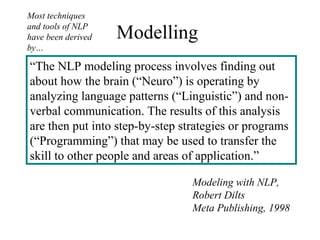
Modelling
“The NLP modeling process involves finding out
about how the brain (“Neuro”) is operating by
analyzing language patterns (“Linguistic”) and non-
verbal communication. The results of this analysis
are then put into step-by-step strategies or programs
(“Programming”) that may be used to transfer the
skill to other people and areas of application.”
Modeling with NLP,
Robert Dilts
Meta Publishing, 1998
Most techniques
and tools of NLP
have been derived
by…
On The Web
• www.purenlp.com
• www.richardbandler.tv
• www.paulmckenna.com
• www.saladltd.co.uk
• www.nlp.biz/NLP
• www.compendiumdev.co.uk/nlp
• www.23nlpeople.com/NLP_links.htm

Neuro Linguistic Programming (artificial intelligence)

  • 2.
    Building Rapport Access Cues VisualConstructed Visual Remembered Auditory Auditory Constructed Remembered Feelings Internal Dialogue Other Cues Auditory • Touching Face • Touching Lips • Touching/Rubbing Fingertips Visual • Visually Defocused
  • 3.
    Building Rapport Questions andAccess Cues • Visual – How does that look to you? – Do you see what I mean? • Auditory – Does that sound good to you? • Internal Dialogue – What do you say to yourself about that? • Feelings – How would you feel about that?
  • 4.
    Neuro Linguistic Programming Linguistic Language andnonverbal communication systems through which neural representations are coded, ordered, and given meaning. Programming The ability to organize our communication and neurological systems to achieve specific desired goals and results. Neuro Nervous system through which experience is received and processed through the five senses. http://www.purenlp.com/nlpis1.htm “…the study of the structure of subjective experience.” www.richardbandler.tv
  • 5.
    Roots of NLP “TheStructure of Magic” volume 1, Richard Bandler & John Virginia Satir Fritz Perls Frank Farrelly Milton Erickson Others Transformational Grammar Roots of NLP  Family Therapy Congruence Groups Change Gestalt Therapy Context Provocative Therapy Attitude Humour Challenge Explore limits Honesty Hypnosis Ambiguity Conversational Change George Miller Gregory Bateson Alfred Korzybski Edward Sapir Mathematical Logic Deep structure Surface Structure Deletion Distortion Generalization [NLP is a Synthesis]
  • 6.
    Modelling “The NLP modelingprocess involves finding out about how the brain (“Neuro”) is operating by analyzing language patterns (“Linguistic”) and non- verbal communication. The results of this analysis are then put into step-by-step strategies or programs (“Programming”) that may be used to transfer the skill to other people and areas of application.” Modeling with NLP, Robert Dilts Meta Publishing, 1998 Most techniques and tools of NLP have been derived by…
  • 7.
    On The Web •www.purenlp.com • www.richardbandler.tv • www.paulmckenna.com • www.saladltd.co.uk • www.nlp.biz/NLP • www.compendiumdev.co.uk/nlp • www.23nlpeople.com/NLP_links.htm

Editor's Notes

  • #7 Summary of Modelling: What was ‘that’? What is ‘This’? What are the differences? What ‘has’ to be there. What else ‘could’ be there.