Climate	
  Change	
  Adapta/on	
  and	
  Mi/ga/on	
  in	
  Agriculture	


          Rewards	
  for	
  mi-ga-on	


                       Henry	
  Neufeldt,	
  ICRAF	
  

                      CCAFS	
  Science	
  Workshop	
  
            Playa	
  del	
  Carmen,	
  1-­‐2	
  December	
  2010	
  
Payments	
  for	
  Environmental	
  Services	
  (PES)	


•  Wunder	
  (2005)	
  

•  Five	
  general	
  criteria	
  for	
  successful	
  PES	
  schemes:	
  

       •  Voluntary	
  transac-ons	
  

       •  Well	
  defined	
  ES	
  

       •  At	
  least	
  one	
  buyer	
  of	
  ES	
  

       •  At	
  least	
  one	
  provider	
  of	
  ES	
  

       •  Payment	
  condi-onal	
  upon	
  delivery	
  of	
  ES	
  
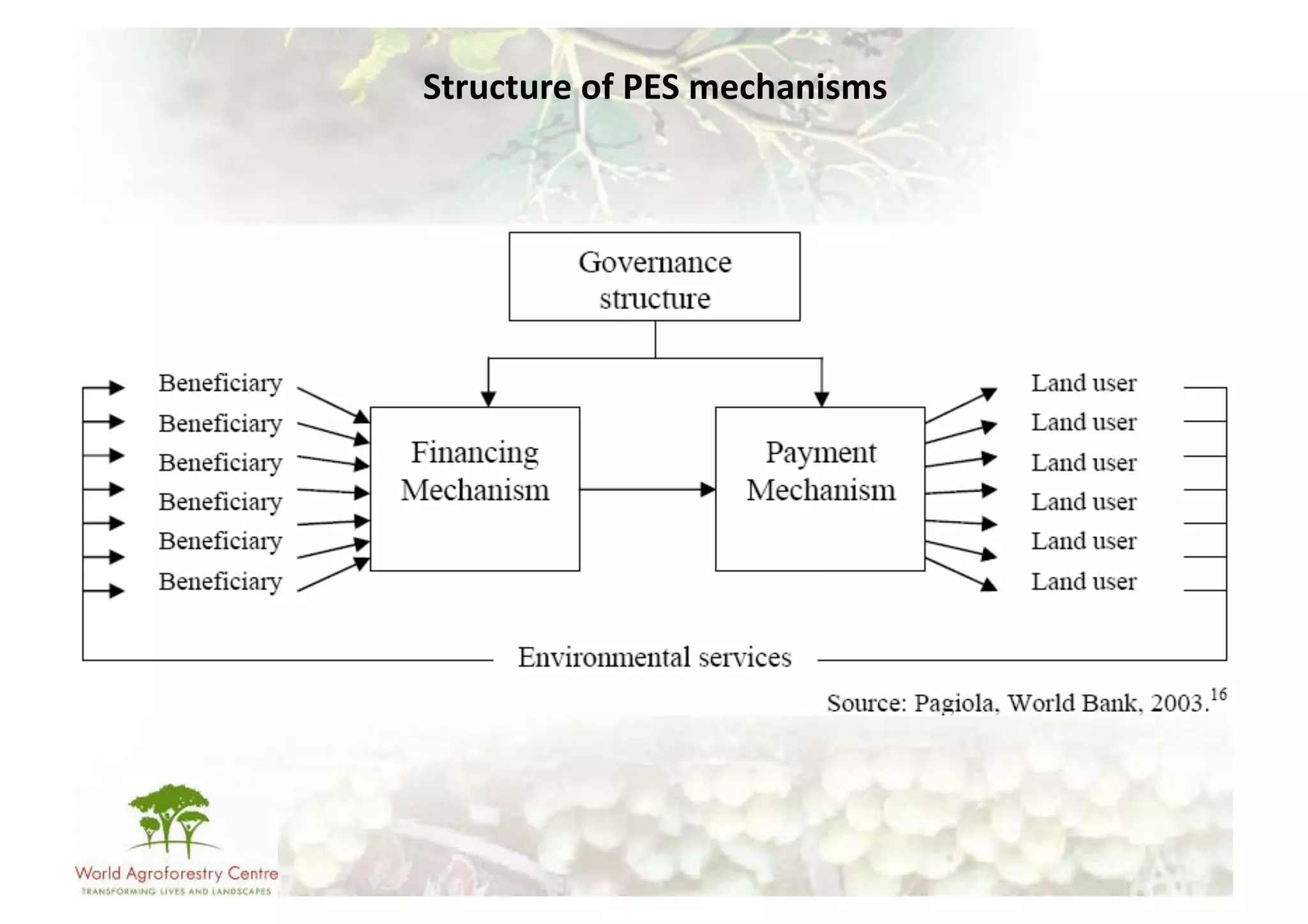
Structure	
  of	
  PES	
  mechanisms	
  
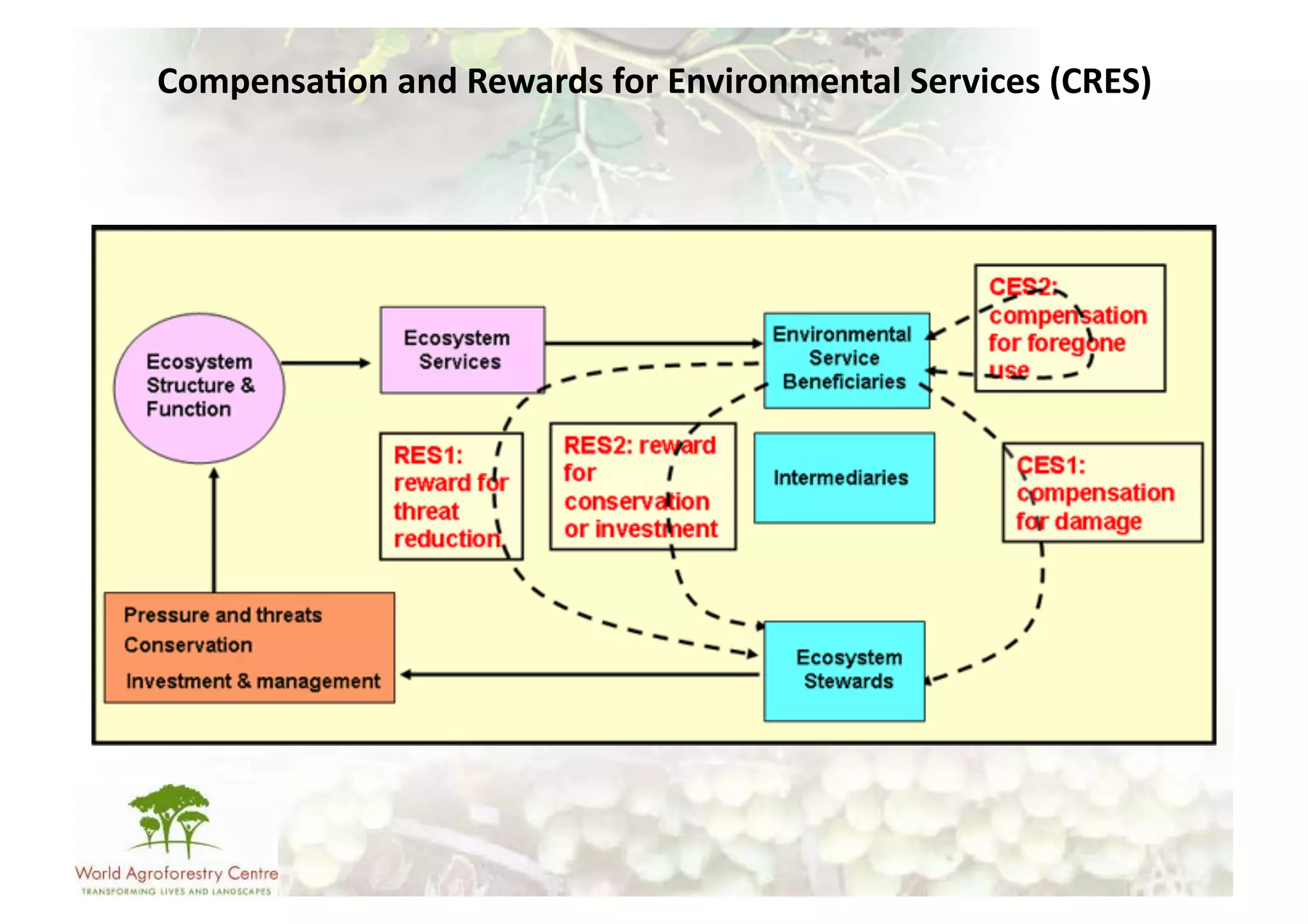
Compensa/on	
  and	
  Rewards	
  for	
  Environmental	
  Services	
  (CRES)	
  

   •  Swallow	
  et	
  al	
  (2009)	
  

   •  Three	
  generic	
  types	
  of	
  stakeholders	
  
          •  Ecosystem	
  stewards	
  (whose	
  ac-ons	
  modify	
  the	
  quan-ty	
  and	
  quality	
  of	
  ES)	
  
          •  ES	
  beneficiaries	
  (who	
  benefit	
  from	
  ES	
  provided	
  by	
  an	
  ecosystem)	
  
          •  Intermediaries	
  (who	
  indirectly	
  shape	
  interac-ons	
  among	
  ecosystem	
  stewards,	
  ES	
  
             beneficiaries	
  and	
  the	
  ecosystem	
  itself)	
  

   •  Defini-on	
  and	
  typology	
  of	
  CRES	
  
          •  Compensa-on	
  for	
  ES	
  are	
  payments	
  or	
  other	
  forms	
  of	
  res-tu-on	
  made	
  to	
  ES	
  
             beneficiaries	
  or	
  ecosystem	
  stewards	
  to	
  offset	
  foregone	
  en-tlements	
  to	
  ES	
  or	
  ecosystem	
  
             stewardship	
  benefits	
  
          •  Rewards	
  for	
  ES	
  are	
  inducements	
  provided	
  to	
  ecosystem	
  stewards	
  to	
  give	
  them	
  incen-ve	
  
             to	
  enhance	
  or	
  maintain	
  ES	
  

   •  Characteris-cs	
  of	
  the	
  mechanisms	
  
          •    Nature	
  of	
  the	
  contract	
  or	
  agreement	
  
          •    Transac-on	
  costs	
  
          •    Type	
  of	
  remunera-on	
  or	
  incen-ves	
  provided	
  
          •    Market	
  based	
  instruments	
  used	
  
          •    Temporal	
  paUern	
  of	
  payment	
  
Compensa/on	
  and	
  Rewards	
  for	
  Environmental	
  Services	
  (CRES)	
  
Principles	
  for	
  fairness	
  and	
  efficiency	
  in	
  enhancing	
  ES:	
  
       Payments,	
  compensa/on	
  or	
  co-­‐investment?	
  
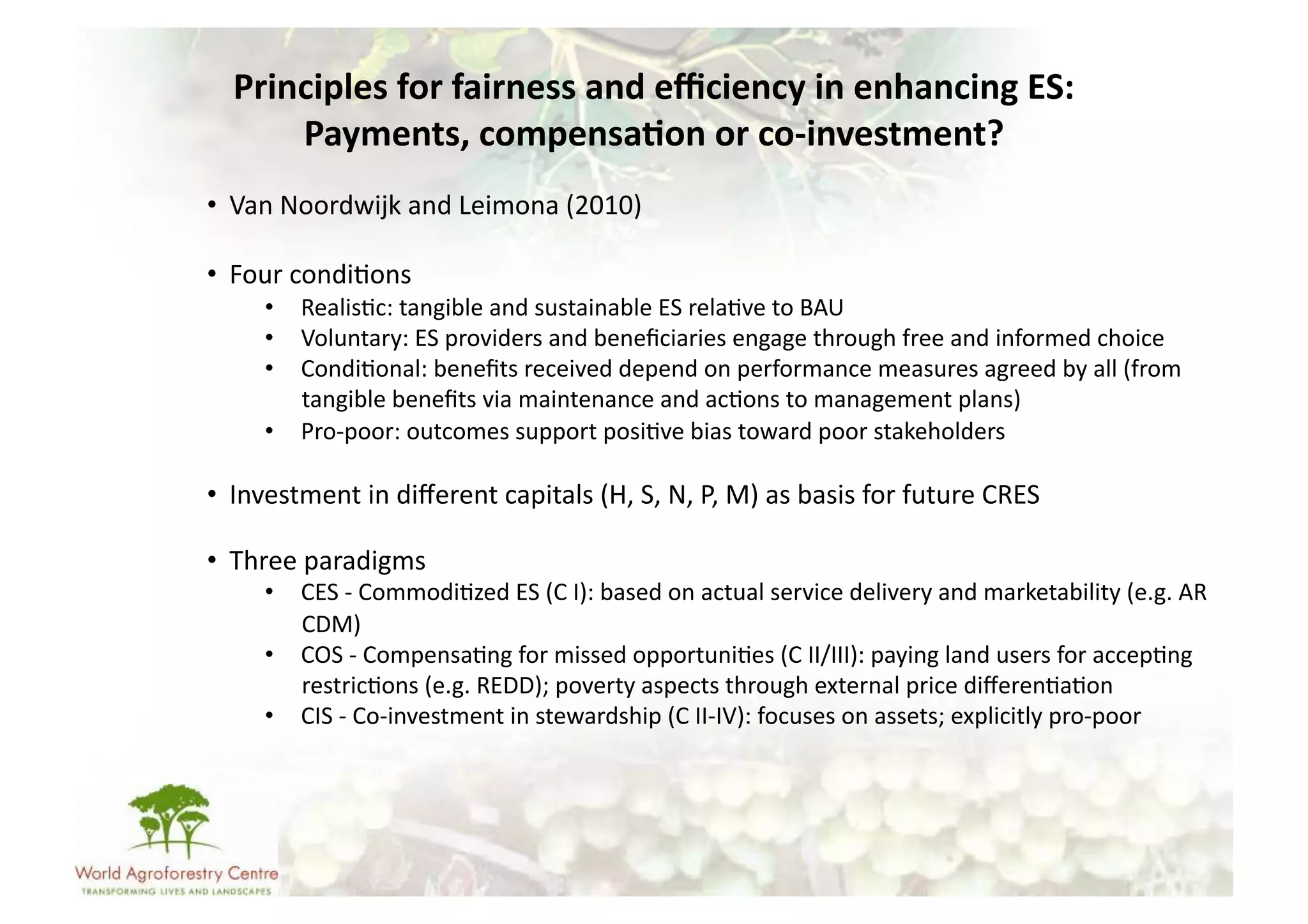
•  Van	
  Noordwijk	
  and	
  Leimona	
  (2010)	
  

•  Four	
  condi-ons	
  
        •  Realis-c:	
  tangible	
  and	
  sustainable	
  ES	
  rela-ve	
  to	
  BAU	
  
        •  Voluntary:	
  ES	
  providers	
  and	
  beneficiaries	
  engage	
  through	
  free	
  and	
  informed	
  choice	
  
        •  Condi-onal:	
  benefits	
  received	
  depend	
  on	
  performance	
  measures	
  agreed	
  by	
  all	
  (from	
  
           tangible	
  benefits	
  via	
  maintenance	
  and	
  ac-ons	
  to	
  management	
  plans)	
  
        •  Pro-­‐poor:	
  outcomes	
  support	
  posi-ve	
  bias	
  toward	
  poor	
  stakeholders	
  

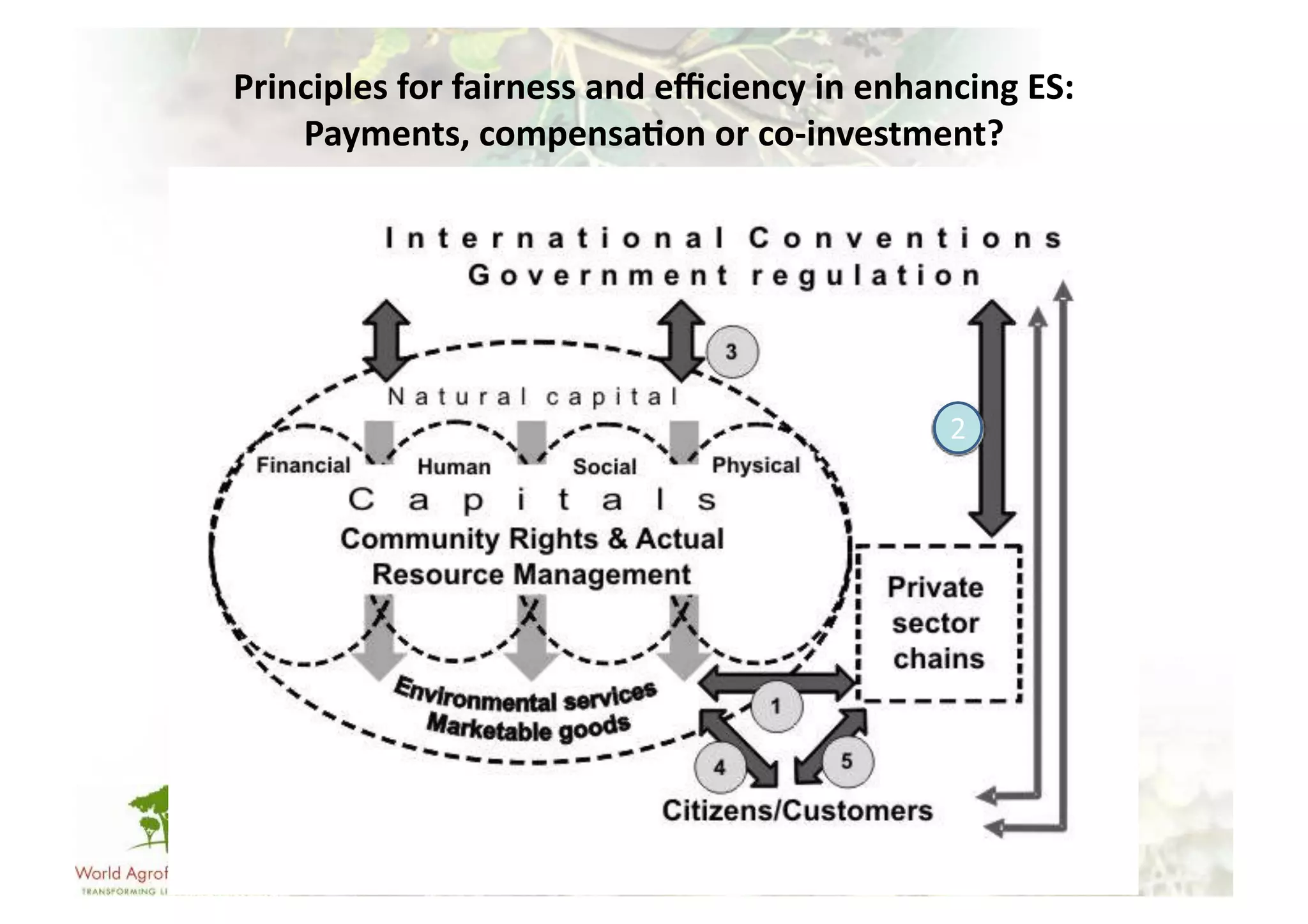
•  Investment	
  in	
  different	
  capitals	
  (H,	
  S,	
  N,	
  P,	
  M)	
  as	
  basis	
  for	
  future	
  CRES	
  

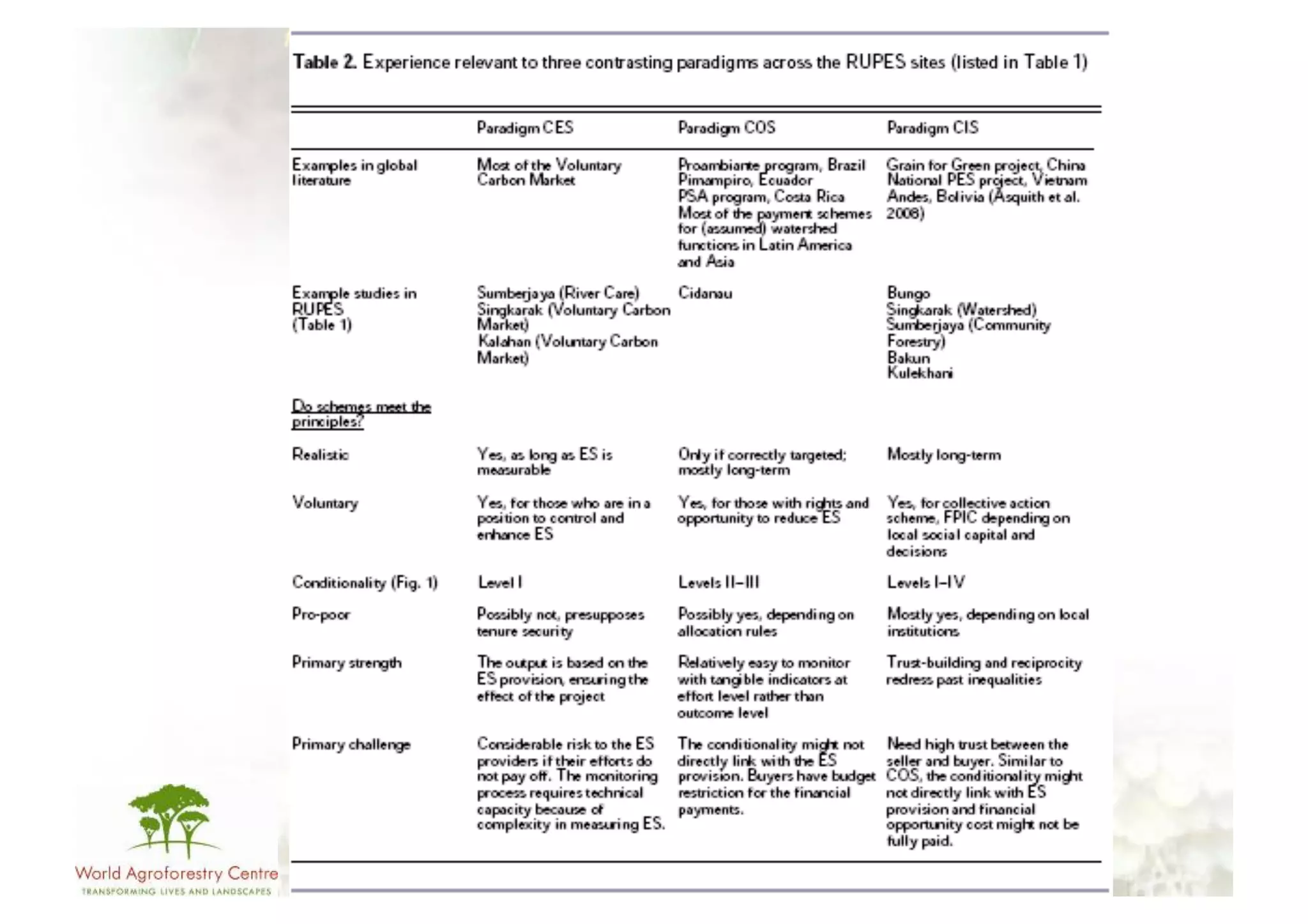
•  Three	
  paradigms	
  
        •  CES	
  -­‐	
  Commodi-zed	
  ES	
  (C	
  I):	
  based	
  on	
  actual	
  service	
  delivery	
  and	
  marketability	
  (e.g.	
  AR	
  
           CDM)	
  
        •  COS	
  -­‐	
  Compensa-ng	
  for	
  missed	
  opportuni-es	
  (C	
  II/III):	
  paying	
  land	
  users	
  for	
  accep-ng	
  
           restric-ons	
  (e.g.	
  REDD);	
  poverty	
  aspects	
  through	
  external	
  price	
  differen-a-on	
  
        •  CIS	
  -­‐	
  Co-­‐investment	
  in	
  stewardship	
  (C	
  II-­‐IV):	
  focuses	
  on	
  assets;	
  explicitly	
  pro-­‐poor	
  
Principles	
  for	
  fairness	
  and	
  efficiency	
  in	
  enhancing	
  ES:	
  
    Payments,	
  compensa/on	
  or	
  co-­‐investment?	
  
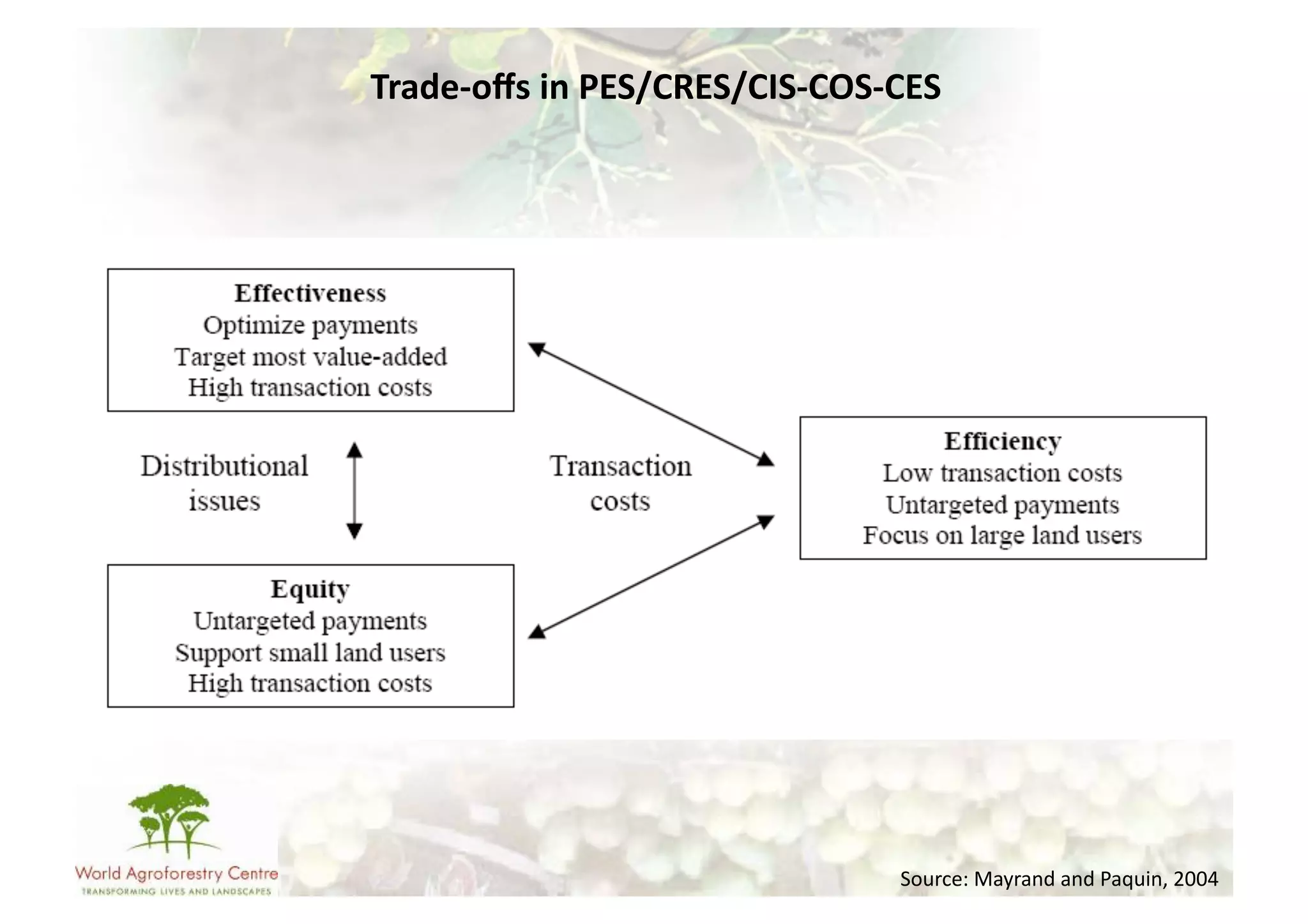
Trade-­‐offs	
  in	
  PES/CRES/CIS-­‐COS-­‐CES	


                                            Source:	
  Mayrand	
  and	
  Paquin,	
  2004	
  
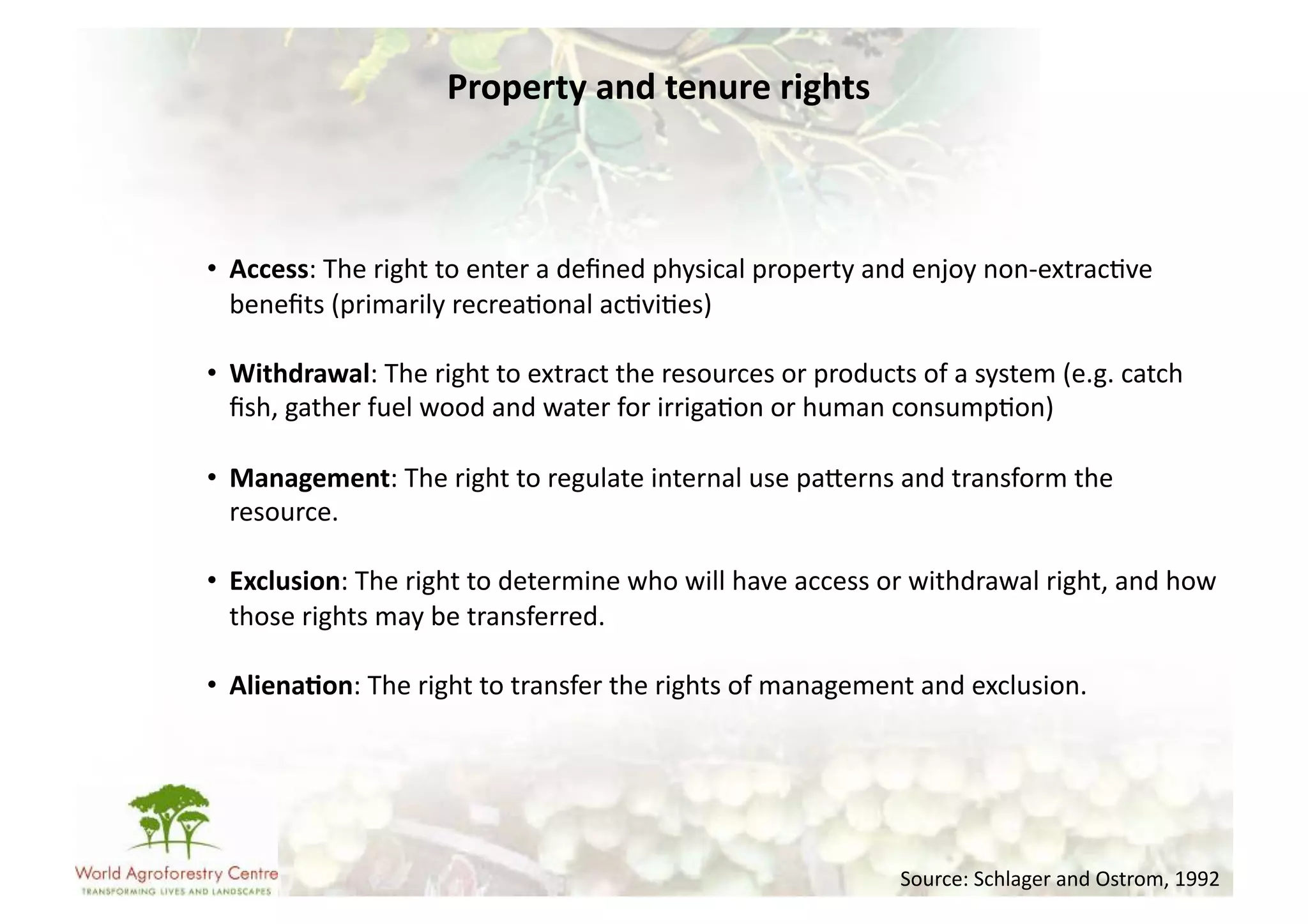
Property	
  and	
  tenure	
  rights	


•  Access:	
  The	
  right	
  to	
  enter	
  a	
  defined	
  physical	
  property	
  and	
  enjoy	
  non-­‐extrac-ve	
  
   benefits	
  (primarily	
  recrea-onal	
  ac-vi-es)	
  

•  Withdrawal:	
  The	
  right	
  to	
  extract	
  the	
  resources	
  or	
  products	
  of	
  a	
  system	
  (e.g.	
  catch	
  
   fish,	
  gather	
  fuel	
  wood	
  and	
  water	
  for	
  irriga-on	
  or	
  human	
  consump-on)	
  

•  Management:	
  The	
  right	
  to	
  regulate	
  internal	
  use	
  paUerns	
  and	
  transform	
  the	
  
   resource.	
  

•  Exclusion:	
  The	
  right	
  to	
  determine	
  who	
  will	
  have	
  access	
  or	
  withdrawal	
  right,	
  and	
  how	
  
   those	
  rights	
  may	
  be	
  transferred.	
  

•  Aliena/on:	
  The	
  right	
  to	
  transfer	
  the	
  rights	
  of	
  management	
  and	
  exclusion.	


                                                                                          Source:	
  Schlager	
  and	
  Ostrom,	
  1992	
  
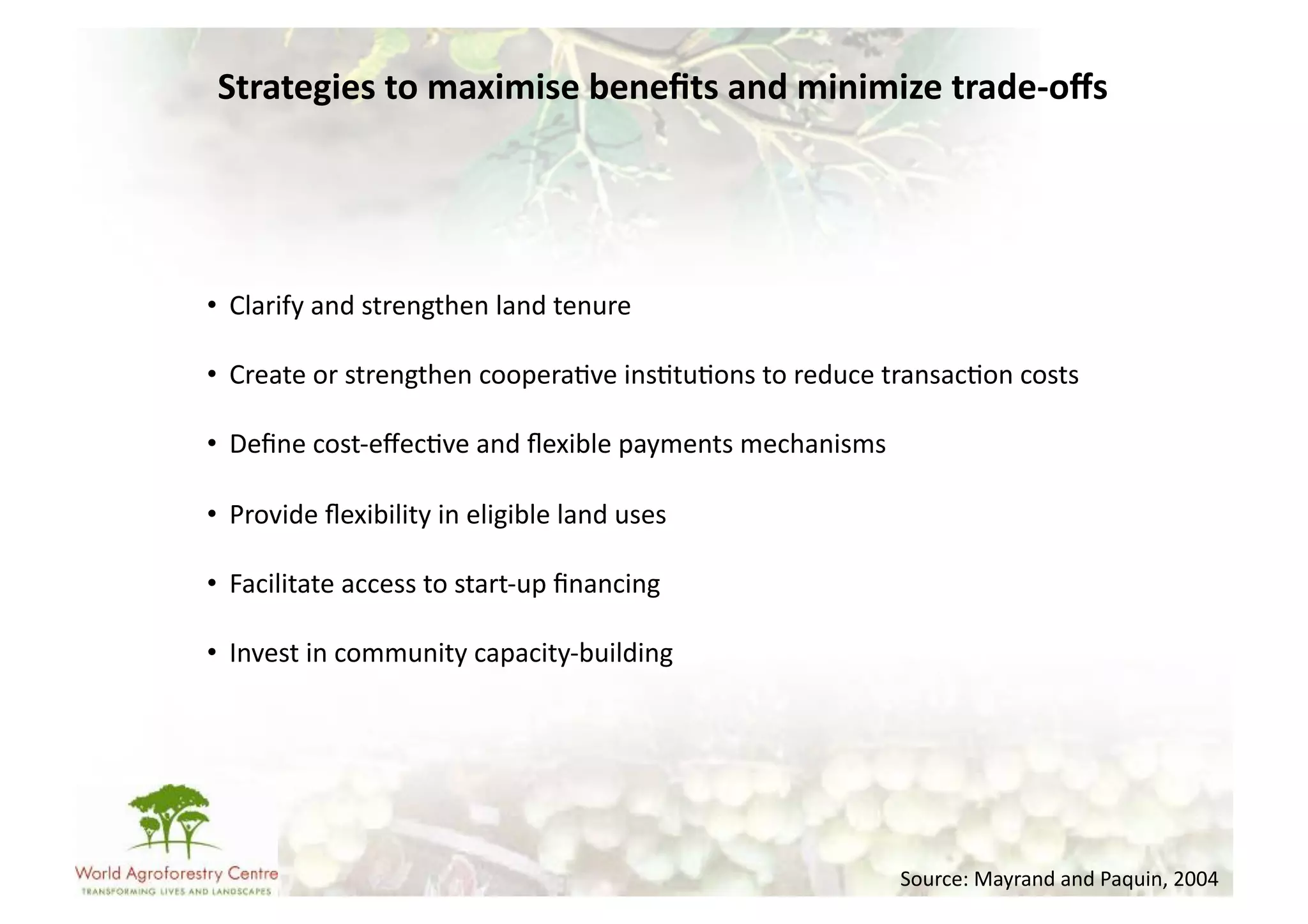
Strategies	
  to	
  maximise	
  benefits	
  and	
  minimize	
  trade-­‐offs	


•  Clarify	
  and	
  strengthen	
  land	
  tenure	
  

•  Create	
  or	
  strengthen	
  coopera-ve	
  ins-tu-ons	
  to	
  reduce	
  transac-on	
  costs	
  

•  Define	
  cost-­‐effec-ve	
  and	
  flexible	
  payments	
  mechanisms	
  

•  Provide	
  flexibility	
  in	
  eligible	
  land	
  uses	
  

•  Facilitate	
  access	
  to	
  start-­‐up	
  financing	
  

•  Invest	
  in	
  community	
  capacity-­‐building	


                                                                              Source:	
  Mayrand	
  and	
  Paquin,	
  2004	
  
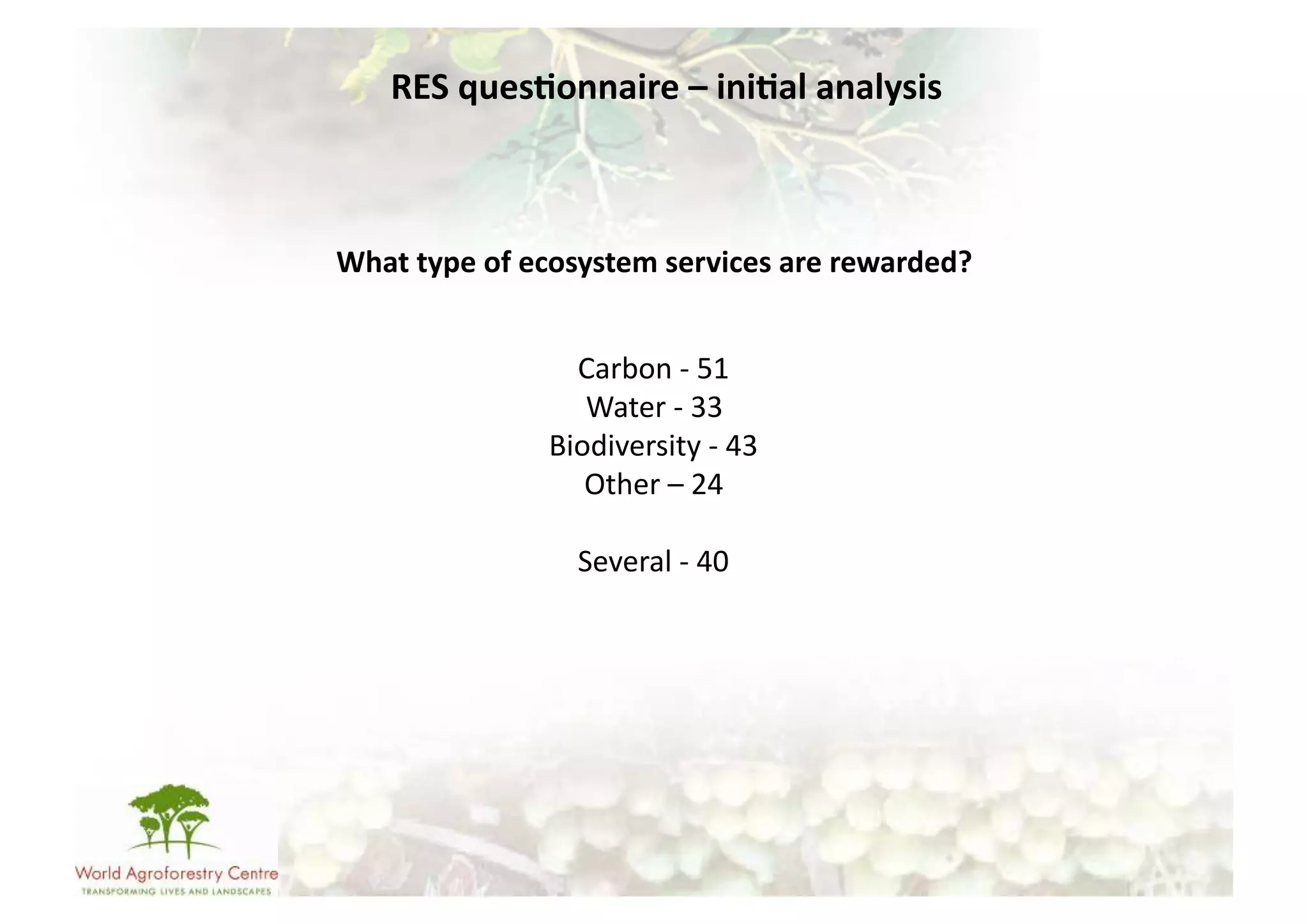
RES	
  ques/onnaire	
  –	
  ini/al	
  analysis	


What	
  type	
  of	
  ecosystem	
  services	
  are	
  rewarded?	


                         Carbon	
  -­‐	
  51	
  
                          Water	
  -­‐	
  33	
  
                       Biodiversity	
  -­‐	
  43	
  
                          Other	
  –	
  24	
  

                          Several	
  -­‐	
  40	
  
RES	
  ques/onnaire	
  –	
  ini/al	
  analysis	


How	
  many	
  households	
  are	
  you	
  reaching	
  (or	
  planning	
  to	
  reach)?	


                                   10000+	


  13	
  
                                   1001-­‐9999	
  	
  11	
  
                                   0-­‐1000	


  38	
  
RES	
  ques/onnaire	
  –	
  ini/al	
  analysis	


                          Who	
  is	
  providing	
  the	
  funds	
  for	
  the	
  scheme?	


                               Government/government	
  agency	
  –	
  25	
  

 Private	
  company	
  examples	
  –	
  Tetra	
  Pak,	
  Camco,	
  Max	
  Hamburger,	
  Coca	
  Cola,	
  Shell,	
  
Marriot,	
  Moore	
  Corpora-on,	
  Exxon	
  Mobile,	
  coffee	
  industries,	
  DAWASCO,	
  Brass	
  LNG,	
  
                               MTV	
  Staying	
  Alive	
  Campaign	
  

                Non-­‐profit	
  examples	
  –	
  SNV	
  Nepal,	
  WWF,	
  Moore	
  Founda-on	


                                        UN-­‐	
  IFAD,	
  UNDP,	
  UNESCO	
  

                                               Carbon	
  markets	
  
RES	
  ques/onnaire	
  –	
  ini/al	
  analysis	


       What	
  kinds	
  of	
  benefits	
  are	
  given	
  to	
  the	
  providers	
  of	
  the	
  ecosystem	
  services?	


                                                             Payments	
  –	
  36	
  
                                                              Services	
  –	
  58	
  
                                                               In	
  kind	
  –	
  36	
  
                                                                Other	
  –	
  19	
  
                     Payments:	
  
              Cash	
  vouchers	
  –	
  1	
  
             Share	
  of	
  project	
  -­‐	
  4	
                            In	
  kind:	
  
                  Grants/loans	
  -­‐	
  1	
                         Agricultural	
  inputs	
  –	
  21	
  
Markets	
  for	
  products/premium	
  prices	
  –	
  3	
             Tools/training	
  books	
  –	
  4	
  
                    New	
  jobs	
  –	
  1	
                                                                Other:	
  
                                                   Services:	
                                     Microfinance	
  loans	
  
                                                 Educa-on	
  –	
  18	
                             Access	
  to	
  markets	
  
                               Professional	
  support/advisory	
  services	
  –	
  17	
       Access	
  to	
  family	
  planning	
  
                                     Capacity	
  building/training	
  –	
  19	
                       Networking	
  
                                                                                           Salaries/wages	
  for	
  local	
  employed	
  

                                     Almost	
  always	
  used	
  in	
  combina/on	
  	
  
RES	
  ques/onnaire	
  –	
  ini/al	
  analysis	


          Who	
  distributes	
  the	
  rewards	
  (or	
  is	
  designated	
  to)?	
  

                      Community	
  based	
  ins-tu-ons	
  –	
  32	
  
                              Private	
  organiza-on	
  –	
  15	
  
                             Non-­‐profit	
  organiza-on	
  –	
  33	
  	
  
              Body	
  or	
  agency	
  designed	
  for	
  that	
  purpose	
  –	
  17	
  
                  Direct	
  payments	
  to	
  beneficiaries	
  –	
  17	
  
                                          Other-­‐4	


Was	
  it	
  necessary	
  to	
  create	
  a	
  new	
  group/organiza/on	
  to	
  distribute	
  
                      the	
  benefits	
  to	
  the	
  ES	
  providers?	
  
                                           Yes	
  –	
  22	
  
                                            No-­‐	
  33	
  
                                           N/A-­‐	
  12	
  
RES	
  ques/onnaire	
  –	
  ini/al	
  analysis	


          On	
  what	
  kinds	
  of	
  contracts	
  is	
  the	
  RES	
  scheme	
  based?	
  

                                      Statutory	
  -­‐	
  32	
  
                                     Customary	
  -­‐	
  20	
  
                                   Specific	
  by-­‐laws	
  –	
  23	
  
                                        Other	
  -­‐	
  15	


Please	
  explain	
  the	
  nature	
  of	
  the	
  contract(s)	
  for	
  the	
  ques/on	
  above?	
  

                       Contracts	
  with	
  coopera-ves	


                    Contracts	
  with	
  individual	
  farmers	


                                Loan	
  subsidies	


                         Contracts	
  with	
  villages	
  	
  
   Contracts	
  nego-ated	
  with	
  village	
  chiefs	
  on	
  behalf	
  of	
  households	
  
RES	
  ques/onnaire	
  –	
  ini/al	
  analysis	


What	
  is	
  the	
  (planned)	
  reward	
  or	
  payment?	


  Environmental	
  benefits/conserva-on	
  -­‐	
  2	
  
             Rewards	
  per	
  village	
  –	
  3	
  
            Increased	
  produc-on	
  -­‐	
  2	
  
        Payments	
  to	
  household	
  –	
  12	
  
               Commission	
  based	
  	
  
Performance	
  based	
  /	
  percentage	
  of	
  profit	
  -­‐	
  2	
  
  BeUer	
  market	
  access,	
  premium	
  prices	
  -­‐	
  2	
  
                       Savings	
  
RES	
  ques/onnaire	
  –	
  ini/al	
  analysis	


           What	
  are	
  the	
  main	
  challenges	
  you	
  have	
  encountered?	


                   Lack	
  of	
  knowledge/awareness	
  of	
  benefits-­‐	
  12	
  
                              Is	
  the	
  project	
  providing	
  benefits?	
  	
  
                               Limited	
  (financial)	
  resources	
  -­‐	
  10	
  
                                                 Tenure	
  -­‐	
  3	
  
                          Accountability/lack	
  of	
  transparency	
  	
  
                                         Weather/Drought	
  –	
  4	
  
                                               Timelines	
  –	
  2	
  
Lack	
  of	
  regulatory	
  certainty/issues	
  around	
  carbon	
  markets	
  or	
  REDD	
  –	
  5	
  
                                Organiza-onal/Monitoring	
  –	
  4	
  
                                       Changing	
  ajtudes	
  –	
  2	
  
                                 Transfer	
  of	
  cash	
  to	
  individuals	
  	
  
                 How	
  to	
  ensure	
  commitment	
  from	
  par-cipants	
  –	
  2	
  
        Big	
  landowners	
  oppose	
  because	
  want	
  access	
  to	
  cheap	
  labour	
  	
  
               Coordina-on	
  between	
  local/na-onal/interna-onal	
  -­‐	
  5	
  
RES	
  ques/onnaire	
  –	
  ini/al	
  analysis	


                               What	
  kinds	
  of	
  conflicts	
  arise	
  (if	
  any)?	


                        Villagers	
  disagree	
  on	
  money	
  distribu-on	
  	
  
        Conflicts	
  of	
  interest/farmers	
  who	
  join	
  and	
  those	
  that	
  do	
  not	
  –	
  2	
  
                      Horizontal	
  conflict	
  between	
  communi-es	
  (?)	
  
                                             Role	
  conflicts	
  
                                      Type	
  of	
  tree	
  to	
  plant	
  
                               Integra-on	
  of	
  different	
  needs	
  
         Who	
  is	
  gejng	
  what	
  –	
  ensuring	
  equitable	
  benefit	
  sharing	
  -­‐	
  3	
  
Opposi-on	
  from	
  different	
  interests	
  (ie	
  loggers	
  in	
  rainforest,	
  farmers	
  don’t	
  want	
  to	
  
                                      preserve	
  puma)	
  –	
  3	
  	
  
                                            Land	
  rights	
  -­‐	
  3	
  
       Environmentally	
  damaging	
  ac-vity	
  of	
  outsiders	
  (ie	
  caUle	
  grazing)	
  
                                           Lack	
  of	
  trust	
  -­‐	
  2	
  
                                       Illegal	
  seUlements	
  
                               Different	
  legal	
  interpreta-ons	
  
RES	
  ques/onnaire	
  –	
  ini/al	
  analysis	


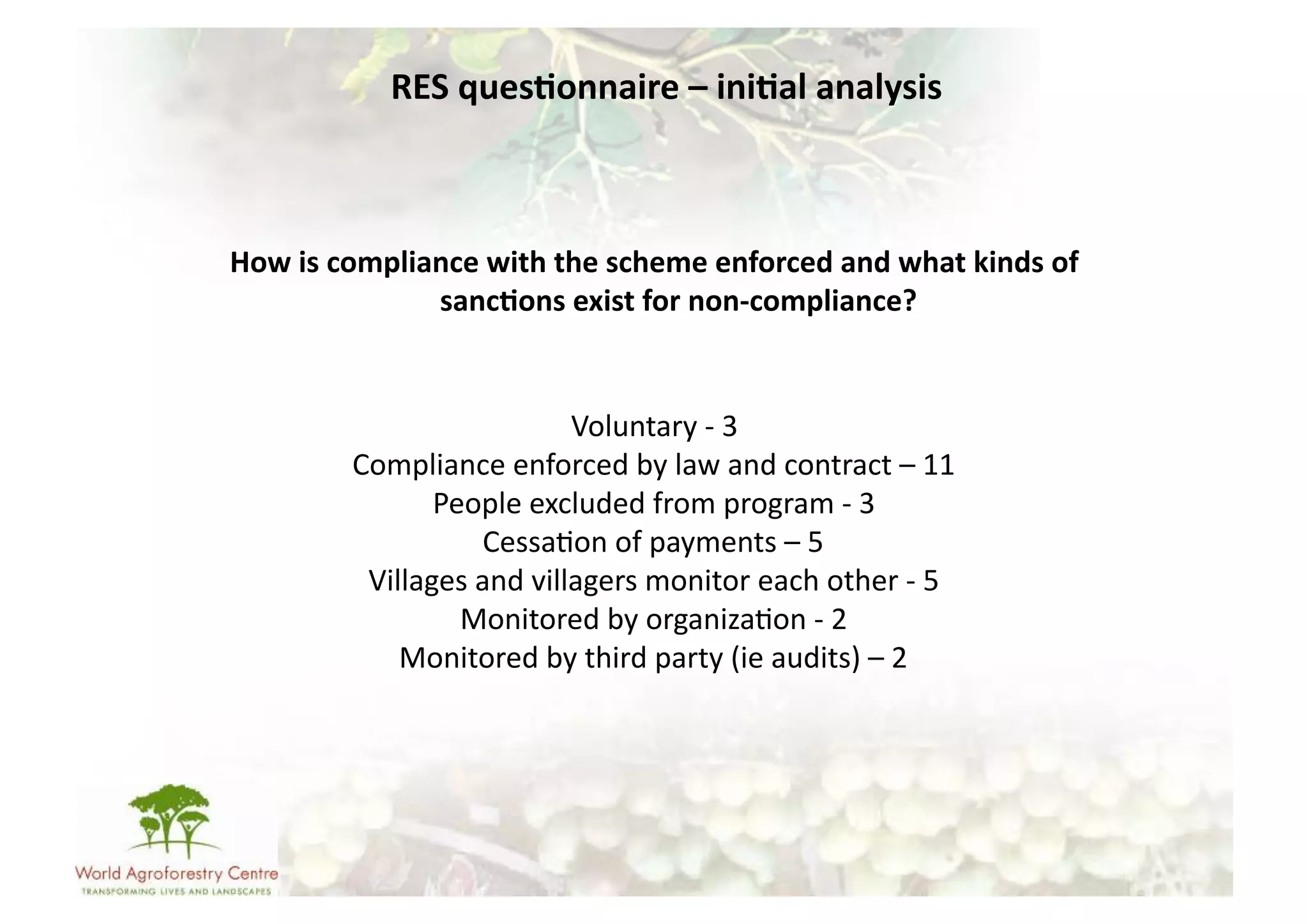
How	
  is	
  compliance	
  with	
  the	
  scheme	
  enforced	
  and	
  what	
  kinds	
  of	
  
                    sanc/ons	
  exist	
  for	
  non-­‐compliance?	


                                     Voluntary	
  -­‐	
  3	
  
             Compliance	
  enforced	
  by	
  law	
  and	
  contract	
  –	
  11	
  
                    People	
  excluded	
  from	
  program	
  -­‐	
  3	
  
                          Cessa-on	
  of	
  payments	
  –	
  5	
  
              Villages	
  and	
  villagers	
  monitor	
  each	
  other	
  -­‐	
  5	
  
                      Monitored	
  by	
  organiza-on	
  -­‐	
  2	
  
                 Monitored	
  by	
  third	
  party	
  (ie	
  audits)	
  –	
  2	
  
RES	
  ques/onnaire	
  –	
  ini/al	
  analysis	


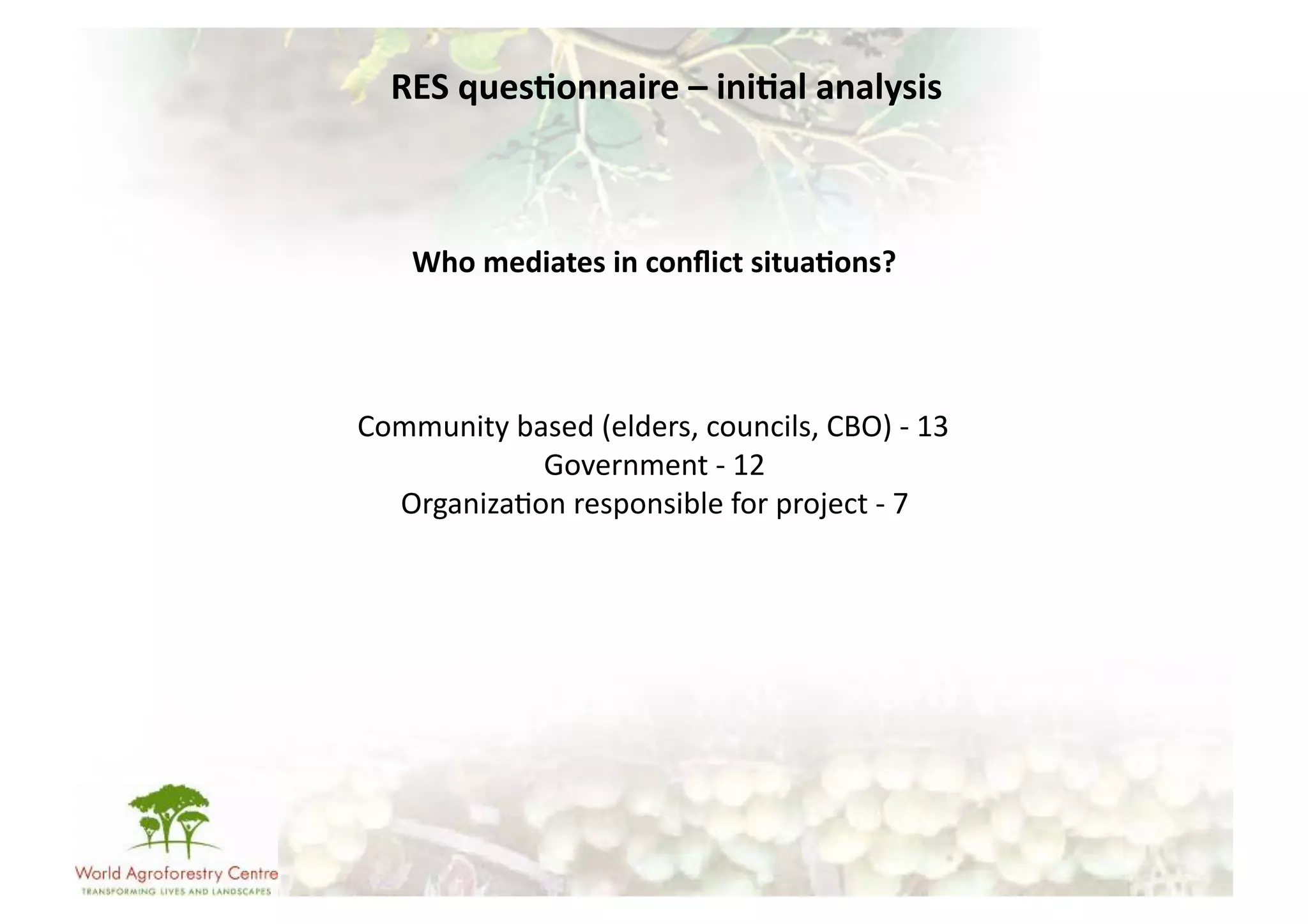
      Who	
  mediates	
  in	
  conflict	
  situa/ons?	


Community	
  based	
  (elders,	
  councils,	
  CBO)	
  -­‐	
  13	
  
               Government	
  -­‐	
  12	
  
  Organiza-on	
  responsible	
  for	
  project	
  -­‐	
  7	
  
RES	
  ques/onnaire	
  –	
  ini/al	
  analysis	


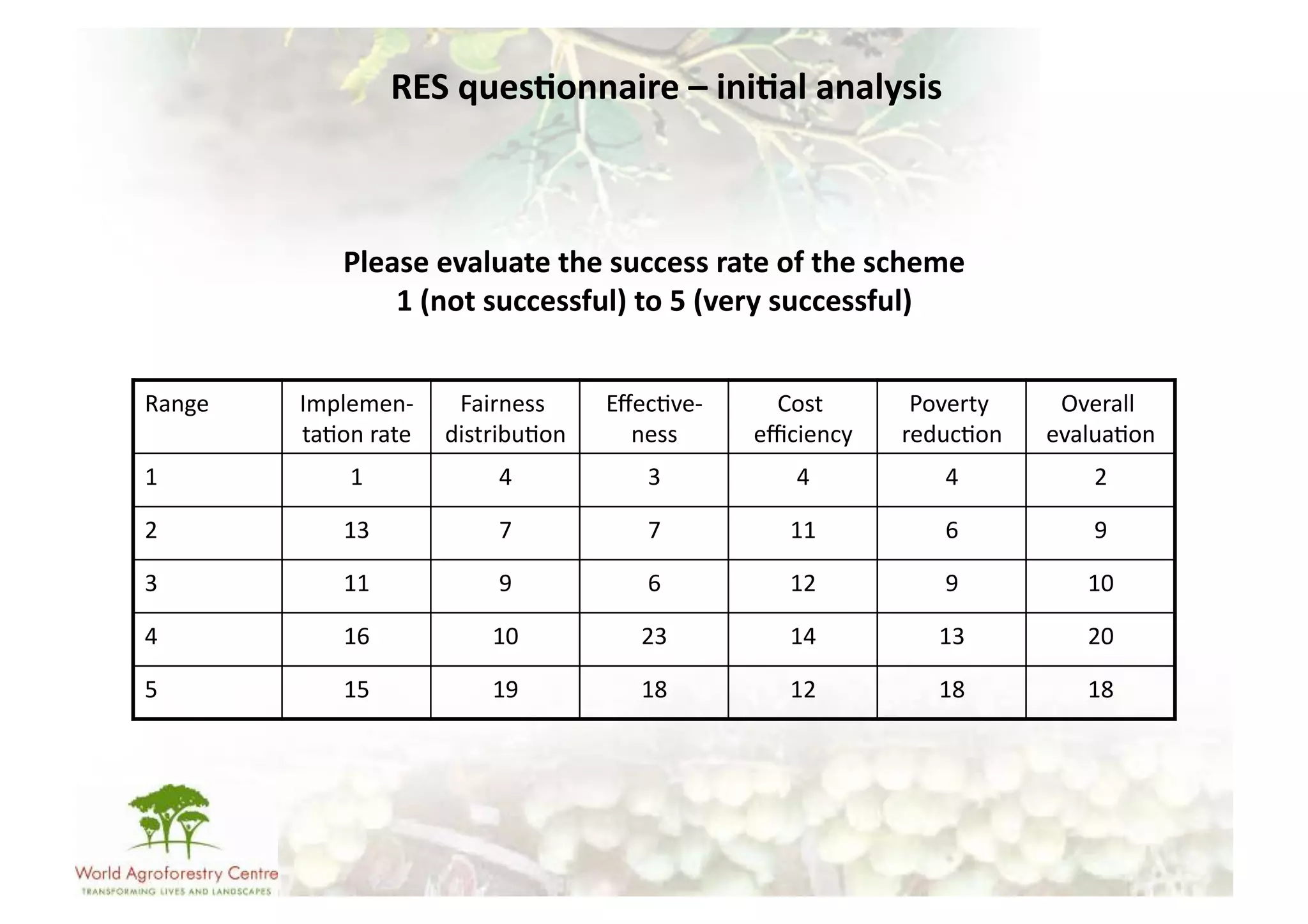
                  Please	
  evaluate	
  the	
  success	
  rate	
  of	
  the	
  scheme	
  	
  
                      1	
  (not	
  successful)	
  to	
  5	
  (very	
  successful)	


Range	
     Implemen-­‐          Fairness	
          Effec-ve-­‐     Cost	
           Poverty	
           Overall	
  
            ta-on	
  rate	
     distribu-on   	
       ness
                                                          	
      efficiency   	
     reduc-on     	
     evalua-on    	
  
1	
                1	
                  4	
              3	
            4	
                4	
                 2	
  

2	
               13	
                  7	
              7	
           11	
                6	
                 9	
  

3	
               11	
                  9	
              6	
           12	
                9	
                10	
  

4	
               16	
                 10	
             23	
           14	
               13	
                20	
  

5	
               15	
                 19	
             18	
           12	
               18	
                18	
  
RES	
  ques/onnaire	
  –	
  ini/al	
  analysis	


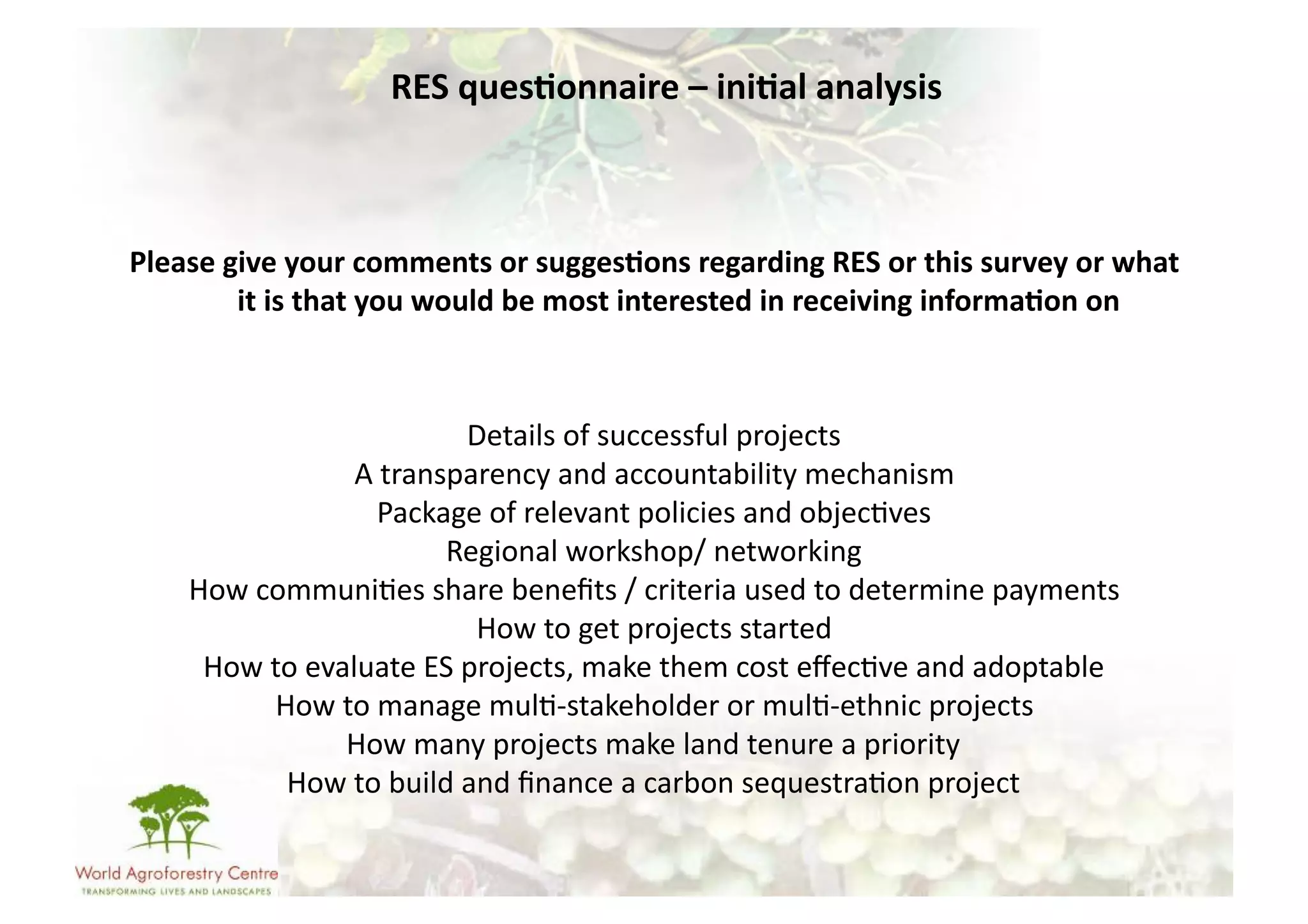
Please	
  give	
  your	
  comments	
  or	
  sugges/ons	
  regarding	
  RES	
  or	
  this	
  survey	
  or	
  what	
  
           it	
  is	
  that	
  you	
  would	
  be	
  most	
  interested	
  in	
  receiving	
  informa/on	
  on	


                                      Details	
  of	
  successful	
  projects	
  
                        A	
  transparency	
  and	
  accountability	
  mechanism	
  
                            Package	
  of	
  relevant	
  policies	
  and	
  objec-ves	
  
                                  Regional	
  workshop/	
  networking	
  
      How	
  communi-es	
  share	
  benefits	
  /	
  criteria	
  used	
  to	
  determine	
  payments	
  
                                       How	
  to	
  get	
  projects	
  started	
  
       How	
  to	
  evaluate	
  ES	
  projects,	
  make	
  them	
  cost	
  effec-ve	
  and	
  adoptable	
  
               How	
  to	
  manage	
  mul--­‐stakeholder	
  or	
  mul--­‐ethnic	
  projects	
  
                       How	
  many	
  projects	
  make	
  land	
  tenure	
  a	
  priority	
  
                How	
  to	
  build	
  and	
  finance	
  a	
  carbon	
  sequestra-on	
  project	
  
Lessons	
  and	
  conclusions?	


•  Evolving	
  framework	
  from	
  PES	
  to	
  CIS	
  

•  Trade-­‐offs	
  between	
  effec-veness,	
  efficiency	
  and	
  equity	
  

•  Few	
  tenure	
  problems	
  reported:	
  can	
  schemes	
  be	
  developed	
  for	
  weaker	
  forms	
  of	
  
   tenure	
  

•  Not	
  possible	
  to	
  make	
  generaliza-ons	
  

•  Many	
  open	
  ques-ons	
  to	
  address	
  
¡¿	
  Thanks	
  for	
  a	
  future	
  !?	
  

Neufeldt - Rewards for mitigation

  • 1.
    Climate  Change  Adapta/on  and  Mi/ga/on  in  Agriculture   Rewards  for  mi-ga-on   Henry  Neufeldt,  ICRAF   CCAFS  Science  Workshop   Playa  del  Carmen,  1-­‐2  December  2010  
  • 2.
    Payments  for  Environmental  Services  (PES)   •  Wunder  (2005)   •  Five  general  criteria  for  successful  PES  schemes:   •  Voluntary  transac-ons   •  Well  defined  ES   •  At  least  one  buyer  of  ES   •  At  least  one  provider  of  ES   •  Payment  condi-onal  upon  delivery  of  ES  
  • 3.
    Structure  of  PES  mechanisms  
  • 4.
    Compensa/on  and  Rewards  for  Environmental  Services  (CRES)   •  Swallow  et  al  (2009)   •  Three  generic  types  of  stakeholders   •  Ecosystem  stewards  (whose  ac-ons  modify  the  quan-ty  and  quality  of  ES)   •  ES  beneficiaries  (who  benefit  from  ES  provided  by  an  ecosystem)   •  Intermediaries  (who  indirectly  shape  interac-ons  among  ecosystem  stewards,  ES   beneficiaries  and  the  ecosystem  itself)   •  Defini-on  and  typology  of  CRES   •  Compensa-on  for  ES  are  payments  or  other  forms  of  res-tu-on  made  to  ES   beneficiaries  or  ecosystem  stewards  to  offset  foregone  en-tlements  to  ES  or  ecosystem   stewardship  benefits   •  Rewards  for  ES  are  inducements  provided  to  ecosystem  stewards  to  give  them  incen-ve   to  enhance  or  maintain  ES   •  Characteris-cs  of  the  mechanisms   •  Nature  of  the  contract  or  agreement   •  Transac-on  costs   •  Type  of  remunera-on  or  incen-ves  provided   •  Market  based  instruments  used   •  Temporal  paUern  of  payment  
  • 5.
    Compensa/on  and  Rewards  for  Environmental  Services  (CRES)  
  • 6.
    Principles  for  fairness  and  efficiency  in  enhancing  ES:   Payments,  compensa/on  or  co-­‐investment?   •  Van  Noordwijk  and  Leimona  (2010)   •  Four  condi-ons   •  Realis-c:  tangible  and  sustainable  ES  rela-ve  to  BAU   •  Voluntary:  ES  providers  and  beneficiaries  engage  through  free  and  informed  choice   •  Condi-onal:  benefits  received  depend  on  performance  measures  agreed  by  all  (from   tangible  benefits  via  maintenance  and  ac-ons  to  management  plans)   •  Pro-­‐poor:  outcomes  support  posi-ve  bias  toward  poor  stakeholders   •  Investment  in  different  capitals  (H,  S,  N,  P,  M)  as  basis  for  future  CRES   •  Three  paradigms   •  CES  -­‐  Commodi-zed  ES  (C  I):  based  on  actual  service  delivery  and  marketability  (e.g.  AR   CDM)   •  COS  -­‐  Compensa-ng  for  missed  opportuni-es  (C  II/III):  paying  land  users  for  accep-ng   restric-ons  (e.g.  REDD);  poverty  aspects  through  external  price  differen-a-on   •  CIS  -­‐  Co-­‐investment  in  stewardship  (C  II-­‐IV):  focuses  on  assets;  explicitly  pro-­‐poor  
  • 7.
    Principles  for  fairness  and  efficiency  in  enhancing  ES:   Payments,  compensa/on  or  co-­‐investment?  
  • 9.
    Trade-­‐offs  in  PES/CRES/CIS-­‐COS-­‐CES   Source:  Mayrand  and  Paquin,  2004  
  • 10.
    Property  and  tenure  rights   •  Access:  The  right  to  enter  a  defined  physical  property  and  enjoy  non-­‐extrac-ve   benefits  (primarily  recrea-onal  ac-vi-es)   •  Withdrawal:  The  right  to  extract  the  resources  or  products  of  a  system  (e.g.  catch   fish,  gather  fuel  wood  and  water  for  irriga-on  or  human  consump-on)   •  Management:  The  right  to  regulate  internal  use  paUerns  and  transform  the   resource.   •  Exclusion:  The  right  to  determine  who  will  have  access  or  withdrawal  right,  and  how   those  rights  may  be  transferred.   •  Aliena/on:  The  right  to  transfer  the  rights  of  management  and  exclusion.   Source:  Schlager  and  Ostrom,  1992  
  • 11.
    Strategies  to  maximise  benefits  and  minimize  trade-­‐offs   •  Clarify  and  strengthen  land  tenure   •  Create  or  strengthen  coopera-ve  ins-tu-ons  to  reduce  transac-on  costs   •  Define  cost-­‐effec-ve  and  flexible  payments  mechanisms   •  Provide  flexibility  in  eligible  land  uses   •  Facilitate  access  to  start-­‐up  financing   •  Invest  in  community  capacity-­‐building   Source:  Mayrand  and  Paquin,  2004  
  • 12.
    RES  ques/onnaire  –  ini/al  analysis   What  type  of  ecosystem  services  are  rewarded?     Carbon  -­‐  51   Water  -­‐  33   Biodiversity  -­‐  43   Other  –  24   Several  -­‐  40  
  • 13.
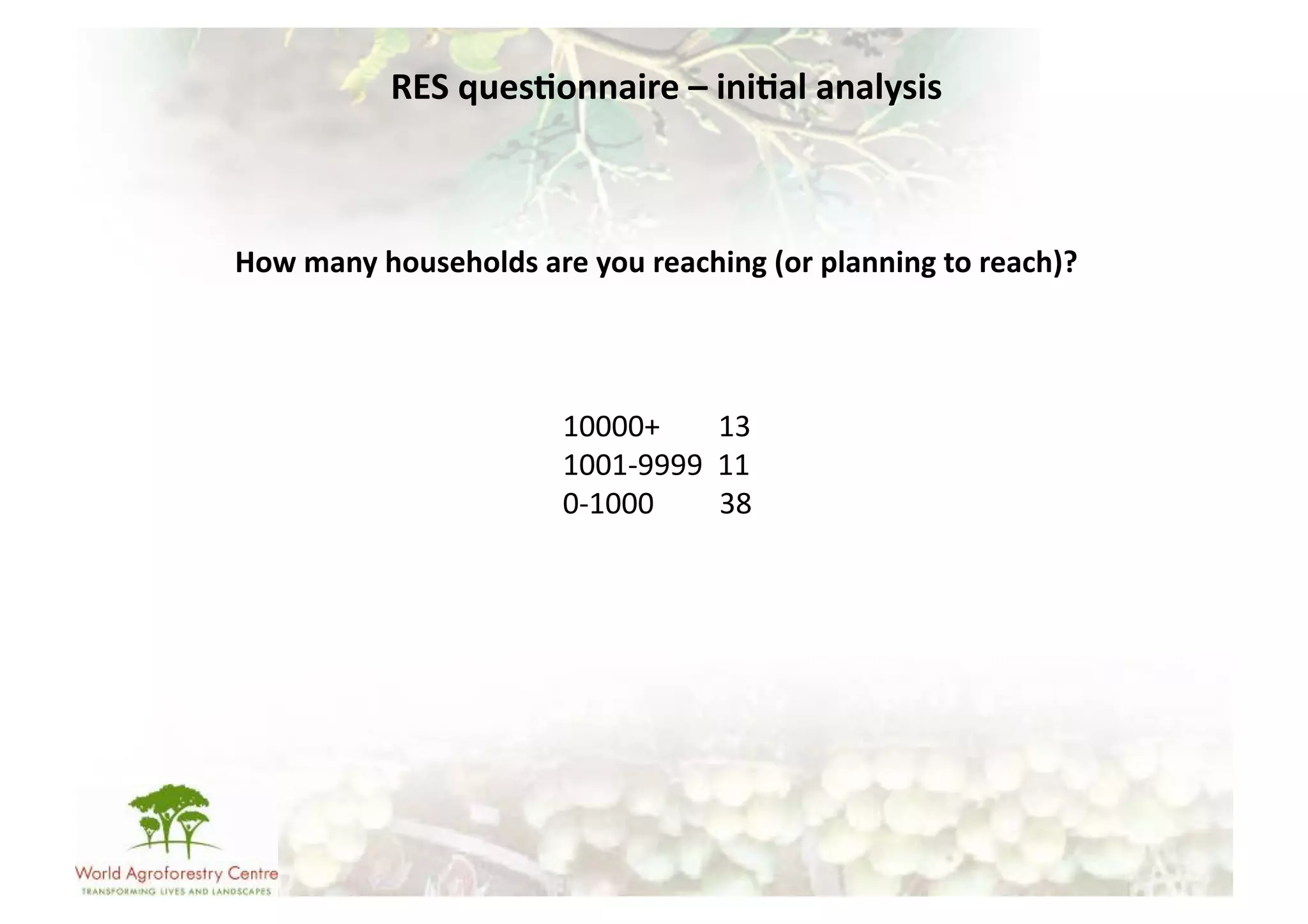
    RES  ques/onnaire  –  ini/al  analysis   How  many  households  are  you  reaching  (or  planning  to  reach)?   10000+                13   1001-­‐9999    11   0-­‐1000                  38  
  • 14.
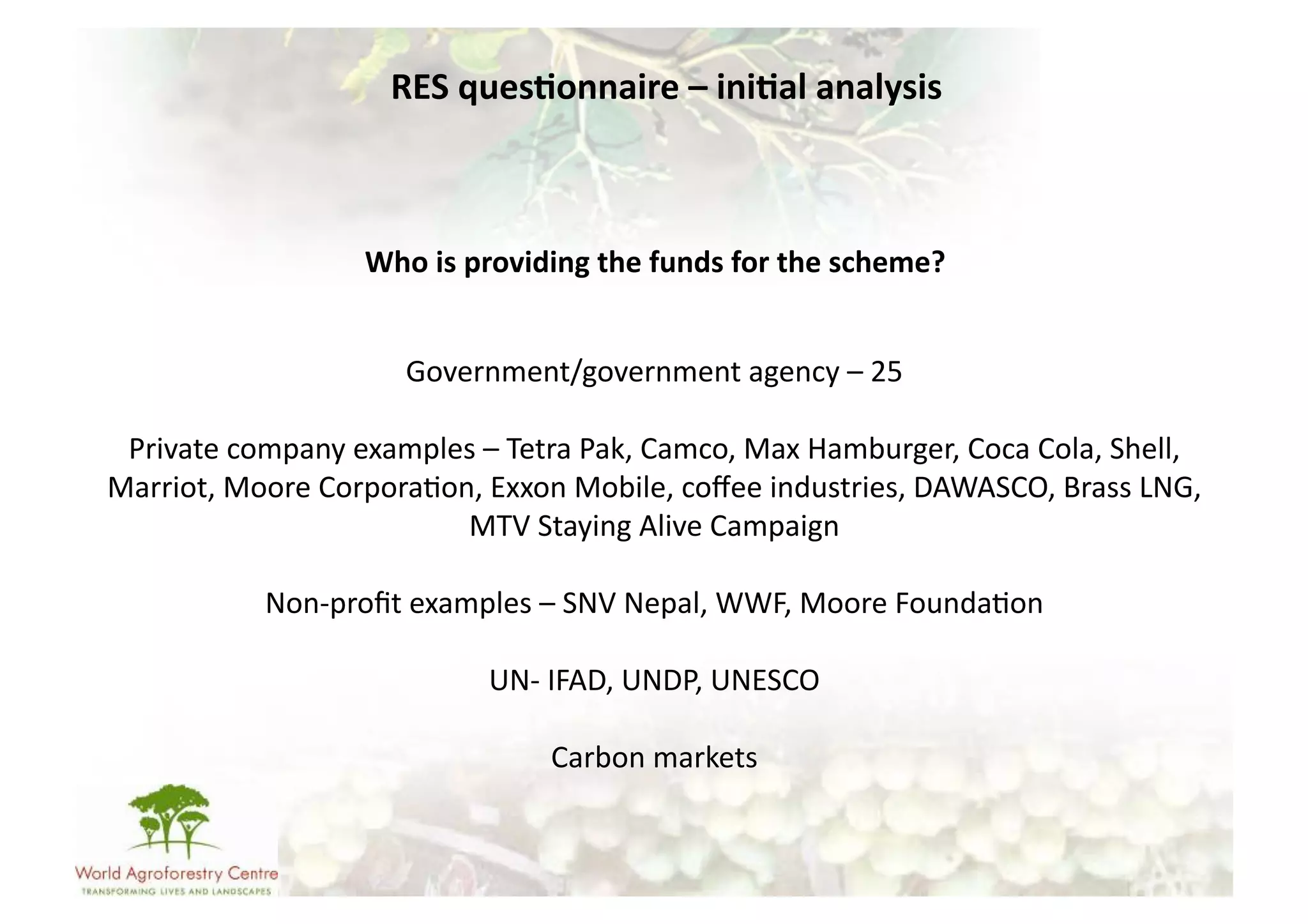
    RES  ques/onnaire  –  ini/al  analysis   Who  is  providing  the  funds  for  the  scheme?   Government/government  agency  –  25   Private  company  examples  –  Tetra  Pak,  Camco,  Max  Hamburger,  Coca  Cola,  Shell,   Marriot,  Moore  Corpora-on,  Exxon  Mobile,  coffee  industries,  DAWASCO,  Brass  LNG,   MTV  Staying  Alive  Campaign   Non-­‐profit  examples  –  SNV  Nepal,  WWF,  Moore  Founda-on     UN-­‐  IFAD,  UNDP,  UNESCO   Carbon  markets  
  • 15.
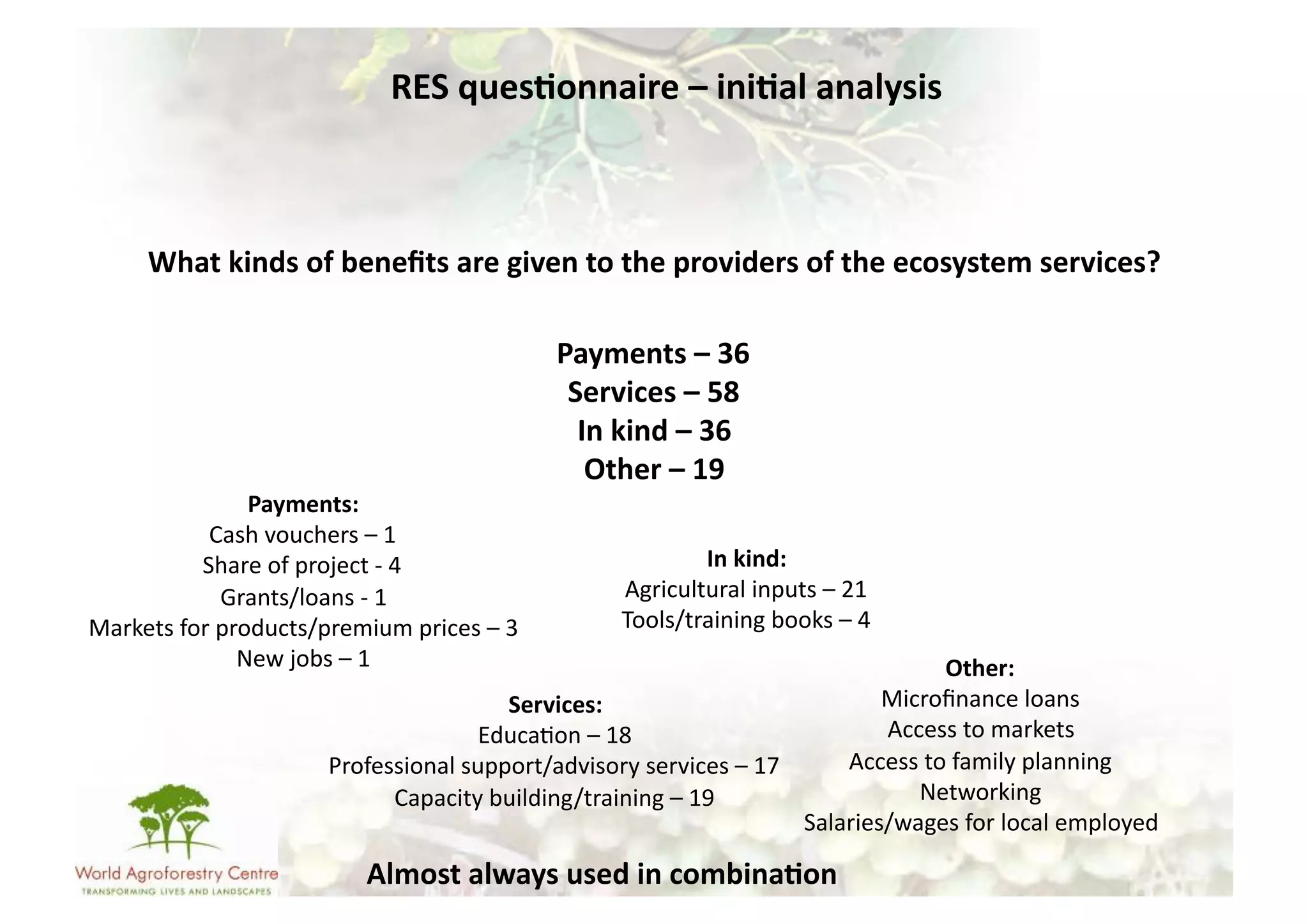
    RES  ques/onnaire  –  ini/al  analysis   What  kinds  of  benefits  are  given  to  the  providers  of  the  ecosystem  services?     Payments  –  36   Services  –  58   In  kind  –  36   Other  –  19   Payments:   Cash  vouchers  –  1   Share  of  project  -­‐  4   In  kind:   Grants/loans  -­‐  1   Agricultural  inputs  –  21   Markets  for  products/premium  prices  –  3   Tools/training  books  –  4   New  jobs  –  1   Other:   Services:   Microfinance  loans   Educa-on  –  18   Access  to  markets   Professional  support/advisory  services  –  17   Access  to  family  planning   Capacity  building/training  –  19   Networking   Salaries/wages  for  local  employed   Almost  always  used  in  combina/on    
  • 16.
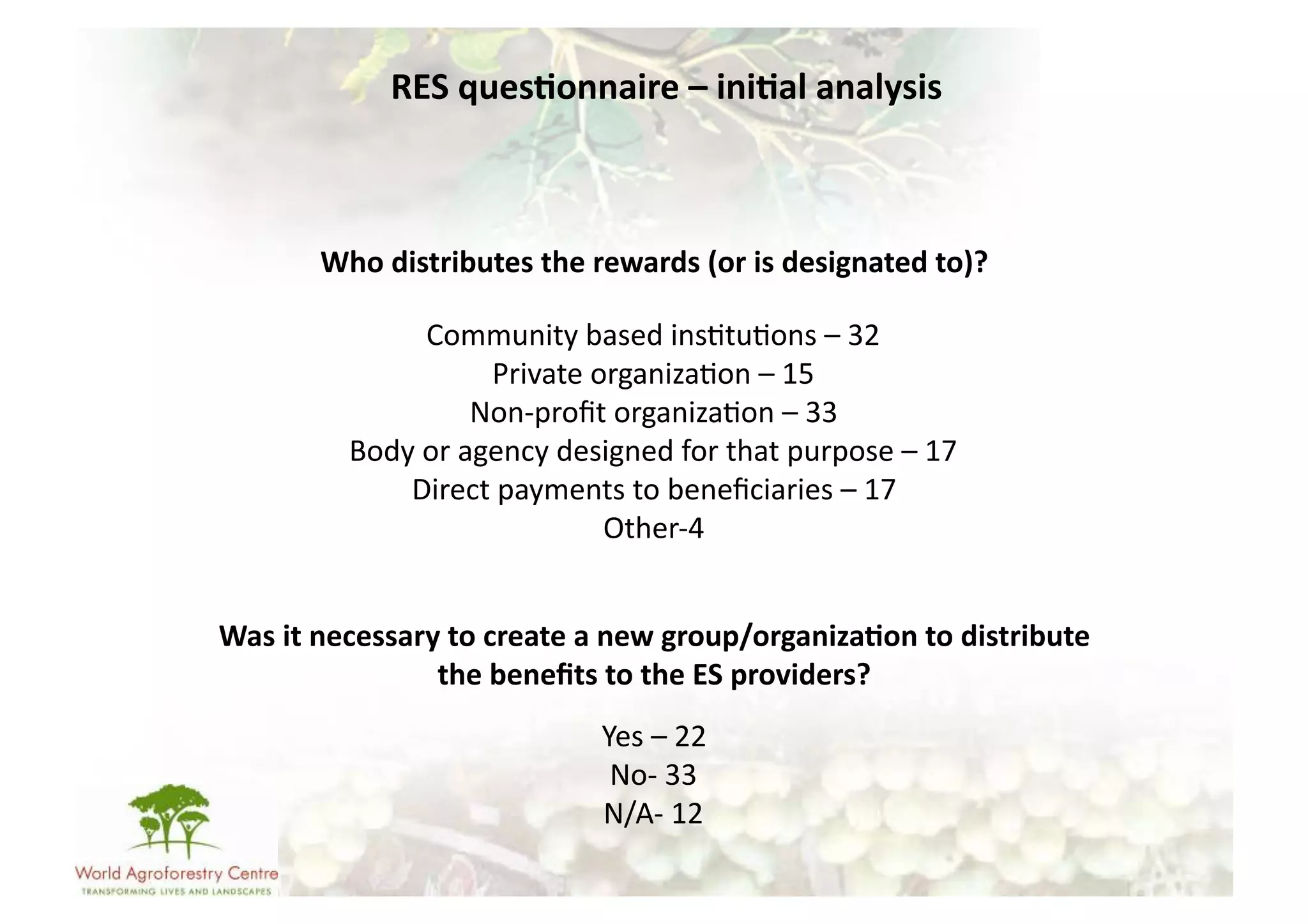
    RES  ques/onnaire  –  ini/al  analysis   Who  distributes  the  rewards  (or  is  designated  to)?   Community  based  ins-tu-ons  –  32   Private  organiza-on  –  15   Non-­‐profit  organiza-on  –  33     Body  or  agency  designed  for  that  purpose  –  17   Direct  payments  to  beneficiaries  –  17   Other-­‐4   Was  it  necessary  to  create  a  new  group/organiza/on  to  distribute   the  benefits  to  the  ES  providers?   Yes  –  22   No-­‐  33   N/A-­‐  12  
  • 17.
    RES  ques/onnaire  –  ini/al  analysis   On  what  kinds  of  contracts  is  the  RES  scheme  based?   Statutory  -­‐  32   Customary  -­‐  20   Specific  by-­‐laws  –  23   Other  -­‐  15   Please  explain  the  nature  of  the  contract(s)  for  the  ques/on  above?   Contracts  with  coopera-ves       Contracts  with  individual  farmers       Loan  subsidies       Contracts  with  villages     Contracts  nego-ated  with  village  chiefs  on  behalf  of  households  
  • 18.
    RES  ques/onnaire  –  ini/al  analysis   What  is  the  (planned)  reward  or  payment?     Environmental  benefits/conserva-on  -­‐  2   Rewards  per  village  –  3   Increased  produc-on  -­‐  2   Payments  to  household  –  12   Commission  based     Performance  based  /  percentage  of  profit  -­‐  2   BeUer  market  access,  premium  prices  -­‐  2   Savings  
  • 19.
    RES  ques/onnaire  –  ini/al  analysis   What  are  the  main  challenges  you  have  encountered?     Lack  of  knowledge/awareness  of  benefits-­‐  12   Is  the  project  providing  benefits?     Limited  (financial)  resources  -­‐  10   Tenure  -­‐  3   Accountability/lack  of  transparency     Weather/Drought  –  4   Timelines  –  2   Lack  of  regulatory  certainty/issues  around  carbon  markets  or  REDD  –  5   Organiza-onal/Monitoring  –  4   Changing  ajtudes  –  2   Transfer  of  cash  to  individuals     How  to  ensure  commitment  from  par-cipants  –  2   Big  landowners  oppose  because  want  access  to  cheap  labour     Coordina-on  between  local/na-onal/interna-onal  -­‐  5  
  • 20.
    RES  ques/onnaire  –  ini/al  analysis   What  kinds  of  conflicts  arise  (if  any)?     Villagers  disagree  on  money  distribu-on     Conflicts  of  interest/farmers  who  join  and  those  that  do  not  –  2   Horizontal  conflict  between  communi-es  (?)   Role  conflicts   Type  of  tree  to  plant   Integra-on  of  different  needs   Who  is  gejng  what  –  ensuring  equitable  benefit  sharing  -­‐  3   Opposi-on  from  different  interests  (ie  loggers  in  rainforest,  farmers  don’t  want  to   preserve  puma)  –  3     Land  rights  -­‐  3   Environmentally  damaging  ac-vity  of  outsiders  (ie  caUle  grazing)   Lack  of  trust  -­‐  2   Illegal  seUlements   Different  legal  interpreta-ons  
  • 21.
    RES  ques/onnaire  –  ini/al  analysis   How  is  compliance  with  the  scheme  enforced  and  what  kinds  of   sanc/ons  exist  for  non-­‐compliance?   Voluntary  -­‐  3   Compliance  enforced  by  law  and  contract  –  11   People  excluded  from  program  -­‐  3   Cessa-on  of  payments  –  5   Villages  and  villagers  monitor  each  other  -­‐  5   Monitored  by  organiza-on  -­‐  2   Monitored  by  third  party  (ie  audits)  –  2  
  • 22.
    RES  ques/onnaire  –  ini/al  analysis   Who  mediates  in  conflict  situa/ons?   Community  based  (elders,  councils,  CBO)  -­‐  13   Government  -­‐  12   Organiza-on  responsible  for  project  -­‐  7  
  • 23.
    RES  ques/onnaire  –  ini/al  analysis   Please  evaluate  the  success  rate  of  the  scheme     1  (not  successful)  to  5  (very  successful)   Range   Implemen-­‐ Fairness   Effec-ve-­‐ Cost   Poverty   Overall   ta-on  rate   distribu-on   ness   efficiency   reduc-on   evalua-on   1   1   4   3   4   4   2   2   13   7   7   11   6   9   3   11   9   6   12   9   10   4   16   10   23   14   13   20   5   15   19   18   12   18   18  
  • 24.
    RES  ques/onnaire  –  ini/al  analysis   Please  give  your  comments  or  sugges/ons  regarding  RES  or  this  survey  or  what   it  is  that  you  would  be  most  interested  in  receiving  informa/on  on     Details  of  successful  projects   A  transparency  and  accountability  mechanism   Package  of  relevant  policies  and  objec-ves   Regional  workshop/  networking   How  communi-es  share  benefits  /  criteria  used  to  determine  payments   How  to  get  projects  started   How  to  evaluate  ES  projects,  make  them  cost  effec-ve  and  adoptable   How  to  manage  mul--­‐stakeholder  or  mul--­‐ethnic  projects   How  many  projects  make  land  tenure  a  priority   How  to  build  and  finance  a  carbon  sequestra-on  project  
  • 25.
    Lessons  and  conclusions?   •  Evolving  framework  from  PES  to  CIS   •  Trade-­‐offs  between  effec-veness,  efficiency  and  equity   •  Few  tenure  problems  reported:  can  schemes  be  developed  for  weaker  forms  of   tenure   •  Not  possible  to  make  generaliza-ons   •  Many  open  ques-ons  to  address  
  • 26.
    ¡¿  Thanks  for  a  future  !?